About the Report
Base Year 2024Vietnam Digital Shipyard Market Overview
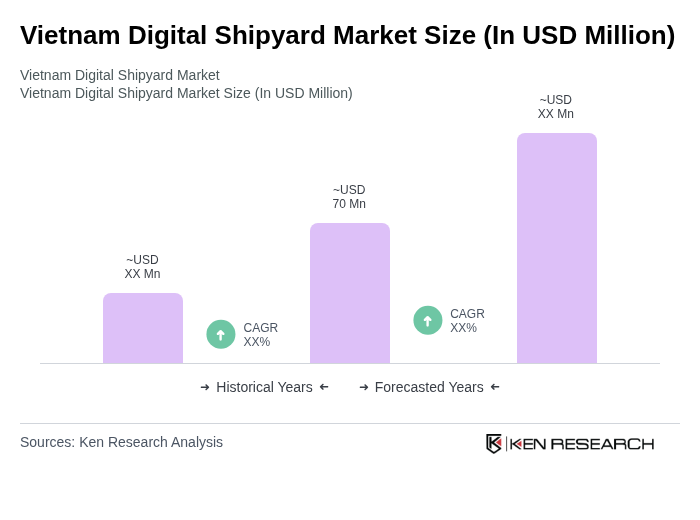
- The Vietnam Digital Shipyard Market is valued at USD 70 million, based on a five-year historical analysis and Vietnam’s share within the rapidly growing global digital shipyard market. This growth is primarily driven by the increasing adoption of digital technologies in shipbuilding processes to enhance efficiency, reduce operational costs, and improve delivery times, in line with Vietnam’s shipbuilding capacity of around 3.5 million tons per year and its strategy to upgrade technology in major yards. The market has seen a steady rise in investments in automation, AI?enabled design tools, industrial IoT, and advanced production management systems as shipyards modernize facilities and move toward smart, digitally enabled operations.
- Key players in this market include Hyundai Vietnam Shipbuilding Co., Ltd. (HVS), Damen Song Cam Shipyard, Saigon Newport Corporation, SBIC – Shipbuilding Industry Corporation, and VARD Vung Tau Ltd., which are among the most active Vietnamese yards in modern shipbuilding, repair, and marine services. These companies benefit from strategic coastal locations, ongoing facility upgrades, and collaborations or joint ventures with international shipbuilders and technology providers, enabling them to integrate CAD/CAM, PLM, simulation, and IoT-based monitoring solutions into design, construction, and lifecycle support.
- Digital transformation in Vietnamese shipyards is guided by national policies on maritime development and industrial modernization, including the Vietnam Maritime Development Strategy to 2030 with a vision to 2045 and government programs promoting digital transformation and Industry 4.0 in manufacturing. In the maritime domain, requirements related to safety, environmental protection, and technology upgrades are implemented under instruments such as the Vietnam Maritime Code 2015 issued by the National Assembly and the Law on High Technologies 2008, which encourage application of advanced and digital technologies in shipbuilding, port, and marine engineering activities. These frameworks drive shipyards to adopt digital solutions in design, planning, and maintenance to remain competitive in regional and international markets.
Vietnam Digital Shipyard Market Segmentation
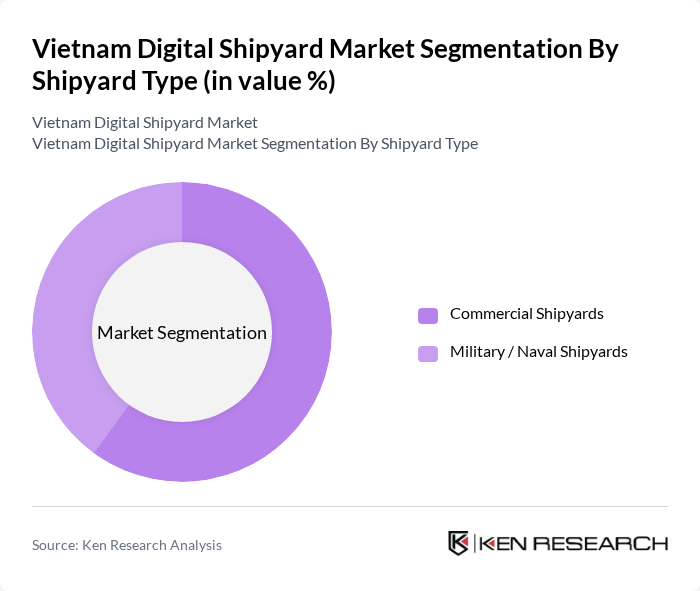
By Shipyard Type:The shipyard type segmentation includes Commercial Shipyards and Military / Naval Shipyards, reflecting how global digital shipyard solutions are structured across commercial and defense segments. Commercial shipyards in Vietnam are primarily focused on building and repairing general cargo vessels, container ships, tankers, and specialized offshore support vessels for export and domestic demand, while military/naval shipyards cater to patrol boats, auxiliary vessels, and other defense-related projects under the Ministry of National Defence. The demand for commercial shipyards is supported by growing maritime trade, Vietnam’s fleet expansion targets, and increasing orders for higher value-added vessels, whereas military shipyards benefit from sustained government defense budgets and modernization programs for the naval fleet.
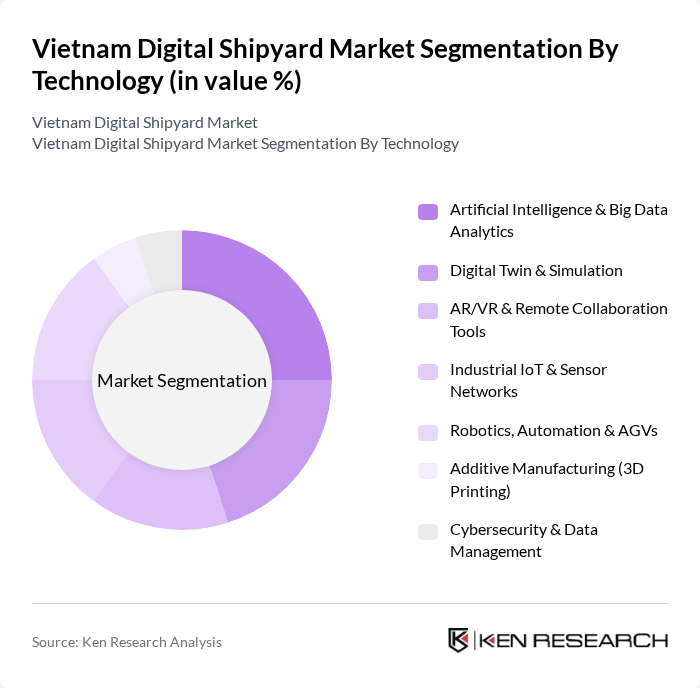
By Technology:The technology segmentation encompasses various advanced technologies such as Artificial Intelligence & Big Data Analytics, Digital Twin & Simulation, AR/VR & Remote Collaboration Tools, Industrial IoT & Sensor Networks, Robotics, Automation & AGVs, Additive Manufacturing (3D Printing), and Cybersecurity & Data Management, which are consistent with global digital shipyard technology stacks. The increasing focus on automation, real?time production monitoring, and data-driven decision-making in Vietnamese yards is propelling the adoption of CAD/CAE platforms, integrated PLM, IIoT-based asset tracking, and simulation tools, with early pilot use of AR/VR for training and remote inspections and growing attention to cybersecurity as more shipyard operations become connected.
Vietnam Digital Shipyard Market Competitive Landscape
The Vietnam Digital Shipyard Market is characterized by a dynamic mix of regional and international players. Leading participants such as Hyundai Vietnam Shipbuilding Co., Ltd. (HVS), Damen Song Cam Shipyard Co., Ltd., Zamil Offshore Services Co. – Vietnam Operations, Saigon Newport Corporation, SBIC – Shipbuilding Industry Corporation (formerly Vinashin), Ha Long Shipyard (SBIC), Pha Rung Shipyard (SBIC), Song Thu Corporation (Ministry of National Defence), Corporation for the Development of Shipbuilding Industry (LILAMA – Shipbuilding Units), VARD Vung Tau Ltd., Petrovietnam Technical Services Corporation (PTSC), Vietnam National Shipping Lines (VIMC, formerly Vinalines), Saigon Shipbuilding and Marine Industry Company (SSMI), Bach Dang Shipbuilding Industry Corporation, Viettel High Technology Industries Corporation (Maritime Digital Solutions) contribute to innovation, geographic expansion, and service delivery in this space through gradual integration of digital design platforms, project management systems, and smart yard solutions.
Vietnam Digital Shipyard Market Industry Analysis
Growth Drivers
- Increasing Demand for Automation in Shipbuilding:The Vietnamese shipbuilding industry is experiencing a significant shift towards automation, driven by the need for efficiency and cost reduction. In future, the automation market in Vietnam is projected to reach approximately $1.4 billion, reflecting a 16% increase from the previous year. This growth is fueled by the rising demand for automated processes in ship design and construction, which enhances productivity and reduces human error, ultimately leading to faster delivery times and improved quality.
- Government Initiatives Promoting Digital Transformation:The Vietnamese government has committed to investing $600 million in digital transformation initiatives by 2025, aiming to modernize the maritime sector. This includes the implementation of policies that encourage the adoption of digital technologies in shipbuilding. The government's focus on enhancing the digital infrastructure is expected to create a conducive environment for innovation, thereby attracting both domestic and foreign investments into the digital shipyard market.
- Rising Investments in Maritime Infrastructure:Vietnam's maritime infrastructure is set to receive an influx of investments, with the government allocating $1.8 billion for port and shipyard upgrades in future. This investment is crucial for enhancing the capacity and efficiency of shipbuilding operations. Improved infrastructure will facilitate the integration of advanced technologies, such as AI and IoT, into shipbuilding processes, thereby driving the growth of the digital shipyard market and positioning Vietnam as a competitive player in the global maritime industry.
Market Challenges
- High Initial Investment Costs:The transition to digital shipbuilding requires substantial initial investments, estimated at around $2.5 million per shipyard for technology upgrades and training. Many local shipbuilders face financial constraints, limiting their ability to adopt advanced technologies. This challenge is exacerbated by the need for ongoing maintenance and updates, which can further strain budgets, hindering the overall growth of the digital shipyard market in Vietnam.
- Limited Skilled Workforce in Digital Technologies:The shortage of skilled labor in digital technologies poses a significant challenge for the Vietnamese shipbuilding sector. Currently, only 25% of the workforce possesses the necessary skills to operate advanced digital tools and technologies. This gap in expertise can lead to inefficiencies and increased operational costs, as companies may struggle to find qualified personnel to implement and manage digital systems effectively, thereby slowing down the market's growth.
Vietnam Digital Shipyard Market Future Outlook
The future of the Vietnam digital shipyard market appears promising, driven by ongoing government support and increasing investments in technology. As the industry embraces automation and digital transformation, the integration of advanced technologies such as AI and IoT will enhance operational efficiency. Furthermore, the shift towards sustainable practices will likely attract new investments, positioning Vietnam as a leader in eco-friendly shipbuilding. The focus on cybersecurity will also become paramount, ensuring the protection of digital assets and fostering trust in maritime operations.
Market Opportunities
- Expansion of Export Markets for Shipbuilding:With Vietnam's strategic location and growing reputation for quality shipbuilding, there is a significant opportunity to expand into new export markets. In future, the export value of Vietnamese ships is expected to reach $1 billion, driven by demand from Southeast Asia and beyond, providing a substantial boost to the digital shipyard sector.
- Collaboration with Tech Firms for Innovation:Collaborating with technology firms presents a unique opportunity for Vietnamese shipyards to innovate and enhance their capabilities. Partnerships with local and international tech companies can lead to the development of cutting-edge solutions, such as predictive maintenance systems, which can reduce downtime and improve operational efficiency, ultimately benefiting the digital shipyard market.
Scope of the Report
| Segment | Sub-Segments |
|---|---|
| By Shipyard Type | Commercial Shipyards Military / Naval Shipyards |
| By Technology | Artificial Intelligence & Big Data Analytics Digital Twin & Simulation AR/VR & Remote Collaboration Tools Industrial IoT & Sensor Networks Robotics, Automation & AGVs Additive Manufacturing (3D Printing) Cybersecurity & Data Management |
| By Process | Research, Design & Engineering Production Planning & Manufacturing Yard Operations & Material Handling Inspection, Maintenance & Repair Lifecycle Support & Upgrades |
| By Capacity | Small Shipyards (<10,000 DWT) Medium Shipyards (10,000–50,000 DWT) Large Shipyards (>50,000 DWT) |
| By End-User | Shipbuilding & Repair Companies Port & Dock / Yard Operators Defense & Coast Guard Establishments Offshore & Energy Sector Operators System Integrators & Engineering Service Providers |
| By Solution | Software Platforms (PLM, CAD/CAM, MES, ERP) Hardware & Automation Systems Integrated Turnkey Systems Services (Consulting, Integration, Training, Support) |
| By Region | Northern Vietnam Central Vietnam Southern Vietnam |
Key Target Audience
Investors and Venture Capitalist Firms
Government and Regulatory Bodies (e.g., Ministry of Industry and Trade, Vietnam Maritime Administration)
Shipbuilding and Repair Companies
Marine Equipment Manufacturers
Logistics and Supply Chain Companies
Technology Providers and Software Developers
Industry Associations (e.g., Vietnam Shipbuilding Industry Association)
Financial Institutions and Banks
Players Mentioned in the Report:
Hyundai Vietnam Shipbuilding Co., Ltd. (HVS)
Damen Song Cam Shipyard Co., Ltd.
Zamil Offshore Services Co. Vietnam Operations
Saigon Newport Corporation
SBIC Shipbuilding Industry Corporation (formerly Vinashin)
Ha Long Shipyard (SBIC)
Pha Rung Shipyard (SBIC)
Song Thu Corporation (Ministry of National Defence)
Corporation for the Development of Shipbuilding Industry (LILAMA Shipbuilding Units)
VARD Vung Tau Ltd.
Petrovietnam Technical Services Corporation (PTSC)
Vietnam National Shipping Lines (VIMC, formerly Vinalines)
Saigon Shipbuilding and Marine Industry Company (SSMI)
Bach Dang Shipbuilding Industry Corporation
Viettel High Technology Industries Corporation (Maritime Digital Solutions)
Table of Contents
Market Assessment Phase
1. Executive Summary and Approach
2. Vietnam Digital Shipyard Market Overview
2.1 Key Insights and Strategic Recommendations
2.2 Vietnam Digital Shipyard Market Overview
2.3 Definition and Scope
2.4 Evolution of Market Ecosystem
2.5 Timeline of Key Regulatory Milestones
2.6 Value Chain & Stakeholder Mapping
2.7 Business Cycle Analysis
2.8 Policy & Incentive Landscape
3. Vietnam Digital Shipyard Market Analysis
3.1 Growth Drivers
3.1.1 Increasing demand for automation in shipbuilding
3.1.2 Government initiatives promoting digital transformation
3.1.3 Rising investments in maritime infrastructure
3.1.4 Adoption of advanced technologies in ship design
3.2 Market Challenges
3.2.1 High initial investment costs
3.2.2 Limited skilled workforce in digital technologies
3.2.3 Regulatory compliance complexities
3.2.4 Competition from established global players
3.3 Market Opportunities
3.3.1 Expansion of export markets for shipbuilding
3.3.2 Collaboration with tech firms for innovation
3.3.3 Development of eco-friendly shipbuilding practices
3.3.4 Utilization of AI and IoT in ship maintenance
3.4 Market Trends
3.4.1 Shift towards sustainable shipbuilding practices
3.4.2 Increasing use of digital twins in design processes
3.4.3 Growth of smart ship technologies
3.4.4 Enhanced focus on cybersecurity in maritime operations
3.5 Government Regulation
3.5.1 Implementation of digital transformation policies
3.5.2 Standards for environmental compliance in shipbuilding
3.5.3 Incentives for adopting advanced manufacturing technologies
3.5.4 Regulations on data security in maritime operations
4. SWOT Analysis
5. Stakeholder Analysis
6. Porter's Five Forces Analysis
7. Vietnam Digital Shipyard Market Market Size, 2019-2024
7.1 By Value
7.2 By Volume
7.3 By Average Selling Price
8. Vietnam Digital Shipyard Market Segmentation
8.1 By Shipyard Type
8.1.1 Commercial Shipyards
8.1.2 Military / Naval Shipyards
8.2 By Technology
8.2.1 Artificial Intelligence & Big Data Analytics
8.2.2 Digital Twin & Simulation
8.2.3 AR/VR & Remote Collaboration Tools
8.2.4 Industrial IoT & Sensor Networks
8.2.5 Robotics, Automation & AGVs
8.2.6 Additive Manufacturing (3D Printing)
8.2.7 Cybersecurity & Data Management
8.3 By Process
8.3.1 Research, Design & Engineering
8.3.2 Production Planning & Manufacturing
8.3.3 Yard Operations & Material Handling
8.3.4 Inspection, Maintenance & Repair
8.3.5 Lifecycle Support & Upgrades
8.4 By Capacity
8.4.1 Small Shipyards (<10,000 DWT)
8.4.2 Medium Shipyards (10,000–50,000 DWT)
8.4.3 Large Shipyards (>50,000 DWT)
8.5 By End-User
8.5.1 Shipbuilding & Repair Companies
8.5.2 Port & Dock / Yard Operators
8.5.3 Defense & Coast Guard Establishments
8.5.4 Offshore & Energy Sector Operators
8.5.5 System Integrators & Engineering Service Providers
8.6 By Solution
8.6.1 Software Platforms (PLM, CAD/CAM, MES, ERP)
8.6.2 Hardware & Automation Systems
8.6.3 Integrated Turnkey Systems
8.6.4 Services (Consulting, Integration, Training, Support)
8.7 By Region
8.7.1 Northern Vietnam
8.7.2 Central Vietnam
8.7.3 Southern Vietnam
9. Vietnam Digital Shipyard Market Competitive Analysis
9.1 Market Share of Key Players
9.2 Cross Comparison of Key Players
9.2.1 Company Name
9.2.2 Shipyard Capacity (Annual DWT or Number of Vessels Delivered)
9.2.3 Digitalization Level (Share of Processes Digitized, %)
9.2.4 Digital CAPEX (Annual Investment in Digital Technologies, USD)
9.2.5 Revenue from Digital Shipyard-Related Projects (%)
9.2.6 Average Project Execution Time (Design-to-Delivery, Months)
9.2.7 On?Time Delivery Rate for Digitally Enabled Projects (%)
9.2.8 Productivity Improvement vs. Baseline (Labor Hours per GT/DWT)
9.2.9 Defect / Rework Rate after Digital Adoption (%)
9.2.10 Number of Active Digital Partnerships (ISVs, Integrators, OEMs)
9.2.11 R&D Intensity (% of Revenue Spent on Digital R&D)
9.2.12 ESG & Energy Efficiency Performance (e.g., Share of Green / Low?Emission Projects)
9.3 SWOT Analysis of Top Players
9.4 Pricing Analysis
9.5 Detailed Profile of Major Companies
9.5.1 Hyundai Vietnam Shipbuilding Co., Ltd. (HVS)
9.5.2 Damen Song Cam Shipyard Co., Ltd.
9.5.3 Zamil Offshore Services Co. – Vietnam Operations
9.5.4 Saigon Newport Corporation
9.5.5 SBIC – Shipbuilding Industry Corporation (formerly Vinashin)
9.5.6 Ha Long Shipyard (SBIC)
9.5.7 Pha Rung Shipyard (SBIC)
9.5.8 Song Thu Corporation (Ministry of National Defence)
9.5.9 Corporation for the Development of Shipbuilding Industry (LILAMA – Shipbuilding Units)
9.5.10 VARD Vung Tau Ltd.
9.5.11 Petrovietnam Technical Services Corporation (PTSC)
9.5.12 Vietnam National Shipping Lines (VIMC, formerly Vinalines)
9.5.13 Saigon Shipbuilding and Marine Industry Company (SSMI)
9.5.14 Bach Dang Shipbuilding Industry Corporation
9.5.15 Viettel High Technology Industries Corporation (Maritime Digital Solutions)
10. Vietnam Digital Shipyard Market End-User Analysis
10.1 Procurement Behavior of Key Ministries
10.1.1 Ministry of Transport
10.1.2 Ministry of Defense
10.1.3 Ministry of Industry and Trade
10.1.4 Ministry of Finance
10.2 Corporate Spend on Infrastructure & Energy
10.2.1 Investment in Shipbuilding Infrastructure
10.2.2 Expenditure on Digital Technologies
10.2.3 Budget Allocation for Maintenance and Repair
10.3 Pain Point Analysis by End-User Category
10.3.1 Challenges in Supply Chain Management
10.3.2 Issues with Regulatory Compliance
10.3.3 Need for Skilled Workforce
10.4 User Readiness for Adoption
10.4.1 Awareness of Digital Solutions
10.4.2 Training and Development Needs
10.5 Post-Deployment ROI and Use Case Expansion
10.5.1 Measurement of ROI in Digital Shipyards
10.5.2 Potential for Scaling Digital Solutions
11. Vietnam Digital Shipyard Market Future Size, 2025-2030
11.1 By Value
11.2 By Volume
11.3 By Average Selling Price
Go-To-Market Strategy Phase
1. Whitespace Analysis + Business Model Canvas
1.1 Market Gaps Identification
1.2 Business Model Development
2. Marketing and Positioning Recommendations
2.1 Branding Strategies
2.2 Product USPs
3. Distribution Plan
3.1 Urban Retail Strategies
3.2 Rural NGO Tie-ups
4. Channel & Pricing Gaps
4.1 Underserved Routes
4.2 Pricing Bands Analysis
5. Unmet Demand & Latent Needs
5.1 Category Gaps
5.2 Consumer Segments
6. Customer Relationship
6.1 Loyalty Programs
6.2 After-sales Service
7. Value Proposition
7.1 Sustainability Initiatives
7.2 Integrated Supply Chains
8. Key Activities
8.1 Regulatory Compliance
8.2 Branding Efforts
8.3 Distribution Setup
9. Entry Strategy Evaluation
9.1 Domestic Market Entry Strategy
9.1.1 Product Mix Considerations
9.1.2 Pricing Band Strategy
9.1.3 Packaging Approaches
9.2 Export Entry Strategy
9.2.1 Target Countries Identification
9.2.2 Compliance Roadmap Development
10. Entry Mode Assessment
10.1 Joint Ventures
10.2 Greenfield Investments
10.3 Mergers & Acquisitions
10.4 Distributor Model Evaluation
11. Capital and Timeline Estimation
11.1 Capital Requirements Analysis
11.2 Timelines for Market Entry
12. Control vs Risk Trade-Off
12.1 Ownership vs Partnerships
13. Profitability Outlook
13.1 Breakeven Analysis
13.2 Long-term Sustainability Strategies
14. Potential Partner List
14.1 Distributors
14.2 Joint Ventures
14.3 Acquisition Targets
15. Execution Roadmap
15.1 Phased Plan for Market Entry
15.1.1 Market Setup
15.1.2 Market Entry
15.1.3 Growth Acceleration
15.1.4 Scale & Stabilize
15.2 Key Activities and Milestones
15.2.1 Milestone Planning
Research Methodology
Phase 1: Approach1
Desk Research
- Analysis of government reports on maritime and shipbuilding policies in Vietnam
- Review of industry publications and market reports specific to digital shipyard technologies
- Examination of trade statistics and import/export data related to shipbuilding materials and technologies
Primary Research
- Interviews with executives from leading shipyards and maritime technology firms in Vietnam
- Surveys targeting shipbuilding engineers and project managers to gather insights on digital transformation
- Field visits to operational shipyards to observe digital processes and technologies in use
Validation & Triangulation
- Cross-validation of findings through multiple data sources including industry reports and expert opinions
- Triangulation of qualitative insights from interviews with quantitative data from surveys
- Sanity checks conducted through expert panel discussions to ensure data reliability
Phase 2: Market Size Estimation1
Top-down Assessment
- Estimation of the overall shipbuilding market size in Vietnam and its digital segment
- Analysis of government investments in maritime infrastructure and technology adoption
- Segmentation of the market by ship type, including commercial, military, and leisure vessels
Bottom-up Modeling
- Collection of data on the number of active shipyards and their production capacities
- Estimation of digital technology adoption rates among shipyards based on firm size and type
- Calculation of revenue generated from digital services and solutions in shipbuilding
Forecasting & Scenario Analysis
- Development of growth projections based on historical trends and current market dynamics
- Scenario analysis considering factors such as regulatory changes and technological advancements
- Creation of baseline, optimistic, and pessimistic forecasts for the digital shipyard market through 2030
Phase 3: CATI Sample Composition1
| Scope Item/Segment | Sample Size | Target Respondent Profiles |
|---|---|---|
| Commercial Shipbuilding | 100 | Shipyard Managers, Production Supervisors |
| Military Vessel Construction | 50 | Defense Procurement Officers, Project Managers |
| Leisure Craft Manufacturing | 40 | Design Engineers, Marketing Managers |
| Digital Technology Integration | 80 | IT Managers, Digital Transformation Leads |
| Supply Chain Management in Shipbuilding | 60 | Logistics Coordinators, Procurement Specialists |
Frequently Asked Questions
What is the current value of the Vietnam Digital Shipyard Market?
The Vietnam Digital Shipyard Market is valued at approximately USD 70 million, reflecting the country's growing share in the global digital shipyard sector, driven by advancements in technology and modernization efforts in shipbuilding processes.
What are the main drivers of growth in the Vietnam Digital Shipyard Market?
Who are the key players in the Vietnam Digital Shipyard Market?
What technologies are being adopted in Vietnam's digital shipyards?
Other Regional/Country Reports
Indonesia Digital Shipyard Market
Malaysia Digital Shipyard Market
KSA Digital Shipyard Market
APAC Digital Shipyard Market
SEA Digital Shipyard Market
Thailand Digital Shipyard Market
Other Adjacent Reports
Malaysia Shipbuilding Automation Market
Brazil Maritime IoT Market
Malaysia Digital Twin Technology Market
Germany AI in Ship Design Market
Oman Robotics in Manufacturing Market
South Korea Additive Manufacturing Market
Qatar Cybersecurity in Maritime Market
Egypt AR VR Training Market
Qatar Naval Defense Technology Market
Japan Port Management Software Market
Why Buy From Us?

What makes us stand out is that our consultants follow Robust, Refine and Result (RRR) methodology. Robust for clear definitions, approaches and sanity checking, Refine for differentiating respondents' facts and opinions, and Result for presenting data with story.

We have set a benchmark in the industry by offering our clients with syndicated and customized market research reports featuring coverage of entire market as well as meticulous research and analyst insights.

While we don't replace traditional research, we flip the method upside down. Our dual approach of Top Bottom & Bottom Top ensures quality deliverable by not just verifying company fundamentals but also looking at the sector and macroeconomic factors.

With one step in the future, our research team constantly tries to show you the bigger picture. We help with some of the tough questions you may encounter along the way: How is the industry positioned? Best marketing channel? KPI's of competitors? By aligning every element, we help maximize success.

Our report gives you instant access to the answers and sources that other companies might choose to hide. We elaborate each steps of research methodology we have used and showcase you the sample size to earn your trust.

If you need any support, we are here! We pride ourselves on universe strength, data quality, and quick, friendly, and professional service.