About the Report
Base Year 2024Vietnam Exoskeleton Market Overview
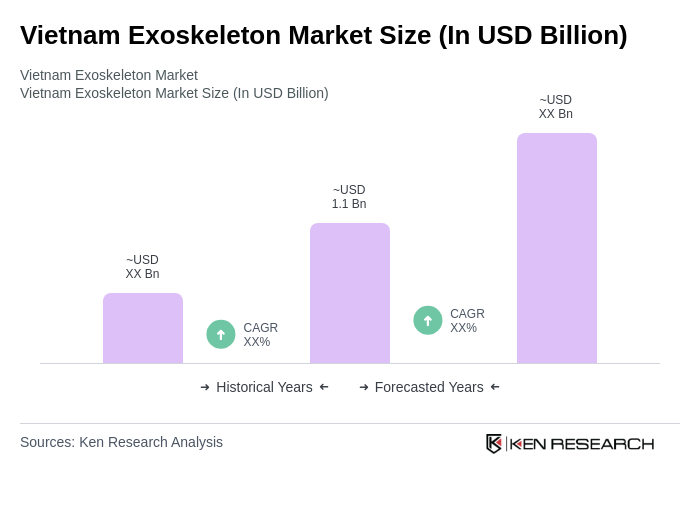
- The Vietnam Exoskeleton Market is valued at USD 1.1 billion, based on a five-year historical analysis. This growth is primarily driven by advancements in robotics technology, the increasing demand for rehabilitation solutions, and the rising need for workforce support in industrial sectors. The integration of exoskeletons in healthcare and manufacturing has significantly contributed to the market's expansion, as these devices enhance productivity and assist in mobility. Notably, the medical exoskeleton segment is experiencing robust growth due to the adoption of AI-powered rehabilitation devices, a rising aging population, and a growing prevalence of neurological and mobility impairments. The construction and industrial segments are also expanding, supported by investments in worker safety and productivity-enhancing technologies .
- Key cities such asHo Chi Minh CityandHanoidominate the Vietnam Exoskeleton Market due to their robust healthcare infrastructure and industrial activities. Ho Chi Minh City, being the economic hub, has seen a surge in manufacturing and logistics, while Hanoi's focus on healthcare innovation has led to increased adoption of exoskeleton technologies. These urban centers are pivotal in driving market growth through investments and technological advancements. The presence of leading hospitals, rehabilitation centers, and industrial parks in these cities accelerates the adoption of exoskeleton solutions for both medical and workforce applications .
- In 2023, the Vietnamese government implementedDecision No. 376/QD-TTg, issued by the Prime Minister, which promotes the development and application of assistive technologies, including exoskeletons, in healthcare and industry. This policy aims to enhance the quality of life for individuals with mobility impairments and improve worker safety in physically demanding jobs. The government has allocatedUSD 20 millionto support research and development in this sector, fostering innovation and accessibility through public-private partnerships and international collaborations .
Vietnam Exoskeleton Market Segmentation
By Type:The market is segmented into various types of exoskeletons, including Active Exoskeletons, Passive Exoskeletons, Hybrid Exoskeletons, Medical Exoskeletons, Industrial Exoskeletons, Military Exoskeletons, Construction Exoskeletons, and Others. Each type serves distinct purposes, catering to different user needs and applications. Active exoskeletons utilize powered actuators to enhance strength and endurance, passive exoskeletons rely on mechanical support to reduce fatigue, and hybrid models combine both approaches. Medical exoskeletons are primarily used for rehabilitation and mobility assistance, while industrial and construction exoskeletons focus on reducing workplace injuries and improving productivity. Military exoskeletons are designed for load carriage and endurance in defense applications .
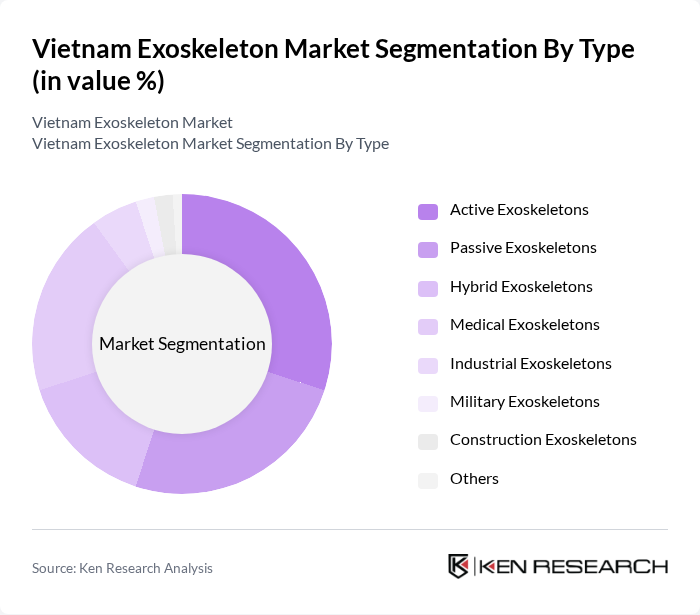
TheActive Exoskeletonssegment is currently leading the market due to their advanced capabilities in enhancing human strength and endurance, making them ideal for industrial applications. These devices are increasingly adopted in manufacturing and logistics, where physical strain is prevalent. The growing awareness of workplace safety and the need for ergonomic solutions are driving demand for active exoskeletons. Additionally, advancements in battery technology, lightweight materials, and AI-driven control systems are making these devices more efficient and user-friendly, further solidifying their market leadership .
By End-User:The market is segmented by end-users, including Healthcare Providers (Hospitals, Clinics), Manufacturing Companies, Defense & Security Agencies, Construction Firms, Logistics & Warehousing, Rehabilitation Centers, Homecare Users, and Others. Each end-user category has unique requirements and applications for exoskeleton technology. Healthcare providers and rehabilitation centers focus on patient mobility and recovery, while manufacturing and construction firms prioritize worker safety and productivity. Defense agencies use exoskeletons for enhanced endurance and load carriage, and logistics companies deploy them to reduce injury risk during material handling .
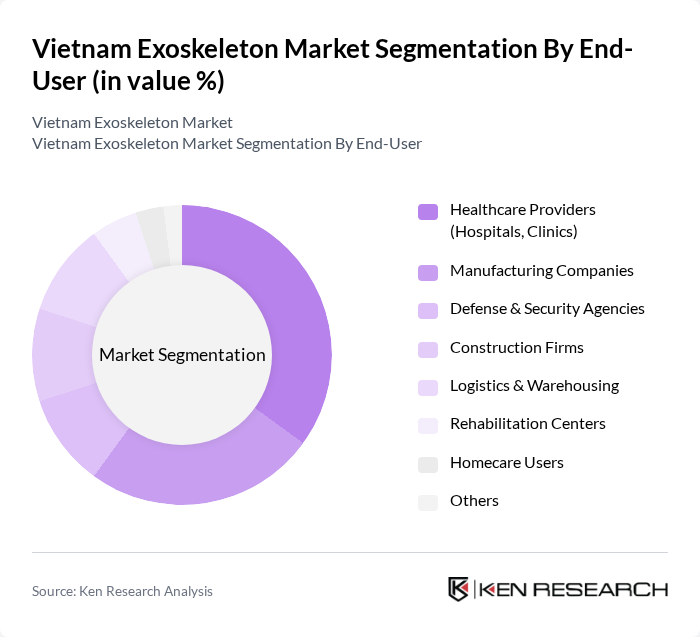
TheHealthcare Providerssegment is the largest end-user category, driven by the increasing adoption of medical exoskeletons for rehabilitation and mobility assistance. Hospitals and clinics are investing in these technologies to improve patient outcomes and enhance the quality of care. The growing prevalence of mobility impairments and the aging population are significant factors contributing to this trend. Additionally, advancements in exoskeleton technology are making them more accessible and effective for rehabilitation purposes, further solidifying their dominance in the market .
Vietnam Exoskeleton Market Competitive Landscape
The Vietnam Exoskeleton Market is characterized by a dynamic mix of regional and international players. Leading participants such as Ekso Bionics, ReWalk Robotics, SuitX (now part of Ottobock), Cyberdyne Inc., Parker Hannifin Corporation, Honda Motor Co., Ltd., Bionik Laboratories, Ottobock, Sarcos Technology and Robotics Corporation, Rex Bionics, AlterG, ATOUN Inc., Hyundai Motor Company, Lockheed Martin Corporation, UPLIFT Labs, Daiwa House Industry Co., Ltd., TechnoRobot JSC (Vietnam), VinBrain (Vietnam), Viet Robotics (Vietnam) contribute to innovation, geographic expansion, and service delivery in this space.
Vietnam Exoskeleton Market Industry Analysis
Growth Drivers
- Increasing Demand for Rehabilitation Solutions:The demand for rehabilitation solutions in Vietnam is projected to rise significantly, driven by an estimated 1.5 million individuals suffering from disabilities in future. The healthcare sector is expected to allocate approximately $1.5 billion towards rehabilitation technologies, including exoskeletons. This investment reflects a growing recognition of the need for advanced rehabilitation methods, particularly for stroke and spinal cord injury patients, enhancing the market's growth potential.
- Rising Aging Population:Vietnam's aging population is projected to reach about 14% of the total population in future, with over approximately 14 million individuals aged 60 and above. This demographic shift is expected to increase the prevalence of age-related health issues, necessitating innovative solutions like exoskeletons for mobility assistance. The government’s focus on improving elderly care services, with a budget increase of 25% for healthcare in future, further supports the demand for exoskeleton technologies in rehabilitation and mobility.
- Advancements in Robotics Technology:The Vietnamese robotics sector is anticipated to grow by 15% annually, fueled by advancements in AI and machine learning. In future, the government plans to invest $600 million in robotics research and development, fostering innovation in exoskeleton design and functionality. These technological advancements are expected to enhance the performance and affordability of exoskeletons, making them more accessible to healthcare providers and consumers alike.
Market Challenges
- High Initial Investment Costs:The high initial investment required for exoskeleton technology poses a significant barrier to market entry. The average cost of an exoskeleton unit is around $40,000, which is prohibitive for many healthcare facilities, especially in rural areas. With Vietnam's GDP per capita at approximately $4,300 in future, the financial burden on institutions limits widespread adoption and hinders market growth.
- Limited Awareness Among Potential Users:Awareness of exoskeleton technology remains low among potential users, including healthcare providers and patients. A survey conducted in future indicated that only 30% of healthcare professionals were familiar with exoskeletons as rehabilitation tools. This lack of knowledge can impede adoption rates, as many potential users are unaware of the benefits and functionalities of these devices, stalling market expansion.
Vietnam Exoskeleton Market Future Outlook
The Vietnam exoskeleton market is poised for significant growth, driven by technological advancements and increasing healthcare investments. As the government prioritizes healthcare innovation, the integration of AI and robotics in rehabilitation solutions will likely enhance user experience and effectiveness. Additionally, the rising elderly population will necessitate more mobility solutions, creating a robust demand for exoskeletons. Collaborative efforts between private companies and research institutions will further accelerate product development, ensuring the market remains dynamic and responsive to user needs.
Market Opportunities
- Expansion in Healthcare Applications:The healthcare sector presents a significant opportunity for exoskeleton manufacturers, with an expected increase in rehabilitation centers by 30% in future. This growth will drive demand for innovative mobility solutions, allowing companies to tailor products specifically for rehabilitation and elderly care, enhancing market penetration and revenue potential.
- Collaborations with Research Institutions:Collaborating with research institutions can lead to breakthroughs in exoskeleton technology, particularly in customization and user experience. With Vietnam's investment in R&D projected to reach $1.2 billion in future, partnerships can facilitate the development of advanced, user-friendly exoskeletons, positioning companies to capitalize on emerging market trends and consumer needs.
Scope of the Report
| Segment | Sub-Segments |
|---|---|
| By Type | Active Exoskeletons Passive Exoskeletons Hybrid Exoskeletons Medical Exoskeletons Industrial Exoskeletons Military Exoskeletons Construction Exoskeletons Others |
| By End-User | Healthcare Providers (Hospitals, Clinics) Manufacturing Companies Defense & Security Agencies Construction Firms Logistics & Warehousing Rehabilitation Centers Homecare Users Others |
| By Application | Rehabilitation & Mobility Assistance Industrial Worker Support Military Operations & Training Construction Labor Assistance Research and Development Personal Mobility Others |
| By Distribution Channel | Direct Sales Online Sales Distributors Retail Outlets Others |
| By Price Range | Low-End Exoskeletons Mid-Range Exoskeletons High-End Exoskeletons Custom Solutions |
| By Component | Actuators Sensors Control Systems Power Supply Structural Frame Software & Connectivity Others |
| By User Demographics | Age Group Gender Occupational Status Health Condition Urban vs Rural Users Others |
Key Target Audience
Investors and Venture Capitalist Firms
Government and Regulatory Bodies (e.g., Ministry of Health, Ministry of Industry and Trade)
Manufacturers and Producers
Healthcare Providers and Rehabilitation Centers
Distributors and Retailers
Technology Providers
Industry Associations (e.g., Vietnam Robotics Association)
Financial Institutions
Players Mentioned in the Report:
Ekso Bionics
ReWalk Robotics
SuitX (now part of Ottobock)
Cyberdyne Inc.
Parker Hannifin Corporation
Honda Motor Co., Ltd.
Bionik Laboratories
Ottobock
Sarcos Technology and Robotics Corporation
Rex Bionics
AlterG
ATOUN Inc.
Hyundai Motor Company
Lockheed Martin Corporation
UPLIFT Labs
Daiwa House Industry Co., Ltd.
TechnoRobot JSC (Vietnam)
VinBrain (Vietnam)
Viet Robotics (Vietnam)
Table of Contents
Market Assessment Phase
1. Executive Summary and Approach
2. Vietnam Exoskeleton Market Overview
2.1 Key Insights and Strategic Recommendations
2.2 Vietnam Exoskeleton Market Overview
2.3 Definition and Scope
2.4 Evolution of Market Ecosystem
2.5 Timeline of Key Regulatory Milestones
2.6 Value Chain & Stakeholder Mapping
2.7 Business Cycle Analysis
2.8 Policy & Incentive Landscape
3. Vietnam Exoskeleton Market Analysis
3.1 Growth Drivers
3.1.1 Increasing demand for rehabilitation solutions
3.1.2 Rising aging population
3.1.3 Government initiatives for industrial automation
3.1.4 Advancements in robotics technology
3.2 Market Challenges
3.2.1 High initial investment costs
3.2.2 Limited awareness among potential users
3.2.3 Regulatory hurdles
3.2.4 Technical limitations of existing products
3.3 Market Opportunities
3.3.1 Expansion in healthcare applications
3.3.2 Development of customized solutions
3.3.3 Collaborations with research institutions
3.3.4 Growth in military applications
3.4 Market Trends
3.4.1 Increasing integration of AI in exoskeletons
3.4.2 Focus on lightweight materials
3.4.3 Rise of wearable technology
3.4.4 Shift towards user-friendly designs
3.5 Government Regulation
3.5.1 Standards for safety and performance
3.5.2 Incentives for R&D in robotics
3.5.3 Import/export regulations for medical devices
3.5.4 Compliance requirements for manufacturing
4. SWOT Analysis
5. Stakeholder Analysis
6. Porter's Five Forces Analysis
7. Vietnam Exoskeleton Market Market Size, 2019-2024
7.1 By Value
7.2 By Volume
7.3 By Average Selling Price
8. Vietnam Exoskeleton Market Segmentation
8.1 By Type
8.1.1 Active Exoskeletons
8.1.2 Passive Exoskeletons
8.1.3 Hybrid Exoskeletons
8.1.4 Medical Exoskeletons
8.1.5 Industrial Exoskeletons
8.1.6 Military Exoskeletons
8.1.7 Construction Exoskeletons
8.1.8 Others
8.2 By End-User
8.2.1 Healthcare Providers (Hospitals, Clinics)
8.2.2 Manufacturing Companies
8.2.3 Defense & Security Agencies
8.2.4 Construction Firms
8.2.5 Logistics & Warehousing
8.2.6 Rehabilitation Centers
8.2.7 Homecare Users
8.2.8 Others
8.3 By Application
8.3.1 Rehabilitation & Mobility Assistance
8.3.2 Industrial Worker Support
8.3.3 Military Operations & Training
8.3.4 Construction Labor Assistance
8.3.5 Research and Development
8.3.6 Personal Mobility
8.3.7 Others
8.4 By Distribution Channel
8.4.1 Direct Sales
8.4.2 Online Sales
8.4.3 Distributors
8.4.4 Retail Outlets
8.4.5 Others
8.5 By Price Range
8.5.1 Low-End Exoskeletons
8.5.2 Mid-Range Exoskeletons
8.5.3 High-End Exoskeletons
8.5.4 Custom Solutions
8.6 By Component
8.6.1 Actuators
8.6.2 Sensors
8.6.3 Control Systems
8.6.4 Power Supply
8.6.5 Structural Frame
8.6.6 Software & Connectivity
8.6.7 Others
8.7 By User Demographics
8.7.1 Age Group
8.7.2 Gender
8.7.3 Occupational Status
8.7.4 Health Condition
8.7.5 Urban vs Rural Users
8.7.6 Others
9. Vietnam Exoskeleton Market Competitive Analysis
9.1 Market Share of Key Players
9.2 Cross Comparison of Key Players
9.2.1 Company Name
9.2.2 Group Size (Large, Medium, or Small as per industry convention)
9.2.3 Revenue Growth Rate (Vietnam exoskeleton segment)
9.2.4 Market Penetration Rate (units sold or installed base in Vietnam)
9.2.5 Customer Retention Rate (repeat purchase or service contracts)
9.2.6 Product Development Cycle Time (average time to launch new models)
9.2.7 Pricing Strategy (premium, value, volume-based)
9.2.8 Distribution Efficiency (coverage of hospitals, clinics, industrial sites)
9.2.9 Customer Satisfaction Score (Vietnam end-user surveys)
9.2.10 Brand Recognition Index (Vietnam market awareness)
9.2.11 Local Partnership Activity (Vietnamese distributor, hospital, or government collaborations)
9.2.12 Regulatory Compliance Status (Vietnam MOH, industrial safety)
9.3 SWOT Analysis of Top Players
9.4 Pricing Analysis
9.5 Detailed Profile of Major Companies
9.5.1 Ekso Bionics
9.5.2 ReWalk Robotics
9.5.3 SuitX (now part of Ottobock)
9.5.4 Cyberdyne Inc.
9.5.5 Parker Hannifin Corporation
9.5.6 Honda Motor Co., Ltd.
9.5.7 Bionik Laboratories
9.5.8 Ottobock
9.5.9 Sarcos Technology and Robotics Corporation
9.5.10 Rex Bionics
9.5.11 AlterG
9.5.12 ATOUN Inc.
9.5.13 Hyundai Motor Company
9.5.14 Lockheed Martin Corporation
9.5.15 UPLIFT Labs
9.5.16 Daiwa House Industry Co., Ltd.
9.5.17 TechnoRobot JSC (Vietnam)
9.5.18 VinBrain (Vietnam)
9.5.19 Viet Robotics (Vietnam)
10. Vietnam Exoskeleton Market End-User Analysis
10.1 Procurement Behavior of Key Ministries
10.1.1 Budget Allocation Trends
10.1.2 Decision-Making Processes
10.1.3 Preferred Procurement Channels
10.1.4 Evaluation Criteria for Exoskeletons
10.2 Corporate Spend on Infrastructure & Energy
10.2.1 Investment Trends in Robotics
10.2.2 Budget Prioritization
10.2.3 Long-term Financial Commitments
10.3 Pain Point Analysis by End-User Category
10.3.1 Healthcare Sector Challenges
10.3.2 Industrial Sector Challenges
10.3.3 Military Sector Challenges
10.4 User Readiness for Adoption
10.4.1 Training Requirements
10.4.2 User Feedback Mechanisms
10.4.3 Adoption Barriers
10.5 Post-Deployment ROI and Use Case Expansion
10.5.1 Performance Metrics
10.5.2 Case Studies of Successful Implementations
10.5.3 Future Use Case Potential
11. Vietnam Exoskeleton Market Future Size, 2025-2030
11.1 By Value
11.2 By Volume
11.3 By Average Selling Price
Go-To-Market Strategy Phase
1. Whitespace Analysis + Business Model Canvas
1.1 Market Gaps Identification
1.2 Value Proposition Development
1.3 Revenue Streams Analysis
1.4 Cost Structure Evaluation
1.5 Key Partnerships Exploration
1.6 Customer Segmentation
1.7 Competitive Advantage Assessment
2. Marketing and Positioning Recommendations
2.1 Branding Strategies
2.2 Product USPs
2.3 Target Audience Engagement
2.4 Digital Marketing Approaches
2.5 Offline Marketing Strategies
3. Distribution Plan
3.1 Urban Retail Strategies
3.2 Rural NGO Tie-Ups
3.3 E-commerce Integration
3.4 Direct Sales Force Deployment
4. Channel & Pricing Gaps
4.1 Underserved Routes
4.2 Pricing Bands Analysis
4.3 Competitor Pricing Comparison
5. Unmet Demand & Latent Needs
5.1 Category Gaps Identification
5.2 Consumer Segments Analysis
5.3 Emerging Trends Exploration
6. Customer Relationship
6.1 Loyalty Programs Development
6.2 After-sales Service Strategies
6.3 Customer Feedback Mechanisms
7. Value Proposition
7.1 Sustainability Initiatives
7.2 Integrated Supply Chains
7.3 Unique Selling Points
8. Key Activities
8.1 Regulatory Compliance
8.2 Branding Initiatives
8.3 Distribution Setup
9. Entry Strategy Evaluation
9.1 Domestic Market Entry Strategy
9.1.1 Product Mix Considerations
9.1.2 Pricing Band Strategy
9.1.3 Packaging Solutions
9.2 Export Entry Strategy
9.2.1 Target Countries Identification
9.2.2 Compliance Roadmap Development
10. Entry Mode Assessment
10.1 Joint Ventures
10.2 Greenfield Investments
10.3 Mergers & Acquisitions
10.4 Distributor Model Evaluation
11. Capital and Timeline Estimation
11.1 Capital Requirements Analysis
11.2 Timelines for Market Entry
12. Control vs Risk Trade-Off
12.1 Ownership vs Partnerships
13. Profitability Outlook
13.1 Breakeven Analysis
13.2 Long-term Sustainability Strategies
14. Potential Partner List
14.1 Distributors Identification
14.2 Joint Ventures Opportunities
14.3 Acquisition Targets
15. Execution Roadmap
15.1 Phased Plan for Market Entry
15.1.1 Market Setup
15.1.2 Market Entry
15.1.3 Growth Acceleration
15.1.4 Scale & Stabilize
15.2 Key Activities and Milestones
15.2.1 Milestone Planning
15.2.2 Activity Tracking
Research Methodology
Phase 1: Approach1
Desk Research
- Analysis of industry reports from Vietnamese government agencies and international organizations
- Review of academic publications and white papers on exoskeleton technology and applications
- Examination of market trends and forecasts from specialized market research firms
Primary Research
- Interviews with key stakeholders in the healthcare and manufacturing sectors utilizing exoskeletons
- Surveys conducted with rehabilitation centers and hospitals implementing exoskeleton technology
- Field interviews with engineers and product developers in exoskeleton manufacturing companies
Validation & Triangulation
- Cross-validation of findings through multiple data sources, including trade publications and expert opinions
- Triangulation of market data with insights from industry conferences and seminars
- Sanity checks through feedback from a panel of industry experts and academic researchers
Phase 2: Market Size Estimation1
Top-down Assessment
- Estimation of market size based on national healthcare expenditure and industrial automation investments
- Segmentation of the market by application areas such as rehabilitation, military, and industrial use
- Incorporation of government initiatives promoting assistive technologies and robotics
Bottom-up Modeling
- Collection of sales data from leading exoskeleton manufacturers operating in Vietnam
- Estimation of unit sales based on adoption rates in healthcare and industrial sectors
- Cost analysis of exoskeleton production and pricing strategies employed by manufacturers
Forecasting & Scenario Analysis
- Multi-variable forecasting using growth rates in healthcare technology and labor market trends
- Scenario analysis based on potential regulatory changes and technological advancements
- Development of baseline, optimistic, and pessimistic market projections through 2030
Phase 3: CATI Sample Composition1
| Scope Item/Segment | Sample Size | Target Respondent Profiles |
|---|---|---|
| Healthcare Sector Adoption | 100 | Rehabilitation Specialists, Hospital Administrators |
| Industrial Applications | 70 | Manufacturing Engineers, Safety Officers |
| Military Use Cases | 40 | Defense Procurement Officers, Military Technologists |
| Research and Development Insights | 60 | Product Developers, R&D Managers |
| Consumer Awareness and Perception | 90 | General Public, Potential Users of Exoskeletons |
Frequently Asked Questions
What is the current value of the Vietnam Exoskeleton Market?
The Vietnam Exoskeleton Market is valued at approximately USD 1.1 billion, driven by advancements in robotics technology, increasing demand for rehabilitation solutions, and the need for workforce support in industrial sectors.
What factors are driving the growth of the Vietnam Exoskeleton Market?
Which cities are leading in the Vietnam Exoskeleton Market?
What types of exoskeletons are available in the Vietnam market?
Other Regional/Country Reports
Indonesia Exoskeleton Market
Malaysia Exoskeleton Market
KSA Exoskeleton Market
APAC Exoskeleton Market
SEA Exoskeleton Market
Thailand Exoskeleton Market
Other Adjacent Reports
Malaysia Medical Robotics Market
Belgium Rehabilitation Devices Market
Qatar Wearable Technology Market Report Size Share Growth Drivers Trends Opportunities & Forecast 2025–2030South Africa Assistive Technology Market
United States Industrial Automation Market Outlook to 2030: Size, Share, Growth and TrendsQatar Orthopedic Devices Market Report Size Share Growth Drivers Trends Opportunities & Forecast 2025–2030South Africa Elderly Care Technology Market
Qatar Military Robotics Market
GCC Construction Safety Equipment Market Size, Share, Trends & Forecast 2025–2030Qatar AI-Powered Healthcare Market
Why Buy From Us?

What makes us stand out is that our consultants follow Robust, Refine and Result (RRR) methodology. Robust for clear definitions, approaches and sanity checking, Refine for differentiating respondents' facts and opinions, and Result for presenting data with story.

We have set a benchmark in the industry by offering our clients with syndicated and customized market research reports featuring coverage of entire market as well as meticulous research and analyst insights.

While we don't replace traditional research, we flip the method upside down. Our dual approach of Top Bottom & Bottom Top ensures quality deliverable by not just verifying company fundamentals but also looking at the sector and macroeconomic factors.

With one step in the future, our research team constantly tries to show you the bigger picture. We help with some of the tough questions you may encounter along the way: How is the industry positioned? Best marketing channel? KPI's of competitors? By aligning every element, we help maximize success.

Our report gives you instant access to the answers and sources that other companies might choose to hide. We elaborate each steps of research methodology we have used and showcase you the sample size to earn your trust.

If you need any support, we are here! We pride ourselves on universe strength, data quality, and quick, friendly, and professional service.