About the Report
Base Year 2024Vietnam Food Can Market Overview
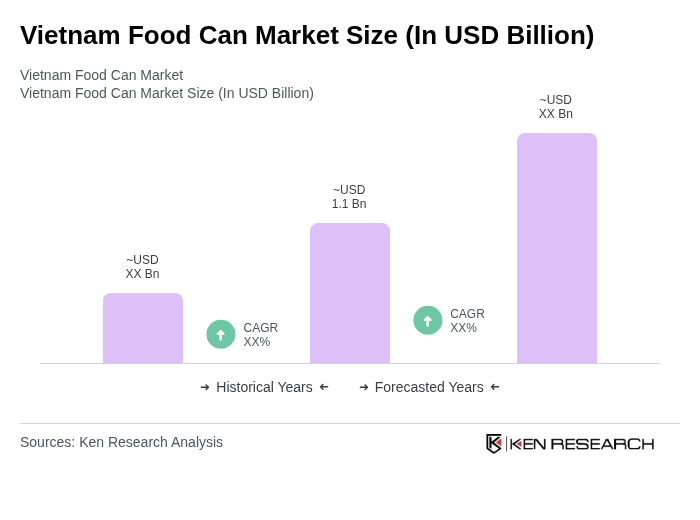
- The Vietnam Food Can Market is valued at USD 1.1 billion, based on a five-year historical analysis of the broader metal cans market (food and beverages) and the canned food segment, normalized from reported figures for Vietnam’s metal cans revenue and canned food sales. This growth is primarily driven by increasing consumer demand for convenient food packaging, coupled with a rise in the consumption of processed and canned foods, supported by the rapid expansion of the convenience food and canned food markets in Vietnam. The market has seen a significant uptick due to urbanization and changing lifestyles, which have led to a greater preference for ready-to-eat meals and preserved food products, alongside the expansion of modern retail and e?commerce channels that enhance access to packaged and canned foods.
- Key cities such as Ho Chi Minh City and Hanoi dominate the market due to their large populations and economic activities, reflecting their role as core hubs of Vietnam’s fast?growing food and beverage industry. These urban centers are experiencing rapid growth in the food and beverage sector and modern foodservice, which is a major contributor to the demand for food cans through higher consumption of processed, packaged, and ready?to?eat products. Additionally, the presence of numerous food processing and beverage companies and the concentration of modern trade channels in these regions further strengthens their market position and sustains demand for food cans.
- Vietnamese regulations governing food?contact packaging for canned products are anchored in instruments such as Circular 34/2011/TT-BYT issued by the Ministry of Health in 2011, which sets technical requirements to ensure that food packaging (including metal cans and linings) does not release contaminants, does not chemically interact with food, and does not reduce product quality or safety. These rules operate alongside Vietnam’s general food safety framework, requiring manufacturers and importers of food-contact materials to comply with hygiene, migration, and quality standards aligned with international food safety practices. This regulatory environment supports certification, testing, and monitoring of food can production and helps ensure that canned food products meet stringent health and safety requirements, thereby reinforcing consumer confidence in the market.
Vietnam Food Can Market Segmentation
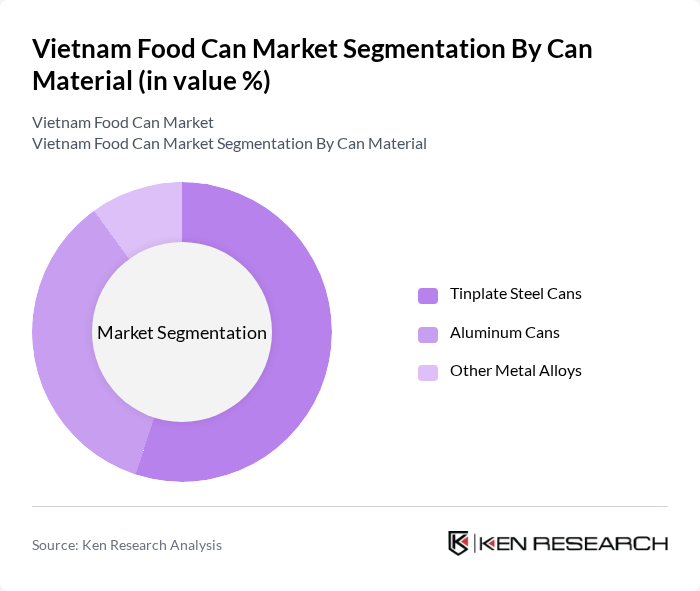
By Can Material:The market is segmented into three primary materials used for food cans: Tinplate Steel Cans, Aluminum Cans, and Other Metal Alloys. Tinplate steel cans are widely used for food applications due to their durability, strong barrier properties, and cost-effectiveness, making them a popular choice among manufacturers, particularly for canned meat, seafood, fruits, and vegetables. Aluminum cans, while more dominant on the beverage side, are gaining traction in food and multi-purpose metal packaging due to their lightweight nature, recyclability, and alignment with sustainability expectations from Vietnamese F&B consumers. Other metal alloys are utilized for specialized or higher?performance applications, such as products requiring particular corrosion resistance or premium packaging features, although they represent a smaller segment of the market. The indicative material mix in the food can segment is reasonably represented as:
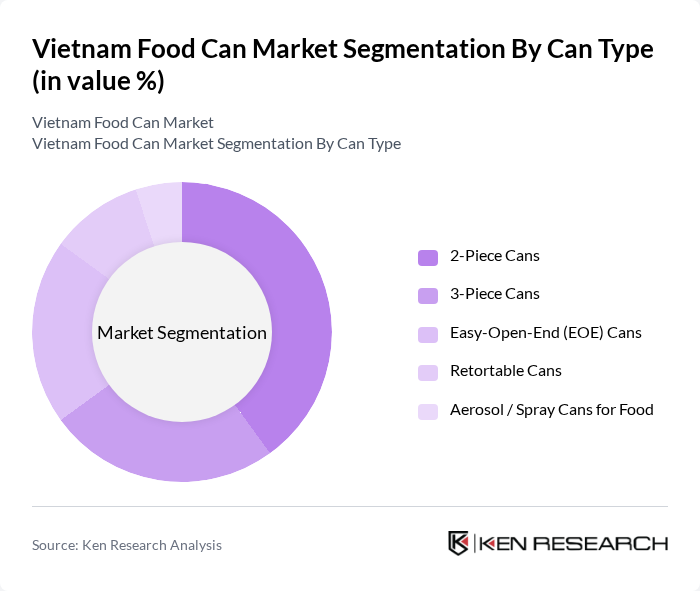
By Can Type:This segmentation includes various types of cans such as 2-Piece Cans, 3-Piece Cans, Easy-Open-End (EOE) Cans, Retortable Cans, and Aerosol/Spray Cans for Food. The 2-piece cans are preferred for their lightweight, reduced seam area, and cost-effective high-speed production, which make them suitable for a wide range of food and beverage fillings. 3-piece cans remain important for foods requiring flexible heights and diameters, such as canned vegetables, sauces, and some meat products. Easy-Open-End (EOE) cans are favored for their convenience and consumer-friendly opening, supporting the broader convenience food and canned ready-meal trend in Vietnam. Retortable cans are increasingly used for ready-to-eat meals, soups, and value-added canned dishes targeted at busy urban consumers seeking long shelf life and food safety. Aerosol cans are popular for food products requiring spray applications such as whipped cream, cooking sprays, and flavoring oils, occupying a niche but growing space within metal food packaging. The type mix in the Vietnamese context can be illustratively captured as:
Vietnam Food Can Market Competitive Landscape
The Vietnam Food Can Market is characterized by a dynamic mix of regional and international players. Leading participants such as Crown Holdings Vietnam, CANPACK Vietnam, TBC-Ball Beverage Can Vietnam Limited, Visy Packaging Vietnam, Tan Tien Can Manufacturing, Tan Binh Can Joint Stock Company, Ben Thanh TSC – Packaging Division, Dong Nai Food Industrial Corporation – Can Division, An Phat Holdings – Packaging Business, Binh Minh Plastics – Packaging Division, Masan Consumer – Packaged Food & Beverage, Vinamilk – Dairy & Nutritional Products, Vissan JSC – Processed Meat & Canned Foods, Quang Ngai Sugar (QNS) – FMCG & Canned Products, Tan Hiep Phat Beverage Group – Beverage Packaging contribute to innovation, geographic expansion, and service delivery in this space.
Vietnam Food Can Market Industry Analysis
Growth Drivers
- Increasing Urbanization:Vietnam's urban population is projected to reach approximately45%by future, up from37%in 2020, according to the World Bank. This rapid urbanization drives demand for food cans as urban dwellers seek convenient meal options. The urban population growth translates to approximately8–10 millionadditional urban residents, increasing the need for packaged food solutions. Urban areas typically have higher disposable incomes, further fueling the demand for food can products that offer convenience and variety.
- Rising Disposable Incomes:The average disposable income in Vietnam is expected to rise to approximatelyUSD 3,000–3,500per capita in future, up from aboutUSD 2,500–3,000in 2020, as reported by the IMF. This increase in disposable income allows consumers to spend more on premium food products, including canned goods. As consumers' purchasing power grows, they are more likely to opt for higher-quality, convenient food options, driving the food can market's expansion in urban and suburban areas.
- Growing Demand for Convenience Foods:The convenience food segment in Vietnam is projected to grow to aroundUSD 4–5 billionin future, reflecting a significant shift in consumer preferences. Factors such as busy lifestyles and the increasing number of working women contribute to this trend. As more consumers prioritize time-saving meal solutions, the demand for canned foods, which offer long shelf life and easy preparation, is expected to rise, further propelling the food can market's growth.
Market Challenges
- Intense Competition:The Vietnam food can market is characterized by fierce competition, with over100local and international brands vying for market share. This saturation leads to price wars and reduced profit margins. According to industry reports, the top five companies hold only30%of the market share, indicating a fragmented landscape. As new entrants continue to emerge, established players must innovate and differentiate their products to maintain their competitive edge.
- Fluctuating Raw Material Prices:The food can industry faces challenges from volatile raw material prices, particularly for metals like aluminum and steel. In recent periods, aluminum prices fluctuated betweenUSD 2,200 and USD 2,600per ton, impacting production costs. These fluctuations can lead to increased operational costs for manufacturers, which may be passed on to consumers, potentially reducing demand for canned products. Companies must develop strategies to mitigate these risks and stabilize their supply chains.
Vietnam Food Can Market Future Outlook
The Vietnam food can market is poised for significant growth, driven by urbanization, rising incomes, and changing consumer preferences. As the population becomes more health-conscious, there is a growing demand for nutritious and convenient food options. Companies are likely to invest in innovative packaging and product development to meet these evolving needs. Additionally, the expansion of e-commerce platforms will facilitate greater access to food can products, enhancing market penetration and consumer engagement in the coming years.
Market Opportunities
- Export Potential:Vietnam's food can industry has significant export potential, with exports projected to reachUSD 1 billionin future. The growing demand for Vietnamese canned goods in international markets, particularly in Asia and Europe, presents an opportunity for local manufacturers to expand their reach and increase revenue. This growth can be supported by government initiatives aimed at promoting food exports.
- Health-Conscious Product Lines:There is a rising trend towards health-conscious eating, with consumers increasingly seeking low-sodium, organic, and plant-based canned options. The market for health-oriented canned foods is expected to grow by20%in future. Companies that innovate and introduce healthier product lines can capture this growing segment, appealing to a broader audience and enhancing brand loyalty.
Scope of the Report
| Segment | Sub-Segments |
|---|---|
| By Can Material | Tinplate Steel Cans Aluminum Cans Other Metal Alloys |
| By Can Type | Piece Cans Piece Cans Easy-Open-End (EOE) Cans Retortable Cans Aerosol / Spray Cans for Food |
| By Food Application | Canned Fruits & Vegetables Canned Meat & Poultry Canned Fish & Seafood Canned Dairy & Infant Nutrition Canned Ready Meals, Soups & Sauces Canned Pet Food Other Canned Food Products |
| By End-User (Customer Type) | Food & Beverage Brand Owners Contract Packers / Co-Packers Private Label / Retailer Brands Export-Oriented Processors |
| By Can Size & Format | Small Cans (<250g) Medium Cans (250g–1kg) Large / Bulk Cans (>1kg) Specialty & Portion-Control Packs |
| By Production Setup | Integrated Can & Filling Operations Standalone Can Manufacturers Imported Empty Cans |
| By Region | Northern Vietnam Central Vietnam Southern Vietnam Others |
Key Target Audience
Investors and Venture Capitalist Firms
Government and Regulatory Bodies (e.g., Ministry of Industry and Trade, Ministry of Health)
Manufacturers and Producers
Distributors and Retailers
Food Safety Authorities (e.g., Vietnam Food Administration)
Packaging Suppliers
Industry Associations (e.g., Vietnam Food Association)
Financial Institutions
Players Mentioned in the Report:
Crown Holdings Vietnam
CANPACK Vietnam
TBC-Ball Beverage Can Vietnam Limited
Visy Packaging Vietnam
Tan Tien Can Manufacturing
Tan Binh Can Joint Stock Company
Ben Thanh TSC Packaging Division
Dong Nai Food Industrial Corporation Can Division
An Phat Holdings Packaging Business
Binh Minh Plastics Packaging Division
Masan Consumer Packaged Food & Beverage
Vinamilk Dairy & Nutritional Products
Vissan JSC Processed Meat & Canned Foods
Quang Ngai Sugar (QNS) FMCG & Canned Products
Tan Hiep Phat Beverage Group Beverage Packaging
Table of Contents
Market Assessment Phase
1. Executive Summary and Approach
2. Vietnam Food Can Market Overview
2.1 Key Insights and Strategic Recommendations
2.2 Vietnam Food Can Market Overview
2.3 Definition and Scope
2.4 Evolution of Market Ecosystem
2.5 Timeline of Key Regulatory Milestones
2.6 Value Chain & Stakeholder Mapping
2.7 Business Cycle Analysis
2.8 Policy & Incentive Landscape
3. Vietnam Food Can Market Analysis
3.1 Growth Drivers
3.1.1 Increasing Urbanization
3.1.2 Rising Disposable Incomes
3.1.3 Growing Demand for Convenience Foods
3.1.4 Expansion of Retail Channels
3.2 Market Challenges
3.2.1 Intense Competition
3.2.2 Fluctuating Raw Material Prices
3.2.3 Regulatory Compliance Issues
3.2.4 Limited Consumer Awareness
3.3 Market Opportunities
3.3.1 Export Potential
3.3.2 Product Innovation
3.3.3 E-commerce Growth
3.3.4 Health-Conscious Product Lines
3.4 Market Trends
3.4.1 Sustainable Packaging Solutions
3.4.2 Increased Focus on Food Safety
3.4.3 Rise of Plant-Based Options
3.4.4 Digital Marketing Strategies
3.5 Government Regulation
3.5.1 Food Safety Standards
3.5.2 Import Tariffs on Raw Materials
3.5.3 Environmental Regulations
3.5.4 Labeling Requirements
4. SWOT Analysis
5. Stakeholder Analysis
6. Porter's Five Forces Analysis
7. Vietnam Food Can Market Market Size, 2019-2024
7.1 By Value
7.2 By Volume
7.3 By Average Selling Price
8. Vietnam Food Can Market Segmentation
8.1 By Can Material
8.1.1 Tinplate Steel Cans
8.1.2 Aluminum Cans
8.1.3 Other Metal Alloys
8.2 By Can Type
8.2.1 2-Piece Cans
8.2.2 3-Piece Cans
8.2.3 Easy-Open-End (EOE) Cans
8.2.4 Retortable Cans
8.2.5 Aerosol / Spray Cans for Food
8.3 By Food Application
8.3.1 Canned Fruits & Vegetables
8.3.2 Canned Meat & Poultry
8.3.3 Canned Fish & Seafood
8.3.4 Canned Dairy & Infant Nutrition
8.3.5 Canned Ready Meals, Soups & Sauces
8.3.6 Canned Pet Food
8.3.7 Other Canned Food Products
8.4 By End-User (Customer Type)
8.4.1 Food & Beverage Brand Owners
8.4.2 Contract Packers / Co-Packers
8.4.3 Private Label / Retailer Brands
8.4.4 Export-Oriented Processors
8.5 By Can Size & Format
8.5.1 Small Cans (<250g)
8.5.2 Medium Cans (250g–1kg)
8.5.3 Large / Bulk Cans (>1kg)
8.5.4 Specialty & Portion-Control Packs
8.6 By Production Setup
8.6.1 Integrated Can & Filling Operations
8.6.2 Standalone Can Manufacturers
8.6.3 Imported Empty Cans
8.7 By Region
8.7.1 Northern Vietnam
8.7.2 Central Vietnam
8.7.3 Southern Vietnam
8.7.4 Others
9. Vietnam Food Can Market Competitive Analysis
9.1 Market Share of Key Players
9.2 Cross Comparison of Key Players
9.2.1 Company Name
9.2.2 Group Size (Large, Medium, or Small as per industry convention)
9.2.3 Vietnam Food Can Revenue (USD, Latest FY)
9.2.4 3-Year Revenue CAGR – Food Can Segment
9.2.5 EBITDA Margin – Food Can Business
9.2.6 Market Share in Vietnam Food Can Market (by Volume)
9.2.7 Capacity Utilization Rate of Can Production
9.2.8 Capex Intensity (Capex / Sales)
9.2.9 Return on Capital Employed (ROCE)
9.2.10 Export Ratio (Export Sales / Total Food Can Sales)
9.2.11 Average Realized Price per ’000 Cans
9.2.12 On-Time Delivery Rate
9.2.13 Customer Concentration (Top 5 as % of Sales)
9.3 SWOT Analysis of Top Players
9.4 Pricing Analysis
9.5 Detailed Profile of Major Companies
9.5.1 Crown Holdings Vietnam
9.5.2 CANPACK Vietnam
9.5.3 TBC-Ball Beverage Can Vietnam Limited
9.5.4 Visy Packaging Vietnam
9.5.5 Tan Tien Can Manufacturing
9.5.6 Tan Binh Can Joint Stock Company
9.5.7 Ben Thanh TSC – Packaging Division
9.5.8 Dong Nai Food Industrial Corporation – Can Division
9.5.9 An Phat Holdings – Packaging Business
9.5.10 Binh Minh Plastics – Packaging Division
9.5.11 Masan Consumer – Packaged Food & Beverage
9.5.12 Vinamilk – Dairy & Nutritional Products
9.5.13 Vissan JSC – Processed Meat & Canned Foods
9.5.14 Quang Ngai Sugar (QNS) – FMCG & Canned Products
9.5.15 Tan Hiep Phat Beverage Group – Beverage Packaging
10. Vietnam Food Can Market End-User Analysis
10.1 Procurement Behavior of Key Ministries
10.1.1 Ministry of Health
10.1.2 Ministry of Agriculture and Rural Development
10.1.3 Ministry of Industry and Trade
10.1.4 Others
10.2 Corporate Spend on Infrastructure & Energy
10.2.1 Food Processing Companies
10.2.2 Retail Chains
10.2.3 Exporters
10.2.4 Others
10.3 Pain Point Analysis by End-User Category
10.3.1 Quality Assurance Issues
10.3.2 Supply Chain Disruptions
10.3.3 Cost Management Challenges
10.3.4 Others
10.4 User Readiness for Adoption
10.4.1 Awareness of Canned Products
10.4.2 Willingness to Pay for Quality
10.4.3 Preference for Local vs Imported
10.4.4 Others
10.5 Post-Deployment ROI and Use Case Expansion
10.5.1 Performance Metrics
10.5.2 Customer Feedback Mechanisms
10.5.3 Market Expansion Strategies
10.5.4 Others
11. Vietnam Food Can Market Future Size, 2025-2030
11.1 By Value
11.2 By Volume
11.3 By Average Selling Price
Go-To-Market Strategy Phase
1. Whitespace Analysis + Business Model Canvas
1.1 Market Gaps Identification
1.2 Business Model Framework
2. Marketing and Positioning Recommendations
2.1 Branding Strategies
2.2 Product USPs
3. Distribution Plan
3.1 Urban Retail vs Rural NGO Tie-ups
4. Channel & Pricing Gaps
4.1 Underserved Routes
4.2 Pricing Bands
5. Unmet Demand & Latent Needs
5.1 Category Gaps
5.2 Consumer Segments
6. Customer Relationship
6.1 Loyalty Programs
6.2 After-sales Service
7. Value Proposition
7.1 Sustainability
7.2 Integrated Supply Chains
8. Key Activities
8.1 Regulatory Compliance
8.2 Branding
8.3 Distribution Setup
9. Entry Strategy Evaluation
9.1 Domestic Market Entry Strategy
9.1.1 Product Mix
9.1.2 Pricing Band
9.1.3 Packaging
9.2 Export Entry Strategy
9.2.1 Target Countries
9.2.2 Compliance Roadmap
10. Entry Mode Assessment
10.1 JV
10.2 Greenfield
10.3 M&A
10.4 Distributor Model
11. Capital and Timeline Estimation
11.1 Capital Requirements
11.2 Timelines
12. Control vs Risk Trade-Off
12.1 Ownership vs Partnerships
13. Profitability Outlook
13.1 Breakeven Analysis
13.2 Long-term Sustainability
14. Potential Partner List
14.1 Distributors
14.2 JVs
14.3 Acquisition Targets
15. Execution Roadmap
15.1 Phased Plan for Market Entry
15.1.1 Market Setup
15.1.2 Market Entry
15.1.3 Growth Acceleration
15.1.4 Scale & Stabilize
15.2 Key Activities and Milestones
15.2.1 Milestone Planning
Research Methodology
Phase 1: Approach1
Desk Research
- Analysis of market reports from Vietnamese agricultural and food industry associations
- Review of government publications on food safety regulations and import/export data
- Examination of consumer behavior studies and trends in canned food consumption
Primary Research
- Interviews with key stakeholders in the food can manufacturing sector
- Surveys conducted with distributors and retailers of canned food products
- Focus group discussions with consumers to understand preferences and purchasing behavior
Validation & Triangulation
- Cross-validation of findings with industry expert opinions and market trends
- Triangulation of data from trade associations, government reports, and primary research
- Sanity checks through feedback from a panel of food industry experts
Phase 2: Market Size Estimation1
Top-down Assessment
- Estimation of total market size based on national food consumption statistics
- Segmentation of the market by product type, including vegetables, fruits, and meats
- Incorporation of growth rates from historical data and projected trends in urbanization
Bottom-up Modeling
- Collection of sales data from leading canned food manufacturers in Vietnam
- Estimation of average selling prices and volume sold across different distribution channels
- Analysis of production capacity and operational efficiencies of local canning facilities
Forecasting & Scenario Analysis
- Development of forecasting models based on demographic shifts and economic indicators
- Scenario analysis considering potential impacts of trade policies and import tariffs
- Baseline, optimistic, and pessimistic projections for market growth through 2030
Phase 3: CATI Sample Composition1
| Scope Item/Segment | Sample Size | Target Respondent Profiles |
|---|---|---|
| Canned Vegetable Producers | 90 | Production Managers, Quality Control Supervisors |
| Canned Fruit Distributors | 70 | Sales Managers, Distribution Coordinators |
| Retailers of Canned Foods | 110 | Store Managers, Category Buyers |
| Consumer Focus Groups | 60 | Regular Canned Food Consumers, Health-Conscious Shoppers |
| Food Safety Regulators | 40 | Regulatory Officers, Compliance Managers |
Frequently Asked Questions
What is the current value of the Vietnam Food Can Market?
The Vietnam Food Can Market is valued at approximately USD 1.1 billion, driven by increasing consumer demand for convenient food packaging and a rise in the consumption of processed and canned foods.
What factors are driving the growth of the Vietnam Food Can Market?
Which cities are the main hubs for the Vietnam Food Can Market?
What are the main materials used for food cans in Vietnam?
Other Regional/Country Reports
Indonesia Food Can Market
Malaysia Food Can Market
KSA Food Can Market
APAC Food Can Market
SEA Food Can Market
Thailand Food Can Market
Other Adjacent Reports
South Korea Convenience Food Market
Japan Processed Food Market
Asia Pacific Metal Packaging Market Outlook to 2030: Size, Share, Growth and TrendsKSA food packaging market size, share, growth drivers, trends, opportunities & forecast 2025–2030Singapore Ready-to-Eat Meal Market
India Food Processing Market Size, Share & Forecast, By Product Type, End-Use Industry & Distribution Channel, 2025-2032Global Packaging Machinery Market Size, Share & Forecast, By Machine Type, End-Use Industry & Technology, 2025-2032Europe Sustainable Packaging Market Size, Share & Forecast 2025-2031Why Buy From Us?

What makes us stand out is that our consultants follow Robust, Refine and Result (RRR) methodology. Robust for clear definitions, approaches and sanity checking, Refine for differentiating respondents' facts and opinions, and Result for presenting data with story.

We have set a benchmark in the industry by offering our clients with syndicated and customized market research reports featuring coverage of entire market as well as meticulous research and analyst insights.

While we don't replace traditional research, we flip the method upside down. Our dual approach of Top Bottom & Bottom Top ensures quality deliverable by not just verifying company fundamentals but also looking at the sector and macroeconomic factors.

With one step in the future, our research team constantly tries to show you the bigger picture. We help with some of the tough questions you may encounter along the way: How is the industry positioned? Best marketing channel? KPI's of competitors? By aligning every element, we help maximize success.

Our report gives you instant access to the answers and sources that other companies might choose to hide. We elaborate each steps of research methodology we have used and showcase you the sample size to earn your trust.

If you need any support, we are here! We pride ourselves on universe strength, data quality, and quick, friendly, and professional service.