About the Report
Base Year 2024Vietnam Vision Processing Unit Market Overview
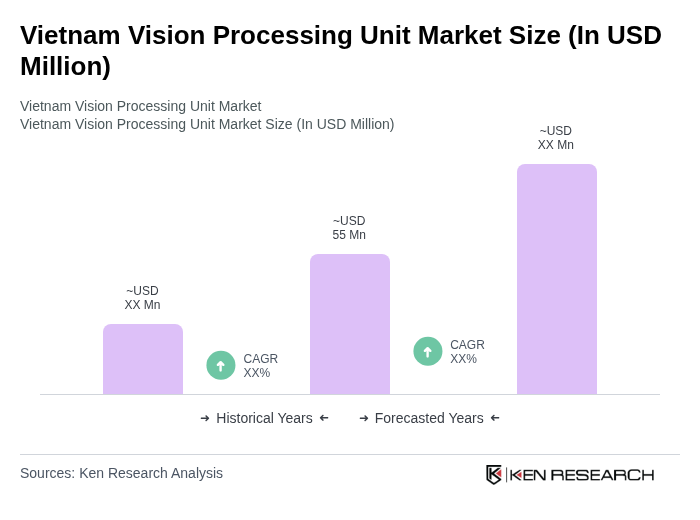
- The Vietnam Vision Processing Unit market is valued at USD 55 million, based on a five-year historical analysis. This growth is primarily driven by the increasing demand for advanced imaging technologies in sectors such as automotive, consumer electronics, and industrial automation. The rise in applications for artificial intelligence and machine learning in vision processing has further fueled market expansion.
- Key cities dominating the market include Ho Chi Minh City and Hanoi, which serve as technological hubs with a concentration of electronics manufacturers and startups. The presence of major tech companies and a growing skilled workforce in these regions contribute to their dominance in the vision processing unit market.
- The Decree No. 57/2021/ND-CP issued by the Government of Vietnam in 2021 promotes the development of high-tech industries, including vision processing technologies. This initiative requires enterprises to meet technology standards for high-tech recognition, provides tax incentives for eligible high-tech products and services, and mandates compliance through certification processes with minimum R&D investment thresholds of 1% of revenue.
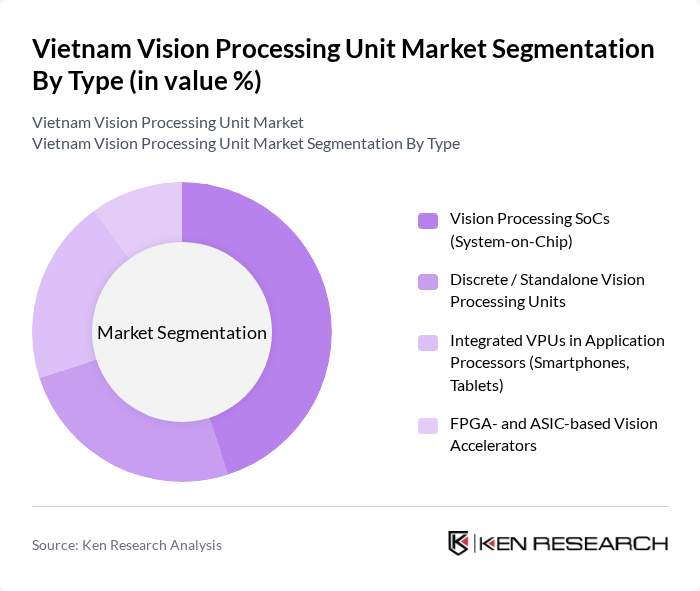
Vietnam Vision Processing Unit Market Segmentation
By Type:The segmentation by type includes Vision Processing SoCs (System-on-Chip), Discrete / Standalone Vision Processing Units, Integrated VPUs in Application Processors (Smartphones, Tablets), and FPGA- and ASIC-based Vision Accelerators. Among these, Vision Processing SoCs are leading the market due to their compact design and efficiency, making them ideal for mobile devices and automotive applications.
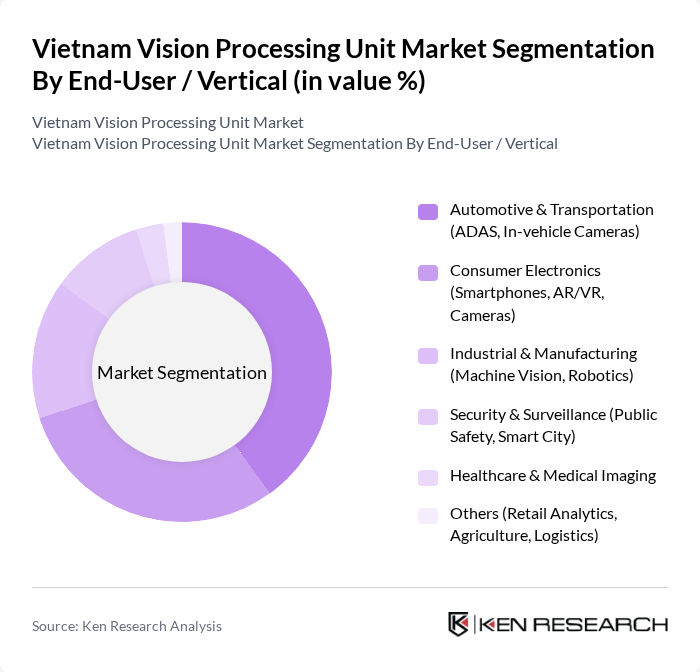
By End-User / Vertical:The end-user segmentation includes Automotive & Transportation, Consumer Electronics, Industrial & Manufacturing, Security & Surveillance, Healthcare & Medical Imaging, and Others. The Automotive & Transportation sector is currently the dominant segment, driven by the increasing adoption of Advanced Driver Assistance Systems (ADAS) and the push towards autonomous vehicles.
Vietnam Vision Processing Unit Market Competitive Landscape
The Vietnam Vision Processing Unit Market is characterized by a dynamic mix of regional and international players. Leading participants such as Intel Corporation, NVIDIA Corporation, Qualcomm Technologies, Inc., Texas Instruments Incorporated, Ambarella, Inc., STMicroelectronics N.V., Renesas Electronics Corporation, Analog Devices, Inc., onsemi (ON Semiconductor Corporation), Infineon Technologies AG, MediaTek Inc., Samsung Electronics Co., Ltd., Sony Semiconductor Solutions Corporation, Huawei Technologies Co., Ltd., Viettel High Tech Industries Corporation contribute to innovation, geographic expansion, and service delivery in this space.
Vietnam Vision Processing Unit Market Industry Analysis
Growth Drivers
- Increasing Demand for AI and Machine Learning Applications:The Vietnamese AI market is projected to reach $1.1 billion in future, driven by a surge in demand for machine learning applications across various sectors. The government aims to integrate AI into 50% of businesses in future, fostering innovation and efficiency. This growth is supported by a 16% annual increase in AI-related investments, indicating a robust market environment for vision processing units that facilitate these technologies.
- Expansion of the Automotive and Robotics Sectors:Vietnam's automotive industry is expected to grow to $7.5 billion in future, with a significant focus on smart vehicles. The robotics sector is also expanding, with a projected market size of $1.6 billion in future. This growth is fueled by increasing investments in automation and smart technologies, creating a substantial demand for vision processing units that enhance vehicle safety and operational efficiency in robotics applications.
- Government Initiatives Promoting Smart City Projects:The Vietnamese government has allocated $2.5 billion for smart city initiatives in future, aiming to improve urban infrastructure and services. This includes the integration of advanced technologies such as vision processing units in traffic management and public safety systems. The focus on smart cities is expected to drive demand for innovative solutions, positioning Vietnam as a key player in the regional technology landscape.
Market Challenges
- High Initial Investment Costs:The entry barrier for companies in the vision processing unit market is significant, with initial investment costs averaging around $550,000 for R&D and infrastructure. This financial burden can deter potential entrants and slow down innovation. Additionally, the need for advanced technology and skilled labor further exacerbates the challenge, limiting the growth potential of local firms in a competitive landscape.
- Limited Local Expertise and Skilled Workforce:Vietnam faces a shortage of skilled professionals in the technology sector, with only 22% of graduates in relevant fields possessing adequate skills for the vision processing unit market. This gap in expertise hampers the development and deployment of advanced technologies. Companies often resort to hiring foreign talent, increasing operational costs and complicating knowledge transfer within the local industry.
Vietnam Vision Processing Unit Market Future Outlook
The Vietnam Vision Processing Unit market is poised for significant growth, driven by advancements in AI and machine learning, alongside government support for smart city initiatives. As local industries increasingly adopt these technologies, the demand for efficient and innovative vision processing solutions will rise. Furthermore, the ongoing expansion of the automotive and robotics sectors will create new opportunities for market players, fostering a competitive landscape that encourages innovation and collaboration among stakeholders.
Market Opportunities
- Growth in IoT Applications:The Internet of Things (IoT) market in Vietnam is projected to reach $3.5 billion in future, creating substantial opportunities for vision processing units. As IoT devices proliferate, the need for advanced vision processing capabilities will increase, enabling smarter and more efficient systems across various sectors, including agriculture, healthcare, and manufacturing.
- Collaborations with Tech Startups:Vietnam's vibrant startup ecosystem, with over 3,500 tech startups, presents opportunities for collaboration in developing customized vision processing solutions. Partnerships with these startups can lead to innovative applications tailored to local market needs, enhancing competitiveness and driving growth in the vision processing unit sector.
Scope of the Report
| Segment | Sub-Segments |
|---|---|
| By Type | Vision Processing SoCs (System-on-Chip) Discrete / Standalone Vision Processing Units Integrated VPUs in Application Processors (Smartphones, Tablets) FPGA- and ASIC-based Vision Accelerators |
| By End-User / Vertical | Automotive & Transportation (ADAS, In-vehicle Cameras) Consumer Electronics (Smartphones, AR/VR, Cameras) Industrial & Manufacturing (Machine Vision, Robotics) Security & Surveillance (Public Safety, Smart City) Healthcare & Medical Imaging Others (Retail Analytics, Agriculture, Logistics) |
| By Application | Advanced Driver Assistance Systems (ADAS) & Autonomous Driving Smartphones & Mobile Devices Imaging Industrial Machine Vision & Quality Inspection Smart Cameras & Video Analytics (CCTV, NVRs) Drones, UAVs & Robotics Navigation AR/VR & Edge AI Devices Others |
| By Technology / Processing Node | ?16 nm VPUs >16–28 nm VPUs >28 nm VPUs AI-Optimized Architectures (CNN / Deep Learning Accelerators) |
| By Distribution Channel | Direct OEM Supply (Automotive, Smartphone, Industrial OEMs) Semiconductor Distributors & Value-Added Resellers Online B2B Platforms Others |
| By Region | Northern Vietnam (Hanoi, Bac Ninh, Hai Phong and vicinity) Southern Vietnam (Ho Chi Minh City, Binh Duong, Dong Nai and vicinity) Central Vietnam (Da Nang, Quang Nam and vicinity) Others |
| By Policy Support & Program Alignment | Government Grants & Innovation Programs (e.g., NIC, NATEC) Tax Incentives for High-Tech & Semiconductor Investments R&D and Pilot Project Funding for AI / Smart City FDI & Industrial Park Incentives for Electronics Manufacturing |
Key Target Audience
Investors and Venture Capitalist Firms
Government and Regulatory Bodies (e.g., Ministry of Information and Communications, Ministry of Science and Technology)
Manufacturers and Producers
Distributors and Retailers
Technology Providers
Industry Associations (e.g., Vietnam Electronics Industries Association)
Financial Institutions
Telecommunications Companies
Players Mentioned in the Report:
Intel Corporation
NVIDIA Corporation
Qualcomm Technologies, Inc.
Texas Instruments Incorporated
Ambarella, Inc.
STMicroelectronics N.V.
Renesas Electronics Corporation
Analog Devices, Inc.
onsemi (ON Semiconductor Corporation)
Infineon Technologies AG
MediaTek Inc.
Samsung Electronics Co., Ltd.
Sony Semiconductor Solutions Corporation
Huawei Technologies Co., Ltd.
Viettel High Tech Industries Corporation
Table of Contents
Market Assessment Phase
1. Executive Summary and Approach
2. Vietnam Vision Processing Unit Market Overview
2.1 Key Insights and Strategic Recommendations
2.2 Vietnam Vision Processing Unit Market Overview
2.3 Definition and Scope
2.4 Evolution of Market Ecosystem
2.5 Timeline of Key Regulatory Milestones
2.6 Value Chain & Stakeholder Mapping
2.7 Business Cycle Analysis
2.8 Policy & Incentive Landscape
3. Vietnam Vision Processing Unit Market Analysis
3.1 Growth Drivers
3.1.1 Increasing demand for AI and machine learning applications
3.1.2 Expansion of the automotive and robotics sectors
3.1.3 Government initiatives promoting smart city projects
3.1.4 Rising consumer electronics market
3.2 Market Challenges
3.2.1 High initial investment costs
3.2.2 Limited local expertise and skilled workforce
3.2.3 Intense competition from international players
3.2.4 Regulatory hurdles and compliance issues
3.3 Market Opportunities
3.3.1 Growth in IoT applications
3.3.2 Collaborations with tech startups
3.3.3 Development of customized solutions for local industries
3.3.4 Export potential to neighboring countries
3.4 Market Trends
3.4.1 Shift towards edge computing
3.4.2 Increasing integration of vision processing in consumer devices
3.4.3 Adoption of open-source platforms
3.4.4 Focus on energy-efficient processing units
3.5 Government Regulation
3.5.1 Standards for electronic components
3.5.2 Incentives for R&D in technology
3.5.3 Import/export regulations for technology products
3.5.4 Data protection and privacy laws
4. SWOT Analysis
5. Stakeholder Analysis
6. Porter's Five Forces Analysis
7. Vietnam Vision Processing Unit Market Market Size, 2019-2024
7.1 By Value
7.2 By Volume
7.3 By Average Selling Price
8. Vietnam Vision Processing Unit Market Segmentation
8.1 By Type
8.1.1 Vision Processing SoCs (System-on-Chip)
8.1.2 Discrete / Standalone Vision Processing Units
8.1.3 Integrated VPUs in Application Processors (Smartphones, Tablets)
8.1.4 FPGA- and ASIC-based Vision Accelerators
8.2 By End-User / Vertical
8.2.1 Automotive & Transportation (ADAS, In-vehicle Cameras)
8.2.2 Consumer Electronics (Smartphones, AR/VR, Cameras)
8.2.3 Industrial & Manufacturing (Machine Vision, Robotics)
8.2.4 Security & Surveillance (Public Safety, Smart City)
8.2.5 Healthcare & Medical Imaging
8.2.6 Others (Retail Analytics, Agriculture, Logistics)
8.3 By Application
8.3.1 Advanced Driver Assistance Systems (ADAS) & Autonomous Driving
8.3.2 Smartphones & Mobile Devices Imaging
8.3.3 Industrial Machine Vision & Quality Inspection
8.3.4 Smart Cameras & Video Analytics (CCTV, NVRs)
8.3.5 Drones, UAVs & Robotics Navigation
8.3.6 AR/VR & Edge AI Devices
8.3.7 Others
8.4 By Technology / Processing Node
8.4.1 ?16 nm VPUs
8.4.2 >16–28 nm VPUs
8.4.3 >28 nm VPUs
8.4.4 AI-Optimized Architectures (CNN / Deep Learning Accelerators)
8.5 By Distribution Channel
8.5.1 Direct OEM Supply (Automotive, Smartphone, Industrial OEMs)
8.5.2 Semiconductor Distributors & Value-Added Resellers
8.5.3 Online B2B Platforms
8.5.4 Others
8.6 By Region
8.6.1 Northern Vietnam (Hanoi, Bac Ninh, Hai Phong and vicinity)
8.6.2 Southern Vietnam (Ho Chi Minh City, Binh Duong, Dong Nai and vicinity)
8.6.3 Central Vietnam (Da Nang, Quang Nam and vicinity)
8.6.4 Others
8.7 By Policy Support & Program Alignment
8.7.1 Government Grants & Innovation Programs (e.g., NIC, NATEC)
8.7.2 Tax Incentives for High-Tech & Semiconductor Investments
8.7.3 R&D and Pilot Project Funding for AI / Smart City
8.7.4 FDI & Industrial Park Incentives for Electronics Manufacturing
9. Vietnam Vision Processing Unit Market Competitive Analysis
9.1 Market Share of Key Players
9.2 Cross Comparison of Key Players
9.2.1 Company Name
9.2.2 Global Semiconductor Revenue (USD, Latest Fiscal Year)
9.2.3 Vision / AI Processor Revenue Share (%)
9.2.4 Vietnam & ASEAN Revenue Exposure (%)
9.2.5 VPU Product Portfolio Breadth (Entry/Mid/High-End Coverage)
9.2.6 Design Wins in Vietnam (Automotive, Smartphone, Industrial OEMs)
9.2.7 R&D Intensity (% of Revenue Spent on R&D)
9.2.8 VPU Performance-per-Watt Benchmark (TOPS/W or FPS/W)
9.2.9 Average Selling Price (ASP) Positioning in Vietnam
9.2.10 Time-to-Market & Product Refresh Cycle (Months)
9.2.11 Local Partnership Depth (Distributors, SI, ODM/OEM in Vietnam)
9.2.12 After-Sales & Technical Support Presence in Vietnam
9.3 SWOT Analysis of Top Players
9.4 Pricing Analysis
9.5 Detailed Profile of Major Companies
9.5.1 Intel Corporation
9.5.2 NVIDIA Corporation
9.5.3 Qualcomm Technologies, Inc.
9.5.4 Texas Instruments Incorporated
9.5.5 Ambarella, Inc.
9.5.6 STMicroelectronics N.V.
9.5.7 Renesas Electronics Corporation
9.5.8 Analog Devices, Inc.
9.5.9 onsemi (ON Semiconductor Corporation)
9.5.10 Infineon Technologies AG
9.5.11 MediaTek Inc.
9.5.12 Samsung Electronics Co., Ltd.
9.5.13 Sony Semiconductor Solutions Corporation
9.5.14 Huawei Technologies Co., Ltd.
9.5.15 Viettel High Tech Industries Corporation
10. Vietnam Vision Processing Unit Market End-User Analysis
10.1 Procurement Behavior of Key Ministries
10.1.1 Budget Allocation Trends
10.1.2 Decision-Making Processes
10.1.3 Preferred Suppliers
10.1.4 Procurement Cycles
10.2 Corporate Spend on Infrastructure & Energy
10.2.1 Investment Trends
10.2.2 Key Sectors of Investment
10.2.3 Budget Prioritization
10.2.4 Future Spending Projections
10.3 Pain Point Analysis by End-User Category
10.3.1 Common Challenges Faced
10.3.2 Technology Gaps
10.3.3 Support Needs
10.3.4 Others
10.4 User Readiness for Adoption
10.4.1 Awareness Levels
10.4.2 Training Requirements
10.4.3 Infrastructure Readiness
10.4.4 Others
10.5 Post-Deployment ROI and Use Case Expansion
10.5.1 ROI Measurement Techniques
10.5.2 Case Studies of Successful Implementations
10.5.3 Future Use Case Opportunities
10.5.4 Others
11. Vietnam Vision Processing Unit Market Future Size, 2025-2030
11.1 By Value
11.2 By Volume
11.3 By Average Selling Price
Go-To-Market Strategy Phase
1. Whitespace Analysis + Business Model Canvas
1.1 Market Gaps Identification
1.2 Business Model Development
2. Marketing and Positioning Recommendations
2.1 Branding Strategies
2.2 Product USPs
3. Distribution Plan
3.1 Urban Retail Strategies
3.2 Rural NGO Tie-ups
4. Channel & Pricing Gaps
4.1 Underserved Routes
4.2 Pricing Bands
5. Unmet Demand & Latent Needs
5.1 Category Gaps
5.2 Consumer Segments
6. Customer Relationship
6.1 Loyalty Programs
6.2 After-sales Service
7. Value Proposition
7.1 Sustainability Initiatives
7.2 Integrated Supply Chains
8. Key Activities
8.1 Regulatory Compliance
8.2 Branding Efforts
8.3 Distribution Setup
9. Entry Strategy Evaluation
9.1 Domestic Market Entry Strategy
9.1.1 Product Mix Considerations
9.1.2 Pricing Band Strategies
9.1.3 Packaging Approaches
9.2 Export Entry Strategy
9.2.1 Target Countries
9.2.2 Compliance Roadmap
10. Entry Mode Assessment
10.1 Joint Ventures
10.2 Greenfield Investments
10.3 Mergers & Acquisitions
10.4 Distributor Model
11. Capital and Timeline Estimation
11.1 Capital Requirements
11.2 Timelines for Implementation
12. Control vs Risk Trade-Off
12.1 Ownership Considerations
12.2 Partnerships Evaluation
13. Profitability Outlook
13.1 Breakeven Analysis
13.2 Long-term Sustainability Strategies
14. Potential Partner List
14.1 Distributors
14.2 Joint Ventures
14.3 Acquisition Targets
15. Execution Roadmap
15.1 Phased Plan for Market Entry
15.1.1 Market Setup
15.1.2 Market Entry
15.1.3 Growth Acceleration
15.1.4 Scale & Stabilize
15.2 Key Activities and Milestones
15.2.1 Milestone Planning
15.2.2 Activity Tracking
Research Methodology
Phase 1: Approach1
Desk Research
- Analysis of industry reports from Vietnamese government agencies and trade associations
- Review of academic publications and white papers on vision processing technologies
- Examination of market trends and forecasts from reputable market research firms
Primary Research
- Interviews with key stakeholders in the semiconductor and electronics sectors
- Surveys targeting R&D managers in companies developing vision processing units
- Field visits to manufacturing facilities to gather insights on production capabilities
Validation & Triangulation
- Cross-validation of findings through multiple data sources including trade publications and expert opinions
- Triangulation of market data with insights from industry conferences and seminars
- Sanity checks conducted through expert panel reviews and feedback sessions
Phase 2: Market Size Estimation1
Top-down Assessment
- Estimation of market size based on national electronics production and export data
- Segmentation of the market by application areas such as automotive, healthcare, and consumer electronics
- Incorporation of government initiatives promoting technology adoption in various sectors
Bottom-up Modeling
- Collection of sales data from leading manufacturers of vision processing units
- Estimation of market share based on production capacity and sales volume
- Analysis of pricing strategies and cost structures of key players in the market
Forecasting & Scenario Analysis
- Development of forecasting models using historical sales data and growth trends
- Scenario analysis based on technological advancements and regulatory changes
- Projections of market growth under different economic conditions through 2030
Phase 3: CATI Sample Composition1
| Scope Item/Segment | Sample Size | Target Respondent Profiles |
|---|---|---|
| Automotive Vision Systems | 100 | Product Managers, Automotive Engineers |
| Healthcare Imaging Solutions | 80 | Medical Device Developers, Radiologists |
| Consumer Electronics Applications | 120 | Product Development Managers, Marketing Directors |
| Industrial Automation Vision Systems | 90 | Operations Managers, Automation Engineers |
| Research and Development in AI Vision | 70 | R&D Directors, AI Specialists |
Frequently Asked Questions
What is the current value of the Vietnam Vision Processing Unit market?
The Vietnam Vision Processing Unit market is valued at approximately USD 55 million, reflecting a five-year historical analysis. This growth is driven by the increasing demand for advanced imaging technologies across various sectors, including automotive and consumer electronics.
Which cities are key players in the Vietnam Vision Processing Unit market?
What government initiatives support the Vietnam Vision Processing Unit market?
What are the main types of vision processing units in Vietnam?
Other Regional/Country Reports
Indonesia Vision Processing Unit Market
Malaysia Vision Processing Unit Market
KSA Vision Processing Unit Market
APAC Vision Processing Unit Market
SEA Vision Processing Unit Market
Thailand Vision Processing Unit Market
Other Adjacent Reports
Mexico Machine Vision Market
South Korea Artificial Intelligence Chip Market
Mexico Automotive ADAS Market
Kuwait Consumer Electronics Imaging Market
South Korea Industrial Automation Market
Qatar Security Surveillance Market
Kuwait Healthcare Imaging Market
KSA Robotics Vision Market
Brazil IoT Sensor Market
Kuwait Semiconductor Processing Market
Why Buy From Us?

What makes us stand out is that our consultants follow Robust, Refine and Result (RRR) methodology. Robust for clear definitions, approaches and sanity checking, Refine for differentiating respondents' facts and opinions, and Result for presenting data with story.

We have set a benchmark in the industry by offering our clients with syndicated and customized market research reports featuring coverage of entire market as well as meticulous research and analyst insights.

While we don't replace traditional research, we flip the method upside down. Our dual approach of Top Bottom & Bottom Top ensures quality deliverable by not just verifying company fundamentals but also looking at the sector and macroeconomic factors.

With one step in the future, our research team constantly tries to show you the bigger picture. We help with some of the tough questions you may encounter along the way: How is the industry positioned? Best marketing channel? KPI's of competitors? By aligning every element, we help maximize success.

Our report gives you instant access to the answers and sources that other companies might choose to hide. We elaborate each steps of research methodology we have used and showcase you the sample size to earn your trust.

If you need any support, we are here! We pride ourselves on universe strength, data quality, and quick, friendly, and professional service.