About the Report
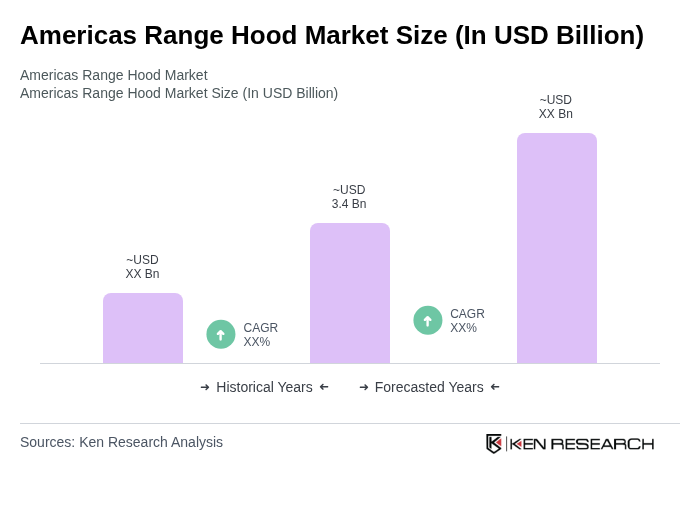
Base Year 2024Americas Range Hood Market Overview
- The Americas Range Hood Market is valued at USD 3.4 billion, based on a five-year historical analysis. This growth is primarily driven by increasing consumer awareness regarding kitchen hygiene and indoor air quality, coupled with the rising trend of home cooking, kitchen remodeling, and the adoption of premium built-in appliances in residential and small commercial kitchens. The demand for efficient ventilation systems has surged as consumers seek to enhance air extraction performance, reduce cooking odors and grease, and improve kitchen aesthetics through sleek, low-noise, and energy-efficient hood designs.
- Key markets in this region include the United States and Canada, which dominate due to high disposable incomes, large installed bases of built-in kitchens, and a strong culture of home improvement and kitchen upgrades. The growing trend of modern, open-plan kitchen designs, rising multi-family and single-family housing construction, and strong growth in foodservice establishments such as restaurants and quick-service restaurants further contribute to the market's expansion in these countries and in major Latin American economies.
- Energy performance and efficiency requirements for range hoods in the U.S. market are influenced by federal appliance standards and building energy programs, including provisions under the Energy Policy and Conservation Act administered by the U.S. Department of Energy (DOE) and ventilation and efficiency criteria incorporated into ENERGY STAR Program Requirements for Residential Ventilating Fans (Version 4.1, U.S. Environmental Protection Agency, 2022), which specify minimum efficacy levels (CFM/Watt), sound limits, and performance testing for qualifying kitchen ventilation products.
Americas Range Hood Market Segmentation
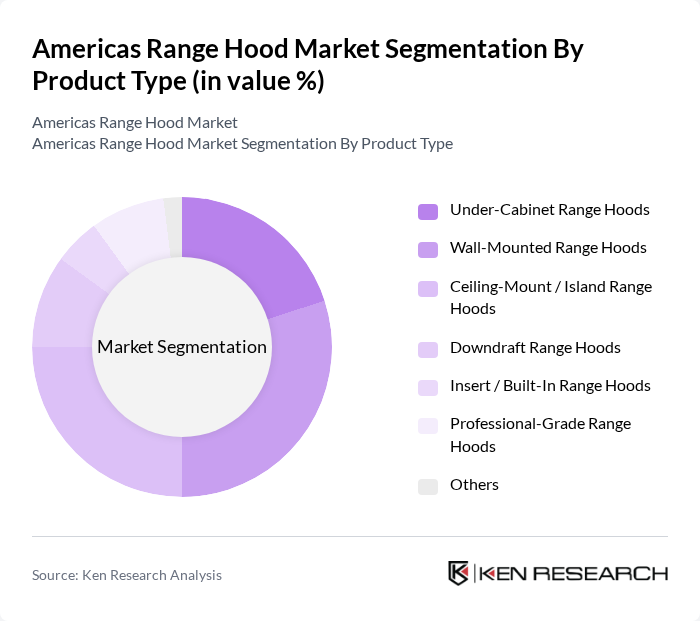
By Product Type:The product type segmentation includes various categories such as Under-Cabinet Range Hoods, Wall-Mounted Range Hoods, Ceiling-Mount / Island Range Hoods, Downdraft Range Hoods, Insert / Built-In Range Hoods, Professional-Grade Range Hoods, and Others. These categories align with the key product groupings used in recent Americas range hood market studies, which commonly distinguish under-cabinet, wall-mounted, and ceiling/island products as primary segments. Wall-Mounted Range Hoods and Under-Cabinet Range Hoods together account for a major share of installations, supported by their broad availability in specialty retail and mass channels, and their compatibility with standard cabinet layouts. Consumers increasingly prefer visually appealing, low-profile wall and island hoods that complement contemporary kitchen décor, support higher airflow rates, and integrate features such as LED lighting, multiple fan speeds, and smart controls, which is reinforced by the growing adoption of open kitchen layouts in urban homes.
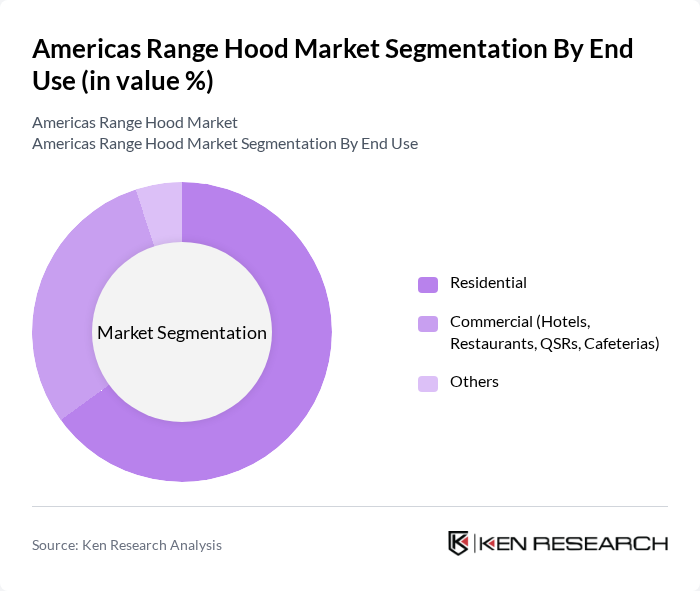
By End Use:The end-use segmentation encompasses Residential, Commercial (Hotels, Restaurants, QSRs, Cafeterias), and Others. The Residential segment is the dominant force in the market, consistent with recent analyses indicating that residential applications account for the largest revenue share of range hood demand in the Americas. Growth in this segment is driven by increasing home renovations, kitchen remodeling, and new residential construction, as well as rising consumer preference for quiet, high-suction, and often smart-connected range hoods to enhance cooking comfort and maintain a cleaner indoor environment. The commercial segment, including hotels, restaurants, QSRs, and cafeterias, continues to expand with the development of hospitality and foodservice infrastructure across North America and Latin America, supporting demand for higher-capacity and professional-grade ventilation systems.
Americas Range Hood Market Competitive Landscape
The Americas Range Hood Market is characterized by a dynamic mix of regional and international players. Leading participants such as Broan-NuTone, LLC, Whirlpool Corporation, Electrolux AB, GE Appliances, a Haier Company, Robert Bosch GmbH (Bosch Home Appliances), Miele, Inc., Samsung Electronics Co., Ltd., LG Electronics Inc., Panasonic Corporation, Zephyr Ventilation, Viking Range, LLC, Dacor, Inc., Faber S.p.A., Haube Range Hood Co., Frigidaire (Electrolux Brand) contribute to innovation, geographic expansion, and service delivery in this space, with several of these companies explicitly identified as key suppliers in recent Americas and global range hood market studies.
Americas Range Hood Market Industry Analysis
Growth Drivers
- Increasing Consumer Awareness of Kitchen Hygiene:The growing emphasis on kitchen hygiene is driving the demand for range hoods. In future, the U.S. kitchen appliance market is projected to reach $24 billion, with a significant portion attributed to hygiene-focused products. Consumers are increasingly aware of the health risks associated with indoor air quality, leading to a 15% increase in range hood sales in urban areas, where air quality concerns are more pronounced.
- Rising Demand for Energy-Efficient Appliances:Energy efficiency is a key consideration for consumers, with 70% of new appliance purchases in future expected to prioritize energy-saving features. The U.S. Department of Energy reports that energy-efficient appliances can reduce energy consumption by up to 30%. This trend is reflected in the range hood market, where models meeting Energy Star standards are seeing a 20% increase in sales, driven by consumer incentives and rebates.
- Growth in Residential Construction and Renovation:The residential construction sector is projected to grow by 5% in future, fueled by a surge in home renovations. According to the National Association of Home Builders, approximately 1.5 million new homes are expected to be built, alongside a 10% increase in renovation projects. This growth directly correlates with the demand for modern kitchen appliances, including range hoods, as homeowners seek to enhance functionality and aesthetics.
Market Challenges
- High Installation and Maintenance Costs:The installation and maintenance of range hoods can be prohibitively expensive, with average costs ranging from $500 to $1,500. This financial barrier can deter potential buyers, particularly in lower-income households. Additionally, the ongoing maintenance costs, which can average $200 annually, further complicate the decision-making process for consumers, limiting market growth.
- Limited Consumer Knowledge About Product Features:Many consumers lack awareness of the advanced features available in modern range hoods, such as variable speed settings and noise reduction technologies. A survey by the Appliance Manufacturers Association indicated that 60% of consumers are unaware of the benefits of these features. This knowledge gap can hinder sales, as consumers may opt for less efficient models due to a lack of understanding of the advantages offered by higher-end products.
Americas Range Hood Market Future Outlook
The Americas range hood market is poised for significant evolution, driven by technological advancements and changing consumer preferences. As smart home technology becomes more prevalent, the integration of IoT in kitchen appliances is expected to enhance user experience and convenience. Additionally, the trend towards eco-friendly products will likely accelerate, with consumers increasingly seeking sustainable options. These factors will shape the market landscape, fostering innovation and expanding the range of available products to meet diverse consumer needs.
Market Opportunities
- Expansion into Emerging Markets:Emerging markets in Latin America and the Caribbean present significant growth opportunities for range hood manufacturers. With a projected increase in disposable income by 8% in future, more consumers will invest in home appliances, including range hoods, enhancing market penetration in these regions.
- Development of Smart Range Hood Technologies:The rise of smart home technology offers a lucrative opportunity for innovation in range hoods. By future, the smart appliance market is expected to grow by 25%, with consumers increasingly interested in features like remote control and automated operation, positioning smart range hoods as a desirable option in modern kitchens.
Scope of the Report
| Segment | Sub-Segments |
|---|---|
| By Product Type | Under-Cabinet Range Hoods Wall-Mounted Range Hoods Ceiling-Mount / Island Range Hoods Downdraft Range Hoods Insert / Built-In Range Hoods Professional-Grade Range Hoods Others |
| By End Use | Residential Commercial (Hotels, Restaurants, QSRs, Cafeterias) Others |
| By Ventilation Type | Ducted Range Hoods Ductless (Recirculating) Range Hoods Convertible Range Hoods Others |
| By Material | Stainless Steel Glass Aluminum Copper Others |
| By Technology & Features | Standard Range Hoods Smart / Connected Range Hoods Auto-clean / Filterless Range Hoods Low-noise / Quiet Range Hoods Others |
| By Price Range | Economy / Budget Range Hoods Mid-Range Range Hoods Premium Range Hoods Luxury Range Hoods Others |
| By Distribution Channel | Supermarkets & Hypermarkets Specialty Retail Stores Online / E-commerce Others |
| By Region | North America South America |
Key Target Audience
Investors and Venture Capitalist Firms
Government and Regulatory Bodies (e.g., Environmental Protection Agency, Department of Energy)
Manufacturers and Producers
Distributors and Retailers
Home Improvement and Renovation Companies
Kitchen Appliance Wholesalers
Industry Associations (e.g., National Kitchen & Bath Association)
Financial Institutions
Players Mentioned in the Report:
Broan-NuTone, LLC
Whirlpool Corporation
Electrolux AB
GE Appliances, a Haier Company
Robert Bosch GmbH (Bosch Home Appliances)
Miele, Inc.
Samsung Electronics Co., Ltd.
LG Electronics Inc.
Panasonic Corporation
Zephyr Ventilation
Viking Range, LLC
Dacor, Inc.
Faber S.p.A.
Haube Range Hood Co.
Frigidaire (Electrolux Brand)
Table of Contents
Market Assessment Phase
1. Executive Summary and Approach
2. Americas Range Hood Market Overview
2.1 Key Insights and Strategic Recommendations
2.2 Americas Range Hood Market Overview
2.3 Definition and Scope
2.4 Evolution of Market Ecosystem
2.5 Timeline of Key Regulatory Milestones
2.6 Value Chain & Stakeholder Mapping
2.7 Business Cycle Analysis
2.8 Policy & Incentive Landscape
3. Americas Range Hood Market Analysis
3.1 Growth Drivers
3.1.1 Increasing consumer awareness of kitchen hygiene
3.1.2 Rising demand for energy-efficient appliances
3.1.3 Growth in residential construction and renovation
3.1.4 Technological advancements in range hood designs
3.2 Market Challenges
3.2.1 High installation and maintenance costs
3.2.2 Limited consumer knowledge about product features
3.2.3 Intense competition among manufacturers
3.2.4 Regulatory compliance and standards
3.3 Market Opportunities
3.3.1 Expansion into emerging markets
3.3.2 Development of smart range hood technologies
3.3.3 Increasing popularity of open kitchen designs
3.3.4 Collaborations with home appliance retailers
3.4 Market Trends
3.4.1 Shift towards eco-friendly and sustainable products
3.4.2 Customization and personalization of kitchen appliances
3.4.3 Integration of IoT in kitchen appliances
3.4.4 Growth of online sales channels
3.5 Government Regulation
3.5.1 Energy efficiency standards for appliances
3.5.2 Emission regulations for kitchen appliances
3.5.3 Safety standards for electrical appliances
3.5.4 Incentives for energy-efficient home upgrades
4. SWOT Analysis
5. Stakeholder Analysis
6. Porter's Five Forces Analysis
7. Americas Range Hood Market Market Size, 2019-2024
7.1 By Value
7.2 By Volume
7.3 By Average Selling Price
8. Americas Range Hood Market Segmentation
8.1 By Product Type
8.1.1 Under-Cabinet Range Hoods
8.1.2 Wall-Mounted Range Hoods
8.1.3 Ceiling-Mount / Island Range Hoods
8.1.4 Downdraft Range Hoods
8.1.5 Insert / Built-In Range Hoods
8.1.6 Professional-Grade Range Hoods
8.1.7 Others
8.2 By End Use
8.2.1 Residential
8.2.2 Commercial (Hotels, Restaurants, QSRs, Cafeterias)
8.2.3 Others
8.3 By Ventilation Type
8.3.1 Ducted Range Hoods
8.3.2 Ductless (Recirculating) Range Hoods
8.3.3 Convertible Range Hoods
8.3.4 Others
8.4 By Material
8.4.1 Stainless Steel
8.4.2 Glass
8.4.3 Aluminum
8.4.4 Copper
8.4.5 Others
8.5 By Technology & Features
8.5.1 Standard Range Hoods
8.5.2 Smart / Connected Range Hoods
8.5.3 Auto-clean / Filterless Range Hoods
8.5.4 Low-noise / Quiet Range Hoods
8.5.5 Others
8.6 By Price Range
8.6.1 Economy / Budget Range Hoods
8.6.2 Mid-Range Range Hoods
8.6.3 Premium Range Hoods
8.6.4 Luxury Range Hoods
8.6.5 Others
8.7 By Distribution Channel
8.7.1 Supermarkets & Hypermarkets
8.7.2 Specialty Retail Stores
8.7.3 Online / E-commerce
8.7.4 Others
8.8 By Region
8.8.1 North America
8.8.2 South America
9. Americas Range Hood Market Competitive Analysis
9.1 Market Share of Key Players
9.2 Cross Comparison of Key Players
9.2.1 Company Name
9.2.2 Group Size (Large, Medium, or Small as per industry convention)
9.2.3 Americas Range Hood Revenue
9.2.4 Americas Market Share (%)
9.2.5 3-year Revenue CAGR in Range Hoods
9.2.6 Product Portfolio Breadth (By Product & Ventilation Type)
9.2.7 Average Selling Price Positioning
9.2.8 Distribution Channel Coverage Index
9.2.9 R&D and Product Innovation Intensity
9.2.10 Geographic Coverage within Americas (Countries / Regions Served)
9.2.11 Brand Awareness / Recognition Score
9.2.12 After-Sales Service & Warranty Coverage
9.3 SWOT Analysis of Top Players
9.4 Pricing Analysis
9.5 Detailed Profile of Major Companies
9.5.1 Broan-NuTone, LLC
9.5.2 Whirlpool Corporation
9.5.3 Electrolux AB
9.5.4 GE Appliances, a Haier Company
9.5.5 Robert Bosch GmbH (Bosch Home Appliances)
9.5.6 Miele, Inc.
9.5.7 Samsung Electronics Co., Ltd.
9.5.8 LG Electronics Inc.
9.5.9 Panasonic Corporation
9.5.10 Zephyr Ventilation
9.5.11 Viking Range, LLC
9.5.12 Dacor, Inc.
9.5.13 Faber S.p.A.
9.5.14 Haube Range Hood Co.
9.5.15 Frigidaire (Electrolux Brand)
10. Americas Range Hood Market End-User Analysis
10.1 Procurement Behavior of Key Ministries
10.1.1 Budget Allocation Trends
10.1.2 Decision-Making Processes
10.1.3 Supplier Selection Criteria
10.1.4 Contracting Practices
10.2 Corporate Spend on Infrastructure & Energy
10.2.1 Investment Trends in Kitchen Appliances
10.2.2 Budgeting for Renovations
10.2.3 Spending on Energy-Efficient Solutions
10.3 Pain Point Analysis by End-User Category
10.3.1 Residential User Concerns
10.3.2 Commercial User Challenges
10.3.3 Industrial User Requirements
10.4 User Readiness for Adoption
10.4.1 Awareness of Product Benefits
10.4.2 Willingness to Invest in Quality
10.4.3 Adoption of Smart Technologies
10.5 Post-Deployment ROI and Use Case Expansion
10.5.1 Performance Metrics
10.5.2 User Feedback and Satisfaction
10.5.3 Opportunities for Upselling
11. Americas Range Hood Market Future Size, 2025-2030
11.1 By Value
11.2 By Volume
11.3 By Average Selling Price
Go-To-Market Strategy Phase
1. Whitespace Analysis + Business Model Canvas
1.1 Market Gaps Identification
1.2 Business Model Framework
2. Marketing and Positioning Recommendations
2.1 Branding Strategies
2.2 Product USPs
3. Distribution Plan
3.1 Urban Retail Strategies
3.2 Rural NGO Tie-Ups
4. Channel & Pricing Gaps
4.1 Underserved Routes
4.2 Pricing Bands
5. Unmet Demand & Latent Needs
5.1 Category Gaps
5.2 Consumer Segments
6. Customer Relationship
6.1 Loyalty Programs
6.2 After-Sales Service
7. Value Proposition
7.1 Sustainability Initiatives
7.2 Integrated Supply Chains
8. Key Activities
8.1 Regulatory Compliance
8.2 Branding Efforts
8.3 Distribution Setup
9. Entry Strategy Evaluation
9.1 Domestic Market Entry Strategy
9.1.1 Product Mix Considerations
9.1.2 Pricing Band Analysis
9.1.3 Packaging Strategies
9.2 Export Entry Strategy
9.2.1 Target Countries
9.2.2 Compliance Roadmap
10. Entry Mode Assessment
10.1 Joint Ventures
10.2 Greenfield Investments
10.3 Mergers & Acquisitions
10.4 Distributor Model
11. Capital and Timeline Estimation
11.1 Capital Requirements
11.2 Timelines for Implementation
12. Control vs Risk Trade-Off
12.1 Ownership Considerations
12.2 Partnerships Evaluation
13. Profitability Outlook
13.1 Breakeven Analysis
13.2 Long-Term Sustainability
14. Potential Partner List
14.1 Distributors
14.2 Joint Ventures
14.3 Acquisition Targets
15. Execution Roadmap
15.1 Phased Plan for Market Entry
15.1.1 Market Setup
15.1.2 Market Entry
15.1.3 Growth Acceleration
15.1.4 Scale & Stabilize
15.2 Key Activities and Milestones
15.2.1 Milestone Planning
15.2.2 Activity Tracking
Research Methodology
Phase 1: Approach1
Desk Research
- Analysis of market reports from industry associations and trade publications
- Review of government publications and statistical data on appliance sales
- Examination of consumer behavior studies related to kitchen appliances
Primary Research
- Interviews with manufacturers and distributors of range hoods
- Surveys targeting kitchen designers and contractors
- Focus groups with consumers to understand preferences and buying behavior
Validation & Triangulation
- Cross-validation of findings with multiple data sources, including sales data and consumer insights
- Triangulation of qualitative insights from interviews with quantitative data from surveys
- Sanity checks through expert reviews from industry veterans and market analysts
Phase 2: Market Size Estimation1
Top-down Assessment
- Estimation of total market size based on overall kitchen appliance sales in the Americas
- Segmentation of the market by product type, including under-cabinet, wall-mounted, and island range hoods
- Incorporation of growth trends in home renovation and new construction projects
Bottom-up Modeling
- Collection of sales data from key manufacturers and retailers in the range hood segment
- Estimation of average selling prices and volume sold across different regions
- Analysis of installation rates and consumer adoption trends for various range hood types
Forecasting & Scenario Analysis
- Development of forecasts based on historical sales data and market growth rates
- Scenario analysis considering economic factors, housing market trends, and consumer preferences
- Creation of baseline, optimistic, and pessimistic forecasts through 2030
Phase 3: CATI Sample Composition1
| Scope Item/Segment | Sample Size | Target Respondent Profiles |
|---|---|---|
| Residential Range Hood Purchases | 120 | Homeowners, Renovation Contractors |
| Commercial Kitchen Installations | 80 | Restaurant Owners, Kitchen Equipment Suppliers |
| Consumer Preferences in Range Hoods | 100 | Interior Designers, Home Appliance Retailers |
| Market Trends in Smart Appliances | 60 | Tech Enthusiasts, Appliance Innovators |
| Impact of Sustainability on Purchases | 70 | Eco-conscious Consumers, Sustainability Advocates |
Frequently Asked Questions
What is the current value of the Americas Range Hood Market?
The Americas Range Hood Market is valued at approximately USD 3.4 billion, reflecting a significant growth trend driven by increased consumer awareness regarding kitchen hygiene and the rising popularity of home cooking and kitchen remodeling.
What factors are driving the growth of the Americas Range Hood Market?
Which countries dominate the Americas Range Hood Market?
What types of range hoods are available in the market?
Other Regional/Country Reports
Indonesia Range Hood Market
Malaysia Range Hood Market
SEA Range Hood Market
Vietnam Range Hood Market
Other Adjacent Reports
Indonesia Home Ventilation Systems Market
Oman Cooking Equipment Market
Vietnam Air Purification Devices Market
Europe Residential Construction MarketPhilippines Commercial Kitchen Equipment Market
UAE Energy-Efficient Appliances Market
Vietnam Smart Home Devices Market
Indonesia Indoor Air Quality Market
Malaysia Kitchen Remodeling Services Market
Why Buy From Us?

What makes us stand out is that our consultants follow Robust, Refine and Result (RRR) methodology. Robust for clear definitions, approaches and sanity checking, Refine for differentiating respondents' facts and opinions, and Result for presenting data with story.

We have set a benchmark in the industry by offering our clients with syndicated and customized market research reports featuring coverage of entire market as well as meticulous research and analyst insights.

While we don't replace traditional research, we flip the method upside down. Our dual approach of Top Bottom & Bottom Top ensures quality deliverable by not just verifying company fundamentals but also looking at the sector and macroeconomic factors.

With one step in the future, our research team constantly tries to show you the bigger picture. We help with some of the tough questions you may encounter along the way: How is the industry positioned? Best marketing channel? KPI's of competitors? By aligning every element, we help maximize success.

Our report gives you instant access to the answers and sources that other companies might choose to hide. We elaborate each steps of research methodology we have used and showcase you the sample size to earn your trust.

If you need any support, we are here! We pride ourselves on universe strength, data quality, and quick, friendly, and professional service.