About the Report
Base Year 2024Germany Residential Construction Market Overview
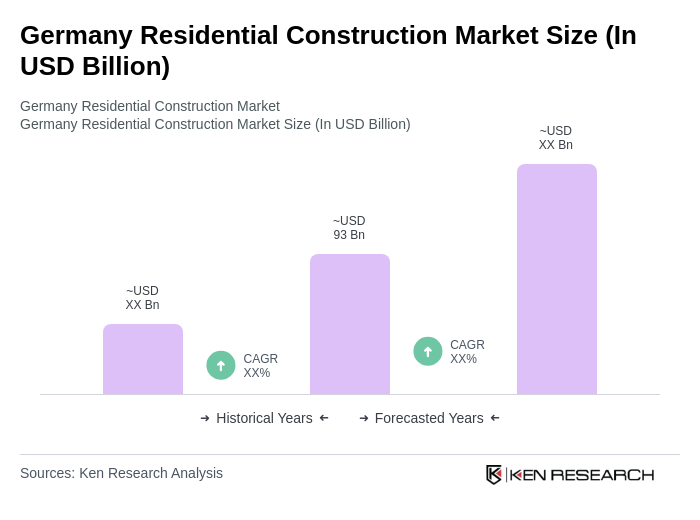
- The Germany Residential Construction Market is valued at approximately USD 93 billion, based on a five-year historical analysis. This market size reflects the residential segment alone and is supported by recent industry reports, which indicate robust activity despite sector-wide challenges . Growth is primarily driven by urbanization, a growing population, and increasing demand for housing, particularly in metropolitan areas. The market has seen significant investments in infrastructure and residential projects, reflecting the country's commitment to improving living standards and accommodating its citizens .
- Key cities dominating the market include Berlin, Munich, and Frankfurt. Berlin's vibrant cultural scene and economic opportunities attract a diverse population, while Munich is known for its high quality of life and strong job market. Frankfurt serves as a financial hub, drawing professionals and families seeking housing, thus driving demand in the residential construction sector .
- In 2023, the German government implemented the Building Energy Act (GEG), which mandates that new residential buildings meet stringent energy efficiency standards. This regulation aims to reduce greenhouse gas emissions and promote sustainable construction practices, encouraging developers to adopt energy-efficient technologies and materials in their projects .
Germany Residential Construction Market Segmentation
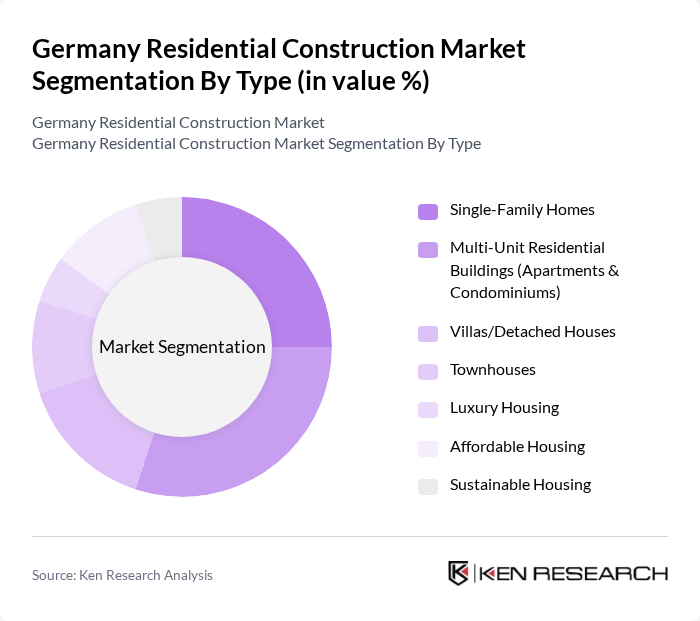
By Type:The residential construction market can be segmented into various types, including Single-Family Homes, Multi-Unit Residential Buildings (Apartments & Condominiums), Villas/Detached Houses, Townhouses, Luxury Housing, Affordable Housing, and Sustainable Housing. Each segment addresses distinct consumer preferences and market demands, reflecting the diverse needs of Germany’s population. Notably, the market is experiencing increased demand for energy-efficient and sustainable housing, driven by regulatory changes and consumer awareness .
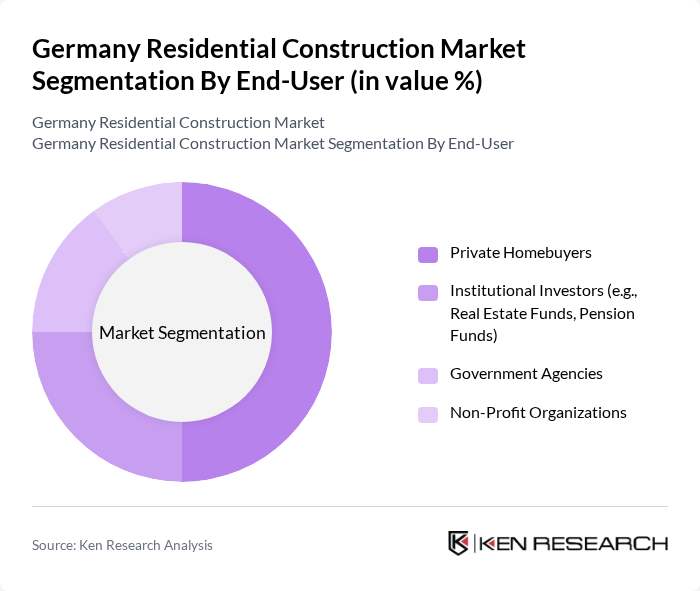
By End-User:The end-user segmentation includes Private Homebuyers, Institutional Investors (e.g., Real Estate Funds, Pension Funds), Government Agencies, and Non-Profit Organizations. Each of these end-users plays a crucial role in shaping the demand for residential construction, influenced by factors such as investment strategies, housing policies, and social objectives. Private homebuyers continue to dominate the market, while institutional investors and government agencies are increasingly active due to incentives for affordable and sustainable housing .
Germany Residential Construction Market Competitive Landscape
The Germany Residential Construction Market is characterized by a dynamic mix of regional and international players. Leading participants such as HOCHTIEF AG, STRABAG SE, Ed. Züblin AG, PORR AG, Bilfinger SE, WOLFF & MÜLLER Holding GmbH & Co. KG, KÖSTER GmbH, BSB Bau- und Spezialbau GmbH, GOLDBECK GmbH, KLEUSBERG GmbH & Co. KG, Vonovia SE, LEG Immobilien SE, Instone Real Estate Group SE, Bauwens GmbH & Co. KG, Bonava Deutschland GmbH contribute to innovation, geographic expansion, and service delivery in this space.
Germany Residential Construction Market Industry Analysis
Growth Drivers
- Urbanization and Population Growth:Germany's urban population is projected to reach approximately78%in future, with cities like Berlin and Munich experiencing significant influxes. The total population is expected to remain relatively stable, with only modest growth due to net migration, rather than an increase of1.5 millionpeople. This urbanization trend necessitates the construction of new homes, particularly in metropolitan areas, where housing shortages are most acute. The growing population directly correlates with the need for more residential units, stimulating market growth.
- Government Housing Initiatives:The German government has committed overEUR 18 billionin future to support affordable housing projects. Initiatives include subsidies for low-income families and incentives for developers to build affordable units. These programs aim to construct approximately400,000 new homes annually, addressing the housing crisis exacerbated by urbanization. Such government backing not only boosts construction activity but also enhances market stability, encouraging private investment in residential projects.
- Low-Interest Rates:The European Central Bank's current interest rate stands at4.25 percent, fostering an environment conducive to borrowing. This low-interest rate scenario is expected to persist into future, making mortgages more affordable for homebuyers. Consequently, residential construction is likely to see increased financing, as both developers and consumers take advantage of favorable lending conditions. This financial accessibility is crucial for stimulating new housing projects across Germany, particularly in urban centers.
Market Challenges
- Rising Material Costs:The construction industry in Germany faces significant challenges due to rising material costs, which have increased by approximately30 percent since 2020for key materials such as timber and steel. Factors such as supply chain disruptions and increased demand for raw materials have contributed to this inflation. In future, the cost of essential materials is expected to remain high, impacting profit margins for construction firms and potentially delaying project timelines as budgets are reassessed.
- Labor Shortages:The German construction sector is grappling with a labor shortage, with an estimated deficit of150,000 to 200,000 skilled workersin future. This shortage is driven by an aging workforce and insufficient training programs for new entrants. As construction projects ramp up to meet housing demands, the lack of available labor could lead to project delays and increased labor costs, ultimately hindering the overall growth of the residential construction market.
Germany Residential Construction Market Future Outlook
The future of the Germany residential construction market appears promising, driven by ongoing urbanization and supportive government policies. As cities expand, the demand for innovative housing solutions will likely increase, particularly in smart home technologies and energy-efficient designs. Additionally, the emphasis on sustainability will shape construction practices, with a growing number of projects seeking green certifications. These trends indicate a dynamic market landscape, where adaptability and innovation will be key to meeting evolving consumer needs and regulatory requirements.
Market Opportunities
- Smart Home Technologies:The integration of smart home technologies is gaining traction, with an estimated market value ofEUR 4.3 billionin future. This trend presents opportunities for developers to incorporate advanced automation and energy management systems into new residential projects, appealing to tech-savvy consumers and enhancing property value.
- Renovation and Retrofitting:With approximately75 percentof Germany's housing stock built before 1990, there is a substantial opportunity for renovation and retrofitting projects. The government’s focus on energy efficiency and sustainability is expected to drive investments in upgrading existing homes, creating a robust market for construction firms specializing in these services.
Scope of the Report
| Segment | Sub-Segments |
|---|---|
| By Type | Single-Family Homes Multi-Unit Residential Buildings (Apartments & Condominiums) Villas/Detached Houses Townhouses Luxury Housing Affordable Housing Sustainable Housing |
| By End-User | Private Homebuyers Institutional Investors (e.g., Real Estate Funds, Pension Funds) Government Agencies Non-Profit Organizations |
| By Financing Type | Mortgages Cash Purchases Government Grants/Subsidies Private Investments |
| By Construction Method | Traditional Construction Prefabricated/Modular Construction Sustainable/Energy-Efficient Construction Renovation and Retrofitting |
| By Region | Northern Germany Southern Germany Eastern Germany Western Germany |
| By Project Size | Small Projects Medium Projects Large Projects |
| By Policy Support | Subsidies Tax Exemptions Incentives for Green Building Others |
Key Target Audience
Investors and Venture Capitalist Firms
Government and Regulatory Bodies (e.g., Federal Ministry of the Interior and Community, German Construction Industry Association)
Real Estate Developers
Construction Contractors and Builders
Architectural and Engineering Firms
Material Suppliers and Manufacturers
Local Municipalities and Urban Planning Authorities
Financial Institutions and Banks
Players Mentioned in the Report:
HOCHTIEF AG
STRABAG SE
Ed. Zublin AG
PORR AG
Bilfinger SE
WOLFF & MULLER Holding GmbH & Co. KG
KOSTER GmbH
BSB Bau- und Spezialbau GmbH
GOLDBECK GmbH
KLEUSBERG GmbH & Co. KG
Vonovia SE
LEG Immobilien SE
Instone Real Estate Group SE
Bauwens GmbH & Co. KG
Bonava Deutschland GmbH
Table of Contents
Market Assessment Phase
1. Executive Summary and Approach
2. Germany Residential Construction Market Overview
2.1 Key Insights and Strategic Recommendations
2.2 Germany Residential Construction Market Overview
2.3 Definition and Scope
2.4 Evolution of Market Ecosystem
2.5 Timeline of Key Regulatory Milestones
2.6 Value Chain & Stakeholder Mapping
2.7 Business Cycle Analysis
2.8 Policy & Incentive Landscape
3. Germany Residential Construction Market Analysis
3.1 Growth Drivers
3.1.1 Urbanization and Population Growth
3.1.2 Government Housing Initiatives
3.1.3 Low-Interest Rates
3.1.4 Sustainable Building Practices
3.2 Market Challenges
3.2.1 Rising Material Costs
3.2.2 Labor Shortages
3.2.3 Regulatory Compliance Complexity
3.2.4 Environmental Concerns
3.3 Market Opportunities
3.3.1 Smart Home Technologies
3.3.2 Renovation and Retrofitting
3.3.3 Green Building Certifications
3.3.4 Public-Private Partnerships
3.4 Market Trends
3.4.1 Modular Construction
3.4.2 Digitalization in Construction
3.4.3 Increased Focus on Energy Efficiency
3.4.4 Use of Sustainable Materials
3.5 Government Regulation
3.5.1 Building Energy Act (GEG)
3.5.2 Federal Funding Programs for Housing
3.5.3 Local Zoning Laws
3.5.4 Construction Safety Regulations
4. SWOT Analysis
5. Stakeholder Analysis
6. Porter's Five Forces Analysis
7. Germany Residential Construction Market Market Size, 2019-2024
7.1 By Value
7.2 By Volume
7.3 By Average Selling Price
8. Germany Residential Construction Market Segmentation
8.1 By Type
8.1.1 Single-Family Homes
8.1.2 Multi-Unit Residential Buildings (Apartments & Condominiums)
8.1.3 Villas/Detached Houses
8.1.4 Townhouses
8.1.5 Luxury Housing
8.1.6 Affordable Housing
8.1.7 Sustainable Housing
8.2 By End-User
8.2.1 Private Homebuyers
8.2.2 Institutional Investors (e.g., Real Estate Funds, Pension Funds)
8.2.3 Government Agencies
8.2.4 Non-Profit Organizations
8.3 By Financing Type
8.3.1 Mortgages
8.3.2 Cash Purchases
8.3.3 Government Grants/Subsidies
8.3.4 Private Investments
8.4 By Construction Method
8.4.1 Traditional Construction
8.4.2 Prefabricated/Modular Construction
8.4.3 Sustainable/Energy-Efficient Construction
8.4.4 Renovation and Retrofitting
8.5 By Region
8.5.1 Northern Germany
8.5.2 Southern Germany
8.5.3 Eastern Germany
8.5.4 Western Germany
8.6 By Project Size
8.6.1 Small Projects
8.6.2 Medium Projects
8.6.3 Large Projects
8.7 By Policy Support
8.7.1 Subsidies
8.7.2 Tax Exemptions
8.7.3 Incentives for Green Building
8.7.4 Others
9. Germany Residential Construction Market Competitive Analysis
9.1 Market Share of Key Players(Micro, Small, Medium, Large Enterprises)
9.2 KPIs for Cross Comparison of Key Players
9.2.1 Company Name
9.2.2 Group Size (Large, Medium, or Small as per industry convention)
9.2.3 Annual Revenue (EUR)
9.2.4 Revenue Growth Rate (%)
9.2.5 Market Share (%)
9.2.6 Number of Residential Units Delivered (Annual)
9.2.7 Average Project Completion Time (Months)
9.2.8 Order Backlog (EUR)
9.2.9 Return on Investment (ROI) (%)
9.2.10 Customer Satisfaction Score (e.g., NPS)
9.2.11 Employee Productivity (Revenue per Employee)
9.2.12 ESG/Green Building Certifications (Number or % of Projects)
9.3 SWOT Analysis of Top Players
9.4 Pricing Analysis(By Class and Payload)
9.5 Detailed Profile of Major Companies
9.5.1 HOCHTIEF AG
9.5.2 STRABAG SE
9.5.3 Ed. Züblin AG
9.5.4 PORR AG
9.5.5 Bilfinger SE
9.5.6 WOLFF & MÜLLER Holding GmbH & Co. KG
9.5.7 KÖSTER GmbH
9.5.8 BSB Bau- und Spezialbau GmbH
9.5.9 GOLDBECK GmbH
9.5.10 KLEUSBERG GmbH & Co. KG
9.5.11 Vonovia SE
9.5.12 LEG Immobilien SE
9.5.13 Instone Real Estate Group SE
9.5.14 Bauwens GmbH & Co. KG
9.5.15 Bonava Deutschland GmbH
10. Germany Residential Construction Market End-User Analysis
10.1 Procurement Behavior of Key Ministries
10.1.1 Ministry of Housing
10.1.2 Ministry of Finance
10.1.3 Ministry of Environment
10.2 Corporate Spend on Infrastructure & Energy
10.2.1 Corporate Investment Trends
10.2.2 Budget Allocations
10.2.3 Infrastructure Development Plans
10.3 Pain Point Analysis by End-User Category
10.3.1 Homebuyers
10.3.2 Real Estate Developers
10.3.3 Government Agencies
10.4 User Readiness for Adoption
10.4.1 Awareness of Sustainable Practices
10.4.2 Financial Readiness
10.4.3 Technological Adoption
10.5 Post-Deployment ROI and Use Case Expansion
10.5.1 Performance Metrics
10.5.2 Long-term Benefits
10.5.3 Case Studies
11. Germany Residential Construction Market Future Size, 2025-2030
11.1 By Value
11.2 By Volume
11.3 By Average Selling Price
Go-To-Market Strategy Phase
1. Whitespace Analysis + Business Model Canvas
1.1 Market Gaps Identification
1.2 Business Model Framework
2. Marketing and Positioning Recommendations
2.1 Branding Strategies
2.2 Product USPs
3. Distribution Plan
3.1 Urban Retail Strategies
3.2 Rural NGO Tie-ups
4. Channel & Pricing Gaps
4.1 Underserved Routes
4.2 Pricing Bands
5. Unmet Demand & Latent Needs
5.1 Category Gaps
5.2 Consumer Segments
6. Customer Relationship
6.1 Loyalty Programs
6.2 After-sales Service
7. Value Proposition
7.1 Sustainability Initiatives
7.2 Integrated Supply Chains
8. Key Activities
8.1 Regulatory Compliance
8.2 Branding Efforts
8.3 Distribution Setup
9. Entry Strategy Evaluation
9.1 Domestic Market Entry Strategy
9.1.1 Product Mix
9.1.2 Pricing Band
9.1.3 Packaging Strategies
9.2 Export Entry Strategy
9.2.1 Target Countries
9.2.2 Compliance Roadmap
10. Entry Mode Assessment
10.1 Joint Ventures
10.2 Greenfield Investments
10.3 Mergers & Acquisitions
10.4 Distributor Model
11. Capital and Timeline Estimation
11.1 Capital Requirements
11.2 Timelines
12. Control vs Risk Trade-Off
12.1 Ownership vs Partnerships
13. Profitability Outlook
13.1 Breakeven Analysis
13.2 Long-term Sustainability
14. Potential Partner List
14.1 Distributors
14.2 Joint Ventures
14.3 Acquisition Targets
15. Execution Roadmap
15.1 Phased Plan for Market Entry
15.1.1 Market Setup
15.1.2 Market Entry
15.1.3 Growth Acceleration
15.1.4 Scale & Stabilize
15.2 Key Activities and Milestones
15.2.1 Milestone Planning
15.2.2 Activity Tracking
Research Methodology
Phase 1: Approach1
Desk Research
- Analysis of government publications and reports on residential construction trends in Germany
- Review of industry reports from construction associations and real estate agencies
- Examination of demographic and economic data from Eurostat and national statistics offices
Primary Research
- Interviews with architects and construction project managers to gather insights on current market practices
- Surveys with real estate developers to understand project pipelines and investment trends
- Field interviews with local contractors to assess challenges and opportunities in residential construction
Validation & Triangulation
- Cross-validation of findings through multiple data sources, including trade publications and market surveys
- Triangulation of qualitative insights from interviews with quantitative data from market reports
- Sanity checks through expert panel reviews comprising industry veterans and academic professionals
Phase 2: Market Size Estimation1
Top-down Assessment
- Estimation of total residential construction value based on national GDP contributions from the construction sector
- Segmentation of the market by types of residential buildings (single-family homes, multi-family units, etc.)
- Incorporation of government housing initiatives and subsidies affecting market dynamics
Bottom-up Modeling
- Collection of project-level data from major construction firms to establish average project costs
- Analysis of material and labor costs to derive a comprehensive cost structure for residential projects
- Volume estimates based on historical construction activity and future project forecasts
Forecasting & Scenario Analysis
- Multi-factor regression analysis incorporating economic indicators, interest rates, and housing demand
- Scenario modeling based on potential regulatory changes and shifts in consumer preferences
- Development of baseline, optimistic, and pessimistic forecasts through 2030
Phase 3: CATI Sample Composition1
| Scope Item/Segment | Sample Size | Target Respondent Profiles |
|---|---|---|
| Single-Family Home Construction | 100 | Architects, General Contractors |
| Multi-Family Residential Projects | 90 | Real Estate Developers, Project Managers |
| Renovation and Remodeling Services | 80 | Home Improvement Contractors, Interior Designers |
| Green Building Initiatives | 60 | Sustainability Consultants, Building Inspectors |
| Government Housing Programs | 50 | Policy Makers, Housing Authority Officials |
Frequently Asked Questions
What is the current value of the Germany Residential Construction Market?
The Germany Residential Construction Market is valued at approximately USD 93 billion, reflecting robust activity in the residential segment despite sector-wide challenges. This valuation is based on a five-year historical analysis and indicates significant investments in housing and infrastructure.
What factors are driving growth in the Germany Residential Construction Market?
Which cities are the main contributors to the Germany Residential Construction Market?
What is the Building Energy Act (GEG) in Germany?
Other Regional/Country Reports
Indonesia Residential Construction Market
Malaysia Residential Construction Market
KSA Residential Construction Market
APAC Residential Construction Market
Why Buy From Us?

What makes us stand out is that our consultants follow Robust, Refine and Result (RRR) methodology. Robust for clear definitions, approaches and sanity checking, Refine for differentiating respondents' facts and opinions, and Result for presenting data with story.

We have set a benchmark in the industry by offering our clients with syndicated and customized market research reports featuring coverage of entire market as well as meticulous research and analyst insights.

While we don't replace traditional research, we flip the method upside down. Our dual approach of Top Bottom & Bottom Top ensures quality deliverable by not just verifying company fundamentals but also looking at the sector and macroeconomic factors.

With one step in the future, our research team constantly tries to show you the bigger picture. We help with some of the tough questions you may encounter along the way: How is the industry positioned? Best marketing channel? KPI's of competitors? By aligning every element, we help maximize success.

Our report gives you instant access to the answers and sources that other companies might choose to hide. We elaborate each steps of research methodology we have used and showcase you the sample size to earn your trust.

If you need any support, we are here! We pride ourselves on universe strength, data quality, and quick, friendly, and professional service.