APAC allogeneic cell therapy market report size, share, growth drivers, trends, opportunities & forecast 2025–2030

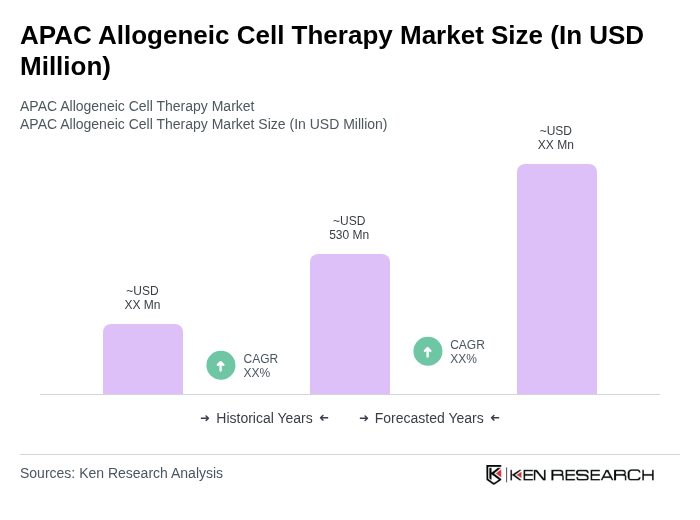
APAC allogeneic cell therapy market, valued at USD 530 million, is growing due to rising chronic diseases, tech innovations, and investments, led by T-cell therapies and hospitals.

Region:Asia

Author(s):Shubham

Product Code:KRAC8930

Pages:94

Published On:November 2025
About the Report

Base Year 2024

APAC Allogeneic Cell Therapy Market Overview

  • The APAC Allogeneic Cell Therapy Market is valued at USD 530 million, based on a five-year historical analysis. This growth is primarily driven by advancements in biotechnology, increased prevalence of chronic diseases such as cancer and autoimmune disorders, and rising investments in research and development. The market is further supported by a surge in clinical trials, expansion of specialized treatment centers, and a growing awareness of the therapeutic potential of cell therapies in treating a broad spectrum of medical conditions, leading to increased adoption in clinical settings.
  • Key players in this market include China, Japan, and South Korea, which dominate due to robust healthcare infrastructure, significant investment in biotechnology, and a high number of clinical trials. These countries have established themselves as leaders in the development and commercialization of innovative therapies, supported by government initiatives, streamlined regulatory pathways, and a strong academic research base. China leads with nearly 35% revenue share in the APAC cell and gene therapy market, while Japan and South Korea are recognized for their advanced clinical research and supportive policy frameworks.
  • In 2023, the Japanese government implemented the “Act on the Safety of Regenerative Medicine” (Ministry of Health, Labour and Welfare, 2023), introducing a regulatory framework that expedites the approval process for allogeneic cell therapies. This framework includes fast-track approvals and conditional marketing authorizations, enhancing patient access to innovative treatments while ensuring rigorous safety and efficacy standards. The act mandates compliance with specific quality management protocols and post-market surveillance for approved therapies.
APAC Allogeneic Cell Therapy Market Size

APAC Allogeneic Cell Therapy Market Segmentation

By Type:The market is segmented into various types of therapies, including T-cell therapies, stem cell therapies, CAR-T cell therapies, NK cell therapies, mesenchymal stem cell (MSC) therapies, hematopoietic stem cell (HSC) therapies, and others. Among these, T-cell therapies are currently leading the market due to their effectiveness in treating hematologic malignancies and solid tumors. The increasing number of clinical trials and regulatory approvals for T-cell therapies has significantly contributed to their dominance, as they are widely recognized for their potential to provide long-lasting remissions in patients. CAR-T cell therapies and NK cell therapies are also experiencing rapid adoption, driven by breakthroughs in oncology and immunotherapy.
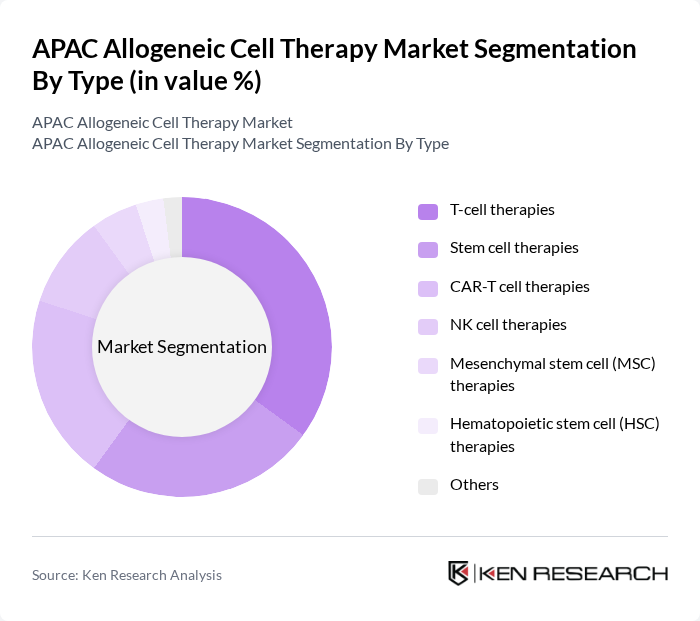
APAC Allogeneic Cell Therapy Market segmentation by Type.

By End-User:The end-user segmentation includes hospitals, research institutions, biopharmaceutical companies, contract development and manufacturing organizations (CDMOs), and others. Hospitals are the leading end-users, primarily due to the increasing number of patients requiring advanced therapies and the growing adoption of cell therapies in clinical practice. The demand for innovative treatment options in hospitals is driving investments in infrastructure and training, further solidifying their position as the dominant end-user in the market. Biopharmaceutical companies and CDMOs are also expanding their roles, reflecting the region’s focus on R&D and scalable manufacturing.
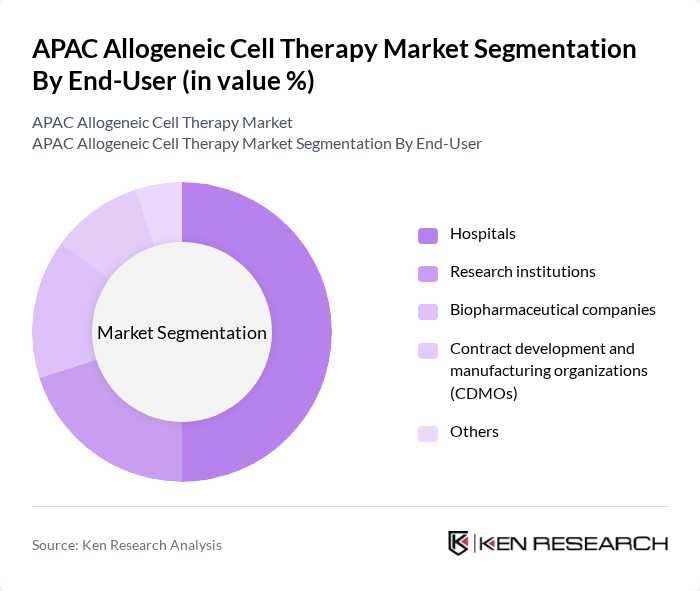
APAC Allogeneic Cell Therapy Market segmentation by End-User.

APAC Allogeneic Cell Therapy Market Competitive Landscape

The APAC Allogeneic Cell Therapy Market is characterized by a dynamic mix of regional and international players. Leading participants such as Takeda Pharmaceutical Company Limited, Fosun Kite Biotechnology Co., Ltd., JW Therapeutics Co. Ltd., Shanghai Cellular Biopharmaceutical Group Co., Ltd. (CBMG), Kolon Life Science, Inc., JCR Pharmaceuticals Co., Ltd., Medipost Co., Ltd., GC Cell Corporation, Chugai Pharmaceutical Co., Ltd., Sumitomo Pharma Co., Ltd., Novartis AG, Gilead Sciences, Inc., Bristol-Myers Squibb Company, Allogene Therapeutics, Inc., BlueRock Therapeutics LP contribute to innovation, geographic expansion, and service delivery in this space.

Takeda Pharmaceutical Company Limited

1781

Tokyo, Japan

Fosun Kite Biotechnology Co., Ltd.

2016

Shanghai, China

JW Therapeutics Co. Ltd.

2016

Shanghai, China

Shanghai Cellular Biopharmaceutical Group Co., Ltd. (CBMG)

2010

Shanghai, China

Kolon Life Science, Inc.

2000

Seongnam, South Korea

Company

Establishment Year

Headquarters

Group Size (Large, Medium, or Small as per industry convention)

Revenue Growth Rate (APAC cell therapy segment)

Number of Allogeneic Cell Therapy Products Approved/Commercialized in APAC

Number of Ongoing Clinical Trials (APAC region)

Market Penetration Rate (APAC)

R&D Investment as % of Revenue

APAC Allogeneic Cell Therapy Market Industry Analysis

Growth Drivers

  • Increasing Prevalence of Chronic Diseases:The APAC region is witnessing a significant rise in chronic diseases, with the World Health Organization reporting that non-communicable diseases account for 60% of all deaths in Asia. In future, it is estimated that over 200 million people in the region will be living with diabetes alone. This growing patient population drives the demand for innovative therapies, including allogeneic cell therapies, which offer potential solutions for managing these conditions effectively.
  • Advancements in Cell Therapy Technologies:Technological innovations in cell therapy are accelerating the development of allogeneic therapies. In future, the global investment in cell therapy research is projected to exceed $10 billion, with APAC countries like China and Japan leading in research initiatives. These advancements enhance the efficacy and safety of therapies, making them more appealing to healthcare providers and patients, thus propelling market growth in the region.
  • Rising Investment in R&D:The APAC region is experiencing a surge in research and development investments, with funding reaching approximately $5 billion in future. Governments and private sectors are increasingly recognizing the potential of allogeneic cell therapies, leading to collaborations and partnerships aimed at accelerating product development. This influx of capital is crucial for overcoming technical challenges and expediting the introduction of innovative therapies to the market.

Market Challenges

  • High Cost of Therapy Development:The development of allogeneic cell therapies is associated with substantial costs, often exceeding $1 billion per therapy. This financial burden can deter smaller biotech firms from entering the market, limiting innovation and competition. Additionally, the high costs can lead to increased prices for patients, potentially restricting access to these advanced therapies, particularly in lower-income APAC countries.
  • Regulatory Hurdles:Navigating the regulatory landscape for allogeneic cell therapies in APAC can be complex and time-consuming. In future, it is estimated that the average time for regulatory approval in the region is around 3-5 years, significantly longer than in other regions. This delay can hinder timely market entry for new therapies, impacting the overall growth of the allogeneic cell therapy market in APAC.

APAC Allogeneic Cell Therapy Market Future Outlook

The future of the APAC allogeneic cell therapy market appears promising, driven by ongoing technological advancements and increasing healthcare investments. As the region continues to prioritize healthcare innovation, the integration of artificial intelligence in therapy development is expected to enhance efficiency and outcomes. Furthermore, the growing emphasis on patient-centric approaches will likely lead to more tailored therapies, improving patient engagement and satisfaction in treatment processes.

Market Opportunities

  • Expansion into Emerging Markets:Emerging markets in APAC, such as India and Vietnam, present significant opportunities for allogeneic cell therapy companies. With a combined population of over 1.5 billion, these markets are experiencing rising healthcare expenditures, projected to reach $200 billion in future, creating a favorable environment for innovative therapies.
  • Collaborations with Biotech Firms:Strategic partnerships between established pharmaceutical companies and biotech firms are becoming increasingly common. In future, over 30% of allogeneic cell therapy projects are expected to involve collaborations, facilitating knowledge sharing and resource pooling, which can accelerate the development and commercialization of new therapies in the APAC region.

Scope of the Report

SegmentSub-Segments
By Type

T-cell therapies

Stem cell therapies

CAR-T cell therapies

NK cell therapies

Mesenchymal stem cell (MSC) therapies

Hematopoietic stem cell (HSC) therapies

Others

By End-User

Hospitals

Research institutions

Biopharmaceutical companies

Contract development and manufacturing organizations (CDMOs)

Others

By Application

Oncology (hematologic and solid tumors)

Autoimmune diseases

Cardiovascular diseases

Neurological disorders

Orthopedic disorders

Others

By Delivery Method

Intravenous

Intratumoral

Subcutaneous

Intra-arterial

Others

By Source of Cells

Donor-derived cells (peripheral blood, bone marrow, umbilical cord, adipose tissue)

Induced pluripotent stem cells (iPSCs)

Others

By Region

East Asia (China, Japan, South Korea)

Southeast Asia (Singapore, Malaysia, Thailand, Indonesia, Vietnam, Philippines)

South Asia (India, Pakistan, Bangladesh)

Oceania (Australia, New Zealand)

Others

By Regulatory Pathway

Fast track approval

Standard approval

Conditional approval

Others

Key Target Audience

Investors and Venture Capitalist Firms

Government and Regulatory Bodies (e.g., Therapeutic Goods Administration, Ministry of Health, National Medical Products Administration)

Biopharmaceutical Companies

Cell Therapy Manufacturers

Healthcare Providers and Hospitals

Clinical Research Organizations

Pharmaceutical Supply Chain Stakeholders

Health Insurance Companies

Players Mentioned in the Report:

Takeda Pharmaceutical Company Limited

Fosun Kite Biotechnology Co., Ltd.

JW Therapeutics Co. Ltd.

Shanghai Cellular Biopharmaceutical Group Co., Ltd. (CBMG)

Kolon Life Science, Inc.

JCR Pharmaceuticals Co., Ltd.

Medipost Co., Ltd.

GC Cell Corporation

Chugai Pharmaceutical Co., Ltd.

Sumitomo Pharma Co., Ltd.

Novartis AG

Gilead Sciences, Inc.

Bristol-Myers Squibb Company

Allogene Therapeutics, Inc.

BlueRock Therapeutics LP

Table of Contents

Market Assessment Phase

1. Executive Summary and Approach


2. APAC Allogeneic Cell Therapy Market Overview

2.1 Key Insights and Strategic Recommendations

2.2 APAC Allogeneic Cell Therapy Market Overview

2.3 Definition and Scope

2.4 Evolution of Market Ecosystem

2.5 Timeline of Key Regulatory Milestones

2.6 Value Chain & Stakeholder Mapping

2.7 Business Cycle Analysis

2.8 Policy & Incentive Landscape


3. APAC Allogeneic Cell Therapy Market Analysis

3.1 Growth Drivers

3.1.1 Increasing prevalence of chronic diseases
3.1.2 Advancements in cell therapy technologies
3.1.3 Rising investment in R&D
3.1.4 Growing demand for personalized medicine

3.2 Market Challenges

3.2.1 High cost of therapy development
3.2.2 Regulatory hurdles
3.2.3 Limited awareness among healthcare providers
3.2.4 Ethical concerns regarding cell sourcing

3.3 Market Opportunities

3.3.1 Expansion into emerging markets
3.3.2 Collaborations with biotech firms
3.3.3 Development of off-the-shelf therapies
3.3.4 Increasing focus on regenerative medicine

3.4 Market Trends

3.4.1 Shift towards allogeneic therapies
3.4.2 Integration of AI in therapy development
3.4.3 Growth of telemedicine in patient management
3.4.4 Rising patient-centric approaches

3.5 Government Regulation

3.5.1 Streamlined approval processes
3.5.2 Enhanced funding for cell therapy research
3.5.3 Guidelines for ethical sourcing of cells
3.5.4 Support for clinical trials and studies

4. SWOT Analysis


5. Stakeholder Analysis


6. Porter's Five Forces Analysis


7. APAC Allogeneic Cell Therapy Market Market Size, 2019-2024

7.1 By Value

7.2 By Volume

7.3 By Average Selling Price


8. APAC Allogeneic Cell Therapy Market Segmentation

8.1 By Type

8.1.1 T-cell therapies
8.1.2 Stem cell therapies
8.1.3 CAR-T cell therapies
8.1.4 NK cell therapies
8.1.5 Mesenchymal stem cell (MSC) therapies
8.1.6 Hematopoietic stem cell (HSC) therapies
8.1.7 Others

8.2 By End-User

8.2.1 Hospitals
8.2.2 Research institutions
8.2.3 Biopharmaceutical companies
8.2.4 Contract development and manufacturing organizations (CDMOs)
8.2.5 Others

8.3 By Application

8.3.1 Oncology (hematologic and solid tumors)
8.3.2 Autoimmune diseases
8.3.3 Cardiovascular diseases
8.3.4 Neurological disorders
8.3.5 Orthopedic disorders
8.3.6 Others

8.4 By Delivery Method

8.4.1 Intravenous
8.4.2 Intratumoral
8.4.3 Subcutaneous
8.4.4 Intra-arterial
8.4.5 Others

8.5 By Source of Cells

8.5.1 Donor-derived cells (peripheral blood, bone marrow, umbilical cord, adipose tissue)
8.5.2 Induced pluripotent stem cells (iPSCs)
8.5.3 Others

8.6 By Region

8.6.1 East Asia (China, Japan, South Korea)
8.6.2 Southeast Asia (Singapore, Malaysia, Thailand, Indonesia, Vietnam, Philippines)
8.6.3 South Asia (India, Pakistan, Bangladesh)
8.6.4 Oceania (Australia, New Zealand)
8.6.5 Others

8.7 By Regulatory Pathway

8.7.1 Fast track approval
8.7.2 Standard approval
8.7.3 Conditional approval
8.7.4 Others

9. APAC Allogeneic Cell Therapy Market Competitive Analysis

9.1 Market Share of Key Players

9.2 Cross Comparison of Key Players

9.2.1 Company Name
9.2.2 Group Size (Large, Medium, or Small as per industry convention)
9.2.3 Revenue Growth Rate (APAC cell therapy segment)
9.2.4 Number of Allogeneic Cell Therapy Products Approved/Commercialized in APAC
9.2.5 Number of Ongoing Clinical Trials (APAC region)
9.2.6 Market Penetration Rate (APAC)
9.2.7 R&D Investment as % of Revenue
9.2.8 Time-to-Market for New Therapies
9.2.9 Manufacturing Capacity (doses/year or equivalent)
9.2.10 Strategic Partnerships/Collaborations in APAC
9.2.11 Distribution Network Coverage (APAC countries)
9.2.12 Regulatory Approval Success Rate (APAC)
9.2.13 Brand Recognition Score (APAC healthcare sector)

9.3 SWOT Analysis of Top Players

9.4 Pricing Analysis

9.5 Detailed Profile of Major Companies

9.5.1 Takeda Pharmaceutical Company Limited
9.5.2 Fosun Kite Biotechnology Co., Ltd.
9.5.3 JW Therapeutics Co. Ltd.
9.5.4 Shanghai Cellular Biopharmaceutical Group Co., Ltd. (CBMG)
9.5.5 Kolon Life Science, Inc.
9.5.6 JCR Pharmaceuticals Co., Ltd.
9.5.7 Medipost Co., Ltd.
9.5.8 GC Cell Corporation
9.5.9 Chugai Pharmaceutical Co., Ltd.
9.5.10 Sumitomo Pharma Co., Ltd.
9.5.11 Novartis AG
9.5.12 Gilead Sciences, Inc.
9.5.13 Bristol-Myers Squibb Company
9.5.14 Allogene Therapeutics, Inc.
9.5.15 BlueRock Therapeutics LP

10. APAC Allogeneic Cell Therapy Market End-User Analysis

10.1 Procurement Behavior of Key Ministries

10.1.1 Budget allocation for cell therapies
10.1.2 Decision-making processes
10.1.3 Evaluation criteria for suppliers
10.1.4 Others

10.2 Corporate Spend on Infrastructure & Energy

10.2.1 Investment in cell therapy facilities
10.2.2 Funding for clinical trials
10.2.3 Partnerships with research institutions
10.2.4 Others

10.3 Pain Point Analysis by End-User Category

10.3.1 Access to innovative therapies
10.3.2 Cost of treatment
10.3.3 Availability of trained professionals
10.3.4 Others

10.4 User Readiness for Adoption

10.4.1 Awareness of allogeneic therapies
10.4.2 Training and education needs
10.4.3 Infrastructure readiness
10.4.4 Others

10.5 Post-Deployment ROI and Use Case Expansion

10.5.1 Measurement of treatment outcomes
10.5.2 Cost-effectiveness analysis
10.5.3 Expansion into new therapeutic areas
10.5.4 Others

11. APAC Allogeneic Cell Therapy Market Future Size, 2025-2030

11.1 By Value

11.2 By Volume

11.3 By Average Selling Price


Go-To-Market Strategy Phase

1. Whitespace Analysis + Business Model Canvas

1.1 Market gaps identification

1.2 Business model development


2. Marketing and Positioning Recommendations

2.1 Branding strategies

2.2 Product USPs


3. Distribution Plan

3.1 Urban retail vs rural NGO tie-ups


4. Channel & Pricing Gaps

4.1 Underserved routes

4.2 Pricing bands


5. Unmet Demand & Latent Needs

5.1 Category gaps

5.2 Consumer segments


6. Customer Relationship

6.1 Loyalty programs

6.2 After-sales service


7. Value Proposition

7.1 Sustainability

7.2 Integrated supply chains


8. Key Activities

8.1 Regulatory compliance

8.2 Branding

8.3 Distribution setup


9. Entry Strategy Evaluation

9.1 Domestic Market Entry Strategy

9.1.1 Product mix
9.1.2 Pricing band
9.1.3 Packaging

9.2 Export Entry Strategy

9.2.1 Target countries
9.2.2 Compliance roadmap

10. Entry Mode Assessment

10.1 JV

10.2 Greenfield

10.3 M&A

10.4 Distributor Model


11. Capital and Timeline Estimation

11.1 Capital requirements

11.2 Timelines


12. Control vs Risk Trade-Off

12.1 Ownership vs Partnerships


13. Profitability Outlook

13.1 Breakeven analysis

13.2 Long-term sustainability


14. Potential Partner List

14.1 Distributors

14.2 JVs

14.3 Acquisition targets


15. Execution Roadmap

15.1 Phased Plan for Market Entry

15.1.1 Market Setup
15.1.2 Market Entry
15.1.3 Growth Acceleration
15.1.4 Scale & Stabilize

15.2 Key Activities and Milestones

15.2.1 Milestone tracking
15.2.2 Activity scheduling

Research Methodology

ApproachModellingSample

Phase 1: Approach1

Desk Research

  • Analysis of industry reports from regulatory bodies such as the APAC Biotech Association
  • Review of scientific publications and clinical trial data related to allogeneic cell therapies
  • Examination of market trends and forecasts from healthcare market research firms

Primary Research

  • Interviews with key opinion leaders in the field of regenerative medicine and cell therapy
  • Surveys targeting clinical researchers and healthcare professionals involved in cell therapy
  • Focus groups with patients and caregivers to understand treatment perceptions and experiences

Validation & Triangulation

  • Cross-validation of findings through multiple data sources including market reports and expert insights
  • Triangulation of quantitative data from clinical trials with qualitative insights from interviews
  • Sanity checks through expert panel reviews to ensure data accuracy and relevance

Phase 2: Market Size Estimation1

Top-down Assessment

  • Estimation of market size based on total healthcare expenditure in APAC countries
  • Segmentation of the market by therapy type, including hematopoietic stem cells and T-cell therapies
  • Incorporation of growth rates from recent FDA approvals and clinical trial outcomes

Bottom-up Modeling

  • Collection of data on the number of treatment centers offering allogeneic cell therapies
  • Estimation of average treatment costs and patient volumes per center
  • Calculation of market size based on treatment frequency and patient demographics

Forecasting & Scenario Analysis

  • Multi-factor analysis considering technological advancements and regulatory changes
  • Scenario modeling based on varying levels of market adoption and reimbursement policies
  • Development of baseline, optimistic, and pessimistic forecasts through 2030

Phase 3: CATI Sample Composition1

Scope Item/SegmentSample SizeTarget Respondent Profiles
Hematopoietic Stem Cell Therapy60Hematologists, Oncologists
T-cell Therapy Applications55Immunologists, Clinical Researchers
Regulatory Perspectives on Cell Therapies40Regulatory Affairs Specialists, Compliance Officers
Patient Experience and Outcomes50Patients, Caregivers, Patient Advocacy Groups
Market Access and Reimbursement Strategies45Health Economists, Payers, Policy Makers

Frequently Asked Questions

What is the current value of the APAC Allogeneic Cell Therapy Market?

The APAC Allogeneic Cell Therapy Market is valued at approximately USD 530 million, driven by advancements in biotechnology, increased prevalence of chronic diseases, and rising investments in research and development.

Which countries dominate the APAC Allogeneic Cell Therapy Market?

What regulatory changes have impacted the allogeneic cell therapy market in Japan?

What types of therapies are included in the APAC Allogeneic Cell Therapy Market?

Other Regional/Country Reports

Indonesia Allogeneic Cell Therapy Market

Malaysia Allogeneic Cell Therapy Market

KSA Allogeneic Cell Therapy Market

SEA Allogeneic Cell Therapy Market

Vietnam Allogeneic Cell Therapy Market

Thailand Allogeneic Cell Therapy Market

Why Buy From Us?

Refine Robust Result (RRR) Framework

What makes us stand out is that our consultants follow Robust, Refine and Result (RRR) methodology. Robust for clear definitions, approaches and sanity checking, Refine for differentiating respondents' facts and opinions, and Result for presenting data with story.

Our Reach Is Unmatched

We have set a benchmark in the industry by offering our clients with syndicated and customized market research reports featuring coverage of entire market as well as meticulous research and analyst insights.

Shifting the Research Paradigm

While we don't replace traditional research, we flip the method upside down. Our dual approach of Top Bottom & Bottom Top ensures quality deliverable by not just verifying company fundamentals but also looking at the sector and macroeconomic factors.

More Insights-Better Decisions

With one step in the future, our research team constantly tries to show you the bigger picture. We help with some of the tough questions you may encounter along the way: How is the industry positioned? Best marketing channel? KPI's of competitors? By aligning every element, we help maximize success.

Transparency and Trust

Our report gives you instant access to the answers and sources that other companies might choose to hide. We elaborate each steps of research methodology we have used and showcase you the sample size to earn your trust.

Round the Clock Support

If you need any support, we are here! We pride ourselves on universe strength, data quality, and quick, friendly, and professional service.

Why Clients Choose Us?

400000+
Reports in repository
150+
Consulting projects a year
100+
Analysts
8000+
Client Queries in 2022








