About the Report
Base Year 2024Listen to the audio summary
APAC Automotive Collision Repair Market Overview
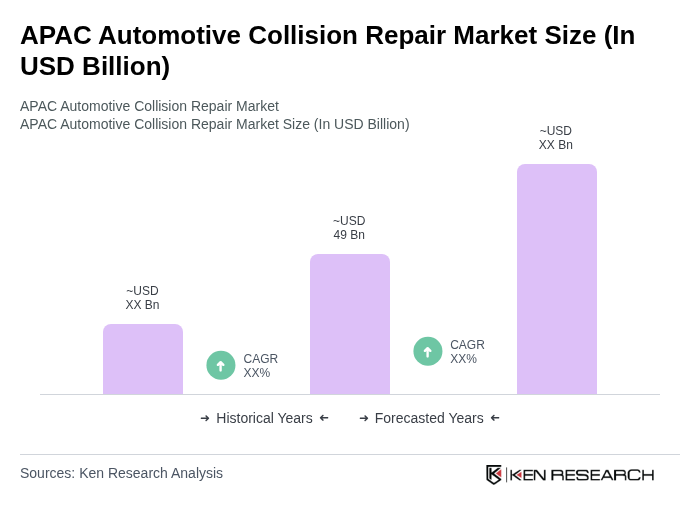
- The APAC Automotive Collision Repair Market is valued at USD 49 billion, based on a five-year historical analysis. Growth is being driven by increasing road accidents and rising vehicle ownership across densely populated markets, supported by expanding insurance coverage and streamlined claims processes that encourage the use of formal repair services. Technological advancements such as ADAS calibration, sophisticated paint matching, and digital diagnostics further bolster market growth in the region.
- Key players in this market include large economies like China and India, where extensive vehicle fleets and urban congestion drive collision repair demand. South Korea and Japan lead in technology-intensive services. Companies such as 3M, Robert Bosch GmbH, Continental AG, Denso Corporation, PPG Industries, and Axalta contribute through advanced coatings, calibration equipment, and diagnostic tools, enhancing service quality and efficiency.
- In 2024, Australia’s government announced a strategic initiative to enhance vocational training for collision repair technicians. This initiative includes funding for programs aimed at developing certified professionals to address skills shortages and elevate service standards in the automotive collision repair sector.
APAC Automotive Collision Repair Market Segmentation
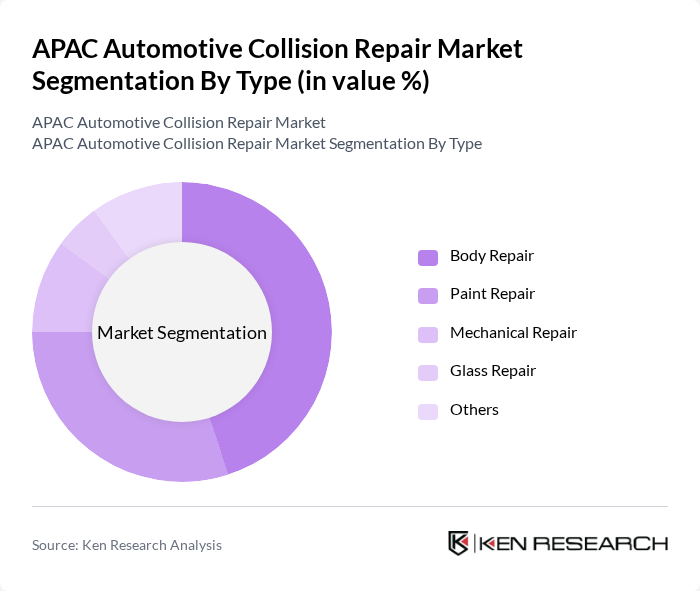
By Type:The market is segmented into various types, including Body Repair, Paint Repair, Mechanical Repair, Glass Repair, and Others. Among these, Body Repair is the leading segment due to the high frequency of collision incidents that necessitate extensive bodywork. The increasing number of vehicles on the road, coupled with urban congestion, has led to a rise in accidents, thereby driving demand for body repair services. Paint Repair follows closely, as aesthetic damage is common in collisions, prompting vehicle owners to seek professional services to maintain their vehicle's appearance.
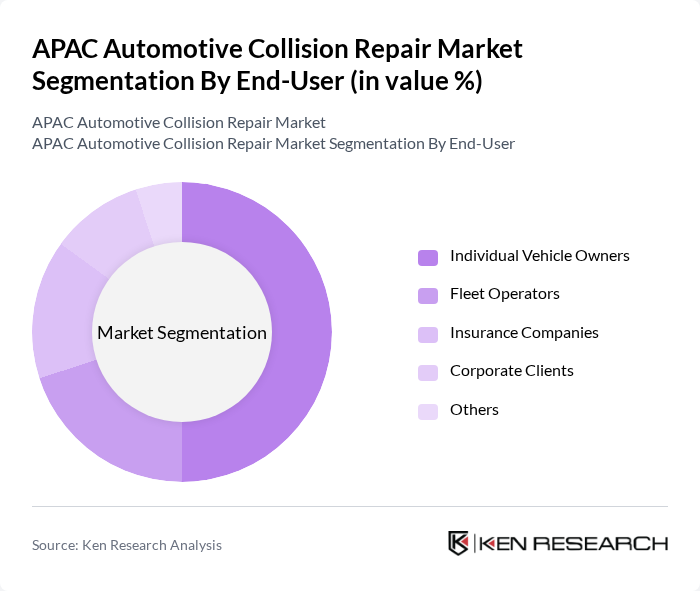
By End-User:The end-user segmentation includes Individual Vehicle Owners, Fleet Operators, Insurance Companies, Corporate Clients, and Others. Individual Vehicle Owners dominate the market, driven by the increasing number of personal vehicles and the growing awareness of the importance of maintaining vehicle safety and aesthetics. Fleet Operators also represent a significant segment, as they require regular maintenance and repair services to ensure their vehicles remain operational and safe for use. Insurance Companies play a crucial role by facilitating claims and repairs, further driving the demand for collision repair services.
APAC Automotive Collision Repair Market Competitive Landscape
The APAC Automotive Collision Repair Market is characterized by a dynamic mix of regional and international players. Leading participants such as 3M, Robert Bosch GmbH, Continental AG, Denso Corporation, PPG Industries, and Axalta contribute to innovation, geographic expansion, and service delivery in this space.
APAC Automotive Collision Repair Market Industry Analysis
Growth Drivers
- Vehicle Ownership and Spare Parts Demand:The APAC automotive aftermarket revenue reached USD 129,024.2 million in the future, driven by a significant vehicle parc in the region. This large number of vehicles increases the demand for collision repair services and spare parts, particularly for tires, consumables, and body parts. As vehicle ownership continues to rise, particularly in emerging markets, the need for effective collision repair solutions will also grow, supporting the overall market expansion.
- Automotive Collision Repair Market Value (APAC):The APAC automotive collision repair market is projected to reach USD 66.48 billion in the future, with 2024 as the base year. This growth is fueled by rising vehicle ownership, especially in populous countries like China and India, where increasing disposable incomes are leading to higher demand for collision repair services. The expanding middle class in these regions is expected to further drive this market's growth, creating a robust environment for service providers.
- Accident Incidents in India:In the future, India is expected to record 461,312 road traffic incidents, resulting in 443,366 injuries. This high incidence of traffic accidents significantly increases the demand for collision repair services across the region. As road traffic continues to rise, particularly in urban areas, the need for efficient and effective repair solutions will become increasingly critical, thereby bolstering the automotive collision repair market in APAC.
Market Challenges
- Aging Vehicle Fleet Requires More Complex Repairs:The global automotive repair and service market is valued at USD 1.1 trillion in the future, with APAC being a dominant player. As the vehicle fleet ages, the complexity of repairs increases, placing pressure on traditional repairers to adapt to new technologies and methods. This challenge can lead to increased operational costs and the need for continuous training, which may hinder smaller service providers from competing effectively.
- High Price Sensitivity and Competition:The APAC aftermarket is characterized by high price sensitivity and a proliferation of low-cost alternatives in the future. Intense competition from local manufacturers and service providers can erode profit margins, compelling businesses to lower prices to attract customers. This competitive landscape can also impact the quality of repairs, as providers may cut corners to maintain profitability, ultimately affecting consumer trust and satisfaction.
APAC Automotive Collision Repair Market Future Outlook
The APAC automotive collision repair market is poised for significant transformation driven by technological advancements and evolving consumer preferences. The integration of advanced repair technologies, such as AI and automation, is expected to enhance operational efficiency and service quality. Additionally, sustainability trends are gaining traction, with a growing emphasis on eco-friendly repair practices. As the market adapts to these changes, service providers will need to innovate continuously to meet the demands of a more environmentally conscious consumer base while ensuring high-quality repairs.
Market Opportunities
- High Growth in Tire and Turbocharger Segments:The APAC automotive aftermarket revenue of USD 129,024.2 million in the future highlights significant growth potential in specific segments. Targeting high-demand parts, such as turbochargers, which are among the fastest-growing sub-segments, presents strategic opportunities for collision repair firms to expand their service offerings and capture a larger market share.
- EV-Related Collision Repair Services:With over 2 million electric vehicles sold in APAC in the future, the rising EV fleet creates a growing need for specialized repair services. This includes expertise in handling batteries, high-voltage systems, and charging components, offering a lucrative opportunity for repair shops to diversify their services and cater to the evolving automotive landscape.
Scope of the Report
| Segment | Sub-Segments |
|---|---|
| By Type | Body Repair Paint Repair Mechanical Repair Glass Repair Others |
| By End-User | Individual Vehicle Owners Fleet Operators Insurance Companies Corporate Clients Others |
| By Region | North India South India East India West India |
| By Service Type | Collision Repair Dent Repair Frame Straightening Paintless Dent Repair Others |
| By Repair Technology | Traditional Repair Techniques Advanced Repair Technologies Eco-Friendly Repair Solutions Others |
| By Customer Segment | Private Vehicle Owners Commercial Vehicle Owners Government Fleets Others |
| By Payment Model | Pay-Per-Service Subscription-Based Services Insurance-Backed Payments Others |
Key Target Audience
Investors and Venture Capitalist Firms
Government and Regulatory Bodies (e.g., Ministry of Transport, National Highway Traffic Safety Administration)
Automotive Manufacturers
Collision Repair Shops and Service Centers
Insurance Companies
Parts Suppliers and Distributors
Automotive Aftermarket Associations
Logistics and Supply Chain Companies
Players Mentioned in the Report:
Agero, Inc.
Caliber Collision Centers
Service King Collision Repair Centers
Fix Auto USA
Gerber Collision & Glass
ABRA Auto Body & Glass
Maaco
CARSTAR
PPG Industries, Inc.
BASF SE
3M Company
AkzoNobel N.V.
DuPont de Nemours, Inc.
Sherwin-Williams Company
I-CAR (Inter-Industry Conference on Auto Collision Repair)
Table of Contents
Market Assessment Phase
1. Executive Summary and Approach
2. APAC Automotive Collision Repair Market Overview
2.1 Key Insights and Strategic Recommendations
2.2 APAC Automotive Collision Repair Market Overview
2.3 Definition and Scope
2.4 Evolution of Market Ecosystem
2.5 Timeline of Key Regulatory Milestones
2.6 Value Chain & Stakeholder Mapping
2.7 Business Cycle Analysis
2.8 Policy & Incentive Landscape
3. APAC Automotive Collision Repair Market Analysis
3.1 Growth Drivers
3.1.1 Increasing Vehicle Ownership
3.1.2 Rising Road Traffic Accidents
3.1.3 Advancements in Repair Technologies
3.1.4 Growing Demand for Eco-Friendly Repair Solutions
3.2 Market Challenges
3.2.1 High Cost of Advanced Repair Equipment
3.2.2 Shortage of Skilled Labor
3.2.3 Regulatory Compliance Issues
3.2.4 Intense Competition Among Service Providers
3.3 Market Opportunities
3.3.1 Expansion of Electric Vehicle Market
3.3.2 Growth in Online Repair Service Platforms
3.3.3 Increasing Insurance Coverage for Repairs
3.3.4 Partnerships with Automotive Manufacturers
3.4 Market Trends
3.4.1 Shift Towards Digital Solutions in Repair Services
3.4.2 Adoption of Sustainable Repair Practices
3.4.3 Integration of AI and Automation in Repair Processes
3.4.4 Rise of Mobile Repair Services
3.5 Government Regulation
3.5.1 Emission Standards for Repair Facilities
3.5.2 Safety Regulations for Repair Practices
3.5.3 Licensing Requirements for Repair Technicians
3.5.4 Consumer Protection Laws in Repair Services
4. SWOT Analysis
5. Stakeholder Analysis
6. Porter's Five Forces Analysis
7. APAC Automotive Collision Repair Market Market Size, 2019-2024
7.1 By Value
7.2 By Volume
7.3 By Average Selling Price
8. APAC Automotive Collision Repair Market Segmentation
8.1 By Type
8.1.1 Body Repair
8.1.2 Paint Repair
8.1.3 Mechanical Repair
8.1.4 Glass Repair
8.1.5 Others
8.2 By End-User
8.2.1 Individual Vehicle Owners
8.2.2 Fleet Operators
8.2.3 Insurance Companies
8.2.4 Corporate Clients
8.2.5 Others
8.3 By Region
8.3.1 North India
8.3.2 South India
8.3.3 East India
8.3.4 West India
8.4 By Service Type
8.4.1 Collision Repair
8.4.2 Dent Repair
8.4.3 Frame Straightening
8.4.4 Paintless Dent Repair
8.4.5 Others
8.5 By Repair Technology
8.5.1 Traditional Repair Techniques
8.5.2 Advanced Repair Technologies
8.5.3 Eco-Friendly Repair Solutions
8.5.4 Others
8.6 By Customer Segment
8.6.1 Private Vehicle Owners
8.6.2 Commercial Vehicle Owners
8.6.3 Government Fleets
8.6.4 Others
8.7 By Payment Model
8.7.1 Pay-Per-Service
8.7.2 Subscription-Based Services
8.7.3 Insurance-Backed Payments
8.7.4 Others
9. APAC Automotive Collision Repair Market Competitive Analysis
9.1 Market Share of Key Players
9.2 Cross Comparison of Key Players
9.2.1 Company Name
9.2.2 Group Size (Large, Medium, or Small as per industry convention)
9.2.3 Revenue Growth Rate
9.2.4 Customer Retention Rate
9.2.5 Average Repair Turnaround Time
9.2.6 Market Penetration Rate
9.2.7 Pricing Strategy
9.2.8 Service Quality Rating
9.2.9 Employee Training and Certification Rate
9.2.10 Customer Satisfaction Score
9.3 SWOT Analysis of Top Players
9.4 Pricing Analysis
9.5 Detailed Profile of Major Companies
9.5.1 Agero, Inc.
9.5.2 Caliber Collision Centers
9.5.3 Service King Collision Repair Centers
9.5.4 Fix Auto USA
9.5.5 Gerber Collision & Glass
9.5.6 ABRA Auto Body & Glass
9.5.7 Maaco
9.5.8 CARSTAR
9.5.9 PPG Industries, Inc.
9.5.10 BASF SE
9.5.11 3M Company
9.5.12 AkzoNobel N.V.
9.5.13 DuPont de Nemours, Inc.
9.5.14 Sherwin-Williams Company
9.5.15 I-CAR (Inter-Industry Conference on Auto Collision Repair)
10. APAC Automotive Collision Repair Market End-User Analysis
10.1 Procurement Behavior of Key Ministries
10.1.1 Government Fleet Maintenance Policies
10.1.2 Budget Allocation for Vehicle Repairs
10.1.3 Preferred Repair Service Providers
10.1.4 Compliance with Safety Standards
10.2 Corporate Spend on Infrastructure & Energy
10.2.1 Investment in Repair Facilities
10.2.2 Expenditure on Training and Development
10.2.3 Budget for Eco-Friendly Solutions
10.2.4 Others
10.3 Pain Point Analysis by End-User Category
10.3.1 Delays in Repair Services
10.3.2 High Repair Costs
10.3.3 Quality of Repair Work
10.3.4 Availability of Spare Parts
10.4 User Readiness for Adoption
10.4.1 Awareness of Advanced Repair Technologies
10.4.2 Willingness to Pay for Quality Services
10.4.3 Adoption of Digital Platforms for Services
10.4.4 Others
10.5 Post-Deployment ROI and Use Case Expansion
10.5.1 Cost Savings from Efficient Repairs
10.5.2 Increased Vehicle Lifespan
10.5.3 Enhanced Customer Satisfaction
10.5.4 Opportunities for Service Expansion
11. APAC Automotive Collision Repair Market Future Size, 2025-2030
11.1 By Value
11.2 By Volume
11.3 By Average Selling Price
Go-To-Market Strategy Phase
1. Whitespace Analysis + Business Model Canvas
1.1 Market Gaps Identification
1.2 Business Model Development
2. Marketing and Positioning Recommendations
2.1 Branding Strategies
2.2 Product USPs
3. Distribution Plan
3.1 Urban Retail Strategies
3.2 Rural NGO Tie-Ups
4. Channel & Pricing Gaps
4.1 Underserved Routes
4.2 Pricing Bands Analysis
5. Unmet Demand & Latent Needs
5.1 Category Gaps
5.2 Consumer Segments
6. Customer Relationship
6.1 Loyalty Programs
6.2 After-Sales Service
7. Value Proposition
7.1 Sustainability Initiatives
7.2 Integrated Supply Chains
8. Key Activities
8.1 Regulatory Compliance
8.2 Branding Efforts
8.3 Distribution Setup
9. Entry Strategy Evaluation
9.1 Domestic Market Entry Strategy
9.1.1 Product Mix Considerations
9.1.2 Pricing Band Strategy
9.1.3 Packaging Options
9.2 Export Entry Strategy
9.2.1 Target Countries Identification
9.2.2 Compliance Roadmap Development
10. Entry Mode Assessment
10.1 Joint Ventures
10.2 Greenfield Investments
10.3 Mergers & Acquisitions
10.4 Distributor Model Evaluation
11. Capital and Timeline Estimation
11.1 Capital Requirements
11.2 Timelines for Implementation
12. Control vs Risk Trade-Off
12.1 Ownership Considerations
12.2 Partnerships Evaluation
13. Profitability Outlook
13.1 Breakeven Analysis
13.2 Long-Term Sustainability Strategies
14. Potential Partner List
14.1 Distributors
14.2 Joint Ventures
14.3 Acquisition Targets
15. Execution Roadmap
15.1 Phased Plan for Market Entry
15.1.1 Market Setup
15.1.2 Market Entry
15.1.3 Growth Acceleration
15.1.4 Scale & Stabilize
15.2 Key Activities and Milestones
15.2.1 Activity Planning
15.2.2 Milestone Tracking
Research Methodology
Phase 1: Approach1
Desk Research
- Industry reports from automotive associations and regulatory bodies in APAC
- Market analysis publications focusing on collision repair trends and technologies
- Statistical data from government transport departments and insurance agencies
Primary Research
- Interviews with collision repair shop owners and managers across key APAC markets
- Surveys targeting automotive insurance providers and claims adjusters
- Field visits to automotive repair facilities to observe operational practices
Validation & Triangulation
- Cross-validation of findings through multiple data sources including trade publications
- Triangulation of market insights from industry experts and academic research
- Sanity checks conducted through expert panel discussions and feedback sessions
Phase 2: Market Size Estimation1
Top-down Assessment
- Analysis of total automotive market size and segmentation by vehicle type
- Estimation of collision repair market share based on historical growth rates
- Incorporation of regional economic indicators and automotive sales forecasts
Bottom-up Modeling
- Data collection on average repair costs and service frequency from repair shops
- Estimation of market size based on the number of vehicles in operation and average repair rates
- Volume x cost analysis for different types of collision repairs (minor vs. major)
Forecasting & Scenario Analysis
- Multi-variable regression analysis incorporating economic growth and vehicle ownership trends
- Scenario modeling based on potential shifts in consumer behavior and regulatory changes
- Development of baseline, optimistic, and pessimistic forecasts through 2030
Phase 3: CATI Sample Composition1
| Scope Item/Segment | Sample Size | Target Respondent Profiles |
|---|---|---|
| Collision Repair Shops | 150 | Shop Owners, Service Managers |
| Insurance Companies | 100 | Claims Adjusters, Underwriters |
| Automotive Parts Suppliers | 80 | Procurement Managers, Sales Directors |
| Vehicle Manufacturers | 70 | Product Development Managers, Aftermarket Service Heads |
| Regulatory Bodies | 50 | Policy Makers, Compliance Officers |
Frequently Asked Questions
What is the current value of the APAC Automotive Collision Repair Market?
The APAC Automotive Collision Repair Market is valued at approximately USD 49 billion, driven by increasing road accidents, rising vehicle ownership, and advancements in repair technologies. This market is expected to grow significantly in the coming years.
What factors are driving growth in the APAC Automotive Collision Repair Market?
Which countries are the key players in the APAC Automotive Collision Repair Market?
What are the main segments of the APAC Automotive Collision Repair Market?
Other Regional/Country Reports
Indonesia Automotive Collision Repair Market
Malaysia Automotive Collision Repair Market
Other Adjacent Reports
Mexico Vehicle Diagnostics Market
Indonesia Automotive Parts MarketSouth Korea Automotive Paints and Coatings Market
Germany Automotive Insurance Market
Canada Fleet Management Market Size, Share & Forecast, By Solution Type, Deployment Model & End-Use Industry, 2025-2032India Electric Vehicle Market Size, Share & Forecast, By Vehicle Type, Powertrain & Sales Channel, 2025-2030Egypt Automotive Service and Repair Market
Philippines automotive glass market Size, Share, Growth Drivers, Trends, Opportunities & Forecast 2025–2030Oman Automotive Safety Systems Market
Why Buy From Us?

What makes us stand out is that our consultants follow Robust, Refine and Result (RRR) methodology. Robust for clear definitions, approaches and sanity checking, Refine for differentiating respondents' facts and opinions, and Result for presenting data with story.

We have set a benchmark in the industry by offering our clients with syndicated and customized market research reports featuring coverage of entire market as well as meticulous research and analyst insights.

While we don't replace traditional research, we flip the method upside down. Our dual approach of Top Bottom & Bottom Top ensures quality deliverable by not just verifying company fundamentals but also looking at the sector and macroeconomic factors.

With one step in the future, our research team constantly tries to show you the bigger picture. We help with some of the tough questions you may encounter along the way: How is the industry positioned? Best marketing channel? KPI's of competitors? By aligning every element, we help maximize success.

Our report gives you instant access to the answers and sources that other companies might choose to hide. We elaborate each steps of research methodology we have used and showcase you the sample size to earn your trust.

If you need any support, we are here! We pride ourselves on universe strength, data quality, and quick, friendly, and professional service.