Apac Burn Ointment Market Size, Share, Growth Drivers, Trends, Opportunities & Forecast 2025–2030

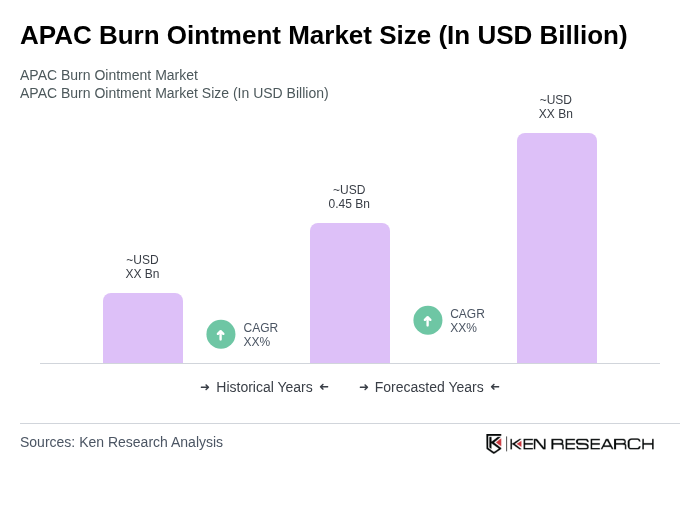
The APAC burn ointment market, valued at USD 0.45 billion, is growing due to increasing burn incidents, early care awareness, and innovative formulations like silver-based and hydrogel ointments.

Region:Asia

Author(s):Shubham

Product Code:KRAD6585

Pages:82

Published On:December 2025
About the Report

Base Year 2024

APAC Burn Ointment Market Overview

  • The APAC Burn Ointment Market is valued at USD 0.45 billion, based on a five-year historical analysis. This growth is primarily driven by increasing incidences of burn injuries in low- and middle-income countries across Asia Pacific, rising awareness about early burn care, and the growing demand for effective topical treatments in both hospital and home-care settings. The market is also influenced by advancements in formulation technologies such as hydrogel-based systems, silver and other antimicrobial combinations, and bioactive/regenerative ingredients, as well as the introduction of innovative products that cater to diverse consumer and clinical needs.
  • Key players in this market include China, India, and Japan, which together account for a major share of regional demand due to their large populations, increasing healthcare expenditure, and a growing focus on improving hospital and emergency care infrastructure. These countries report substantial numbers of burn injuries each year, particularly from domestic, industrial, and traffic-related accidents in China and India, as well as scalds and contact burns, leading to a higher demand for burn ointments and related topical burn care products.
  • In India, key burn ointment molecules such as silver sulfadiazine are classified and supplied as part of the country’s essential medicines framework under the National List of Essential Medicines (NLEM) issued by the Ministry of Health and Family Welfare and periodically updated, most recently through the National List of Essential Medicines 2022, which guides procurement and availability across public health facilities, including rural areas. This policy framework aims to improve access to effective burn care products by ensuring their prioritized inclusion in state procurement and public-sector supply chains, thereby supporting availability for burn victims in both urban and rural settings.
APAC Burn Ointment Market Size

APAC Burn Ointment Market Segmentation

By Product Type:The product type segmentation includes various ointments designed for burn treatment, broadly aligned with global burn ointment categories. The leading sub-segment is Topical Antibiotic Ointments, which continue to generate the largest revenue share globally because of clinical familiarity, low unit cost, and their effectiveness in preventing infections in superficial and partial-thickness burn wounds. Silver-based Ointments are also gaining traction, especially in hospital settings, due to their broad-spectrum antimicrobial and anti-biofilm properties and their growing reimbursement support in several Asia Pacific markets. Aloe vera and Plant-based Soothing Gels are popular among consumers seeking natural and over-the-counter remedies for minor burns and sunburn, while Honey and Hydrogel-based Burn Ointments are recognized in clinical literature for maintaining a moist wound environment, supporting debridement, and promoting healing. The market is characterized by a growing trend towards herbal and organic products and bioactive formulations, reflecting consumer preferences for safer, more natural options and the broader shift in wound care towards products that combine infection control with tissue regeneration.

APAC Burn Ointment Market segmentation by Product Type.

By Depth of Burn:The depth of burn segmentation categorizes ointments based on the severity of burns they are designed to treat, aligning with clinical burn-severity classifications used in wound care and burn centers. Minor (Superficial) Burns dominate the market in volume terms due to their high prevalence in everyday domestic and occupational accidents and their frequent management with over-the-counter products. Partial-Thickness Burns are also significant, as they require more specialized antimicrobial and moisture-balancing topical preparations and contribute meaningfully to prescription and hospital sales. Full-Thickness Burns, while less common, necessitate advanced treatment options, including adjuvant topical therapy alongside surgical management for wound-bed preparation, infection prevention, and graft support. The increasing awareness of proper burn care protocols, expanding burn units in Asia Pacific, and the availability of specialized products for each burn type are driving growth and product differentiation in this segment.

APAC Burn Ointment Market segmentation by Depth of Burn.

APAC Burn Ointment Market Competitive Landscape

The APAC Burn Ointment Market is characterized by a dynamic mix of regional and international players, mirroring the global competitive environment in burn and advanced wound care. Leading participants such as Johnson & Johnson (Biafine, Neosporin, OTC burn care portfolio), Smith & Nephew plc, 3M Company, Mölnlycke Health Care AB, PAUL HARTMANN AG, ConvaTec Group plc, Sun Pharmaceutical Industries Ltd. (Burnheal and other topical burn products), Dr. Reddy’s Laboratories Ltd., Cipla Limited, Glenmark Pharmaceuticals Ltd., Viatris Inc. (including legacy Mylan topical portfolio), Bharat Serums and Vaccines Limited (burn and wound management portfolio), MEDIWOUND Ltd., Coloplast A/S, Local and Regional APAC Brands (e.g., Burnaid – Mundipharma; regional OTC burn gels and ointments) contribute to innovation, geographic expansion, and service delivery in this space through a combination of prescription and OTC offerings, hospital-focused product lines, and retail pharmacy and e-commerce-based burn care ranges.

Johnson & Johnson

1886

New Brunswick, New Jersey, USA

Smith & Nephew plc

1856

London, United Kingdom

3M Company

1902

Maplewood, Minnesota, USA

Mölnlycke Health Care AB

1849

Gothenburg, Sweden

Sun Pharmaceutical Industries Ltd.

1983

Mumbai, India

Company

Establishment Year

Headquarters

Group Size (Global, Regional, or Local Player)

APAC Burn Ointment Revenue and 5-year CAGR

Product Portfolio Breadth (OTC vs Prescription, depth-of-burn coverage)

R&D Intensity (R&D spend as % of revenue in wound/burn care)

Geographic Footprint within APAC (number of countries / markets served)

Distribution Reach (hospital coverage, retail pharmacy networks, e-commerce presence)

APAC Burn Ointment Market Industry Analysis

Growth Drivers

  • Increasing Incidence of Burn Injuries:The World Health Organization reported that approximately 180,000 deaths occur annually due to burns, with a significant number of these cases in the Asia-Pacific region. In future, the incidence of burn injuries is projected to rise by 5% annually, driven by industrial accidents and household incidents. This increase necessitates effective burn treatment solutions, thereby propelling the demand for burn ointments across the region, particularly in densely populated urban areas.
  • Rising Awareness About Burn Treatment:Public health campaigns in APAC countries have significantly increased awareness regarding burn treatment options. For instance, the Indian government allocated $1.5 billion in future for healthcare education initiatives, emphasizing burn prevention and treatment. This heightened awareness is expected to lead to a 20% increase in the utilization of burn ointments, as more individuals seek timely and effective treatment for burn injuries, thus driving market growth.
  • Advancements in Burn Ointment Formulations:The burn ointment market is witnessing rapid innovation, with new formulations incorporating advanced healing agents. In future, the introduction of bioengineered skin substitutes and antimicrobial agents is expected to enhance treatment efficacy. Research indicates that these advanced formulations can reduce healing time by up to 30%, leading to increased adoption among healthcare providers and patients, thereby boosting market demand significantly.

Market Challenges

  • High Cost of Advanced Treatments:The cost of advanced burn treatments, including specialized ointments and therapies, can be prohibitive. In future, the average cost of advanced burn ointments is projected to reach $150 per unit, which may limit accessibility for lower-income populations. This financial barrier can hinder the overall market growth, as many individuals may opt for less effective, over-the-counter alternatives due to affordability issues.
  • Limited Access in Rural Areas:Access to quality burn treatment remains a significant challenge in rural regions of APAC. According to the Asian Development Bank, approximately 60% of rural populations lack access to essential healthcare services. In future, this disparity is expected to persist, limiting the reach of burn ointment products and hindering market penetration in these underserved areas, ultimately affecting overall sales and growth potential.

APAC Burn Ointment Market Future Outlook

The APAC burn ointment market is poised for transformative growth, driven by technological advancements and increasing healthcare investments. As telemedicine services expand, patients will gain easier access to consultations and prescriptions for burn treatments. Additionally, the shift towards preventive healthcare will encourage consumers to prioritize burn safety and treatment options. These trends indicate a robust future for the market, with innovative products and improved accessibility likely to enhance overall consumer engagement and satisfaction.

Market Opportunities

  • Expansion of E-commerce Platforms:The rise of e-commerce in APAC presents a significant opportunity for burn ointment manufacturers. In future, online sales are expected to account for 30% of total sales, driven by increased internet penetration and consumer preference for online shopping. This shift allows companies to reach a broader audience, particularly in remote areas where traditional retail access is limited.
  • Development of Natural and Organic Products:There is a growing consumer preference for natural and organic burn ointments, driven by health-conscious trends. In future, the market for organic burn treatments is projected to grow by 25%, as consumers seek safer alternatives. This trend presents an opportunity for manufacturers to innovate and develop products that cater to this demand, enhancing their market position and attracting environmentally conscious consumers.

Scope of the Report

SegmentSub-Segments
By Product Type

Topical Antibiotic Ointments (e.g., bacitracin, neomycin, polymyxin B)

Silver-based Ointments (e.g., silver sulfadiazine)

Iodine-based Ointments

Aloe vera and Plant-based Soothing Gels

Honey and Hydrogel-based Burn Ointments

Other Combination and Specialty Ointments

By Depth of Burn

Minor (Superficial) Burns

Partial-Thickness Burns

Full-Thickness Burns (adjuvant topical therapy)

By Application

First Aid and Household Use

Hospital-based Acute Burn Care

Post-surgical and Scar Management

Occupational and Industrial Burn Care

By End-User

Hospitals

Burn Care Centers and Specialty Clinics

General Clinics

Home Care Users

Pharmacies & Drugstores

By Distribution Channel

Hospital Pharmacies

Retail Pharmacies & Drugstores

Online Pharmacies and E-commerce Platforms

Direct Tenders and Institutional Sales

By Nature / Ingredient Origin

Synthetic / Conventional Ointments

Herbal and Ayurvedic Ointments

Natural and Organic-certified Ointments

Others

By Country

China

India

Japan

South Korea

Australia & New Zealand

Southeast Asia (Indonesia, Malaysia, Thailand, Vietnam, Philippines, Singapore, etc.)

Rest of Asia Pacific

Key Target Audience

Investors and Venture Capitalist Firms

Government and Regulatory Bodies (e.g., Ministry of Health, Food and Drug Administration)

Manufacturers and Producers

Distributors and Retailers

Pharmaceutical Companies

Healthcare Providers and Hospitals

Industry Associations (e.g., Asia Pacific Pharmaceutical Association)

Insurance Companies

Players Mentioned in the Report:

Johnson & Johnson (Biafine, Neosporin, OTC burn care portfolio)

Smith & Nephew plc

3M Company

Molnlycke Health Care AB

PAUL HARTMANN AG

ConvaTec Group plc

Sun Pharmaceutical Industries Ltd. (Burnheal and other topical burn products)

Dr. Reddys Laboratories Ltd.

Cipla Limited

Glenmark Pharmaceuticals Ltd.

Viatris Inc. (including legacy Mylan topical portfolio)

Bharat Serums and Vaccines Limited (burn and wound management portfolio)

MEDIWOUND Ltd.

Coloplast A/S

Local and Regional APAC Brands (e.g., Burnaid Mundipharma; regional OTC burn gels and ointments)

Table of Contents

Market Assessment Phase

1. Executive Summary and Approach


2. APAC Burn Ointment Market Overview

2.1 Key Insights and Strategic Recommendations

2.2 APAC Burn Ointment Market Overview

2.3 Definition and Scope

2.4 Evolution of Market Ecosystem

2.5 Timeline of Key Regulatory Milestones

2.6 Value Chain & Stakeholder Mapping

2.7 Business Cycle Analysis

2.8 Policy & Incentive Landscape


3. APAC Burn Ointment Market Analysis

3.1 Growth Drivers

3.1.1 Increasing incidence of burn injuries
3.1.2 Rising awareness about burn treatment
3.1.3 Advancements in burn ointment formulations
3.1.4 Growth in healthcare infrastructure

3.2 Market Challenges

3.2.1 High cost of advanced treatments
3.2.2 Limited access in rural areas
3.2.3 Regulatory hurdles
3.2.4 Competition from alternative therapies

3.3 Market Opportunities

3.3.1 Expansion of e-commerce platforms
3.3.2 Increasing investment in healthcare
3.3.3 Development of natural and organic products
3.3.4 Collaborations with healthcare providers

3.4 Market Trends

3.4.1 Growing demand for over-the-counter products
3.4.2 Shift towards preventive healthcare
3.4.3 Rise in telemedicine services
3.4.4 Focus on personalized medicine

3.5 Government Regulation

3.5.1 Stricter safety and efficacy standards
3.5.2 Guidelines for product labeling
3.5.3 Approval processes for new formulations
3.5.4 Incentives for local manufacturing

4. SWOT Analysis


5. Stakeholder Analysis


6. Porter's Five Forces Analysis


7. APAC Burn Ointment Market Size, 2019-2024

7.1 By Value

7.2 By Volume

7.3 By Average Selling Price


8. APAC Burn Ointment Market Segmentation

8.1 By Product Type

8.1.1 Topical Antibiotic Ointments (e.g., bacitracin, neomycin, polymyxin B)
8.1.2 Silver-based Ointments (e.g., silver sulfadiazine)
8.1.3 Iodine-based Ointments
8.1.4 Aloe vera and Plant-based Soothing Gels
8.1.5 Honey and Hydrogel-based Burn Ointments
8.1.6 Other Combination and Specialty Ointments

8.2 By Depth of Burn

8.2.1 Minor (Superficial) Burns
8.2.2 Partial-Thickness Burns
8.2.3 Full-Thickness Burns (adjuvant topical therapy)

8.3 By Application

8.3.1 First Aid and Household Use
8.3.2 Hospital-based Acute Burn Care
8.3.3 Post-surgical and Scar Management
8.3.4 Occupational and Industrial Burn Care

8.4 By End-User

8.4.1 Hospitals
8.4.2 Burn Care Centers and Specialty Clinics
8.4.3 General Clinics
8.4.4 Home Care Users
8.4.5 Pharmacies & Drugstores

8.5 By Distribution Channel

8.5.1 Hospital Pharmacies
8.5.2 Retail Pharmacies & Drugstores
8.5.3 Online Pharmacies and E-commerce Platforms
8.5.4 Direct Tenders and Institutional Sales

8.6 By Nature / Ingredient Origin

8.6.1 Synthetic / Conventional Ointments
8.6.2 Herbal and Ayurvedic Ointments
8.6.3 Natural and Organic-certified Ointments
8.6.4 Others

8.7 By Country

8.7.1 China
8.7.2 India
8.7.3 Japan
8.7.4 South Korea
8.7.5 Australia & New Zealand
8.7.6 Southeast Asia (Indonesia, Malaysia, Thailand, Vietnam, Philippines, Singapore, etc.)
8.7.7 Rest of Asia Pacific

9. APAC Burn Ointment Market Competitive Analysis

9.1 Market Share of Key Players

9.2 Cross Comparison of Key Players

9.2.1 Company Name
9.2.2 Group Size (Global, Regional, or Local Player)
9.2.3 APAC Burn Ointment Revenue and 5-year CAGR
9.2.4 Product Portfolio Breadth (OTC vs Prescription, depth-of-burn coverage)
9.2.5 R&D Intensity (R&D spend as % of revenue in wound/burn care)
9.2.6 Geographic Footprint within APAC (number of countries / markets served)
9.2.7 Distribution Reach (hospital coverage, retail pharmacy networks, e-commerce presence)
9.2.8 Average Realized Price Band by Product Type
9.2.9 Market Share in Key APAC Countries (China, India, Japan, etc.)
9.2.10 Regulatory Approvals and Product Registrations in APAC
9.2.11 Brand Equity Indicators (physician recommendation rate, pharmacy brand preference)
9.2.12 Strategic Alliances and Licensing Deals in Burn Care

9.3 SWOT Analysis of Top Players

9.4 Pricing Analysis

9.5 Detailed Profile of Major Companies

9.5.1 Johnson & Johnson (Biafine, Neosporin, OTC burn care portfolio)
9.5.2 Smith & Nephew plc
9.5.3 3M Company
9.5.4 Mölnlycke Health Care AB
9.5.5 PAUL HARTMANN AG
9.5.6 ConvaTec Group plc
9.5.7 Sun Pharmaceutical Industries Ltd. (Burnheal and other topical burn products)
9.5.8 Dr. Reddy’s Laboratories Ltd.
9.5.9 Cipla Limited
9.5.10 Glenmark Pharmaceuticals Ltd.
9.5.11 Viatris Inc. (including legacy Mylan topical portfolio)
9.5.12 Bharat Serums and Vaccines Limited (burn and wound management portfolio)
9.5.13 MEDIWOUND Ltd.
9.5.14 Coloplast A/S
9.5.15 Local and Regional APAC Brands (e.g., Burnaid – Mundipharma; regional OTC burn gels and ointments)

10. APAC Burn Ointment Market End-User Analysis

10.1 Procurement Behavior of Key Ministries

10.1.1 Budget Allocation Trends
10.1.2 Decision-Making Processes
10.1.3 Preferred Suppliers
10.1.4 Compliance Requirements

10.2 Corporate Spend on Infrastructure & Energy

10.2.1 Investment Trends
10.2.2 Spending Priorities
10.2.3 Budget Constraints
10.2.4 Future Projections

10.3 Pain Point Analysis by End-User Category

10.3.1 Common Challenges Faced
10.3.2 Product Performance Issues
10.3.3 Service Gaps
10.3.4 Regulatory Compliance Challenges

10.4 User Readiness for Adoption

10.4.1 Awareness Levels
10.4.2 Training Needs
10.4.3 Adoption Barriers
10.4.4 Support Requirements

10.5 Post-Deployment ROI and Use Case Expansion

10.5.1 ROI Measurement Techniques
10.5.2 Use Case Success Stories
10.5.3 Expansion Opportunities
10.5.4 Feedback Mechanisms

11. APAC Burn Ointment Market Future Size, 2025-2030

11.1 By Value

11.2 By Volume

11.3 By Average Selling Price


Go-To-Market Strategy Phase

1. Whitespace Analysis + Business Model Canvas

1.1 Market Gaps Identification

1.2 Business Model Framework


2. Marketing and Positioning Recommendations

2.1 Branding Strategies

2.2 Product USPs


3. Distribution Plan

3.1 Urban Retail vs Rural NGO Tie-ups


4. Channel & Pricing Gaps

4.1 Underserved Routes

4.2 Pricing Bands


5. Unmet Demand & Latent Needs

5.1 Category Gaps

5.2 Consumer Segments


6. Customer Relationship

6.1 Loyalty Programs

6.2 After-sales Service


7. Value Proposition

7.1 Sustainability

7.2 Integrated Supply Chains


8. Key Activities

8.1 Regulatory Compliance

8.2 Branding

8.3 Distribution Setup


9. Entry Strategy Evaluation

9.1 Domestic Market Entry Strategy

9.1.1 Product Mix
9.1.2 Pricing Band
9.1.3 Packaging

9.2 Export Entry Strategy

9.2.1 Target Countries
9.2.2 Compliance Roadmap

10. Entry Mode Assessment

10.1 JV

10.2 Greenfield

10.3 M&A

10.4 Distributor Model


11. Capital and Timeline Estimation

11.1 Capital Requirements

11.2 Timelines


12. Control vs Risk Trade-Off

12.1 Ownership vs Partnerships


13. Profitability Outlook

13.1 Breakeven Analysis

13.2 Long-term Sustainability


14. Potential Partner List

14.1 Distributors

14.2 JVs

14.3 Acquisition Targets


15. Execution Roadmap

15.1 Phased Plan for Market Entry

15.1.1 Market Setup
15.1.2 Market Entry
15.1.3 Growth Acceleration
15.1.4 Scale & Stabilize

15.2 Key Activities and Milestones

15.2.1 Milestone Tracking
15.2.2 Activity Scheduling

Research Methodology

ApproachModellingSample

Phase 1: Approach1

Desk Research

  • Analysis of market reports from healthcare associations and industry publications
  • Review of government health statistics and burn injury prevalence data
  • Examination of product catalogs and specifications from leading burn ointment manufacturers

Primary Research

  • Interviews with dermatologists and burn care specialists to understand treatment preferences
  • Surveys with hospital procurement managers regarding purchasing patterns
  • Field interviews with pharmacists to gauge consumer behavior and product availability

Validation & Triangulation

  • Cross-validation of findings with multiple healthcare databases and journals
  • Triangulation of data from primary interviews and secondary sources for accuracy
  • Sanity checks through expert panel discussions with industry veterans

Phase 2: Market Size Estimation1

Top-down Assessment

  • Estimation of total healthcare expenditure in APAC countries related to burn treatment
  • Segmentation of market size by product type, including ointments, gels, and sprays
  • Incorporation of demographic data to assess the prevalence of burn injuries

Bottom-up Modeling

  • Volume estimates based on sales data from pharmacies and hospitals
  • Cost analysis of burn ointments based on pricing strategies of key players
  • Calculation of market size using unit sales multiplied by average selling prices

Forecasting & Scenario Analysis

  • Multi-variable forecasting considering factors like population growth and healthcare access
  • Scenario analysis based on potential regulatory changes affecting product availability
  • Development of baseline, optimistic, and pessimistic market growth projections through 2030

Phase 3: CATI Sample Composition1

Scope Item/SegmentSample SizeTarget Respondent Profiles
Hospital Procurement for Burn Care100Procurement Managers, Medical Directors
Pharmacy Sales of Burn Ointments80Pharmacists, Store Managers
Dermatology Clinics' Product Usage70Dermatologists, Nurse Practitioners
Consumer Preferences in Burn Treatment90Patients, Caregivers
Market Insights from Healthcare Distributors60Distribution Managers, Sales Representatives

Frequently Asked Questions

What is the current value of the APAC Burn Ointment Market?

The APAC Burn Ointment Market is valued at approximately USD 0.45 billion, driven by increasing burn injury incidences and rising awareness about effective burn care treatments in both hospital and home-care settings.

What factors are driving the growth of the APAC Burn Ointment Market?

Which countries are the largest consumers of burn ointments in the APAC region?

What types of burn ointments are most popular in the APAC market?

Other Regional/Country Reports

Indonesia Burn Ointment Market

Malaysia Burn Ointment Market

KSA Burn Ointment Market

SEA Burn Ointment Market

Vietnam Burn Ointment Market

Thailand Burn Ointment Market

Other Adjacent Reports

Philippines wound care market size, share, growth drivers, trends, opportunities & forecast 2025–2030

Philippines Topical Antibiotic Market

Oman Scar Treatment Market

Philippines Pain Management Market

Japan Dermatology Market

Bahrain Regenerative Medicine Market

Germany Advanced Dressing Market

Philippines Burn Treatment Device Market

Egypt Antimicrobial Agent Market

Egypt Emergency Medical Supply Market

Why Buy From Us?

Refine Robust Result (RRR) Framework

What makes us stand out is that our consultants follow Robust, Refine and Result (RRR) methodology. Robust for clear definitions, approaches and sanity checking, Refine for differentiating respondents' facts and opinions, and Result for presenting data with story.

Our Reach Is Unmatched

We have set a benchmark in the industry by offering our clients with syndicated and customized market research reports featuring coverage of entire market as well as meticulous research and analyst insights.

Shifting the Research Paradigm

While we don't replace traditional research, we flip the method upside down. Our dual approach of Top Bottom & Bottom Top ensures quality deliverable by not just verifying company fundamentals but also looking at the sector and macroeconomic factors.

More Insights-Better Decisions

With one step in the future, our research team constantly tries to show you the bigger picture. We help with some of the tough questions you may encounter along the way: How is the industry positioned? Best marketing channel? KPI's of competitors? By aligning every element, we help maximize success.

Transparency and Trust

Our report gives you instant access to the answers and sources that other companies might choose to hide. We elaborate each steps of research methodology we have used and showcase you the sample size to earn your trust.

Round the Clock Support

If you need any support, we are here! We pride ourselves on universe strength, data quality, and quick, friendly, and professional service.

Why Clients Choose Us?

400000+
Reports in repository
150+
Consulting projects a year
100+
Analysts
8000+
Client Queries in 2022








