Ken Research Logo

APAC Home Webcam Market

The APAC Home Webcam Market, valued at USD 1.4 billion, is growing due to demand for remote communication, e-learning, and content creation.

Region:Asia

Author(s):Dev

Product Code:KRAD5106

Pages:98

Published On:December 2025

About the Report

Base Year 2024

APAC Home Webcam Market Overview

  • The APAC Home Webcam Market is valued at USD 1.4 billion, based on a five-year historical analysis and regional share derived from the global home webcam market size. This growth is primarily driven by the increasing demand for remote communication tools, particularly during and after the pandemic, and the rise in online content creation and game streaming. The surge in e-learning, hybrid education models, telecommuting, and home-based video conferencing has further accelerated the adoption of webcams, making them essential for both personal and professional use across APAC.
  • Key players in this market include China, Japan, and India, which dominate due to their large populations, strong consumer electronics industries, and rapid technological advancements. China leads in manufacturing capabilities and exports of webcams and PC cameras, while Japan and India have seen significant growth in consumer demand for high-quality webcams, driven by the rise of remote work, online education, and the expansion of creator and gaming ecosystems.
  • In 2023, the Indian government strengthened cybersecurity requirements for connected digital devices, including webcams, through mandatory compliance with standards under the Information Technology Act, 2000 and the “Information Technology (Reasonable Security Practices and Procedures and Sensitive Personal Data or Information) Rules, 2011” issued by the Ministry of Electronics and Information Technology, along with related directions of the Indian Computer Emergency Response Team (CERT-In) on secure configuration and data protection. This framework requires manufacturers and service providers handling personal data through devices such as webcams to implement reasonable security practices, encryption, vulnerability management, and incident reporting, which supports user data protection, enhances consumer trust, and encourages market growth for compliant products in the APAC region.
APAC Home Webcam Market Size

APAC Home Webcam Market Segmentation

By Type:The market is segmented into various types of webcams, including USB Webcams, Wireless Webcams, HD Webcams, 4K Webcams, and PTZ Webcams. USB Webcams are widely used due to their ease of connectivity, plug?and?play compatibility, and affordability, and globally USB-type devices account for more than half of home webcam revenues. Wireless Webcams are gaining traction for their convenience, flexibility, and integration with Wi?Fi/Bluetooth enabled devices, especially in home offices and home surveillance. HD and 4K Webcams are preferred by content creators, gamers, and professional streamers for their superior image quality and support for high?resolution live streaming, while PTZ Webcams are popular in professional and prosumer settings for their advanced features such as pan?tilt?zoom, auto?framing, and wide?area coverage.
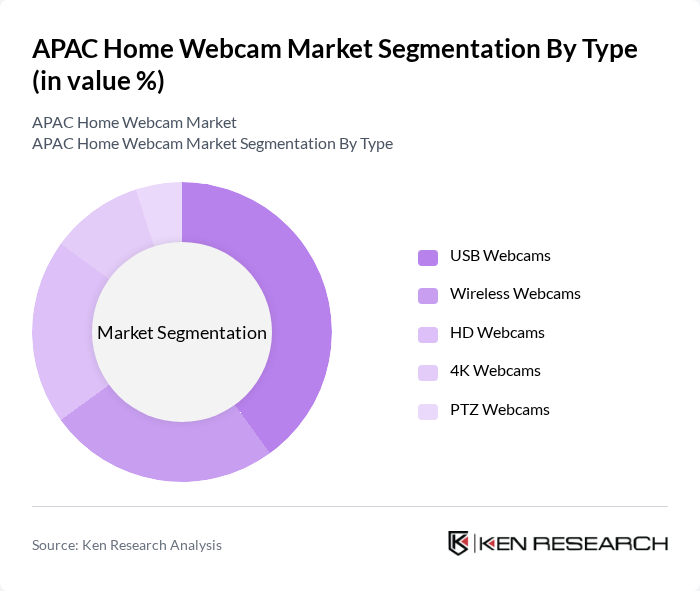
APAC Home Webcam Market segmentation by Type.

By End-User:The end-user segmentation includes Individual Consumers / Households, SOHO & Home Offices, Home-Based Content Creators & Streamers, Home Security & Surveillance Users, and Others. Individual consumers dominate the market due to the increasing need for personal video communication for social interaction, online classes, and telehealth. Home-based content creators and streamers are driving demand for high-quality HD and 4K webcams with better low-light performance and integrated microphones, in line with the rapid growth of the global creator and live?streaming economy. SOHO and home offices are also significant contributors as remote and hybrid work models remain widely adopted across APAC, supporting sustained demand for reliable webcams for corporate meetings and collaboration platforms.
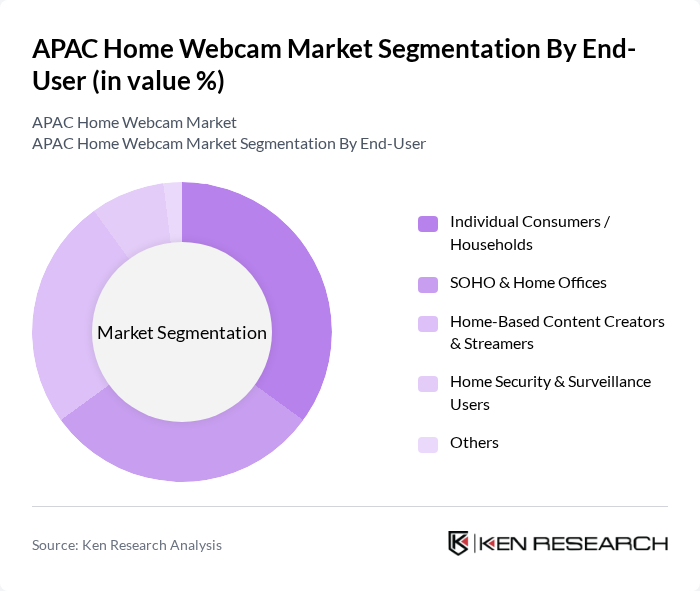
APAC Home Webcam Market segmentation by End-User.

APAC Home Webcam Market Competitive Landscape

The APAC Home Webcam Market is characterized by a dynamic mix of regional and international players. Leading participants such as Logitech International S.A., Razer Inc., Microsoft Corporation, Canon Inc., Sony Group Corporation, AVerMedia Technologies, Inc., Dell Technologies Inc., HP Inc., Creative Technology Ltd., ASUSTeK Computer Inc., Elgato (Corsair Gaming, Inc.), Jabra (GN Audio A/S), NexiGo, AUKEY, AVer Information Inc. (AVer) contribute to innovation, geographic expansion, and service delivery in this space.

Logitech International S.A.

1981

Lausanne, Switzerland

Razer Inc.

2005

Singapore

Microsoft Corporation

1975

Redmond, Washington, USA

Canon Inc.

1937

Tokyo, Japan

Sony Group Corporation

1946

Tokyo, Japan

Company

Establishment Year

Headquarters

Group Size (Global Major, Regional Champion, Local/Niche Player)

APAC Home Webcam Revenue (Latest Year)

APAC Home Webcam Revenue CAGR (Historical 3–5 Years)

APAC Market Share (%) in Home Webcams

Geographic Coverage within APAC (No. of Countries / Key Markets Served)

Product Portfolio Breadth (No. of Home Webcam SKUs)

APAC Home Webcam Market Industry Analysis

Growth Drivers

  • Increasing Remote Work Culture:The remote work culture in the APAC region has surged, with an estimated 30% of the workforce working remotely in future. This shift has led to a significant increase in demand for home webcams, as companies invest in technology to facilitate virtual meetings. According to the International Labour Organization, remote work is expected to remain prevalent, driving the need for high-quality video conferencing tools, including webcams, to enhance communication and collaboration.
  • Rising Demand for Online Education:The online education sector in APAC is projected to reach $50 billion in future, fueled by a growing number of students opting for digital learning platforms. This trend has increased the demand for webcams, as educators and students require reliable video tools for effective learning experiences. The World Bank reports that educational institutions are increasingly adopting technology, further propelling the need for high-quality webcams to support interactive learning environments.
  • Advancements in Webcam Technology:Technological advancements have significantly improved webcam features, with high-definition models becoming standard. In future, over 60% of webcams sold in APAC are expected to support 1080p resolution or higher. This trend is driven by consumer demand for better video quality in both personal and professional settings. Industry reports indicate that manufacturers are investing in innovative features, such as AI enhancements, to meet the evolving needs of users, further stimulating market growth.

Market Challenges

  • High Competition and Price Wars:The APAC home webcam market is characterized by intense competition, with over 100 brands vying for market share. This saturation has led to aggressive pricing strategies, with some brands reducing prices by up to 20% in future to attract consumers. Such price wars can erode profit margins for manufacturers, making it challenging to sustain long-term growth while maintaining product quality and innovation.
  • Privacy and Security Concerns:Privacy issues surrounding webcam usage have become increasingly prominent, with reports indicating that 70% of consumers express concerns about unauthorized access to their devices. In future, regulatory bodies in APAC are expected to implement stricter data protection laws, which may impose additional compliance costs on manufacturers. These challenges can hinder market growth as consumers become more cautious about adopting webcam technology due to security fears.

APAC Home Webcam Market Future Outlook

The APAC home webcam market is poised for significant evolution, driven by technological advancements and changing consumer preferences. As remote work and online education continue to thrive, the demand for high-quality webcams is expected to rise. Additionally, the integration of AI features and enhanced video quality will likely become standard. Manufacturers will need to adapt to regulatory changes regarding privacy and data protection, ensuring that their products meet consumer expectations while navigating a competitive landscape.

Market Opportunities

  • Expansion into Emerging Markets:Emerging markets in Southeast Asia are witnessing rapid digital adoption, with internet penetration expected to reach 70% in future. This presents a significant opportunity for webcam manufacturers to tap into new customer bases, particularly among young professionals and students seeking affordable yet high-quality video solutions.
  • Integration with Smart Home Devices:The growing trend of smart home technology offers a unique opportunity for webcam manufacturers to develop products that seamlessly integrate with smart home ecosystems. In future, it is estimated that 40% of households in APAC will have smart devices, creating demand for webcams that enhance home security and connectivity.

Scope of the Report

SegmentSub-Segments
By Type

USB Webcams

Wireless Webcams

HD Webcams

K Webcams

PTZ Webcams

By End-User

Individual Consumers / Households

SOHO & Home Offices

Home-Based Content Creators & Streamers

Home Security & Surveillance Users

Others

By Region

China

Japan

India

South Korea

ASEAN (Indonesia, Malaysia, Thailand, Vietnam, Philippines, Singapore, etc.)

Australia & New Zealand

Rest of APAC

By Technology

CMOS Sensor Technology

CCD Sensor Technology

Infrared / Night-Vision Enabled

AI-Enabled / Smart Webcams

By Application

Video Conferencing & Remote Work

Streaming and Content Creation

Security & Surveillance

Online Education & E-Learning

Others

By Sales Channel

Online (E-commerce & Brand Webstores)

Offline (Consumer Electronics Retail & IT Channels)

OEM / Bundled Sales with PCs & Monitors

Others

By Price Band

Entry-Level (? USD 30)

Mid-Range (USD 31–99)

Premium (? USD 100)

Key Target Audience

Investors and Venture Capitalist Firms

Government and Regulatory Bodies (e.g., Ministry of Electronics and Information Technology, Telecommunications Regulatory Authority)

Manufacturers and Producers

Distributors and Retailers

Technology Providers

Industry Associations

Financial Institutions

Telecommunications Companies

Players Mentioned in the Report:

Logitech International S.A.

Razer Inc.

Microsoft Corporation

Canon Inc.

Sony Group Corporation

AVerMedia Technologies, Inc.

Dell Technologies Inc.

HP Inc.

Creative Technology Ltd.

ASUSTeK Computer Inc.

Elgato (Corsair Gaming, Inc.)

Jabra (GN Audio A/S)

NexiGo

AUKEY

AVer Information Inc. (AVer)

Table of Contents

Market Assessment Phase

1. Executive Summary and Approach


2. APAC Home Webcam Market Overview

2.1 Key Insights and Strategic Recommendations

2.2 APAC Home Webcam Market Overview

2.3 Definition and Scope

2.4 Evolution of Market Ecosystem

2.5 Timeline of Key Regulatory Milestones

2.6 Value Chain & Stakeholder Mapping

2.7 Business Cycle Analysis

2.8 Policy & Incentive Landscape


3. APAC Home Webcam Market Analysis

3.1 Growth Drivers

3.1.1 Increasing Remote Work Culture
3.1.2 Rising Demand for Online Education
3.1.3 Growth in Social Media Usage
3.1.4 Advancements in Webcam Technology

3.2 Market Challenges

3.2.1 High Competition and Price Wars
3.2.2 Privacy and Security Concerns
3.2.3 Rapid Technological Changes
3.2.4 Supply Chain Disruptions

3.3 Market Opportunities

3.3.1 Expansion into Emerging Markets
3.3.2 Integration with Smart Home Devices
3.3.3 Development of AI-Powered Features
3.3.4 Partnerships with Educational Institutions

3.4 Market Trends

3.4.1 Increased Focus on High-Definition Video Quality
3.4.2 Growing Popularity of Live Streaming
3.4.3 Shift Towards Wireless Webcams
3.4.4 Emphasis on User-Friendly Interfaces

3.5 Government Regulation

3.5.1 Data Protection Regulations
3.5.2 Import Tariffs on Electronic Goods
3.5.3 Standards for Video Quality
3.5.4 Environmental Compliance Regulations

4. SWOT Analysis


5. Stakeholder Analysis


6. Porter's Five Forces Analysis


7. APAC Home Webcam Market Market Size, 2019-2024

7.1 By Value

7.2 By Volume

7.3 By Average Selling Price


8. APAC Home Webcam Market Segmentation

8.1 By Type

8.1.1 USB Webcams
8.1.2 Wireless Webcams
8.1.3 HD Webcams
8.1.4 4K Webcams
8.1.5 PTZ Webcams

8.2 By End-User

8.2.1 Individual Consumers / Households
8.2.2 SOHO & Home Offices
8.2.3 Home-Based Content Creators & Streamers
8.2.4 Home Security & Surveillance Users
8.2.5 Others

8.3 By Region

8.3.1 China
8.3.2 Japan
8.3.3 India
8.3.4 South Korea
8.3.5 ASEAN (Indonesia, Malaysia, Thailand, Vietnam, Philippines, Singapore, etc.)
8.3.6 Australia & New Zealand
8.3.7 Rest of APAC

8.4 By Technology

8.4.1 CMOS Sensor Technology
8.4.2 CCD Sensor Technology
8.4.3 Infrared / Night-Vision Enabled
8.4.4 AI-Enabled / Smart Webcams

8.5 By Application

8.5.1 Video Conferencing & Remote Work
8.5.2 Streaming and Content Creation
8.5.3 Security & Surveillance
8.5.4 Online Education & E-Learning
8.5.5 Others

8.6 By Sales Channel

8.6.1 Online (E-commerce & Brand Webstores)
8.6.2 Offline (Consumer Electronics Retail & IT Channels)
8.6.3 OEM / Bundled Sales with PCs & Monitors
8.6.4 Others

8.7 By Price Band

8.7.1 Entry-Level (? USD 30)
8.7.2 Mid-Range (USD 31–99)
8.7.3 Premium (? USD 100)

9. APAC Home Webcam Market Competitive Analysis

9.1 Market Share of Key Players

9.2 Cross Comparison of Key Players

9.2.1 Company Name
9.2.2 Group Size (Global Major, Regional Champion, Local/Niche Player)
9.2.3 APAC Home Webcam Revenue (Latest Year)
9.2.4 APAC Home Webcam Revenue CAGR (Historical 3–5 Years)
9.2.5 APAC Market Share (%) in Home Webcams
9.2.6 Geographic Coverage within APAC (No. of Countries / Key Markets Served)
9.2.7 Product Portfolio Breadth (No. of Home Webcam SKUs)
9.2.8 Share of USB vs Wireless Webcam Sales (%)
9.2.9 Average Selling Price Positioning (Entry / Mid / Premium)
9.2.10 R&D / Innovation Intensity (as % of Total Revenue)
9.2.11 Online Channel Share in APAC Webcam Sales (%)
9.2.12 Customer Ratings / Satisfaction Score (Major APAC E-commerce Platforms)

9.3 SWOT Analysis of Top Players

9.4 Pricing Analysis

9.5 Detailed Profile of Major Companies

9.5.1 Logitech International S.A.
9.5.2 Razer Inc.
9.5.3 Microsoft Corporation
9.5.4 Canon Inc.
9.5.5 Sony Group Corporation
9.5.6 AVerMedia Technologies, Inc.
9.5.7 Dell Technologies Inc.
9.5.8 HP Inc.
9.5.9 Creative Technology Ltd.
9.5.10 ASUSTeK Computer Inc.
9.5.11 Elgato (Corsair Gaming, Inc.)
9.5.12 Jabra (GN Audio A/S)
9.5.13 NexiGo
9.5.14 AUKEY
9.5.15 AVer Information Inc. (AVer)

10. APAC Home Webcam Market End-User Analysis

10.1 Procurement Behavior of Key Ministries

10.1.1 Budget Allocation Trends
10.1.2 Decision-Making Processes
10.1.3 Preferred Vendor Criteria
10.1.4 Procurement Timelines

10.2 Corporate Spend on Infrastructure & Energy

10.2.1 Investment Priorities
10.2.2 Spending Patterns
10.2.3 Budget Constraints
10.2.4 Future Spending Projections

10.3 Pain Point Analysis by End-User Category

10.3.1 Technical Support Issues
10.3.2 Integration Challenges
10.3.3 Cost Management Concerns
10.3.4 User Experience Feedback

10.4 User Readiness for Adoption

10.4.1 Awareness Levels
10.4.2 Training Needs
10.4.3 Adoption Barriers
10.4.4 Support Requirements

10.5 Post-Deployment ROI and Use Case Expansion

10.5.1 Performance Metrics
10.5.2 User Feedback Mechanisms
10.5.3 Future Use Cases
10.5.4 ROI Measurement Techniques

11. APAC Home Webcam Market Future Size, 2025-2030

11.1 By Value

11.2 By Volume

11.3 By Average Selling Price


Go-To-Market Strategy Phase

1. Whitespace Analysis + Business Model Canvas

1.1 Market Gaps Identification

1.2 Business Model Framework


2. Marketing and Positioning Recommendations

2.1 Branding Strategies

2.2 Product USPs


3. Distribution Plan

3.1 Urban Retail vs Rural NGO Tie-Ups


4. Channel & Pricing Gaps

4.1 Underserved Routes

4.2 Pricing Bands


5. Unmet Demand & Latent Needs

5.1 Category Gaps

5.2 Consumer Segments


6. Customer Relationship

6.1 Loyalty Programs

6.2 After-Sales Service


7. Value Proposition

7.1 Sustainability

7.2 Integrated Supply Chains


8. Key Activities

8.1 Regulatory Compliance

8.2 Branding

8.3 Distribution Setup


9. Entry Strategy Evaluation

9.1 Domestic Market Entry Strategy

9.1.1 Product Mix
9.1.2 Pricing Band
9.1.3 Packaging

9.2 Export Entry Strategy

9.2.1 Target Countries
9.2.2 Compliance Roadmap

10. Entry Mode Assessment

10.1 Joint Ventures

10.2 Greenfield Investments

10.3 Mergers & Acquisitions

10.4 Distributor Model


11. Capital and Timeline Estimation

11.1 Capital Requirements

11.2 Timelines


12. Control vs Risk Trade-Off

12.1 Ownership vs Partnerships


13. Profitability Outlook

13.1 Breakeven Analysis

13.2 Long-Term Sustainability


14. Potential Partner List

14.1 Distributors

14.2 Joint Ventures

14.3 Acquisition Targets


15. Execution Roadmap

15.1 Phased Plan for Market Entry

15.1.1 Market Setup
15.1.2 Market Entry
15.1.3 Growth Acceleration
15.1.4 Scale & Stabilize

15.2 Key Activities and Milestones

15.2.1 Milestone Planning
15.2.2 Activity Tracking

Research Methodology

ApproachModellingSample

Phase 1: Approach1

Desk Research

  • Market reports from industry associations and trade publications focused on the APAC home webcam sector
  • Analysis of consumer electronics sales data from government and market research agencies
  • Review of technological advancements and trends in webcam features and functionalities

Primary Research

  • Interviews with product managers at leading webcam manufacturers in the APAC region
  • Surveys targeting end-users to understand preferences and usage patterns
  • Focus group discussions with tech enthusiasts and remote workers to gather qualitative insights

Validation & Triangulation

  • Cross-validation of findings through multiple data sources, including sales figures and consumer feedback
  • Triangulation of market trends with insights from industry experts and analysts
  • Sanity checks through expert panel reviews to ensure data accuracy and relevance

Phase 2: Market Size Estimation1

Top-down Assessment

  • Estimation of total market size based on overall consumer electronics expenditure in the APAC region
  • Segmentation of the market by product type, including built-in vs. external webcams
  • Incorporation of growth rates from related sectors such as remote work and online education

Bottom-up Modeling

  • Collection of sales data from major retailers and e-commerce platforms for webcam products
  • Estimation of average selling prices and volume sold across different market segments
  • Analysis of distribution channels and their impact on market penetration rates

Forecasting & Scenario Analysis

  • Multi-factor regression analysis incorporating variables such as internet penetration and remote work trends
  • Scenario planning based on potential shifts in consumer behavior and technological advancements
  • Development of baseline, optimistic, and pessimistic forecasts through 2030

Phase 3: CATI Sample Composition1

Scope Item/SegmentSample SizeTarget Respondent Profiles
Consumer Preferences for Home Webcams120Home Users, Remote Workers
Retail Insights on Webcam Sales90Retail Managers, Electronics Buyers
Technological Adoption Trends75IT Managers, Tech Enthusiasts
Market Trends in Online Education60Educators, E-learning Platform Managers
Impact of Social Media on Webcam Usage80Content Creators, Influencers

Frequently Asked Questions

What is the current value of the APAC Home Webcam Market?

The APAC Home Webcam Market is valued at approximately USD 1.4 billion, driven by increased demand for remote communication tools, online content creation, and video conferencing, particularly during and after the pandemic.

Which countries are the key players in the APAC Home Webcam Market?

What factors are driving the growth of the APAC Home Webcam Market?

What are the main types of webcams available in the APAC market?

Other Regional/Country Reports

Indonesia Home Webcam Market

Malaysia Home Webcam Market

KSA Home Webcam Market

SEA Home Webcam Market

Vietnam Home Webcam Market

Thailand Home Webcam Market

Other Adjacent Reports

Thailand Video Conferencing Software Market

South Korea Home Security Camera Market

South Africa Content Creation Equipment Market

South Africa Online Education Technology Market

Brazil Remote Work Tools Market

Vietnam Smart Home Devices Market

Global gaming peripherals market size, share, growth drivers, trends, opportunities & forecast 2025–2030

KSA Computer Accessories Market

Malaysia Streaming Devices Market

UAE Telehealth Equipment Market

Why Buy From Us?

Refine Robust Result (RRR) Framework

What makes us stand out is that our consultants follow Robust, Refine and Result (RRR) methodology. Robust for clear definitions, approaches and sanity checking, Refine for differentiating respondents' facts and opinions, and Result for presenting data with story.

Our Reach Is Unmatched

We have set a benchmark in the industry by offering our clients with syndicated and customized market research reports featuring coverage of entire market as well as meticulous research and analyst insights.

Shifting the Research Paradigm

While we don't replace traditional research, we flip the method upside down. Our dual approach of Top Bottom & Bottom Top ensures quality deliverable by not just verifying company fundamentals but also looking at the sector and macroeconomic factors.

More Insights-Better Decisions

With one step in the future, our research team constantly tries to show you the bigger picture. We help with some of the tough questions you may encounter along the way: How is the industry positioned? Best marketing channel? KPI's of competitors? By aligning every element, we help maximize success.

Transparency and Trust

Our report gives you instant access to the answers and sources that other companies might choose to hide. We elaborate each steps of research methodology we have used and showcase you the sample size to earn your trust.

Round the Clock Support

If you need any support, we are here! We pride ourselves on universe strength, data quality, and quick, friendly, and professional service.

Why Clients Choose Us?

400000+
Reports in repository
150+
Consulting projects a year
100+
Analysts
8000+
Client Queries in 2022








