About the Report
Base Year 2024APAC Luxury Travel Market Overview
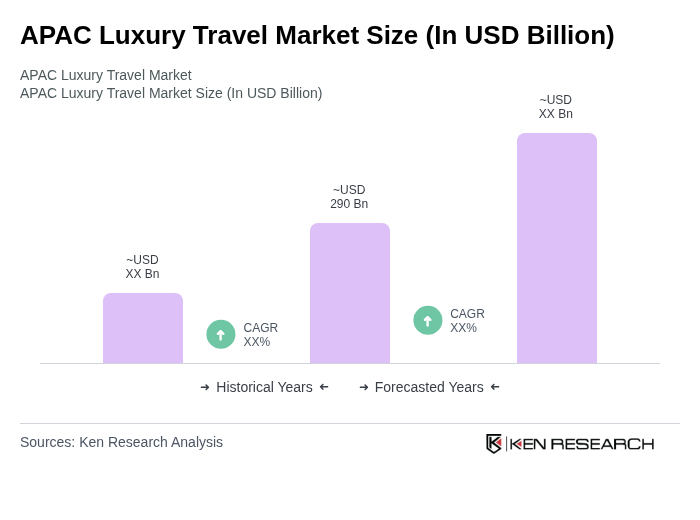
- The APAC Luxury Travel Market is valued at USD 290 billion, based on a five-year historical analysis. This growth is primarily driven by increasing disposable incomes, a rising number of high-net-worth individuals, a growing appetite for unique and personalized travel experiences, rising demand for wellness retreats, and culinary tourism. The luxury travel segment has seen a significant uptick as consumers seek exclusive offerings and high-quality services.
- Key players in this market include China, Japan, and Australia, which dominate due to their rich cultural heritage, diverse landscapes, and well-developed tourism infrastructure. These countries attract affluent travelers seeking luxury experiences, from high-end shopping to gourmet dining and bespoke travel itineraries, making them prime destinations in the luxury travel sector.
- The Swadesh Darshan 2.0 Scheme, 2022 issued by the Ministry of Tourism, Government of India, promotes luxury travel through development of sustainable and luxury tourism infrastructure including theme-based tourist circuits with compliance requirements for high-end resorts and experiential facilities targeting international visitors.
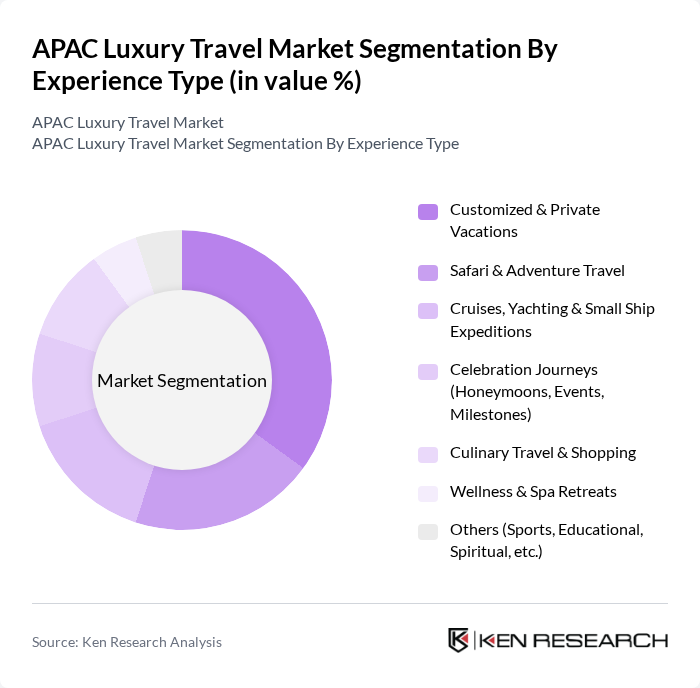
APAC Luxury Travel Market Segmentation
By Experience Type:The experience type segmentation includes various subsegments such as Customized & Private Vacations, Safari & Adventure Travel, Cruises, Yachting & Small Ship Expeditions, Celebration Journeys, Culinary Travel & Shopping, Wellness & Spa Retreats, and Others. Among these, Safari & Adventure Travel dominates the market due to the increasing demand for personalized travel experiences. Travelers are increasingly seeking unique itineraries tailored to their preferences, which has led to a surge in bespoke travel services. This trend is further fueled by the desire for privacy and exclusivity, especially in the post-pandemic era.
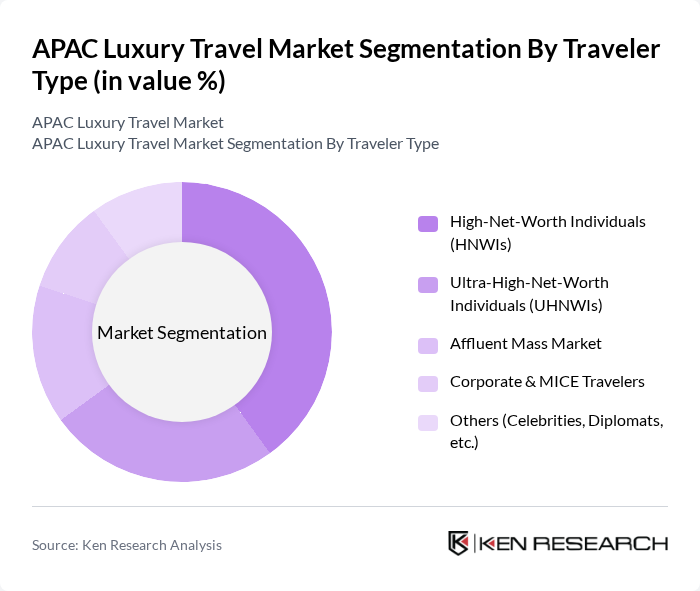
By Traveler Type:The traveler type segmentation encompasses High-Net-Worth Individuals (HNWIs), Ultra-High-Net-Worth Individuals (UHNWIs), Affluent Mass Market, Corporate & MICE Travelers, and Others. The High-Net-Worth Individuals segment is the leading subsegment, driven by their significant spending power and preference for exclusive travel experiences. This group is increasingly investing in luxury travel, seeking unique and personalized itineraries that cater to their specific interests and lifestyles. The rise of experiential travel among affluent consumers has further solidified this segment's dominance in the luxury travel market.
APAC Luxury Travel Market Competitive Landscape
The APAC Luxury Travel Market is characterized by a dynamic mix of regional and international players. Leading participants such as TUI Group, Abercrombie & Kent, Scott Dunn, Lindblad Expeditions Holdings, Inc., Exodus Travels Limited, Butterfield & Robinson, Inc., Geographic Expeditions, Inc. (GeoEx), Travel Edge, Inc. (Navigatr Group), Four Seasons Hotels and Resorts, Aman Resorts, Shangri-La Group (Shangri-La Hotels and Resorts), Banyan Tree Group (Banyan Tree Holdings), The Oberoi Group (Oberoi Hotels & Resorts), Indian Hotels Company Limited (Taj Hotels, Taj Hotels Resorts and Palaces), Mandarin Oriental Hotel Group contribute to innovation, geographic expansion, and service delivery in this space.
APAC Luxury Travel Market Industry Analysis
Growth Drivers
- Rising Disposable Incomes:The APAC region has witnessed a significant increase in disposable incomes, with countries like China and India reporting growth rates of 6.5% and 7.0% respectively in future. This economic uplift has led to a surge in luxury spending, with the average household income in urban areas reaching approximately $16,000 annually. As more consumers enter the middle and upper classes, the demand for luxury travel experiences is expected to rise, driving market growth.
- Increasing Demand for Unique Experiences:In future, the luxury travel segment is seeing a shift towards personalized and unique experiences, with 75% of affluent travelers prioritizing experiential over material purchases. This trend is supported by a growing preference for bespoke travel itineraries, with the luxury travel market in APAC projected to see a 25% increase in customized travel packages. This demand is fueled by a desire for authenticity and cultural immersion, enhancing the overall travel experience.
- Growth of Digital Platforms for Travel Booking:The digital transformation in travel booking is reshaping the luxury travel landscape. In future, online travel agencies (OTAs) are expected to account for 65% of luxury travel bookings in APAC, driven by platforms like Airbnb Luxe and luxury-focused travel apps. This shift is supported by a 20% increase in mobile bookings, as consumers increasingly prefer the convenience of digital platforms for planning and booking their luxury travel experiences.
Market Challenges
- Economic Uncertainty:Economic fluctuations pose a significant challenge to the luxury travel market in APAC. In future, the region is projected to experience a GDP growth slowdown, with estimates around 4.0%, down from 5.0% in previous years. This uncertainty can lead to reduced consumer spending on luxury travel, as potential travelers may prioritize savings over discretionary expenses, impacting overall market growth and profitability.
- Intense Competition:The luxury travel market in APAC is characterized by fierce competition among established brands and new entrants. In future, over 250 luxury travel agencies are expected to operate in the region, leading to price wars and reduced profit margins. This competitive landscape necessitates continuous innovation and differentiation, as companies strive to capture the attention of affluent travelers who have numerous options available to them.
APAC Luxury Travel Market Future Outlook
The APAC luxury travel market is poised for dynamic growth, driven by evolving consumer preferences and technological advancements. As travelers increasingly seek sustainable and personalized experiences, luxury brands must adapt to these trends. The integration of artificial intelligence in travel planning is expected to enhance customer engagement, while the rise of wellness tourism will cater to health-conscious travelers. These factors will shape the future landscape of luxury travel, creating new avenues for growth and innovation in the sector.
Market Opportunities
- Emerging Markets in Southeast Asia:Southeast Asia presents a lucrative opportunity for luxury travel, with countries like Vietnam and Thailand experiencing a 30% increase in international tourist arrivals in future. This growth is driven by improved infrastructure and marketing efforts, making these destinations attractive for luxury travelers seeking new experiences and cultural immersion.
- Growth in Wellness Tourism:The wellness tourism sector is projected to grow significantly, with an estimated market value of $700 billion in future. This trend is fueled by a rising awareness of health and well-being among affluent travelers, leading to increased demand for luxury wellness retreats and holistic travel experiences that promote relaxation and rejuvenation.
Scope of the Report
| Segment | Sub-Segments |
|---|---|
| By Experience Type | Customized & Private Vacations Safari & Adventure Travel Cruises, Yachting & Small Ship Expeditions Celebration Journeys (Honeymoons, Events, Milestones) Culinary Travel & Shopping Wellness & Spa Retreats Others (Sports, Educational, Spiritual, etc.) |
| By Traveler Type | High-Net-Worth Individuals (HNWIs) Ultra-High-Net-Worth Individuals (UHNWIs) Affluent Mass Market Corporate & MICE Travelers Others (Celebrities, Diplomats, etc.) |
| By Country / Sub-region | China Japan South Korea India Australia & New Zealand ASEAN-5 (Singapore, Thailand, Indonesia, Malaysia, Vietnam) Rest of APAC |
| By Travel Style | Fully Independent Travelers (FIT) Small Group & Escorted Tours Family & Multi-generational Travel Couples & Honeymoon Travel Others (Bleisure, Solo Luxury, etc.) |
| By Duration of Stay | Short-Term (1–3 Days) Medium-Term (4–7 Days) Long-Term (8–14 Days) Extended Stays (15+ Days) |
| By Booking Channel | Online Travel Agencies (OTAs) Direct Brand Websites & Apps Luxury Travel Advisors & Tour Operators Corporate Travel Management Companies Others (Concierge Services, GDS, etc.) |
| By Service Type | Luxury Accommodation (Hotels, Resorts, Villas) Premium & Business-Class Transportation Activities & Bespoke Experiences Fine Dining & Gastronomy Ancillary Services (Concierge, Security, Private Guides) |
Key Target Audience
Investors and Venture Capitalist Firms
Government and Regulatory Bodies (e.g., Ministry of Tourism, National Tourism Administration)
Luxury Hotel Chains and Resorts
Travel Agencies and Tour Operators
Airline Companies
Luxury Goods Manufacturers
Destination Marketing Organizations
Financial Institutions
Players Mentioned in the Report:
TUI Group
Abercrombie & Kent
Scott Dunn
Lindblad Expeditions Holdings, Inc.
Exodus Travels Limited
Butterfield & Robinson, Inc.
Geographic Expeditions, Inc. (GeoEx)
Travel Edge, Inc. (Navigatr Group)
Four Seasons Hotels and Resorts
Aman Resorts
Shangri-La Group (Shangri-La Hotels and Resorts)
Banyan Tree Group (Banyan Tree Holdings)
The Oberoi Group (Oberoi Hotels & Resorts)
Indian Hotels Company Limited (Taj Hotels, Taj Hotels Resorts and Palaces)
Mandarin Oriental Hotel Group
Luxtripper (Moresand Limited)
Table of Contents
Market Assessment Phase
1. Executive Summary and Approach
2. APAC Luxury Travel Market Overview
2.1 Key Insights and Strategic Recommendations
2.2 APAC Luxury Travel Market Overview
2.3 Definition and Scope
2.4 Evolution of Market Ecosystem
2.5 Timeline of Key Regulatory Milestones
2.6 Value Chain & Stakeholder Mapping
2.7 Business Cycle Analysis
2.8 Policy & Incentive Landscape
3. APAC Luxury Travel Market Analysis
3.1 Growth Drivers
3.1.1 Rising Disposable Incomes
3.1.2 Increasing Demand for Unique Experiences
3.1.3 Growth of Digital Platforms for Travel Booking
3.1.4 Expansion of Luxury Brands in APAC
3.2 Market Challenges
3.2.1 Economic Uncertainty
3.2.2 Intense Competition
3.2.3 Regulatory Hurdles
3.2.4 Environmental Concerns
3.3 Market Opportunities
3.3.1 Emerging Markets in Southeast Asia
3.3.2 Growth in Wellness Tourism
3.3.3 Customization and Personalization Trends
3.3.4 Technological Innovations in Travel
3.4 Market Trends
3.4.1 Rise of Sustainable Travel
3.4.2 Increased Use of AI in Travel Planning
3.4.3 Shift Towards Experiential Travel
3.4.4 Growth of Luxury Cruise Tourism
3.5 Government Regulation
3.5.1 Travel Safety Regulations
3.5.2 Environmental Protection Laws
3.5.3 Visa and Immigration Policies
3.5.4 Tax Incentives for Luxury Tourism
4. SWOT Analysis
5. Stakeholder Analysis
6. Porter's Five Forces Analysis
7. APAC Luxury Travel Market Market Size, 2019-2024
7.1 By Value
7.2 By Volume
7.3 By Average Selling Price
8. APAC Luxury Travel Market Segmentation
8.1 By Experience Type
8.1.1 Customized & Private Vacations
8.1.2 Safari & Adventure Travel
8.1.3 Cruises, Yachting & Small Ship Expeditions
8.1.4 Celebration Journeys (Honeymoons, Events, Milestones)
8.1.5 Culinary Travel & Shopping
8.1.6 Wellness & Spa Retreats
8.1.7 Others (Sports, Educational, Spiritual, etc.)
8.2 By Traveler Type
8.2.1 High-Net-Worth Individuals (HNWIs)
8.2.2 Ultra-High-Net-Worth Individuals (UHNWIs)
8.2.3 Affluent Mass Market
8.2.4 Corporate & MICE Travelers
8.2.5 Others (Celebrities, Diplomats, etc.)
8.3 By Country / Sub-region
8.3.1 China
8.3.2 Japan
8.3.3 South Korea
8.3.4 India
8.3.5 Australia & New Zealand
8.3.6 ASEAN-5 (Singapore, Thailand, Indonesia, Malaysia, Vietnam)
8.3.7 Rest of APAC
8.4 By Travel Style
8.4.1 Fully Independent Travelers (FIT)
8.4.2 Small Group & Escorted Tours
8.4.3 Family & Multi-generational Travel
8.4.4 Couples & Honeymoon Travel
8.4.5 Others (Bleisure, Solo Luxury, etc.)
8.5 By Duration of Stay
8.5.1 Short-Term (1–3 Days)
8.5.2 Medium-Term (4–7 Days)
8.5.3 Long-Term (8–14 Days)
8.5.4 Extended Stays (15+ Days)
8.6 By Booking Channel
8.6.1 Online Travel Agencies (OTAs)
8.6.2 Direct Brand Websites & Apps
8.6.3 Luxury Travel Advisors & Tour Operators
8.6.4 Corporate Travel Management Companies
8.6.5 Others (Concierge Services, GDS, etc.)
8.7 By Service Type
8.7.1 Luxury Accommodation (Hotels, Resorts, Villas)
8.7.2 Premium & Business-Class Transportation
8.7.3 Activities & Bespoke Experiences
8.7.4 Fine Dining & Gastronomy
8.7.5 Ancillary Services (Concierge, Security, Private Guides)
9. APAC Luxury Travel Market Competitive Analysis
9.1 Market Share of Key Players
9.2 Cross Comparison of Key Players
9.2.1 Company Name
9.2.2 Group Size / Operational Scale (No. of Properties / Offices / Destinations Served)
9.2.3 APAC Luxury Travel Revenue and Revenue Growth Rate
9.2.4 Share of APAC in Global Luxury Travel Revenue
9.2.5 Average Booking Value per Traveler
9.2.6 Room / Cabin Occupancy Rate and Load Factor (where applicable)
9.2.7 Market Share in Key APAC Source & Destination Markets
9.2.8 Customer Retention / Repeat Booking Rate
9.2.9 Distribution Mix (Direct vs Intermediated Bookings)
9.2.10 RevPAR / Yield per Available Inventory (Hotel, Cruise, Tour)
9.2.11 Digital Engagement Metrics (Website Traffic, App MAUs, Social Reach)
9.2.12 Sustainability & ESG Performance Indicators (e.g., Certified Properties, Emissions per Guest Night)
9.3 SWOT Analysis of Top Players
9.4 Pricing Analysis
9.5 Detailed Profile of Major Companies
9.5.1 TUI Group
9.5.2 Abercrombie & Kent
9.5.3 Scott Dunn
9.5.4 Lindblad Expeditions Holdings, Inc.
9.5.5 Exodus Travels Limited
9.5.6 Butterfield & Robinson, Inc.
9.5.7 Geographic Expeditions, Inc. (GeoEx)
9.5.8 Travel Edge, Inc. (Navigatr Group)
9.5.9 Four Seasons Hotels and Resorts
9.5.10 Aman Resorts
9.5.11 Shangri-La Group (Shangri-La Hotels and Resorts)
9.5.12 Banyan Tree Group (Banyan Tree Holdings)
9.5.13 The Oberoi Group (Oberoi Hotels & Resorts)
9.5.14 Indian Hotels Company Limited (Taj Hotels, Taj Hotels Resorts and Palaces)
9.5.15 Mandarin Oriental Hotel Group
10. APAC Luxury Travel Market End-User Analysis
10.1 Procurement Behavior of Key Ministries
10.1.1 Government Travel Policies
10.1.2 Budget Allocations for Luxury Travel
10.1.3 Preferred Travel Agencies
10.1.4 Compliance Requirements
10.2 Corporate Spend on Infrastructure & Energy
10.2.1 Corporate Travel Budgets
10.2.2 Investment in Luxury Experiences
10.2.3 Partnerships with Luxury Providers
10.2.4 Trends in Corporate Retreats
10.3 Pain Point Analysis by End-User Category
10.3.1 Cost Management
10.3.2 Quality of Service
10.3.3 Accessibility Issues
10.3.4 Customization Needs
10.4 User Readiness for Adoption
10.4.1 Awareness of Luxury Options
10.4.2 Technology Adoption
10.4.3 Feedback Mechanisms
10.4.4 Training and Support
10.5 Post-Deployment ROI and Use Case Expansion
10.5.1 Measurement of Success
10.5.2 Customer Feedback Integration
10.5.3 Expansion into New Markets
10.5.4 Long-term Partnerships
11. APAC Luxury Travel Market Future Size, 2025-2030
11.1 By Value
11.2 By Volume
11.3 By Average Selling Price
Go-To-Market Strategy Phase
1. Whitespace Analysis + Business Model Canvas
1.1 Market Gaps Identification
1.2 Value Proposition Development
1.3 Revenue Streams Analysis
1.4 Cost Structure Evaluation
1.5 Key Partnerships Exploration
1.6 Customer Segmentation
1.7 Channels of Distribution
2. Marketing and Positioning Recommendations
2.1 Branding Strategies
2.2 Product USPs
2.3 Target Audience Identification
2.4 Communication Strategy
2.5 Digital Marketing Approaches
2.6 Event Marketing
2.7 Influencer Collaborations
3. Distribution Plan
3.1 Urban Retail Strategies
3.2 Rural NGO Tie-ups
3.3 Online Distribution Channels
3.4 Partnerships with Local Agencies
3.5 Direct Sales Approaches
3.6 Customer Experience Enhancements
3.7 Logistics and Supply Chain Management
4. Channel & Pricing Gaps
4.1 Underserved Routes
4.2 Pricing Bands Analysis
4.3 Competitor Pricing Strategies
4.4 Customer Willingness to Pay
4.5 Dynamic Pricing Models
4.6 Seasonal Pricing Adjustments
4.7 Value-Based Pricing Strategies
5. Unmet Demand & Latent Needs
5.1 Category Gaps
5.2 Consumer Segments Analysis
5.3 Emerging Trends Identification
5.4 Customer Feedback Utilization
5.5 Market Research Insights
5.6 Product Development Opportunities
5.7 Service Enhancements
6. Customer Relationship
6.1 Loyalty Programs
6.2 After-sales Service
6.3 Customer Engagement Strategies
6.4 Feedback Mechanisms
6.5 Personalization Approaches
6.6 Community Building Initiatives
6.7 Customer Education Programs
7. Value Proposition
7.1 Sustainability Initiatives
7.2 Integrated Supply Chains
7.3 Unique Selling Points
7.4 Customer-Centric Approaches
7.5 Competitive Advantages
7.6 Brand Loyalty Factors
7.7 Market Differentiation Strategies
8. Key Activities
8.1 Regulatory Compliance
8.2 Branding Initiatives
8.3 Distribution Setup
8.4 Training and Development
8.5 Marketing Campaigns
8.6 Performance Monitoring
8.7 Stakeholder Engagement
9. Entry Strategy Evaluation
9.1 Domestic Market Entry Strategy
9.1.1 Product Mix
9.1.2 Pricing Band
9.1.3 Packaging Strategies
9.2 Export Entry Strategy
9.2.1 Target Countries
9.2.2 Compliance Roadmap
10. Entry Mode Assessment
10.1 Joint Ventures
10.2 Greenfield Investments
10.3 Mergers & Acquisitions
10.4 Distributor Model
10.5 Risk Assessment
10.6 Market Adaptation Strategies
10.7 Partnership Evaluation
11. Capital and Timeline Estimation
11.1 Capital Requirements
11.2 Timelines
11.3 Funding Sources
11.4 Financial Projections
11.5 Budget Allocation
11.6 Milestone Tracking
11.7 Resource Planning
12. Control vs Risk Trade-Off
12.1 Ownership vs Partnerships
12.2 Risk Mitigation Strategies
12.3 Control Mechanisms
12.4 Partnership Dynamics
12.5 Long-term Sustainability
12.6 Exit Strategies
12.7 Performance Metrics
13. Profitability Outlook
13.1 Breakeven Analysis
13.2 Long-term Sustainability
13.3 Profit Margin Projections
13.4 Revenue Growth Forecasts
13.5 Cost Management Strategies
13.6 Financial Health In
Research Methodology
Phase 1: Approach1
Desk Research
- Analysis of luxury travel market reports from industry associations and tourism boards across APAC
- Review of published articles and white papers on luxury travel trends and consumer behavior
- Examination of government tourism statistics and economic reports relevant to luxury travel
Primary Research
- Interviews with luxury travel agents and tour operators to gather insights on market dynamics
- Surveys targeting affluent travelers to understand preferences and spending habits
- Field interviews with hotel managers and luxury service providers to assess service offerings
Validation & Triangulation
- Cross-validation of findings through multiple data sources, including consumer surveys and industry reports
- Triangulation of qualitative insights from interviews with quantitative data from surveys
- Sanity checks conducted through expert panel reviews comprising industry veterans
Phase 2: Market Size Estimation1
Top-down Assessment
- Estimation of total luxury travel expenditure based on national tourism revenue data
- Segmentation of the market by travel type, including leisure, business, and experiential travel
- Incorporation of growth rates from historical data and projected tourism trends in APAC
Bottom-up Modeling
- Collection of data on average spending per trip from luxury travel agencies and customer surveys
- Estimation of market size based on the number of high-net-worth individuals in key APAC countries
- Volume x average spend calculations for different luxury travel segments
Forecasting & Scenario Analysis
- Multi-factor regression analysis incorporating economic indicators, travel restrictions, and consumer confidence
- Scenario modeling based on potential impacts of geopolitical events and health crises on travel behavior
- Baseline, optimistic, and pessimistic forecasts for luxury travel growth through 2030
Phase 3: CATI Sample Composition1
| Scope Item/Segment | Sample Size | Target Respondent Profiles |
|---|---|---|
| Luxury Hotel Experiences | 150 | Hotel Managers, Luxury Travel Advisors |
| High-End Travel Packages | 120 | Travel Agency Owners, Tour Operators |
| Affluent Traveler Preferences | 140 | High-Net-Worth Individuals, Frequent Luxury Travelers |
| Luxury Cruise Market Insights | 80 | Cruise Line Executives, Travel Planners |
| Private Jet and Yacht Services | 70 | Private Aviation Executives, Yacht Charter Managers |
Frequently Asked Questions
What is the current value of the APAC Luxury Travel Market?
The APAC Luxury Travel Market is valued at approximately USD 290 billion, reflecting significant growth driven by increasing disposable incomes and a rising number of high-net-worth individuals seeking unique and personalized travel experiences.
Which countries dominate the APAC Luxury Travel Market?
What are the key growth drivers of the APAC Luxury Travel Market?
What types of experiences are popular in the APAC Luxury Travel Market?
Other Regional/Country Reports
Indonesia Luxury Travel Market
Malaysia Luxury Travel Market
KSA Luxury Travel Market
SEA Luxury Travel Market
Other Adjacent Reports
Philippines Luxury Hospitality Market
Indonesia Wellness Tourism Market
UAE Culinary Tourism Market
Japan Adventure Travel Market
Thailand Private Aviation Market
UAE Yacht Charter Market
Singapore High-End Retail Market
Germany Sustainable Tourism Market
UAE Travel Technology Market
Singapore MICE Tourism Market
Why Buy From Us?

What makes us stand out is that our consultants follow Robust, Refine and Result (RRR) methodology. Robust for clear definitions, approaches and sanity checking, Refine for differentiating respondents' facts and opinions, and Result for presenting data with story.

We have set a benchmark in the industry by offering our clients with syndicated and customized market research reports featuring coverage of entire market as well as meticulous research and analyst insights.

While we don't replace traditional research, we flip the method upside down. Our dual approach of Top Bottom & Bottom Top ensures quality deliverable by not just verifying company fundamentals but also looking at the sector and macroeconomic factors.

With one step in the future, our research team constantly tries to show you the bigger picture. We help with some of the tough questions you may encounter along the way: How is the industry positioned? Best marketing channel? KPI's of competitors? By aligning every element, we help maximize success.

Our report gives you instant access to the answers and sources that other companies might choose to hide. We elaborate each steps of research methodology we have used and showcase you the sample size to earn your trust.

If you need any support, we are here! We pride ourselves on universe strength, data quality, and quick, friendly, and professional service.