About the Report
Base Year 2024APAC Military Animals Market Overview
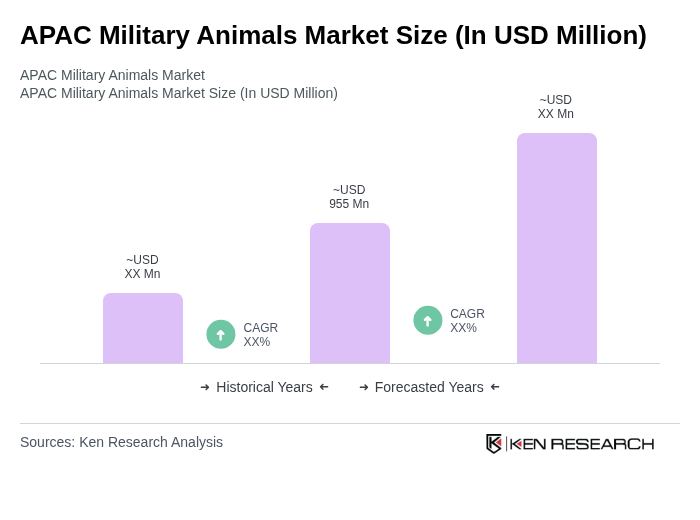
- The APAC Military Animals Market is valued at USD 955 million, based on a five-year historical analysis. Growth is driven by expanding investments in detection, search and rescue, and combat-support capabilities using working animals, especially dogs and horses, with modernization programs increasingly integrating AI-based training systems to boost operational efficiency and animal welfare.
- Key players in this market include countries like India, China, and Japan, which dominate due to their significant defense budgets and strategic military initiatives. The increasing focus on enhancing national security and counter-terrorism efforts has led to a higher demand for military animals, particularly in urban warfare and specialized operations.
- In 2023, the Indian government implemented a new policy aimed at enhancing the welfare and training of military animals, which includes a budget allocation of INR 200 million for veterinary care and advanced training facilities. This initiative reflects the growing recognition of the importance of military animals in defense operations and their overall well-being.
APAC Military Animals Market Segmentation
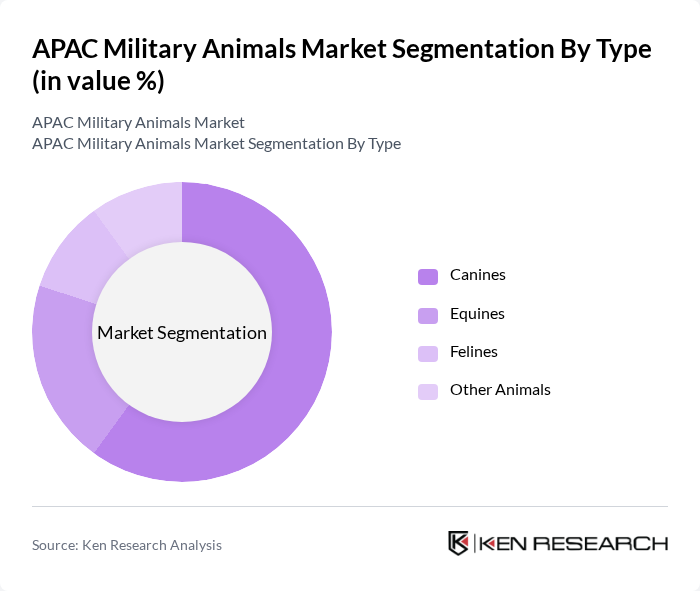
By Type:The market is segmented into various types of military animals, including canines, equines, felines, and other animals. Among these, canines are the most dominant due to their versatility in roles such as detection, search and rescue, and combat support. The increasing reliance on trained dogs for various military applications has solidified their position as the leading type in the market.
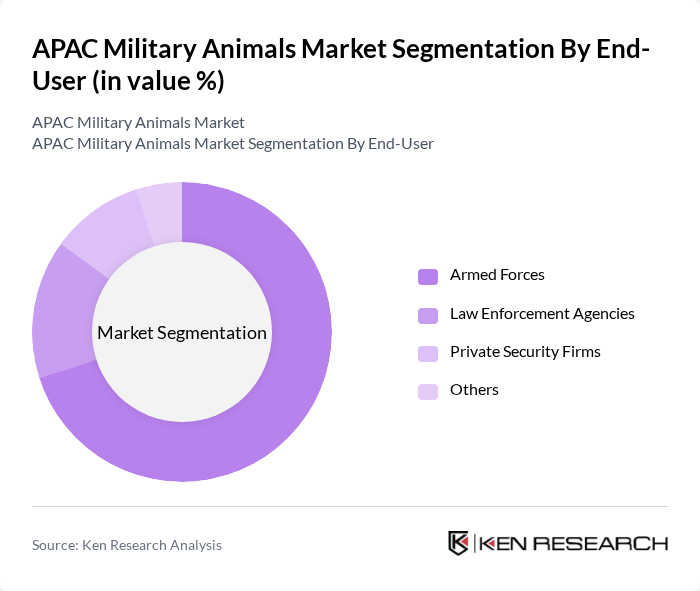
By End-User:The end-users of military animals include armed forces, law enforcement agencies, private security firms, and others. Armed forces are the primary end-users, utilizing military animals for various operational roles, including reconnaissance and explosive detection. The increasing focus on national security and counter-terrorism efforts has led to a higher demand for military animals, particularly in urban warfare and specialized operations.
APAC Military Animals Market Competitive Landscape
The APAC Military Animals Market is characterized by a dynamic mix of regional and international players. Leading participants such as K9s for Warriors, Military Working Dog Foundation, Canine Companions for Independence, The War Dog Memorial, Paws of War, American Humane Association, Dogs on Deployment, The K9 Project, VetDogs, The Animal Rescue League, PETA, The Humane Society, The ASPCA, The Animal Welfare Institute, The International Fund for Animal Welfare contribute to innovation, geographic expansion, and service delivery in this space.
APAC Military Animals Market Industry Analysis
Growth Drivers
- Large APAC Military Animals Market Base:The global Military Animals market is valued at USD 954.5 million in future, with Asia Pacific identified as the fastest-growing regional market. This highlights the APAC region's significant role in the military animals segment, where dogs, horses, and marine mammals are utilized for detection, rescue, reconnaissance, and combat support. The increasing reliance on these animals underscores their importance in military operations across the region.
- Strong Regional GDP Base:The combined nominal GDP of the Asia-Pacific region is estimated at USD 40,869 billion in future. This robust economic foundation supports increased defense spending and the capacity to invest in military animal programs. As nations within APAC continue to grow economically, the allocation of funds towards military enhancements, including animal deployment, is expected to rise significantly, fostering market growth.
- Rapid Increase in APAC Military Spending:Military expenditure in East Asia is projected to rise by USD 433 billion in future, reflecting a 7.8% increase from the previous period. Notably, China alone accounts for USD 314 billion of this expenditure. This escalation in defense budgets is likely to bolster the procurement and deployment of military animals, as nations prioritize enhancing their military capabilities through diverse resources, including trained animals.
Market Challenges
- Limited Public-Sector Transparency & Data Gaps:There is a notable lack of specific public data regarding military animals in APAC for future, with most figures derived from broader global reports. This scarcity of APAC-specific data indicates structural opacity, complicating market analysis and forecasting. The absence of reliable statistics can hinder strategic planning and investment decisions within the military animal sector.
- High Training and Maintenance Costs:Military animal programs incur significant costs for training, healthcare, procurement, and welfare. For instance, U.S. military programs report expenditures of USD 38–45 million in the previous period for similar initiatives. Extrapolating these figures to the APAC context suggests that comparable cost burdens may pose challenges, particularly for complex animal training, logistics, and long-term care, impacting overall program viability.
APAC Military Animals Market Future Outlook
The future of the APAC Military Animals market appears promising, driven by technological advancements and increasing military collaborations. The integration of AI-driven wearables and smart communication tools is expected to enhance the operational capabilities of military animals. Additionally, as nations recognize the value of military animals in diverse roles, including reconnaissance and search and rescue, there will be a growing emphasis on developing specialized training programs to optimize their effectiveness in various military operations.
Market Opportunities
- APAC as Fastest-Growing Region:The APAC region is positioned as the fastest-growing segment in the global Military Animals market. This trend presents a clear opportunity to develop localized supply chains, breeding programs, and technology-enhanced training capabilities tailored to the unique needs of military operations in the region.
- Leveraging Veterinary AI Infrastructure:With 71% of veterinary professionals in China adopting AI technologies, APAC nations can leverage this trend to enhance military animal healthcare and training efficiency. By integrating advanced veterinary AI, military programs can optimize animal health management and performance tracking, leading to improved operational outcomes in military contexts.
Scope of the Report
| Segment | Sub-Segments |
|---|---|
| By Type | Canines Equines Felines Other Animals |
| By End-User | Armed Forces Law Enforcement Agencies Private Security Firms Others |
| By Region | North India South India East India West India |
| By Application | Search and Rescue Operations Explosive Detection Patrol and Surveillance Others |
| By Training Methodology | Traditional Training Modern Training Techniques Behavioral Training Others |
| By Health Management | Preventive Care Emergency Care Nutritional Management Others |
| By Procurement Source | Government Procurement Private Sector Procurement International Aid and Donations Others |
Key Target Audience
Investors and Venture Capitalist Firms
Government and Regulatory Bodies (e.g., Ministry of Defence, Department of Agriculture)
Military and Defense Contractors
Animal Training and Handling Organizations
Veterinary Services and Animal Health Companies
Logistics and Supply Chain Management Firms
Non-Governmental Organizations (NGOs) focused on Animal Welfare
Insurance Companies specializing in Military and Animal Coverage
Players Mentioned in the Report:
K9s for Warriors
Military Working Dog Foundation
Canine Companions for Independence
The War Dog Memorial
Paws of War
American Humane Association
Dogs on Deployment
The K9 Project
VetDogs
The Animal Rescue League
PETA
The Humane Society
The ASPCA
The Animal Welfare Institute
The International Fund for Animal Welfare
Table of Contents
Market Assessment Phase
1. Executive Summary and Approach
2. APAC Military Animals Market Overview
2.1 Key Insights and Strategic Recommendations
2.2 APAC Military Animals Market Overview
2.3 Definition and Scope
2.4 Evolution of Market Ecosystem
2.5 Timeline of Key Regulatory Milestones
2.6 Value Chain & Stakeholder Mapping
2.7 Business Cycle Analysis
2.8 Policy & Incentive Landscape
3. APAC Military Animals Market Analysis
3.1 Growth Drivers
3.1.1 Increased Defense Budgets
3.1.2 Rising Demand for Specialized Military Training
3.1.3 Technological Advancements in Animal Training
3.1.4 Growing Focus on Animal Welfare in Military Operations
3.2 Market Challenges
3.2.1 Ethical Concerns Regarding Animal Use
3.2.2 High Maintenance Costs of Military Animals
3.2.3 Limited Availability of Trained Personnel
3.2.4 Regulatory Restrictions on Animal Deployment
3.3 Market Opportunities
3.3.1 Expansion of Military Collaborations Across APAC
3.3.2 Development of Advanced Training Programs
3.3.3 Increased Investment in Animal Health Technologies
3.3.4 Growing Public Support for Military Animal Programs
3.4 Market Trends
3.4.1 Integration of Technology in Animal Training
3.4.2 Shift Towards Sustainable Military Practices
3.4.3 Enhanced Focus on Multi-Role Military Animals
3.4.4 Rising Popularity of Canine Units in Military Operations
3.5 Government Regulation
3.5.1 Animal Welfare Regulations
3.5.2 Import and Export Regulations for Military Animals
3.5.3 Training Standards and Certification Requirements
3.5.4 Environmental Impact Assessments for Animal Use
4. SWOT Analysis
5. Stakeholder Analysis
6. Porter's Five Forces Analysis
7. APAC Military Animals Market Market Size, 2019-2024
7.1 By Value
7.2 By Volume
7.3 By Average Selling Price
8. APAC Military Animals Market Segmentation
8.1 By Type
8.1.1 Canines
8.1.2 Equines
8.1.3 Felines
8.1.4 Other Animals
8.2 By End-User
8.2.1 Armed Forces
8.2.2 Law Enforcement Agencies
8.2.3 Private Security Firms
8.2.4 Others
8.3 By Region
8.3.1 North India
8.3.2 South India
8.3.3 East India
8.3.4 West India
8.4 By Application
8.4.1 Search and Rescue Operations
8.4.2 Explosive Detection
8.4.3 Patrol and Surveillance
8.4.4 Others
8.5 By Training Methodology
8.5.1 Traditional Training
8.5.2 Modern Training Techniques
8.5.3 Behavioral Training
8.5.4 Others
8.6 By Health Management
8.6.1 Preventive Care
8.6.2 Emergency Care
8.6.3 Nutritional Management
8.6.4 Others
8.7 By Procurement Source
8.7.1 Government Procurement
8.7.2 Private Sector Procurement
8.7.3 International Aid and Donations
8.7.4 Others
9. APAC Military Animals Market Competitive Analysis
9.1 Market Share of Key Players
9.2 Cross Comparison of Key Players
9.2.1 Company Name
9.2.2 Group Size (Large, Medium, or Small as per industry convention)
9.2.3 Revenue Growth Rate
9.2.4 Market Penetration Rate
9.2.5 Customer Retention Rate
9.2.6 Pricing Strategy
9.2.7 Training Efficiency Metrics
9.2.8 Animal Health Management Success Rate
9.2.9 Compliance with Regulatory Standards
9.2.10 Innovation Rate in Training Techniques
9.3 SWOT Analysis of Top Players
9.4 Pricing Analysis
9.5 Detailed Profile of Major Companies
9.5.1 K9s for Warriors
9.5.2 Military Working Dog Foundation
9.5.3 Canine Companions for Independence
9.5.4 The War Dog Memorial
9.5.5 Paws of War
9.5.6 American Humane Association
9.5.7 Dogs on Deployment
9.5.8 The K9 Project
9.5.9 VetDogs
9.5.10 The Animal Rescue League
9.5.11 PETA
9.5.12 The Humane Society
9.5.13 The ASPCA
9.5.14 The Animal Welfare Institute
9.5.15 The International Fund for Animal Welfare
10. APAC Military Animals Market End-User Analysis
10.1 Procurement Behavior of Key Ministries
10.1.1 Ministry of Defense
10.1.2 Ministry of Home Affairs
10.1.3 Ministry of Agriculture
10.1.4 Others
10.2 Corporate Spend on Infrastructure & Energy
10.2.1 Budget Allocation for Military Animals
10.2.2 Investment in Training Facilities
10.2.3 Expenditure on Veterinary Care
10.2.4 Others
10.3 Pain Point Analysis by End-User Category
10.3.1 Budget Constraints
10.3.2 Training Limitations
10.3.3 Health Management Issues
10.3.4 Others
10.4 User Readiness for Adoption
10.4.1 Training Program Availability
10.4.2 Support from Government Agencies
10.4.3 Public Perception of Military Animals
10.4.4 Others
10.5 Post-Deployment ROI and Use Case Expansion
10.5.1 Effectiveness in Operations
10.5.2 Cost-Benefit Analysis
10.5.3 Opportunities for Future Use Cases
10.5.4 Others
11. APAC Military Animals Market Future Size, 2025-2030
11.1 By Value
11.2 By Volume
11.3 By Average Selling Price
Go-To-Market Strategy Phase
1. Whitespace Analysis + Business Model Canvas
1.1 Market Gaps Identification
1.2 Business Model Development
2. Marketing and Positioning Recommendations
2.1 Branding Strategies
2.2 Product USPs
3. Distribution Plan
3.1 Urban Retail vs Rural NGO Tie-ups
4. Channel & Pricing Gaps
4.1 Underserved Routes
4.2 Pricing Bands
5. Unmet Demand & Latent Needs
5.1 Category Gaps
5.2 Consumer Segments
6. Customer Relationship
6.1 Loyalty Programs
6.2 After-sales Service
7. Value Proposition
7.1 Sustainability
7.2 Integrated Supply Chains
8. Key Activities
8.1 Regulatory Compliance
8.2 Branding
8.3 Distribution Setup
9. Entry Strategy Evaluation
9.1 Domestic Market Entry Strategy
9.1.1 Product Mix
9.1.2 Pricing Band
9.1.3 Packaging
9.2 Export Entry Strategy
9.2.1 Target Countries
9.2.2 Compliance Roadmap
10. Entry Mode Assessment
10.1 JV
10.2 Greenfield
10.3 M&A
10.4 Distributor Model
11. Capital and Timeline Estimation
11.1 Capital Requirements
11.2 Timelines
12. Control vs Risk Trade-Off
12.1 Ownership vs Partnerships
13. Profitability Outlook
13.1 Breakeven Analysis
13.2 Long-term Sustainability
14. Potential Partner List
14.1 Distributors
14.2 JVs
14.3 Acquisition Targets
15. Execution Roadmap
15.1 Phased Plan for Market Entry
15.1.1 Market Setup
15.1.2 Market Entry
15.1.3 Growth Acceleration
15.1.4 Scale & Stabilize
15.2 Key Activities and Milestones
15.2.1 Activity Planning
15.2.2 Milestone Tracking
Research Methodology
Phase 1: Approach1
Desk Research
- Analysis of government reports and publications on military animal usage in APAC countries
- Review of academic journals and white papers focusing on the role of animals in military operations
- Examination of industry reports from defense and veterinary organizations regarding trends and forecasts
Primary Research
- Interviews with military veterinarians and animal handlers across various APAC nations
- Surveys conducted with defense procurement officers regarding military animal programs
- Field visits to military bases to observe animal training and deployment practices
Validation & Triangulation
- Cross-validation of findings through multiple expert interviews and secondary data sources
- Triangulation of data from military reports, academic studies, and industry insights
- Sanity checks through feedback from a panel of military animal experts and stakeholders
Phase 2: Market Size Estimation1
Top-down Assessment
- Estimation of military animal market size based on defense budgets of APAC countries
- Analysis of historical spending trends on military animals and related services
- Incorporation of regional security dynamics influencing military animal deployment
Bottom-up Modeling
- Data collection on the number of military animals used by each country in the region
- Cost analysis of procurement, training, and maintenance of military animals
- Volume estimates based on animal types and their specific military applications
Forecasting & Scenario Analysis
- Multi-factor regression analysis considering geopolitical tensions and defense spending
- Scenario modeling based on potential changes in military strategies and animal welfare regulations
- Baseline, optimistic, and pessimistic forecasts through 2030 based on historical data
Phase 3: CATI Sample Composition1
| Scope Item/Segment | Sample Size | Target Respondent Profiles |
|---|---|---|
| Military Animal Procurement | 100 | Procurement Officers, Defense Analysts |
| Veterinary Care in Military | 80 | Military Veterinarians, Animal Care Specialists |
| Training Programs for Military Animals | 70 | Training Coordinators, Animal Handlers |
| Deployment Strategies for Military Animals | 60 | Military Strategists, Operations Managers |
| Animal Welfare Regulations in Defense | 50 | Regulatory Officers, Animal Welfare Advocates |
Frequently Asked Questions
What is the current value of the APAC Military Animals Market?
The APAC Military Animals Market is valued at approximately USD 955 million, reflecting a significant investment in military animals for detection, search and rescue, and combat-support roles, particularly in countries like India, China, and Japan.
Which types of military animals are most commonly used in the APAC region?
What are the primary end-users of military animals in APAC?
How is the APAC Military Animals Market expected to grow in the future?
Other Regional/Country Reports
Malaysia Military Animals Market
KSA Military Animals Market
SEA Military Animals Market
Vietnam Military Animals Market
Thailand Military Animals Market
Other Adjacent Reports
South Korea Animal Training Market
Singapore Defense Technology Market
South Africa Search and Rescue Equipment Market
Vietnam Security Services Market Outlook to 2030Egypt AI in Defense Market
Canada Animal Healthcare MarketGermany Military Equipment Market
Vietnam Detection Equipment Market
South Korea Law Enforcement Technology Market
Why Buy From Us?

What makes us stand out is that our consultants follow Robust, Refine and Result (RRR) methodology. Robust for clear definitions, approaches and sanity checking, Refine for differentiating respondents' facts and opinions, and Result for presenting data with story.

We have set a benchmark in the industry by offering our clients with syndicated and customized market research reports featuring coverage of entire market as well as meticulous research and analyst insights.

While we don't replace traditional research, we flip the method upside down. Our dual approach of Top Bottom & Bottom Top ensures quality deliverable by not just verifying company fundamentals but also looking at the sector and macroeconomic factors.

With one step in the future, our research team constantly tries to show you the bigger picture. We help with some of the tough questions you may encounter along the way: How is the industry positioned? Best marketing channel? KPI's of competitors? By aligning every element, we help maximize success.

Our report gives you instant access to the answers and sources that other companies might choose to hide. We elaborate each steps of research methodology we have used and showcase you the sample size to earn your trust.

If you need any support, we are here! We pride ourselves on universe strength, data quality, and quick, friendly, and professional service.