About the Report
Base Year 2024APAC Personal Sound Amplification Products Market Overview
- The APAC Personal Sound Amplification Products Market is valued at USD 1.1 billion, based on a five-year historical analysis. This growth is primarily driven by the increasing prevalence of hearing loss among the aging population, coupled with rising awareness of personal sound amplification products as a cost-effective alternative to traditional hearing aids.
- Countries such as China, Japan, and India dominate the market due to their large populations and growing middle class, which is increasingly adopting personal sound amplification products. Additionally, urbanization and advancements in technology have led to a surge in demand for innovative sound amplification solutions in these regions.
- The Bureau of Indian Standards (BIS) Personal Sound Amplification Products (PSAP) Regulations, 2023 issued by the Ministry of Consumer Affairs, Food and Public Distribution, establish quality and safety standards for PSAP devices, requiring BIS certification for manufacturing, import, and sale with compliance thresholds for sound output limiting and electromagnetic compatibility to ensure safe over-the-counter availability for mild hearing impairment.

APAC Personal Sound Amplification Products Market Segmentation
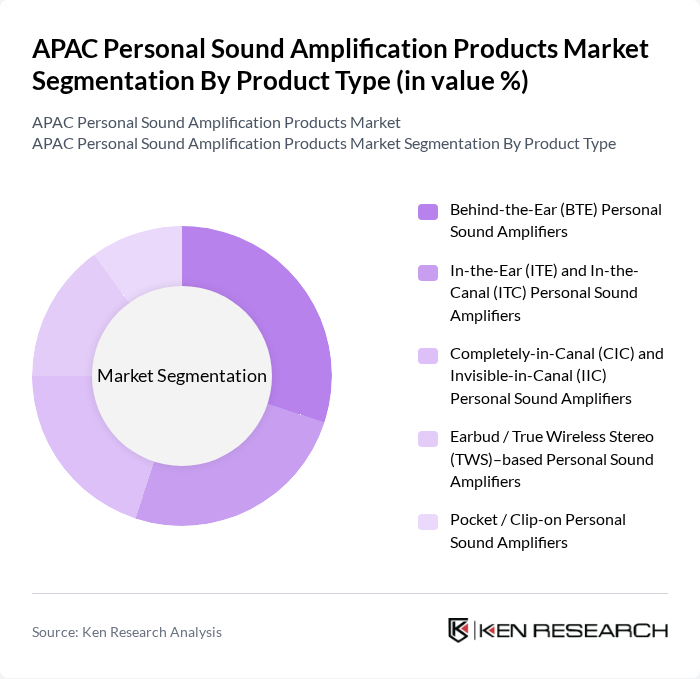
By Product Type:The product type segmentation includes various categories of personal sound amplification products, each catering to different consumer preferences and needs. The Behind-the-Ear (BTE) amplifiers are popular due to their comfort and ease of use, while In-the-Ear (ITE) and In-the-Canal (ITC) amplifiers are favored for their discreetness. Completely-in-Canal (CIC) and Invisible-in-Canal (IIC) amplifiers appeal to users seeking maximum invisibility. Earbud/True Wireless Stereo (TWS) amplifiers are gaining traction among younger consumers, while Pocket/Clip-on amplifiers are preferred for their portability and convenience.
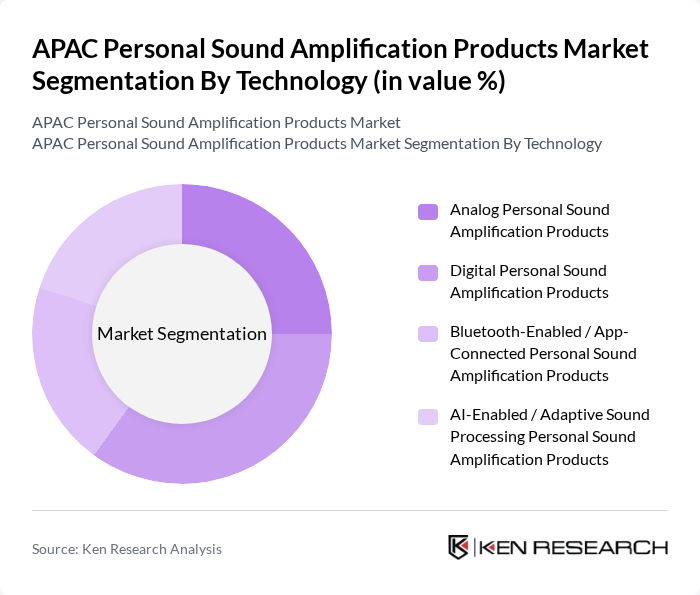
By Technology:The technology segmentation highlights the various types of sound amplification technologies available in the market. Analog personal sound amplification products are still in demand due to their simplicity and lower cost. However, digital personal sound amplification products are gaining popularity for their superior sound quality and customization options. Bluetooth-enabled/app-connected products are increasingly sought after for their convenience and connectivity features, while AI-enabled/adaptive sound processing products are emerging as the latest trend, offering advanced features that enhance user experience.
APAC Personal Sound Amplification Products Market Competitive Landscape
The APAC Personal Sound Amplification Products Market is characterized by a dynamic mix of regional and international players. Leading participants such as Sonova Holding AG, GN Store Nord A/S, WS Audiology A/S, Demant A/S, Starkey Hearing Technologies, William Demant (Bernafon / Oticon Brands in APAC), Sound World Solutions, Inc., Etymotic Research, Inc., Williams Sound, LLC, Bellman & Symfon AB, MERRY ELECTRONICS Co., Ltd., Tinteo SAS, Sonic Technology Products, Inc., Bose Corporation, Sony Corporation contribute to innovation, geographic expansion, and service delivery in this space.
APAC Personal Sound Amplification Products Market Industry Analysis
Growth Drivers
- Increasing Aging Population:The APAC region is experiencing a significant demographic shift, with the number of individuals aged 65 and older projected to reach 350 million in future, according to the United Nations. This growing elderly population is more susceptible to hearing loss, driving demand for personal sound amplification products. As awareness of hearing health increases, the need for accessible solutions becomes critical, positioning the market for substantial growth in response to this demographic trend.
- Rising Awareness of Hearing Health:Health organizations in APAC are increasingly promoting the importance of hearing health, with campaigns reaching over 120 million people annually. This heightened awareness is leading to more individuals seeking solutions for hearing impairments. The World Health Organization estimates that untreated hearing loss affects 1.6 billion people globally, emphasizing the urgent need for effective sound amplification products, thus propelling market growth in the region.
- Technological Advancements in Sound Amplification:Innovations in sound amplification technology are transforming the market landscape. In future, it is expected that over 70% of new products will incorporate advanced features such as Bluetooth connectivity and noise-cancellation capabilities. These enhancements not only improve user experience but also attract a broader consumer base, including younger individuals, thereby expanding the market reach and driving sales growth in the APAC region.
Market Challenges
- High Cost of Advanced Devices:The average price of advanced personal sound amplification devices in APAC can exceed $600, which poses a significant barrier for many potential users. With a substantial portion of the population earning below the median income level, affordability remains a critical challenge. This high cost limits access to essential hearing solutions, particularly in lower-income segments, hindering overall market growth and adoption rates.
- Limited Awareness in Rural Areas:Approximately 65% of the population in rural APAC regions lacks access to information about hearing health and available products. This gap in awareness is exacerbated by inadequate healthcare infrastructure, which limits outreach and education efforts. Consequently, many individuals remain unaware of personal sound amplification products, resulting in lower adoption rates and stunted market growth in these underserved areas.
APAC Personal Sound Amplification Products Market Future Outlook
The APAC personal sound amplification products market is poised for significant evolution, driven by technological advancements and changing consumer preferences. As manufacturers increasingly focus on integrating artificial intelligence and machine learning into their products, personalized sound experiences will become more prevalent. Additionally, the rise of e-commerce platforms is expected to enhance product accessibility, allowing consumers to explore a wider range of options conveniently. These trends indicate a dynamic market landscape that will adapt to meet the diverse needs of consumers in the region.
Market Opportunities
- Expansion into Emerging Markets:Emerging markets in Southeast Asia, with a combined population of over 650 million, present significant growth opportunities. As disposable incomes rise, the demand for affordable personal sound amplification products is expected to increase, allowing companies to tap into new customer bases and drive revenue growth in these regions.
- Development of Smart Personal Sound Amplification Products:The integration of smart technology into personal sound amplification devices is a burgeoning opportunity. With an estimated 1.6 billion smart device users in APAC in future, manufacturers can leverage this trend to create innovative products that enhance user experience, thereby attracting tech-savvy consumers and expanding market share.
Scope of the Report
| Segment | Sub-Segments |
|---|---|
| By Product Type | Behind-the-Ear (BTE) Personal Sound Amplifiers In-the-Ear (ITE) and In-the-Canal (ITC) Personal Sound Amplifiers Completely-in-Canal (CIC) and Invisible-in-Canal (IIC) Personal Sound Amplifiers Earbud / True Wireless Stereo (TWS)–based Personal Sound Amplifiers Pocket / Clip-on Personal Sound Amplifiers |
| By Technology | Analog Personal Sound Amplification Products Digital Personal Sound Amplification Products Bluetooth-Enabled / App-Connected Personal Sound Amplification Products AI-Enabled / Adaptive Sound Processing Personal Sound Amplification Products |
| By End-User | Adults (19–64 Years) Geriatric Population (65+ Years) Teenagers and Young Adults (13–18 Years) Others |
| By Application | Personal Listening and Everyday Communication TV, Cinema, and Home Entertainment Outdoor and Recreational Activities Professional and Occupational Use |
| By Distribution Channel | Online Marketplaces and Brand E-commerce Pharmacies and Opticals Consumer Electronics and Specialty Retail Stores Hospital, ENT Clinics, and Hearing Centers Others |
| By Price Range | Entry-Level (Below USD 100) Mid-Range (USD 100–299) Premium (USD 300 and Above) Subscription / Rental-Based Offerings |
| By Country (APAC) | China Japan India South Korea Australia & New Zealand Southeast Asia (Indonesia, Thailand, Malaysia, Vietnam, Philippines, Others) Rest of Asia Pacific |
Key Target Audience
Investors and Venture Capitalist Firms
Government and Regulatory Bodies (e.g., Ministry of Health, National Institute of Health, Food and Drug Administration)
Manufacturers and Producers
Distributors and Retailers
Healthcare Providers and Clinics
Technology Providers
Industry Associations (e.g., Hearing Industries Association)
Financial Institutions
Players Mentioned in the Report:
Sonova Holding AG
GN Store Nord A/S
WS Audiology A/S
Demant A/S
Starkey Hearing Technologies
William Demant (Bernafon / Oticon Brands in APAC)
Sound World Solutions, Inc.
Etymotic Research, Inc.
Williams Sound, LLC
Bellman & Symfon AB
MERRY ELECTRONICS Co., Ltd.
Tinteo SAS
Sonic Technology Products, Inc.
Bose Corporation
Sony Corporation
Table of Contents
Market Assessment Phase
1. Executive Summary and Approach
2. APAC Personal Sound Amplification Products Market Overview
2.1 Key Insights and Strategic Recommendations
2.2 APAC Personal Sound Amplification Products Market Overview
2.3 Definition and Scope
2.4 Evolution of Market Ecosystem
2.5 Timeline of Key Regulatory Milestones
2.6 Value Chain & Stakeholder Mapping
2.7 Business Cycle Analysis
2.8 Policy & Incentive Landscape
3. APAC Personal Sound Amplification Products Market Analysis
3.1 Growth Drivers
3.1.1 Increasing Aging Population
3.1.2 Rising Awareness of Hearing Health
3.1.3 Technological Advancements in Sound Amplification
3.1.4 Growing Demand for Affordable Hearing Solutions
3.2 Market Challenges
3.2.1 High Cost of Advanced Devices
3.2.2 Limited Awareness in Rural Areas
3.2.3 Regulatory Hurdles
3.2.4 Competition from Hearing Aids
3.3 Market Opportunities
3.3.1 Expansion into Emerging Markets
3.3.2 Development of Smart Personal Sound Amplification Products
3.3.3 Partnerships with Healthcare Providers
3.3.4 Increasing Online Sales Channels
3.4 Market Trends
3.4.1 Personalization of Sound Amplification Devices
3.4.2 Integration of AI and Machine Learning
3.4.3 Growth of Direct-to-Consumer Sales Models
3.4.4 Focus on Sustainability in Product Design
3.5 Government Regulation
3.5.1 Standards for Device Safety and Efficacy
3.5.2 Subsidies for Hearing Health Initiatives
3.5.3 Regulations on Marketing and Advertising
3.5.4 Import Tariffs on Sound Amplification Devices
4. SWOT Analysis
5. Stakeholder Analysis
6. Porter's Five Forces Analysis
7. APAC Personal Sound Amplification Products Market Market Size, 2019-2024
7.1 By Value
7.2 By Volume
7.3 By Average Selling Price
8. APAC Personal Sound Amplification Products Market Segmentation
8.1 By Product Type
8.1.1 Behind-the-Ear (BTE) Personal Sound Amplifiers
8.1.2 In-the-Ear (ITE) and In-the-Canal (ITC) Personal Sound Amplifiers
8.1.3 Completely-in-Canal (CIC) and Invisible-in-Canal (IIC) Personal Sound Amplifiers
8.1.4 Earbud / True Wireless Stereo (TWS)–based Personal Sound Amplifiers
8.1.5 Pocket / Clip-on Personal Sound Amplifiers
8.2 By Technology
8.2.1 Analog Personal Sound Amplification Products
8.2.2 Digital Personal Sound Amplification Products
8.2.3 Bluetooth-Enabled / App-Connected Personal Sound Amplification Products
8.2.4 AI-Enabled / Adaptive Sound Processing Personal Sound Amplification Products
8.3 By End-User
8.3.1 Adults (19–64 Years)
8.3.2 Geriatric Population (65+ Years)
8.3.3 Teenagers and Young Adults (13–18 Years)
8.3.4 Others
8.4 By Application
8.4.1 Personal Listening and Everyday Communication
8.4.2 TV, Cinema, and Home Entertainment
8.4.3 Outdoor and Recreational Activities
8.4.4 Professional and Occupational Use
8.5 By Distribution Channel
8.5.1 Online Marketplaces and Brand E-commerce
8.5.2 Pharmacies and Opticals
8.5.3 Consumer Electronics and Specialty Retail Stores
8.5.4 Hospital, ENT Clinics, and Hearing Centers
8.5.5 Others
8.6 By Price Range
8.6.1 Entry-Level (Below USD 100)
8.6.2 Mid-Range (USD 100–299)
8.6.3 Premium (USD 300 and Above)
8.6.4 Subscription / Rental-Based Offerings
8.7 By Country (APAC)
8.7.1 China
8.7.2 Japan
8.7.3 India
8.7.4 South Korea
8.7.5 Australia & New Zealand
8.7.6 Southeast Asia (Indonesia, Thailand, Malaysia, Vietnam, Philippines, Others)
8.7.7 Rest of Asia Pacific
9. APAC Personal Sound Amplification Products Market Competitive Analysis
9.1 Market Share of Key Players
9.2 Cross Comparison of Key Players
9.2.1 Company Name
9.2.2 APAC Personal Sound Amplification Products Revenue (Latest Year)
9.2.3 APAC Revenue CAGR (3–5 Year)
9.2.4 APAC Market Share (%)
9.2.5 Units Shipped in APAC (Annual)
9.2.6 Average Selling Price (ASP) in APAC
9.2.7 Share of Online vs Offline Sales in APAC
9.2.8 Product Portfolio Breadth (Number of PSAP Models in APAC)
9.2.9 R&D Intensity (% of Revenue Spent on R&D)
9.2.10 Regulatory and Compliance Coverage Across APAC Markets
9.2.11 Strategic Partnerships and Distribution Reach in APAC
9.2.12 Customer Ratings / Net Promoter Score (NPS) in APAC
9.3 SWOT Analysis of Top Players
9.4 Pricing Analysis
9.5 Detailed Profile of Major Companies
9.5.1 Sonova Holding AG
9.5.2 GN Store Nord A/S
9.5.3 WS Audiology A/S
9.5.4 Demant A/S
9.5.5 Starkey Hearing Technologies
9.5.6 William Demant (Bernafon / Oticon Brands in APAC)
9.5.7 Sound World Solutions, Inc.
9.5.8 Etymotic Research, Inc.
9.5.9 Williams Sound, LLC
9.5.10 Bellman & Symfon AB
9.5.11 MERRY ELECTRONICS Co., Ltd.
9.5.12 Tinteo SAS
9.5.13 Sonic Technology Products, Inc.
9.5.14 Bose Corporation
9.5.15 Sony Corporation
10. APAC Personal Sound Amplification Products Market End-User Analysis
10.1 Procurement Behavior of Key Ministries
10.1.1 Government Procurement Policies
10.1.2 Budget Allocations for Hearing Health
10.1.3 Collaboration with NGOs
10.1.4 Others
10.2 Corporate Spend on Infrastructure & Energy
10.2.1 Investment in Hearing Health Initiatives
10.2.2 Funding for Research and Development
10.2.3 Partnerships with Educational Institutions
10.2.4 Others
10.3 Pain Point Analysis by End-User Category
10.3.1 Accessibility Issues
10.3.2 Affordability Concerns
10.3.3 Lack of Awareness
10.3.4 Others
10.4 User Readiness for Adoption
10.4.1 Technology Acceptance Levels
10.4.2 Training and Support Needs
10.4.3 Feedback Mechanisms
10.4.4 Others
10.5 Post-Deployment ROI and Use Case Expansion
10.5.1 Measurement of Effectiveness
10.5.2 User Experience Feedback
10.5.3 Opportunities for Upselling
10.5.4 Others
11. APAC Personal Sound Amplification Products Market Future Size, 2025-2030
11.1 By Value
11.2 By Volume
11.3 By Average Selling Price
Go-To-Market Strategy Phase
1. Whitespace Analysis + Business Model Canvas
1.1 Market Gaps Identification
1.2 Business Model Framework
2. Marketing and Positioning Recommendations
2.1 Branding Strategies
2.2 Product USPs
3. Distribution Plan
3.1 Urban Retail vs Rural NGO Tie-ups
4. Channel & Pricing Gaps
4.1 Underserved Routes
4.2 Pricing Bands
5. Unmet Demand & Latent Needs
5.1 Category Gaps
5.2 Consumer Segments
6. Customer Relationship
6.1 Loyalty Programs
6.2 After-sales Service
7. Value Proposition
7.1 Sustainability
7.2 Integrated Supply Chains
8. Key Activities
8.1 Regulatory Compliance
8.2 Branding
8.3 Distribution Setup
9. Entry Strategy Evaluation
9.1 Domestic Market Entry Strategy
9.1.1 Product Mix
9.1.2 Pricing Band
9.1.3 Packaging
9.2 Export Entry Strategy
9.2.1 Target Countries
9.2.2 Compliance Roadmap
10. Entry Mode Assessment
10.1 JV
10.2 Greenfield
10.3 M&A
10.4 Distributor Model
11. Capital and Timeline Estimation
11.1 Capital Requirements
11.2 Timelines
12. Control vs Risk Trade-Off
12.1 Ownership vs Partnerships
13. Profitability Outlook
13.1 Breakeven Analysis
13.2 Long-term Sustainability
14. Potential Partner List
14.1 Distributors
14.2 JVs
14.3 Acquisition Targets
15. Execution Roadmap
15.1 Phased Plan for Market Entry
15.1.1 Market Setup
15.1.2 Market Entry
15.1.3 Growth Acceleration
15.1.4 Scale & Stabilize
15.2 Key Activities and Milestones
15.2.1 Milestone Planning
15.2.2 Activity Tracking
Research Methodology
Phase 1: Approach1
Desk Research
- Market reports from industry associations and government publications on personal sound amplification products
- Analysis of consumer behavior studies and demographic data from reputable market research firms
- Review of academic journals and white papers focusing on hearing health and assistive technologies
Primary Research
- Interviews with audiologists and hearing aid specialists to understand market needs and trends
- Surveys conducted with end-users of personal sound amplification products to gather insights on preferences and usage
- Focus group discussions with caregivers and healthcare professionals to assess the impact of these products on quality of life
Validation & Triangulation
- Cross-validation of findings through multiple data sources, including sales data and consumer feedback
- Triangulation of insights from primary interviews with secondary data trends to ensure consistency
- Sanity checks through expert panel reviews comprising industry veterans and market analysts
Phase 2: Market Size Estimation1
Top-down Assessment
- Estimation of market size based on overall healthcare expenditure in the APAC region
- Segmentation of the market by country, product type, and distribution channel
- Incorporation of growth rates from related sectors such as audiology services and hearing aids
Bottom-up Modeling
- Collection of sales data from key distributors and retailers of personal sound amplification products
- Estimation of average selling prices and volume sold across different market segments
- Analysis of consumer purchasing patterns and frequency of product replacement
Forecasting & Scenario Analysis
- Utilization of historical sales data to project future market growth through time series analysis
- Scenario modeling based on potential regulatory changes and technological advancements in sound amplification
- Development of best-case, worst-case, and most-likely scenarios to assess market dynamics through 2030
Phase 3: CATI Sample Composition1
| Scope Item/Segment | Sample Size | Target Respondent Profiles |
|---|---|---|
| End-User Feedback on Personal Sound Amplification | 150 | Individuals aged 50+, Hearing Impairment Patients |
| Healthcare Professional Insights | 120 | Audiologists, ENT Specialists |
| Retailer Perspectives on Market Trends | 90 | Store Managers, Product Buyers |
| Caregiver Experiences with Sound Amplification Products | 70 | Family Caregivers, Home Health Aides |
| Market Trends from Industry Experts | 60 | Market Analysts, Product Developers |
Frequently Asked Questions
What is the current value of the APAC Personal Sound Amplification Products Market?
The APAC Personal Sound Amplification Products Market is valued at approximately USD 1.1 billion, reflecting a significant growth trend driven by the increasing prevalence of hearing loss among the aging population and rising awareness of these products as alternatives to traditional hearing aids.
Which countries dominate the APAC Personal Sound Amplification Products Market?
What are the key regulations affecting the Personal Sound Amplification Products in India?
What are the main product types in the APAC Personal Sound Amplification Products Market?
Other Regional/Country Reports
Indonesia Personal Sound Amplification Products Market
Malaysia Personal Sound Amplification Products Market
KSA Personal Sound Amplification Products Market
SEA Personal Sound Amplification Products Market
Vietnam Personal Sound Amplification Products Market
Thailand Personal Sound Amplification Products Market
Other Adjacent Reports
Oman Assistive Listening Devices Market
Germany Audiology Services Market
Qatar Wearable Audio Devices Market
Germany Elderly Care Products Market
Egypt Consumer Electronics Audio Market
Oman Bluetooth Earbuds Market
South Korea Health Monitoring Wearables Market
South Korea Teleaudiology Market
Kuwait OTC Hearing Devices Market
Why Buy From Us?

What makes us stand out is that our consultants follow Robust, Refine and Result (RRR) methodology. Robust for clear definitions, approaches and sanity checking, Refine for differentiating respondents' facts and opinions, and Result for presenting data with story.

We have set a benchmark in the industry by offering our clients with syndicated and customized market research reports featuring coverage of entire market as well as meticulous research and analyst insights.

While we don't replace traditional research, we flip the method upside down. Our dual approach of Top Bottom & Bottom Top ensures quality deliverable by not just verifying company fundamentals but also looking at the sector and macroeconomic factors.

With one step in the future, our research team constantly tries to show you the bigger picture. We help with some of the tough questions you may encounter along the way: How is the industry positioned? Best marketing channel? KPI's of competitors? By aligning every element, we help maximize success.

Our report gives you instant access to the answers and sources that other companies might choose to hide. We elaborate each steps of research methodology we have used and showcase you the sample size to earn your trust.

If you need any support, we are here! We pride ourselves on universe strength, data quality, and quick, friendly, and professional service.