APAC Suction Catheters Market Report Size Share Growth Drivers Trends Opportunities & Forecast 2025–2030

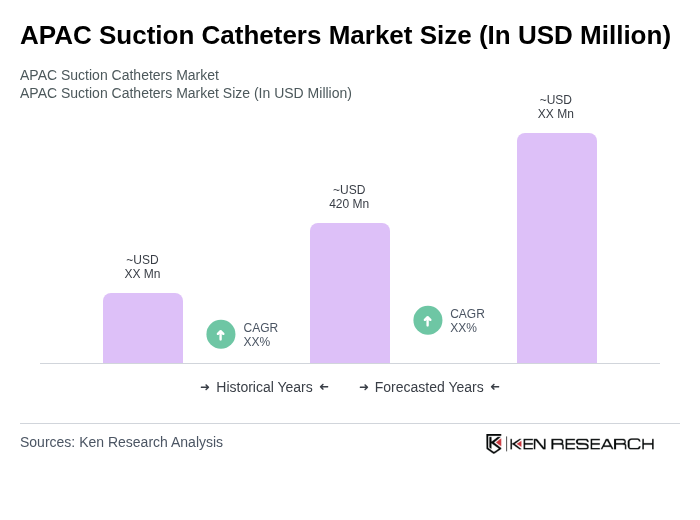
The APAC Suction Catheters Market, valued at USD 400 million, is growing due to rising respiratory issues, aging population, and innovations in medical devices.

Region:Asia

Author(s):Geetanshi

Product Code:KRAA3480

Pages:80

Published On:January 2026
About the Report

Base Year 2024

APAC Suction Catheters Market Overview

  • The APAC Suction Catheters Market is valued at USD 400 million, based on a five-year historical analysis. This growth is primarily driven by the increasing prevalence of respiratory diseases such as COPD and asthma, advancements in medical technology including minimally invasive surgeries, and a growing geriatric population requiring respiratory support. The demand for suction catheters is further fueled by the rising number of surgical procedures, expanding healthcare infrastructure, urbanization, and the need for effective airway management in critical care settings.
  • Countries such as Japan, China, and India dominate the APAC Suction Catheters Market due to their large healthcare infrastructure and increasing investments in medical technology. Japan leads with its advanced healthcare system and high demand for innovative medical devices, while China and India benefit from their vast populations and rising healthcare expenditure, which drives the need for suction catheters in hospitals and clinics.
  • The Medical Device Rules, 2017 issued by the Central Drugs Standard Control Organization (CDSCO), Ministry of Health and Family Welfare, Government of India, regulate suction catheters as Class B and C medical devices requiring registration, quality management system compliance under ISO 13485 standards, and labeling requirements for sterile single-use catheters to ensure patient safety in healthcare facilities. This regulation standardizes the quality of medical devices through risk-based classification, manufacturing audits, and import licensing, thereby increasing the demand for compliant suction catheters in the market.
APAC Suction Catheters Market Size

APAC Suction Catheters Market Segmentation

By Type:The market is segmented into various types of suction catheters, including Closed Suction Catheters, Open Suction Catheters, Manual Suction Catheters, Electric Suction Catheters, and Others. Among these, Closed Suction Catheters are gaining traction due to their ability to minimize the risk of infection and improve patient comfort through continuous ventilation and reduced exposure during suctioning. The increasing adoption of these catheters in critical care settings is driving their dominance in the market.
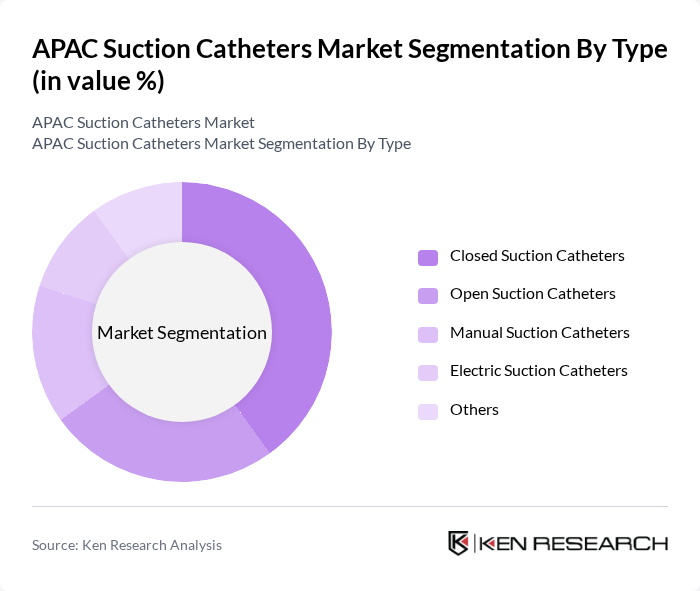
APAC Suction Catheters Market segmentation by Type.

By End-User:The end-user segmentation includes Hospitals, Clinics, Home Care Settings, Long-term Care Facilities, and Others. Hospitals are the leading end-users of suction catheters, driven by the high volume of surgical procedures and critical care admissions. The increasing focus on patient safety and infection control in hospitals further enhances the demand for suction catheters in these settings.
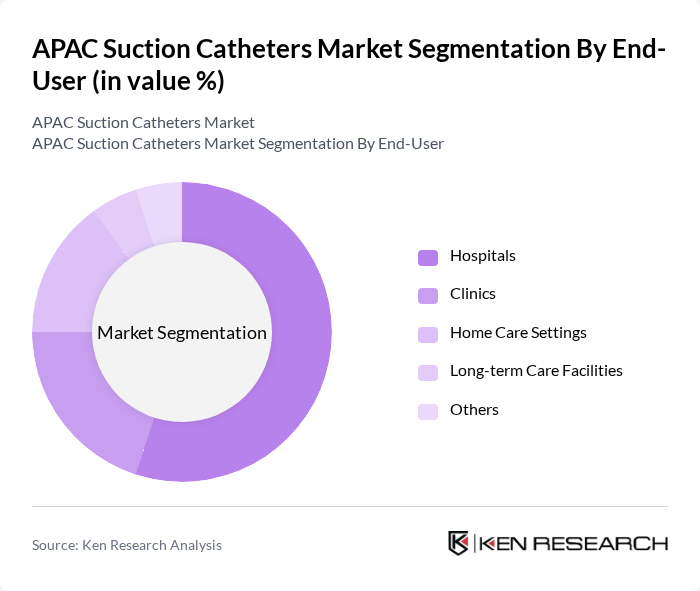
APAC Suction Catheters Market segmentation by End-User.

APAC Suction Catheters Market Competitive Landscape

The APAC Suction Catheters Market is characterized by a dynamic mix of regional and international players. Leading participants such as Medtronic, Boston Scientific, Teleflex, Smiths Medical, ConvaTec, Becton Dickinson, Halyard Health, Cook Medical, Cardinal Health, Medline Industries, 3M, Stryker Corporation, Olympus Corporation, Fresenius Kabi, Johnson & Johnson contribute to innovation, geographic expansion, and service delivery in this space.

Medtronic

1949

Dublin, Ireland

Boston Scientific

1979

Marlborough, Massachusetts, USA

Teleflex

1943

Wayne, Pennsylvania, USA

Smiths Medical

1963

Keene, New Hampshire, USA

ConvaTec

1978

Reading, United Kingdom

Company

Establishment Year

Headquarters

Group Size (Large, Medium, or Small as per industry convention)

Revenue Growth Rate

Market Penetration Rate

Customer Retention Rate

Product Innovation Rate

Distribution Efficiency

APAC Suction Catheters Market Industry Analysis

Growth Drivers

  • Increasing Prevalence of Respiratory Diseases:The APAC region is witnessing a significant rise in respiratory diseases, with the World Health Organization reporting that approximately 1.3 billion people suffer from chronic respiratory conditions. This increase is driven by urbanization and pollution, particularly in densely populated areas. The demand for suction catheters is expected to grow as healthcare providers seek effective solutions for managing these conditions, leading to an estimated 16% increase in suction catheter usage in future.
  • Rising Geriatric Population:The geriatric population in APAC is projected to reach 1.2 billion in future, according to the United Nations. This demographic shift is associated with a higher incidence of respiratory ailments, necessitating advanced medical devices like suction catheters. As older adults often require more frequent medical interventions, the demand for suction catheters is expected to rise significantly, with an estimated 21% increase in usage among this population segment.
  • Technological Advancements in Suction Catheter Design:Innovations in suction catheter technology, such as the development of soft, flexible materials and integrated suction systems, are enhancing patient comfort and efficacy. The market is seeing a surge in products that minimize trauma and improve suction efficiency. Reports indicate that the introduction of these advanced designs could lead to a 32% increase in market adoption rates in future, as healthcare facilities prioritize patient-centric solutions.

Market Challenges

  • Stringent Regulatory Requirements:The regulatory landscape for medical devices in APAC is complex, with stringent requirements imposed by local health authorities. Compliance with ISO standards and local regulations can delay product launches and increase costs. For instance, the average time for regulatory approval can exceed 14 months, which poses a significant barrier for manufacturers looking to enter the market swiftly and capitalize on emerging opportunities.
  • High Cost of Advanced Suction Catheters:The cost of advanced suction catheters can be prohibitive, particularly in developing APAC markets where healthcare budgets are constrained. For example, high-end suction catheters can range from USD 55 to USD 210 each, making them less accessible for smaller healthcare facilities. This financial barrier limits the adoption of innovative technologies, hindering overall market growth and leading to a reliance on lower-cost alternatives.

APAC Suction Catheters Market Future Outlook

The APAC suction catheters market is poised for significant growth driven by demographic shifts and technological advancements. As the prevalence of respiratory diseases continues to rise, healthcare providers are increasingly adopting innovative suction catheter solutions. Additionally, the integration of smart technologies and a focus on patient-centric care are expected to shape future product developments. The market will likely see enhanced collaboration between manufacturers and healthcare providers to address emerging needs and improve patient outcomes.

Market Opportunities

  • Expansion in Emerging APAC Markets:Emerging markets in APAC, such as India and Vietnam, present significant growth opportunities for suction catheter manufacturers. With increasing healthcare investments projected to reach USD 120 billion in future, companies can capitalize on the rising demand for advanced medical devices in these regions, enhancing market penetration and brand visibility.
  • Development of Innovative Suction Catheter Technologies:There is a growing opportunity for the development of next-generation suction catheters that incorporate smart technologies, such as real-time monitoring and data analytics. This innovation can improve patient management and outcomes, with potential market growth driven by a projected 27% increase in demand for smart medical devices in future, aligning with global healthcare trends.

Scope of the Report

SegmentSub-Segments
By Type

Closed Suction Catheters

Open Suction Catheters

Manual Suction Catheters

Electric Suction Catheters

Others

By End-User

Hospitals

Clinics

Home Care Settings

Long-term Care Facilities

Others

By Region

North India

South India

East India

West India

By Application

Emergency Care

Surgical Procedures

Critical Care

Others

By Material

PVC Suction Catheters

Silicone Suction Catheters

Latex Suction Catheters

Others

By Distribution Channel

Direct Sales

Distributors

Online Sales

Others

By Pricing Model

Premium Pricing

Competitive Pricing

Value-based Pricing

Others

Key Target Audience

Investors and Venture Capitalist Firms

Government and Regulatory Bodies (e.g., Ministry of Health, Food and Drug Administration)

Manufacturers and Producers

Distributors and Retailers

Healthcare Providers and Hospitals

Medical Device Wholesalers

Industry Associations (e.g., Asia Pacific Medical Technology Association)

Financial Institutions and Investment Banks

Players Mentioned in the Report:

Medtronic

Boston Scientific

Teleflex

Smiths Medical

ConvaTec

Becton Dickinson

Halyard Health

Cook Medical

Cardinal Health

Medline Industries

3M

Stryker Corporation

Olympus Corporation

Fresenius Kabi

Johnson & Johnson

Table of Contents

Market Assessment Phase

1. Executive Summary and Approach


2. APAC Suction Catheters Market Overview

2.1 Key Insights and Strategic Recommendations

2.2 APAC Suction Catheters Market Overview

2.3 Definition and Scope

2.4 Evolution of Market Ecosystem

2.5 Timeline of Key Regulatory Milestones

2.6 Value Chain & Stakeholder Mapping

2.7 Business Cycle Analysis

2.8 Policy & Incentive Landscape


3. APAC Suction Catheters Market Analysis

3.1 Growth Drivers

3.1.1 Increasing prevalence of respiratory diseases
3.1.2 Rising geriatric population
3.1.3 Technological advancements in suction catheter design
3.1.4 Growing demand for minimally invasive procedures

3.2 Market Challenges

3.2.1 Stringent regulatory requirements
3.2.2 High cost of advanced suction catheters
3.2.3 Limited awareness in emerging markets
3.2.4 Competition from alternative devices

3.3 Market Opportunities

3.3.1 Expansion in emerging APAC markets
3.3.2 Development of innovative suction catheter technologies
3.3.3 Strategic partnerships with healthcare providers
3.3.4 Increasing investment in healthcare infrastructure

3.4 Market Trends

3.4.1 Shift towards disposable suction catheters
3.4.2 Integration of smart technologies in medical devices
3.4.3 Focus on patient-centric healthcare solutions
3.4.4 Rise in telemedicine and remote patient monitoring

3.5 Government Regulation

3.5.1 Compliance with ISO standards
3.5.2 Approval processes by local health authorities
3.5.3 Guidelines for medical device safety and efficacy
3.5.4 Regulations on manufacturing practices

4. SWOT Analysis


5. Stakeholder Analysis


6. Porter's Five Forces Analysis


7. APAC Suction Catheters Market Market Size, 2019-2024

7.1 By Value

7.2 By Volume

7.3 By Average Selling Price


8. APAC Suction Catheters Market Segmentation

8.1 By Type

8.1.1 Closed Suction Catheters
8.1.2 Open Suction Catheters
8.1.3 Manual Suction Catheters
8.1.4 Electric Suction Catheters
8.1.5 Others

8.2 By End-User

8.2.1 Hospitals
8.2.2 Clinics
8.2.3 Home Care Settings
8.2.4 Long-term Care Facilities
8.2.5 Others

8.3 By Region

8.3.1 North India
8.3.2 South India
8.3.3 East India
8.3.4 West India

8.4 By Application

8.4.1 Emergency Care
8.4.2 Surgical Procedures
8.4.3 Critical Care
8.4.4 Others

8.5 By Material

8.5.1 PVC Suction Catheters
8.5.2 Silicone Suction Catheters
8.5.3 Latex Suction Catheters
8.5.4 Others

8.6 By Distribution Channel

8.6.1 Direct Sales
8.6.2 Distributors
8.6.3 Online Sales
8.6.4 Others

8.7 By Pricing Model

8.7.1 Premium Pricing
8.7.2 Competitive Pricing
8.7.3 Value-based Pricing
8.7.4 Others

9. APAC Suction Catheters Market Competitive Analysis

9.1 Market Share of Key Players

9.2 Cross Comparison of Key Players

9.2.1 Company Name
9.2.2 Group Size (Large, Medium, or Small as per industry convention)
9.2.3 Revenue Growth Rate
9.2.4 Market Penetration Rate
9.2.5 Customer Retention Rate
9.2.6 Product Innovation Rate
9.2.7 Distribution Efficiency
9.2.8 Pricing Strategy
9.2.9 Customer Satisfaction Score
9.2.10 Sales Conversion Rate

9.3 SWOT Analysis of Top Players

9.4 Pricing Analysis

9.5 Detailed Profile of Major Companies

9.5.1 Medtronic
9.5.2 Boston Scientific
9.5.3 Teleflex
9.5.4 Smiths Medical
9.5.5 ConvaTec
9.5.6 Becton Dickinson
9.5.7 Halyard Health
9.5.8 Cook Medical
9.5.9 Cardinal Health
9.5.10 Medline Industries
9.5.11 3M
9.5.12 Stryker Corporation
9.5.13 Olympus Corporation
9.5.14 Fresenius Kabi
9.5.15 Johnson & Johnson

10. APAC Suction Catheters Market End-User Analysis

10.1 Procurement Behavior of Key Ministries

10.1.1 Budget Allocation Trends
10.1.2 Procurement Processes
10.1.3 Supplier Selection Criteria
10.1.4 Contract Management Practices

10.2 Corporate Spend on Infrastructure & Energy

10.2.1 Investment Trends in Healthcare Infrastructure
10.2.2 Spending on Medical Equipment
10.2.3 Budgeting for Emergency Services
10.2.4 Allocation for Research and Development

10.3 Pain Point Analysis by End-User Category

10.3.1 Challenges in Procurement
10.3.2 Issues with Product Availability
10.3.3 Quality Concerns
10.3.4 Training and Support Needs

10.4 User Readiness for Adoption

10.4.1 Awareness Levels
10.4.2 Training Requirements
10.4.3 Infrastructure Readiness
10.4.4 Financial Readiness

10.5 Post-Deployment ROI and Use Case Expansion

10.5.1 Measurement of ROI
10.5.2 Expansion into New Use Cases
10.5.3 Feedback Mechanisms
10.5.4 Long-term Value Assessment

11. APAC Suction Catheters Market Future Size, 2025-2030

11.1 By Value

11.2 By Volume

11.3 By Average Selling Price


Go-To-Market Strategy Phase

1. Whitespace Analysis + Business Model Canvas

1.1 Market Gaps Identification

1.2 Business Model Development


2. Marketing and Positioning Recommendations

2.1 Branding Strategies

2.2 Product USPs


3. Distribution Plan

3.1 Urban Retail Strategies

3.2 Rural NGO Tie-ups


4. Channel & Pricing Gaps

4.1 Underserved Routes

4.2 Pricing Bands Analysis


5. Unmet Demand & Latent Needs

5.1 Category Gaps

5.2 Consumer Segments


6. Customer Relationship

6.1 Loyalty Programs

6.2 After-sales Service


7. Value Proposition

7.1 Sustainability Initiatives

7.2 Integrated Supply Chains


8. Key Activities

8.1 Regulatory Compliance

8.2 Branding Efforts

8.3 Distribution Setup


9. Entry Strategy Evaluation

9.1 Domestic Market Entry Strategy

9.1.1 Product Mix Considerations
9.1.2 Pricing Band Strategy
9.1.3 Packaging Approaches

9.2 Export Entry Strategy

9.2.1 Target Countries
9.2.2 Compliance Roadmap

10. Entry Mode Assessment

10.1 Joint Ventures

10.2 Greenfield Investments

10.3 Mergers & Acquisitions

10.4 Distributor Model


11. Capital and Timeline Estimation

11.1 Capital Requirements

11.2 Timelines for Implementation


12. Control vs Risk Trade-Off

12.1 Ownership Considerations

12.2 Partnerships Evaluation


13. Profitability Outlook

13.1 Breakeven Analysis

13.2 Long-term Sustainability


14. Potential Partner List

14.1 Distributors

14.2 Joint Ventures

14.3 Acquisition Targets


15. Execution Roadmap

15.1 Phased Plan for Market Entry

15.1.1 Market Setup
15.1.2 Market Entry
15.1.3 Growth Acceleration
15.1.4 Scale & Stabilize

15.2 Key Activities and Milestones

15.2.1 Milestone Planning
15.2.2 Activity Tracking

Research Methodology

ApproachModellingSample

Phase 1: Approach1

Desk Research

  • Analysis of market reports from healthcare associations and industry publications
  • Review of government health statistics and regulatory frameworks in APAC countries
  • Examination of trade data and import/export statistics related to suction catheters

Primary Research

  • Interviews with healthcare professionals, including surgeons and respiratory therapists
  • Surveys targeting procurement managers in hospitals and healthcare facilities
  • Field interviews with manufacturers and distributors of suction catheters

Validation & Triangulation

  • Cross-validation of findings through multiple data sources, including sales data and expert opinions
  • Triangulation of market trends with insights from industry conferences and seminars
  • Sanity checks conducted through expert panel reviews and feedback loops

Phase 2: Market Size Estimation1

Top-down Assessment

  • Estimation of total healthcare expenditure in APAC as a baseline for market size
  • Segmentation of suction catheter usage by healthcare settings (hospitals, clinics, home care)
  • Incorporation of demographic trends and disease prevalence rates affecting suction catheter demand

Bottom-up Modeling

  • Volume estimates based on historical sales data from leading manufacturers
  • Cost analysis of suction catheters, including production and distribution expenses
  • Calculation of market size based on unit sales and average selling prices

Forecasting & Scenario Analysis

  • Multi-variable forecasting using factors such as population growth and healthcare access
  • Scenario analysis based on potential regulatory changes and technological advancements
  • Development of baseline, optimistic, and pessimistic market growth projections through 2030

Phase 3: CATI Sample Composition1

Scope Item/SegmentSample SizeTarget Respondent Profiles
Hospital Procurement Departments120Procurement Managers, Supply Chain Coordinators
Healthcare Professionals in Critical Care100Surgeons, Respiratory Therapists
Home Healthcare Providers80Home Care Managers, Nursing Supervisors
Manufacturers of Suction Catheters70Product Managers, R&D Directors
Distributors and Wholesalers90Sales Managers, Logistics Coordinators

Frequently Asked Questions

What is the current value of the APAC Suction Catheters Market?

The APAC Suction Catheters Market is valued at approximately USD 400 million, driven by factors such as the rising prevalence of respiratory diseases, advancements in medical technology, and an increasing geriatric population requiring respiratory support.

Which countries dominate the APAC Suction Catheters Market?

What are the main types of suction catheters available in the market?

Who are the primary end-users of suction catheters?

Other Regional/Country Reports

Indonesia Suction Catheters Market

Malaysia Suction Catheters Market

KSA Suction Catheters Market

SEA Suction Catheters Market

Vietnam Suction Catheters Market

Thailand Suction Catheters Market

Why Buy From Us?

Refine Robust Result (RRR) Framework

What makes us stand out is that our consultants follow Robust, Refine and Result (RRR) methodology. Robust for clear definitions, approaches and sanity checking, Refine for differentiating respondents' facts and opinions, and Result for presenting data with story.

Our Reach Is Unmatched

We have set a benchmark in the industry by offering our clients with syndicated and customized market research reports featuring coverage of entire market as well as meticulous research and analyst insights.

Shifting the Research Paradigm

While we don't replace traditional research, we flip the method upside down. Our dual approach of Top Bottom & Bottom Top ensures quality deliverable by not just verifying company fundamentals but also looking at the sector and macroeconomic factors.

More Insights-Better Decisions

With one step in the future, our research team constantly tries to show you the bigger picture. We help with some of the tough questions you may encounter along the way: How is the industry positioned? Best marketing channel? KPI's of competitors? By aligning every element, we help maximize success.

Transparency and Trust

Our report gives you instant access to the answers and sources that other companies might choose to hide. We elaborate each steps of research methodology we have used and showcase you the sample size to earn your trust.

Round the Clock Support

If you need any support, we are here! We pride ourselves on universe strength, data quality, and quick, friendly, and professional service.

Why Clients Choose Us?

400000+
Reports in repository
150+
Consulting projects a year
100+
Analysts
8000+
Client Queries in 2022








