About the Report
Base Year 2024APAC Synthetic Media Market Overview
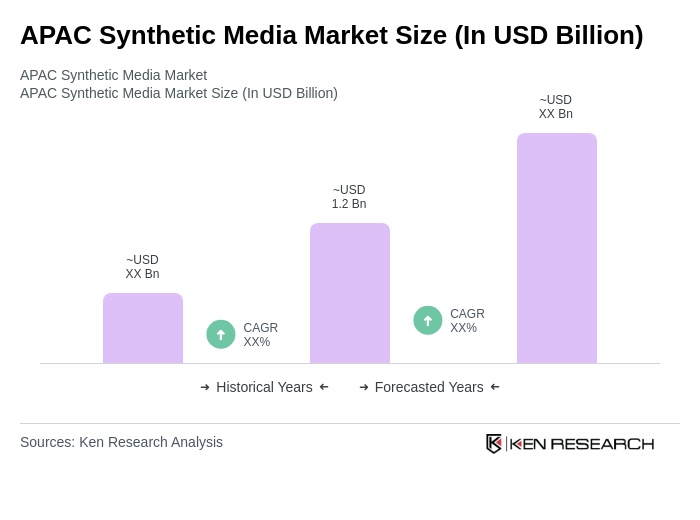
- The APAC Synthetic Media Market is valued at USD 1.2 billion, based on a five-year historical analysis. This growth is driven by rapid advancements in artificial intelligence and machine learning, which have enabled the creation of high-quality synthetic media content. Key growth drivers include the proliferation of generative AI models, falling costs of content creation, and the expansion of 5G infrastructure, all of which have accelerated adoption across entertainment, marketing, education, and e-commerce sectors. The pandemic further catalyzed demand for scalable digital communication, virtual teachers, and AI avatars, making synthetic media integral to the region’s digital transformation .
- Key players in this market include China, Japan, and South Korea, which dominate due to robust technological infrastructure and significant investments in AI research and development. China leads the region with over 28% market share, followed by Japan and South Korea, leveraging advanced capabilities in generative AI, virtual influencers, and digital-human projects to meet growing consumer demand for innovative media solutions .
- In 2023, the Indian government introduced the "Advisory on the Use of Artificial Intelligence in Media and Entertainment Sector, 2023" issued by the Ministry of Information & Broadcasting. This regulation mandates transparency in AI-generated content, requiring clear labeling and disclosure to inform consumers about the synthetic nature of media. The guidelines also set operational standards for ethical production, watermarking, and accountability, fostering trust and responsible innovation in synthetic media .
APAC Synthetic Media Market Segmentation
By Type:The market is segmented into text-based, audio-based, video-based, image-based, interactive, generative AI-based, and others. Text-based synthetic media covers chatbots and automated content generation, audio-based includes voice cloning and speech synthesis, video-based encompasses deepfake videos and AI-generated avatars, image-based involves generative art and synthetic photography, interactive refers to dynamic media experiences, and generative AI-based covers multimodal content creation. Each type addresses distinct consumer and enterprise needs, shaping market dynamics .
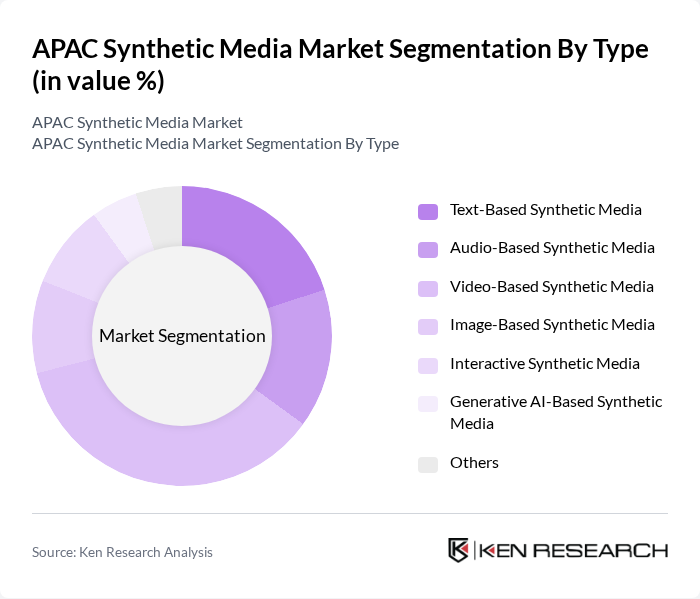
The video-based synthetic media segment is currently dominating the market, accounting for the largest share due to surging consumption of video content on social media, streaming platforms, and online education. The popularity of short-form mobile entertainment, AI-powered video marketing, and immersive experiences has driven adoption of synthetic video technologies, making this segment the preferred choice for brands and content creators .
By End-User:The market is segmented by end-user applications, including entertainment & gaming, marketing and advertising, education & e-learning, corporate training & communication, e-commerce & retail, government & public sector, and others. Entertainment & gaming utilizes synthetic media for immersive experiences, virtual influencers, and AI-driven content. Marketing and advertising leverage generative AI for personalized campaigns, while education & e-learning benefit from virtual teachers and automated content. Corporate training uses AI avatars and simulations, e-commerce applies synthetic images and videos for product listings, and government & public sector deploys AI for digital communication and citizen engagement .
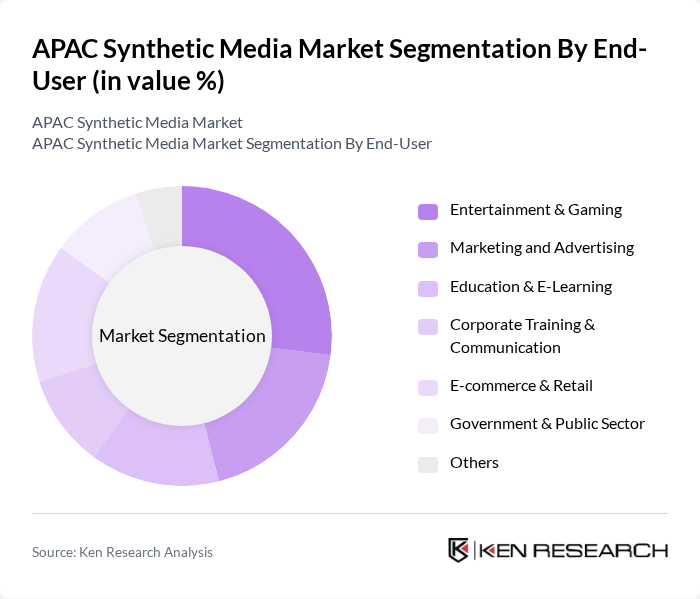
The entertainment and gaming segment leads the market, driven by demand for high-quality, immersive content and the rise of virtual reality (VR) and augmented reality (AR) technologies. AI-generated avatars, virtual influencers, and interactive gameplay are fueling growth, supported by the popularity of streaming platforms and user-generated content tools .
APAC Synthetic Media Market Competitive Landscape
The APAC Synthetic Media Market is characterized by a dynamic mix of regional and international players. Leading participants such as Synthesia, DeepBrain, Rephrase.ai, D-ID, Runway, Aiva Technologies, Hour One, Descript, Synthesys, Pictory, Lumen5, Wibbitz, Magisto, Veed.io, Flawless AI, Alibaba Cloud (Wan 2.2), ByteDance (Douyin, CapCut), Baidu, Tencent Cloud, Zhipu AI, Kakao Brain, LINE Corporation, ObEN, DeepScience (Japan), Neosapience, Sogou, GliaCloud, Viseme.ai, Hour Studio, ZEGOCLOUD contribute to innovation, geographic expansion, and service delivery in this space.
APAC Synthetic Media Market Industry Analysis
Growth Drivers
- Increasing Demand for Personalized Content:The APAC region is witnessing a surge in demand for personalized content, driven by a growing consumer base that values tailored experiences. In future, the e-commerce sector in APAC is projected to reach $4 trillion, with personalized marketing strategies expected to enhance customer engagement. This trend is supported by a 25% increase in digital content consumption, indicating a strong market for synthetic media that caters to individual preferences and enhances user experience.
- Advancements in AI and Machine Learning Technologies:The rapid evolution of AI and machine learning technologies is a significant growth driver for the synthetic media market in APAC. In future, the AI market in the region is anticipated to exceed $120 billion, with machine learning applications becoming increasingly sophisticated. This technological advancement enables the creation of high-quality synthetic media, enhancing its appeal across various sectors, including entertainment, education, and marketing, thereby driving market growth.
- Expansion of Digital Platforms and Streaming Services:The proliferation of digital platforms and streaming services in APAC is fueling the demand for synthetic media. By future, the number of streaming subscribers in the region is expected to surpass 1.2 billion, reflecting a 20% annual growth rate. This expansion creates a robust market for synthetic media, as content creators seek innovative ways to engage audiences, leading to increased investments in synthetic media technologies and applications.
Market Challenges
- Ethical Concerns Regarding Deepfakes:The rise of synthetic media, particularly deepfakes, poses significant ethical challenges in the APAC market. In future, it is estimated that 35% of consumers will express concerns over the authenticity of digital content, leading to potential backlash against brands utilizing synthetic media. This skepticism can hinder adoption rates and create a need for stringent ethical guidelines to ensure responsible usage and maintain consumer trust.
- Regulatory Hurdles and Compliance Issues:The regulatory landscape surrounding synthetic media in APAC is complex and evolving. In future, over 45% of companies in the region anticipate facing compliance challenges related to data protection and intellectual property rights. These regulatory hurdles can slow down the adoption of synthetic media technologies, as businesses navigate the legal implications of using AI-generated content, impacting overall market growth.
APAC Synthetic Media Market Future Outlook
The future of the synthetic media market in APAC appears promising, driven by technological advancements and increasing consumer acceptance. As AI and machine learning continue to evolve, the quality and accessibility of synthetic media will improve, fostering greater integration into various sectors. Additionally, the rise of ethical guidelines and regulatory frameworks will help address concerns, paving the way for responsible innovation. This environment will likely encourage investment and collaboration, further propelling market growth in the coming years.
Market Opportunities
- Growth in E-Learning and Online Education:The e-learning market in APAC is projected to reach $120 billion in future, creating significant opportunities for synthetic media applications. Enhanced interactive content can improve learning outcomes, making synthetic media an attractive solution for educational institutions seeking to engage students effectively.
- Potential in Virtual Reality and Augmented Reality Applications:The AR and VR market in APAC is expected to exceed $40 billion in future, presenting a lucrative opportunity for synthetic media integration. As businesses explore immersive experiences, synthetic media can enhance storytelling and user engagement, driving demand for innovative content solutions in these emerging technologies.
Scope of the Report
| Segment | Sub-Segments |
|---|---|
| By Type | Text-Based Synthetic Media Audio-Based Synthetic Media Video-Based Synthetic Media Image-Based Synthetic Media Interactive Synthetic Media Generative AI-Based Synthetic Media Others |
| By End-User | Entertainment & Gaming Marketing and Advertising Education & E-Learning Corporate Training & Communication E-commerce & Retail Government & Public Sector Others |
| By Region | China Japan South Korea India Southeast Asia Oceania Others |
| By Application | Content Creation (Video, Audio, Text, Image) Marketing Campaigns Virtual Events & Conferences Customer Engagement & Support Gaming & Metaverse Social Media Influencers & Virtual Humans Others |
| By Distribution Channel | Direct Sales Online Platforms & Marketplaces Partnerships with Content Creators & Agencies OEM & Cloud Providers Others |
| By Pricing Model | Subscription-Based Pay-Per-Use Licensing Freemium/Trial Others |
| By User Experience | Interactive Experiences Passive Consumption Customizable Content Multilingual/Localization Features Others |
Key Target Audience
Investors and Venture Capitalist Firms
Government and Regulatory Bodies (e.g., Ministry of Electronics and Information Technology, National Broadcasting and Telecommunications Commission)
Media and Entertainment Companies
Advertising Agencies
Content Creation Platforms
Technology Providers
Telecommunications Companies
Digital Marketing Firms
Players Mentioned in the Report:
Synthesia
DeepBrain
Rephrase.ai
D-ID
Runway
Aiva Technologies
Hour One
Descript
Synthesys
Pictory
Lumen5
Wibbitz
Magisto
Veed.io
Flawless AI
Alibaba Cloud (Wan 2.2)
ByteDance (Douyin, CapCut)
Baidu
Tencent Cloud
Zhipu AI
Kakao Brain
LINE Corporation
ObEN
DeepScience (Japan)
Neosapience
Sogou
GliaCloud
Viseme.ai
Hour Studio
ZEGOCLOUD
Table of Contents
Market Assessment Phase
1. Executive Summary and Approach
2. APAC Synthetic Media Market Overview
2.1 Key Insights and Strategic Recommendations
2.2 APAC Synthetic Media Market Overview
2.3 Definition and Scope
2.4 Evolution of Market Ecosystem
2.5 Timeline of Key Regulatory Milestones
2.6 Value Chain & Stakeholder Mapping
2.7 Business Cycle Analysis
2.8 Policy & Incentive Landscape
3. APAC Synthetic Media Market Analysis
3.1 Growth Drivers
3.1.1 Increasing Demand for Personalized Content
3.1.2 Advancements in AI and Machine Learning Technologies
3.1.3 Rising Adoption of Synthetic Media in Marketing
3.1.4 Expansion of Digital Platforms and Streaming Services
3.2 Market Challenges
3.2.1 Ethical Concerns Regarding Deepfakes
3.2.2 Regulatory Hurdles and Compliance Issues
3.2.3 High Initial Investment Costs
3.2.4 Limited Awareness Among Potential Users
3.3 Market Opportunities
3.3.1 Growth in E-Learning and Online Education
3.3.2 Potential in Virtual Reality and Augmented Reality Applications
3.3.3 Expansion into Emerging Markets
3.3.4 Collaborations with Content Creators and Influencers
3.4 Market Trends
3.4.1 Increasing Use of Synthetic Media in Entertainment
3.4.2 Integration of Synthetic Media in Social Media Platforms
3.4.3 Growth of User-Generated Content Utilizing Synthetic Media
3.4.4 Rise of Ethical Guidelines for Synthetic Media Usage
3.5 Government Regulation
3.5.1 Data Protection and Privacy Laws
3.5.2 Regulations on Deepfake Technology
3.5.3 Intellectual Property Rights for Synthetic Content
3.5.4 Compliance Standards for Advertising and Marketing
4. SWOT Analysis
5. Stakeholder Analysis
6. Porter's Five Forces Analysis
7. APAC Synthetic Media Market Market Size, 2019-2024
7.1 By Value
7.2 By Volume
7.3 By Average Selling Price
8. APAC Synthetic Media Market Segmentation
8.1 By Type
8.1.1 Text-Based Synthetic Media
8.1.2 Audio-Based Synthetic Media
8.1.3 Video-Based Synthetic Media
8.1.4 Image-Based Synthetic Media
8.1.5 Interactive Synthetic Media
8.1.6 Generative AI-Based Synthetic Media
8.1.7 Others
8.2 By End-User
8.2.1 Entertainment & Gaming
8.2.2 Marketing and Advertising
8.2.3 Education & E-Learning
8.2.4 Corporate Training & Communication
8.2.5 E-commerce & Retail
8.2.6 Government & Public Sector
8.2.7 Others
8.3 By Region
8.3.1 China
8.3.2 Japan
8.3.3 South Korea
8.3.4 India
8.3.5 Southeast Asia
8.3.6 Oceania
8.3.7 Others
8.4 By Application
8.4.1 Content Creation (Video, Audio, Text, Image)
8.4.2 Marketing Campaigns
8.4.3 Virtual Events & Conferences
8.4.4 Customer Engagement & Support
8.4.5 Gaming & Metaverse
8.4.6 Social Media Influencers & Virtual Humans
8.4.7 Others
8.5 By Distribution Channel
8.5.1 Direct Sales
8.5.2 Online Platforms & Marketplaces
8.5.3 Partnerships with Content Creators & Agencies
8.5.4 OEM & Cloud Providers
8.5.5 Others
8.6 By Pricing Model
8.6.1 Subscription-Based
8.6.2 Pay-Per-Use
8.6.3 Licensing
8.6.4 Freemium/Trial
8.6.5 Others
8.7 By User Experience
8.7.1 Interactive Experiences
8.7.2 Passive Consumption
8.7.3 Customizable Content
8.7.4 Multilingual/Localization Features
8.7.5 Others
9. APAC Synthetic Media Market Competitive Analysis
9.1 Market Share of Key Players
9.2 Cross Comparison of Key Players
9.2.1 Company Name
9.2.2 Group Size (Large, Medium, or Small as per industry convention)
9.2.3 Revenue Growth Rate (YoY %)
9.2.4 Customer Acquisition Cost (CAC)
9.2.5 Customer Retention Rate (%)
9.2.6 Market Penetration Rate (Regional Share %)
9.2.7 Pricing Strategy (Subscription, Licensing, Freemium, etc.)
9.2.8 Average Deal Size (USD)
9.2.9 Return on Investment (ROI %)
9.2.10 Brand Equity Score (Survey/Index)
9.2.11 R&D Intensity (% of Revenue)
9.2.12 Product Localization Index (Languages Supported)
9.2.13 Regulatory Compliance Score
9.3 SWOT Analysis of Top Players
9.4 Pricing Analysis
9.5 Detailed Profile of Major Companies
9.5.1 Synthesia
9.5.2 DeepBrain
9.5.3 Rephrase.ai
9.5.4 D-ID
9.5.5 Runway
9.5.6 Aiva Technologies
9.5.7 Hour One
9.5.8 Descript
9.5.9 Synthesys
9.5.10 Pictory
9.5.11 Lumen5
9.5.12 Wibbitz
9.5.13 Magisto
9.5.14 Veed.io
9.5.15 Flawless AI
9.5.16 Alibaba Cloud (Wan 2.2)
9.5.17 ByteDance (Douyin, CapCut)
9.5.18 Baidu
9.5.19 Tencent Cloud
9.5.20 Zhipu AI
9.5.21 Kakao Brain
9.5.22 LINE Corporation
9.5.23 ObEN
9.5.24 DeepScience (Japan)
9.5.25 Neosapience
9.5.26 Sogou
9.5.27 GliaCloud
9.5.28 Viseme.ai
9.5.29 Hour Studio
9.5.30 ZEGOCLOUD
10. APAC Synthetic Media Market End-User Analysis
10.1 Procurement Behavior of Key Ministries
10.1.1 Government Initiatives for Digital Transformation
10.1.2 Budget Allocations for Media and Technology
10.1.3 Collaboration with Private Sector for Innovation
10.2 Corporate Spend on Infrastructure & Energy
10.2.1 Investment in Digital Infrastructure
10.2.2 Spending on Training and Development
10.2.3 Budget for Marketing and Advertising
10.3 Pain Point Analysis by End-User Category
10.3.1 Content Quality Concerns
10.3.2 Integration with Existing Systems
10.3.3 Cost Management Issues
10.4 User Readiness for Adoption
10.4.1 Awareness of Synthetic Media Benefits
10.4.2 Training Needs for Effective Use
10.4.3 Technological Infrastructure Readiness
10.5 Post-Deployment ROI and Use Case Expansion
10.5.1 Measurement of Success Metrics
10.5.2 Opportunities for Scaling Usage
10.5.3 Feedback Mechanisms for Continuous Improvement
11. APAC Synthetic Media Market Future Size, 2025-2030
11.1 By Value
11.2 By Volume
11.3 By Average Selling Price
Go-To-Market Strategy Phase
1. Whitespace Analysis + Business Model Canvas
1.1 Market Gaps Identification
1.2 Value Proposition Development
1.3 Revenue Streams Analysis
1.4 Cost Structure Evaluation
1.5 Key Partnerships Exploration
1.6 Customer Segmentation
1.7 Channels for Delivery
2. Marketing and Positioning Recommendations
2.1 Branding Strategies
2.2 Product USPs
2.3 Target Audience Identification
2.4 Communication Strategies
2.5 Digital Marketing Approaches
3. Distribution Plan
3.1 Urban Retail Strategies
3.2 Rural NGO Tie-Ups
3.3 Online Distribution Channels
3.4 Partnerships with Local Distributors
4. Channel & Pricing Gaps
4.1 Underserved Routes
4.2 Pricing Bands Analysis
4.3 Competitor Pricing Strategies
5. Unmet Demand & Latent Needs
5.1 Category Gaps Identification
5.2 Consumer Segments Analysis
5.3 Emerging Trends Exploration
6. Customer Relationship
6.1 Loyalty Programs Development
6.2 After-Sales Service Strategies
6.3 Customer Feedback Mechanisms
7. Value Proposition
7.1 Sustainability Initiatives
7.2 Integrated Supply Chains
7.3 Unique Selling Points
8. Key Activities
8.1 Regulatory Compliance
8.2 Branding Initiatives
8.3 Distribution Setup
9. Entry Strategy Evaluation
9.1 Domestic Market Entry Strategy
9.1.1 Product Mix Considerations
9.1.2 Pricing Band Strategy
9.1.3 Packaging Innovations
9.2 Export Entry Strategy
9.2.1 Target Countries Identification
9.2.2 Compliance Roadmap Development
10. Entry Mode Assessment
10.1 Joint Ventures
10.2 Greenfield Investments
10.3 Mergers & Acquisitions
10.4 Distributor Model Evaluation
11. Capital and Timeline Estimation
11.1 Capital Requirements Analysis
11.2 Timelines for Market Entry
12. Control vs Risk Trade-Off
12.1 Ownership vs Partnerships
13. Profitability Outlook
13.1 Breakeven Analysis
13.2 Long-Term Sustainability Strategies
14. Potential Partner List
14.1 Distributors Identification
14.2 Joint Ventures Opportunities
14.3 Acquisition Targets
15. Execution Roadmap
15.1 Phased Plan for Market Entry
15.1.1 Market Setup
15.1.2 Market Entry
15.1.3 Growth Acceleration
15.1.4 Scale & Stabilize
15.2 Key Activities and Milestones
15.2.1 Milestone Planning
15.2.2 Activity Tracking
Research Methodology
Phase 1: Approach1
Desk Research
- Industry reports from market research firms focusing on synthetic media trends in APAC
- Government publications and white papers on digital content regulations and technology adoption
- Academic journals and conference proceedings discussing advancements in synthetic media technologies
Primary Research
- Interviews with technology leaders in synthetic media companies across APAC
- Surveys targeting content creators and digital marketers utilizing synthetic media tools
- Focus groups with end-users to understand perceptions and acceptance of synthetic media
Validation & Triangulation
- Cross-validation of findings through multiple industry expert interviews
- Triangulation of data from primary and secondary sources to ensure consistency
- Sanity checks through feedback from a panel of synthetic media experts
Phase 2: Market Size Estimation1
Top-down Assessment
- Analysis of overall digital media spending in APAC to estimate synthetic media share
- Segmentation by industry verticals such as entertainment, advertising, and education
- Incorporation of growth rates from related sectors like AI and machine learning
Bottom-up Modeling
- Estimation of revenue from leading synthetic media platforms and tools
- Analysis of user adoption rates and average spending per user on synthetic media solutions
- Volume x pricing model based on subscription and licensing fees for synthetic media products
Forecasting & Scenario Analysis
- Multi-variable forecasting using trends in AI technology and consumer behavior
- Scenario analysis based on regulatory changes and technological advancements
- Development of baseline, optimistic, and pessimistic growth projections through 2030
Phase 3: CATI Sample Composition1
| Scope Item/Segment | Sample Size | Target Respondent Profiles |
|---|---|---|
| Entertainment Industry Adoption | 100 | Content Producers, Studio Executives |
| Advertising Sector Utilization | 80 | Marketing Directors, Creative Strategists |
| Education Technology Integration | 70 | EdTech Innovators, Curriculum Developers |
| Gaming Industry Insights | 60 | Game Developers, User Experience Designers |
| Corporate Training Applications | 50 | HR Managers, Training Coordinators |
Frequently Asked Questions
What is the current value of the APAC Synthetic Media Market?
The APAC Synthetic Media Market is valued at approximately USD 1.2 billion, driven by advancements in artificial intelligence and machine learning, which facilitate the creation of high-quality synthetic media content across various sectors.
What are the key growth drivers of the APAC Synthetic Media Market?
Which countries dominate the APAC Synthetic Media Market?
What types of synthetic media are prevalent in the APAC market?
Other Regional/Country Reports
Indonesia Synthetic Media Market
Malaysia Synthetic Media Market
KSA Synthetic Media Market
SEA Synthetic Media Market
Vietnam Synthetic Media Market
Thailand Synthetic Media Market
Other Adjacent Reports
Brazil Deepfake Technology Market
Brazil Voice Synthesis Market
Philippines Video Editing Software Market
UAE digital advertising market report Size, Share, Growth Drivers, Trends, Opportunities & Forecast 2025–2030Indonesia Entertainment Streaming Market
Philippines E-Learning Platforms Market
Global Virtual Reality MarketAPAC augmented reality market Size, Share, Growth Drivers, Trends, Opportunities & Forecast 2025–2030Oman Cybersecurity Solutions Market
Why Buy From Us?

What makes us stand out is that our consultants follow Robust, Refine and Result (RRR) methodology. Robust for clear definitions, approaches and sanity checking, Refine for differentiating respondents' facts and opinions, and Result for presenting data with story.

We have set a benchmark in the industry by offering our clients with syndicated and customized market research reports featuring coverage of entire market as well as meticulous research and analyst insights.

While we don't replace traditional research, we flip the method upside down. Our dual approach of Top Bottom & Bottom Top ensures quality deliverable by not just verifying company fundamentals but also looking at the sector and macroeconomic factors.

With one step in the future, our research team constantly tries to show you the bigger picture. We help with some of the tough questions you may encounter along the way: How is the industry positioned? Best marketing channel? KPI's of competitors? By aligning every element, we help maximize success.

Our report gives you instant access to the answers and sources that other companies might choose to hide. We elaborate each steps of research methodology we have used and showcase you the sample size to earn your trust.

If you need any support, we are here! We pride ourselves on universe strength, data quality, and quick, friendly, and professional service.