GCC Animal Feed Market Outlook 2030: USD 8 Billion Market, but Commodity Milling Margins Are Falling Below 9%
Ken Research
August 5, 2026 - 15 min read
August 5, 2026
by Ken ResearchThe GCC animal feed market is expanding, but market growth is no longer a reliable indicator of where profit will accrue.
The GCC compound feed market is valued at approximately USD 8 billion in 2025, supported by demand of around 18 million metric tonnes and projected growth of nearly 7% CAGR through 2030. The opportunity, however, is highly concentrated: Saudi Arabia accounts for approximately 74% of regional compound feed volume, making it the principal market for demand, capacity expansion and competitive positioning across the GCC.
The attractive headline, however, conceals a widening margin divide.
Standalone commodity millers continue to operate with an ingredient base that can represent 70% to 75% of production costs. More than 85% of feed ingredients are imported across the GCC, while dependence on corn, soybean meal and barley exceeds 90% in key parts of the market. When input prices rise, independent millers absorb the immediate pressure. Their ability to pass that increase to farmers is constrained by customer economics, price competition and limited product differentiation.
At the same time, leading competitors are moving beyond conventional feed milling. They are building captive feed systems, combining nutrition with animal health, entering feed minerals, expanding aquaculture exposure and capturing downstream margins in farming, processing, cold chain and distribution.
The strategic issue is no longer whether the GCC animal feed market will expand, but whether companies are positioned in the value-chain segments where that growth can generate defensible margins.
The Russia-Ukraine War and Strait of Hormuz Disruption Exposed a Structural Weakness in GCC Feed Economics
The Russia-Ukraine war did not create the GCC’s dependence on imported feed ingredients, but it demonstrated how quickly that dependence can undermine mill-level profitability.
Ken Research’s commodity analysis shows corn prices rising from USD 165 per tonne in 2020 to USD 318 in 2022. Soybean prices increased from USD 373 to USD 570 per tonne, while barley moved from USD 148 to USD 225 per tonne over the same period. Disruption to Black Sea exports pushed all three major ingredients to their period highs in 2022.
Prices subsequently moderated. Corn declined to USD 190 per tonne in 2024 before reaching USD 209 through May 2026. Barley fell to USD 115 in 2025 and stood at USD 117 through May 2026. Soybean declined to USD 381 in 2025 but increased again to USD 452 through May 2026.
The Strait of Hormuz has added another layer of risk to this import-dependent model. Ken Research identifies disruption around the passage as a source of additional pressure on corn and soybean costs, with the potential to weaken gross margins further. For GCC feed companies, the exposure extends beyond the commodity price itself to shipping availability, freight, delivery schedules and the amount of inventory required to protect production continuity.
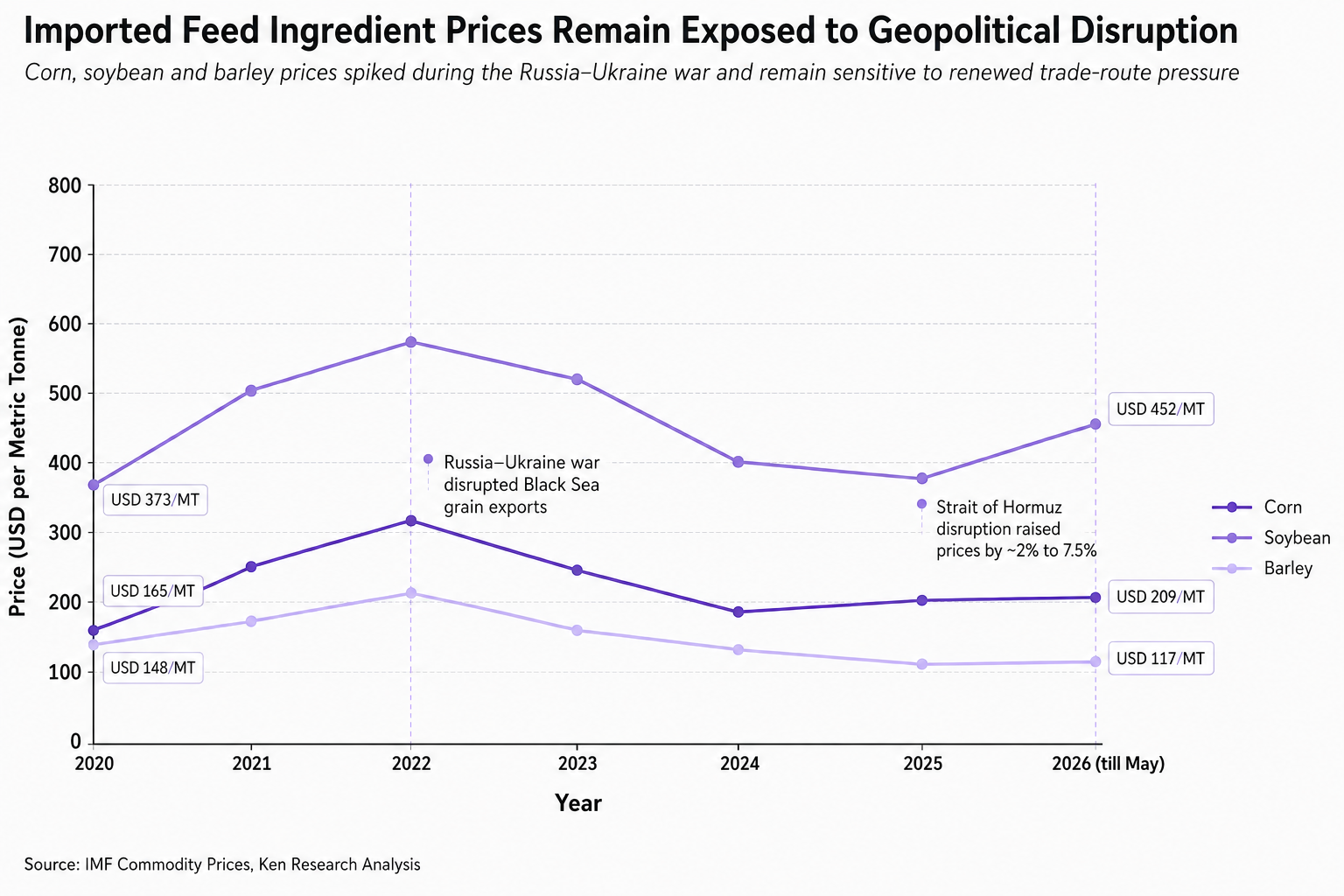
The strategic risk is not a permanently rising commodity cycle, but repeated exposure to geopolitical shocks across both supply origins and critical import corridors.
Also Read: Strait of Hormuz Disruption, Fertiliser Prices and Global Food-Security Risk
The exposure is amplified by feed formulation.
Corn can represent approximately 60% to 65% of poultry feed and 65% to 70% of ruminant feed. Soybean and barley add further commodity exposure. When the largest components of the formulation are internationally priced and imported through exposed trade routes, volatility moves directly into the cost base.
For a standalone feed miller, this becomes a bottleneck because cost and revenue do not move together.
Raw ingredients are purchased at prevailing market rates. Selling prices, however, may be constrained by farmer affordability, competition and the wider economics of poultry, dairy and livestock production. A rapid cost increase can therefore compress gross profit before the miller can renegotiate customer pricing.
This explains why procurement capability is becoming as important as milling capacity. Ingredient sourcing, freight management, safety-stock policy, formulation flexibility and working-capital control now determine whether demand growth creates profit or simply increases exposure.
A company considering new capacity should not begin with the question, “How fast is regional feed demand growing?” It should begin with a harder question:
Can the business maintain supply and retain an acceptable contribution per tonne when commodity prices, freight costs and import routes are disrupted simultaneously?
How Saudi Arabia’s 74% Share Shapes GCC Feed Investment and Market Entry?
Saudi Arabia accounts for approximately 8.4 to 9.2 million tonnes of feed demand and around 74% of GCC compound feed volume. It also has more than 12 large feed mills and the deepest base of integrated poultry, dairy and animal-protein operators in the region.
That scale makes the GCC feed market predominantly a Saudi-led economic system.
Saudi Arabia influences the region’s procurement volumes, capacity decisions, customer expectations and integration models. It is where companies are making the largest commitments to captive feed, processing, animal health, speciality minerals and food-security-driven production.
The remaining GCC markets fulfil different roles.
The UAE accounts for around 8% of regional feed volume and operates as a regional trading and re-export hub. Its competitive advantage lies in logistics, Jebel Ali infrastructure and access to wider MENA and East African markets.
Oman represents approximately 5% of volume, but its strategic relevance is greater in aquaculture. Its coastal geography and marine-feed links differentiate it from markets centred primarily on poultry and dairy.
Qatar accounts for about 5% of GCC volume and is characterised by concentrated, food-security-led production. Kuwait contributes around 5%, while Bahrain represents roughly 3% and remains the smallest, most import-dependent market.
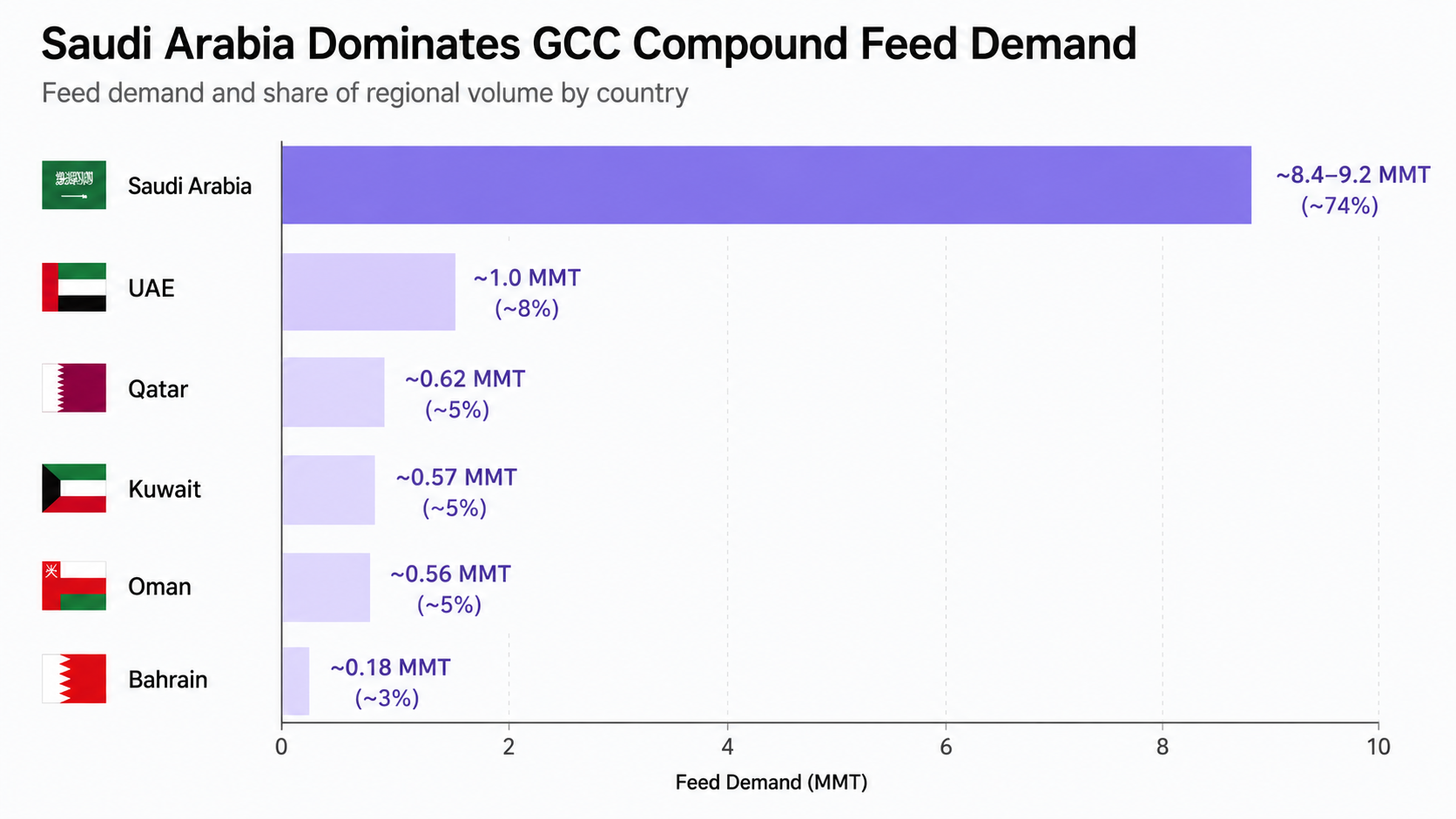
This creates different entry models across the GCC.
Saudi Arabia is the essential market for companies seeking production scale. The UAE is more relevant for distribution, trading and re-export. Oman offers a more specialised aquaculture position. Qatar is better understood through integrated domestic production. Kuwait and Bahrain may be addressed more effectively through regional distribution than through substantial standalone manufacturing.
A GCC strategy built around one product, one commercial model and one route to market will therefore miss the underlying structure of the region. Examine the country-level demand patterns, market-entry models, route-to-market priorities and the structural differences shaping investment decisions across Saudi Arabia, the UAE, Oman, Qatar, Kuwait and Bahrain. Download the complimentary GCC Animal Nutrition Market Analysis.
90%+ Import Dependence Leaves Commodity Feed Margins Structurally Exposed
Ken Research estimates standalone commodity-milling gross margins at approximately 5% to 9%. Four forces are reinforcing that pressure.
The first is import dependence. Domestic feed-crop production remains constrained by the region’s arid climate and limited agricultural resources. More than 90% of corn, soy, and barley are imported. Standalone millers purchase most of their major ingredients at globally determined prices and carry the associated commodity, freight and supply-chain risk.
The second is weak pricing power. Feed customers cannot absorb unlimited increases because feed is already a major component of farming costs. Millers can face a lag between paying more for ingredients and recovering that cost through higher selling prices.
The third is increasing competition from integrated operators. Global and regional integrators have expanded their presence through investments and partnerships, including JBS’s Jeddah plant, the BRF Saudi joint venture, the Cargill-ARASCO-NEOM agreement and the MHP-Tanmiah partnership. These models bring captive demand, larger procurement platforms and value capture beyond the mill gate.
The fourth is limited differentiation in commodity feed. GCC feed export prices fell from approximately USD 1,812 per tonne in 2023 to USD 860 in 2024, a decline of around 53%. While export prices are not a direct proxy for domestic mill margins, the decline signals intensifying price pressure on undifferentiated feed products.
These pressures cannot be solved through volume alone.
A larger mill may achieve lower fixed costs per tonne, but scale does not remove commodity exposure, customer credit risk or weak price pass-through. Production growth can even increase working-capital requirements and deepen exposure to low-margin accounts.
How GCC Feed Leaders Are Defending Margins Beyond Commodity Milling
Vertical integration is becoming a margin-protection strategy, not simply a scale strategy. Captive demand improves mill utilisation, farm integration links formulation to animal performance, and downstream processing and distribution add further sources of value capture. As imported-input volatility and commodity-feed pricing pressure intensify, control across the value chain gives leading operators more levers to absorb shocks, coordinate production and protect returns. The advantage lies not in owning more assets, but in controlling the stages that most directly shape cost, demand and margin.
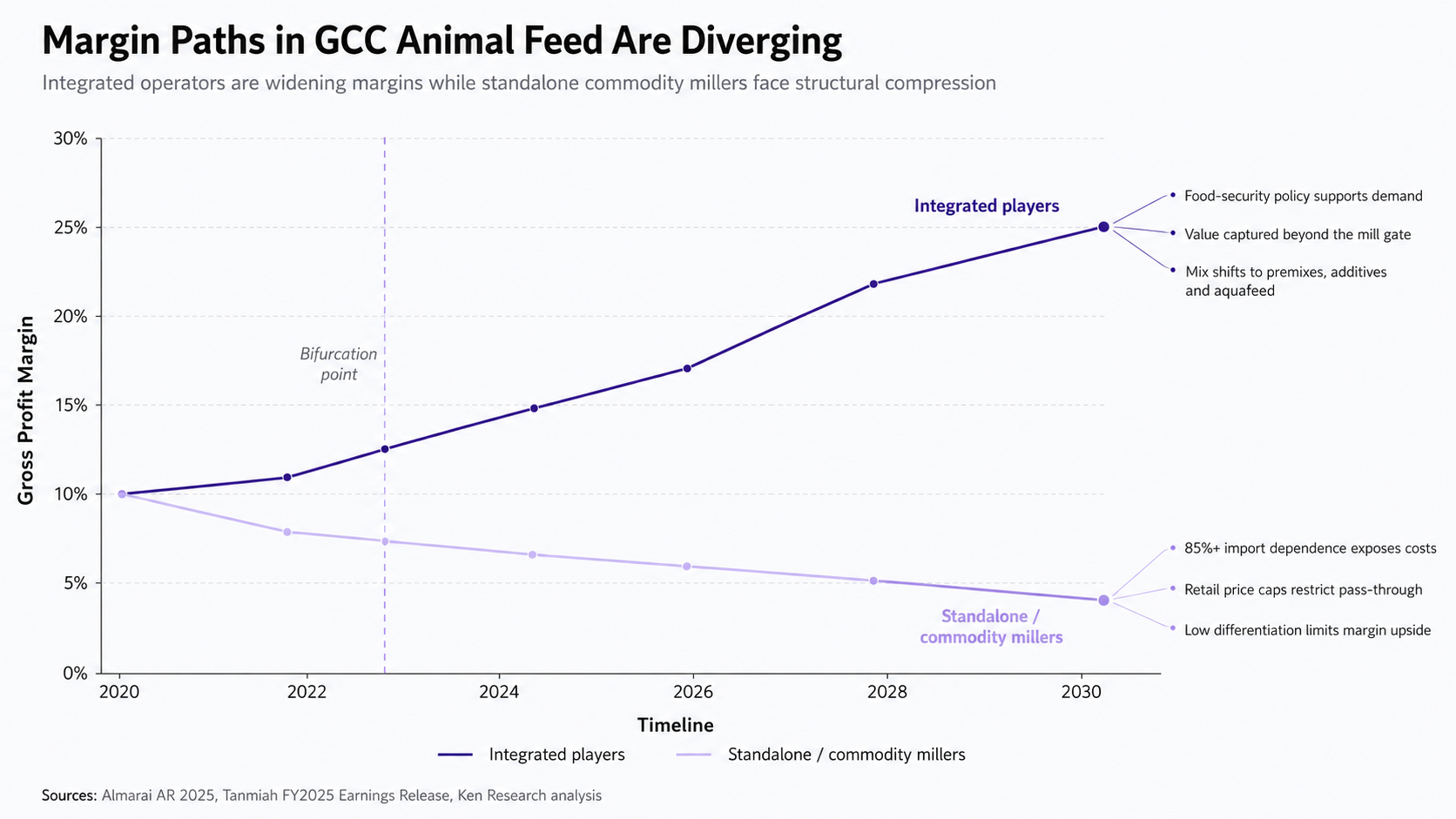
The market’s leading operators reveal how the competitive model is changing.
Almarai, the largest feed buyer in the GCC, represents the fullest form of vertical integration. Its system spans captive feed mills, farms, processing, cold chain, distribution and retail. The company reported USD 5.8 billion in FY2025 revenue, a gross margin of approximately 31.5%, net profit growth of 6.18% to SAR 2.456 billion, and a USD 4.8 billion five-year investment plan.
These figures demonstrate the economics of a broader integrated food platform that captures value across several stages.
Tanmiah, the first GCC company to bundle feed-plus-health as a single revenue stream, follows a feed-to-processing model supported by animal-health capabilities. It reported USD 681 million in FY2025 revenue, reflecting 3.5% growth. The company processed 168 million birds and recorded a gross margin of 22.8%. Its Dahna feed mill and new large-bird processing plant were commissioned in 2025, strengthening control across feed and poultry production.
Baladna demonstrates a sovereign-backed dairy-integration model. It increased Qatar’s dairy self-sufficiency from 28% in 2017 to 100% in 2022, developed a herd of more than 30,000 Holstein cows, and invested more than USD 1.72 billion. Its operating model combines captive total mixed ration production, farming, processing and cold-chain distribution.
ARASCO occupies another strategic position. It combines imported raw materials, premixes, compound feed and DCP production. Its DCP capacity of approximately 250,000 tonnes per year and compound feed capacity of around 4 million tonnes provide exposure to both large-volume and higher-value categories.
NAQUA represents the integrated aquaculture model, linking captive aquafeed with shrimp and fish farming, processing and cold-chain exports.
These companies differ in ownership, species focus and operating model, but the competitive trend is consistent. Leading players are reducing their dependence on a single mill-level margin.
They are capturing value through captive demand, downstream processing, animal health, feed minerals, specialist nutrition and export access.
For an independent miller, the competitor is therefore no longer simply another feed producer. It may be an integrated platform that can accept a lower standalone feed return because it earns profit elsewhere in the chain.
Vertical Integration Can Protect Value, but Only Where Control Justifies the Capital
Integration provides three potential economic advantages.
It secures internal demand for feed. It enables closer coordination between formulation and animal performance. It allows the operator to capture margin in farming, processing, distribution or branded food rather than relying on the mill gate alone.
These benefits help explain the divergence between integrated operators and standalone commodity millers.
Ken Research’s analysis shows integrated-player margins moving upward over time while commodity-miller margins trend downward. The trajectory is indicative, but the strategic direction is clear: companies controlling multiple stages have more levers for absorbing input shocks and reallocating value across the chain.
However, integration is not automatically superior.
It requires capital, farm-management capability, biosecurity, downstream execution and stronger working-capital management. A company can destroy value by acquiring stages it cannot operate well.
The decision should therefore not be framed as “integrate or be left behind.” The more useful question is:
Which stage of integration materially improves the company’s economics, and which capabilities are better accessed through partnerships?
For standalone millers, feed-plus-health bundling or speciality distribution may offer a more capital-efficient route than farm ownership. Established poultry operators can strengthen existing integration through targeted feed and processing investments, while global nutrition companies may use local partnerships or joint ventures to access customers, distribution and market capabilities.
Which GCC Animal Feed Segments Offer the Strongest Margin Expansion Potential?
Ken Research identifies a clear margin gradient across the GCC feed value chain.
Commodity feed milling is positioned below 9% gross margin. Premixes and additives are estimated at around 12% to 15%. DCP and speciality feed minerals exceed 18%, while aquafeed and speciality nutrition are positioned above 20%. Integrated models are estimated at around 12% to 18%, with additional value captured through farming, processing and distribution.
These ranges do not mean that every speciality category is more attractive than every commodity business. Profitability must be considered alongside volume, capital intensity, market access and execution risk.
A high-margin category with limited addressable demand or difficult customer access may generate less value than a lower-margin business with substantial volume and a genuine cost advantage.
The relevant investment test is the interaction of four factors: recurring margin, scalable demand, capability fit and defensibility.
Premixes and Additives Offer 12%–15% Margins Through Technical Differentiation
Premixes and additives represent a different competitive model from commodity feed.
Ken Research estimates the feed premix and additives market increasing from approximately USD 3.1 billion in 2022 to USD 3.90 billion in 2025, with a projected CAGR of 6.2% to reach USD 5.27 billion by 2030.
The category’s strategic appeal lies in its connection to animal performance. Premixes, vitamins, minerals, amino acids and enzymes can improve feed conversion, nutrient delivery, health and production consistency.
This allows suppliers to compete on outcomes rather than tonnes.
However, the category cannot be entered credibly through manufacturing equipment alone. It requires formulation expertise, regulatory compliance, technical selling, product trials and customer trust.
The best route depends less on available plant space than on access to technical knowledge and customers.
Feed-Plus-Health Bundling Offers a Nearer-Term Route out of Commodity Dependence
Feed-plus-health bundling is one of the more accessible strategic adjacencies identified by Ken Research.
The model combines feed with animal-health products, veterinary support, farm advisory or monitoring. It changes the commercial relationship from a feed transaction into a farm-performance proposition.
Tanmiah’s feed and animal-health platform provides a relevant regional example. Its feed-and-health segment generated approximately USD 116 million, while the broader company expanded poultry processing and commissioned new feed and processing capacity.
The attraction for standalone millers is that bundling may use existing farm relationships without requiring full downstream ownership.
Ken Research assesses feed-plus-health bundling as a low-to-medium-capital pathway with the potential for a 5 to 8 percentage-point margin uplift.
The proposition will succeed only if it improves a measurable farm outcome. Adding more products to the catalogue is not sufficient. The company must demonstrate better feed conversion, lower mortality, stronger animal health or more consistent production.
DCP Offers a Higher-Value Mineral and Export Opportunity
Dicalcium phosphate creates a distinct profit pool because it is a processed, specification-led feed mineral rather than a bulk grain or standard compound feed.
Ken Research estimates gross margins above 18% for DCP and speciality feed minerals. Saudi Arabia has emerged as the primary GCC exporter, supported by domestic phosphate resources and industrial processing capability.
DCP export prices increased from approximately USD 556 per tonne in 2022 to USD 1,795 in 2023, while the export value to Vietnam reached USD 3,244 per tonne.
A high destination price is not enough. The product must remain competitive after energy, conversion, freight, distributor margin and market-access costs.
For companies with a structural input advantage, DCP can provide a stronger export proposition than bulk commodity feed.
Aquafeed Is Emerging as a 20%+ Margin Opportunity in GCC Animal Nutrition
Aquafeed is gaining strategic relevance as technical performance, species-specific formulation and integrated production models create greater scope for differentiation than conventional feed.
Dive deeper into the USD 499 million Saudi aquafeed opportunity, Oman–Saudi trade flows, integrated operating models and the conditions required to build a commercially viable position in this segment. Download the complimentary GCC Animal Nutrition Market Analysis .
USD 77 Million in GCC Speciality Feed Exports Signals a New Growth Platform
Ken Research estimates total GCC speciality feed exports at approximately USD 77 million in 2024. The emerging corridors show three distinct regional models.
Saudi Arabia is exporting DCP and compound-feed preparations, including approximately USD 29 million to Bangladesh, USD 14 million to Iraq, USD 11 million to Vietnam and USD 7 million to the UAE across selected product flows.
Oman is supplying around USD 18 million of aquafeed-related inputs to Saudi Arabia.
The UAE re-exported approximately 55 million kilograms of feed ingredients in 2024, using Jebel Ali as a redistribution platform into East Africa and wider MENA markets.
The data shows that the regional opportunity is not confined to domestic animal production. Yet export attractiveness differs sharply by product. Bulk commodity feed has limited value per tonne and is subject to freight pressure. Higher-value minerals, premixes and specialist nutrition products can absorb logistics and channel costs more effectively.
Export decisions should therefore be based on landed competitiveness, recurring buyer demand and product differentiation rather than headline trade flows alone.
The Right Strategy Depends on the Player’s Starting Position
Standalone commodity millers should first protect core economics through stronger procurement, formulation, utilisation and working-capital control. Their clearest near-term route is feed-plus-health bundling, which offers margin expansion without requiring full downstream ownership.
Integrated operators should extract more value from assets they already control. Captive feed, farming, processing and distribution create multiple margin levers, but further integration should be pursued only where it strengthens returns.
Global nutrition companies and new entrants are better positioned to compete through speciality nutrition, local partnerships and joint ventures than by replicating commodity-feed scale.
Investors must distinguish total feed demand from commercially accessible demand. Captive production by integrated operators means headline consumption can overstate the merchant opportunity.
What Decision-Makers Should Resolve Before Committing Capital
Capital allocation in GCC animal feed should begin with a clear understanding of where margins are created, where demand is commercially accessible and which risks can be controlled. Ken Research supports this by benchmarking value-chain economics across feed, premixes, additives, minerals and integrated models, helping companies separate structurally attractive opportunities from those supported only by headline growth.
New commodity capacity should be tested against sourcing economics, achievable utilisation, buyer concentration and sustainable contribution per tonne. Higher-value categories such as premixes, additives, DCP, aquafeed and speciality nutrition should then be assessed through product demand, technical requirements, pricing benchmarks and competitive positioning.
The route to market also requires discipline. Build-buy-partner analysis can determine whether technical capability, distribution access and customer relationships should be developed internally, acquired or accessed through collaboration. Export opportunities must be evaluated on landed competitiveness, buyer requirements, recurring demand and route-to-market economics rather than trade values alone.
The result should be a board-ready investment roadmap that defines where to play, how to enter and which options to avoid. Schedule a strategic consultation with Ken Research to evaluate the most defensible GCC feed profit pools, the operating model required to capture them, and the areas where capital deployment should be avoided.
GCC Feed Growth Will Reward Selective Movement, Not Indiscriminate Expansion
The GCC animal feed market remains attractive in scale, but its profit pools are becoming less uniform.
Commodity milling will continue to supply the bulk of regional demand, yet independent millers face imported ingredient volatility, limited pricing power and increasingly sophisticated integrated competition.
Higher-value opportunities are emerging in premixes, additives, DCP, aquafeed, feed-plus-health and selected export corridors. Each requires a different combination of capital, capability and market access.
The companies most likely to outperform will not necessarily be those with the largest installed feed capacity. They will be those that understand which risks they can control, which customer outcomes they can improve and which parts of the value chain offer them a defensible right to win.
Ken Research helps feed millers, integrated agribusinesses, nutrition companies, importers, exporters and investors assess these choices through value-chain margin benchmarking, competitor analysis, product-opportunity assessment, market-entry strategy, build-buy-partner evaluation and export-market prioritisation. Speak with a Ken Research expert to assess which GCC animal nutrition profit pools are commercially accessible for your business and what capabilities will be required to compete.
Get started
We've helped companies around the world future-proof
their businesses - and we can do the same for you.