About the Report
Base Year 2024Asean Bancassurance Market Overview
- The Asean Bancassurance Market is valued at USD 34 billion, based on a five-year historical analysis. This growth is primarily driven by the increasing integration of banking and insurance services, rising digital distribution via mobile and online channels, and stronger bank–insurer partnerships that leverage large customer bases for cross-sell. The market has seen growing demand for bundled financial solutions and protection-led offerings, supported by data-driven personalization and embedded insurance in banking journeys.
- Countries such as Singapore, Malaysia, and Thailand dominate the Asean Bancassurance Market due to advanced financial infrastructure, high banked populations, and supportive supervisory regimes that enable bank–insurer tie-ups. Singapore acts as a regional financial hub with multiple multinational insurers and banks coordinating regional bancassurance strategies, while Malaysia and Thailand benefit from mature bank networks and rising middle-income consumers focused on protection and savings solutions.
- In 2023, the region did not adopt a single “ASEAN Insurance Act”; rather, bancassurance is governed by country-level regulations that have increasingly emphasized conduct, suitability, and disclosure (e.g., MAS fair dealing in Singapore, BNM bancassurance guidelines in Malaysia, and OIC conduct rules in Thailand). These frameworks mandate consumer protection standards for banks distributing insurance, aiming to enhance transparency and trust in bancassurance.

Asean Bancassurance Market Segmentation
By Type:The Asean Bancassurance Market can be segmented into various types, including Life Bancassurance, Non-Life Bancassurance, Investment-Linked Insurance, Takaful, and SME Group Products. Each of these segments caters to different consumer needs and preferences, reflecting the diverse landscape of financial products available in the region.
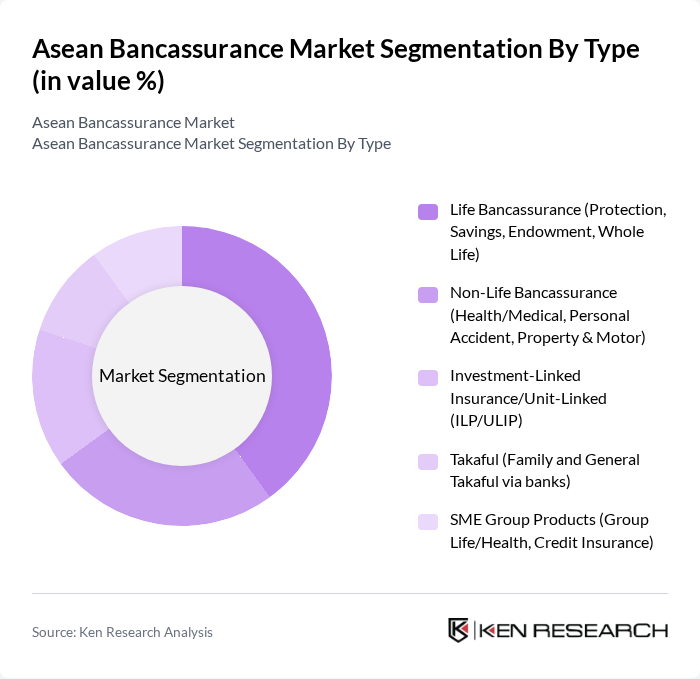
The Life Bancassurance segment is currently the dominant player in the Asean Bancassurance Market, driven by demand for protection (term, health riders, critical illness) and savings/endowment solutions distributed through banks. Rising financial literacy and disposable income, combined with banks’ advisory-led sales and digital pre-qualification, are supporting strong life insurance uptake via bancassurance.
By End-User:The market can also be segmented based on end-users, which include Retail/Individual Customers, MSME/SME Customers, Corporate & Commercial Banking Clients, and Affluent/Private Banking & Mass Affluent Segments. Each of these segments has unique characteristics and requirements, influencing the types of bancassurance products offered.
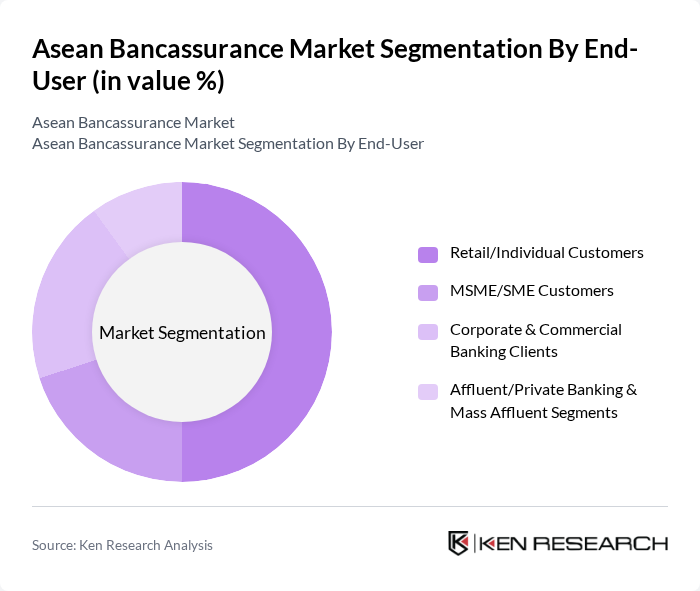
The Retail/Individual Customers segment leads the Asean Bancassurance Market, accounting for a significant portion of the overall market share. Banks’ omnichannel distribution, payroll and CASA-linked offers, and simplified protection products have increased penetration among retail customers, particularly in emerging ASEAN markets where banks are principal distribution partners for insurance.
Asean Bancassurance Market Competitive Landscape
The Asean Bancassurance Market is characterized by a dynamic mix of regional and international players. Leading participants such as DBS Bank Ltd., Oversea-Chinese Banking Corporation (OCBC Bank), United Overseas Bank (UOB), Bangkok Bank Public Company Limited, Krungthai Bank Public Company Limited, Kasikornbank Public Company Limited, Bank Rakyat Indonesia (Persero) Tbk, Bank Mandiri (Persero) Tbk, Bank Central Asia (BCA), Bank Negara Indonesia (BNI), Maybank (Malayan Banking Berhad) / Etiqa, CIMB Group Holdings Berhad, Public Bank Berhad, Hong Leong Bank Berhad / Hong Leong Assurance Berhad, RHB Bank Berhad / RHB Insurance Berhad, Prudential plc (Prudential Corporation Asia / Pru Life UK Philippines, Prudential Thailand), AIA Group Limited, Great Eastern Holdings Limited, Allianz SE (Allianz Ayudhya, Allianz Indonesia, Allianz Malaysia), Manulife Financial Corporation (Manulife Vietnam, Manulife Indonesia), Sun Life Financial Inc. (Sun Life Malaysia, Sun Life Vietnam), FWD Group Holdings Limited, Generali Group (Assicurazioni Generali S.p.A.), Chubb Limited (Chubb Life/General in ASEAN), AXA (AXA Affin Life Insurance Berhad, Philippines/Singapore operations) contribute to innovation, geographic expansion, and service delivery in this space.
Asean Bancassurance Market Industry Analysis
Growth Drivers
- Increasing Financial Literacy:The ASEAN region has seen a significant rise in financial literacy, with the World Bank reporting that financial literacy rates increased from 30% to 50%. This growth is driven by government initiatives and educational programs aimed at improving financial knowledge. As individuals become more aware of financial products, including insurance, the demand for bancassurance services is expected to rise, leading to increased market penetration and customer engagement.
- Rising Demand for Insurance Products:The ASEAN insurance market has experienced robust growth, with total insurance premiums reaching approximately $100 billion, up from $80 billion. This surge is attributed to increasing awareness of risk management and the need for financial security among consumers. As disposable incomes rise, particularly in emerging economies, the demand for diverse insurance products, including life and health insurance, is expected to continue its upward trajectory, benefiting bancassurance partnerships.
- Technological Advancements in Financial Services:The integration of technology in financial services has transformed the bancassurance landscape. In future, digital insurance platforms are expected to account for 25% of total insurance sales in ASEAN, a significant increase from 15%. This shift is driven by the proliferation of mobile banking and fintech solutions, enabling banks and insurers to offer seamless, user-friendly services. Enhanced customer experiences through technology are likely to attract more clients to bancassurance offerings.
Market Challenges
- Regulatory Compliance Issues:The bancassurance sector faces stringent regulatory frameworks across ASEAN countries, which can hinder operational efficiency. For instance, compliance costs have risen by 20%, impacting profitability. Regulatory bodies are increasingly focused on consumer protection and transparency, necessitating that banks and insurers invest in compliance systems. This challenge can slow down the pace of innovation and market entry for new products, affecting overall growth.
- Competition from Direct Insurance Channels:The rise of direct insurance channels poses a significant challenge to bancassurance. In future, direct insurance sales are expected to account for 40% of the total insurance market, up from 30%. Consumers are increasingly opting for online platforms that offer competitive pricing and convenience. This trend forces banks and insurers to rethink their strategies and enhance their value propositions to retain customers and maintain market share in the evolving landscape.
Asean Bancassurance Market Future Outlook
The future of the ASEAN bancassurance market appears promising, driven by ongoing digital transformation and evolving consumer preferences. As financial literacy continues to improve, more individuals are expected to seek integrated financial solutions. Additionally, the increasing adoption of artificial intelligence and big data analytics will enable personalized offerings, enhancing customer engagement. The focus on sustainable investment products is also likely to shape the market, aligning with global trends towards responsible finance and ethical investing.
Market Opportunities
- Expansion into Emerging Markets:There is a significant opportunity for bancassurance providers to expand into emerging markets within ASEAN, where insurance penetration remains low. For example, countries like Myanmar and Laos have insurance penetration rates below 2%. Targeting these markets can lead to substantial growth, as increasing economic development and rising incomes create a demand for insurance products.
- Development of Customized Insurance Products:The demand for tailored insurance solutions is on the rise, with consumers seeking products that meet their specific needs. In future, 60% of consumers are expected to express interest in personalized insurance offerings. By leveraging data analytics, bancassurance providers can create customized products that cater to diverse customer segments, enhancing customer satisfaction and loyalty while driving sales growth.
Scope of the Report
| Segment | Sub-Segments |
|---|---|
| By Type | Life Bancassurance (Protection, Savings, Endowment, Whole Life) Non-Life Bancassurance (Health/Medical, Personal Accident, Property & Motor) Investment-Linked Insurance/Unit-Linked (ILP/ULIP) Takaful (Family and General Takaful via banks) SME Group Products (Group Life/Health, Credit Insurance) |
| By End-User | Retail/Individual Customers MSME/SME Customers Corporate & Commercial Banking Clients Affluent/Private Banking & Mass Affluent Segments |
| By Distribution Model | Pure Distributor Exclusive Partnership Financial Holding/Ownership Joint Venture |
| By Channel | Bank Branch/Relationship Manager Digital/Mobile and Online Banking Contact Center/Tele-bancassurance ATM/Kiosk and Embedded In-App Journeys |
| By Geography (ASEAN) | Indonesia Thailand Malaysia Singapore Vietnam Philippines Others (Brunei, Cambodia, Laos, Myanmar) |
| By Policy Duration | Short-term (?5 years) Long-term (>5 years) |
| By Claims & Servicing | Traditional/In-branch Digital/Straight-Through Processing Hybrid/Omni-channel |
Key Target Audience
Investors and Venture Capitalist Firms
Government and Regulatory Bodies (e.g., ASEAN Insurance Regulators, Bank Negara Malaysia)
Insurance Companies
Banking Institutions
Financial Technology (FinTech) Companies
Insurance Brokers and Agents
Industry Associations (e.g., ASEAN Insurance Council)
Reinsurers
Players Mentioned in the Report:
DBS Bank Ltd.
Oversea-Chinese Banking Corporation (OCBC Bank)
United Overseas Bank (UOB)
Bangkok Bank Public Company Limited
Krungthai Bank Public Company Limited
Kasikornbank Public Company Limited
Bank Rakyat Indonesia (Persero) Tbk
Bank Mandiri (Persero) Tbk
Bank Central Asia (BCA)
Bank Negara Indonesia (BNI)
Maybank (Malayan Banking Berhad) / Etiqa
CIMB Group Holdings Berhad
Public Bank Berhad
Hong Leong Bank Berhad / Hong Leong Assurance Berhad
RHB Bank Berhad / RHB Insurance Berhad
Prudential plc (Prudential Corporation Asia / Pru Life UK Philippines, Prudential Thailand)
AIA Group Limited
Great Eastern Holdings Limited
Allianz SE (Allianz Ayudhya, Allianz Indonesia, Allianz Malaysia)
Manulife Financial Corporation (Manulife Vietnam, Manulife Indonesia)
Sun Life Financial Inc. (Sun Life Malaysia, Sun Life Vietnam)
FWD Group Holdings Limited
Generali Group (Assicurazioni Generali S.p.A.)
Chubb Limited (Chubb Life/General in ASEAN)
AXA (AXA Affin Life Insurance Berhad, Philippines/Singapore operations)
Table of Contents
Market Assessment Phase
1. Executive Summary and Approach
2. Asean Bancassurance Market Overview
2.1 Key Insights and Strategic Recommendations
2.2 Asean Bancassurance Market Overview
2.3 Definition and Scope
2.4 Evolution of Market Ecosystem
2.5 Timeline of Key Regulatory Milestones
2.6 Value Chain & Stakeholder Mapping
2.7 Business Cycle Analysis
2.8 Policy & Incentive Landscape
3. Asean Bancassurance Market Analysis
3.1 Growth Drivers
3.1.1 Increasing Financial Literacy
3.1.2 Rising Demand for Insurance Products
3.1.3 Strategic Partnerships between Banks and Insurers
3.1.4 Technological Advancements in Financial Services
3.2 Market Challenges
3.2.1 Regulatory Compliance Issues
3.2.2 Competition from Direct Insurance Channels
3.2.3 Consumer Trust and Awareness
3.2.4 Economic Volatility in the Region
3.3 Market Opportunities
3.3.1 Expansion into Emerging Markets
3.3.2 Development of Customized Insurance Products
3.3.3 Digital Transformation Initiatives
3.3.4 Increasing Cross-Selling Opportunities
3.4 Market Trends
3.4.1 Growth of Digital Bancassurance Platforms
3.4.2 Shift Towards Personalized Insurance Solutions
3.4.3 Integration of AI and Big Data Analytics
3.4.4 Focus on Sustainable and Ethical Investment Products
3.5 Government Regulation
3.5.1 Enhanced Consumer Protection Laws
3.5.2 Regulatory Framework for Digital Insurance
3.5.3 Tax Incentives for Insurance Products
3.5.4 Licensing Requirements for Bancassurance Partnerships
4. SWOT Analysis
5. Stakeholder Analysis
6. Porter's Five Forces Analysis
7. Asean Bancassurance Market Market Size, 2019-2024
7.1 By Value
7.2 By Volume
7.3 By Average Selling Price
8. Asean Bancassurance Market Segmentation
8.1 By Type
8.1.1 Life Bancassurance (Protection, Savings, Endowment, Whole Life)
8.1.2 Non-Life Bancassurance (Health/Medical, Personal Accident, Property & Motor)
8.1.3 Investment-Linked Insurance/Unit-Linked (ILP/ULIP)
8.1.4 Takaful (Family and General Takaful via banks)
8.1.5 SME Group Products (Group Life/Health, Credit Insurance)
8.2 By End-User
8.2.1 Retail/Individual Customers
8.2.2 MSME/SME Customers
8.2.3 Corporate & Commercial Banking Clients
8.2.4 Affluent/Private Banking & Mass Affluent Segments
8.3 By Distribution Model
8.3.1 Pure Distributor
8.3.2 Exclusive Partnership
8.3.3 Financial Holding/Ownership
8.3.4 Joint Venture
8.4 By Channel
8.4.1 Bank Branch/Relationship Manager
8.4.2 Digital/Mobile and Online Banking
8.4.3 Contact Center/Tele-bancassurance
8.4.4 ATM/Kiosk and Embedded In-App Journeys
8.5 By Geography (ASEAN)
8.5.1 Indonesia
8.5.2 Thailand
8.5.3 Malaysia
8.5.4 Singapore
8.5.5 Vietnam
8.5.6 Philippines
8.5.7 Others (Brunei, Cambodia, Laos, Myanmar)
8.6 By Policy Duration
8.6.1 Short-term (?5 years)
8.6.2 Long-term (>5 years)
8.7 By Claims & Servicing
8.7.1 Traditional/In-branch
8.7.2 Digital/Straight-Through Processing
8.7.3 Hybrid/Omni-channel
9. Asean Bancassurance Market Competitive Analysis
9.1 Market Share of Key Players
9.2 Cross Comparison of Key Players
9.2.1 Company Name (Bank or Insurer)
9.2.2 Partnership Model Type (Pure Distributor, Exclusive, JV, Holding)
9.2.3 Bancassurance GWP/APE from ASEAN (Annual, USD)
9.2.4 New Business APE Growth (YoY, %)
9.2.5 Product Mix (% Life vs Non-Life; % ILP vs Protection)
9.2.6 Cross-sell Penetration (% of bank customers with ?1 insurance policy)
9.2.7 Average Policy Size (Ticket size, USD)
9.2.8 Claims Settlement Ratio (% within regulatory TAT)
9.2.9 Distribution Efficiency (Policies per RM/branch; digital STP rate %)
9.2.10 Commission/Revenue Share to Banks (% of GWP or APE)
9.2.11 Persistency/Retention (13-month and 25-month, %)
9.2.12 Bancassurance ROI (Partnership IRR or payback period)
9.3 SWOT Analysis of Top Players
9.4 Pricing Analysis
9.5 Detailed Profile of Major Companies
9.5.1 DBS Bank Ltd.
9.5.2 Oversea-Chinese Banking Corporation (OCBC Bank)
9.5.3 United Overseas Bank (UOB)
9.5.4 Bangkok Bank Public Company Limited
9.5.5 Krungthai Bank Public Company Limited
9.5.6 Kasikornbank Public Company Limited
9.5.7 Bank Rakyat Indonesia (Persero) Tbk
9.5.8 Bank Mandiri (Persero) Tbk
9.5.9 Bank Central Asia (BCA)
9.5.10 Bank Negara Indonesia (BNI)
9.5.11 Maybank (Malayan Banking Berhad) / Etiqa
9.5.12 CIMB Group Holdings Berhad
9.5.13 Public Bank Berhad
9.5.14 Hong Leong Bank Berhad / Hong Leong Assurance Berhad
9.5.15 RHB Bank Berhad / RHB Insurance Berhad
9.5.16 Prudential plc (Prudential Corporation Asia / Pru Life UK Philippines, Prudential Thailand)
9.5.17 AIA Group Limited
9.5.18 Great Eastern Holdings Limited
9.5.19 Allianz SE (Allianz Ayudhya, Allianz Indonesia, Allianz Malaysia)
9.5.20 Manulife Financial Corporation (Manulife Vietnam, Manulife Indonesia)
9.5.21 Sun Life Financial Inc. (Sun Life Malaysia, Sun Life Vietnam)
9.5.22 FWD Group Holdings Limited
9.5.23 Generali Group (Assicurazioni Generali S.p.A.)
9.5.24 Chubb Limited (Chubb Life/General in ASEAN)
9.5.25 AXA (AXA Affin Life Insurance Berhad, Philippines/Singapore operations)
10. Asean Bancassurance Market End-User Analysis
10.1 Procurement Behavior of Key Ministries
10.1.1 Budget Allocation for Insurance Products
10.1.2 Decision-Making Processes
10.1.3 Evaluation Criteria for Insurance Providers
10.2 Corporate Spend on Infrastructure & Energy
10.2.1 Investment Trends in Insurance
10.2.2 Budgeting for Risk Management
10.2.3 Long-term Financial Planning
10.3 Pain Point Analysis by End-User Category
10.3.1 Lack of Awareness about Insurance Products
10.3.2 Complexity of Insurance Terms
10.3.3 Delays in Claims Processing
10.4 User Readiness for Adoption
10.4.1 Technology Adoption Levels
10.4.2 Training and Support Needs
10.5 Post-Deployment ROI and Use Case Expansion
10.5.1 Measurement of ROI
10.5.2 Opportunities for Upselling
10.5.3 Expansion into New Markets
11. Asean Bancassurance Market Future Size, 2025-2030
11.1 By Value
11.2 By Volume
11.3 By Average Selling Price
Go-To-Market Strategy Phase
1. Whitespace Analysis + Business Model Canvas
1.1 Identification of Market Gaps
1.2 Business Model Framework
2. Marketing and Positioning Recommendations
2.1 Branding Strategies
2.2 Product USPs
3. Distribution Plan
3.1 Urban Retail Strategies
3.2 Rural NGO Tie-ups
4. Channel & Pricing Gaps
4.1 Underserved Routes
4.2 Pricing Bands
5. Unmet Demand & Latent Needs
5.1 Category Gaps
5.2 Consumer Segments
6. Customer Relationship
6.1 Loyalty Programs
6.2 After-sales Service
7. Value Proposition
7.1 Sustainability Initiatives
7.2 Integrated Supply Chains
8. Key Activities
8.1 Regulatory Compliance
8.2 Branding Efforts
8.3 Distribution Setup
9. Entry Strategy Evaluation
9.1 Domestic Market Entry Strategy
9.1.1 Product Mix Considerations
9.1.2 Pricing Band Strategies
9.1.3 Packaging Options
9.2 Export Entry Strategy
9.2.1 Target Countries
9.2.2 Compliance Roadmap
10. Entry Mode Assessment
10.1 Joint Ventures
10.2 Greenfield Investments
10.3 Mergers & Acquisitions
10.4 Distributor Model
11. Capital and Timeline Estimation
11.1 Capital Requirements
11.2 Timelines for Market Entry
12. Control vs Risk Trade-Off
12.1 Ownership Considerations
12.2 Partnerships vs Control
13. Profitability Outlook
13.1 Breakeven Analysis
13.2 Long-term Sustainability
14. Potential Partner List
14.1 Distributors
14.2 Joint Ventures
14.3 Acquisition Targets
15. Execution Roadmap
15.1 Phased Plan for Market Entry
15.1.1 Market Setup
15.1.2 Market Entry
15.1.3 Growth Acceleration
15.1.4 Scale & Stabilize
15.2 Key Activities and Milestones
15.2.1 Milestone Planning
15.2.2 Activity Tracking
Research Methodology
Phase 1: Approach1
Desk Research
- Analysis of industry reports from ASEAN financial regulatory bodies
- Review of bancassurance market trends through publications by insurance associations
- Examination of demographic and economic data from ASEAN member states' statistical offices
Primary Research
- Interviews with senior executives from leading banks and insurance companies
- Surveys targeting financial advisors and bancassurance sales agents
- Focus groups with consumers to understand perceptions of bancassurance products
Validation & Triangulation
- Cross-validation of findings with multiple industry reports and expert opinions
- Triangulation of data from financial institutions, regulatory bodies, and market surveys
- Sanity checks through expert panel discussions and feedback sessions
Phase 2: Market Size Estimation1
Top-down Assessment
- Estimation of total insurance premiums in the ASEAN region as a baseline
- Segmentation of bancassurance contributions by country and product type
- Incorporation of macroeconomic indicators such as GDP growth and financial inclusion rates
Bottom-up Modeling
- Collection of sales data from major banks offering bancassurance products
- Analysis of customer acquisition costs and retention rates for bancassurance
- Volume and revenue projections based on historical sales trends and market penetration rates
Forecasting & Scenario Analysis
- Multi-variable forecasting models incorporating economic growth and regulatory changes
- Scenario analysis based on varying levels of consumer adoption and market competition
- Development of baseline, optimistic, and pessimistic forecasts through 2030
Phase 3: CATI Sample Composition1
| Scope Item/Segment | Sample Size | Target Respondent Profiles |
|---|---|---|
| Bancassurance Product Awareness | 150 | Bank Customers, Insurance Policyholders |
| Consumer Preferences in Insurance Products | 100 | Financial Advisors, Insurance Agents |
| Market Trends in ASEAN Bancassurance | 80 | Bank Executives, Insurance Company Managers |
| Regulatory Impact on Bancassurance | 70 | Regulatory Officials, Compliance Officers |
| Customer Satisfaction with Bancassurance Services | 90 | End Consumers, Customer Service Representatives |
Frequently Asked Questions
What is the current value of the Asean Bancassurance Market?
The Asean Bancassurance Market is valued at approximately USD 34 billion, reflecting significant growth driven by the integration of banking and insurance services, digital distribution channels, and strong partnerships between banks and insurers.
Which countries dominate the Asean Bancassurance Market?
How is bancassurance regulated in the ASEAN region?
What are the main segments of the Asean Bancassurance Market?
Other Regional/Country Reports
Why Buy From Us?

What makes us stand out is that our consultants follow Robust, Refine and Result (RRR) methodology. Robust for clear definitions, approaches and sanity checking, Refine for differentiating respondents' facts and opinions, and Result for presenting data with story.

We have set a benchmark in the industry by offering our clients with syndicated and customized market research reports featuring coverage of entire market as well as meticulous research and analyst insights.

While we don't replace traditional research, we flip the method upside down. Our dual approach of Top Bottom & Bottom Top ensures quality deliverable by not just verifying company fundamentals but also looking at the sector and macroeconomic factors.

With one step in the future, our research team constantly tries to show you the bigger picture. We help with some of the tough questions you may encounter along the way: How is the industry positioned? Best marketing channel? KPI's of competitors? By aligning every element, we help maximize success.

Our report gives you instant access to the answers and sources that other companies might choose to hide. We elaborate each steps of research methodology we have used and showcase you the sample size to earn your trust.

If you need any support, we are here! We pride ourselves on universe strength, data quality, and quick, friendly, and professional service.