About the Report
Base Year 2024Asia Pacific Prefabricated Housing Market Overview
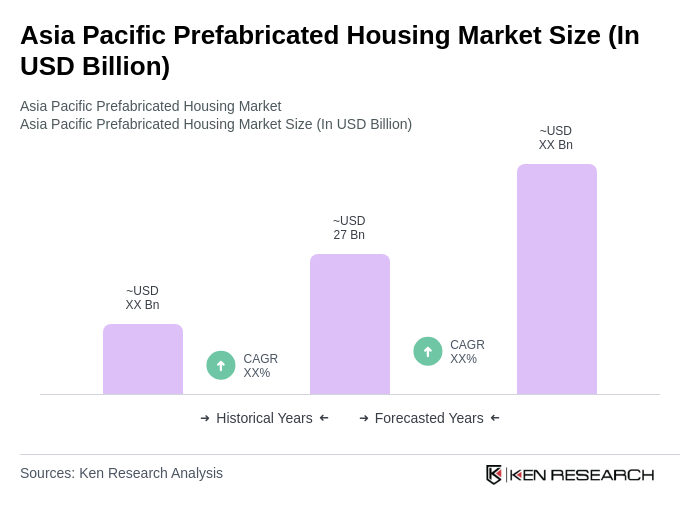
- The Asia Pacific Prefabricated Housing Market is valued at USD 27 billion, based on a five-year historical analysis. This growth is primarily driven by rapid urbanization, rising construction costs that favor offsite methods, and technology improvements in modular and panelized systems. The market has seen a significant shift towards sustainable building practices, with prefabricated homes offering reduced construction time and lower environmental impact.
- Countries such as China, Japan, and Australia dominate the market due to robust construction ecosystems, deep prefab supply chains, and policy support for innovative housing solutions. China leads with its large-scale urbanization projects, while Japan's focus on earthquake-resistant designs and Australia's emphasis on sustainable living contribute to their market leadership.
- In 2023, the Australian government advanced a new intergovernmental framework to address housing supply, with funding streams and programs aimed at enabling affordable dwellings and accelerating delivery; these initiatives—alongside a national target to construct 1.2 million new homes—have catalyzed increased use of modular and prefabricated approaches to meet timelines and sustainability objectives.
Asia Pacific Prefabricated Housing Market Segmentation
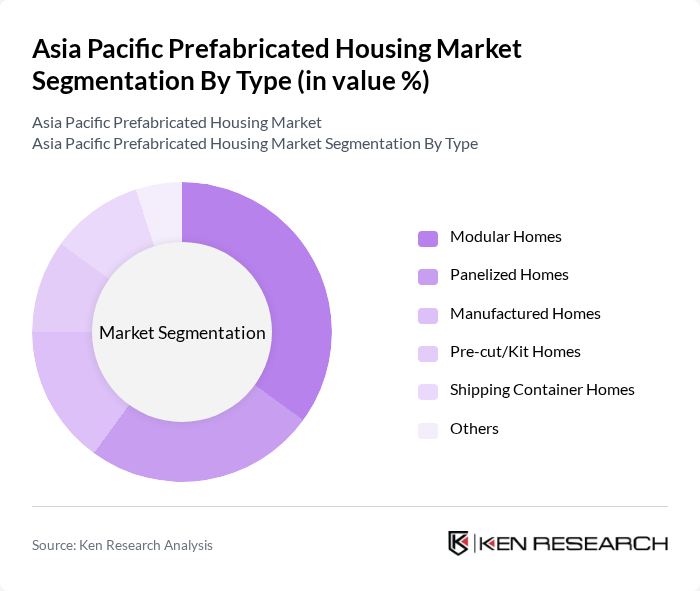
By Type:The prefabricated housing market can be segmented into various types, including modular homes, panelized homes, manufactured homes, pre-cut/kit homes, shipping container homes, and others. Modular homes are gaining popularity for flexibility, quality control, and speed, especially in dense urban markets and remote area deployments. Panelized homes are favored for quick assembly and logistics efficiency to sites with limited crane access, while shipping container homes appeal to eco-conscious consumers and fast deployment needs in tourism and micro-housing use cases.
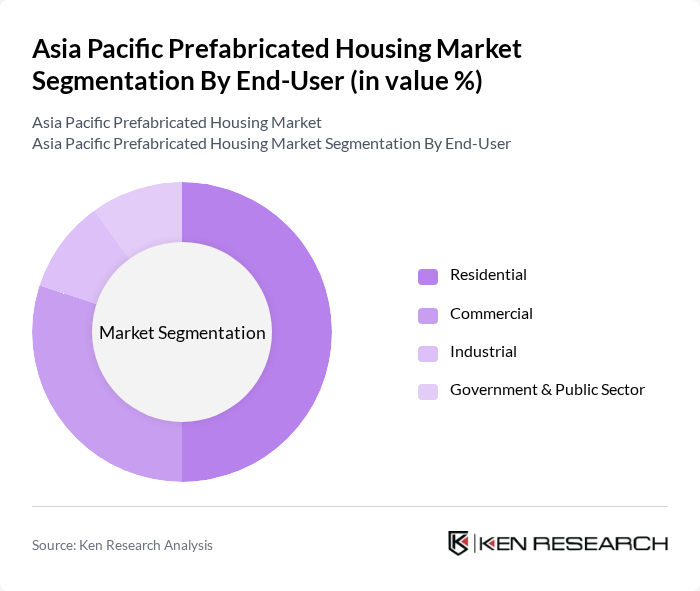
By End-User:The end-user segmentation includes residential, commercial, industrial, and government & public sector applications. The residential segment is the largest, driven by affordability needs, urban infill programs, and replacement demand in disaster-resilient construction, particularly in Japan. Commercial applications are growing in urban areas for hotels, student housing, and healthcare facilities leveraging modular’s speed. The industrial sector uses prefabricated structures for rapid setup of site offices and worker accommodations. Government projects focus on social and community housing, emergency dwellings, and remote-area services leveraging offsite delivery.
Asia Pacific Prefabricated Housing Market Competitive Landscape
The Asia Pacific Prefabricated Housing Market is characterized by a dynamic mix of regional and international players. Leading participants such as Sekisui House, Ltd., Daiwa House Industry Co., Ltd., Panasonic Homes Co., Ltd., Lendlease Group, Hickory Group (Australia), Modscape (Australia), CIMC Modular Building Systems (China), Broad Sustainable Building Co., Ltd. (China), VBC (Volumetric Building Companies) Asia, PT Tata Logam Lestari – Domus (Indonesia), Wee House Company (Hong Kong/China), Nihon House Holdings Co., Ltd., Sekisui Chemical Co., Ltd. (Housing Company), Sumitomo Forestry Co., Ltd. (Housing & Construction), BYD Prefab (BYD Integrated Build, China) contribute to innovation, geographic expansion, and service delivery in this space.
Asia Pacific Prefabricated Housing Market Industry Analysis
Growth Drivers
- Increasing Urbanization:The Asia Pacific region is experiencing rapid urbanization, with urban populations projected to reach 1.5 billion in the future, according to the United Nations. This surge in urban dwellers drives the demand for housing solutions that are both quick to deploy and cost-effective. Prefabricated housing offers a viable solution, as it can be constructed in a fraction of the time compared to traditional methods, addressing the urgent need for housing in densely populated urban areas.
- Cost Efficiency in Construction:The prefabricated housing sector is gaining traction due to its cost efficiency. Reports indicate that prefabricated homes can reduce construction costs by up to 15% compared to conventional building methods. This is particularly significant in the Asia Pacific region, where construction costs have risen by approximately 6% annually. The ability to save on labor and material costs while maintaining quality makes prefabricated housing an attractive option for developers and consumers alike.
- Sustainability and Eco-Friendliness:Sustainability is becoming a critical factor in construction, with the Asia Pacific region aiming to reduce carbon emissions by 25% in the future. Prefabricated housing aligns with these goals, as it typically generates less waste and utilizes sustainable materials. For instance, studies show that prefabricated homes can reduce construction waste by up to 40%, making them a more environmentally friendly option. This trend is increasingly appealing to environmentally conscious consumers and governments alike.
Market Challenges
- Regulatory Hurdles:The prefabricated housing market faces significant regulatory challenges, with varying building codes and standards across Asia Pacific countries. For example, in countries like India and Indonesia, local regulations can delay project approvals by up to four months. These inconsistencies create barriers for manufacturers and developers, hindering the growth of the prefabricated housing sector and complicating compliance efforts for international companies.
- Quality Perception Issues:Despite advancements, prefabricated housing often suffers from a perception of inferior quality compared to traditional homes. A survey by the Asia Pacific Housing Forum revealed that 55% of potential buyers express concerns about the durability and safety of prefabricated structures. This skepticism can impede market growth, as consumers may prefer conventional homes, which they perceive as more reliable, despite the benefits of prefabricated options.
Asia Pacific Prefabricated Housing Market Future Outlook
The future of the Asia Pacific prefabricated housing market appears promising, driven by increasing urbanization and a growing emphasis on sustainability. As governments implement policies to promote affordable housing, the demand for prefabricated solutions is expected to rise. Additionally, technological advancements in construction methods will enhance efficiency and quality, making prefabricated homes more appealing. The integration of smart technologies will further attract consumers, positioning the market for significant growth in the coming years.
Market Opportunities
- Rising Demand for Affordable Housing:With over 250 million people in the Asia Pacific region lacking adequate housing, the demand for affordable housing solutions is surging. Prefabricated homes can be produced at lower costs, making them an ideal solution to address this pressing need. This presents a significant opportunity for manufacturers to cater to a growing market segment focused on affordability and accessibility.
- Technological Advancements in Construction:Innovations in construction technology, such as 3D printing and modular design, are revolutionizing the prefabricated housing market. These advancements can reduce construction time and costs, making prefabricated homes more competitive. As these technologies become more mainstream, they will open new avenues for growth and efficiency, allowing companies to meet the evolving demands of consumers and developers.
Scope of the Report
| Segment | Sub-Segments |
|---|---|
| By Type | Modular Homes Panelized Homes Manufactured Homes Pre-cut/Kit Homes Shipping Container Homes Others |
| By End-User | Residential Commercial Industrial Government & Public Sector |
| By Region | China Japan India Australia South Korea Southeast Asia (Indonesia, Vietnam, Malaysia, Thailand, Philippines, Singapore) Rest of Asia Pacific |
| By Application | Single-family Housing Multifamily/Apartment Housing Temporary/Relocatable Housing (worker camps, student housing) Social/Affordable Housing Disaster Relief & Emergency Shelters |
| By Investment Source | Private Domestic Investment Foreign Direct Investment (FDI) Public-Private Partnerships (PPP) Government Schemes & Public Funding |
| By Policy Support | Subsidies & Grants Tax Incentives Regulatory Fast-tracking/Approvals Green Building/ESG-linked Incentives |
| By Distribution Channel | Direct Sales (B2B, government tenders) Online/Configurator Platforms Dealers & Franchise Partners EPC/Developers & Turnkey Contractors |
Key Target Audience
Investors and Venture Capitalist Firms
Government and Regulatory Bodies (e.g., Ministry of Housing and Urban Affairs, National Development and Reform Commission)
Manufacturers and Producers
Distributors and Retailers
Construction and Engineering Firms
Real Estate Developers
Industry Associations (e.g., Prefabricated Building Association)
Financial Institutions (e.g., Development Banks, Housing Finance Companies)
Players Mentioned in the Report:
Sekisui House, Ltd.
Daiwa House Industry Co., Ltd.
Panasonic Homes Co., Ltd.
Lendlease Group
Hickory Group (Australia)
Modscape (Australia)
CIMC Modular Building Systems (China)
Broad Sustainable Building Co., Ltd. (China)
VBC (Volumetric Building Companies) Asia
PT Tata Logam Lestari Domus (Indonesia)
Wee House Company (Hong Kong/China)
Nihon House Holdings Co., Ltd.
Sekisui Chemical Co., Ltd. (Housing Company)
Sumitomo Forestry Co., Ltd. (Housing & Construction)
BYD Prefab (BYD Integrated Build, China)
Table of Contents
Market Assessment Phase
1. Executive Summary and Approach
2. Asia Pacific Prefabricated Housing Market Overview
2.1 Key Insights and Strategic Recommendations
2.2 Asia Pacific Prefabricated Housing Market Overview
2.3 Definition and Scope
2.4 Evolution of Market Ecosystem
2.5 Timeline of Key Regulatory Milestones
2.6 Value Chain & Stakeholder Mapping
2.7 Business Cycle Analysis
2.8 Policy & Incentive Landscape
3. Asia Pacific Prefabricated Housing Market Analysis
3.1 Growth Drivers
3.1.1 Increasing Urbanization
3.1.2 Cost Efficiency in Construction
3.1.3 Sustainability and Eco-Friendliness
3.1.4 Government Initiatives and Support
3.2 Market Challenges
3.2.1 Regulatory Hurdles
3.2.2 Quality Perception Issues
3.2.3 Supply Chain Disruptions
3.2.4 Limited Awareness Among Consumers
3.3 Market Opportunities
3.3.1 Rising Demand for Affordable Housing
3.3.2 Technological Advancements in Construction
3.3.3 Expansion into Emerging Markets
3.3.4 Partnerships with Local Governments
3.4 Market Trends
3.4.1 Modular Construction Techniques
3.4.2 Smart Home Integration
3.4.3 Prefabricated Housing for Disaster Relief
3.4.4 Customization and Personalization Options
3.5 Government Regulation
3.5.1 Building Codes and Standards
3.5.2 Environmental Regulations
3.5.3 Incentives for Sustainable Practices
3.5.4 Zoning Laws and Land Use Policies
4. SWOT Analysis
5. Stakeholder Analysis
6. Porter's Five Forces Analysis
7. Asia Pacific Prefabricated Housing Market Market Size, 2019-2024
7.1 By Value
7.2 By Volume
7.3 By Average Selling Price
8. Asia Pacific Prefabricated Housing Market Segmentation
8.1 By Type
8.1.1 Modular Homes
8.1.2 Panelized Homes
8.1.3 Manufactured Homes
8.1.4 Pre-cut/Kit Homes
8.1.5 Shipping Container Homes
8.1.6 Others
8.2 By End-User
8.2.1 Residential
8.2.2 Commercial
8.2.3 Industrial
8.2.4 Government & Public Sector
8.3 By Region
8.3.1 China
8.3.2 Japan
8.3.3 India
8.3.4 Australia
8.3.5 South Korea
8.3.6 Southeast Asia (Indonesia, Vietnam, Malaysia, Thailand, Philippines, Singapore)
8.3.7 Rest of Asia Pacific
8.4 By Application
8.4.1 Single-family Housing
8.4.2 Multifamily/Apartment Housing
8.4.3 Temporary/Relocatable Housing (worker camps, student housing)
8.4.4 Social/Affordable Housing
8.4.5 Disaster Relief & Emergency Shelters
8.5 By Investment Source
8.5.1 Private Domestic Investment
8.5.2 Foreign Direct Investment (FDI)
8.5.3 Public-Private Partnerships (PPP)
8.5.4 Government Schemes & Public Funding
8.6 By Policy Support
8.6.1 Subsidies & Grants
8.6.2 Tax Incentives
8.6.3 Regulatory Fast-tracking/Approvals
8.6.4 Green Building/ESG-linked Incentives
8.7 By Distribution Channel
8.7.1 Direct Sales (B2B, government tenders)
8.7.2 Online/Configurator Platforms
8.7.3 Dealers & Franchise Partners
8.7.4 EPC/Developers & Turnkey Contractors
9. Asia Pacific Prefabricated Housing Market Competitive Analysis
9.1 Market Share of Key Players
9.2 Cross Comparison of Key Players
9.2.1 Company Name
9.2.2 Group Size (Large, Medium, or Small as per industry convention)
9.2.3 Asia Pacific Revenue (USD, latest fiscal year)
9.2.4 Revenue Growth Rate (3-year CAGR, %)
9.2.5 Installed/Annual Production Capacity (units or sqm)
9.2.6 Market Penetration (countries served in APAC)
9.2.7 Backlog/Order Book (USD or months of coverage)
9.2.8 Average Selling Price (per sqm or per unit)
9.2.9 Gross Margin (%)
9.2.10 On-time Delivery Rate (%)
9.2.11 Warranty/Defect Rate (%)
9.2.12 Product Mix (modular, panelized, manufactured, container)
9.2.13 Vertical Integration Level (in-house design, MEP, logistics)
9.2.14 ESG/Green Certifications (e.g., Green Star, BEE, CASBEE)
9.2.15 Strategic Partnerships (developers, governments, EPCs)
9.2.16 R&D/Technology Adoption (BIM, DfMA, automation)
9.2.17 Customer Segments (residential, social housing, commercial)
9.2.18 Customer Satisfaction/NPS
9.3 SWOT Analysis of Top Players
9.4 Pricing Analysis
9.5 Detailed Profile of Major Companies
9.5.1 Sekisui House, Ltd.
9.5.2 Daiwa House Industry Co., Ltd.
9.5.3 Panasonic Homes Co., Ltd.
9.5.4 Lendlease Group
9.5.5 Hickory Group (Australia)
9.5.6 Modscape (Australia)
9.5.7 CIMC Modular Building Systems (China)
9.5.8 Broad Sustainable Building Co., Ltd. (China)
9.5.9 VBC (Volumetric Building Companies) Asia
9.5.10 PT Tata Logam Lestari – Domus (Indonesia)
9.5.11 Wee House Company (Hong Kong/China)
9.5.12 Nihon House Holdings Co., Ltd.
9.5.13 Sekisui Chemical Co., Ltd. (Housing Company)
9.5.14 Sumitomo Forestry Co., Ltd. (Housing & Construction)
9.5.15 BYD Prefab (BYD Integrated Build, China)
10. Asia Pacific Prefabricated Housing Market End-User Analysis
10.1 Procurement Behavior of Key Ministries
10.1.1 Government Housing Initiatives
10.1.2 Budget Allocations for Infrastructure
10.1.3 Procurement Processes and Standards
10.2 Corporate Spend on Infrastructure & Energy
10.2.1 Investment Trends in Housing
10.2.2 Corporate Partnerships with Prefabricated Housing Firms
10.2.3 Budgeting for Sustainable Solutions
10.3 Pain Point Analysis by End-User Category
10.3.1 Affordability Issues
10.3.2 Quality Concerns
10.3.3 Delivery Timeliness
10.4 User Readiness for Adoption
10.4.1 Awareness of Prefabricated Solutions
10.4.2 Training and Support Needs
10.4.3 Financial Readiness
10.5 Post-Deployment ROI and Use Case Expansion
10.5.1 Performance Metrics
10.5.2 Case Studies of Successful Deployments
10.5.3 Future Expansion Plans
11. Asia Pacific Prefabricated Housing Market Future Size, 2025-2030
11.1 By Value
11.2 By Volume
11.3 By Average Selling Price
Go-To-Market Strategy Phase
1. Whitespace Analysis + Business Model Canvas
1.1 Market Gaps Identification
1.2 Business Model Framework
2. Marketing and Positioning Recommendations
2.1 Branding Strategies
2.2 Product USPs
3. Distribution Plan
3.1 Urban Retail Strategies
3.2 Rural NGO Tie-Ups
4. Channel & Pricing Gaps
4.1 Underserved Routes
4.2 Pricing Bands
5. Unmet Demand & Latent Needs
5.1 Category Gaps
5.2 Consumer Segments
6. Customer Relationship
6.1 Loyalty Programs
6.2 After-Sales Service
7. Value Proposition
7.1 Sustainability
7.2 Integrated Supply Chains
8. Key Activities
8.1 Regulatory Compliance
8.2 Branding
8.3 Distribution Setup
9. Entry Strategy Evaluation
9.1 Domestic Market Entry Strategy
9.1.1 Product Mix
9.1.2 Pricing Band
9.1.3 Packaging
9.2 Export Entry Strategy
9.2.1 Target Countries
9.2.2 Compliance Roadmap
10. Entry Mode Assessment
10.1 Joint Ventures
10.2 Greenfield Investments
10.3 Mergers & Acquisitions
10.4 Distributor Model
11. Capital and Timeline Estimation
11.1 Capital Requirements
11.2 Timelines
12. Control vs Risk Trade-Off
12.1 Ownership vs Partnerships
13. Profitability Outlook
13.1 Breakeven Analysis
13.2 Long-Term Sustainability
14. Potential Partner List
14.1 Distributors
14.2 Joint Ventures
14.3 Acquisition Targets
15. Execution Roadmap
15.1 Phased Plan for Market Entry
15.1.1 Market Setup
15.1.2 Market Entry
15.1.3 Growth Acceleration
15.1.4 Scale & Stabilize
15.2 Key Activities and Milestones
15.2.1 Activity Planning
15.2.2 Milestone Tracking
Research Methodology
Phase 1: Approach1
Desk Research
- Analysis of industry reports from organizations such as the Asia Pacific Housing Forum
- Review of government publications and housing policies from various Asia Pacific nations
- Examination of market trends and forecasts from real estate and construction journals
Primary Research
- Interviews with architects and engineers specializing in prefabricated housing
- Surveys with developers and contractors involved in prefabricated construction projects
- Focus groups with end-users to understand preferences and perceptions of prefabricated homes
Validation & Triangulation
- Cross-validation of data through multiple sources including trade associations and market analysts
- Triangulation of findings from primary interviews and secondary data sources
- Sanity checks conducted through expert panel discussions and feedback sessions
Phase 2: Market Size Estimation1
Top-down Assessment
- Estimation of market size based on national housing demand statistics and growth rates
- Segmentation of the market by country, type of prefabricated housing, and end-user demographics
- Incorporation of government initiatives promoting sustainable and affordable housing solutions
Bottom-up Modeling
- Collection of data on production capacities and sales figures from leading prefabricated housing manufacturers
- Cost analysis of materials and labor specific to prefabricated construction methods
- Volume estimates based on project completions and ongoing developments in the region
Forecasting & Scenario Analysis
- Utilization of historical growth rates to project future market trends through 2030
- Scenario modeling based on economic indicators, urbanization rates, and housing policies
- Development of best-case, worst-case, and most-likely scenarios for market evolution
Phase 3: CATI Sample Composition1
| Scope Item/Segment | Sample Size | Target Respondent Profiles |
|---|---|---|
| Residential Prefabricated Housing | 150 | Homeowners, Real Estate Developers |
| Commercial Prefabricated Structures | 100 | Commercial Property Managers, Architects |
| Government Housing Initiatives | 80 | Policy Makers, Urban Planners |
| Eco-Friendly Prefabricated Solutions | 70 | Sustainability Consultants, Environmental Engineers |
| Technological Innovations in Prefabrication | 90 | Construction Technology Experts, R&D Managers |
Frequently Asked Questions
What is the current value of the Asia Pacific Prefabricated Housing Market?
The Asia Pacific Prefabricated Housing Market is valued at approximately USD 27 billion, reflecting a significant growth trend driven by urbanization, rising construction costs, and advancements in technology related to modular and panelized systems.
Which countries are leading in the Asia Pacific Prefabricated Housing Market?
What are the main types of prefabricated housing?
What are the key drivers of growth in the Asia Pacific Prefabricated Housing Market?
Other Regional/Country Reports
Indonesia Prefabricated Housing Market
Malaysia Prefabricated Housing Market
APAC Prefabricated Housing Market
Why Buy From Us?

What makes us stand out is that our consultants follow Robust, Refine and Result (RRR) methodology. Robust for clear definitions, approaches and sanity checking, Refine for differentiating respondents' facts and opinions, and Result for presenting data with story.

We have set a benchmark in the industry by offering our clients with syndicated and customized market research reports featuring coverage of entire market as well as meticulous research and analyst insights.

While we don't replace traditional research, we flip the method upside down. Our dual approach of Top Bottom & Bottom Top ensures quality deliverable by not just verifying company fundamentals but also looking at the sector and macroeconomic factors.

With one step in the future, our research team constantly tries to show you the bigger picture. We help with some of the tough questions you may encounter along the way: How is the industry positioned? Best marketing channel? KPI's of competitors? By aligning every element, we help maximize success.

Our report gives you instant access to the answers and sources that other companies might choose to hide. We elaborate each steps of research methodology we have used and showcase you the sample size to earn your trust.

If you need any support, we are here! We pride ourselves on universe strength, data quality, and quick, friendly, and professional service.