CHAPTER 1 - MARKET SUMMARY
Market Overview
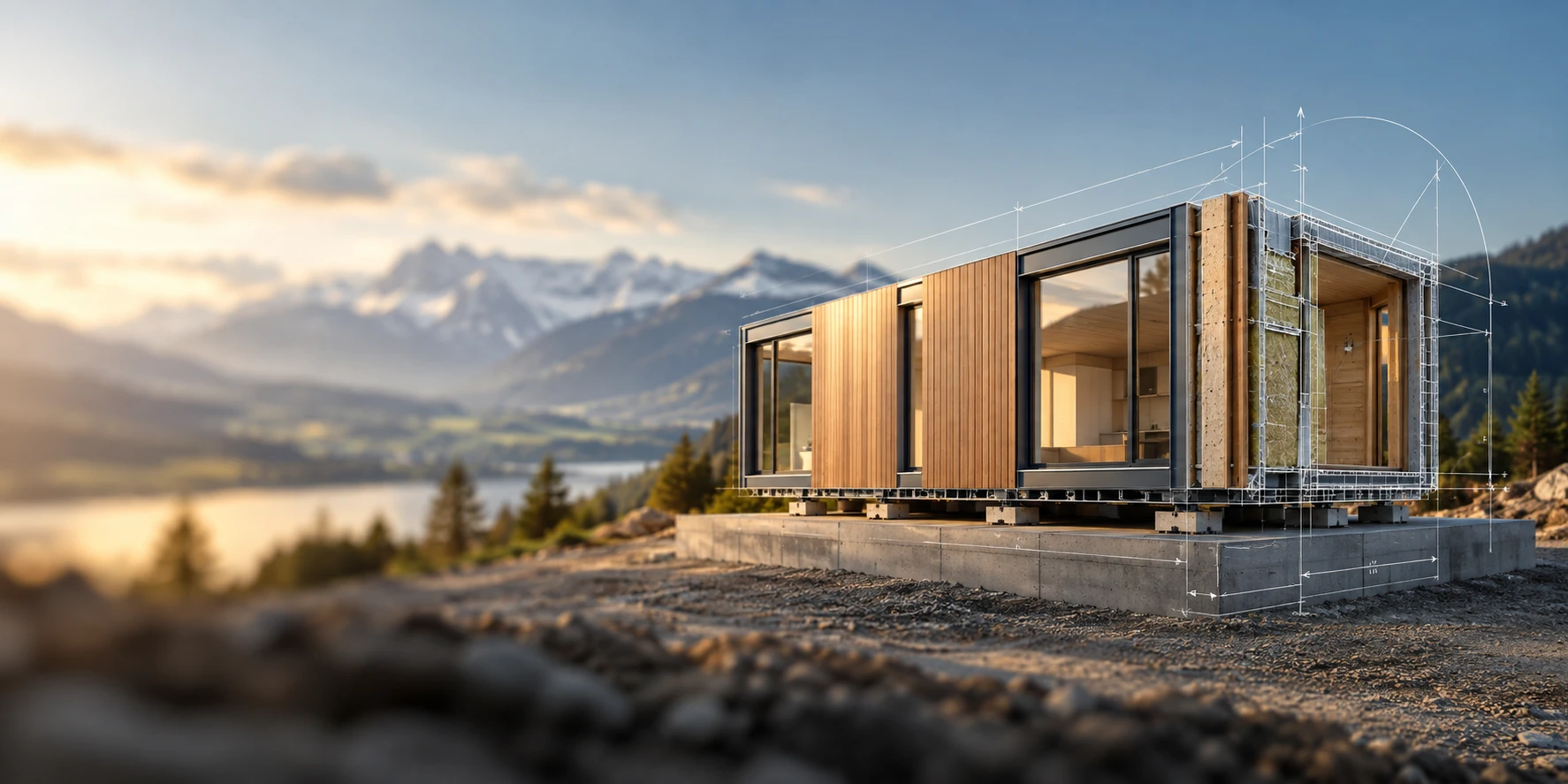
The Austria Prefabricated Housing Market operates through factory production of structural panels, timber frames and modular assemblies that are transported for rapid on-site installation. In 2025, prefabricated construction represented 35.4% of completed Austrian single- and two-family houses, demonstrating that off-site construction has moved beyond a niche proposition. Buyers increasingly value schedule certainty, standardized quality and predictable total project costs.
Production and demand are geographically concentrated. Lower Austria and Upper Austria together accounted for 58.4% of Austrian prefabricated homes in 2025, reflecting strong owner-occupied housing activity, established timber-processing ecosystems and proximity to major manufacturing plants. This concentration supports efficient logistics and installer utilization, but it also makes regional order pipelines strategically important when manufacturers allocate capacity and sales resources.
Market Value
USD 1,025 million
2025
Dominant Region
Lower Austria and Upper Austria
58.4%, 2025
Dominant Segment
Completion Level
fastest growing, 2025-2032
Total Number of Players
62
Future Outlook
The Austria Prefabricated Housing Market is projected to increase from USD 1,025 Mn in 2025 to USD 1,468 Mn by 2032, implying a forecast CAGR of 5.27%. This follows a difficult 2020-2025 period in which the modeled market contracted at a -2.53% historical CAGR, driven mainly by the sharp 2023-2024 housing downturn. Recovery is expected to be gradual rather than volume-led initially, supported by improving housing finance, delayed-project execution and a rising share of prefabricated construction within Austria's constrained low-rise residential pipeline. Factory utilization should improve as order visibility normalizes and manufacturers benefit from scale.
Value growth is expected to run ahead of unit growth as the product mix shifts toward turnkey delivery, higher-performance envelopes and integrated energy systems. Market volume is modeled to rise from approximately 3,543 homes in 2025 to 4,341 homes by 2032, a 2.94% unit CAGR, while implied revenue per delivered home advances from about USD 289 thousand to USD 338 thousand. Turnkey homes already represented approximately 44% of the market in 2025 and are expected to exceed 45% by 2029, supporting higher contract values and a larger service component.
5.27%
Forecast CAGR
$1,468 Mn
2030 Projection
Base Year
2025
Historical Period
2020-2025
Forecast Period
2025-2032
Historical CAGR
-2.53%
CHAPTER 2 - SCOPE OF REPORT
Scope of the Market
CHAPTER 3 - Key Stakeholders
Key Target Audience
Key stakeholders who can leverage from this market analysis for investment, strategy, and operational planning.
Investors
CAGR, capacity utilization, contract value, consolidation, capex, risk
Corporates
order backlog, pricing, factory throughput, sourcing, margins, expansion
Government
housing supply, affordability, permits, energy standards, productivity, resilience
Operators
turnkey mix, lead times, installation, automation, procurement, utilization
Financial institutions
mortgage demand, LTV, affordability, developer finance, collateral, defaults
CHAPTER 4 - Market Size & Growth
Market Size, Growth Forecast and Trends
This section evaluates the historical market size, analyzes year-over-year growth dynamics, and presents forecast projections supported by market performance indicators and demand-side drivers.
Historical & Projected Market Size ($ Million)
Year-over-Year Growth Rate (%)
Market Value vs Volume Growth (%)
Historical Market Performance (2020-2025)
The market expanded strongly through 2022 as low financing costs, high detached-house demand and post-pandemic construction backlogs supported factory order books. Modeled volume peaked at approximately 5,798 homes in 2022 before falling to around 3,450 in 2024. The 2024 value contraction of 33.7% marked the principal inflection point. Austria's wider residential sector showed the same direction: new-building completions fell 20.2% in 2024, while single- and two-family building completions declined 25.4%. The 2025 rebound therefore represents stabilization from a low base rather than a return to the previous construction cycle.
Forecast Market Outlook (2025-2032)
The forecast assumes a gradual recovery in orders, improving factory utilization and continued share gains for prefabricated systems. The market reaches USD 1,468 Mn by 2032 at a 5.27% value CAGR, while modeled volume reaches approximately 4,341 homes. Implied average revenue per home rises to about USD 338 thousand as turnkey completion, energy systems and premium fit-out capture a larger portion of customer budgets. The trajectory remains conservative relative to earlier housing-cycle peaks because 2025 new-building permits were still 40% below their 2015 level, limiting near-term physical construction capacity despite improving low-rise permit momentum.
CHAPTER 5 - Market Data
Market Breakdown
The Austria Prefabricated Housing Market is transitioning from cyclical stabilization toward mix-led value creation. For CEOs and investors, the critical issue is whether manufacturers can convert a modest unit recovery into higher factory utilization, turnkey attachment and revenue per delivered home.
Year | Market Size (USD Mn) | YoY Growth (%) | Market Volume (Homes) | Volume YoY (%) | Implied Revenue per Home (USD 000) | Period |
|---|---|---|---|---|---|---|
| 2020 | $1,165 Mn | +- | 4,703 | - | Forecast | |
| 2021 | $1,334 Mn | +14.5% | 5,380 | 14.4% | Forecast | |
| 2022 | $1,470 Mn | +10.2% | 5,798 | 7.8% | Forecast | |
| 2023 | $1,470 Mn | +0.0% | 5,357 | -7.6% | Forecast | |
| 2024 | $974 Mn | +-33.7% | 3,450 | -35.6% | Forecast | |
| 2025 | $1,025 Mn | +5.2% | 3,543 | 2.7% | Forecast | |
| 2026 | $1,074 Mn | +4.8% | 3,586 | 1.2% | Forecast | |
| 2027 | $1,128 Mn | +5.0% | 3,694 | 3.0% | Forecast | |
| 2028 | $1,187 Mn | +5.2% | 3,812 | 3.2% | Forecast | |
| 2029 | $1,250 Mn | +5.3% | 3,938 | 3.3% | Forecast | |
| 2030 | $1,318 Mn | +5.4% | 4,068 | 3.3% | Forecast | |
| 2031 | $1,390 Mn | +5.5% | 4,202 | 3.3% | Forecast | |
| 2032 | $1,468 Mn | +5.6% | 4,341 | 3.3% | Forecast |
Market Volume
3,543 homes, 2025, Austria. Unit demand stabilized after the 2024 correction, while prefabrication captured 35.4% of completed one- and two-family homes, supporting better factory utilization.
Volume YoY
2.7%, 2025, Austria. The return to positive unit growth is reinforced by a healthier low-rise pipeline: permits in new residential buildings with one or two dwellings increased 8.2% in 2025.
Implied Revenue per Home
USD 289 thousand, 2025, Austria. Mix is becoming more important than pure units because turnkey homes represented about 44% of demand and carried an average market price near EUR 321,240.
CHAPTER 6 - Segmentation
Market Segmentation Framework
Comprehensive analysis across key dimensions providing insights into market structure, consumer preferences, and distribution patterns.
No of Segments
7
Dominant Segment
Housing Type
Fastest Growing Segment
Completion Level
Construction Type
Material
Housing Type
Completion Level
Customer Type
Sales Channel
Geography
Key Segmentation Takeaways
Comprehensive analysis across all extracted segmentation dimensions providing insights into market structure, consumer preferences, and distribution patterns.
Housing Type
Single-family houses remain the principal revenue pool because Austria's prefabricated sector developed around owner-occupied detached housing and standardized timber-frame production. However, affordability pressures are progressively improving the economics of duplex and terraced configurations. Manufacturers with adaptable floor plans can preserve factory standardization while extending the addressable customer base into denser and more price-sensitive residential formats.
Completion Level
Turnkey delivery is the fastest-growing commercial model as households prioritize budget visibility, reduced coordination risk and single-provider accountability. The leading opportunity is fully finished turnkey housing bundled with building services, energy systems and interior options. This shifts more expenditure into the manufacturer's contract, raises revenue per home and favors scaled operators able to integrate design, procurement, installation and after-sales responsibility.
CHAPTER 7 - Regional Analysis
Regional Analysis
Austria is one of Central Europe's more developed prefabricated housing markets, combining a relatively high low-rise prefab penetration rate with a smaller absolute housing base than Germany. On a normalized peer basis, Austria ranks second among selected adjacent markets by 2025 value, while housing finance normalization and factory investment support medium-term recovery.
Focus Country Ranking
2nd
Focus Country Market Size
USD 1,025 Mn (2025)
Focus Country CAGR (2025-2032)
5.27%
Focus Country Ranking
2nd
Focus Country Market Size
USD 1,025 Mn (2025)
Focus Country CAGR (2025-2032)
5.27%
Regional Analysis (Current Year)
Market Position
Austria ranks 2nd in the selected peer set, supported by a 35.4% prefabrication rate in completed low-rise housing and established timber-frame manufacturing capacity.
Growth Advantage
Austria's 5.27% value CAGR is below the modeled German and Czech trajectories but remains above slower mature-market benchmarks, with Interconnection forecasting 3.0% annual Austrian unit growth through 2029.
Competitive Strengths
Austria combines 35.4% prefab penetration, an 8.2% increase in low-rise permits in 2025 and new large-scale factory investments, improving the platform for recovery.
CHAPTER 8 - INDUSTRY ANALYSIS
Growth Drivers, Challenges & Opportunities
Comprehensive analysis of key factors shaping the Austria Prefabricated Housing Market, including growth catalysts, operational challenges, and emerging opportunities across production, distribution, and consumer segments.
Growth Drivers
Rising Prefabrication Penetration
- Market unit volume returned to positive territory at +2.7% (2025, Austria), showing that prefabricated suppliers outperformed the still-constrained overall housing cycle and can capture incremental share before total residential construction fully recovers.
- Timber-frame construction represents approximately 75% (2025, Austria) of prefabricated homes, giving established manufacturers a standardized production platform, repeatable engineering and mature supplier ecosystems that support quality and factory productivity.
- Interconnection projects about 3.0% annual volume growth (2025-2029, Austria), indicating that the category can expand through penetration gains even if the country's total residential completion pipeline remains below historical peaks.
Housing Finance Normalization
- Improving credit availability expands the addressable pool of owner-builders because monthly new housing lending rose by more than 50% YoY (Jan-Feb 2025, Austria), supporting project restarts after the 2023-2024 financing shock.
- KIM-V expired on 30 June 2025 (Austria), giving banks greater flexibility while retaining supervisory benchmarks, which can improve credit conversion for qualified households without removing underwriting discipline.
- FMA guidance retains reference thresholds of 90% loan-to-collateral, 40% debt-service-to-income and 35 years maximum maturity (2025, Austria), making affordability and standardized total project pricing key competitive advantages for prefab suppliers.
Public Housing and Construction Support
- The program targets approximately 10,000 owner-occupied homes, 10,000 rental dwellings and 5,000 renovations (package target, Austria), creating procurement opportunities for repeatable off-site solutions where public or developer schedules reward construction speed.
- The federal government allocated EUR 1 Bn for 2024-2026 in purpose grants for affordable owner-occupied and rental housing, supporting denser residential formats that can broaden prefab demand beyond detached homes.
- Discounted federal loans to states total EUR 500 Mn across 2024-2025 at up to 1.5% interest through 2028, lowering financing costs for qualifying housing programs and strengthening the business case for standardized delivery.
Market Challenges
New-Build Pipeline Compression
- New-building dwelling permits declined 7.1% YoY (2025, Austria), constraining the future addressable installation pool and forcing manufacturers to compete more aggressively for each qualified residential project.
- The 2025 new-building permit level was 40% below 2015 (Austria), demonstrating that the downturn is structural enough to require capacity discipline, geographic diversification and higher revenue capture per project.
- New-building completions already dropped 20.2% in 2024 (Austria), confirming the lagged transmission from weak permits into realized construction and increasing order-book risk for suppliers exposed to low-rise new build.
Affordability and Credit Discipline
- A maximum reference loan-to-collateral ratio of 90% (2025, Austria) means households generally require meaningful equity, raising conversion risk for younger buyers and increasing demand for smaller floor plans and predictable all-in pricing.
- Residential construction costs increased 2.3% in 2025 (Austria), sustaining pressure on manufacturer procurement, labor and subcontractor budgets even after the exceptional material-price volatility of earlier years eased.
- Turnkey homes carried an average price around EUR 321,240 (2025, Austria), so customer preference for convenience also raises absolute financing needs, making design-to-cost and optional specification packages commercially important.
Concentration and Capacity Risk
- The top 10 providers increased their value-based concentration in 2025 (Austria), strengthening scaled players while smaller manufacturers face greater difficulty absorbing certification, marketing, model-home and plant overheads.
- Lower Austria and Upper Austria represented 58.4% of prefab demand in 2025, creating regional exposure that can amplify factory order volatility when low-rise construction weakens in these two core states.
- ELK is investing approximately EUR 60 Mn in a new Schrems production facility (2026, Austria) targeting capacity of up to 1,500 houses annually, raising the competitive productivity benchmark for the wider industry.
Market Opportunities
Turnkey and Compact Product Upsell
- Turnkey penetration is expected to exceed 45% by 2029 (Austria), giving manufacturers opportunities to capture interior finishing, building-services integration and procurement margins instead of selling only structural shells.
- Single-family houses still account for 86.1% of prefab demand in 2025, but two-family and terraced formats are gaining share, favoring developers and manufacturers that can standardize smaller, denser plans.
- Price growth moderated to 2.6% in 2025 after 17.0% in 2023, creating room for product redesign and value engineering to restore affordability without relying primarily on nominal price increases.
Urban Multi-Unit Prefabrication
- Vienna completed 12,478 dwellings in 2024, the highest total among Austrian federal provinces, providing a large urban demand pool for multi-unit timber and hybrid off-site systems.
- Glorit held 51.5% of Vienna's housebuilding market in 2025 and increased its 2026 housing-project production by roughly 30%, demonstrating the scalability of developer-led prefab models in urban growth districts.
- The federal housing package targets roughly 20,000 new owner and rental dwellings, benefiting manufacturers that adapt panelized systems from detached housing toward repetitive townhouse and multi-storey residential typologies.
Automated Local Production Capacity
- ELK's planned facility includes a production hall exceeding 16,000 m² (2026, Schrems), allowing higher throughput and process automation that can reduce unit overhead when market volumes recover.
- The expanded ELK platform targets production capacity of up to 1,500 houses per year, establishing a scale benchmark that can accelerate industry investment in digital design-to-manufacturing and standardized components.
- HARTL HAUS already manufactures approximately 300 house units annually in Echsenbach, illustrating the operational value of integrated local factories, carpentry and assembly capability for maintaining quality and delivery control.
CHAPTER 9 - Competitive Landscape
Competitive Landscape Overview
Competition is consolidating around scaled timber-frame manufacturers, turnkey developers and technically differentiated regional specialists, with factory utilization, financing resilience, brand trust and integrated delivery increasingly determining competitive strength.
Market Share Distribution
Top 5 Players
Market Dynamics
8 new entrants in the past 5 years, indicating strong market attractiveness and growth potential.
Company Name | Market Share | Headquarters | Founding Year | Core Market Focus |
|---|---|---|---|---|
ELK Fertighaus GmbH | - | Schrems, Austria | 1959 | Large-scale timber-frame single-family and multi-unit prefabricated housing |
Glorit Bausysteme GmbH | - | Groß-Enzersdorf, Austria | - | Premium turnkey prefabricated housing and residential development in Vienna |
GRIFFNER | - | Griffen, Austria | - | Premium architect-designed timber prefabricated homes |
Haas Fertigbau | - | Falkenberg, Germany | 1972 | Timber prefabricated homes and larger residential timber construction |
HARTL HAUS | - | Echsenbach, Austria | 1897 | Timber-frame homes with integrated construction and joinery |
VARIO-HAUS | - | Wiener Neustadt, Austria | 1983 | Energy-efficient timber prefabricated single-family and residential projects |
WOLF HAUS | - | Scharnstein, Austria | 1966 | Timber-frame prefabricated houses and customer-assisted construction options |
GENBÖCK HAUS | - | Haag am Hausruck, Austria | 1987 | Timber-frame energy-efficient housing and large-volume timber projects |
ETZI-HAUS | - | Ried im Traunkreis, Austria | 1993 | Prefabricated residential construction and general contracting |
LUMAR Haus GmbH | - | Wiener Neudorf, Austria | 2014 | High-efficiency timber prefabricated houses and sustainable residential systems |
Cross Comparison Parameters
The report provides detailed cross-comparison of key players across 10 performance parameters to identify competitive strengths and weaknesses.
Annual Residential Units Delivered
Turnkey Completion Mix
Austria Prefabricated Housing Revenue Growth
Average Contract Value per Unit
Analysis Covered
Market Share Analysis:
Compares competitive positioning using Austria-specific revenue and delivery indicators.
Cross Comparison Matrix:
Benchmarks operating scale, mix, growth and contract economics comparatively.
SWOT Analysis:
Assesses strategic strengths, weaknesses, opportunities and competitive exposure individually.
Pricing Strategy Analysis:
Compares turnkey, finish-ready and shell pricing architecture across competitors.
Company Profiles:
Reviews product focus, geographic presence, capacity and strategic positioning.
CHAPTER 10 - REPORT TOC
Table of Contents
Market Assessment Phase
Supply-side and competitive intelligence covering market sizing, segmentation, competitive dynamics, regulatory landscape, and future forecasts.
Go-To-Market Strategy Phase
15 chapters
Entry strategy evaluation, execution roadmap, partner recommendations, and profitability outlook.
Survey Phase
8 chapters
Demand-side primary research conducted through structured interviews and online surveys with end users across priority metros and Tier 2/3 cities to capture consumption behavior, unmet needs, and purchase drivers.
Complete Report Coverage
201+ detailed sections covering every aspect of the market
143
Assessment Sections
58
Strategy Sections
CHAPTER 11 - Our Approach
Research Methodology
Desk Research
- Analyze Austrian housing permit statistics
- Review prefab manufacturer operating disclosures
- Map construction standards and incentives
- Benchmark timber housing market indicators
Primary Research
- Interview prefab manufacturer commercial directors
- Engage residential developer procurement managers
- Consult timber component plant managers
- Interview architects and construction managers
Validation and Triangulation
- 276 stakeholder responses normalized and weighted
- Cross-check factory volumes against completions
- Validate pricing against turnkey contracts
- Reconcile permits with future demand
CHAPTER 12 - FAQ
FAQs
Still have questions?
Our research team is here to help you find the right solution
CHAPTER 13 - Related Research
Explore Related Reports
Expand your market intelligence with complementary research across regions and adjacent markets.
Regional/Country ReportsRelated market analysis across key regions
Related market analysis across key regions
No regional reports found.
Adjacent ReportsRelated markets and complementary research
Related markets and complementary research
No adjacent reports found.
500+
Market Research Reports
50+
Countries Covered
15+
Industry Verticals