About the Report
Base Year 2024Global Scandinavia Prefabricated Housing Market Overview
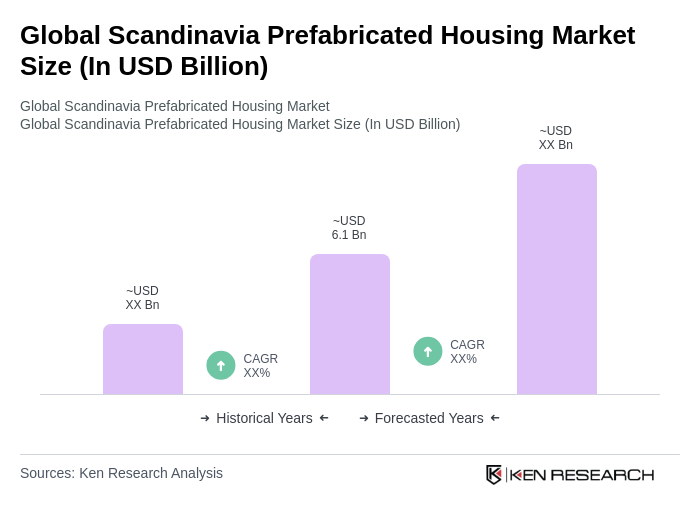
- The Global Scandinavia Prefabricated Housing Market is valued at USD 6.1 billion, based on a five-year historical analysis. This level is consistent with authoritative market assessments placing the Scandinavia prefabricated housing market near USD 6.07 billion, supported by sustained demand for energy-efficient, offsite-built homes across Sweden, Norway, and Denmark .
- Key players in this market include Sweden, Norway, and Denmark, which lead due to advanced industrialized building methods, strong public policy support for sustainable construction, and high living standards that translate into robust demand for quality housing. Industry coverage consistently identifies Sweden as the largest market, followed by Norway and Denmark, reflecting high adoption of offsite construction in housing .
- In 2023, the Swedish regulatory framework continued to require that all new residential buildings meet specific energy performance standards under Boverket’s building regulations (BBR), aligned with EU Energy Performance of Buildings requirements; tightening of energy performance requirements and climate declarations for buildings has reinforced demand for solutions with strong energy and carbon profiles, including prefabricated housing .
Global Scandinavia Prefabricated Housing Market Segmentation
By Type:The prefabricated housing market can be segmented into various types, including Modular (Volumetric) Homes, Panelized Homes, Pre-cut/Kit Homes, Mobile/Relocatable & Container-Based Units, and Hybrid Systems. Each type caters to different consumer needs and preferences, influencing market dynamics .
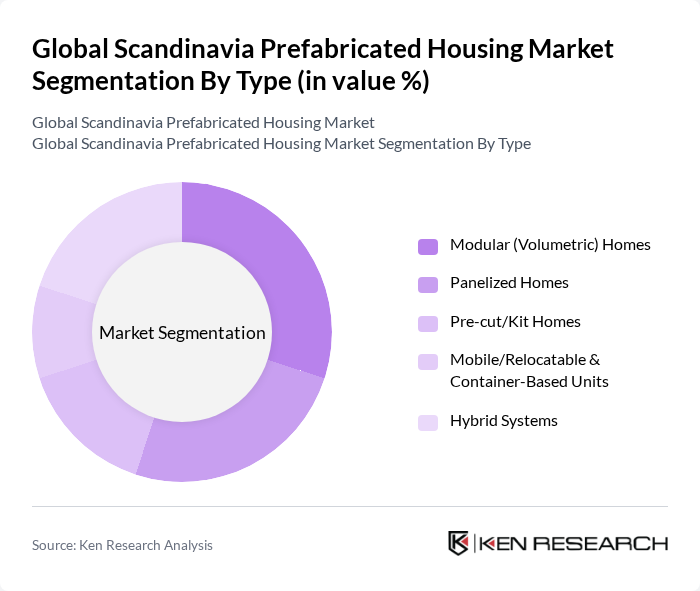
The Modular (Volumetric) Homes segment is currently leading the market due to its efficient construction process and flexibility in design. These homes are built in sections in a factory setting and then transported to the site for assembly, significantly reducing construction time and labor costs. The growing trend towards sustainable living and energy-efficient homes has further propelled the demand for modular homes, as they often incorporate advanced building technologies and materials that enhance energy performance .
By End-User/Application:The market can be segmented into Residential (Single-Family), Residential (Multi-Family), Commercial (Offices, Retail, Hospitality), and Industrial & Social Infrastructure (Education, Healthcare, Public Housing). Each application type reflects different consumer needs and market trends .
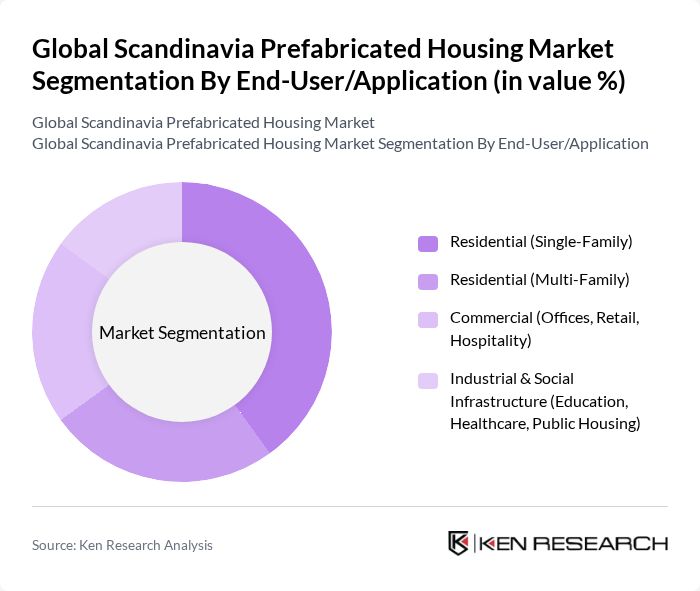
The Residential (Single-Family) segment dominates the market, driven by a growing preference for personalized living spaces and the increasing number of first-time homebuyers. The trend towards sustainable and energy-efficient homes has also influenced consumer choices, with many opting for prefabricated solutions that offer both affordability and environmental benefits. Additionally, the rise in remote work has led to an increased demand for homes that provide adequate space for home offices. In Scandinavia, single-family prefab holds the largest share of residential demand, supported by high offsite usage in Sweden and widespread adoption across suburban markets .
Global Scandinavia Prefabricated Housing Market Competitive Landscape
The Global Scandinavia Prefabricated Housing Market is characterized by a dynamic mix of regional and international players. Leading participants such as Lindbäcks Bygg AB, OBOS BBL, Skanska Industrialized Construction (BoKlok), HusCompagniet A/S, Älvsbyhus AB, Derome AB (A-hus), Trivselhus AB, Hjältevadshus AB, Fiskarhedenvillan AB, Mjöbäcksvillan AB, Myresjöhus (OBOS Sverige AB), SmålandsVillan (OBOS Sverige AB), SundaHus Prefab & Partners, Kodumaja AS, HUF Haus GmbH & Co. KG contribute to innovation, geographic expansion, and service delivery in this space .
Global Scandinavia Prefabricated Housing Market Industry Analysis
Growth Drivers
- Increasing Demand for Affordable Housing:The demand for affordable housing in Scandinavia is projected to rise significantly, with an estimated 1.5 million new homes needed by 2030 to accommodate population growth. The average housing cost in urban areas has surged to approximately €3,500 per square meter, prompting a shift towards prefabricated solutions that can reduce construction costs by up to 20%. This trend is driven by a growing population and urbanization, particularly in cities like Stockholm and Oslo.
- Sustainability and Eco-Friendly Construction:The Scandinavian region is a leader in sustainable building practices, with over 60% of new constructions aiming for energy efficiency certifications. The EU's Green Deal mandates a 55% reduction in greenhouse gas emissions by 2030, pushing builders towards eco-friendly prefabricated housing. In future, the market for sustainable materials is expected to reach €12 billion, reflecting a strong consumer preference for environmentally responsible housing solutions that align with these regulations.
- Technological Advancements in Prefabrication:Technological innovations in prefabrication are revolutionizing the construction process, with automation and robotics increasing efficiency by 35%. The integration of Building Information Modeling (BIM) has improved project planning and execution, reducing construction time by 30%. In future, investments in construction technology in Scandinavia are projected to exceed €1.5 billion, further enhancing the appeal of prefabricated housing as a viable option for developers and consumers alike.
Market Challenges
- High Initial Investment Costs:Despite the long-term savings associated with prefabricated housing, the initial investment remains a significant barrier. The average upfront cost for prefabricated homes can reach €220,000, which is often higher than traditional construction methods. This financial hurdle is exacerbated by rising material costs, which have increased by 18% in the past year, making it challenging for developers to offer competitive pricing while maintaining quality.
- Regulatory Hurdles:The prefabricated housing sector faces stringent regulatory challenges, with building codes varying significantly across regions. In future, compliance costs are expected to rise by 12% due to new environmental regulations and safety standards. These complexities can delay project timelines and increase costs, discouraging potential investors and developers from entering the market, particularly in areas with strict zoning laws and permitting processes.
Global Scandinavia Prefabricated Housing Market Future Outlook
The future of the prefabricated housing market in Scandinavia appears promising, driven by increasing urbanization and a strong focus on sustainability. As cities expand, the need for efficient housing solutions will intensify, leading to greater adoption of prefabricated methods. Additionally, advancements in technology will streamline production processes, making these homes more accessible. The integration of smart technologies will further enhance the appeal of prefabricated housing, aligning with consumer preferences for modern, energy-efficient living spaces.
Market Opportunities
- Expansion into Emerging Markets:Scandinavian companies have the opportunity to expand into emerging markets in Eastern Europe, where the demand for affordable housing is surging. With a projected housing deficit of 2.5 million units by 2025 in these regions, prefabricated solutions can meet this urgent need while capitalizing on lower labor costs and increasing local partnerships.
- Customization and Personalization Trends:There is a growing trend towards customization in housing, with consumers seeking personalized designs. The prefabricated housing market can leverage this by offering modular designs that allow for tailored solutions. In future, the demand for customizable homes is expected to increase by 35%, providing a lucrative opportunity for manufacturers to differentiate their offerings and attract a broader customer base.
Scope of the Report
| Segment | Sub-Segments |
|---|---|
| By Type | Modular (Volumetric) Homes Panelized Homes Pre-cut/Kit Homes Mobile/Relocatable & Container-Based Units Hybrid Systems |
| By End-User/Application | Residential (Single-Family) Residential (Multi-Family) Commercial (Offices, Retail, Hospitality) Industrial & Social Infrastructure (Education, Healthcare, Public Housing) |
| By Sales Channel | Direct-to-Developer/Project Sales Direct-to-Consumer Authorized Dealers/Distributors Online/Configurator Platforms |
| By Material Used | Timber/Wood Steel/Metal Concrete Composites & Engineered Materials |
| By Design Style | Contemporary/Modern Scandinavian Traditional/Nordic Classic Rustic/Cabin Minimalist/Passive House |
| By Price Range | Entry (Budget) Mid-Range Premium |
| By Region (Within Scandinavia) | Sweden Norway Denmark Finland Iceland |
Key Target Audience
Investors and Venture Capitalist Firms
Government and Regulatory Bodies (e.g., Swedish National Board of Housing, Building and Planning)
Manufacturers and Producers
Distributors and Retailers
Construction and Development Companies
Real Estate Investment Trusts (REITs)
Environmental Agencies (e.g., Nordic Council of Ministers)
Building Material Suppliers
Players Mentioned in the Report:
Lindbacks Bygg AB
OBOS BBL
Skanska Industrialized Construction (BoKlok)
HusCompagniet A/S
Alvsbyhus AB
Derome AB (A-hus)
Trivselhus AB
Hjaltevadshus AB
Fiskarhedenvillan AB
Mjobacksvillan AB
Myresjohus (OBOS Sverige AB)
SmalandsVillan (OBOS Sverige AB)
SundaHus Prefab & Partners
Kodumaja AS
HUF Haus GmbH & Co. KG
Table of Contents
Market Assessment Phase
1. Executive Summary and Approach
2. Global Scandinavia Prefabricated Housing Market Overview
2.1 Key Insights and Strategic Recommendations
2.2 Global Scandinavia Prefabricated Housing Market Overview
2.3 Definition and Scope
2.4 Evolution of Market Ecosystem
2.5 Timeline of Key Regulatory Milestones
2.6 Value Chain & Stakeholder Mapping
2.7 Business Cycle Analysis
2.8 Policy & Incentive Landscape
3. Global Scandinavia Prefabricated Housing Market Analysis
3.1 Growth Drivers
3.1.1 Increasing Demand for Affordable Housing
3.1.2 Sustainability and Eco-Friendly Construction
3.1.3 Technological Advancements in Prefabrication
3.1.4 Government Initiatives and Support
3.2 Market Challenges
3.2.1 High Initial Investment Costs
3.2.2 Regulatory Hurdles
3.2.3 Limited Consumer Awareness
3.2.4 Supply Chain Disruptions
3.3 Market Opportunities
3.3.1 Expansion into Emerging Markets
3.3.2 Customization and Personalization Trends
3.3.3 Integration of Smart Home Technologies
3.3.4 Partnerships with Local Governments
3.4 Market Trends
3.4.1 Rise of Modular Construction
3.4.2 Increased Focus on Energy Efficiency
3.4.3 Adoption of Circular Economy Principles
3.4.4 Growth of Online Sales Channels
3.5 Government Regulation
3.5.1 Building Codes and Standards
3.5.2 Environmental Regulations
3.5.3 Zoning Laws
3.5.4 Incentives for Sustainable Building Practices
4. SWOT Analysis
5. Stakeholder Analysis
6. Porter's Five Forces Analysis
7. Global Scandinavia Prefabricated Housing Market Market Size, 2019-2024
7.1 By Value
7.2 By Volume
7.3 By Average Selling Price
8. Global Scandinavia Prefabricated Housing Market Segmentation
8.1 By Type
8.1.1 Modular (Volumetric) Homes
8.1.2 Panelized Homes
8.1.3 Pre-cut/Kit Homes
8.1.4 Mobile/Relocatable & Container-Based Units
8.1.5 Hybrid Systems
8.2 By End-User/Application
8.2.1 Residential (Single-Family)
8.2.2 Residential (Multi-Family)
8.2.3 Commercial (Offices, Retail, Hospitality)
8.2.4 Industrial & Social Infrastructure (Education, Healthcare, Public Housing)
8.3 By Sales Channel
8.3.1 Direct-to-Developer/Project Sales
8.3.2 Direct-to-Consumer
8.3.3 Authorized Dealers/Distributors
8.3.4 Online/Configurator Platforms
8.4 By Material Used
8.4.1 Timber/Wood
8.4.2 Steel/Metal
8.4.3 Concrete
8.4.4 Composites & Engineered Materials
8.5 By Design Style
8.5.1 Contemporary/Modern Scandinavian
8.5.2 Traditional/Nordic Classic
8.5.3 Rustic/Cabin
8.5.4 Minimalist/Passive House
8.6 By Price Range
8.6.1 Entry (Budget)
8.6.2 Mid-Range
8.6.3 Premium
8.7 By Region (Within Scandinavia)
8.7.1 Sweden
8.7.2 Norway
8.7.3 Denmark
8.7.4 Finland
8.7.5 Iceland
9. Global Scandinavia Prefabricated Housing Market Competitive Analysis
9.1 Market Share of Key Players
9.2 Cross Comparison of Key Players
9.2.1 Company Name
9.2.2 Company Size (by employees/revenue band)
9.2.3 Revenue Growth (3Y CAGR, %)
9.2.4 Market Coverage (countries/states served in Scandinavia)
9.2.5 Installed Capacity (units or m² per year)
9.2.6 Order Backlog (months of production)
9.2.7 Average Lead Time (factory to site, weeks)
9.2.8 Product Mix (single-family vs multi-family share)
9.2.9 Material Mix (timber/steel/concrete %)
9.2.10 ESG/Certifications (Nordic Swan, BREEAM, Passive House)
9.2.11 Margin Profile (EBIT margin, %)
9.2.12 Pricing Positioning (entry/mid/premium)
9.2.13 Strategic Partnerships (developers/municipal frameworks)
9.2.14 Innovation Intensity (R&D spend %, patents, digital configurators)
9.2.15 Customer Satisfaction/Defect Rate (NPS or defects per 100 units)
9.3 SWOT Analysis of Top Players
9.4 Pricing Analysis
9.5 Detailed Profile of Major Companies
9.5.1 Lindbäcks Bygg AB
9.5.2 OBOS BBL
9.5.3 Skanska Industrialized Construction (BoKlok)
9.5.4 HusCompagniet A/S
9.5.5 Älvsbyhus AB
9.5.6 Derome AB (A-hus)
9.5.7 Trivselhus AB
9.5.8 Hjältevadshus AB
9.5.9 Fiskarhedenvillan AB
9.5.10 Mjöbäcksvillan AB
9.5.11 Myresjöhus (OBOS Sverige AB)
9.5.12 SmålandsVillan (OBOS Sverige AB)
9.5.13 SundaHus Prefab & Partners
9.5.14 Kodumaja AS
9.5.15 HUF Haus GmbH & Co. KG
10. Global Scandinavia Prefabricated Housing Market End-User Analysis
10.1 Procurement Behavior of Key Ministries
10.1.1 Government Housing Initiatives
10.1.2 Budget Allocations for Prefabricated Housing
10.1.3 Collaboration with Private Sector
10.1.4 Regulatory Compliance Requirements
10.2 Corporate Spend on Infrastructure & Energy
10.2.1 Investment in Sustainable Housing
10.2.2 Budget Trends in Construction
10.2.3 Partnerships with Prefabricated Housing Firms
10.3 Pain Point Analysis by End-User Category
10.3.1 Cost Constraints
10.3.2 Quality Assurance Issues
10.3.3 Delivery Timeliness
10.3.4 Customization Limitations
10.4 User Readiness for Adoption
10.4.1 Awareness of Prefabricated Solutions
10.4.2 Perceived Value of Prefabricated Housing
10.4.3 Training and Support Needs
10.5 Post-Deployment ROI and Use Case Expansion
10.5.1 Performance Metrics Tracking
10.5.2 Long-term Cost Savings
10.5.3 Expansion into New Markets
11. Global Scandinavia Prefabricated Housing Market Future Size, 2025-2030
11.1 By Value
11.2 By Volume
11.3 By Average Selling Price
Go-To-Market Strategy Phase
1. Whitespace Analysis + Business Model Canvas
1.1 Market Gaps Identification
1.2 Business Model Framework
2. Marketing and Positioning Recommendations
2.1 Branding Strategies
2.2 Product USPs
3. Distribution Plan
3.1 Urban Retail Strategies
3.2 Rural NGO Tie-ups
4. Channel & Pricing Gaps
4.1 Underserved Routes
4.2 Pricing Bands Analysis
5. Unmet Demand & Latent Needs
5.1 Category Gaps
5.2 Consumer Segments
6. Customer Relationship
6.1 Loyalty Programs
6.2 After-sales Service
7. Value Proposition
7.1 Sustainability Initiatives
7.2 Integrated Supply Chains
8. Key Activities
8.1 Regulatory Compliance
8.2 Branding Efforts
8.3 Distribution Setup
9. Entry Strategy Evaluation
9.1 Domestic Market Entry Strategy
9.1.1 Product Mix Considerations
9.1.2 Pricing Band Strategy
9.1.3 Packaging Solutions
9.2 Export Entry Strategy
9.2.1 Target Countries Identification
9.2.2 Compliance Roadmap Development
10. Entry Mode Assessment
10.1 Joint Ventures
10.2 Greenfield Investments
10.3 Mergers & Acquisitions
10.4 Distributor Model Evaluation
11. Capital and Timeline Estimation
11.1 Capital Requirements Analysis
11.2 Timelines for Market Entry
12. Control vs Risk Trade-Off
12.1 Ownership vs Partnerships
13. Profitability Outlook
13.1 Breakeven Analysis
13.2 Long-term Sustainability Strategies
14. Potential Partner List
14.1 Distributors
14.2 Joint Ventures
14.3 Acquisition Targets
15. Execution Roadmap
15.1 Phased Plan for Market Entry
15.1.1 Market Setup
15.1.2 Market Entry
15.1.3 Growth Acceleration
15.1.4 Scale & Stabilize
15.2 Key Activities and Milestones
15.2.1 Milestone Tracking
15.2.2 Activity Scheduling
Research Methodology
Phase 1: Approach1
Desk Research
- Analysis of industry reports from global housing associations and market research firms
- Review of government publications and housing policy documents from Scandinavian countries
- Examination of academic journals and case studies on prefabricated housing technologies
Primary Research
- Interviews with architects and builders specializing in prefabricated housing
- Surveys with homeowners who have opted for prefabricated solutions
- Focus groups with industry experts and stakeholders in the housing market
Validation & Triangulation
- Cross-validation of data from multiple sources including trade publications and expert interviews
- Triangulation of market trends with historical data and future projections
- Sanity checks through expert panel reviews to ensure data accuracy
Phase 2: Market Size Estimation1
Top-down Assessment
- Estimation of market size based on national housing statistics and construction spending
- Segmentation by type of prefabricated housing (modular, panelized, etc.)
- Incorporation of demographic trends and urbanization rates in Scandinavian countries
Bottom-up Modeling
- Volume estimates based on production data from leading prefabricated housing manufacturers
- Cost analysis derived from material and labor expenses in prefabrication
- Calculation of market size based on unit sales and average selling prices
Forecasting & Scenario Analysis
- Multi-variable regression analysis incorporating economic indicators and housing demand
- Scenario modeling based on potential regulatory changes and sustainability trends
- Development of baseline, optimistic, and pessimistic forecasts through 2030
Phase 3: CATI Sample Composition1
| Scope Item/Segment | Sample Size | Target Respondent Profiles |
|---|---|---|
| Residential Prefabricated Housing | 120 | Homeowners, Architects, Builders |
| Commercial Prefabricated Structures | 100 | Real Estate Developers, Project Managers |
| Government Housing Initiatives | 80 | Policy Makers, Urban Planners |
| Sustainability in Prefabrication | 70 | Environmental Consultants, Sustainability Officers |
| Technological Innovations in Prefabrication | 90 | R&D Managers, Technology Providers |
Frequently Asked Questions
What is the current value of the Global Scandinavia Prefabricated Housing Market?
The Global Scandinavia Prefabricated Housing Market is valued at approximately USD 6.1 billion, reflecting a consistent demand for energy-efficient, offsite-built homes in Sweden, Norway, and Denmark, as supported by various market assessments.
Which countries are the key players in the Scandinavia Prefabricated Housing Market?
What types of prefabricated homes are available in the market?
What drives the demand for prefabricated housing in Scandinavia?
Other Regional/Country Reports
Indonesia Prefabricated Housing Market
Malaysia Prefabricated Housing Market
APAC Prefabricated Housing Market
Why Buy From Us?

What makes us stand out is that our consultants follow Robust, Refine and Result (RRR) methodology. Robust for clear definitions, approaches and sanity checking, Refine for differentiating respondents' facts and opinions, and Result for presenting data with story.

We have set a benchmark in the industry by offering our clients with syndicated and customized market research reports featuring coverage of entire market as well as meticulous research and analyst insights.

While we don't replace traditional research, we flip the method upside down. Our dual approach of Top Bottom & Bottom Top ensures quality deliverable by not just verifying company fundamentals but also looking at the sector and macroeconomic factors.

With one step in the future, our research team constantly tries to show you the bigger picture. We help with some of the tough questions you may encounter along the way: How is the industry positioned? Best marketing channel? KPI's of competitors? By aligning every element, we help maximize success.

Our report gives you instant access to the answers and sources that other companies might choose to hide. We elaborate each steps of research methodology we have used and showcase you the sample size to earn your trust.

If you need any support, we are here! We pride ourselves on universe strength, data quality, and quick, friendly, and professional service.