Australia Fountain Dispenser Equipment Market Report Size Share Growth Drivers Trends Opportunities & Forecast 2025–2030

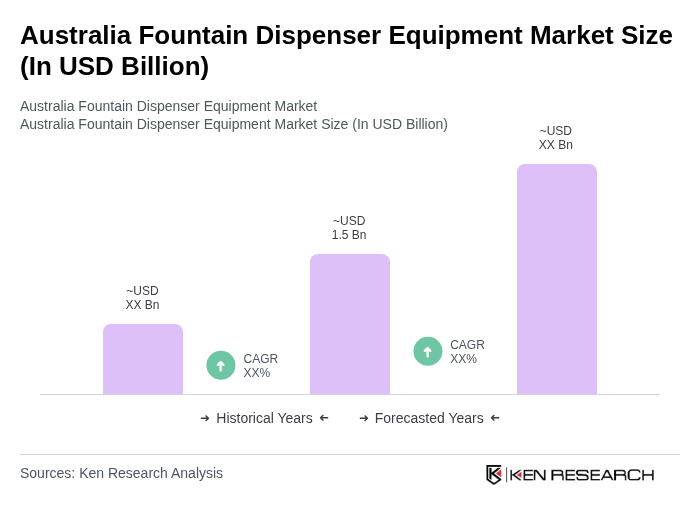
The Australia Fountain Dispenser Equipment Market is valued at USD 1.5 billion, fueled by convenience in beverage dispensing and hospitality growth.

Region:Global

Author(s):Geetanshi

Product Code:KRAA0584

Pages:98

Published On:January 2026
About the Report

Base Year 2024

Australia Fountain Dispenser Equipment Market Overview

  • The Australia Fountain Dispenser Equipment Market is valued at USD 1.5 billion, based on a five-year historical analysis. This growth is primarily driven by the increasing demand for convenience in beverage dispensing, particularly in the foodservice sector, as well as the rising trend of self-service beverage stations in various establishments.
  • Key cities such as Sydney, Melbourne, and Brisbane dominate the market due to their high population density and vibrant hospitality industries. These urban centers are hubs for restaurants, cafes, and entertainment venues, which significantly contribute to the demand for fountain dispenser equipment.
  • The National Greenhouse and Energy Reporting Act, 2007 issued by the Australian Government requires businesses above specified energy thresholds to report emissions and adopt energy-efficient equipment standards, including compliance with Minimum Energy Performance Standards for beverage dispensers that promote reduced energy consumption and waste minimization in commercial operations.
Australia Fountain Dispenser Equipment Market Size

Australia Fountain Dispenser Equipment Market Segmentation

By Type:The market can be segmented into various types of dispensers, including Carbonated Beverage Dispensers, Juice Dispensers, Water Dispensers, Alcoholic Beverage Dispensers, Frozen Beverage Dispensers, Specialty Beverage Dispensers, and Others. Each type serves different consumer preferences and operational needs, with carbonated beverage dispensers being particularly popular in fast-food chains and restaurants.
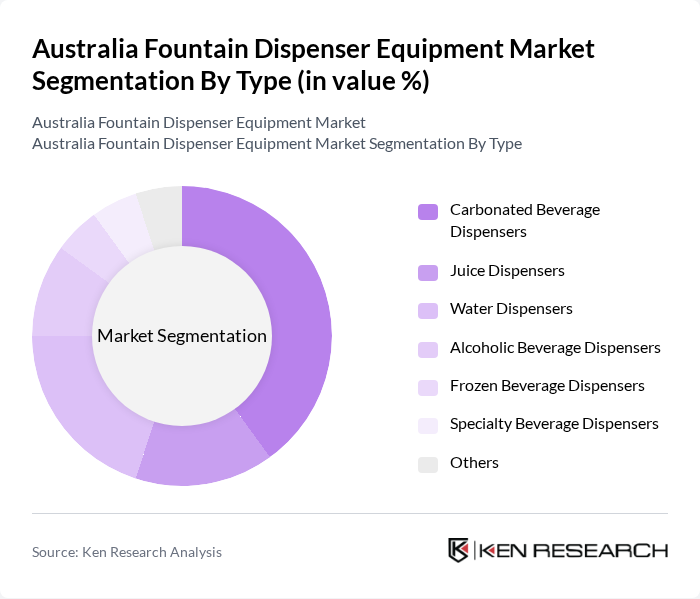
Australia Fountain Dispenser Equipment Market segmentation by Type.

By End-User:The end-user segmentation includes Restaurants, Cafes, Bars and Pubs, Cinemas, Events and Catering Services, and Others. Restaurants and cafes are the primary users of fountain dispensers, driven by the need for efficient beverage service and customer satisfaction.
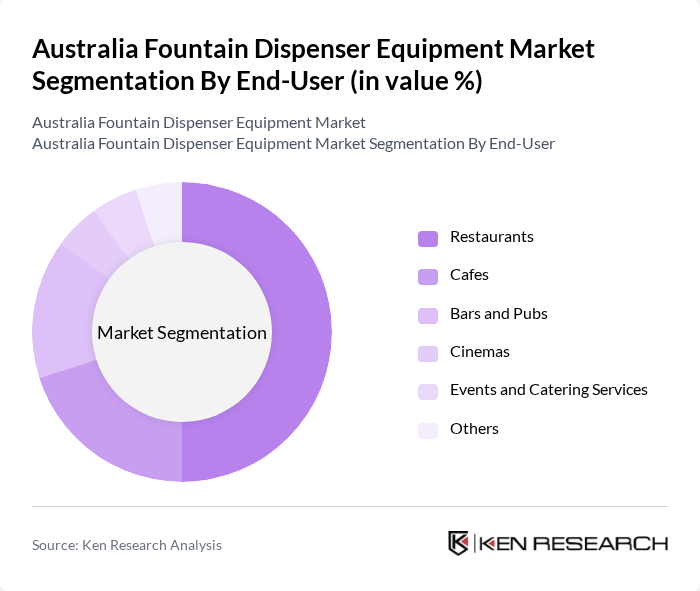
Australia Fountain Dispenser Equipment Market segmentation by End-User.

Australia Fountain Dispenser Equipment Market Competitive Landscape

The Australia Fountain Dispenser Equipment Market is characterized by a dynamic mix of regional and international players. Leading participants such as Coca-Cola Amatil, PepsiCo Australia, SODEXO, Cott Beverages, Britvic Australia, Asahi Beverages, Frucor Suntory, Monster Energy, Red Bull Australia, Nestlé Waters Australia, Diageo Australia, Lion Co., Carlton & United Breweries, Australian Vintage Ltd., Bundaberg Brewed Drinks contribute to innovation, geographic expansion, and service delivery in this space.

Coca-Cola Amatil

1904

Sydney, Australia

PepsiCo Australia

1965

North Sydney, Australia

SODEXO

1966

Paris, France

Cott Beverages

1895

Tampa, USA

Britvic Australia

1943

Hemel Hempstead, UK

Company

Establishment Year

Headquarters

Group Size (Large, Medium, or Small as per industry convention)

Revenue Growth Rate

Market Penetration Rate

Customer Retention Rate

Average Order Value

Pricing Strategy

Australia Fountain Dispenser Equipment Market Industry Analysis

Growth Drivers

  • Increasing Demand for Beverage Dispensing Solutions:The Australian beverage industry is projected to reach AUD 22 billion in future, driven by a growing preference for convenience and variety. This demand is particularly evident in urban areas, where consumers seek quick and efficient beverage options. The rise in on-the-go consumption patterns, especially among millennials, has led to an increased need for fountain dispenser equipment in various sectors, including hospitality and retail, further fueling market growth.
  • Rising Popularity of Self-Service Kiosks:Self-service kiosks are becoming increasingly popular in Australia, with an estimated 18% growth in installations expected in future. This trend is driven by consumer preferences for personalized experiences and reduced wait times. Quick Service Restaurants (QSRs) and cafes are adopting these kiosks to enhance customer engagement and streamline operations, leading to a higher demand for advanced fountain dispensing solutions that integrate seamlessly with these systems.
  • Technological Advancements in Dispensing Equipment:The fountain dispenser equipment market is witnessing significant technological innovations, with investments in smart technology projected to exceed AUD 600 million in future. These advancements include automated systems and IoT integration, which enhance operational efficiency and customer experience. As businesses increasingly adopt these technologies, the demand for modern, efficient dispensing solutions is expected to rise, driving market growth in Australia.

Market Challenges

  • High Initial Investment Costs:The initial investment for fountain dispenser equipment can be substantial, often exceeding AUD 12,000 for advanced systems. This high upfront cost can deter small and medium-sized enterprises from investing in new technology. Additionally, the financial burden of installation and training further complicates the decision-making process, limiting market penetration and growth opportunities for new entrants in the industry.
  • Maintenance and Operational Costs:Ongoing maintenance and operational costs for fountain dispensing systems can reach up to AUD 2,500 annually, depending on usage and technology. These costs include regular servicing, parts replacement, and utilities, which can strain the budgets of businesses, particularly in the competitive QSR sector. As a result, many operators may hesitate to upgrade or invest in new equipment, impacting overall market growth.

Australia Fountain Dispenser Equipment Market Future Outlook

The future of the Australia fountain dispenser equipment market appears promising, driven by technological advancements and evolving consumer preferences. As businesses increasingly adopt automated and smart dispensing solutions, the market is expected to witness a shift towards more efficient and user-friendly systems. Additionally, the growing emphasis on sustainability will likely encourage innovations in eco-friendly dispensing technologies, further enhancing market dynamics and attracting new investments in the sector.

Market Opportunities

  • Growth in the Hospitality Sector:The Australian hospitality sector is projected to grow by AUD 4 billion in future, creating significant opportunities for fountain dispenser equipment suppliers. As hotels and restaurants seek to enhance guest experiences, the demand for innovative beverage solutions will rise, providing a lucrative market for advanced dispensing technologies.
  • Innovations in Eco-Friendly Dispensing Solutions:With increasing consumer awareness regarding environmental issues, the demand for eco-friendly dispensing solutions is on the rise. Companies that invest in sustainable technologies, such as biodegradable materials and energy-efficient systems, can tap into this growing market segment, potentially increasing their market share and customer loyalty.

Scope of the Report

SegmentSub-Segments
By Type

Carbonated Beverage Dispensers

Juice Dispensers

Water Dispensers

Alcoholic Beverage Dispensers

Frozen Beverage Dispensers

Specialty Beverage Dispensers

Others

By End-User

Restaurants

Cafes

Bars and Pubs

Cinemas

Events and Catering Services

Others

By Application

Indoor Installations

Outdoor Installations

Mobile Units

Self-Service Stations

Others

By Distribution Channel

Direct Sales

Online Retail

Distributors and Wholesalers

Specialty Stores

Others

By Region

New South Wales

Victoria

Queensland

Western Australia

South Australia

Tasmania

Others

By Brand

Leading National Brands

Emerging Local Brands

Private Label Brands

Others

By Price Range

Budget Segment

Mid-Range Segment

Premium Segment

Others

Key Target Audience

Investors and Venture Capitalist Firms

Government and Regulatory Bodies (e.g., Australian Competition and Consumer Commission, Food Standards Australia New Zealand)

Manufacturers and Producers

Distributors and Retailers

Hospitality Industry Stakeholders

Event Organizers and Venue Managers

Facility Management Companies

Health and Safety Regulatory Agencies

Players Mentioned in the Report:

Coca-Cola Amatil

PepsiCo Australia

SODEXO

Cott Beverages

Britvic Australia

Asahi Beverages

Frucor Suntory

Monster Energy

Red Bull Australia

Nestle Waters Australia

Diageo Australia

Lion Co.

Carlton & United Breweries

Australian Vintage Ltd.

Bundaberg Brewed Drinks

Table of Contents

Market Assessment Phase

1. Executive Summary and Approach


2. Australia Fountain Dispenser Equipment Market Overview

2.1 Key Insights and Strategic Recommendations

2.2 Australia Fountain Dispenser Equipment Market Overview

2.3 Definition and Scope

2.4 Evolution of Market Ecosystem

2.5 Timeline of Key Regulatory Milestones

2.6 Value Chain & Stakeholder Mapping

2.7 Business Cycle Analysis

2.8 Policy & Incentive Landscape


3. Australia Fountain Dispenser Equipment Market Analysis

3.1 Growth Drivers

3.1.1 Increasing Demand for Beverage Dispensing Solutions
3.1.2 Rising Popularity of Self-Service Kiosks
3.1.3 Expansion of Quick Service Restaurants (QSRs)
3.1.4 Technological Advancements in Dispensing Equipment

3.2 Market Challenges

3.2.1 High Initial Investment Costs
3.2.2 Maintenance and Operational Costs
3.2.3 Regulatory Compliance Issues
3.2.4 Competition from Alternative Beverage Solutions

3.3 Market Opportunities

3.3.1 Growth in the Hospitality Sector
3.3.2 Increasing Health Consciousness Among Consumers
3.3.3 Expansion into Untapped Regional Markets
3.3.4 Innovations in Eco-Friendly Dispensing Solutions

3.4 Market Trends

3.4.1 Shift Towards Automated Dispensing Systems
3.4.2 Integration of Smart Technology in Equipment
3.4.3 Customization and Personalization of Beverage Options
3.4.4 Focus on Sustainability and Waste Reduction

3.5 Government Regulation

3.5.1 Food Safety Standards Compliance
3.5.2 Environmental Regulations on Waste Management
3.5.3 Health and Safety Regulations for Equipment
3.5.4 Licensing and Permitting Requirements

4. SWOT Analysis


5. Stakeholder Analysis


6. Porter's Five Forces Analysis


7. Australia Fountain Dispenser Equipment Market Market Size, 2019-2024

7.1 By Value

7.2 By Volume

7.3 By Average Selling Price


8. Australia Fountain Dispenser Equipment Market Segmentation

8.1 By Type

8.1.1 Carbonated Beverage Dispensers
8.1.2 Juice Dispensers
8.1.3 Water Dispensers
8.1.4 Alcoholic Beverage Dispensers
8.1.5 Frozen Beverage Dispensers
8.1.6 Specialty Beverage Dispensers
8.1.7 Others

8.2 By End-User

8.2.1 Restaurants
8.2.2 Cafes
8.2.3 Bars and Pubs
8.2.4 Cinemas
8.2.5 Events and Catering Services
8.2.6 Others

8.3 By Application

8.3.1 Indoor Installations
8.3.2 Outdoor Installations
8.3.3 Mobile Units
8.3.4 Self-Service Stations
8.3.5 Others

8.4 By Distribution Channel

8.4.1 Direct Sales
8.4.2 Online Retail
8.4.3 Distributors and Wholesalers
8.4.4 Specialty Stores
8.4.5 Others

8.5 By Region

8.5.1 New South Wales
8.5.2 Victoria
8.5.3 Queensland
8.5.4 Western Australia
8.5.5 South Australia
8.5.6 Tasmania
8.5.7 Others

8.6 By Brand

8.6.1 Leading National Brands
8.6.2 Emerging Local Brands
8.6.3 Private Label Brands
8.6.4 Others

8.7 By Price Range

8.7.1 Budget Segment
8.7.2 Mid-Range Segment
8.7.3 Premium Segment
8.7.4 Others

9. Australia Fountain Dispenser Equipment Market Competitive Analysis

9.1 Market Share of Key Players

9.2 Cross Comparison of Key Players

9.2.1 Company Name
9.2.2 Group Size (Large, Medium, or Small as per industry convention)
9.2.3 Revenue Growth Rate
9.2.4 Market Penetration Rate
9.2.5 Customer Retention Rate
9.2.6 Average Order Value
9.2.7 Pricing Strategy
9.2.8 Product Diversification Index
9.2.9 Customer Satisfaction Score
9.2.10 Distribution Efficiency

9.3 SWOT Analysis of Top Players

9.4 Pricing Analysis

9.5 Detailed Profile of Major Companies

9.5.1 Coca-Cola Amatil
9.5.2 PepsiCo Australia
9.5.3 SODEXO
9.5.4 Cott Beverages
9.5.5 Britvic Australia
9.5.6 Asahi Beverages
9.5.7 Frucor Suntory
9.5.8 Monster Energy
9.5.9 Red Bull Australia
9.5.10 Nestlé Waters Australia
9.5.11 Diageo Australia
9.5.12 Lion Co.
9.5.13 Carlton & United Breweries
9.5.14 Australian Vintage Ltd.
9.5.15 Bundaberg Brewed Drinks

10. Australia Fountain Dispenser Equipment Market End-User Analysis

10.1 Procurement Behavior of Key Ministries

10.1.1 Budget Allocation Trends
10.1.2 Procurement Processes and Timelines
10.1.3 Preferred Suppliers and Brands
10.1.4 Evaluation Criteria for Equipment

10.2 Corporate Spend on Infrastructure & Energy

10.2.1 Investment Trends in Beverage Dispensing
10.2.2 Budgeting for Equipment Upgrades
10.2.3 Cost-Benefit Analysis Practices
10.2.4 Long-term Financial Commitments

10.3 Pain Point Analysis by End-User Category

10.3.1 Equipment Reliability Issues
10.3.2 Maintenance and Support Challenges
10.3.3 Cost Management Concerns
10.3.4 User Experience and Satisfaction

10.4 User Readiness for Adoption

10.4.1 Training and Support Needs
10.4.2 Technology Acceptance Levels
10.4.3 Feedback Mechanisms
10.4.4 Adoption Barriers

10.5 Post-Deployment ROI and Use Case Expansion

10.5.1 Measurement of ROI
10.5.2 Case Studies of Successful Implementations
10.5.3 Future Use Case Opportunities
10.5.4 Customer Feedback and Iteration

11. Australia Fountain Dispenser Equipment Market Future Size, 2025-2030

11.1 By Value

11.2 By Volume

11.3 By Average Selling Price


Go-To-Market Strategy Phase

1. Whitespace Analysis + Business Model Canvas

1.1 Market Gaps Identification

1.2 Business Model Framework


2. Marketing and Positioning Recommendations

2.1 Branding Strategies

2.2 Product USPs


3. Distribution Plan

3.1 Urban Retail vs Rural NGO Tie-ups


4. Channel & Pricing Gaps

4.1 Underserved Routes

4.2 Pricing Bands


5. Unmet Demand & Latent Needs

5.1 Category Gaps

5.2 Consumer Segments


6. Customer Relationship

6.1 Loyalty Programs

6.2 After-sales Service


7. Value Proposition

7.1 Sustainability

7.2 Integrated Supply Chains


8. Key Activities

8.1 Regulatory Compliance

8.2 Branding

8.3 Distribution Setup


9. Entry Strategy Evaluation

9.1 Domestic Market Entry Strategy

9.1.1 Product Mix
9.1.2 Pricing Band
9.1.3 Packaging

9.2 Export Entry Strategy

9.2.1 Target Countries
9.2.2 Compliance Roadmap

10. Entry Mode Assessment

10.1 JV

10.2 Greenfield

10.3 M&A

10.4 Distributor Model


11. Capital and Timeline Estimation

11.1 Capital Requirements

11.2 Timelines


12. Control vs Risk Trade-Off

12.1 Ownership vs Partnerships


13. Profitability Outlook

13.1 Breakeven Analysis

13.2 Long-term Sustainability


14. Potential Partner List

14.1 Distributors

14.2 JVs

14.3 Acquisition Targets


15. Execution Roadmap

15.1 Phased Plan for Market Entry

15.1.1 Market Setup
15.1.2 Market Entry
15.1.3 Growth Acceleration
15.1.4 Scale & Stabilize

15.2 Key Activities and Milestones

15.2.1 Milestone Planning
15.2.2 Activity Tracking

Research Methodology

ApproachModellingSample

Phase 1: Approach1

Desk Research

  • Industry reports from Australian beverage associations and market research firms
  • Government publications on food and beverage regulations and standards
  • Analysis of import/export data related to fountain dispenser equipment

Primary Research

  • Interviews with key stakeholders in the beverage industry, including manufacturers and distributors
  • Surveys targeting restaurant and café owners regarding their fountain dispenser usage
  • Field visits to venues utilizing fountain dispensers to gather firsthand operational insights

Validation & Triangulation

  • Cross-validation of findings through multiple data sources, including sales data and industry forecasts
  • Triangulation of insights from primary interviews with secondary data trends
  • Sanity checks conducted through expert panel discussions with industry veterans

Phase 2: Market Size Estimation1

Top-down Assessment

  • Estimation of market size based on overall beverage consumption trends in Australia
  • Segmentation of market by end-user categories such as restaurants, cafes, and entertainment venues
  • Incorporation of growth rates from related sectors, such as fast food and casual dining

Bottom-up Modeling

  • Collection of sales data from leading fountain dispenser manufacturers in Australia
  • Estimation of average unit prices and sales volumes across different market segments
  • Analysis of installation and maintenance costs to determine total market value

Forecasting & Scenario Analysis

  • Multi-variable forecasting using historical sales data and projected growth in the food service sector
  • Scenario analysis based on potential regulatory changes affecting beverage dispensing
  • Development of baseline, optimistic, and pessimistic market growth scenarios through 2030

Phase 3: CATI Sample Composition1

Scope Item/SegmentSample SizeTarget Respondent Profiles
Restaurant Sector Fountain Dispenser Usage120Restaurant Owners, Beverage Managers
Café and Coffee Shop Equipment Preferences100Café Owners, Operations Managers
Fast Food Chain Equipment Insights80Franchise Managers, Supply Chain Coordinators
Event Venue Beverage Dispensing Practices70Event Coordinators, Venue Managers
Retail Outlet Fountain Dispenser Trends90Retail Managers, Product Buyers

Frequently Asked Questions

What is the current value of the Australia Fountain Dispenser Equipment Market?

The Australia Fountain Dispenser Equipment Market is valued at approximately USD 1.5 billion, reflecting a significant growth trend driven by increasing demand for convenience in beverage dispensing, particularly in the foodservice sector.

Which cities are the primary markets for fountain dispenser equipment in Australia?

What types of fountain dispensers are available in the Australian market?

Who are the major players in the Australia Fountain Dispenser Equipment Market?

Other Adjacent Reports

Malaysia Beverage Vending Machine Market

Qatar Commercial Refrigeration Equipment Market Report Size, Share, Growth Drivers, Trends, Opportunities & Forecast 2025–2030

Bahrain Foodservice Equipment Market

Mexico Hospitality Supplies Market

Bahrain Self-Service Kiosk Market

KSA Carbonated Soft Drink Market

Europe Alcoholic Beverage Market

UAE Juice and Nectar Market

UAE Frozen Dessert Equipment Market

Middle East Catering Services Market Report Size Share Growth Drivers Trends Opportunities & Forecast 2025–2030

Why Buy From Us?

Refine Robust Result (RRR) Framework

What makes us stand out is that our consultants follow Robust, Refine and Result (RRR) methodology. Robust for clear definitions, approaches and sanity checking, Refine for differentiating respondents' facts and opinions, and Result for presenting data with story.

Our Reach Is Unmatched

We have set a benchmark in the industry by offering our clients with syndicated and customized market research reports featuring coverage of entire market as well as meticulous research and analyst insights.

Shifting the Research Paradigm

While we don't replace traditional research, we flip the method upside down. Our dual approach of Top Bottom & Bottom Top ensures quality deliverable by not just verifying company fundamentals but also looking at the sector and macroeconomic factors.

More Insights-Better Decisions

With one step in the future, our research team constantly tries to show you the bigger picture. We help with some of the tough questions you may encounter along the way: How is the industry positioned? Best marketing channel? KPI's of competitors? By aligning every element, we help maximize success.

Transparency and Trust

Our report gives you instant access to the answers and sources that other companies might choose to hide. We elaborate each steps of research methodology we have used and showcase you the sample size to earn your trust.

Round the Clock Support

If you need any support, we are here! We pride ourselves on universe strength, data quality, and quick, friendly, and professional service.

Why Clients Choose Us?

400000+
Reports in repository
150+
Consulting projects a year
100+
Analysts
8000+
Client Queries in 2022








