About the Report
Base Year 2024Australia Micro Market Overview
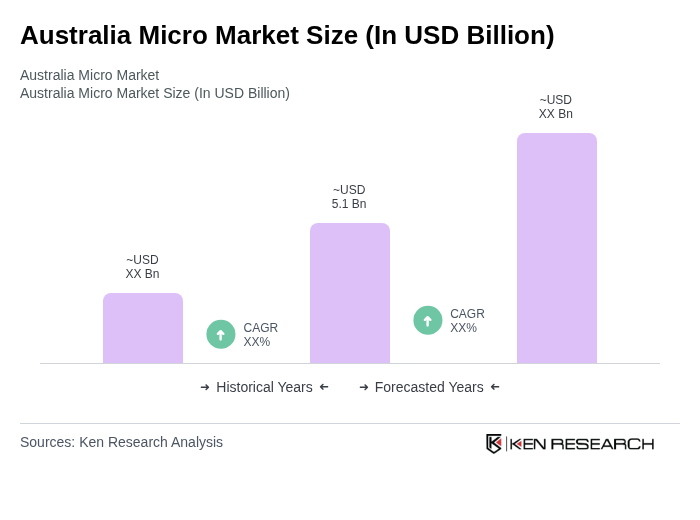
- The Australia Micro Market is valued at USD 5.1 billion, based on a five-year historical analysis, reflecting the aggregation of adjacent smart energy and digital infrastructure segments such as distributed generation, energy storage, EV charging, smart metering, and related enabling technologies. This growth is primarily driven by the increasing demand for renewable energy solutions, rapid deployment of behind-the-meter solar PV, and strong policy support for decarbonisation through mechanisms such as state-based renewable energy zones. The market is witnessing a clear shift towards decentralized energy systems and local energy markets, supported by virtual power plants, community batteries, and advanced distribution management systems, which are becoming essential for enhancing energy security, grid flexibility, and sustainability.
- Key hubs in this market include Sydney, Melbourne, and Brisbane, which dominate due to their robust transmission and distribution infrastructure, high population density, and significant investments in renewable and distributed energy projects. These cities are also home to numerous technology firms, utilities, and research institutions such as the University of New South Wales, CSIRO, and the University of Melbourne that foster innovation in distributed energy resources, microgrids, and smart grid solutions, making them pivotal in the micro market landscape.
- The Renewable Energy (Electricity) Act 2000 and associated Renewable Energy Target (RET) schemes, administered by the Clean Energy Regulator, established a Large-scale Renewable Energy Target of 33,000 GWh of eligible renewable electricity generation per year from 2020, implemented through the creation and surrender of Large-scale Generation Certificates (LGCs). This regulatory framework requires liable entities (mainly electricity retailers) to meet annual renewable power purchase obligations, thereby encouraging investment in utility-scale and distributed renewable energy projects and supporting the growth of microgrids, distributed generation, and storage-based solutions across Australia.
Australia Micro Market Segmentation
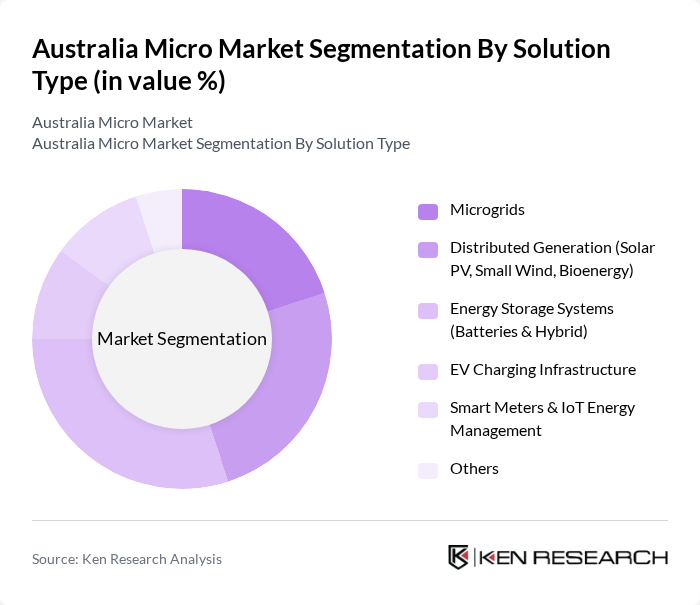
By Solution Type:The solution type segmentation includes various subsegments such as Microgrids, Distributed Generation, Energy Storage Systems, EV Charging Infrastructure, Smart Meters & IoT, and Others. Microgrids encompass islandable and grid-connected systems integrating local generation, storage, and control systems for applications in remote communities, mines, campuses, and defence facilities. Distributed Generation includes rooftop and small-scale solar PV, small wind, and bioenergy systems that are typically installed close to the point of consumption and are increasingly supported by feed-in tariffs and net-metering style arrangements. Energy Storage Systems cover residential, commercial, and utility-scale batteries and hybrid systems that provide peak shaving, backup power, and ancillary services, and are growing rapidly with the uptake of household solar and virtual power plants. EV Charging Infrastructure comprises home, workplace, public AC charging, and fast and ultra-fast DC charging networks, which are expanding alongside rising electric vehicle adoption and government charging infrastructure grants. Smart Meters & IoT Energy Management includes advanced metering infrastructure, demand response platforms, and IoT-based energy management systems that enable real-time monitoring, dynamic tariffs, and load flexibility for residential and commercial users. Among these, Energy Storage Systems are currently one of the fastest-growing components of the ecosystem, driven by increasing adoption of residential and commercial batteries, cost declines in lithium-ion technologies, and the need for reliable energy supply to support high solar penetration. The growing integration of variable renewable energy sources has also heightened the demand for efficient energy storage solutions to provide grid stability, frequency control, and peak demand management, making this subsegment a focal point for investment and innovation.
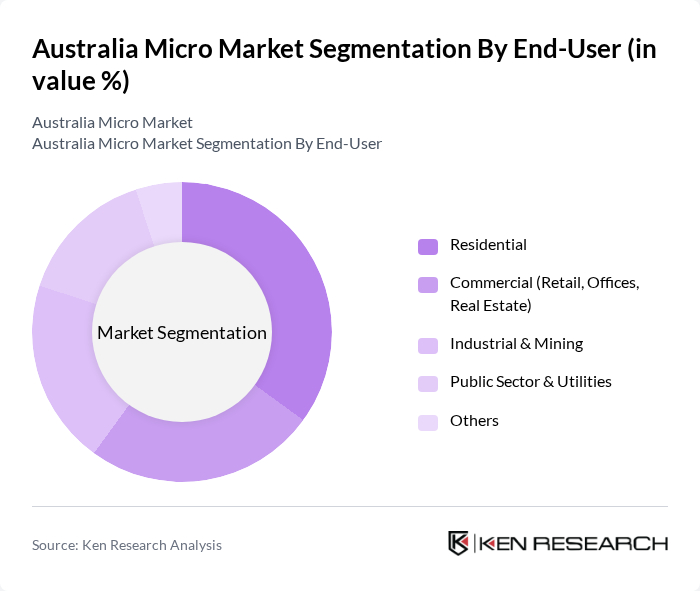
By End-User:The end-user segmentation encompasses Residential, Commercial, Industrial & Mining, Public Sector & Utilities, and Others. The Residential segment is currently a major demand centre, driven by the high penetration of rooftop solar, growing adoption of smart home technologies, and increased installation of home battery systems and EV chargers. Consumers are becoming more aware of energy costs and sustainability, supported by time-of-use tariffs, feed-in arrangements, and energy management apps, leading to a surge in demand for residential-scale distributed generation, storage, and demand response solutions tailored for home applications. The Commercial segment (retail, offices, real estate) is also expanding its use of microgrids, on-site solar, and building energy management systems to meet corporate decarbonisation targets and improve operational resilience, while Industrial & Mining and Public Sector & Utilities increasingly deploy microgrid and storage solutions in remote operations, defence bases, and critical infrastructure.
Australia Micro Market Competitive Landscape
The Australia Micro Market is characterized by a dynamic mix of regional and international players. Leading participants such as AGL Energy, Origin Energy, EnergyAustralia, Iberdrola Australia (formerly Infigen Energy), Neoen, Cleanaway Waste Management, Australian Renewable Energy Agency (ARENA), Red Energy, Simply Energy, Powercor Australia, AusNet Services, Jemena, Enel X, Fluence Energy, Tilt Renewables contribute to innovation, geographic expansion, and service delivery in this space.
Australia Micro Market Industry Analysis
Growth Drivers
- Increasing Demand for Renewable Energy:The Australian renewable energy sector is projected to reach AUD 50 billion in future, driven by a 20% increase in demand for clean energy solutions. This surge is largely attributed to the government's commitment to achieving a 50% renewable energy target by 2030. Additionally, the International Energy Agency reported that renewable energy sources accounted for 29% of Australia's total electricity generation in future, highlighting a significant shift towards sustainable energy practices.
- Government Incentives and Subsidies:In future, the Australian government allocated AUD 1.5 billion for renewable energy initiatives, including microgrid development. This funding supports various programs aimed at enhancing energy efficiency and reducing carbon emissions. Furthermore, the Clean Energy Regulator reported that over 3 million households have installed solar panels, benefiting from feed-in tariffs and rebates, which encourage the adoption of renewable technologies and stimulate market growth.
- Technological Advancements in Microgrid Solutions:The microgrid technology market in Australia is expected to grow significantly, with investments reaching AUD 2 billion in future. Innovations in energy management systems and battery storage solutions are enhancing the efficiency and reliability of microgrids. According to the Australian Energy Market Operator, the integration of advanced technologies has improved grid resilience, enabling better management of distributed energy resources and facilitating the transition to a decentralized energy system.
Market Challenges
- High Initial Investment Costs:The upfront costs associated with microgrid installations can exceed AUD 1 million, posing a significant barrier for many potential adopters. This financial hurdle is compounded by the need for advanced infrastructure and technology, which can deter investment. According to the Clean Energy Council, only 15% of Australian businesses have adopted microgrid solutions, primarily due to concerns over initial capital expenditures and long-term financial viability.
- Regulatory Compliance Complexity:Navigating the regulatory landscape in Australia can be challenging for microgrid developers. The National Electricity Market (NEM) regulations require compliance with numerous standards, which can lead to delays and increased costs. In future, the Australian Energy Regulator reported that 40% of microgrid projects faced regulatory hurdles, impacting their implementation timelines and overall market growth potential.
Australia Micro Market Future Outlook
The future of the microgrid market in Australia appears promising, driven by increasing investments in renewable energy and technological advancements. In future, the integration of smart grid technologies is expected to enhance energy management and efficiency. Additionally, the rise of community energy projects will foster local engagement and investment in sustainable infrastructure, further supporting the transition towards decentralized energy systems. As consumer awareness grows, the market is likely to witness accelerated adoption of microgrid solutions.
Market Opportunities
- Expansion of Smart Grid Technologies:The Australian government is investing AUD 500 million in smart grid initiatives in future, creating opportunities for microgrid developers. This investment aims to enhance grid reliability and efficiency, facilitating the integration of renewable energy sources. As smart grid technologies evolve, they will enable better energy management and foster innovation in microgrid solutions.
- Partnerships with Local Governments:Collaborations between microgrid developers and local governments are expected to increase, with over 30% of municipalities exploring microgrid projects in future. These partnerships can leverage government funding and resources, enhancing project feasibility. Local governments are increasingly recognizing the benefits of microgrids for energy resilience and sustainability, creating a favorable environment for growth.
Scope of the Report
| Segment | Sub-Segments |
|---|---|
| By Solution Type (Microgrids, Distributed Generation, Energy Storage, EV Charging, Smart Meters & IoT, Others) | Microgrids Distributed Generation (Solar PV, Small Wind, Bioenergy) Energy Storage Systems (Batteries & Hybrid) EV Charging Infrastructure Smart Meters & IoT Energy Management Others |
| By End-User (Residential, Commercial, Industrial & Mining, Public Sector & Utilities) | Residential Commercial (Retail, Offices, Real Estate) Industrial & Mining Public Sector & Utilities Others |
| By Region (ACT & New South Wales, Victoria & Tasmania, Queensland, Northern Territory & South Australia, Western Australia) | ACT & New South Wales Victoria & Tasmania Queensland Northern Territory & South Australia Western Australia |
| By Business Model (Capex Sale, Energy-as-a-Service, Lease/Rental, PPP & Community Models) | Capex Sale (Outright Purchase) Energy-as-a-Service (Subscription/Pay-per-use) Lease/Rental Models PPP & Community Ownership Models Others |
| By Application (On-grid Optimization, Off-grid & Remote Communities, Backup & Resilience, Commercial & Industrial Flexibility) | On-grid Optimization & Peak Shaving Off-grid & Remote Communities Backup Power & Resilience Commercial & Industrial Flexibility Services Others |
| By Ownership (Utility-owned, Customer-owned, Third-party/ESCO-owned, Community-owned) | Utility-owned Customer-owned (Residential & C&I) Third-party/ESCO-owned Community-owned Others |
| By Technology Stack (Hardware, Software & Analytics, Services) | Hardware (Generation, Storage, Devices) Software & Analytics Platforms Installation & O&M Services Others |
Key Target Audience
Investors and Venture Capitalist Firms
Government and Regulatory Bodies (e.g., Australian Competition and Consumer Commission, Department of Industry, Science, Energy and Resources)
Manufacturers and Producers
Distributors and Retailers
Industry Associations
Financial Institutions
Trade Associations
Logistics and Supply Chain Companies
Players Mentioned in the Report:
AGL Energy
Origin Energy
EnergyAustralia
Iberdrola Australia (formerly Infigen Energy)
Neoen
Cleanaway Waste Management
Australian Renewable Energy Agency (ARENA)
Red Energy
Simply Energy
Powercor Australia
AusNet Services
Jemena
Enel X
Fluence Energy
Tilt Renewables
Table of Contents
Market Assessment Phase
1. Executive Summary and Approach
2. Australia Micro Market Overview
2.1 Key Insights and Strategic Recommendations
2.2 Australia Micro Market Overview
2.3 Definition and Scope
2.4 Evolution of Market Ecosystem
2.5 Timeline of Key Regulatory Milestones
2.6 Value Chain & Stakeholder Mapping
2.7 Business Cycle Analysis
2.8 Policy & Incentive Landscape
3. Australia Micro Market Analysis
3.1 Growth Drivers
3.1.1 Increasing Demand for Renewable Energy
3.1.2 Government Incentives and Subsidies
3.1.3 Technological Advancements in Microgrid Solutions
3.1.4 Rising Environmental Awareness
3.2 Market Challenges
3.2.1 High Initial Investment Costs
3.2.2 Regulatory Compliance Complexity
3.2.3 Limited Consumer Awareness
3.2.4 Competition from Traditional Energy Sources
3.3 Market Opportunities
3.3.1 Expansion of Smart Grid Technologies
3.3.2 Partnerships with Local Governments
3.3.3 Development of Energy Storage Solutions
3.3.4 Increasing Investment in Sustainable Infrastructure
3.4 Market Trends
3.4.1 Growth of Decentralized Energy Systems
3.4.2 Integration of IoT in Energy Management
3.4.3 Shift Towards Energy Independence
3.4.4 Rise of Community Energy Projects
3.5 Government Regulation
3.5.1 Renewable Energy Target (RET)
3.5.2 National Electricity Market (NEM) Regulations
3.5.3 Feed-in Tariffs for Microgeneration
3.5.4 Environmental Protection Policies
4. SWOT Analysis
5. Stakeholder Analysis
6. Porter's Five Forces Analysis
7. Australia Micro Market Market Size, 2019-2024
7.1 By Value
7.2 By Volume
7.3 By Average Selling Price
8. Australia Micro Market Segmentation
8.1 By Solution Type (Microgrids, Distributed Generation, Energy Storage, EV Charging, Smart Meters & IoT, Others)
8.1.1 Microgrids
8.1.2 Distributed Generation (Solar PV, Small Wind, Bioenergy)
8.1.3 Energy Storage Systems (Batteries & Hybrid)
8.1.4 EV Charging Infrastructure
8.1.5 Smart Meters & IoT Energy Management
8.1.6 Others
8.2 By End-User (Residential, Commercial, Industrial & Mining, Public Sector & Utilities)
8.2.1 Residential
8.2.2 Commercial (Retail, Offices, Real Estate)
8.2.3 Industrial & Mining
8.2.4 Public Sector & Utilities
8.2.5 Others
8.3 By Region (ACT & New South Wales, Victoria & Tasmania, Queensland, Northern Territory & South Australia, Western Australia)
8.3.1 ACT & New South Wales
8.3.2 Victoria & Tasmania
8.3.3 Queensland
8.3.4 Northern Territory & South Australia
8.3.5 Western Australia
8.4 By Business Model (Capex Sale, Energy-as-a-Service, Lease/Rental, PPP & Community Models)
8.4.1 Capex Sale (Outright Purchase)
8.4.2 Energy-as-a-Service (Subscription/Pay-per-use)
8.4.3 Lease/Rental Models
8.4.4 PPP & Community Ownership Models
8.4.5 Others
8.5 By Application (On-grid Optimization, Off-grid & Remote Communities, Backup & Resilience, Commercial & Industrial Flexibility)
8.5.1 On-grid Optimization & Peak Shaving
8.5.2 Off-grid & Remote Communities
8.5.3 Backup Power & Resilience
8.5.4 Commercial & Industrial Flexibility Services
8.5.5 Others
8.6 By Ownership (Utility-owned, Customer-owned, Third-party/ESCO-owned, Community-owned)
8.6.1 Utility-owned
8.6.2 Customer-owned (Residential & C&I)
8.6.3 Third-party/ESCO-owned
8.6.4 Community-owned
8.6.5 Others
8.7 By Technology Stack (Hardware, Software & Analytics, Services)
8.7.1 Hardware (Generation, Storage, Devices)
8.7.2 Software & Analytics Platforms
8.7.3 Installation & O&M Services
8.7.4 Others
9. Australia Micro Market Competitive Analysis
9.1 Market Share of Key Players (Micro, Small, Medium, Large Enterprises)
9.2 Cross Comparison of Key Players
9.2.1 Company Name
9.2.2 Group Size (Large, Medium, or Small as per industry convention)
9.2.3 Annual Revenue (Latest FY, AUD Million)
9.2.4 3-year Revenue CAGR (%)
9.2.5 EBITDA Margin (%)
9.2.6 Return on Capital Employed (ROCE, %)
9.2.7 Customer Acquisition Cost (CAC per Customer)
9.2.8 Customer Lifetime Value (CLV)
9.2.9 Market Share in Target Segment (%)
9.2.10 Installed Capacity / Assets Under Management (MW, #Sites)
9.2.11 Average Revenue per User / Site (ARPU/ARPS)
9.2.12 Churn / Customer Retention Rate (%)
9.3 SWOT Analysis of Top Players
9.4 Pricing Analysis (By Class and Payload)
9.5 Detailed Profile of Major Companies
9.5.1 AGL Energy
9.5.2 Origin Energy
9.5.3 EnergyAustralia
9.5.4 Iberdrola Australia (formerly Infigen Energy)
9.5.5 Neoen
9.5.6 Cleanaway Waste Management
9.5.7 Australian Renewable Energy Agency (ARENA)
9.5.8 Red Energy
9.5.9 Simply Energy
9.5.10 Powercor Australia
9.5.11 AusNet Services
9.5.12 Jemena
9.5.13 Enel X
9.5.14 Fluence Energy
9.5.15 Tilt Renewables
10. Australia Micro Market End-User Analysis
10.1 Procurement Behavior of Key Ministries
10.1.1 Ministry of Energy
10.1.2 Ministry of Environment
10.1.3 Ministry of Infrastructure
10.1.4 Ministry of Finance
10.2 Corporate Spend on Infrastructure & Energy
10.2.1 Corporate Investments in Renewable Projects
10.2.2 Budget Allocations for Energy Efficiency
10.2.3 Expenditure on Sustainable Technologies
10.2.4 Funding for Research and Development
10.3 Pain Point Analysis by End-User Category
10.3.1 Residential Users
10.3.2 Commercial Users
10.3.3 Industrial Users
10.3.4 Government Entities
10.4 User Readiness for Adoption
10.4.1 Awareness of Microgrid Solutions
10.4.2 Financial Readiness
10.4.3 Technical Capability
10.4.4 Regulatory Understanding
10.5 Post-Deployment ROI and Use Case Expansion
10.5.1 Performance Metrics
10.5.2 User Satisfaction Levels
10.5.3 Scalability of Solutions
10.5.4 Future Investment Plans
11. Australia Micro Market Future Size, 2025-2030
11.1 By Value
11.2 By Volume
11.3 By Average Selling Price
Go-To-Market Strategy Phase
1. Whitespace Analysis + Business Model Canvas
1.1 Market Gaps Identification
1.2 Value Proposition Development
1.3 Revenue Streams Analysis
1.4 Cost Structure Evaluation
1.5 Key Partnerships Exploration
1.6 Customer Segmentation
1.7 Channels of Distribution
2. Marketing and Positioning Recommendations
2.1 Branding Strategies
2.2 Product USPs
2.3 Target Market Identification
2.4 Communication Strategy
2.5 Digital Marketing Approaches
3. Distribution Plan
3.1 Urban Retail Strategies
3.2 Rural NGO Tie-ups
3.3 Online Distribution Channels
3.4 Direct Sales Approaches
4. Channel & Pricing Gaps
4.1 Underserved Routes
4.2 Pricing Bands Analysis
4.3 Competitor Pricing Strategies
5. Unmet Demand & Latent Needs
5.1 Category Gaps
5.2 Consumer Segments Analysis
5.3 Emerging Trends Identification
6. Customer Relationship
6.1 Loyalty Programs
6.2 After-sales Service
6.3 Customer Feedback Mechanisms
7. Value Proposition
7.1 Sustainability Initiatives
7.2 Integrated Supply Chains
7.3 Competitive Advantages
8. Key Activities
8.1 Regulatory Compliance
8.2 Branding Efforts
8.3 Distribution Setup
9. Entry Strategy Evaluation
9.1 Domestic Market Entry Strategy
9.1.1 Product Mix
9.1.2 Pricing Band
9.1.3 Packaging Considerations
9.2 Export Entry Strategy
9.2.1 Target Countries
9.2.2 Compliance Roadmap
10. Entry Mode Assessment
10.1 JV Opportunities
10.2 Greenfield Investments
10.3 M&A Considerations
10.4 Distributor Model Evaluation
11. Capital and Timeline Estimation
11.1 Capital Requirements
11.2 Timelines for Implementation
12. Control vs Risk Trade-Off
12.1 Ownership Considerations
12.2 Partnerships Evaluation
13. Profitability Outlook
13.1 Breakeven Analysis
13.2 Long-term Sustainability
14. Potential Partner List
14.1 Distributors
14.2 JVs
14.3 Acquisition Targets
15. Execution Roadmap
15.1 Phased Plan for Market Entry
15.1.1 Market Setup
15.1.2 Market Entry
15.1.3 Growth Acceleration
15.1.4 Scale & Stabilize
15.2 Key Activities and Milestones
15.2.1 Milestone Planning
15.2.2 Activity Tracking
Research Methodology
Phase 1: Approach1
Desk Research
- Analysis of government publications and reports on the Australian micro market landscape
- Review of industry white papers and market analysis reports from local research firms
- Examination of demographic and economic data from the Australian Bureau of Statistics
Primary Research
- In-depth interviews with industry experts and thought leaders in the Australian micro market
- Surveys targeting small business owners and entrepreneurs within niche sectors
- Focus groups with consumers to understand preferences and behaviors in micro markets
Validation & Triangulation
- Cross-referencing findings from desk research with insights gathered from primary research
- Utilizing expert feedback to validate market trends and consumer insights
- Sanity checks through comparative analysis with historical data and market forecasts
Phase 2: Market Size Estimation1
Top-down Assessment
- Estimation of market size based on national economic indicators and sector-specific growth rates
- Segmentation of the market by key demographics and geographic regions within Australia
- Incorporation of government initiatives and funding programs supporting micro enterprises
Bottom-up Modeling
- Collection of sales data from a representative sample of micro businesses across various sectors
- Estimation of average revenue per business based on industry benchmarks
- Calculation of total market size by aggregating data from individual business performance
Forecasting & Scenario Analysis
- Development of predictive models using historical growth trends and economic forecasts
- Scenario planning based on potential regulatory changes and market disruptions
- Creation of multiple growth scenarios (baseline, optimistic, and pessimistic) through 2030
Phase 3: CATI Sample Composition1
| Scope Item/Segment | Sample Size | Target Respondent Profiles |
|---|---|---|
| Food and Beverage Micro Enterprises | 100 | Business Owners, Operations Managers |
| Health and Wellness Startups | 80 | Founders, Marketing Managers |
| Local Artisans and Crafts | 70 | Artisans, Sales Representatives |
| Technology and Digital Services | 90 | Tech Entrepreneurs, Product Managers |
| Eco-Friendly Product Manufacturers | 60 | Business Owners, Product Development Managers |
Frequently Asked Questions
What is the current value of the Australia Micro Market?
The Australia Micro Market is valued at approximately USD 5.1 billion, reflecting growth driven by renewable energy demand, distributed generation, and energy storage solutions. This valuation is based on a comprehensive five-year historical analysis of the market.
What are the key drivers of growth in the Australia Micro Market?
Which cities are the main hubs for the Australia Micro Market?
What are the main segments of the Australia Micro Market?
Other Regional/Country Reports
Indonesia Micro Market Report Size Share Growth Drivers Trends Opportunities & Forecast 2025–2030
APAC Micro Market Report Size Share Growth Drivers Trends Opportunities & Forecast 2025–2030
Other Adjacent Reports
Egypt Distributed Generation Market
UAE Energy Storage MarketPortugal EV Charging Infrastructure MarketIndonesia Smart Metering Market
Indonesia Microgrid Technology Market
Global Virtual Power Plant Market Report Size, Share, Growth Drivers, Trends, Opportunities & Forecast 2025–2030India Smart Grid Market Outlook to 2030KSA energy management systems market size, share, growth drivers, trends, opportunities & forecast 2025–2030Belgium Battery Technology Market
Why Buy From Us?

What makes us stand out is that our consultants follow Robust, Refine and Result (RRR) methodology. Robust for clear definitions, approaches and sanity checking, Refine for differentiating respondents' facts and opinions, and Result for presenting data with story.

We have set a benchmark in the industry by offering our clients with syndicated and customized market research reports featuring coverage of entire market as well as meticulous research and analyst insights.

While we don't replace traditional research, we flip the method upside down. Our dual approach of Top Bottom & Bottom Top ensures quality deliverable by not just verifying company fundamentals but also looking at the sector and macroeconomic factors.

With one step in the future, our research team constantly tries to show you the bigger picture. We help with some of the tough questions you may encounter along the way: How is the industry positioned? Best marketing channel? KPI's of competitors? By aligning every element, we help maximize success.

Our report gives you instant access to the answers and sources that other companies might choose to hide. We elaborate each steps of research methodology we have used and showcase you the sample size to earn your trust.

If you need any support, we are here! We pride ourselves on universe strength, data quality, and quick, friendly, and professional service.