About the Report
Base Year 2024Thailand Micro Market Overview
- The Thailand micro and small enterprise segment can be reasonably valued at approximately USD 13–14 billion in terms of economic output within the broader domestic market, based on synthesis of recent data on retail, services, tourism?related activity, and the role of micro and small firms in Thailand’s economy. This growth is primarily driven by the increasing number of micro enterprises, which account for the majority of Thailand’s business establishments and play a critical role in job creation and economic stability. The rise in digitalization, including rapid expansion of e?commerce, QR payments, and online marketplaces, together with targeted government support programs for small businesses, has further fueled this market by enabling micro entrepreneurs to access new technologies, finance, and domestic and international markets.
- Key geographic hubs for micro and small enterprises include Bangkok, Chiang Mai, and Phuket, which benefit from vibrant tourism sectors, dense consumer markets, and sustained urbanization. Bangkok, as the capital, serves as a hub for commerce, financial services, logistics, and digital innovation, while Chiang Mai and Phuket attract both local and international investments driven by tourism, creative industries, meetings and events activity, and hospitality?linked services, strengthening their micro business ecosystems.
- In place of the referenced “Micro Business Development Act,” which does not align with current Thai legislative instruments, support for micro enterprises is implemented through frameworks such as the Small and Medium Enterprises Promotion Act B.E. 2543 (2000), administered by the Office of Small and Medium Enterprises Promotion (OSMEP), and subsequent SME promotion master plans. These policies provide financial support schemes, credit guarantees via state?owned specialized financial institutions, training and digital upskilling programs, and tax incentives for formalized small and micro businesses, with dedicated multi?billion?baht budgets channeled through SME funds and soft?loan programs to expand access to credit and resources, thereby promoting entrepreneurship and economic growth in the micro segment.
Thailand Micro Market Segmentation
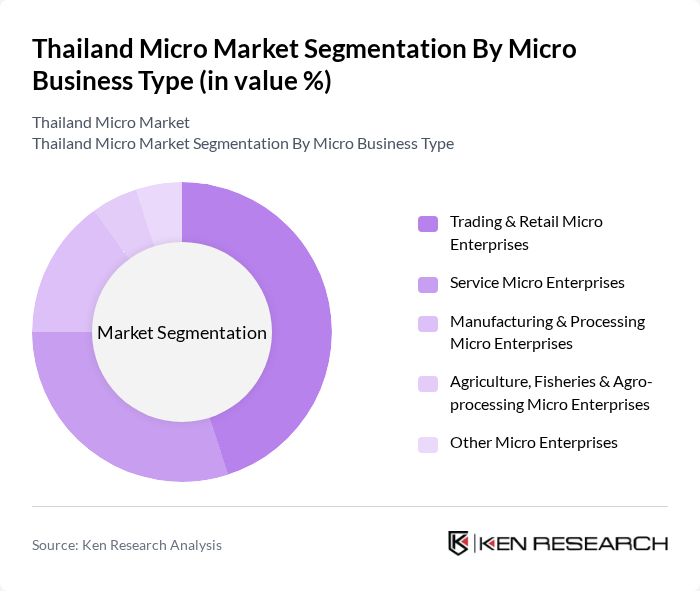
By Micro Business Type:The micro market in Thailand is segmented into various business types, including Trading & Retail, Services, Manufacturing & Processing, Agriculture, Fisheries & Agro-processing, and Other Micro Enterprises. Trading & Retail Micro Enterprises form the largest segment, supported by strong consumer demand for fast?moving consumer goods, food and beverages, and household items across both modern trade and traditional “mom?and?pop” stores, particularly in urban and peri?urban areas. The rapid rise of e?commerce, social commerce, and digital payment adoption has significantly contributed to the growth of this segment, as more consumers prefer online and omnichannel shopping, and micro retailers increasingly sell via marketplaces and social platforms.
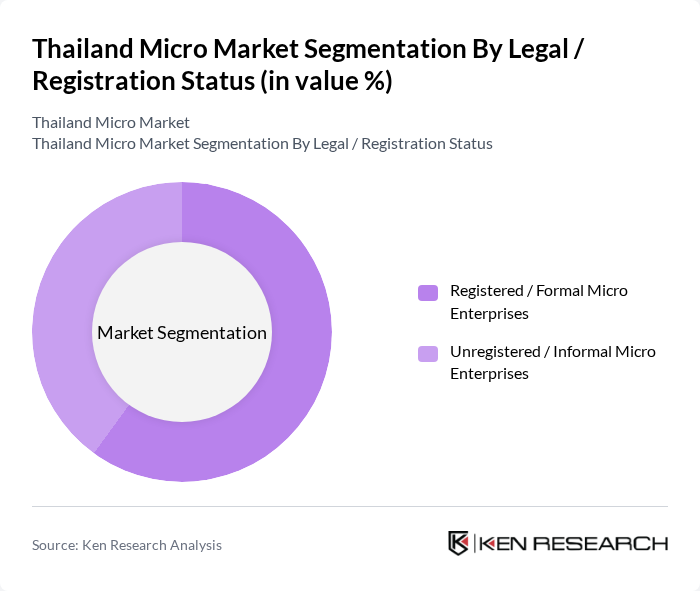
By Legal / Registration Status:The micro market is also categorized based on the legal or registration status of enterprises, which includes Registered / Formal Micro Enterprises and Unregistered / Informal Micro Enterprises. The Registered / Formal Micro Enterprises segment is increasingly significant, driven by policy measures that link formal registration with access to government support programs, bank financing, export opportunities, and participation in public procurement. Initiatives to encourage formalization include simplified registration processes, digital one?stop service platforms, tax incentives for SMEs, and targeted advisory and training services, which collectively support the shift of informal operators into the formal sector while a substantial informal micro segment still remains.
Thailand Micro Market Competitive Landscape
The Thailand Micro Market is characterized by a dynamic mix of regional and international players. Leading participants such as Energy Absolute Public Company Limited, BCPG Public Company Limited, Solartron Public Company Limited, Thai Solar Energy Public Company Limited, Gunkul Engineering Public Company Limited, Wind Energy Holding Company Limited, Green Earth Power (Thailand) Company Limited, Charoen Pokphand Group Company Limited, PTT Public Company Limited, Electricity Generating Authority of Thailand (EGAT), RATCH Group Public Company Limited, Thai Oil Public Company Limited, Bangkok Solar Company Limited, Solar Power Company Limited, Energy Development Corporation Limited contribute to innovation, geographic expansion, and service delivery in this space.
Thailand Micro Market Industry Analysis
Growth Drivers
- Increasing Demand for Renewable Energy:Thailand's renewable energy sector is projected to reach 19,600 MW by future, driven by a national goal of 30% renewable energy in the power generation mix. The government aims to reduce greenhouse gas emissions by 20-25% by future, aligning with global climate commitments. This shift is supported by the World Bank's report indicating a 15% annual increase in renewable energy investments, highlighting a robust market for micro energy solutions.
- Government Incentives for Micro Energy Solutions:The Thai government has allocated approximately THB 10 billion (USD 290 million) for renewable energy projects in future, including micro energy solutions. This funding supports initiatives like the Feed-in Tariff program, which guarantees fixed payments for renewable energy producers. Additionally, the government offers tax incentives that can reduce project costs by up to 20%, making micro energy solutions more financially viable for investors and consumers alike.
- Technological Advancements in Energy Storage:The energy storage market in Thailand is expected to grow significantly, with investments projected to reach THB 5 billion (USD 150 million) by future. Innovations in battery technology, such as lithium-ion and flow batteries, are enhancing energy storage capabilities, allowing for better integration of renewable sources. The National Energy Policy Council's support for energy storage systems is crucial, as it aims to increase storage capacity to 1,000 MW by future, facilitating the growth of micro energy solutions.
Market Challenges
- High Initial Investment Costs:The upfront costs for micro energy systems can be prohibitive, with average installation costs ranging from THB 200,000 to THB 500,000 (USD 6,000 to USD 15,000) per system. This financial barrier limits adoption, particularly among low-income households. According to the Energy Regulatory Commission, only 15% of potential users have adopted micro energy solutions due to these high initial costs, hindering market growth.
- Regulatory Compliance Complexity:Navigating the regulatory landscape in Thailand can be challenging for micro energy projects. The Energy Regulatory Commission has over 50 regulations governing renewable energy, which can lead to delays and increased costs. Compliance with environmental impact assessments and local zoning laws adds further complexity. As a result, many potential investors are deterred, with only 30% of projects successfully navigating the regulatory framework in future.
Thailand Micro Market Future Outlook
The Thailand micro market is poised for significant transformation as the government intensifies its focus on renewable energy and sustainability. With a projected increase in renewable energy investments and supportive policies, the market is expected to attract more stakeholders. Technological advancements in energy storage and smart grid solutions will further enhance the efficiency and reliability of micro energy systems. As awareness of environmental sustainability grows, consumer demand for decentralized energy solutions will likely rise, creating a favorable environment for innovation and investment.
Market Opportunities
- Expansion of Off-Grid Solutions:With over 3 million households in rural areas lacking reliable electricity, off-grid micro energy solutions present a significant opportunity. The government’s initiative to provide electricity to all by future supports this market, potentially increasing off-grid installations by 25% annually, thus enhancing energy access and economic development in underserved regions.
- Partnerships with Local Governments:Collaborations with local governments can facilitate the deployment of micro energy projects. By leveraging local knowledge and resources, these partnerships can streamline project implementation and enhance community engagement. The government’s commitment to supporting local initiatives is expected to drive a 30% increase in community-based projects by future, fostering sustainable energy practices.
Scope of the Report
| Segment | Sub-Segments |
|---|---|
| By Micro Business Type (Trading, Services, Manufacturing, Agriculture, Others) | Trading & Retail Micro Enterprises Service Micro Enterprises Manufacturing & Processing Micro Enterprises Agriculture, Fisheries & Agro-processing Micro Enterprises Other Micro Enterprises |
| By Legal / Registration Status (Formal, Informal) | Registered / Formal Micro Enterprises Unregistered / Informal Micro Enterprises |
| By End-User / Sector (Retail & Wholesale, Food & Beverage, Tourism & Hospitality, Creative & Digital, Transport & Logistics, Others) | Retail & Wholesale Trade Food & Beverage and Street Food Vendors Tourism, Travel & Hospitality Services Creative, Digital & Professional Services Transport, Delivery & Logistics Services Other Sectoral Micro Enterprises |
| By Geography (Bangkok Metropolitan Region, Central, Northern, Northeastern, Southern, Eastern Economic Corridor) | Bangkok Metropolitan Region Central Thailand (excluding BMR) Northern Thailand Northeastern (Isan) Thailand Southern Thailand Eastern Economic Corridor (EEC) |
| By Sales / Channel Model (Offline Only, Online Only, Omnichannel) | Offline & Traditional Channel Focused Online / Platform-Based Micro Enterprises Omnichannel Micro Enterprises |
| By Ownership & Demographics (Women-led, Youth-led, Family-run, Migrant & Minority-owned) | Women-led Micro Enterprises Youth-led (Under 35) Micro Enterprises Family-run Micro Enterprises Migrant & Minority-owned Micro Enterprises |
| By Access to Finance & Support (Self-financed, Bank-financed, Government-supported, NGO/Impact-funded) | Self-financed / Informally Financed Bank & Microfinance-supported Government & State-scheme-supported NGO, Impact Investor & Development Partner-supported |
Key Target Audience
Investors and Venture Capitalist Firms
Government and Regulatory Bodies (e.g., Ministry of Commerce, Office of the National Economic and Social Development Council)
Manufacturers and Producers
Distributors and Retailers
Technology Providers
Industry Associations
Financial Institutions
Export and Import Agencies
Players Mentioned in the Report:
Energy Absolute Public Company Limited
BCPG Public Company Limited
Solartron Public Company Limited
Thai Solar Energy Public Company Limited
Gunkul Engineering Public Company Limited
Wind Energy Holding Company Limited
Green Earth Power (Thailand) Company Limited
Charoen Pokphand Group Company Limited
PTT Public Company Limited
Electricity Generating Authority of Thailand (EGAT)
RATCH Group Public Company Limited
Thai Oil Public Company Limited
Bangkok Solar Company Limited
Solar Power Company Limited
Energy Development Corporation Limited
Table of Contents
Market Assessment Phase
1. Executive Summary and Approach
2. Thailand Micro Market Overview
2.1 Key Insights and Strategic Recommendations
2.2 Thailand Micro Market Overview
2.3 Definition and Scope
2.4 Evolution of Market Ecosystem
2.5 Timeline of Key Regulatory Milestones
2.6 Value Chain & Stakeholder Mapping
2.7 Business Cycle Analysis
2.8 Policy & Incentive Landscape
3. Thailand Micro Market Analysis
3.1 Growth Drivers
3.1.1 Increasing Demand for Renewable Energy
3.1.2 Government Incentives for Micro Energy Solutions
3.1.3 Technological Advancements in Energy Storage
3.1.4 Rising Awareness of Environmental Sustainability
3.2 Market Challenges
3.2.1 High Initial Investment Costs
3.2.2 Regulatory Compliance Complexity
3.2.3 Limited Access to Financing
3.2.4 Competition from Traditional Energy Sources
3.3 Market Opportunities
3.3.1 Expansion of Off-Grid Solutions
3.3.2 Partnerships with Local Governments
3.3.3 Development of Innovative Financing Models
3.3.4 Growing Export Potential in Southeast Asia
3.4 Market Trends
3.4.1 Shift Towards Decentralized Energy Systems
3.4.2 Increasing Adoption of Smart Grid Technologies
3.4.3 Rise of Community-Based Energy Projects
3.4.4 Focus on Energy Efficiency Solutions
3.5 Government Regulation
3.5.1 Feed-in Tariff Policies
3.5.2 Renewable Energy Certificates (RECs)
3.5.3 Tax Incentives for Micro Energy Projects
3.5.4 Environmental Impact Assessments Requirements
4. SWOT Analysis
5. Stakeholder Analysis
6. Porter's Five Forces Analysis
7. Thailand Micro Market Market Size, 2019-2024
7.1 By Value
7.2 By Volume
7.3 By Average Selling Price
8. Thailand Micro Market Segmentation
8.1 By Micro Business Type (Trading, Services, Manufacturing, Agriculture, Others)
8.1.1 Trading & Retail Micro Enterprises
8.1.2 Service Micro Enterprises
8.1.3 Manufacturing & Processing Micro Enterprises
8.1.4 Agriculture, Fisheries & Agro-processing Micro Enterprises
8.1.5 Other Micro Enterprises
8.2 By Legal / Registration Status (Formal, Informal)
8.2.1 Registered / Formal Micro Enterprises
8.2.2 Unregistered / Informal Micro Enterprises
8.3 By End-User / Sector (Retail & Wholesale, Food & Beverage, Tourism & Hospitality, Creative & Digital, Transport & Logistics, Others)
8.3.1 Retail & Wholesale Trade
8.3.2 Food & Beverage and Street Food Vendors
8.3.3 Tourism, Travel & Hospitality Services
8.3.4 Creative, Digital & Professional Services
8.3.5 Transport, Delivery & Logistics Services
8.3.6 Other Sectoral Micro Enterprises
8.4 By Geography (Bangkok Metropolitan Region, Central, Northern, Northeastern, Southern, Eastern Economic Corridor)
8.4.1 Bangkok Metropolitan Region
8.4.2 Central Thailand (excluding BMR)
8.4.3 Northern Thailand
8.4.4 Northeastern (Isan) Thailand
8.4.5 Southern Thailand
8.4.6 Eastern Economic Corridor (EEC)
8.5 By Sales / Channel Model (Offline Only, Online Only, Omnichannel)
8.5.1 Offline & Traditional Channel Focused
8.5.2 Online / Platform-Based Micro Enterprises
8.5.3 Omnichannel Micro Enterprises
8.6 By Ownership & Demographics (Women-led, Youth-led, Family-run, Migrant & Minority-owned)
8.6.1 Women-led Micro Enterprises
8.6.2 Youth-led (Under 35) Micro Enterprises
8.6.3 Family-run Micro Enterprises
8.6.4 Migrant & Minority-owned Micro Enterprises
8.7 By Access to Finance & Support (Self-financed, Bank-financed, Government-supported, NGO/Impact-funded)
8.7.1 Self-financed / Informally Financed
8.7.2 Bank & Microfinance-supported
8.7.3 Government & State-scheme-supported
8.7.4 NGO, Impact Investor & Development Partner-supported
9. Thailand Micro Market Competitive Analysis
9.1 Market Share of Key Players(Micro, Small, Medium, Large Enterprises)
9.2 Cross Comparison of Key Players
9.2.1 Company Name
9.2.2 Group Size (Large, Medium, or Small as per industry convention)
9.2.3 Annual Revenue (THB) and 3-year Revenue CAGR
9.2.4 EBITDA Margin
9.2.5 Customer Acquisition Cost (CAC)
9.2.6 Customer Lifetime Value (CLV)
9.2.7 Market Share in Target Segment (%)
9.2.8 Customer Retention / Churn Rate
9.2.9 Average Ticket / Deal Size
9.2.10 Return on Invested Capital (ROIC)
9.2.11 Payback Period for New Investments
9.2.12 Leverage Ratio (Net Debt / EBITDA)
9.3 SWOT Analysis of Top Players
9.4 Pricing Analysis(By Class and Payload)
9.5 Detailed Profile of Major Companies
9.5.1 Energy Absolute Public Company Limited
9.5.2 BCPG Public Company Limited
9.5.3 Solartron Public Company Limited
9.5.4 Thai Solar Energy Public Company Limited
9.5.5 Gunkul Engineering Public Company Limited
9.5.6 Wind Energy Holding Company Limited
9.5.7 Green Earth Power (Thailand) Company Limited
9.5.8 Charoen Pokphand Group Company Limited
9.5.9 PTT Public Company Limited
9.5.10 Electricity Generating Authority of Thailand (EGAT)
9.5.11 RATCH Group Public Company Limited
9.5.12 Thai Oil Public Company Limited
9.5.13 Bangkok Solar Company Limited
9.5.14 Solar Power Company Limited
9.5.15 Energy Development Corporation Limited
10. Thailand Micro Market End-User Analysis
10.1 Procurement Behavior of Key Ministries
10.1.1 Ministry of Energy
10.1.2 Ministry of Interior
10.1.3 Ministry of Industry
10.1.4 Ministry of Natural Resources and Environment
10.2 Corporate Spend on Infrastructure & Energy
10.2.1 Energy Infrastructure Investments
10.2.2 Renewable Energy Projects
10.2.3 Energy Efficiency Programs
10.2.4 Corporate Sustainability Initiatives
10.3 Pain Point Analysis by End-User Category
10.3.1 Residential Users
10.3.2 Commercial Users
10.3.3 Industrial Users
10.3.4 Government Entities
10.4 User Readiness for Adoption
10.4.1 Awareness of Micro Energy Solutions
10.4.2 Financial Readiness
10.4.3 Technical Capability
10.4.4 Policy Support
10.5 Post-Deployment ROI and Use Case Expansion
10.5.1 Performance Metrics
10.5.2 User Satisfaction Levels
10.5.3 Scalability of Solutions
10.5.4 Future Investment Plans
11. Thailand Micro Market Future Size, 2025-2030
11.1 By Value
11.2 By Volume
11.3 By Average Selling Price
Go-To-Market Strategy Phase
1. Whitespace Analysis + Business Model Canvas
1.1 Market Gaps Identification
1.2 Business Model Development
2. Marketing and Positioning Recommendations
2.1 Branding Strategies
2.2 Product USPs
3. Distribution Plan
3.1 Urban Retail vs Rural NGO Tie-ups
4. Channel & Pricing Gaps
4.1 Underserved Routes
4.2 Pricing Bands
5. Unmet Demand & Latent Needs
5.1 Category Gaps
5.2 Consumer Segments
6. Customer Relationship
6.1 Loyalty Programs
6.2 After-sales Service
7. Value Proposition
7.1 Sustainability
7.2 Integrated Supply Chains
8. Key Activities
8.1 Regulatory Compliance
8.2 Branding
8.3 Distribution Setup
9. Entry Strategy Evaluation
9.1 Domestic Market Entry Strategy
9.1.1 Product Mix
9.1.2 Pricing Band
9.1.3 Packaging
9.2 Export Entry Strategy
9.2.1 Target Countries
9.2.2 Compliance Roadmap
10. Entry Mode Assessment
10.1 Joint Ventures
10.2 Greenfield Investments
10.3 Mergers & Acquisitions
10.4 Distributor Model
11. Capital and Timeline Estimation
11.1 Capital Requirements
11.2 Timelines
12. Control vs Risk Trade-Off
12.1 Ownership vs Partnerships
13. Profitability Outlook
13.1 Breakeven Analysis
13.2 Long-term Sustainability
14. Potential Partner List
14.1 Distributors
14.2 Joint Ventures
14.3 Acquisition Targets
15. Execution Roadmap
15.1 Phased Plan for Market Entry
15.1.1 Market Setup
15.1.2 Market Entry
15.1.3 Growth Acceleration
15.1.4 Scale & Stabilize
15.2 Key Activities and Milestones
15.2.1 Milestone Planning
15.2.2 Activity Tracking
Research Methodology
Phase 1: Approach1
Desk Research
- Analysis of government publications and economic reports from the Bank of Thailand
- Review of industry reports from the Thailand Board of Investment (BOI)
- Examination of market trends and consumer behavior studies published by local universities
Primary Research
- Interviews with key stakeholders in the tourism and hospitality sectors
- Surveys conducted with local SMEs to understand market dynamics
- Focus groups with consumers to gauge preferences and spending habits
Validation & Triangulation
- Cross-validation of findings with data from the National Statistical Office of Thailand
- Triangulation of insights from primary interviews with secondary data sources
- Sanity checks through expert reviews from industry veterans and academic professionals
Phase 2: Market Size Estimation1
Top-down Assessment
- Estimation of market size based on national GDP growth and sector contributions
- Segmentation of the market by region and consumer demographics
- Incorporation of tourism growth forecasts and their impact on local economies
Bottom-up Modeling
- Collection of sales data from leading local businesses and franchises
- Estimation of average transaction values across different market segments
- Volume analysis based on consumer footfall and online engagement metrics
Forecasting & Scenario Analysis
- Utilization of time-series analysis to project future market trends
- Scenario modeling based on potential economic shifts and policy changes
- Development of best-case, worst-case, and most-likely market scenarios through 2030
Phase 3: CATI Sample Composition1
| Scope Item/Segment | Sample Size | Target Respondent Profiles |
|---|---|---|
| Tourism Sector Insights | 150 | Tour Operators, Hotel Managers |
| Consumer Spending Behavior | 120 | Local Residents, Expatriates |
| SME Growth Challenges | 80 | Business Owners, Financial Managers |
| Retail Market Trends | 110 | Store Managers, Marketing Directors |
| Online Shopping Preferences | 90 | E-commerce Managers, Digital Marketing Specialists |
Frequently Asked Questions
What is the economic output of the Thailand micro market?
The Thailand micro and small enterprise segment is valued at approximately USD 1314 billion, driven by the growth of micro enterprises that significantly contribute to job creation and economic stability within the country.
Which regions in Thailand are key hubs for micro enterprises?
What types of businesses are included in the Thailand micro market?
How does the legal status affect micro enterprises in Thailand?
Other Regional/Country Reports
Indonesia Micro Market Report Size Share Growth Drivers Trends Opportunities & Forecast 2025–2030
APAC Micro Market Report Size Share Growth Drivers Trends Opportunities & Forecast 2025–2030
Other Adjacent Reports
Mexico Digital Payment Market
Angola Agriculture MarketWhy Buy From Us?

What makes us stand out is that our consultants follow Robust, Refine and Result (RRR) methodology. Robust for clear definitions, approaches and sanity checking, Refine for differentiating respondents' facts and opinions, and Result for presenting data with story.

We have set a benchmark in the industry by offering our clients with syndicated and customized market research reports featuring coverage of entire market as well as meticulous research and analyst insights.

While we don't replace traditional research, we flip the method upside down. Our dual approach of Top Bottom & Bottom Top ensures quality deliverable by not just verifying company fundamentals but also looking at the sector and macroeconomic factors.

With one step in the future, our research team constantly tries to show you the bigger picture. We help with some of the tough questions you may encounter along the way: How is the industry positioned? Best marketing channel? KPI's of competitors? By aligning every element, we help maximize success.

Our report gives you instant access to the answers and sources that other companies might choose to hide. We elaborate each steps of research methodology we have used and showcase you the sample size to earn your trust.

If you need any support, we are here! We pride ourselves on universe strength, data quality, and quick, friendly, and professional service.