About the Report
Base Year 2024Australia Online Loan and Lending Apps Market Overview
- The Australia Online Loan and Lending Apps Market is valued at approximately AUD 6.3 billion, based on a five-year historical analysis. This growth is primarily driven by the rapid adoption of digital financial services, increasing consumer demand for quick and accessible loan options, and the proliferation of mobile technology that facilitates seamless transactions. Additional drivers include high smartphone and internet penetration, the expansion of open banking, and the growing popularity of alternative lending solutions such as buy now pay later (BNPL) and peer-to-peer lending platforms .
- Key cities dominating this market include Sydney, Melbourne, and Brisbane. These urban centers are characterized by high population density, robust economic environments, and a tech-savvy consumer base, collectively fostering a conducive atmosphere for online lending platforms to thrive .
- The Consumer Data Right (CDR) Rules, 2019 issued by the Australian Competition and Consumer Commission (ACCC), enable consumers to access and share their financial data with accredited third parties. This regulatory framework enhances competition in the lending market, empowering consumers to make more informed decisions and potentially lower borrowing costs through greater transparency and personalized financial products .

Australia Online Loan and Lending Apps Market Segmentation
By Type:The market is segmented into various types of loans, including personal loans, business loans, student loans, home loans (digital mortgages), car loans, payday loans, buy now pay later (BNPL), peer-to-peer (P2P) loans, and other digital credit products. Each type serves different consumer needs and preferences, contributing to the overall market dynamics. Personal loans remain the most popular, followed by business loans and BNPL, reflecting consumer demand for flexible and fast credit solutions .
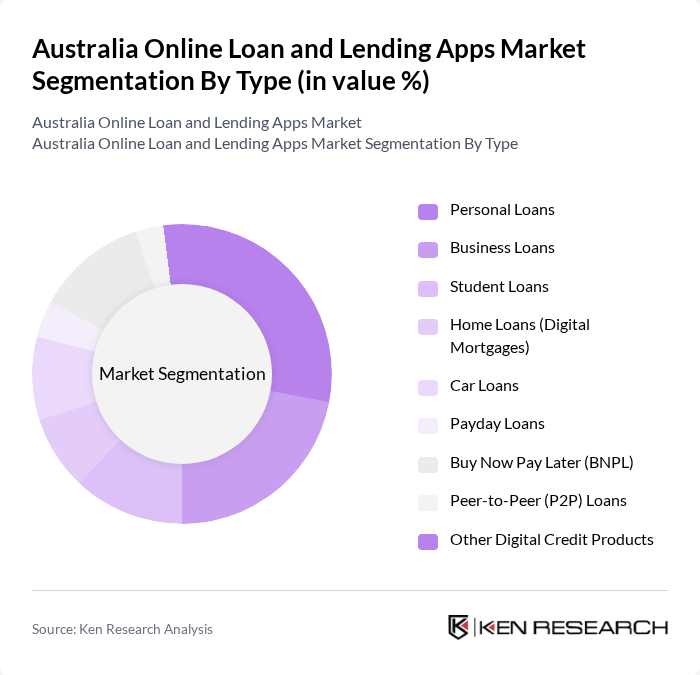
The personal loans segment is currently dominating the market due to its versatility and appeal to a wide range of consumers. Individuals often seek personal loans for purposes such as debt consolidation, home improvements, and unexpected expenses. The ease of application and rapid approval processes offered by online platforms further enhance their attractiveness. The increasing trend of financial literacy and digital adoption among consumers has led to greater understanding and uptake of personal finance products .
By End-User:The market is segmented by end-users, including individuals (salaried and self-employed), small and medium enterprises (SMEs), corporates, students, and non-profit organizations. Each segment has unique borrowing needs and preferences, influencing the types of loans they seek. Individuals, especially those in urban areas, are the primary users of online lending platforms, followed by SMEs seeking fast and flexible funding solutions .

The individuals segment, particularly salaried and self-employed borrowers, is the largest in the market. This is largely due to the increasing number of people seeking personal loans for purposes such as home renovations, travel, and debt consolidation. The convenience of online applications and the ability to compare different loan options have made personal loans a popular choice. The rise of the gig economy has also led to more self-employed individuals seeking flexible loan options to manage their finances .
Australia Online Loan and Lending Apps Market Competitive Landscape
The Australia Online Loan and Lending Apps Market is characterized by a dynamic mix of regional and international players. Leading participants such as Afterpay Limited, Zip Co Limited, Prospa Group Limited, MoneyMe Limited, SocietyOne, Wisr Limited, Harmoney Corp Limited, Cash Converters International Limited, Credit Union Australia (Great Southern Bank), ANZ Banking Group, Commonwealth Bank of Australia, Westpac Banking Corporation, National Australia Bank, Bendigo and Adelaide Bank, Suncorp Group, Latitude Financial Services, Plenti Group Limited, Nimble Australia, Pepper Money Limited, Brighte Capital contribute to innovation, geographic expansion, and service delivery in this space.
Australia Online Loan and Lending Apps Market Industry Analysis
Growth Drivers
- Increasing Smartphone Penetration:As of future, Australia boasts a smartphone penetration rate of approximately 90%, with over 23 million users. This widespread adoption facilitates access to online loan and lending apps, allowing consumers to apply for loans conveniently. The Australian Bureau of Statistics reported that mobile internet usage has surged by 15% year-on-year, indicating a growing reliance on mobile devices for financial transactions. This trend is expected to drive the demand for digital lending solutions significantly.
- Rising Demand for Quick and Accessible Loans:In future, the demand for quick loans in Australia is projected to reach AUD 10 billion, reflecting a shift in consumer behavior towards immediate financial solutions. Factors such as economic uncertainty and the need for rapid access to funds have led to an increase in short-term loans. According to the Australian Finance Industry Association, the number of online loan applications has increased by 25% over the past year, highlighting the urgency for accessible lending options.
- Growth of Digital Payment Systems:The digital payment landscape in Australia is evolving rapidly, with a projected transaction value of AUD 100 billion in future. The rise of contactless payments and digital wallets has streamlined the loan application process, making it easier for consumers to manage their finances. The Australian Payments Network reported a 30% increase in digital payment transactions, which enhances the integration of lending apps with payment systems, thereby boosting user engagement and loan uptake.
Market Challenges
- Regulatory Compliance Issues:The online lending sector in Australia faces stringent regulatory requirements, including adherence to the National Consumer Credit Protection Act. In future, compliance costs are expected to rise by 20%, impacting profitability for lenders. The Australian Securities and Investments Commission has increased scrutiny on lending practices, leading to potential fines and operational disruptions for non-compliant firms. This regulatory landscape poses significant challenges for new entrants and established players alike.
- Consumer Trust and Security Concerns:As online fraud incidents rise, consumer trust in digital lending platforms is waning. In future, it is estimated that 40% of Australians express concerns about data security when applying for loans online. The Australian Cyber Security Centre reported a 25% increase in cybercrime targeting financial services, which exacerbates these fears. Lenders must invest in robust security measures to mitigate risks and restore consumer confidence in their platforms.
Australia Online Loan and Lending Apps Market Future Outlook
The future of the online loan and lending apps market in Australia appears promising, driven by technological advancements and evolving consumer preferences. As digital literacy increases, more Australians are likely to embrace mobile-first lending solutions. Additionally, the integration of artificial intelligence in credit scoring is expected to enhance the accuracy of loan assessments, making lending more inclusive. These trends indicate a shift towards more personalized and efficient lending experiences, positioning the market for sustained growth in the coming years.
Market Opportunities
- Expansion into Underserved Demographics:There is a significant opportunity to target underserved demographics, such as young adults and low-income households. In future, approximately 30% of Australians aged 18-24 are unbanked or underbanked, representing a potential market of 1.5 million individuals. Tailoring loan products to meet their specific needs can drive growth and foster financial inclusion.
- Development of Personalized Loan Products:The demand for personalized loan products is on the rise, with 65% of consumers expressing interest in tailored financial solutions. By leveraging data analytics, lenders can create customized offerings that align with individual financial situations. This approach not only enhances customer satisfaction but also increases the likelihood of loan approval, thereby driving revenue growth in the sector.
Scope of the Report
| Segment | Sub-Segments |
|---|---|
| By Type | Personal Loans Business Loans Student Loans Home Loans (Digital Mortgages) Car Loans Payday Loans Buy Now Pay Later (BNPL) Peer-to-Peer (P2P) Loans Other Digital Credit Products |
| By End-User | Individuals (Salaried, Self-Employed) Small and Medium Enterprises (SMEs) Corporates Students Non-Profit Organizations |
| By Loan Amount | Micro Loans (? AUD 5,000) Small Loans (AUD 5,001–20,000) Medium Loans (AUD 20,001–100,000) Large Loans (> AUD 100,000) |
| By Loan Duration | Short-Term Loans (? 1 year) Medium-Term Loans (1–5 years) Long-Term Loans (> 5 years) |
| By Application | Emergency Funding Business Expansion Education Financing Home Improvement Vehicle Purchase Debt Consolidation |
| By Distribution Channel | Mobile Apps Websites Third-Party Platforms/Aggregators |
| By Customer Segment | First-Time Borrowers Repeat Borrowers High-Risk Borrowers Low-Risk Borrowers Millennials/Gen Z Seniors |
Key Target Audience
Investors and Venture Capitalist Firms
Government and Regulatory Bodies (e.g., Australian Securities and Investments Commission, Australian Competition and Consumer Commission)
Financial Institutions
Payment Processing Companies
Insurance Providers
Technology Providers
Industry Associations (e.g., Australian Finance Industry Association)
Consumer Advocacy Groups
Players Mentioned in the Report:
Afterpay Limited
Zip Co Limited
Prospa Group Limited
MoneyMe Limited
SocietyOne
Wisr Limited
Harmoney Corp Limited
Cash Converters International Limited
Credit Union Australia (Great Southern Bank)
ANZ Banking Group
Commonwealth Bank of Australia
Westpac Banking Corporation
National Australia Bank
Bendigo and Adelaide Bank
Suncorp Group
Latitude Financial Services
Plenti Group Limited
Nimble Australia
Pepper Money Limited
Brighte Capital
Table of Contents
Market Assessment Phase
1. Executive Summary and Approach
2. Australia Online Loan and Lending Apps Market Overview
2.1 Key Insights and Strategic Recommendations
2.2 Australia Online Loan and Lending Apps Market Overview
2.3 Definition and Scope
2.4 Evolution of Market Ecosystem
2.5 Timeline of Key Regulatory Milestones
2.6 Value Chain & Stakeholder Mapping
2.7 Business Cycle Analysis
2.8 Policy & Incentive Landscape
3. Australia Online Loan and Lending Apps Market Analysis
3.1 Growth Drivers
3.1.1 Increasing smartphone penetration
3.1.2 Rising demand for quick and accessible loans
3.1.3 Growth of digital payment systems
3.1.4 Enhanced customer experience through technology
3.2 Market Challenges
3.2.1 Regulatory compliance issues
3.2.2 High competition among lenders
3.2.3 Consumer trust and security concerns
3.2.4 Economic fluctuations affecting loan repayment
3.3 Market Opportunities
3.3.1 Expansion into underserved demographics
3.3.2 Development of personalized loan products
3.3.3 Integration of AI for credit scoring
3.3.4 Partnerships with fintech companies
3.4 Market Trends
3.4.1 Shift towards mobile-first lending solutions
3.4.2 Increasing use of alternative data for credit assessment
3.4.3 Growth of peer-to-peer lending platforms
3.4.4 Focus on sustainable lending practices
3.5 Government Regulation
3.5.1 National Consumer Credit Protection Act
3.5.2 Australian Securities and Investments Commission guidelines
3.5.3 Anti-Money Laundering and Counter-Terrorism Financing Act
3.5.4 Privacy Act compliance requirements
4. SWOT Analysis
5. Stakeholder Analysis
6. Porter's Five Forces Analysis
7. Australia Online Loan and Lending Apps Market Market Size, 2019-2024
7.1 By Value
7.2 By Volume
7.3 By Average Selling Price
8. Australia Online Loan and Lending Apps Market Segmentation
8.1 By Type
8.1.1 Personal Loans
8.1.2 Business Loans
8.1.3 Student Loans
8.1.4 Home Loans (Digital Mortgages)
8.1.5 Car Loans
8.1.6 Payday Loans
8.1.7 Buy Now Pay Later (BNPL)
8.1.8 Peer-to-Peer (P2P) Loans
8.1.9 Other Digital Credit Products
8.2 By End-User
8.2.1 Individuals (Salaried, Self-Employed)
8.2.2 Small and Medium Enterprises (SMEs)
8.2.3 Corporates
8.2.4 Students
8.2.5 Non-Profit Organizations
8.3 By Loan Amount
8.3.1 Micro Loans (? AUD 5,000)
8.3.2 Small Loans (AUD 5,001–20,000)
8.3.3 Medium Loans (AUD 20,001–100,000)
8.3.4 Large Loans (> AUD 100,000)
8.4 By Loan Duration
8.4.1 Short-Term Loans (? 1 year)
8.4.2 Medium-Term Loans (1–5 years)
8.4.3 Long-Term Loans (> 5 years)
8.5 By Application
8.5.1 Emergency Funding
8.5.2 Business Expansion
8.5.3 Education Financing
8.5.4 Home Improvement
8.5.5 Vehicle Purchase
8.5.6 Debt Consolidation
8.6 By Distribution Channel
8.6.1 Mobile Apps
8.6.2 Websites
8.6.3 Third-Party Platforms/Aggregators
8.7 By Customer Segment
8.7.1 First-Time Borrowers
8.7.2 Repeat Borrowers
8.7.3 High-Risk Borrowers
8.7.4 Low-Risk Borrowers
8.7.5 Millennials/Gen Z
8.7.6 Seniors
9. Australia Online Loan and Lending Apps Market Competitive Analysis
9.1 Market Share of Key Players
9.2 Cross Comparison of Key Players
9.2.1 Company Name
9.2.2 Group Size (Large, Medium, or Small as per industry convention)
9.2.3 Customer Acquisition Cost (CAC)
9.2.4 Loan Approval Rate (%)
9.2.5 Average Loan Amount (AUD)
9.2.6 Default Rate (%)
9.2.7 Customer Retention Rate (%)
9.2.8 Pricing Strategy (Interest Rate/APR, Fees)
9.2.9 Revenue Growth Rate (%)
9.2.10 Market Penetration Rate (%)
9.2.11 Mobile App Ratings (App Store/Google Play)
9.2.12 Time to Disbursement (hours/days)
9.2.13 Net Promoter Score (NPS)
9.3 SWOT Analysis of Top Players
9.4 Pricing Analysis
9.5 Detailed Profile of Major Companies
9.5.1 Afterpay Limited
9.5.2 Zip Co Limited
9.5.3 Prospa Group Limited
9.5.4 MoneyMe Limited
9.5.5 SocietyOne
9.5.6 Wisr Limited
9.5.7 Harmoney Corp Limited
9.5.8 Cash Converters International Limited
9.5.9 Credit Union Australia (Great Southern Bank)
9.5.10 ANZ Banking Group
9.5.11 Commonwealth Bank of Australia
9.5.12 Westpac Banking Corporation
9.5.13 National Australia Bank
9.5.14 Bendigo and Adelaide Bank
9.5.15 Suncorp Group
9.5.16 Latitude Financial Services
9.5.17 Plenti Group Limited
9.5.18 Nimble Australia
9.5.19 Pepper Money Limited
9.5.20 Brighte Capital
10. Australia Online Loan and Lending Apps Market End-User Analysis
10.1 Procurement Behavior of Key Ministries
10.1.1 Budget Allocation for Loans
10.1.2 Loan Approval Processes
10.1.3 Preferred Loan Types
10.2 Corporate Spend on Infrastructure & Energy
10.2.1 Investment in Digital Solutions
10.2.2 Funding for Startups
10.2.3 Expenditure on Financial Services
10.3 Pain Point Analysis by End-User Category
10.3.1 Accessibility Issues
10.3.2 High Interest Rates
10.3.3 Lengthy Approval Times
10.4 User Readiness for Adoption
10.4.1 Awareness of Online Lending Options
10.4.2 Comfort with Digital Transactions
10.4.3 Trust in Online Platforms
10.5 Post-Deployment ROI and Use Case Expansion
10.5.1 Measurement of Financial Benefits
10.5.2 Customer Feedback and Adaptation
10.5.3 Opportunities for Upselling
11. Australia Online Loan and Lending Apps Market Future Size, 2025-2030
11.1 By Value
11.2 By Volume
11.3 By Average Selling Price
Go-To-Market Strategy Phase
1. Whitespace Analysis + Business Model Canvas
1.1 Market Gaps Identification
1.2 Value Proposition Development
1.3 Revenue Streams Analysis
1.4 Cost Structure Evaluation
1.5 Key Partnerships Exploration
1.6 Customer Segments Definition
1.7 Channels Strategy
2. Marketing and Positioning Recommendations
2.1 Branding Strategies
2.2 Product USPs
2.3 Target Audience Engagement
2.4 Digital Marketing Tactics
2.5 Customer Retention Strategies
3. Distribution Plan
3.1 Urban Retail Strategies
3.2 Rural NGO Tie-Ups
3.3 Online vs Offline Distribution
3.4 Partnership Opportunities
4. Channel & Pricing Gaps
4.1 Underserved Routes
4.2 Pricing Bands Analysis
4.3 Competitor Pricing Comparison
5. Unmet Demand & Latent Needs
5.1 Category Gaps Identification
5.2 Consumer Segments Analysis
5.3 Emerging Trends Exploration
6. Customer Relationship
6.1 Loyalty Programs Development
6.2 After-Sales Service Strategies
6.3 Customer Feedback Mechanisms
7. Value Proposition
7.1 Sustainability Initiatives
7.2 Integrated Supply Chains
7.3 Unique Selling Points
8. Key Activities
8.1 Regulatory Compliance
8.2 Branding Initiatives
8.3 Distribution Setup
9. Entry Strategy Evaluation
9.1 Domestic Market Entry Strategy
9.1.1 Product Mix Considerations
9.1.2 Pricing Band Strategy
9.1.3 Packaging Options
9.2 Export Entry Strategy
9.2.1 Target Countries Identification
9.2.2 Compliance Roadmap Development
10. Entry Mode Assessment
10.1 Joint Ventures
10.2 Greenfield Investments
10.3 Mergers & Acquisitions
10.4 Distributor Model Evaluation
11. Capital and Timeline Estimation
11.1 Capital Requirements Analysis
11.2 Timelines for Implementation
12. Control vs Risk Trade-Off
12.1 Ownership vs Partnerships
13. Profitability Outlook
13.1 Breakeven Analysis
13.2 Long-Term Sustainability Strategies
14. Potential Partner List
14.1 Distributors Identification
14.2 Joint Ventures Opportunities
14.3 Acquisition Targets
15. Execution Roadmap
15.1 Phased Plan for Market Entry
15.1.1 Market Setup
15.1.2 Market Entry
15.1.3 Growth Acceleration
15.1.4 Scale & Stabilize
15.2 Key Activities and Milestones
15.2.1 Milestone Planning
15.2.2 Activity Tracking
Research Methodology
Phase 1: Approach1
Desk Research
- Analysis of industry reports from financial institutions and market research firms
- Review of government publications and regulatory frameworks related to online lending
- Examination of consumer behavior studies and trends in digital finance
Primary Research
- Interviews with executives from leading online loan and lending app companies
- Surveys targeting users of online lending platforms to gather insights on preferences and experiences
- Focus groups with financial advisors and fintech experts to discuss market dynamics
Validation & Triangulation
- Cross-validation of findings through multiple data sources, including user reviews and financial performance metrics
- Triangulation of qualitative insights from interviews with quantitative data from surveys
- Sanity checks conducted through expert panel reviews to ensure data reliability
Phase 2: Market Size Estimation1
Top-down Assessment
- Estimation of total addressable market based on national lending statistics and digital adoption rates
- Segmentation of the market by loan type, including personal loans, business loans, and payday loans
- Incorporation of macroeconomic indicators such as interest rates and consumer credit trends
Bottom-up Modeling
- Collection of transaction data from leading online lending platforms to establish volume benchmarks
- Analysis of average loan amounts and repayment terms to calculate revenue potential
- Estimation of market share based on user acquisition strategies and customer retention rates
Forecasting & Scenario Analysis
- Multi-variable regression analysis incorporating economic growth, regulatory changes, and technological advancements
- Scenario modeling based on varying levels of market penetration and consumer adoption rates
- Development of baseline, optimistic, and pessimistic forecasts through 2030
Phase 3: CATI Sample Composition1
| Scope Item/Segment | Sample Size | Target Respondent Profiles |
|---|---|---|
| Personal Loan Users | 100 | Individuals aged 25-45, employed, with prior loan experience |
| Small Business Loan Applicants | 60 | Small business owners, entrepreneurs seeking funding |
| Payday Loan Users | 40 | Individuals in urgent financial need, typically aged 18-35 |
| Fintech Industry Experts | 40 | Financial analysts, fintech consultants, and market researchers |
| Regulatory Stakeholders | 40 | Policy makers, compliance officers, and legal advisors in finance |
Frequently Asked Questions
What is the current value of the Australia Online Loan and Lending Apps Market?
The Australia Online Loan and Lending Apps Market is valued at approximately AUD 6.3 billion, driven by the rapid adoption of digital financial services and increasing consumer demand for quick and accessible loan options.
What factors are driving the growth of online lending in Australia?
Which cities are the main hubs for online lending in Australia?
What are the Consumer Data Right (CDR) Rules in Australia?
Other Regional/Country Reports
Indonesia Online Loan and Lending Apps Market
Malaysia Online Loan and Lending Apps Market
KSA Online Loan and Lending Apps Market
APAC Online Loan and Lending Apps Market
SEA Online Loan and Lending Apps Market
Other Adjacent Reports
Brazil Digital Banking Market
Thailand Peer-to-Peer Lending Market
Egypt Buy Now Pay Later Market
KSA Fintech Market
Singapore Mobile Payment Market
Japan Credit Scoring Technology Market
Brazil RegTech Market
Brazil Cybersecurity in Finance Market
Malaysia Personal Finance Management Apps Market
Japan Alternative Lending Market
Why Buy From Us?

What makes us stand out is that our consultants follow Robust, Refine and Result (RRR) methodology. Robust for clear definitions, approaches and sanity checking, Refine for differentiating respondents' facts and opinions, and Result for presenting data with story.

We have set a benchmark in the industry by offering our clients with syndicated and customized market research reports featuring coverage of entire market as well as meticulous research and analyst insights.

While we don't replace traditional research, we flip the method upside down. Our dual approach of Top Bottom & Bottom Top ensures quality deliverable by not just verifying company fundamentals but also looking at the sector and macroeconomic factors.

With one step in the future, our research team constantly tries to show you the bigger picture. We help with some of the tough questions you may encounter along the way: How is the industry positioned? Best marketing channel? KPI's of competitors? By aligning every element, we help maximize success.

Our report gives you instant access to the answers and sources that other companies might choose to hide. We elaborate each steps of research methodology we have used and showcase you the sample size to earn your trust.

If you need any support, we are here! We pride ourselves on universe strength, data quality, and quick, friendly, and professional service.