Region:Asia
Author(s):Dev
Product Code:KRAA5194
Pages:98
Published On:January 2026
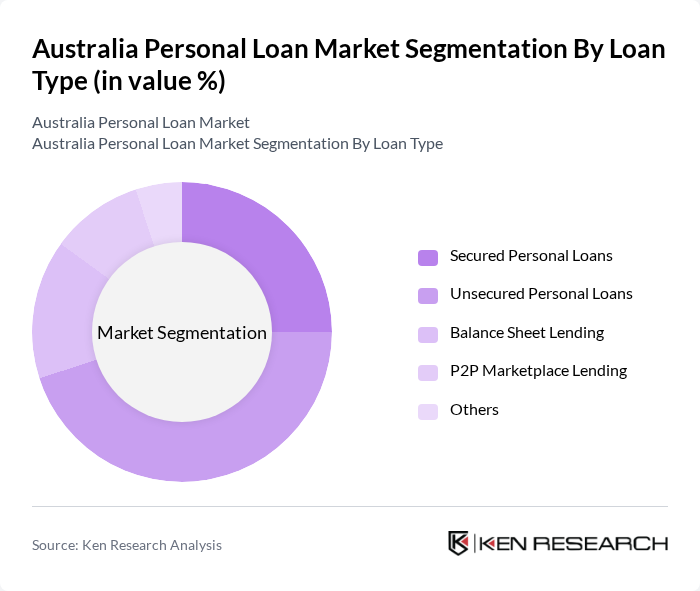
By Loan Type:The personal loan market is segmented into various types, including secured personal loans, unsecured personal loans, balance sheet lending, P2P marketplace lending, and others. Secured personal loans are the fastest-growing segment with borrowers seeking lower interest rates and higher loan values by pledging assets such as vehicles, deposits, or property. P2P marketplace lending is becoming the fastest-growing segment within the Australia personal loan market, driven by its ability to offer borrowers direct access to investors with often lower interest rates and more flexible lending criteria compared to traditional financial institutions. Traditional balance sheet lending, led by banks and credit unions, remains dominant due to its established infrastructure, regulatory adherence, and access to deep funding pools.
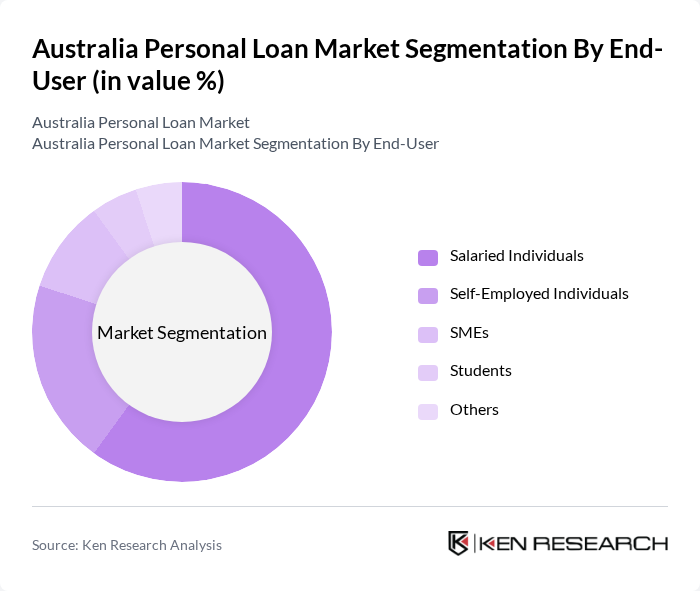
By End-User:The end-user segmentation includes salaried individuals, self-employed individuals, SMEs, students, and others. Salaried individuals dominate the market, as they typically have stable income sources, making them more attractive to lenders. Self-employed individuals and business owners represent the fastest-growing employment segment in the Australia personal loan market, reflecting the country's dynamic entrepreneurial landscape, with 2,662,998 actively trading businesses in the Australian economy as of June 2024. Self-employed individuals and SMEs also represent significant segments, driven by the need for financing to support business operations and personal expenses.
The Australia Personal Loan Market is characterized by a dynamic mix of regional and international players. Leading participants such as Commonwealth Bank of Australia, Westpac Banking Corporation, ANZ Banking Group, National Australia Bank, Latitude Financial Services, Pepper Money, Prospa, MoneyMe, Harmoney, Suncorp Group, Bendigo and Adelaide Bank, Bank of Queensland, Credit Union Australia, Australian Military Bank, Greater Bank contribute to innovation, geographic expansion, and service delivery in this space. Key players are facing heightened competition, with major banks, credit unions, and fintech/P2P lenders competing on key factors such as pricing, digital engagement, and product flexibility. Lenders are increasingly leveraging technological innovations, including data analytics, AI-driven risk assessments, and digital onboarding, to enhance customer experiences and improve loan approval processes.
The future of the Australian personal loan market appears promising, driven by technological advancements and evolving consumer preferences. As digital lending continues to gain traction, lenders are expected to enhance their online offerings, improving customer engagement and satisfaction. Additionally, the focus on personalized loan products will likely cater to diverse consumer needs, fostering inclusivity. With economic recovery anticipated in future, consumer confidence is expected to rise, further stimulating demand for personal loans and creating a dynamic lending environment.
| Segment | Sub-Segments |
|---|---|
| By Loan Type | Secured Personal Loans Unsecured Personal Loans Balance Sheet Lending P2P Marketplace Lending Others |
| By End-User | Salaried Individuals Self-Employed Individuals SMEs Students Others |
| By Loan Purpose | Debt Consolidation Home Improvement Vehicle Purchase Education Financing Others |
| By Loan Amount | Micro Loans (< AUD 5,000) Small Loans (AUD 5,001–20,000) Medium Loans (AUD 20,001–100,000) Large Loans (> AUD 100,000) |
| By Distribution Channel | Mobile Apps Websites Third-Party Platforms/Aggregators Banks and Credit Unions Others |
| Scope Item/Segment | Sample Size | Target Respondent Profiles |
|---|---|---|
| Personal Loan Borrowers | 120 | Individuals aged 25-45 with recent loan experience |
| Financial Advisors | 80 | Professionals providing financial advice to consumers |
| Bank Loan Officers | 60 | Loan officers from major banks and credit unions |
| Consumer Advocacy Groups | 40 | Representatives from organizations focused on consumer rights |
| Regulatory Bodies | 30 | Officials from financial regulatory authorities in Australia |
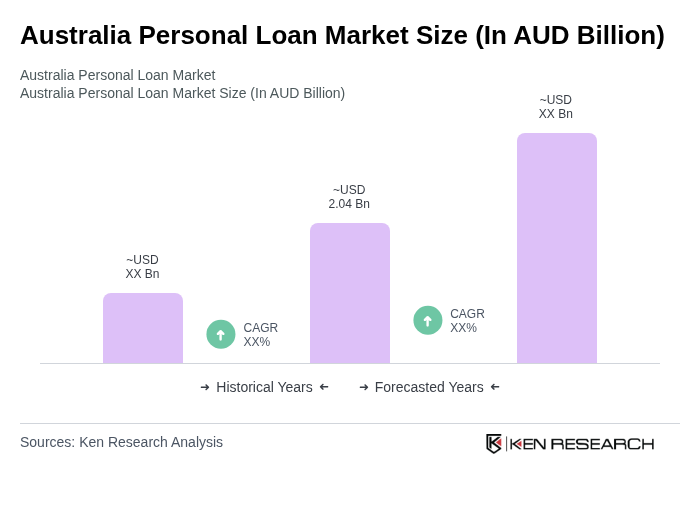
The Australia personal loan market is valued at approximately AUD 2.04 billion. This growth is driven by increasing consumer demand for flexible financing options and the rise of digital lending platforms that enhance accessibility for borrowers.

What makes us stand out is that our consultants follow Robust, Refine and Result (RRR) methodology. Robust for clear definitions, approaches and sanity checking, Refine for differentiating respondents' facts and opinions, and Result for presenting data with story.

We have set a benchmark in the industry by offering our clients with syndicated and customized market research reports featuring coverage of entire market as well as meticulous research and analyst insights.

While we don't replace traditional research, we flip the method upside down. Our dual approach of Top Bottom & Bottom Top ensures quality deliverable by not just verifying company fundamentals but also looking at the sector and macroeconomic factors.

With one step in the future, our research team constantly tries to show you the bigger picture. We help with some of the tough questions you may encounter along the way: How is the industry positioned? Best marketing channel? KPI's of competitors? By aligning every element, we help maximize success.

Our report gives you instant access to the answers and sources that other companies might choose to hide. We elaborate each steps of research methodology we have used and showcase you the sample size to earn your trust.

If you need any support, we are here! We pride ourselves on universe strength, data quality, and quick, friendly, and professional service.













