About the Report
Base Year 2024Australia Wine Barrel Market Overview
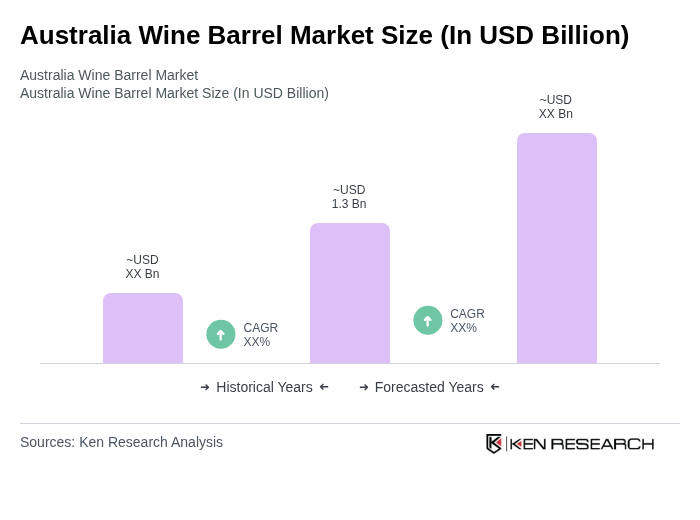
- The Australia Wine Barrel Market is valued at USD 1.3 billion, based on a five-year historical analysis. This growth is primarily driven by the increasing demand for premium wines, which necessitates the use of high-quality barrels for aging, alongside rising adoption of alternative oak sourcing and growing focus on sustainability certifications. The rise in wine tourism and the expansion of vineyards across the country have further fueled the market, as producers seek to enhance the flavor profiles of their wines through barrel aging.
- Key regions dominating the market include New South Wales, Victoria, and South Australia. These areas are renowned for their wine production, with a favorable climate and rich soil contributing to the cultivation of high-quality grapes. The presence of established wineries and a growing number of boutique vineyards in these regions also play a significant role in driving the demand for wine barrels.
- The Wine Australia Corporation Act 1980, administered by Wine Australia, establishes standards for sustainable viticulture practices applicable to the wine industry, including requirements for timber sourcing certification from managed forests for barrel production to meet environmental compliance thresholds. This framework mandates producers to maintain verifiable supply chain documentation for oak materials used in aging processes.
Australia Wine Barrel Market Segmentation
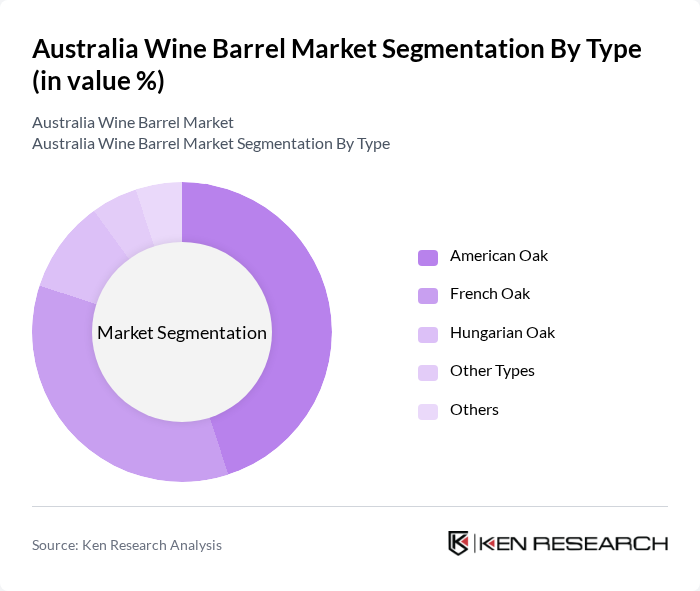
By Type:The market is segmented into various types of barrels, including American Oak, French Oak, Hungarian Oak, Other Types, and Others. Among these, American Oak barrels are particularly popular due to their ability to impart distinct flavors and aromas to the wine, making them a preferred choice for many winemakers. French Oak barrels, known for their subtlety and complexity, also hold a significant share of the market. The demand for Hungarian Oak is growing as winemakers explore diverse flavor profiles. Overall, the type of barrel used significantly influences the aging process and the final taste of the wine.
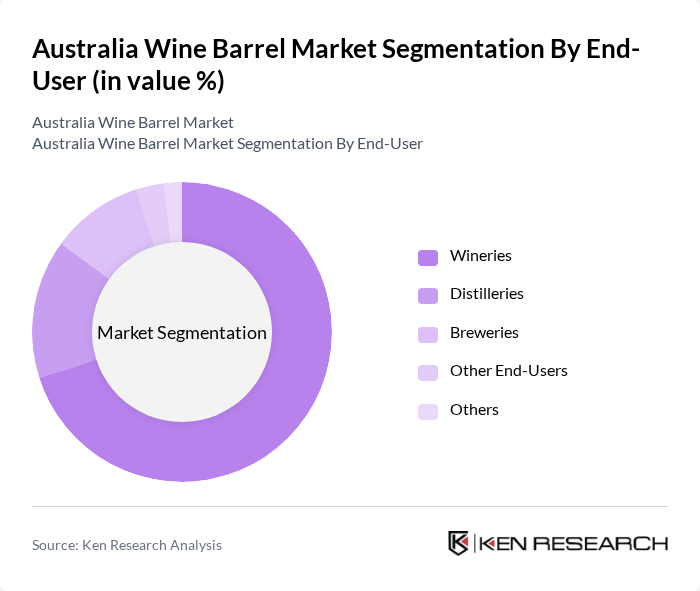
By End-User:The end-user segmentation includes Wineries, Distilleries, Breweries, Other End-Users, and Others. Wineries dominate the market as they are the primary consumers of wine barrels for aging their products. The increasing number of craft wineries and the trend towards premium wine production have led to a surge in demand for barrels. Distilleries are also emerging as significant users of barrels for aging spirits, while breweries are beginning to adopt barrel aging techniques for craft beers. This diversification in end-users is contributing to the overall growth of the market.
Australia Wine Barrel Market Competitive Landscape
The Australia Wine Barrel Market is characterized by a dynamic mix of regional and international players. Leading participants such as Barossa Valley Wine Barrels, Seguin Moreau Australia, The Barrel Factory, Thistle Hill Vineyard, Australian Oak Barrels, Bouchard Cooperages, Tonnellerie de Mercurey, Tonnellerie Radoux, Tonnellerie François Frères, Tonnellerie Seguin Moreau, Tonnellerie Taransaud, Tonnellerie Saury, Tonnellerie Doreau, Tonnellerie de la Côte, Tonnellerie de Bordeaux contribute to innovation, geographic expansion, and service delivery in this space.
Australia Wine Barrel Market Industry Analysis
Growth Drivers
- Increasing Demand for Premium Wines:The Australian wine industry has seen a significant rise in premium wine consumption, with sales of wines priced over AUD 20 increasing by 15% in future. This trend is driven by a growing middle class and a shift towards quality over quantity. The premium segment now accounts for 30% of total wine sales, indicating a robust market for high-quality barrels that enhance wine flavor and aging potential, thus driving demand for specialized barrel production.
- Growth in the Australian Wine Industry:The Australian wine industry contributed AUD 45 billion to the economy in future, with exports reaching AUD 3.2 billion. This growth is fueled by favorable climatic conditions and an increase in vineyard acreage, which expanded by 5% over the past year. As wineries scale up production to meet both domestic and international demand, the need for quality barrels is expected to rise, further stimulating the barrel market.
- Rising Export Opportunities:Australia’s wine exports have surged, with a 10% increase in volume in future, particularly to Asian markets like China and Japan. The Australian government has invested AUD 1 million in promoting wine exports, enhancing global market access. This expansion creates a higher demand for barrels, as wineries seek to produce distinctive wines that cater to international tastes, thus driving growth in the barrel market.
Market Challenges
- Fluctuating Raw Material Prices:The cost of oak, a primary material for barrel production, has seen a 20% increase in future due to supply chain disruptions and increased demand. This volatility poses a significant challenge for barrel manufacturers, as rising costs can lead to higher prices for wineries, potentially reducing their profit margins and affecting overall market growth.
- Competition from Alternative Aging Methods:The emergence of alternative aging techniques, such as stainless steel and concrete aging, has gained traction among winemakers. In future, approximately 25% of wineries reported using these methods to reduce costs and enhance flavor profiles. This shift presents a challenge to traditional barrel manufacturers, as they must innovate to maintain relevance in a changing market landscape.
Australia Wine Barrel Market Future Outlook
The future of the Australia wine barrel market appears promising, driven by increasing consumer preferences for premium and organic wines. As wineries continue to innovate in barrel design and aging techniques, the demand for high-quality barrels is expected to rise. Additionally, the focus on sustainability will likely lead to the adoption of eco-friendly practices in barrel production, aligning with global trends towards environmental responsibility. This evolving landscape presents opportunities for growth and collaboration within the industry.
Market Opportunities
- Expansion into Asian Markets:With Asian wine consumption projected to grow by 20% in future, Australian barrel manufacturers have a significant opportunity to tap into this expanding market. Establishing partnerships with local wineries can facilitate entry and enhance brand visibility, driving demand for quality barrels tailored to regional preferences.
- Customization of Barrels for Niche Markets:There is a growing trend towards customized barrels that cater to specific wine styles and consumer preferences. By offering tailored solutions, barrel manufacturers can differentiate themselves in a competitive market, potentially increasing sales by targeting niche segments that prioritize unique aging characteristics.
Scope of the Report
| Segment | Sub-Segments |
|---|---|
| By Type | American Oak French Oak Hungarian Oak Other Types Others |
| By End-User | Wineries Distilleries Breweries Other End-Users Others |
| By Region | New South Wales Victoria South Australia Western Australia Others |
| By Barrel Size | Liters Liters Liters Other Sizes Others |
| By Aging Process | Traditional Aging Accelerated Aging Hybrid Aging Others |
| By Price Range | Low-End Mid-Range High-End Others |
| By Customization Options | Standard Barrels Customized Barrels Limited Edition Barrels Others |
Key Target Audience
Investors and Venture Capitalist Firms
Government and Regulatory Bodies (e.g., Australian Wine and Brandy Corporation, Department of Agriculture, Water and the Environment)
Manufacturers and Producers
Distributors and Retailers
Wine Exporters
Industry Associations (e.g., Winemakers' Federation of Australia)
Financial Institutions
Packaging Suppliers
Players Mentioned in the Report:
Barossa Valley Wine Barrels
Seguin Moreau Australia
The Barrel Factory
Thistle Hill Vineyard
Australian Oak Barrels
Bouchard Cooperages
Tonnellerie de Mercurey
Tonnellerie Radoux
Tonnellerie Francois Freres
Tonnellerie Seguin Moreau
Tonnellerie Taransaud
Tonnellerie Saury
Tonnellerie Doreau
Tonnellerie de la Cote
Tonnellerie de Bordeaux
Table of Contents
Market Assessment Phase
1. Executive Summary and Approach
2. Australia Wine Barrel Market Overview
2.1 Key Insights and Strategic Recommendations
2.2 Australia Wine Barrel Market Overview
2.3 Definition and Scope
2.4 Evolution of Market Ecosystem
2.5 Timeline of Key Regulatory Milestones
2.6 Value Chain & Stakeholder Mapping
2.7 Business Cycle Analysis
2.8 Policy & Incentive Landscape
3. Australia Wine Barrel Market Analysis
3.1 Growth Drivers
3.1.1 Increasing demand for premium wines
3.1.2 Growth in the Australian wine industry
3.1.3 Rising export opportunities
3.1.4 Technological advancements in barrel production
3.2 Market Challenges
3.2.1 Fluctuating raw material prices
3.2.2 Competition from alternative aging methods
3.2.3 Environmental regulations
3.2.4 Limited awareness among new wineries
3.3 Market Opportunities
3.3.1 Expansion into Asian markets
3.3.2 Customization of barrels for niche markets
3.3.3 Sustainable production practices
3.3.4 Collaborations with local wineries
3.4 Market Trends
3.4.1 Increasing preference for oak barrels
3.4.2 Growth in organic and biodynamic wines
3.4.3 Innovations in barrel design
3.4.4 Rising interest in barrel aging techniques
3.5 Government Regulation
3.5.1 Standards for wood sourcing
3.5.2 Regulations on chemical treatments
3.5.3 Environmental impact assessments
3.5.4 Labeling and quality assurance requirements
4. SWOT Analysis
5. Stakeholder Analysis
6. Porter's Five Forces Analysis
7. Australia Wine Barrel Market Market Size, 2019-2024
7.1 By Value
7.2 By Volume
7.3 By Average Selling Price
8. Australia Wine Barrel Market Segmentation
8.1 By Type
8.1.1 American Oak
8.1.2 French Oak
8.1.3 Hungarian Oak
8.1.4 Other Types
8.1.5 Others
8.2 By End-User
8.2.1 Wineries
8.2.2 Distilleries
8.2.3 Breweries
8.2.4 Other End-Users
8.2.5 Others
8.3 By Region
8.3.1 New South Wales
8.3.2 Victoria
8.3.3 South Australia
8.3.4 Western Australia
8.3.5 Others
8.4 By Barrel Size
8.4.1 225 Liters
8.4.2 300 Liters
8.4.3 500 Liters
8.4.4 Other Sizes
8.4.5 Others
8.5 By Aging Process
8.5.1 Traditional Aging
8.5.2 Accelerated Aging
8.5.3 Hybrid Aging
8.5.4 Others
8.6 By Price Range
8.6.1 Low-End
8.6.2 Mid-Range
8.6.3 High-End
8.6.4 Others
8.7 By Customization Options
8.7.1 Standard Barrels
8.7.2 Customized Barrels
8.7.3 Limited Edition Barrels
8.7.4 Others
9. Australia Wine Barrel Market Competitive Analysis
9.1 Market Share of Key Players
9.2 Cross Comparison of Key Players
9.2.1 Company Name
9.2.2 Group Size (Large, Medium, or Small as per industry convention)
9.2.3 Revenue Growth Rate
9.2.4 Market Penetration Rate
9.2.5 Customer Retention Rate
9.2.6 Pricing Strategy
9.2.7 Production Efficiency
9.2.8 Product Quality Index
9.2.9 Brand Recognition Score
9.2.10 Distribution Network Strength
9.3 SWOT Analysis of Top Players
9.4 Pricing Analysis
9.5 Detailed Profile of Major Companies
9.5.1 Barossa Valley Wine Barrels
9.5.2 Seguin Moreau Australia
9.5.3 The Barrel Factory
9.5.4 Thistle Hill Vineyard
9.5.5 Australian Oak Barrels
9.5.6 Bouchard Cooperages
9.5.7 Tonnellerie de Mercurey
9.5.8 Tonnellerie Radoux
9.5.9 Tonnellerie François Frères
9.5.10 Tonnellerie Seguin Moreau
9.5.11 Tonnellerie Taransaud
9.5.12 Tonnellerie Saury
9.5.13 Tonnellerie Doreau
9.5.14 Tonnellerie de la Côte
9.5.15 Tonnellerie de Bordeaux
10. Australia Wine Barrel Market End-User Analysis
10.1 Procurement Behavior of Key Ministries
10.1.1 Government contracts and tenders
10.1.2 Budget allocation for wine industry
10.1.3 Compliance with local sourcing regulations
10.1.4 Evaluation criteria for suppliers
10.2 Corporate Spend on Infrastructure & Energy
10.2.1 Investment in winery infrastructure
10.2.2 Spending on sustainable practices
10.2.3 Budget for equipment upgrades
10.2.4 Financial support for innovation
10.3 Pain Point Analysis by End-User Category
10.3.1 Quality consistency issues
10.3.2 Supply chain disruptions
10.3.3 Cost management challenges
10.3.4 Regulatory compliance burdens
10.4 User Readiness for Adoption
10.4.1 Awareness of barrel options
10.4.2 Willingness to invest in quality
10.4.3 Training and education needs
10.4.4 Adoption of new technologies
10.5 Post-Deployment ROI and Use Case Expansion
10.5.1 Measurement of aging impact on wine quality
10.5.2 Analysis of cost savings from efficient barrels
10.5.3 Expansion into new wine styles
10.5.4 Customer feedback and satisfaction metrics
11. Australia Wine Barrel Market Future Size, 2025-2030
11.1 By Value
11.2 By Volume
11.3 By Average Selling Price
Go-To-Market Strategy Phase
1. Whitespace Analysis + Business Model Canvas
1.1 Market gaps and opportunities
2. Marketing and Positioning Recommendations
2.1 Branding strategies
2.2 Product USPs
3. Distribution Plan
3.1 Urban retail vs rural NGO tie-ups
4. Channel & Pricing Gaps
4.1 Underserved routes
4.2 Pricing bands
5. Unmet Demand & Latent Needs
5.1 Category gaps
5.2 Consumer segments
6. Customer Relationship
6.1 Loyalty programs
6.2 After-sales service
7. Value Proposition
7.1 Sustainability
7.2 Integrated supply chains
8. Key Activities
8.1 Regulatory compliance
8.2 Branding
8.3 Distribution setup
9. Entry Strategy Evaluation
9.1 Domestic Market Entry Strategy
9.1.1 Product mix
9.1.2 Pricing band
9.1.3 Packaging
9.2 Export Entry Strategy
9.2.1 Target countries
9.2.2 Compliance roadmap
10. Entry Mode Assessment
10.1 JV, Greenfield, M&A, Distributor Model
11. Capital and Timeline Estimation
11.1 Capital requirements
11.2 Timelines
12. Control vs Risk Trade-Off
12.1 Ownership vs Partnerships
13. Profitability Outlook
13.1 Breakeven analysis
13.2 Long-term sustainability
14. Potential Partner List
14.1 Distributors
14.2 JVs
14.3 Acquisition targets
15. Execution Roadmap
15.1 Phased Plan for Market Entry
15.1.1 Market Setup
15.1.2 Market Entry
15.1.3 Growth Acceleration
15.1.4 Scale & Stabilize
15.2 Key Activities and Milestones
15.2.1 Milestone tracking
15.2.2 Activity scheduling
Research Methodology
Phase 1: Approach1
Desk Research
- Industry reports from Australian wine associations and market research firms
- Government publications on wine production and export statistics
- Academic journals focusing on wine barrel technology and materials
Primary Research
- Interviews with winemakers and vineyard owners regarding barrel preferences
- Surveys with barrel manufacturers to understand production capacities
- Field visits to wineries to observe barrel usage and storage practices
Validation & Triangulation
- Cross-validation of data from industry reports and primary interviews
- Triangulation of insights from winemakers, suppliers, and industry experts
- Sanity checks through expert panel discussions and feedback sessions
Phase 2: Market Size Estimation1
Top-down Assessment
- Analysis of total wine production volumes in Australia and barrel usage rates
- Segmentation of the market by barrel type (e.g., oak, stainless steel)
- Incorporation of export data to assess international demand for Australian wine barrels
Bottom-up Modeling
- Volume estimates based on production data from leading wineries
- Cost analysis of barrel production, including raw materials and labor
- Estimation of market share for different barrel manufacturers based on sales data
Forecasting & Scenario Analysis
- Multi-factor regression analysis considering trends in wine consumption and production
- Scenario modeling based on potential changes in export tariffs and trade agreements
- Baseline, optimistic, and pessimistic forecasts through 2030 based on market dynamics
Phase 3: CATI Sample Composition1
| Scope Item/Segment | Sample Size | Target Respondent Profiles |
|---|---|---|
| Winery Barrel Usage | 120 | Winemakers, Vineyard Managers |
| Barrel Manufacturing Insights | 100 | Production Managers, Quality Control Experts |
| Export Market Trends | 80 | Export Managers, Trade Analysts |
| Consumer Preferences in Wine | 100 | Wine Retailers, Sommeliers |
| Barrel Material Innovations | 70 | Research & Development Managers, Material Scientists |
Frequently Asked Questions
What is the current value of the Australia Wine Barrel Market?
The Australia Wine Barrel Market is valued at approximately USD 1.3 billion, driven by the increasing demand for premium wines and the adoption of sustainable practices in barrel production.
Which regions in Australia dominate the wine barrel market?
What types of barrels are most commonly used in Australia?
Who are the primary end-users of wine barrels in Australia?
Other Regional/Country Reports
Other Adjacent Reports
KSA Wine Production Market
Oman Spirits Aging Market
Vietnam Beer Barrel Market
Vietnam Oak Timber Market
UAE Viticulture Equipment Market
Indonesia Beverage Packaging Market Size, Share, Growth Drivers, Trends, Opportunities & Forecast 2025–2030Germany Sustainable Forestry Market
Indonesia wine tourism market report size, share, growth drivers, trends, opportunities & forecast 2025–2030Bahrain Premium Alcoholic Beverage Market
Germany Barrel Manufacturing Market
Why Buy From Us?

What makes us stand out is that our consultants follow Robust, Refine and Result (RRR) methodology. Robust for clear definitions, approaches and sanity checking, Refine for differentiating respondents' facts and opinions, and Result for presenting data with story.

We have set a benchmark in the industry by offering our clients with syndicated and customized market research reports featuring coverage of entire market as well as meticulous research and analyst insights.

While we don't replace traditional research, we flip the method upside down. Our dual approach of Top Bottom & Bottom Top ensures quality deliverable by not just verifying company fundamentals but also looking at the sector and macroeconomic factors.

With one step in the future, our research team constantly tries to show you the bigger picture. We help with some of the tough questions you may encounter along the way: How is the industry positioned? Best marketing channel? KPI's of competitors? By aligning every element, we help maximize success.

Our report gives you instant access to the answers and sources that other companies might choose to hide. We elaborate each steps of research methodology we have used and showcase you the sample size to earn your trust.

If you need any support, we are here! We pride ourselves on universe strength, data quality, and quick, friendly, and professional service.