About the Report
Base Year 2024Japan Wine Barrel Market Overview
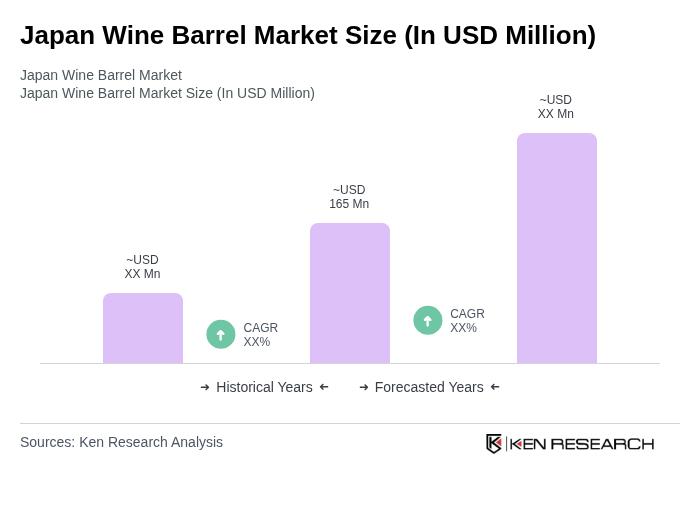
- The Japan Wine Barrel Market is valued at USD 165 million, based on a five-year historical analysis. This growth is primarily driven by the increasing popularity of wine consumption in Japan, coupled with the rising number of local wineries that require high-quality barrels for aging. The demand for premium wine barrels, particularly those made from oak, has surged as consumers become more discerning about wine quality and flavor profiles.
- Key regions dominating the market include Yamanashi, Nagano, and Hokkaido. Yamanashi is renowned for its wine production, benefiting from favorable climate conditions and a rich tradition of viticulture. Nagano, with its diverse grape varieties, and Hokkaido, known for its unique wine styles, also contribute significantly to the market's growth, supported by local wineries that prioritize quality and craftsmanship. Japanese winemakers employ meticulous approaches to quality, often blending traditional and modern aging techniques, including limited use of stainless steel barrels for white wines and hybrid barrels for experimental batches.
- In 2023, the Japanese government implemented regulations aimed at promoting sustainable practices in the wine industry. This includes guidelines for the sourcing of wood for barrels, encouraging the use of sustainably harvested timber. The initiative aims to enhance the environmental responsibility of wineries and cooperages, ensuring that the production of wine barrels aligns with broader sustainability goals.
Japan Wine Barrel Market Segmentation
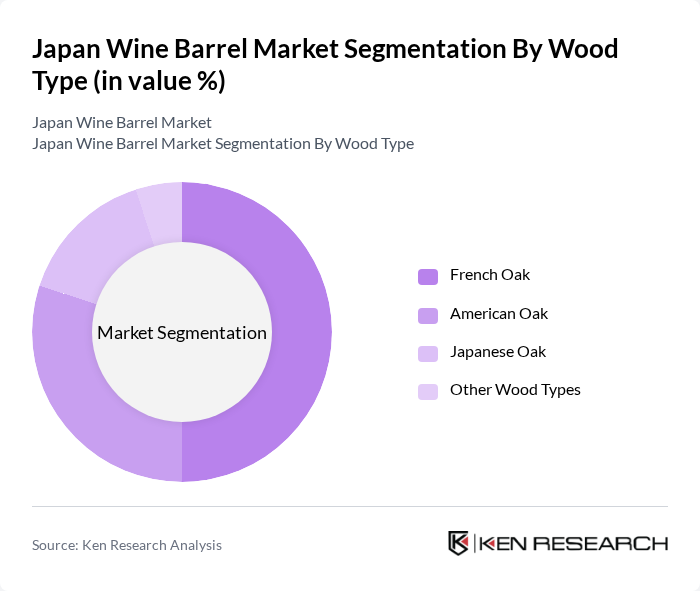
By Wood Type:The market is segmented by wood type into French Oak, American Oak, Japanese Oak, and Other Wood Types. French Oak is highly sought after for its ability to impart complex flavors and aromas to wine, making it the most popular choice among winemakers. American Oak, known for its sweeter and bolder flavor profile, is also widely used, particularly in the production of certain red wines. Japanese Oak, while less common, is gaining traction due to its unique characteristics and local sourcing. Other wood types are utilized for niche markets and experimental wines.
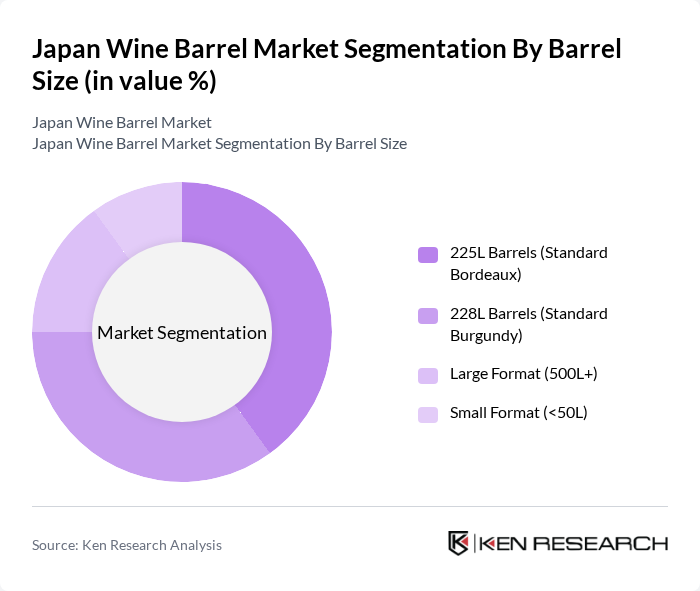
By Barrel Size:The market is also segmented by barrel size, including 225L Barrels (Standard Bordeaux), 228L Barrels (Standard Burgundy), Large Format (500L+), and Small Format (<50L). The 225L and 228L barrels are the most commonly used sizes, favored for their versatility in aging both red and white wines. Large format barrels are increasingly popular among wineries looking to produce unique blends, while small format barrels are often used for experimental batches or premium wines that require specific aging conditions.
Japan Wine Barrel Market Competitive Landscape
The Japan Wine Barrel Market is characterized by a dynamic mix of regional and international players. Leading participants such as Tonnellerie Radoux, Seguin Moreau, Taransaud, Demptos, Saury, Boutes, Francois Freres, The Barrel Mill, World Cooperage, J. D. Heald, Napa Valley Barrel Company, Cooperages 1912, Canton Cooperage, Missouri Oak Barrel Company, Independent Stave Company contribute to innovation, geographic expansion, and service delivery in this space.
Japan Wine Barrel Market Industry Analysis
Growth Drivers
- Increasing Demand for Premium Wines:The Japanese wine market has seen a significant increase in premium wine consumption, with sales reaching approximately 1.3 million cases in future. This trend is driven by a growing middle class and a shift in consumer preferences towards high-quality products. The premium segment is projected to account for over 40% of total wine sales in future, indicating a robust demand for quality wine barrels that enhance aging processes and flavor profiles.
- Growth of Domestic Wine Production:Japan's domestic wine production has surged, with an output of around 575,000 hectoliters in future, marking a 15% increase from the previous year. This growth is fueled by favorable climatic conditions and increased investment in vineyards. As local wineries expand, the demand for high-quality barrels is expected to rise, supporting the aging process and improving the overall quality of Japanese wines, which are gaining international recognition.
- Rising Interest in Wine Tourism:Wine tourism in Japan has become increasingly popular, with over 2.2 million visitors to wine regions in future. This trend not only boosts local economies but also enhances the visibility of Japanese wines globally. As tourists seek authentic experiences, wineries are investing in premium barrels to improve their offerings. This growing interest in wine tourism is expected to further drive the demand for quality wine barrels, supporting the overall market growth.
Market Challenges
- High Cost of Quality Barrels:The production of high-quality wine barrels involves significant costs, with premium oak barrels priced between ¥110,000 and ¥320,000 each. This high investment can deter smaller wineries from purchasing the necessary barrels, limiting their ability to produce premium wines. As a result, the overall growth of the wine barrel market may be constrained, particularly among emerging wineries that struggle with capital investment.
- Limited Availability of Raw Materials:The sourcing of quality oak for barrel production is becoming increasingly challenging, with global demand outpacing supply. In future, the price of oak wood increased by 20%, driven by environmental regulations and deforestation concerns. This scarcity can lead to production delays and increased costs for barrel manufacturers, ultimately impacting the availability of barrels for Japanese wineries and hindering market growth.
Japan Wine Barrel Market Future Outlook
The Japan wine barrel market is poised for growth, driven by increasing domestic wine production and a rising interest in premium wines. As wineries continue to innovate and adopt sustainable practices, the demand for eco-friendly barrels is expected to rise. Additionally, advancements in barrel technology will likely enhance the aging process, attracting more consumers. The market is also anticipated to benefit from collaborations between local wineries and barrel manufacturers, fostering a more dynamic and competitive landscape in the coming years.
Market Opportunities
- Export Potential to Asian Markets:Japan's wine barrel manufacturers have significant opportunities to export to neighboring Asian markets, where wine consumption is on the rise. Countries like China and South Korea are increasingly interested in premium wines, creating a demand for quality barrels. This potential for export can enhance revenue streams for Japanese manufacturers, contributing to market growth.
- Innovations in Barrel Design and Materials:The development of innovative barrel designs and alternative materials, such as hybrid barrels, presents a unique opportunity for manufacturers. These innovations can cater to the evolving preferences of winemakers seeking to enhance flavor profiles while reducing environmental impact. By investing in research and development, companies can position themselves as leaders in a competitive market.
Scope of the Report
| Segment | Sub-Segments |
|---|---|
| By Wood Type | French Oak American Oak Japanese Oak Other Wood Types |
| By Barrel Size | L Barrels (Standard Bordeaux) L Barrels (Standard Burgundy) Large Format (500L+) Small Format (<50L) |
| By Toast Level | Light Toast Medium Toast Heavy Toast Other Toast Levels |
| By End Use | Red Wine Aging White Wine Aging Sparkling Wine Aging Other Uses |
| By Prior Use | New Barrels One-Wine Barrels Neutral Barrels Other |
| By Sales Channel | Direct to Wineries Distributors/Importers Online Platforms Other Channels |
| By Region | Yamanashi Nagano Hokkaido Other Regions |
Key Target Audience
Investors and Venture Capitalist Firms
Government and Regulatory Bodies (e.g., Ministry of Agriculture, Forestry and Fisheries, Japan External Trade Organization)
Manufacturers and Producers
Distributors and Retailers
Wine Importers and Exporters
Hospitality and Restaurant Chains
Industry Associations (e.g., Japan Wine Producers Association)
Financial Institutions
Players Mentioned in the Report:
Tonnellerie Radoux
Seguin Moreau
Taransaud
Demptos
Saury
Boutes
Francois Freres
The Barrel Mill
World Cooperage
J. D. Heald
Napa Valley Barrel Company
Cooperages 1912
Canton Cooperage
Missouri Oak Barrel Company
Independent Stave Company
Table of Contents
Market Assessment Phase
1. Executive Summary and Approach
2. Japan Wine Barrel Market Overview
2.1 Key Insights and Strategic Recommendations
2.2 Japan Wine Barrel Market Overview
2.3 Definition and Scope
2.4 Evolution of Market Ecosystem
2.5 Timeline of Key Regulatory Milestones
2.6 Value Chain & Stakeholder Mapping
2.7 Business Cycle Analysis
2.8 Policy & Incentive Landscape
3. Japan Wine Barrel Market Analysis
3.1 Growth Drivers
3.1.1 Increasing demand for premium wines
3.1.2 Growth of domestic wine production
3.1.3 Rising interest in wine tourism
3.1.4 Expansion of wine distribution channels
3.2 Market Challenges
3.2.1 High cost of quality barrels
3.2.2 Limited availability of raw materials
3.2.3 Competition from alternative aging methods
3.2.4 Regulatory hurdles in production
3.3 Market Opportunities
3.3.1 Export potential to Asian markets
3.3.2 Innovations in barrel design and materials
3.3.3 Collaborations with local wineries
3.3.4 Growing interest in sustainable practices
3.4 Market Trends
3.4.1 Shift towards eco-friendly barrels
3.4.2 Increasing customization of barrels
3.4.3 Rise of small-batch winemaking
3.4.4 Adoption of technology in barrel production
3.5 Government Regulation
3.5.1 Standards for barrel production materials
3.5.2 Import regulations for wine barrels
3.5.3 Environmental regulations on wood sourcing
3.5.4 Quality control measures for wine aging
4. SWOT Analysis
5. Stakeholder Analysis
6. Porter's Five Forces Analysis
7. Japan Wine Barrel Market Market Size, 2019-2024
7.1 By Value
7.2 By Volume
7.3 By Average Selling Price
8. Japan Wine Barrel Market Segmentation
8.1 By Wood Type
8.1.1 French Oak
8.1.2 American Oak
8.1.3 Japanese Oak
8.1.4 Other Wood Types
8.2 By Barrel Size
8.2.1 225L Barrels (Standard Bordeaux)
8.2.2 228L Barrels (Standard Burgundy)
8.2.3 Large Format (500L+)
8.2.4 Small Format (<50L)
8.3 By Toast Level
8.3.1 Light Toast
8.3.2 Medium Toast
8.3.3 Heavy Toast
8.3.4 Other Toast Levels
8.4 By End Use
8.4.1 Red Wine Aging
8.4.2 White Wine Aging
8.4.3 Sparkling Wine Aging
8.4.4 Other Uses
8.5 By Prior Use
8.5.1 New Barrels
8.5.2 One-Wine Barrels
8.5.3 Neutral Barrels
8.5.4 Other
8.6 By Sales Channel
8.6.1 Direct to Wineries
8.6.2 Distributors/Importers
8.6.3 Online Platforms
8.6.4 Other Channels
8.7 By Region
8.7.1 Yamanashi
8.7.2 Nagano
8.7.3 Hokkaido
8.7.4 Other Regions
9. Japan Wine Barrel Market Competitive Analysis
9.1 Market Share of Key Players
9.2 Cross Comparison of Key Players
9.2.1 Company Name
9.2.2 Market Share (%)
9.2.3 Revenue Growth Rate (CAGR 2019-2024)
9.2.4 Production Capacity (000s Barrels/Year)
9.2.5 Export Volume to Japan (Units)
9.2.6 Average Selling Price (USD/Barrel)
9.2.7 R&D Investment (% of Revenue)
9.2.8 Customer Satisfaction Score
9.2.9 Supply Chain Reliability Index
9.2.10 Sustainability Rating
9.3 SWOT Analysis of Top Players
9.4 Pricing Analysis
9.5 Detailed Profile of Major Companies
9.5.1 Tonnellerie Radoux
9.5.2 Seguin Moreau
9.5.3 Taransaud
9.5.4 Demptos
9.5.5 Saury
9.5.6 Boutes
9.5.7 Francois Freres
9.5.8 The Barrel Mill
9.5.9 World Cooperage
9.5.10 J. D. Heald
9.5.11 Napa Valley Barrel Company
9.5.12 Cooperages 1912
9.5.13 Canton Cooperage
9.5.14 Missouri Oak Barrel Company
9.5.15 Independent Stave Company
10. Japan Wine Barrel Market End-User Analysis
10.1 Procurement Behavior of Key Ministries
10.1.1 Budget Allocation Trends
10.1.2 Decision-Making Processes
10.1.3 Supplier Selection Criteria
10.1.4 Contracting Practices
10.2 Corporate Spend on Infrastructure & Energy
10.2.1 Investment Trends in Wine Production
10.2.2 Spending on Barrel Acquisition
10.2.3 Budgeting for Quality Control
10.2.4 Other Expenditures
10.3 Pain Point Analysis by End-User Category
10.3.1 Wineries
10.3.2 Distilleries
10.3.3 Breweries
10.3.4 Other End-Users
10.4 User Readiness for Adoption
10.4.1 Awareness of Barrel Types
10.4.2 Willingness to Invest in Quality
10.4.3 Training Needs for Staff
10.4.4 Other Readiness Factors
10.5 Post-Deployment ROI and Use Case Expansion
10.5.1 Measurement of ROI
10.5.2 Case Studies of Successful Implementations
10.5.3 Future Use Cases
10.5.4 Other Considerations
11. Japan Wine Barrel Market Future Size, 2025-2030
11.1 By Value
11.2 By Volume
11.3 By Average Selling Price
Go-To-Market Strategy Phase
1. Whitespace Analysis + Business Model Canvas
1.1 Market Gaps Identification
1.2 Business Model Components
2. Marketing and Positioning Recommendations
2.1 Branding Strategies
2.2 Product USPs
3. Distribution Plan
3.1 Urban Retail vs Rural NGO Tie-ups
4. Channel & Pricing Gaps
4.1 Underserved Routes
4.2 Pricing Bands
5. Unmet Demand & Latent Needs
5.1 Category Gaps
5.2 Consumer Segments
6. Customer Relationship
6.1 Loyalty Programs
6.2 After-sales Service
7. Value Proposition
7.1 Sustainability
7.2 Integrated Supply Chains
8. Key Activities
8.1 Regulatory Compliance
8.2 Branding
8.3 Distribution Setup
9. Entry Strategy Evaluation
9.1 Domestic Market Entry Strategy
9.1.1 Product Mix
9.1.2 Pricing Band
9.1.3 Packaging
9.2 Export Entry Strategy
9.2.1 Target Countries
9.2.2 Compliance Roadmap
10. Entry Mode Assessment
10.1 JV
10.2 Greenfield
10.3 M&A
10.4 Distributor Model
11. Capital and Timeline Estimation
11.1 Capital Requirements
11.2 Timelines
12. Control vs Risk Trade-Off
12.1 Ownership vs Partnerships
13. Profitability Outlook
13.1 Breakeven Analysis
13.2 Long-term Sustainability
14. Potential Partner List
14.1 Distributors
14.2 JVs
14.3 Acquisition Targets
15. Execution Roadmap
15.1 Phased Plan for Market Entry
15.1.1 Market Setup
15.1.2 Market Entry
15.1.3 Growth Acceleration
15.1.4 Scale & Stabilize
15.2 Key Activities and Milestones
15.2.1 Milestone Planning
15.2.2 Activity Tracking
Research Methodology
Phase 1: Approach1
Desk Research
- Analysis of industry reports from Japanese wine associations and market research firms
- Review of government publications on wine production and import statistics in Japan
- Examination of academic journals and articles focusing on the Japanese wine market trends and consumer behavior
Primary Research
- Interviews with winemakers and vineyard owners to understand production practices and barrel usage
- Surveys with distributors and retailers to gauge market demand and consumer preferences
- Field visits to wineries and wine festivals to observe market dynamics and consumer interactions
Validation & Triangulation
- Cross-validation of findings through multiple data sources including trade publications and expert opinions
- Triangulation of market data with insights from industry experts and stakeholders
- Sanity checks through feedback from a panel of wine industry experts
Phase 2: Market Size Estimation1
Top-down Assessment
- Estimation of total wine consumption in Japan and its correlation with barrel usage
- Analysis of import/export data to understand the impact of foreign wine on local barrel demand
- Incorporation of trends in premiumization and organic wine production affecting barrel types
Bottom-up Modeling
- Volume estimates based on production capacities of local wineries and their barrel requirements
- Cost analysis of different barrel types (e.g., oak, stainless steel) used in the Japanese market
- Calculation of market size based on average barrel prices and estimated sales volume
Forecasting & Scenario Analysis
- Multi-factor regression analysis considering factors like tourism growth and wine consumption trends
- Scenario modeling based on potential changes in consumer preferences and regulatory impacts
- Development of baseline, optimistic, and pessimistic forecasts through 2030
Phase 3: CATI Sample Composition1
| Scope Item/Segment | Sample Size | Target Respondent Profiles |
|---|---|---|
| Winery Production Insights | 100 | Winemakers, Vineyard Managers |
| Retail Wine Sales Analysis | 80 | Retail Managers, Wine Shop Owners |
| Consumer Preferences Survey | 120 | Wine Consumers, Enthusiasts |
| Barrel Suppliers Feedback | 60 | Barrel Manufacturers, Distributors |
| Market Trend Analysis | 70 | Industry Analysts, Market Researchers |
Frequently Asked Questions
What is the current value of the Japan Wine Barrel Market?
The Japan Wine Barrel Market is valued at approximately USD 165 million, reflecting a significant growth trend driven by increasing wine consumption and the rising number of local wineries requiring high-quality barrels for aging.
Which regions are the key players in the Japan Wine Barrel Market?
What types of wood are commonly used for wine barrels in Japan?
What are the common barrel sizes used in the Japan Wine Barrel Market?
Other Regional/Country Reports
Other Adjacent Reports
Singapore Winemaking Equipment Market
South Korea Whiskey Barrel Market
South Africa Oak Wood Supply Market
Indonesia Beverage Packaging Market Size, Share, Growth Drivers, Trends, Opportunities & Forecast 2025–2030Egypt Wine Cork Market
Oman Wine Bottle Market
Egypt Viticulture Supplies Market
Indonesia wine tourism market report size, share, growth drivers, trends, opportunities & forecast 2025–2030Germany Sustainable Timber Market
Indonesia Cooperage Products Market
Why Buy From Us?

What makes us stand out is that our consultants follow Robust, Refine and Result (RRR) methodology. Robust for clear definitions, approaches and sanity checking, Refine for differentiating respondents' facts and opinions, and Result for presenting data with story.

We have set a benchmark in the industry by offering our clients with syndicated and customized market research reports featuring coverage of entire market as well as meticulous research and analyst insights.

While we don't replace traditional research, we flip the method upside down. Our dual approach of Top Bottom & Bottom Top ensures quality deliverable by not just verifying company fundamentals but also looking at the sector and macroeconomic factors.

With one step in the future, our research team constantly tries to show you the bigger picture. We help with some of the tough questions you may encounter along the way: How is the industry positioned? Best marketing channel? KPI's of competitors? By aligning every element, we help maximize success.

Our report gives you instant access to the answers and sources that other companies might choose to hide. We elaborate each steps of research methodology we have used and showcase you the sample size to earn your trust.

If you need any support, we are here! We pride ourselves on universe strength, data quality, and quick, friendly, and professional service.