About the Report
Base Year 2024Bahrain Food Service Supply Market Overview
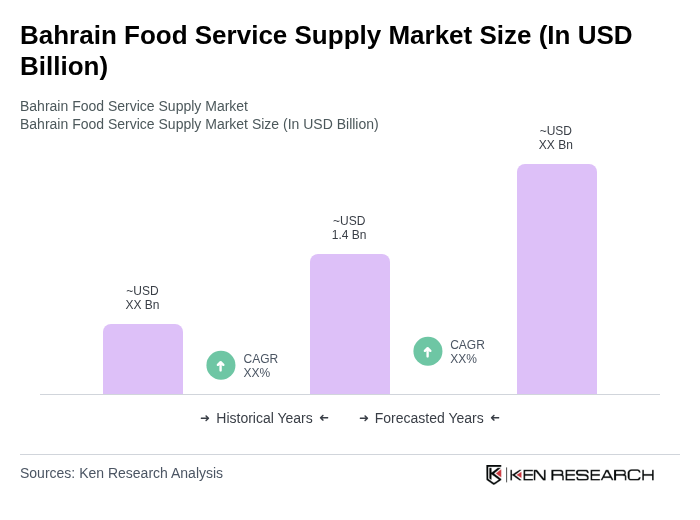
- The Bahrain Food Service Supply Market is valued at USD 1.4 billion, based on a five-year historical analysis. This growth is primarily driven by the increasing demand for diverse food options, the rise of the hospitality sector, a growing population that favors dining out, rapid expansion of quick-service restaurants, growth of online food delivery platforms, and tourism-led demand for food and beverage services. The market has seen a significant shift towards convenience and quality, with consumers increasingly opting for ready-to-eat meals, premium ingredients, healthier options, and sustainable food choices.
- Key players in this market include Manama, the capital, which serves as a central hub for food service operations, and Muharraq, known for its vibrant dining scene. The dominance of these cities is attributed to their high population density, robust tourism infrastructure, and a growing number of expatriates, all of which contribute to a thriving food service environment.
- The Food Safety Regulations, 2017 issued by the Ministry of Health requires all food service providers to obtain a food safety license, implement Hazard Analysis and Critical Control Points (HACCP) systems for food handling and storage, maintain hygiene standards through regular inspections, and comply with temperature controls and sanitation thresholds to ensure public health protection across the supply chain.
Bahrain Food Service Supply Market Segmentation
By Type:This segmentation includes various categories that cater to the diverse needs of the food service industry. The subsegments are Food & Beverage Ingredients, Chilled & Frozen Foods, Disposables & Packaging, Commercial Kitchen Equipment & Appliances, Cleaning, Hygiene & Sanitation Supplies, Tableware & Smallwares, and Others. Each of these subsegments plays a crucial role in the overall market dynamics.
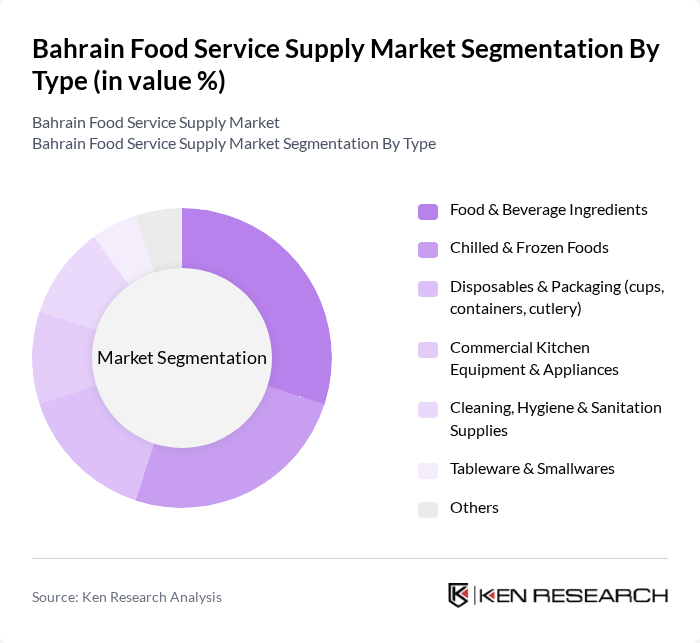
The Food & Beverage Ingredients subsegment is currently dominating the market due to the increasing consumer preference for high-quality and diverse food options. This trend is driven by a growing awareness of health and nutrition, leading to a higher demand for organic and locally sourced ingredients. Additionally, the rise of gourmet dining experiences has further propelled the need for premium food products. As a result, this subsegment is expected to maintain its leadership position in the market.
By End-User:This segmentation focuses on the various types of establishments that utilize food service supplies. The subsegments include Full-Service Restaurants, Quick-Service Restaurants & Fast Food Chains, Cafes, Coffee Shops & Bakeries, Hotels, Resorts & Hospitality, Catering & Institutional Foodservice, Cloud / Ghost Kitchens, and Others. Each end-user category has distinct requirements and purchasing behaviors.
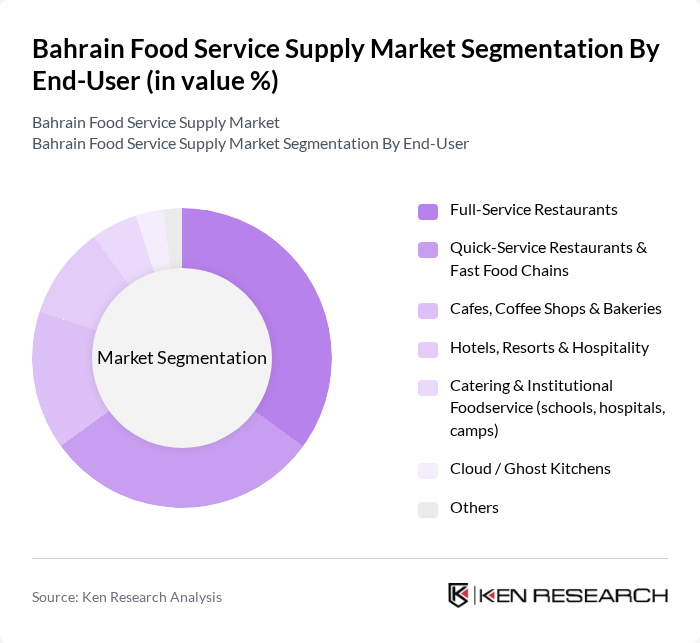
Full-Service Restaurants are the leading end-user segment, driven by the growing trend of dining out and the increasing number of establishments offering diverse cuisines. This segment benefits from a higher average spend per customer compared to quick-service outlets, making it a lucrative market. The demand for unique dining experiences and high-quality service further solidifies the position of full-service restaurants as a dominant player in the food service supply market.
Bahrain Food Service Supply Market Competitive Landscape
The Bahrain Food Service Supply Market is characterized by a dynamic mix of regional and international players. Leading participants such as Banader Hotels Company BSC (Food & Catering Operations), Trafco Group BSC (Bahrain Foodservice Distribution Division), Bahrain Livestock Company (BLC), Bahrain Flour Mills Company BSC, Delmon Bakery & Foodstuff Company, Sayed Kadhem Al Durazi & Sons BSC (Food Import & Distribution), Nasser Abd Mohammed (NAM) Group – Food Service & Distribution, Awal Dairy Company, Al Jazira Group – Supermarkets & Food Distribution, LuLu Group International – Bahrain Foodservice & Wholesale Division, Americana Restaurants (KFC, Pizza Hut and other QSR brands in Bahrain), Al Abraaj Restaurants Group, YumYum Tree Food Court Company, Zayani Foods (exclusive franchisee & distributor for selected QSR brands), Kitopi – Cloud Kitchen & Foodservice Operator in Bahrain contribute to innovation, geographic expansion, and service delivery in this space.
Bahrain Food Service Supply Market Industry Analysis
Growth Drivers
- Increasing Demand for Food Delivery Services:The food delivery sector in Bahrain has seen a significant surge, with the market valued at approximately BHD 40 million in future. This growth is driven by a 30% increase in online food orders, reflecting changing consumer preferences towards convenience. The rise of mobile applications and partnerships with local restaurants has further fueled this demand, making food delivery a vital component of the food service supply market.
- Growth of the Tourism Sector:Bahrain's tourism sector is projected to contribute BHD 1.9 billion to the economy in future, driven by an influx of international visitors. The increase in tourist arrivals, estimated at 2 million in future, has led to a higher demand for diverse food options. This trend encourages food service suppliers to expand their offerings, catering to both local and international tastes, thus enhancing market growth.
- Rising Disposable Incomes:The average disposable income in Bahrain is expected to reach BHD 1,500 per month in future, reflecting a 25% increase from previous levels. This rise in disposable income allows consumers to spend more on dining out and food services. As households have more financial flexibility, the demand for premium food products and dining experiences is likely to increase, positively impacting the food service supply market.
Market Challenges
- High Competition Among Suppliers:The Bahrain food service supply market is characterized by intense competition, with over 250 suppliers vying for market share. This saturation leads to price wars and reduced profit margins, making it challenging for new entrants to establish themselves. Established players often engage in aggressive marketing strategies, further complicating the landscape for smaller suppliers trying to gain traction.
- Fluctuating Raw Material Prices:The volatility of raw material prices poses a significant challenge for food service suppliers in Bahrain. For instance, the price of wheat has increased by 20% in the past year due to global supply chain disruptions. Such fluctuations can lead to unpredictable costs for suppliers, affecting their pricing strategies and overall profitability, thereby creating instability in the market.
Bahrain Food Service Supply Market Future Outlook
The Bahrain food service supply market is poised for dynamic growth, driven by evolving consumer preferences and technological advancements. The integration of digital platforms for food ordering and delivery is expected to enhance operational efficiency. Additionally, the increasing focus on health and sustainability will likely shape product offerings, encouraging suppliers to innovate. As the tourism sector continues to rebound, the demand for diverse culinary experiences will further stimulate market expansion, creating a vibrant landscape for food service suppliers.
Market Opportunities
- Growth in Health-Conscious Food Options:With a rising awareness of health and wellness, the demand for organic and health-focused food products is increasing. The market for organic food in Bahrain is projected to reach BHD 70 million in future, presenting a lucrative opportunity for suppliers to cater to health-conscious consumers and expand their product lines.
- Expansion of Online Food Ordering Platforms:The online food ordering market is expected to grow significantly, with an estimated value of BHD 60 million in future. This growth presents an opportunity for suppliers to partner with digital platforms, enhancing their reach and accessibility. By leveraging technology, suppliers can streamline operations and improve customer engagement, driving sales and market presence.
Scope of the Report
| Segment | Sub-Segments |
|---|---|
| By Type | Food & Beverage Ingredients Chilled & Frozen Foods Disposables & Packaging (cups, containers, cutlery) Commercial Kitchen Equipment & Appliances Cleaning, Hygiene & Sanitation Supplies Tableware & Smallwares Others |
| By End-User | Full-Service Restaurants Quick-Service Restaurants & Fast Food Chains Cafes, Coffee Shops & Bakeries Hotels, Resorts & Hospitality Catering & Institutional Foodservice (schools, hospitals, camps) Cloud / Ghost Kitchens Others |
| By Distribution Channel | Direct Contracts with HoReCa Operators Foodservice Distributors & Wholesalers Cash & Carry / Wholesale Retail (hypermarkets, wholesale clubs) Online B2B Platforms & e-Procurement Portals Importers & Trading Companies Others |
| By Product Category | Fresh Produce, Meat & Seafood Frozen & Chilled Convenience Foods Dry & Packaged Foods (grains, sauces, condiments) Beverages (hot, cold & specialty drinks) Bakery & Confectionery Inputs Non-Food Consumables (packaging, disposables) Others |
| By Service Type | Contract Foodservice & Catering On-demand Delivery Fulfilment for HoReCa Storage, Cold Chain & Logistics Services Equipment Installation & Maintenance Services Value-Added Services (menu development, private label, repacking) Others |
| By Customer Type | Independent Outlets Chained Outlets (local & international) Government & Institutional Buyers Industrial, Oil & Gas and Labor Camps Catering Management Companies Others |
| By Region | Capital Governorate (Manama) Muharraq Governorate Northern Governorate Southern Governorate Other Key Cities & Industrial Zones |
Key Target Audience
Investors and Venture Capitalist Firms
Government and Regulatory Bodies (e.g., Ministry of Industry and Commerce, Bahrain Food Safety Authority)
Manufacturers and Producers
Distributors and Retailers
Food Service Operators (e.g., Restaurants, Cafes, Catering Services)
Logistics and Supply Chain Companies
Industry Associations (e.g., Bahrain Restaurant Association)
Financial Institutions
Players Mentioned in the Report:
Banader Hotels Company BSC (Food & Catering Operations)
Trafco Group BSC (Bahrain Foodservice Distribution Division)
Bahrain Livestock Company (BLC)
Bahrain Flour Mills Company BSC
Delmon Bakery & Foodstuff Company
Sayed Kadhem Al Durazi & Sons BSC (Food Import & Distribution)
Nasser Abd Mohammed (NAM) Group Food Service & Distribution
Awal Dairy Company
Al Jazira Group Supermarkets & Food Distribution
LuLu Group International Bahrain Foodservice & Wholesale Division
Americana Restaurants (KFC, Pizza Hut and other QSR brands in Bahrain)
Al Abraaj Restaurants Group
YumYum Tree Food Court Company
Zayani Foods (exclusive franchisee & distributor for selected QSR brands)
Kitopi Cloud Kitchen & Foodservice Operator in Bahrain
Table of Contents
Market Assessment Phase
1. Executive Summary and Approach
2. Bahrain Food Service Supply Market Overview
2.1 Key Insights and Strategic Recommendations
2.2 Bahrain Food Service Supply Market Overview
2.3 Definition and Scope
2.4 Evolution of Market Ecosystem
2.5 Timeline of Key Regulatory Milestones
2.6 Value Chain & Stakeholder Mapping
2.7 Business Cycle Analysis
2.8 Policy & Incentive Landscape
3. Bahrain Food Service Supply Market Analysis
3.1 Growth Drivers
3.1.1 Increasing demand for food delivery services
3.1.2 Growth of the tourism sector
3.1.3 Rising disposable incomes
3.1.4 Expansion of international food chains
3.2 Market Challenges
3.2.1 High competition among suppliers
3.2.2 Fluctuating raw material prices
3.2.3 Regulatory compliance issues
3.2.4 Supply chain disruptions
3.3 Market Opportunities
3.3.1 Growth in health-conscious food options
3.3.2 Expansion of online food ordering platforms
3.3.3 Increasing focus on sustainability
3.3.4 Development of local food production
3.4 Market Trends
3.4.1 Rise of plant-based food products
3.4.2 Integration of technology in food service
3.4.3 Emphasis on food safety and hygiene
3.4.4 Growth of ghost kitchens
3.5 Government Regulation
3.5.1 Food safety regulations
3.5.2 Import/export regulations for food products
3.5.3 Labor laws affecting food service
3.5.4 Environmental regulations for waste management
4. SWOT Analysis
5. Stakeholder Analysis
6. Porter's Five Forces Analysis
7. Bahrain Food Service Supply Market Market Size, 2019-2024
7.1 By Value
7.2 By Volume
7.3 By Average Selling Price
8. Bahrain Food Service Supply Market Segmentation
8.1 By Type
8.1.1 Food & Beverage Ingredients
8.1.2 Chilled & Frozen Foods
8.1.3 Disposables & Packaging (cups, containers, cutlery)
8.1.4 Commercial Kitchen Equipment & Appliances
8.1.5 Cleaning, Hygiene & Sanitation Supplies
8.1.6 Tableware & Smallwares
8.1.7 Others
8.2 By End-User
8.2.1 Full-Service Restaurants
8.2.2 Quick-Service Restaurants & Fast Food Chains
8.2.3 Cafes, Coffee Shops & Bakeries
8.2.4 Hotels, Resorts & Hospitality
8.2.5 Catering & Institutional Foodservice (schools, hospitals, camps)
8.2.6 Cloud / Ghost Kitchens
8.2.7 Others
8.3 By Distribution Channel
8.3.1 Direct Contracts with HoReCa Operators
8.3.2 Foodservice Distributors & Wholesalers
8.3.3 Cash & Carry / Wholesale Retail (hypermarkets, wholesale clubs)
8.3.4 Online B2B Platforms & e-Procurement Portals
8.3.5 Importers & Trading Companies
8.3.6 Others
8.4 By Product Category
8.4.1 Fresh Produce, Meat & Seafood
8.4.2 Frozen & Chilled Convenience Foods
8.4.3 Dry & Packaged Foods (grains, sauces, condiments)
8.4.4 Beverages (hot, cold & specialty drinks)
8.4.5 Bakery & Confectionery Inputs
8.4.6 Non-Food Consumables (packaging, disposables)
8.4.7 Others
8.5 By Service Type
8.5.1 Contract Foodservice & Catering
8.5.2 On-demand Delivery Fulfilment for HoReCa
8.5.3 Storage, Cold Chain & Logistics Services
8.5.4 Equipment Installation & Maintenance Services
8.5.5 Value-Added Services (menu development, private label, repacking)
8.5.6 Others
8.6 By Customer Type
8.6.1 Independent Outlets
8.6.2 Chained Outlets (local & international)
8.6.3 Government & Institutional Buyers
8.6.4 Industrial, Oil & Gas and Labor Camps
8.6.5 Catering Management Companies
8.6.6 Others
8.7 By Region
8.7.1 Capital Governorate (Manama)
8.7.2 Muharraq Governorate
8.7.3 Northern Governorate
8.7.4 Southern Governorate
8.7.5 Other Key Cities & Industrial Zones
9. Bahrain Food Service Supply Market Competitive Analysis
9.1 Market Share of Key Players
9.2 Cross Comparison of Key Players
9.2.1 Company Name
9.2.2 Scale of Operations (local, regional GCC, global)
9.2.3 Bahrain Foodservice Supply Revenue (latest year, USD/BHD)
9.2.4 3-Year Revenue CAGR in Bahrain Foodservice Segment
9.2.5 Number of HoReCa Accounts / Active Outlet Customers in Bahrain
9.2.6 Share of Sales to Chained vs Independent Outlets
9.2.7 Average Order Value per HoReCa Customer
9.2.8 Distribution Coverage (number of warehouses / cold stores / delivery routes)
9.2.9 On-time Delivery Rate & Fill Rate
9.2.10 Product Portfolio Breadth (SKUs across chilled, frozen, dry & non-food)
9.2.11 Share of Private Label / Exclusive Brands
9.2.12 Digital Capability (B2B ordering platform / integration with POS & ERP)
9.2.13 EBITDA Margin (Bahrain operations, estimated)
9.2.14 Customer Retention / Contract Renewal Rate
9.2.15 Brand Recognition & Relationship Strength with Key Chains
9.3 SWOT Analysis of Top Players
9.4 Pricing Analysis
9.5 Detailed Profile of Major Companies
9.5.1 Banader Hotels Company BSC (Food & Catering Operations)
9.5.2 Trafco Group BSC (Bahrain Foodservice Distribution Division)
9.5.3 Bahrain Livestock Company (BLC)
9.5.4 Bahrain Flour Mills Company BSC
9.5.5 Delmon Bakery & Foodstuff Company
9.5.6 Sayed Kadhem Al Durazi & Sons BSC (Food Import & Distribution)
9.5.7 Nasser Abd Mohammed (NAM) Group – Food Service & Distribution
9.5.8 Awal Dairy Company
9.5.9 Al Jazira Group – Supermarkets & Food Distribution
9.5.10 LuLu Group International – Bahrain Foodservice & Wholesale Division
9.5.11 Americana Restaurants (KFC, Pizza Hut and other QSR brands in Bahrain)
9.5.12 Al Abraaj Restaurants Group
9.5.13 YumYum Tree Food Court Company
9.5.14 Zayani Foods (exclusive franchisee & distributor for selected QSR brands)
9.5.15 Kitopi – Cloud Kitchen & Foodservice Operator in Bahrain
10. Bahrain Food Service Supply Market End-User Analysis
10.1 Procurement Behavior of Key Ministries
10.1.1 Ministry of Health
10.1.2 Ministry of Industry, Commerce and Tourism
10.1.3 Ministry of Education
10.1.4 Ministry of Works, Municipalities Affairs and Urban Planning
10.2 Corporate Spend on Infrastructure & Energy
10.2.1 Corporate Food Service Contracts
10.2.2 Investment in Kitchen Equipment
10.2.3 Spending on Food Safety Compliance
10.2.4 Budget Allocation for Catering Services
10.3 Pain Point Analysis by End-User Category
10.3.1 Quality of Food Supplies
10.3.2 Timeliness of Deliveries
10.3.3 Cost Management
10.3.4 Supplier Reliability
10.4 User Readiness for Adoption
10.4.1 Technology Adoption in Ordering
10.4.2 Training for Staff
10.4.3 Infrastructure Readiness
10.4.4 Consumer Awareness
10.5 Post-Deployment ROI and Use Case Expansion
10.5.1 Measurement of Cost Savings
10.5.2 Customer Satisfaction Metrics
10.5.3 Expansion of Service Offerings
10.5.4 Long-term Supplier Relationships
11. Bahrain Food Service Supply Market Future Size, 2025-2030
11.1 By Value
11.2 By Volume
11.3 By Average Selling Price
Go-To-Market Strategy Phase
1. Whitespace Analysis + Business Model Canvas
1.1 Market Gaps Identification
1.2 Business Model Development
2. Marketing and Positioning Recommendations
2.1 Branding Strategies
2.2 Product USPs
3. Distribution Plan
3.1 Urban Retail vs Rural NGO Tie-ups
4. Channel & Pricing Gaps
4.1 Underserved Routes
4.2 Pricing Bands
5. Unmet Demand & Latent Needs
5.1 Category Gaps
5.2 Consumer Segments
6. Customer Relationship
6.1 Loyalty Programs
6.2 After-sales Service
7. Value Proposition
7.1 Sustainability
7.2 Integrated Supply Chains
8. Key Activities
8.1 Regulatory Compliance
8.2 Branding
8.3 Distribution Setup
9. Entry Strategy Evaluation
9.1 Domestic Market Entry Strategy
9.1.1 Product Mix
9.1.2 Pricing Band
9.1.3 Packaging
9.2 Export Entry Strategy
9.2.1 Target Countries
9.2.2 Compliance Roadmap
10. Entry Mode Assessment
10.1 JV
10.2 Greenfield
10.3 M&A
10.4 Distributor Model
11. Capital and Timeline Estimation
11.1 Capital Requirements
11.2 Timelines
12. Control vs Risk Trade-Off
12.1 Ownership vs Partnerships
13. Profitability Outlook
13.1 Breakeven Analysis
13.2 Long-term Sustainability
14. Potential Partner List
14.1 Distributors
14.2 JVs
14.3 Acquisition Targets
15. Execution Roadmap
15.1 Phased Plan for Market Entry
15.1.1 Market Setup
15.1.2 Market Entry
15.1.3 Growth Acceleration
15.1.4 Scale & Stabilize
15.2 Key Activities and Milestones
15.2.1 Milestone Planning
15.2.2 Activity Tracking
Research Methodology
Phase 1: Approach1
Desk Research
- Analysis of industry reports from Bahrain's Ministry of Industry and Commerce
- Review of market studies published by local food service associations
- Examination of trade publications and market insights from regional food service expos
Primary Research
- Interviews with key stakeholders in the food service supply chain, including distributors and wholesalers
- Surveys targeting restaurant owners and managers to gather insights on supply preferences
- Field visits to food service establishments to observe procurement practices and supplier interactions
Validation & Triangulation
- Cross-validation of findings with data from Bahrain's National Bureau of Statistics
- Triangulation of insights from primary interviews with secondary data trends
- Sanity checks through expert panel discussions with industry veterans
Phase 2: Market Size Estimation1
Top-down Assessment
- Estimation of total food service market size based on national consumption data
- Segmentation of the market by food service type (e.g., restaurants, cafes, catering)
- Incorporation of growth rates from tourism and population trends in Bahrain
Bottom-up Modeling
- Collection of sales data from leading food service suppliers in Bahrain
- Estimation of average order sizes and frequency of purchases across different segments
- Analysis of cost structures and pricing strategies of local suppliers
Forecasting & Scenario Analysis
- Multi-variable forecasting using historical growth rates and economic indicators
- Scenario analysis based on potential changes in consumer behavior and regulatory impacts
- Development of baseline, optimistic, and pessimistic market projections through 2030
Phase 3: CATI Sample Composition1
| Scope Item/Segment | Sample Size | Target Respondent Profiles |
|---|---|---|
| Restaurant Supply Chain Insights | 120 | Restaurant Owners, Purchasing Managers |
| Catering Services Procurement | 90 | Catering Managers, Event Coordinators |
| Food Distributor Feedback | 70 | Distribution Managers, Sales Representatives |
| Consumer Preferences in Food Services | 110 | Food Service Customers, Regular Diners |
| Market Trends in Food Supply | 80 | Industry Analysts, Market Researchers |
Frequently Asked Questions
What is the current value of the Bahrain Food Service Supply Market?
The Bahrain Food Service Supply Market is valued at approximately USD 1.4 billion, reflecting a robust growth driven by increasing demand for diverse food options, the hospitality sector's expansion, and a growing population favoring dining out.
What factors are driving growth in the Bahrain Food Service Supply Market?
Which cities are central to the Bahrain Food Service Supply Market?
What are the main segments of the Bahrain Food Service Supply Market?
Other Regional/Country Reports
Indonesia Food Service Supply Market
Malaysia Food Service Supply Market
KSA Food Service Supply Market
APAC Food Service Supply Market
SEA Food Service Supply Market
Vietnam Food Service Supply Market
Other Adjacent Reports
Qatar Food Delivery Services Market
Bahrain Hospitality Equipment Market
Vietnam restaurant management software market size, share, growth drivers, trends, opportunities & forecast 2025–2030Indonesia Food Packaging Solutions Market
UAE Commercial Kitchen Appliances MarketThailand Cleaning and Sanitation Products Market
Qatar Tourism and Travel Market
KSA Online Food Ordering Platforms Market
Japan Organic Food Ingredients Market
Brazil Catering and Event Services Market
Why Buy From Us?

What makes us stand out is that our consultants follow Robust, Refine and Result (RRR) methodology. Robust for clear definitions, approaches and sanity checking, Refine for differentiating respondents' facts and opinions, and Result for presenting data with story.

We have set a benchmark in the industry by offering our clients with syndicated and customized market research reports featuring coverage of entire market as well as meticulous research and analyst insights.

While we don't replace traditional research, we flip the method upside down. Our dual approach of Top Bottom & Bottom Top ensures quality deliverable by not just verifying company fundamentals but also looking at the sector and macroeconomic factors.

With one step in the future, our research team constantly tries to show you the bigger picture. We help with some of the tough questions you may encounter along the way: How is the industry positioned? Best marketing channel? KPI's of competitors? By aligning every element, we help maximize success.

Our report gives you instant access to the answers and sources that other companies might choose to hide. We elaborate each steps of research methodology we have used and showcase you the sample size to earn your trust.

If you need any support, we are here! We pride ourselves on universe strength, data quality, and quick, friendly, and professional service.