Region:Middle East
Author(s):Geetanshi
Product Code:KRAD7308
Pages:95
Published On:December 2025
By Type:The market is segmented into various types of heat recovery ventilators, each catering to different needs and applications. The primary subsegments include Heat Recovery Ventilators (HRVs), Energy Recovery Ventilators (ERVs), Combined HRV/ERV Systems, and Heat Recovery Cores & Modules for OEM integration. Among these, HRVs are currently leading the market due to their effectiveness in providing fresh air while recovering heat, making them popular in residential and commercial applications.

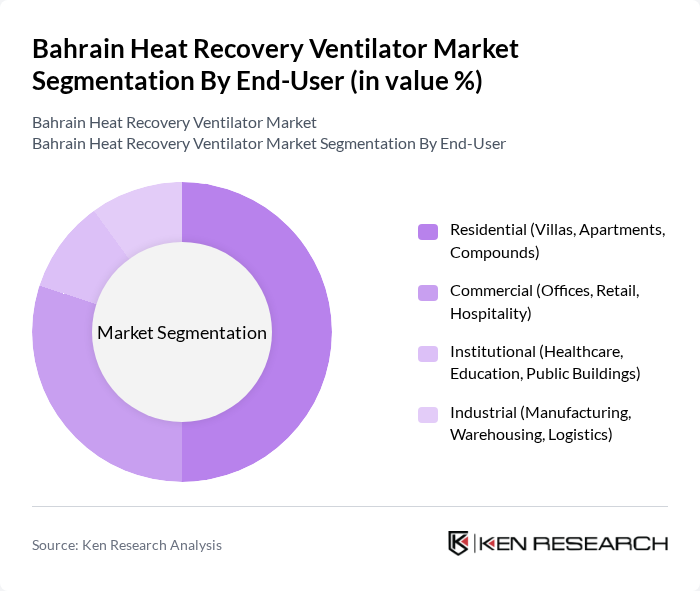
By End-User:The end-user segmentation includes Residential, Commercial, Institutional, and Industrial sectors. Each of these sectors has unique requirements for ventilation systems. The residential segment, particularly villas and apartments, is currently the largest end-user due to the growing trend of energy-efficient homes. The commercial sector follows closely, driven by the need for improved air quality in offices and retail spaces.
The Bahrain Heat Recovery Ventilator Market is characterized by a dynamic mix of regional and international players. Leading participants such as Daikin Middle East & Africa FZE (Daikin Bahrain Channel), Trane Technologies (Trane Middle East – Bahrain Projects), Johnson Controls (York – Johnson Controls Bahrain), Mitsubishi Electric – Cooling & Heating (Middle East), LG Electronics Gulf FZE (LG Air Solutions in Bahrain), Carrier Middle East (Carrier Bahrain), Rheem Manufacturing – Middle East, Zamil Air Conditioners & Home Appliances (Zamil AC), Swegon Group AB, Systemair AB (Systemair Middle East), Greenheck Fan Corporation, Venmar Ventilation / Broan-NuTone, Vent-Axia (Volution Group), Halton Group, and local MEP & HVAC integrators contribute to innovation, geographic expansion, and service delivery in this space.
The Bahrain Heat Recovery Ventilator Market is poised for significant growth as consumer awareness increases and government regulations tighten. In future, the integration of smart technologies in HVAC systems is expected to enhance energy efficiency, attracting more consumers. Additionally, the trend towards sustainable building practices will likely drive demand for heat recovery ventilators, particularly in new residential and commercial projects, creating a favorable environment for market expansion and innovation.
| Segment | Sub-Segments |
|---|---|
| By Type | Heat Recovery Ventilators (HRVs) Energy Recovery Ventilators (ERVs) Combined HRV/ERV Systems Heat Recovery Cores & Modules (for OEM integration) |
| By End-User | Residential (Villas, Apartments, Compounds) Commercial (Offices, Retail, Hospitality) Institutional (Healthcare, Education, Public Buildings) Industrial (Manufacturing, Warehousing, Logistics) |
| By Application | New Green Building Projects (LEED, BREEAM, Estidama-aligned) Standard New Construction Retrofit of Existing HVAC Systems Specialized Applications (Cleanrooms, Data Centers, Labs) |
| By System Configuration | Centralized Air-Handling-Unit-Integrated Systems Decentralized Room-Based Units Packaged Rooftop HRV/ERV Systems Demand-Controlled Ventilation with Heat Recovery |
| By Installation Type | Ducted Ceiling-Mount Systems Wall-Mount / Through-the-Wall Systems Inline Duct HRV/ERV Modules |
| By Maintenance Model | OEM Annual Service Contracts Third-Party Facility Management (FM) Contracts In-House Maintenance |
| By Policy / Compliance Driver | Compliance with Bahrain Building Energy Codes Green Building / Sustainability Certifications Corporate ESG & Net-Zero Commitments Indoor Air Quality (IAQ) & Occupational Health Requirements |
| Scope Item/Segment | Sample Size | Target Respondent Profiles |
|---|---|---|
| Commercial Building Projects | 45 | Project Managers, Building Owners |
| Residential HVAC Installations | 40 | Homeowners, Contractors |
| Industrial Facility Upgrades | 40 | Facility Managers, Operations Directors |
| Energy Efficiency Programs | 45 | Energy Auditors, Sustainability Consultants |
| Government Policy Impact | 40 | Regulatory Officials, Policy Makers |
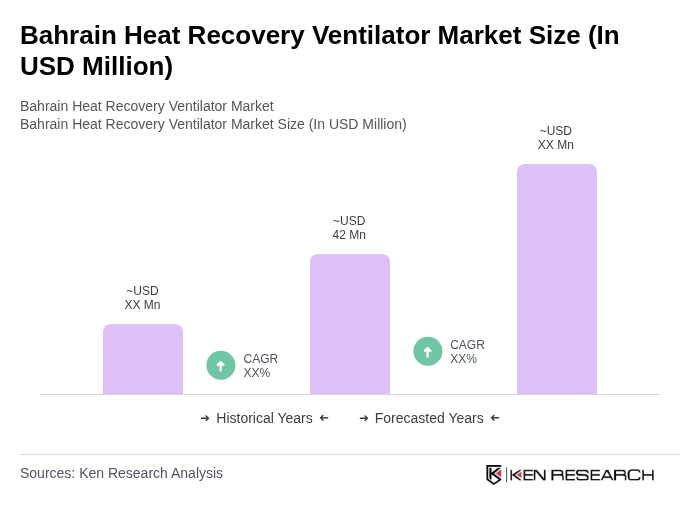
The Bahrain Heat Recovery Ventilator market is valued at approximately USD 42 million, driven by increasing energy efficiency awareness, rising construction activities, and the demand for improved indoor air quality in both residential and commercial buildings.

What makes us stand out is that our consultants follow Robust, Refine and Result (RRR) methodology. Robust for clear definitions, approaches and sanity checking, Refine for differentiating respondents' facts and opinions, and Result for presenting data with story.

We have set a benchmark in the industry by offering our clients with syndicated and customized market research reports featuring coverage of entire market as well as meticulous research and analyst insights.

While we don't replace traditional research, we flip the method upside down. Our dual approach of Top Bottom & Bottom Top ensures quality deliverable by not just verifying company fundamentals but also looking at the sector and macroeconomic factors.

With one step in the future, our research team constantly tries to show you the bigger picture. We help with some of the tough questions you may encounter along the way: How is the industry positioned? Best marketing channel? KPI's of competitors? By aligning every element, we help maximize success.

Our report gives you instant access to the answers and sources that other companies might choose to hide. We elaborate each steps of research methodology we have used and showcase you the sample size to earn your trust.

If you need any support, we are here! We pride ourselves on universe strength, data quality, and quick, friendly, and professional service.













