Ken Research Logo

Bahrain Luxury Cigar Market

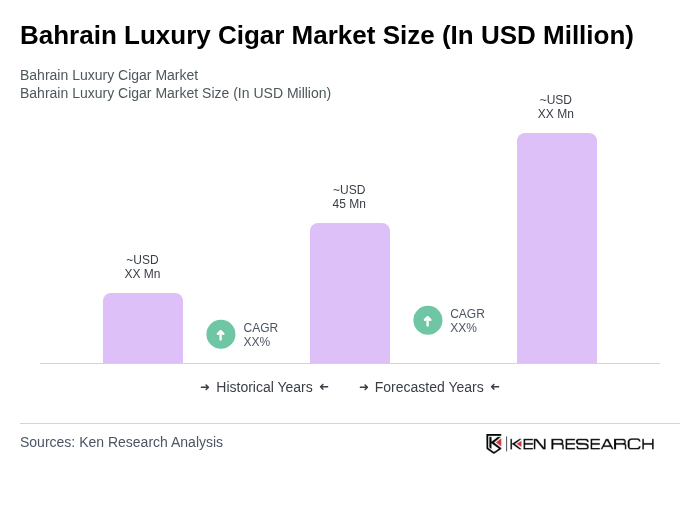
The Bahrain luxury cigar market, valued at USD 45 million, is growing due to increasing disposable incomes, luxury lifestyle trends, and expanding tourism and hospitality sectors.

Region:Middle East

Author(s):Dev

Product Code:KRAD5283

Pages:97

Published On:December 2025
About the Report

Base Year 2024

Bahrain Luxury Cigar Market Overview

  • The Bahrain Luxury Cigar Market is valued at USD 45 million, based on a five-year historical analysis. This growth is primarily driven by the increasing disposable income of consumers, a rising trend in luxury gifting, the growing popularity of cigars among affluent individuals, and demand from tourism and hospitality venues.
  • Key players in this market include Manama, the capital city, which serves as a hub for luxury goods, and other affluent areas such as Riffa and Muharraq. The dominance of these locations is attributed to their high concentration of wealthy individuals and luxury retail outlets, making them prime markets for luxury cigars. Additionally, the presence of high-end hotels and lounges further supports the market's growth.
  • The Bahrain Tobacco Control Law, 2010 issued by the Ministry of Health, governs tobacco products including luxury cigars. This law mandates health warnings on all tobacco packaging, prohibits advertising and promotion, restricts sales to minors under 21, and requires compliance with import licensing and quality standards for consumer safety.
Bahrain Luxury Cigar Market Size

Bahrain Luxury Cigar Market Segmentation

By Type:The market is segmented into various types of cigars, including handmade premium cigars, machine-made cigars, cigarillos, flavored and infused cigars, and limited-edition and special release cigars. Among these, handmade premium cigars dominate the market due to their artisanal quality and the growing preference for unique smoking experiences. Consumers are increasingly drawn to the craftsmanship and exclusivity associated with handmade cigars, which enhances their appeal in the luxury segment.
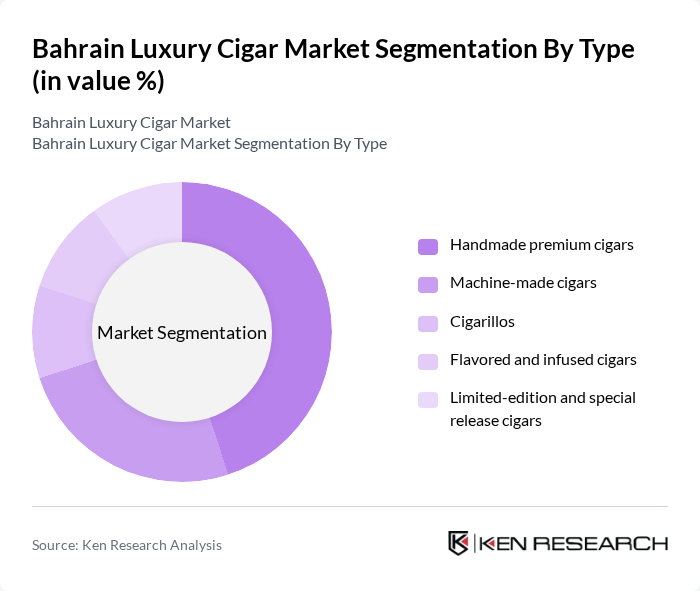
Bahrain Luxury Cigar Market segmentation by Type.

By End-User:The end-user segmentation includes affluent individual consumers, corporate and VIP gifting clients, duty-free and travel retail buyers, hotels, resorts, and fine-dining venues, as well as private clubs and cigar lounges. Affluent individual consumers represent the largest segment, driven by a growing culture of luxury consumption and the desire for premium experiences. This demographic is increasingly investing in high-quality cigars as a status symbol and a means of personal enjoyment.
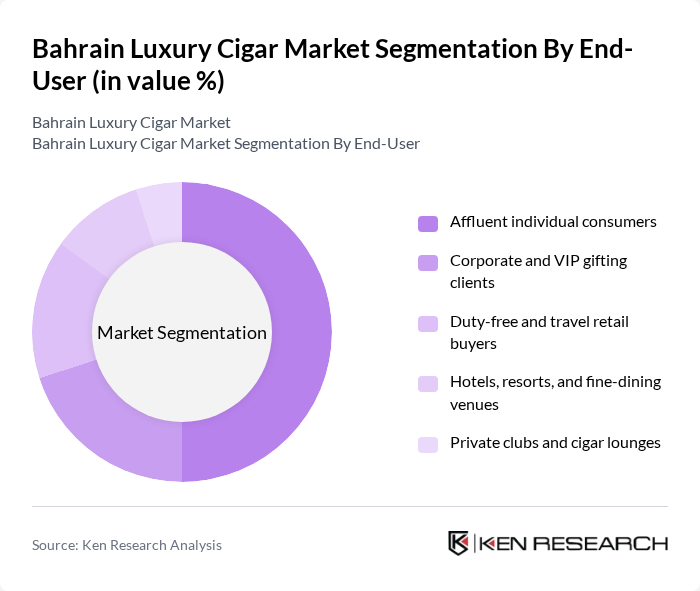
Bahrain Luxury Cigar Market segmentation by End-User.

Bahrain Luxury Cigar Market Competitive Landscape

The Bahrain Luxury Cigar Market is characterized by a dynamic mix of regional and international players. Leading participants such as Habanos S.A. (Cuban cigar brands distributed in Bahrain), Oettinger Davidoff AG (Davidoff and associated brands), Scandinavian Tobacco Group A/S (STG), Imperial Brands PLC (Premium cigar portfolio, incl. Montecristo, Romeo y Julieta via subsidiaries), Plasencia Cigars S.A., Casdagli Cigars (through Luxury Tobacco World WLL in Bahrain), Luxury Tobacco World WLL (Bahrain-based premium cigar distributor and retailer), Bahrain Duty Free Shop Complex B.S.C. (cigar retail operations), Ritz-Carlton Bahrain – Cigar Lounge & retail humidor, The Domain Hotel & Spa – Cigar and whisky lounge, Sheraton Bahrain Hotel – Cigar bar & premium cigar program, Gulf Hotel Bahrain – Cigar lounge and premium cigar offering, Diplomat Radisson Blu Hotel – Cigar lounge and bar, Jumeirah Gulf of Bahrain Resort & Spa – Premium cigar and shisha venues, Four Seasons Hotel Bahrain Bay – High-end lounge with curated cigar selection contribute to innovation, geographic expansion, and service delivery in this space.

Habanos S.A.

1994

Havana, Cuba

Oettinger Davidoff AG

1926

Buchs, Switzerland

Scandinavian Tobacco Group A/S

2008

Copenhagen, Denmark

Imperial Brands PLC

1901

Bristol, United Kingdom

Plasencia Cigars S.A.

1865

Estelí, Nicaragua

Company

Establishment Year

Headquarters

Group size (global, regional, or local operator)

Bahrain luxury cigar revenue and 5-year CAGR

Share of premium and ultra-premium portfolio

Market penetration across key channels (duty-free, hotels, boutiques, online)

Average revenue per user (ARPU) / ticket size

Gross margin and indicative price positioning

Bahrain Luxury Cigar Market Industry Analysis

Growth Drivers

  • Increasing Disposable Income Among Consumers:The average disposable income in Bahrain is projected to reach approximately BHD 1,600 per month in future, reflecting a 5% increase from the previous period. This rise in disposable income allows consumers to allocate more funds towards luxury products, including premium cigars. As more individuals enter higher income brackets, the demand for luxury cigars is expected to grow, driven by a willingness to spend on high-quality, indulgent experiences.
  • Rising Interest in Luxury Lifestyle Products:The luxury goods market in Bahrain is anticipated to grow by 6% annually, with luxury cigars being a significant segment. This trend is fueled by a cultural shift towards luxury consumption, particularly among affluent consumers who seek unique and high-end products. The increasing number of luxury events and social gatherings further promotes the consumption of premium cigars, enhancing their status as symbols of wealth and sophistication.
  • Growth of Tourism and Hospitality Sectors:Bahrain's tourism sector is expected to welcome over 13 million visitors in future, a 10% increase from the previous period. This influx of tourists, particularly from affluent markets, boosts the demand for luxury products, including cigars. The expansion of high-end hotels and resorts, which often feature cigar lounges, creates an environment conducive to cigar consumption, thereby driving market growth in the luxury cigar segment.

Market Challenges

  • Stringent Regulations on Tobacco Products:Bahrain has implemented strict regulations on tobacco advertising and sales, which can hinder market growth. The government enforces a ban on advertising tobacco products, limiting brand visibility and consumer engagement. Additionally, compliance with health regulations requires significant investment from companies, which can deter new entrants and restrict the overall growth of the luxury cigar market.
  • High Taxation on Luxury Goods:The taxation on luxury goods, including cigars, is notably high in Bahrain, with excise taxes on tobacco products set at 100% of the selective excise tax base price. This high tax burden can lead to increased retail prices, potentially reducing consumer demand. As consumers become more price-sensitive, the luxury cigar market may face challenges in maintaining sales volumes, particularly among middle-income consumers who may opt for more affordable alternatives.

Bahrain Luxury Cigar Market Future Outlook

The Bahrain luxury cigar market is poised for growth, driven by increasing disposable incomes and a burgeoning interest in luxury lifestyle products. As tourism continues to rise, the demand for premium cigars is expected to expand, particularly in upscale hospitality venues. However, challenges such as stringent regulations and high taxation may temper growth. Companies that adapt to these challenges while leveraging emerging trends, such as online retail and personalized experiences, will likely thrive in this evolving market landscape.

Market Opportunities

  • Emergence of Online Retail Platforms:The growth of e-commerce in Bahrain presents a significant opportunity for luxury cigar brands. With online sales projected to increase by 15% in future, companies can reach a broader audience, including younger consumers who prefer digital shopping. This shift allows for innovative marketing strategies and personalized customer experiences, enhancing brand loyalty and sales.
  • Collaborations with Luxury Brands:Strategic partnerships with established luxury brands can enhance market presence and credibility. Collaborations can lead to co-branded products and exclusive offerings, appealing to affluent consumers. Such partnerships can also facilitate entry into new markets, leveraging the existing customer base of luxury brands to drive cigar sales and brand recognition.

Scope of the Report

SegmentSub-Segments
By Type

Handmade premium cigars

Machine-made cigars

Cigarillos

Flavored and infused cigars

Limited-edition and special release cigars

By End-User

Affluent individual consumers

Corporate and VIP gifting clients

Duty-free and travel retail buyers

Hotels, resorts, and fine-dining venues

Private clubs and cigar lounges

By Occasion

Weddings and family celebrations

Corporate and business networking events

Leisure and personal enjoyment

Tourism and hospitality experiences

Festive seasons and special gifting

By Packaging Type

Wooden and luxury presentation boxes

Bundles and cabinet packs

Tubes and single-stick packaging

Sampler packs and gift sets

By Distribution Channel

Airport and seaport duty-free shops

Specialty cigar and tobacco boutiques

Luxury hotels, lounges, and clubs

Online and e-commerce platforms

Supermarkets, hypermarkets, and other retail

By Price Range

Ultra-premium (above BHD 10 per stick)

Premium (BHD 5–10 per stick)

Mid-range (BHD 2–5 per stick)

Entry-level premium (below BHD 2 per stick)

By Brand Origin

Cuban brands

Dominican Republic brands

Nicaraguan and Honduran brands

Other international brands

Key Target Audience

Investors and Venture Capitalist Firms

Government and Regulatory Bodies (e.g., Bahrain Ministry of Health, Bahrain Economic Development Board)

Luxury Cigar Manufacturers and Producers

Distributors and Retailers of Luxury Goods

Hospitality Industry Stakeholders (e.g., Luxury Hotels and Resorts)

Cigar Lounge Owners and Operators

Importers and Exporters of Tobacco Products

Luxury Goods Market Analysts

Players Mentioned in the Report:

Habanos S.A. (Cuban cigar brands distributed in Bahrain)

Oettinger Davidoff AG (Davidoff and associated brands)

Scandinavian Tobacco Group A/S (STG)

Imperial Brands PLC (Premium cigar portfolio, incl. Montecristo, Romeo y Julieta via subsidiaries)

Plasencia Cigars S.A.

Casdagli Cigars (through Luxury Tobacco World WLL in Bahrain)

Luxury Tobacco World WLL (Bahrain-based premium cigar distributor and retailer)

Bahrain Duty Free Shop Complex B.S.C. (cigar retail operations)

Ritz-Carlton Bahrain Cigar Lounge & retail humidor

The Domain Hotel & Spa Cigar and whisky lounge

Sheraton Bahrain Hotel Cigar bar & premium cigar program

Gulf Hotel Bahrain Cigar lounge and premium cigar offering

Diplomat Radisson Blu Hotel Cigar lounge and bar

Jumeirah Gulf of Bahrain Resort & Spa Premium cigar and shisha venues

Four Seasons Hotel Bahrain Bay High-end lounge with curated cigar selection

Table of Contents

Market Assessment Phase

1. Executive Summary and Approach


2. Bahrain Luxury Cigar Market Overview

2.1 Key Insights and Strategic Recommendations

2.2 Bahrain Luxury Cigar Market Overview

2.3 Definition and Scope

2.4 Evolution of Market Ecosystem

2.5 Timeline of Key Regulatory Milestones

2.6 Value Chain & Stakeholder Mapping

2.7 Business Cycle Analysis

2.8 Policy & Incentive Landscape


3. Bahrain Luxury Cigar Market Analysis

3.1 Growth Drivers

3.1.1 Increasing disposable income among consumers
3.1.2 Rising interest in luxury lifestyle products
3.1.3 Growth of tourism and hospitality sectors
3.1.4 Expansion of premium retail outlets

3.2 Market Challenges

3.2.1 Stringent regulations on tobacco products
3.2.2 High taxation on luxury goods
3.2.3 Limited local production capabilities
3.2.4 Competition from alternative smoking products

3.3 Market Opportunities

3.3.1 Emergence of online retail platforms
3.3.2 Collaborations with luxury brands
3.3.3 Growing demand for personalized cigar experiences
3.3.4 Expansion into regional markets

3.4 Market Trends

3.4.1 Increasing popularity of limited edition cigars
3.4.2 Rise of cigar lounges and clubs
3.4.3 Shift towards organic and natural tobacco products
3.4.4 Enhanced focus on sustainability in production

3.5 Government Regulation

3.5.1 Restrictions on advertising tobacco products
3.5.2 Mandatory health warnings on packaging
3.5.3 Licensing requirements for retailers
3.5.4 Import regulations for luxury cigars

4. SWOT Analysis


5. Stakeholder Analysis


6. Porter's Five Forces Analysis


7. Bahrain Luxury Cigar Market Market Size, 2019-2024

7.1 By Value

7.2 By Volume

7.3 By Average Selling Price


8. Bahrain Luxury Cigar Market Segmentation

8.1 By Type

8.1.1 Handmade premium cigars
8.1.2 Machine-made cigars
8.1.3 Cigarillos
8.1.4 Flavored and infused cigars
8.1.5 Limited-edition and special release cigars

8.2 By End-User

8.2.1 Affluent individual consumers
8.2.2 Corporate and VIP gifting clients
8.2.3 Duty-free and travel retail buyers
8.2.4 Hotels, resorts, and fine-dining venues
8.2.5 Private clubs and cigar lounges

8.3 By Occasion

8.3.1 Weddings and family celebrations
8.3.2 Corporate and business networking events
8.3.3 Leisure and personal enjoyment
8.3.4 Tourism and hospitality experiences
8.3.5 Festive seasons and special gifting

8.4 By Packaging Type

8.4.1 Wooden and luxury presentation boxes
8.4.2 Bundles and cabinet packs
8.4.3 Tubes and single-stick packaging
8.4.4 Sampler packs and gift sets

8.5 By Distribution Channel

8.5.1 Airport and seaport duty-free shops
8.5.2 Specialty cigar and tobacco boutiques
8.5.3 Luxury hotels, lounges, and clubs
8.5.4 Online and e-commerce platforms
8.5.5 Supermarkets, hypermarkets, and other retail

8.6 By Price Range

8.6.1 Ultra-premium (above BHD 10 per stick)
8.6.2 Premium (BHD 5–10 per stick)
8.6.3 Mid-range (BHD 2–5 per stick)
8.6.4 Entry-level premium (below BHD 2 per stick)

8.7 By Brand Origin

8.7.1 Cuban brands
8.7.2 Dominican Republic brands
8.7.3 Nicaraguan and Honduran brands
8.7.4 Other international brands

9. Bahrain Luxury Cigar Market Competitive Analysis

9.1 Market Share of Key Players

9.2 Cross Comparison of Key Players

9.2.1 Company name and ownership structure
9.2.2 Group size (global, regional, or local operator)
9.2.3 Bahrain luxury cigar revenue and 5-year CAGR
9.2.4 Share of premium and ultra-premium portfolio
9.2.5 Market penetration across key channels (duty-free, hotels, boutiques, online)
9.2.6 Average revenue per user (ARPU) / ticket size
9.2.7 Gross margin and indicative price positioning
9.2.8 Brand awareness and positioning among affluent consumers
9.2.9 Breadth and depth of distribution network in Bahrain
9.2.10 New product launch frequency and exclusive release activity

9.3 SWOT Analysis of Top Players

9.4 Pricing Analysis

9.5 Detailed Profile of Major Companies

9.5.1 Habanos S.A. (Cuban cigar brands distributed in Bahrain)
9.5.2 Oettinger Davidoff AG (Davidoff and associated brands)
9.5.3 Scandinavian Tobacco Group A/S (STG)
9.5.4 Imperial Brands PLC (Premium cigar portfolio, incl. Montecristo, Romeo y Julieta via subsidiaries)
9.5.5 Plasencia Cigars S.A.
9.5.6 Casdagli Cigars (through Luxury Tobacco World WLL in Bahrain)
9.5.7 Luxury Tobacco World WLL (Bahrain-based premium cigar distributor and retailer)
9.5.8 Bahrain Duty Free Shop Complex B.S.C. (cigar retail operations)
9.5.9 Ritz-Carlton Bahrain – Cigar Lounge & retail humidor
9.5.10 The Domain Hotel & Spa – Cigar and whisky lounge
9.5.11 Sheraton Bahrain Hotel – Cigar bar & premium cigar program
9.5.12 Gulf Hotel Bahrain – Cigar lounge and premium cigar offering
9.5.13 Diplomat Radisson Blu Hotel – Cigar lounge and bar
9.5.14 Jumeirah Gulf of Bahrain Resort & Spa – Premium cigar and shisha venues
9.5.15 Four Seasons Hotel Bahrain Bay – High-end lounge with curated cigar selection

10. Bahrain Luxury Cigar Market End-User Analysis

10.1 Procurement Behavior of Key Ministries

10.1.1 Ministry of Finance
10.1.2 Ministry of Industry and Commerce
10.1.3 Ministry of Health
10.1.4 Ministry of Tourism

10.2 Corporate Spend on Infrastructure & Energy

10.2.1 Corporate events
10.2.2 Hospitality investments
10.2.3 Retail expansion
10.2.4 Marketing and promotions

10.3 Pain Point Analysis by End-User Category

10.3.1 Regulatory compliance
10.3.2 Supply chain disruptions
10.3.3 Quality assurance
10.3.4 Pricing volatility

10.4 User Readiness for Adoption

10.4.1 Awareness of luxury cigars
10.4.2 Accessibility of products
10.4.3 Consumer education
10.4.4 Brand loyalty

10.5 Post-Deployment ROI and Use Case Expansion

10.5.1 Customer feedback mechanisms
10.5.2 Repeat purchase rates
10.5.3 Market expansion opportunities
10.5.4 Brand partnerships

11. Bahrain Luxury Cigar Market Future Size, 2025-2030

11.1 By Value

11.2 By Volume

11.3 By Average Selling Price


Go-To-Market Strategy Phase

1. Whitespace Analysis + Business Model Canvas

1.1 Market gaps identification

1.2 Value proposition development

1.3 Revenue model exploration

1.4 Customer segmentation analysis

1.5 Competitive landscape assessment

1.6 Key partnerships identification

1.7 Cost structure analysis


2. Marketing and Positioning Recommendations

2.1 Branding strategies

2.2 Product USPs

2.3 Target audience definition

2.4 Marketing channels selection

2.5 Promotional tactics


3. Distribution Plan

3.1 Urban retail vs rural NGO tie-ups

3.2 Distribution channel optimization

3.3 Logistics and supply chain management

3.4 Partnership with distributors


4. Channel & Pricing Gaps

4.1 Underserved routes

4.2 Pricing bands

4.3 Competitive pricing analysis

4.4 Value-based pricing strategies


5. Unmet Demand & Latent Needs

5.1 Category gaps

5.2 Consumer segments

5.3 Product development opportunities

5.4 Market entry strategies


6. Customer Relationship

6.1 Loyalty programs

6.2 After-sales service

6.3 Customer engagement strategies

6.4 Feedback and improvement mechanisms


7. Value Proposition

7.1 Sustainability

7.2 Integrated supply chains

7.3 Unique selling propositions

7.4 Customer-centric approaches


8. Key Activities

8.1 Regulatory compliance

8.2 Branding

8.3 Distribution setup

8.4 Marketing execution


9. Entry Strategy Evaluation

9.1 Domestic Market Entry Strategy

9.1.1 Product mix
9.1.2 Pricing band
9.1.3 Packaging

9.2 Export Entry Strategy

9.2.1 Target countries
9.2.2 Compliance roadmap

10. Entry Mode Assessment

10.1 JV

10.2 Greenfield

10.3 M&A

10.4 Distributor Model


11. Capital and Timeline Estimation

11.1 Capital requirements

11.2 Timelines


12. Control vs Risk Trade-Off

12.1 Ownership vs Partnerships


13. Profitability Outlook

13.1 Breakeven analysis

13.2 Long-term sustainability


14. Potential Partner List

14.1 Distributors

14.2 JVs

14.3 Acquisition targets


15. Execution Roadmap

15.1 Phased Plan for Market Entry

15.1.1 Market Setup
15.1.2 Market Entry
15.1.3 Growth Acceleration
15.1.4 Scale & Stabilize

15.2 Key Activities and Milestones

15.2.1 Activity timelines
15.2.2 Milestone tracking

Research Methodology

ApproachModellingSample

Phase 1: Approach1

Desk Research

  • Market reports from industry associations and trade publications focused on luxury goods
  • Government publications and trade statistics related to tobacco and luxury markets in Bahrain
  • Academic journals and white papers analyzing consumer behavior in the luxury cigar segment

Primary Research

  • Interviews with luxury cigar retailers and distributors in Bahrain
  • Surveys targeting affluent consumers to understand purchasing preferences and trends
  • Field visits to cigar lounges and specialty shops to observe customer interactions and product offerings

Validation & Triangulation

  • Cross-validation of findings with multiple data sources, including sales data and consumer surveys
  • Triangulation of insights from retailers, consumers, and market analysts
  • Sanity checks through expert panel discussions with industry veterans and market researchers

Phase 2: Market Size Estimation1

Top-down Assessment

  • Analysis of overall luxury goods market size in Bahrain to estimate the cigar segment
  • Segmentation of the market by demographics, including age, income, and lifestyle factors
  • Incorporation of tourism data to assess the impact of international visitors on luxury cigar sales

Bottom-up Modeling

  • Volume estimates based on sales data from leading luxury cigar retailers
  • Price point analysis to determine average spending per consumer on luxury cigars
  • Estimation of market penetration rates among affluent consumers in Bahrain

Forecasting & Scenario Analysis

  • Multi-factor regression analysis incorporating economic indicators and consumer spending trends
  • Scenario modeling based on potential changes in regulations affecting tobacco sales
  • Baseline, optimistic, and pessimistic forecasts for market growth through 2030

Phase 3: CATI Sample Composition1

Scope Item/SegmentSample SizeTarget Respondent Profiles
Luxury Cigar Retailers40Store Owners, Sales Managers
Affluent Consumers150High-Income Individuals, Luxury Lifestyle Enthusiasts
Cigar Lounge Operators40Managers, Event Coordinators
Importers and Distributors40Supply Chain Managers, Business Development Executives
Market Analysts and Experts30Industry Analysts, Economic Researchers

Frequently Asked Questions

What is the current value of the Bahrain Luxury Cigar Market?

The Bahrain Luxury Cigar Market is valued at approximately USD 45 million, reflecting a five-year historical analysis. This growth is driven by increasing disposable incomes, luxury gifting trends, and demand from tourism and hospitality sectors.

What factors are driving the growth of the luxury cigar market in Bahrain?

Which locations in Bahrain are prominent for luxury cigar sales?

What types of cigars dominate the Bahrain Luxury Cigar Market?

Other Regional/Country Reports

Indonesia Luxury Cigar Market

Malaysia Luxury Cigar Market

KSA Luxury Cigar Market

APAC Luxury Cigar Market

SEA Luxury Cigar Market

Vietnam Luxury Cigar Market

Other Adjacent Reports

Germany Premium Spirits Market

Egypt Luxury Accessories Market

Germany Fine Wine Market

South Korea High-End Hospitality Market

GCC Duty-Free Retail Market Size, Share, Growth Drivers, Trends, Opportunities & Forecast 2025–2030

Oman Luxury Gifting Market

Japan Tobacco Accessories Market

Philippines Premium Smoking Products Market

Malaysia Luxury Lifestyle Products Market

Belgium Fine Dining Market

Why Buy From Us?

Refine Robust Result (RRR) Framework

What makes us stand out is that our consultants follow Robust, Refine and Result (RRR) methodology. Robust for clear definitions, approaches and sanity checking, Refine for differentiating respondents' facts and opinions, and Result for presenting data with story.

Our Reach Is Unmatched

We have set a benchmark in the industry by offering our clients with syndicated and customized market research reports featuring coverage of entire market as well as meticulous research and analyst insights.

Shifting the Research Paradigm

While we don't replace traditional research, we flip the method upside down. Our dual approach of Top Bottom & Bottom Top ensures quality deliverable by not just verifying company fundamentals but also looking at the sector and macroeconomic factors.

More Insights-Better Decisions

With one step in the future, our research team constantly tries to show you the bigger picture. We help with some of the tough questions you may encounter along the way: How is the industry positioned? Best marketing channel? KPI's of competitors? By aligning every element, we help maximize success.

Transparency and Trust

Our report gives you instant access to the answers and sources that other companies might choose to hide. We elaborate each steps of research methodology we have used and showcase you the sample size to earn your trust.

Round the Clock Support

If you need any support, we are here! We pride ourselves on universe strength, data quality, and quick, friendly, and professional service.

Why Clients Choose Us?

400000+
Reports in repository
150+
Consulting projects a year
100+
Analysts
8000+
Client Queries in 2022








