About the Report
Base Year 2024Bahrain Micro-Investing Apps Market Overview
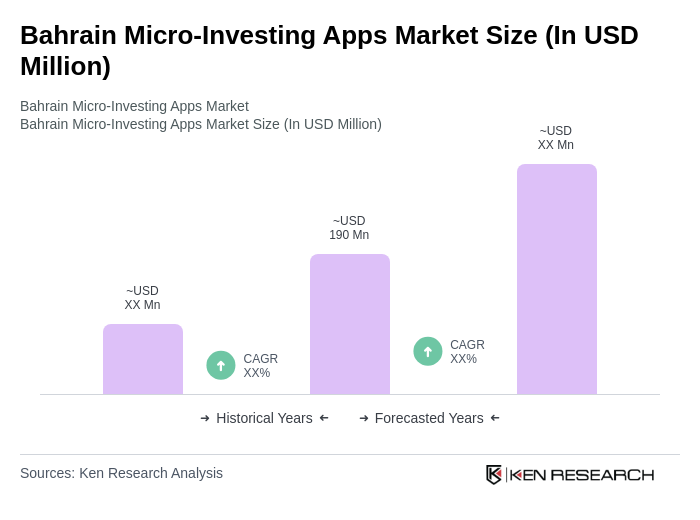
- The Bahrain Micro-Investing Apps Market is valued at USD 190 million, based on a five-year analysis of digital investment transaction values and regional market share estimates. Market expansion is primarily driven by the rapid adoption of digital financial services, increasing smartphone and internet penetration, and a surge in investment activity among younger demographics. The proliferation of user-friendly, low-minimum platforms has further enabled first-time and novice investors to participate in micro-investing, reflecting broader trends in digital financial inclusion and fintech adoption .
- Key market activity is concentrated in Manama, Bahrain’s capital and principal financial hub, as well as urban centers such as Muharraq and Riffa. These cities lead due to their high population density, robust economic activity, and the presence of major financial institutions and fintech startups. The high concentration of digitally literate youth and professionals in these areas further accelerates the uptake of micro-investing platforms .
- The Central Bank of Bahrain issued the “Digital Financial Advice (Robo-Advice) Module” under the CBB Rulebook Volume 5 in 2023. This regulation mandates that micro-investing and robo-advisory platforms provide transparent disclosures on fees, risks, and investment strategies, and comply with fit-and-proper requirements for management. The regulation covers licensing, operational standards, and consumer protection measures, aiming to foster trust and transparency in Bahrain’s digital investment ecosystem .
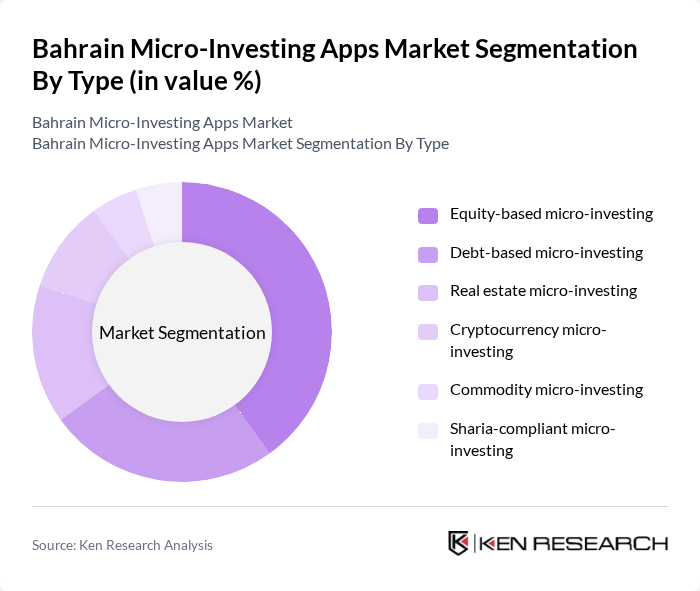
Bahrain Micro-Investing Apps Market Segmentation
By Type:The micro-investing apps market in Bahrain is segmented into equity-based, debt-based, real estate, cryptocurrency, commodity, and Sharia-compliant micro-investing. Equity-based micro-investing holds the largest share, supported by growing interest in stock markets and the accessibility of fractional shares. Debt-based micro-investing is gaining traction, particularly among users seeking stable, fixed-income returns. Demand for Sharia-compliant investment options remains significant, reflecting the cultural and religious investment preferences prevalent in Bahrain .
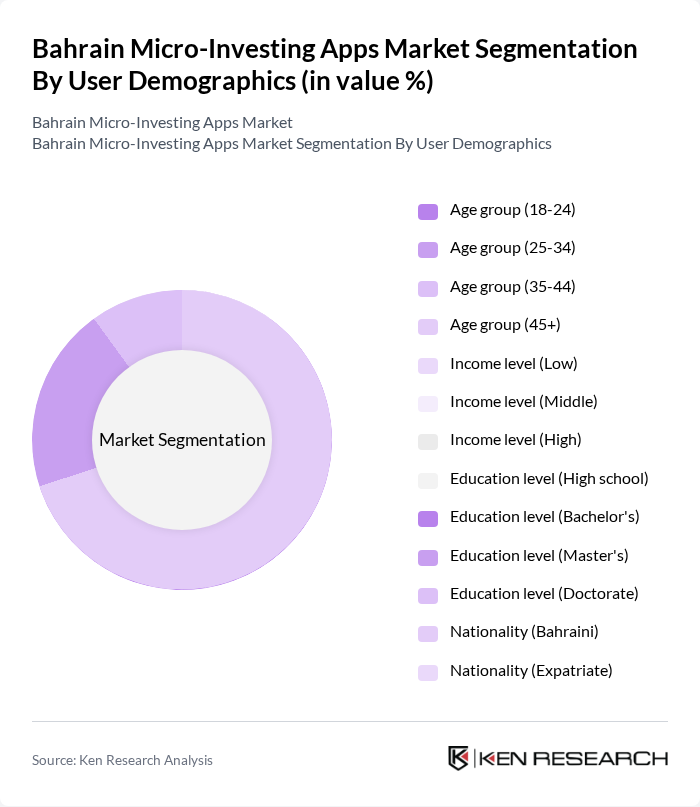
By User Demographics:User demographics for micro-investing apps in Bahrain include age, income, education, and nationality. The 25-34 age group is the most active, reflecting a tech-savvy, investment-oriented segment. Middle-income earners constitute the majority of users, seeking to build wealth through accessible investment tools. Individuals with a Bachelor’s degree are overrepresented among users, indicating a link between higher education and financial literacy. Bahraini nationals form the largest user group, with expatriates also participating significantly .
Bahrain Micro-Investing Apps Market Competitive Landscape
The Bahrain Micro-Investing Apps Market is characterized by a dynamic mix of regional and international players. Leading participants such as Trading 212, Interactive Brokers, XTB, MEXEM, tastytrade, TradeStation Global, EasyEquities, Zacks Trade, Tradier, CapTrader, Al Baraka Banking Group, Bahrain Islamic Bank, Gulf International Bank, Bank of Bahrain and Kuwait, Khaleeji Commercial Bank, Bahrain Investment Market, Al Salam Bank, SICO BSC, Bahrain Financial Exchange contribute to innovation, geographic expansion, and service delivery in this space.
Bahrain Micro-Investing Apps Market Industry Analysis
Growth Drivers
- Increasing Smartphone Penetration:As of future, Bahrain's smartphone penetration rate is projected to reach 97%, with approximately 1.7 million smartphone users. This widespread access to mobile technology facilitates the adoption of micro-investing apps, allowing users to manage investments conveniently. The World Bank reports that mobile internet subscriptions in Bahrain have increased by 10% annually, indicating a strong trend towards digital financial solutions that cater to the tech-savvy population.
- Rising Financial Literacy Among Youth:The financial literacy rate among Bahraini youth has improved significantly, with 65% of individuals aged 18-30 demonstrating basic financial knowledge as of future. This demographic shift is crucial, as young investors are increasingly seeking low-cost investment options. The Central Bank of Bahrain has initiated programs to enhance financial education, contributing to a more informed investor base that is eager to engage with micro-investing platforms.
- Demand for Low-Cost Investment Options:In future, the average Bahraini household income is estimated at BHD 1,300 per month, with many individuals seeking affordable investment avenues. Micro-investing apps, which allow users to start investing with as little as BHD 10, cater to this demand. The growing trend of budget-conscious investing is supported by a 15% increase in users opting for low-cost platforms, reflecting a shift in investment behavior towards accessibility and affordability.
Market Challenges
- Regulatory Compliance Issues:The micro-investing sector in Bahrain faces significant regulatory hurdles, with over 25% of fintech startups reporting difficulties in meeting compliance requirements. The Central Bank of Bahrain has stringent licensing regulations that can delay market entry for new apps. This regulatory landscape can stifle innovation and deter potential investors, as companies navigate complex legal frameworks that require substantial resources to address.
- Limited Awareness of Micro-Investing:Despite the growth potential, awareness of micro-investing remains low, with only 30% of the population familiar with the concept as of future. This lack of understanding poses a barrier to market penetration, as many potential users are unaware of the benefits and functionalities of micro-investing apps. Educational initiatives are essential to bridge this gap and encourage broader adoption among the general public.
Bahrain Micro-Investing Apps Market Future Outlook
The future of the micro-investing apps market in Bahrain appears promising, driven by technological advancements and a growing appetite for investment among younger demographics. As fintech partnerships expand, innovative solutions will emerge, enhancing user experience and accessibility. Additionally, the integration of educational content within apps will empower users, fostering a culture of informed investing. These trends indicate a robust growth trajectory, positioning Bahrain as a key player in the micro-investing landscape in the region.
Market Opportunities
- Expansion of Fintech Partnerships:Collaborations between micro-investing apps and established financial institutions can enhance credibility and user trust. By leveraging existing customer bases, these partnerships can drive user acquisition, potentially increasing the number of active users by 35% within two years, according to industry forecasts.
- Development of Educational Content for Users:Creating targeted educational resources can significantly improve user engagement and retention. By offering tutorials and investment guides, apps can increase user knowledge and confidence, potentially boosting user retention rates by 30% as users become more informed about investment strategies and market dynamics.
Scope of the Report
| Segment | Sub-Segments |
|---|---|
| By Type | Equity-based micro-investing Debt-based micro-investing Real estate micro-investing Cryptocurrency micro-investing Commodity micro-investing Sharia-compliant micro-investing |
| By User Demographics | Age group (18-24, 25-34, 35-44, 45+) Income level (Low, Middle, High) Education level (High school, Bachelor's, Master's, Doctorate) Nationality (Bahraini, Expatriate) |
| By Investment Amount | Less than $10 $10 - $50 $51 - $100 Above $100 |
| By Investment Duration | Short-term (less than 1 year) Medium-term (1-3 years) Long-term (more than 3 years) |
| By Platform Type | Mobile applications Web-based platforms Hybrid platforms |
| By Marketing Channel | Social media marketing Influencer partnerships Content marketing Digital advertising |
| By Geographic Focus | Urban areas Rural areas Expat communities Others |
Key Target Audience
Investors and Venture Capitalist Firms
Government and Regulatory Bodies (e.g., Central Bank of Bahrain, Bahrain Economic Development Board)
Financial Technology Startups
Mobile Application Developers
Payment Processing Companies
Wealth Management Firms
Insurance Companies
Retail Banks
Players Mentioned in the Report:
Trading 212
Interactive Brokers
XTB
MEXEM
tastytrade
TradeStation Global
EasyEquities
Zacks Trade
Tradier
CapTrader
Al Baraka Banking Group
Bahrain Islamic Bank
Gulf International Bank
Bank of Bahrain and Kuwait
Khaleeji Commercial Bank
Bahrain Investment Market
Al Salam Bank
SICO BSC
Bahrain Financial Exchange
Table of Contents
Market Assessment Phase
1. Executive Summary and Approach
2. Bahrain Micro-Investing Apps Market Overview
2.1 Key Insights and Strategic Recommendations
2.2 Bahrain Micro-Investing Apps Market Overview
2.3 Definition and Scope
2.4 Evolution of Market Ecosystem
2.5 Timeline of Key Regulatory Milestones
2.6 Value Chain & Stakeholder Mapping
2.7 Business Cycle Analysis
2.8 Policy & Incentive Landscape
3. Bahrain Micro-Investing Apps Market Analysis
3.1 Growth Drivers
3.1.1 Increasing smartphone penetration
3.1.2 Rising financial literacy among youth
3.1.3 Demand for low-cost investment options
3.1.4 Growth of digital payment systems
3.2 Market Challenges
3.2.1 Regulatory compliance issues
3.2.2 Limited awareness of micro-investing
3.2.3 Competition from traditional investment platforms
3.2.4 Economic fluctuations affecting disposable income
3.3 Market Opportunities
3.3.1 Expansion of fintech partnerships
3.3.2 Development of educational content for users
3.3.3 Introduction of gamified investing experiences
3.3.4 Targeting niche markets (e.g., women investors)
3.4 Market Trends
3.4.1 Increasing use of AI in investment recommendations
3.4.2 Growth of socially responsible investing
3.4.3 Rise of subscription-based investment models
3.4.4 Integration of social media in investment platforms
3.5 Government Regulation
3.5.1 Licensing requirements for fintech companies
3.5.2 Consumer protection regulations
3.5.3 Anti-money laundering (AML) compliance
3.5.4 Data privacy laws affecting user information
4. SWOT Analysis
5. Stakeholder Analysis
6. Porter's Five Forces Analysis
7. Bahrain Micro-Investing Apps Market Market Size, 2019-2024
7.1 By Value
7.2 By Volume
7.3 By Average Selling Price
8. Bahrain Micro-Investing Apps Market Segmentation
8.1 By Type
8.1.1 Equity-based micro-investing
8.1.2 Debt-based micro-investing
8.1.3 Real estate micro-investing
8.1.4 Cryptocurrency micro-investing
8.1.5 Commodity micro-investing
8.1.6 Sharia-compliant micro-investing
8.2 By User Demographics
8.2.1 Age group (18-24, 25-34, 35-44, 45+)
8.2.2 Income level (Low, Middle, High)
8.2.3 Education level (High school, Bachelor's, Master's, Doctorate)
8.2.4 Nationality (Bahraini, Expatriate)
8.3 By Investment Amount
8.3.1 Less than $10
8.3.2 $10 - $50
8.3.3 $51 - $100
8.3.4 Above $100
8.4 By Investment Duration
8.4.1 Short-term (less than 1 year)
8.4.2 Medium-term (1-3 years)
8.4.3 Long-term (more than 3 years)
8.5 By Platform Type
8.5.1 Mobile applications
8.5.2 Web-based platforms
8.5.3 Hybrid platforms
8.6 By Marketing Channel
8.6.1 Social media marketing
8.6.2 Influencer partnerships
8.6.3 Content marketing
8.6.4 Digital advertising
8.7 By Geographic Focus
8.7.1 Urban areas
8.7.2 Rural areas
8.7.3 Expat communities
8.7.4 Others
9. Bahrain Micro-Investing Apps Market Competitive Analysis
9.1 Market Share of Key Players
9.2 Cross Comparison of Key Players
9.2.1 Company Name
9.2.2 Group Size (Large, Medium, or Small as per industry convention)
9.2.3 Number of Active Users
9.2.4 User Growth Rate
9.2.5 Customer Acquisition Cost (CAC)
9.2.6 Average Revenue Per User (ARPU)
9.2.7 Assets Under Management (AUM)
9.2.8 Churn Rate
9.2.9 Customer Lifetime Value (CLV)
9.2.10 Pricing Strategy
9.2.11 Market Penetration Rate
9.2.12 Return on Investment (ROI)
9.2.13 Availability of Fractional Shares
9.2.14 Minimum Deposit Requirement
9.2.15 Platform Security & Regulatory Compliance
9.3 SWOT Analysis of Top Players
9.4 Pricing Analysis
9.5 Detailed Profile of Major Companies
9.5.1 Trading 212
9.5.2 Interactive Brokers
9.5.3 XTB
9.5.4 MEXEM
9.5.5 tastytrade
9.5.6 TradeStation Global
9.5.7 EasyEquities
9.5.8 Zacks Trade
9.5.9 Tradier
9.5.10 CapTrader
9.5.11 Al Baraka Banking Group
9.5.12 Bahrain Islamic Bank
9.5.13 Gulf International Bank
9.5.14 Bank of Bahrain and Kuwait
9.5.15 Khaleeji Commercial Bank
9.5.16 Bahrain Investment Market
9.5.17 Al Salam Bank
9.5.18 SICO BSC
9.5.19 Bahrain Financial Exchange
10. Bahrain Micro-Investing Apps Market End-User Analysis
10.1 Procurement Behavior of Key Ministries
10.1.1 Investment in financial literacy programs
10.1.2 Adoption of digital financial solutions
10.1.3 Collaboration with fintech startups
10.2 Corporate Spend on Infrastructure & Energy
10.2.1 Budget allocation for technology upgrades
10.2.2 Investment in employee financial wellness
10.3 Pain Point Analysis by End-User Category
10.3.1 Lack of trust in digital platforms
10.3.2 Complexity of investment options
10.4 User Readiness for Adoption
10.4.1 Familiarity with mobile banking
10.4.2 Attitude towards risk-taking
10.5 Post-Deployment ROI and Use Case Expansion
10.5.1 Measurement of user engagement
10.5.2 Analysis of investment performance
11. Bahrain Micro-Investing Apps Market Future Size, 2025-2030
11.1 By Value
11.2 By Volume
11.3 By Average Selling Price
Go-To-Market Strategy Phase
1. Whitespace Analysis + Business Model Canvas
1.1 Market gaps identification
1.2 Value proposition development
1.3 Revenue stream analysis
1.4 Customer segment targeting
1.5 Key partnerships exploration
1.6 Cost structure evaluation
1.7 Channels for delivery
2. Marketing and Positioning Recommendations
2.1 Branding strategies
2.2 Product USPs
3. Distribution Plan
3.1 Urban retail vs rural NGO tie-ups
4. Channel & Pricing Gaps
4.1 Underserved routes
4.2 Pricing bands
5. Unmet Demand & Latent Needs
5.1 Category gaps
5.2 Consumer segments
6. Customer Relationship
6.1 Loyalty programs
6.2 After-sales service
7. Value Proposition
7.1 Sustainability
7.2 Integrated supply chains
8. Key Activities
8.1 Regulatory compliance
8.2 Branding
8.3 Distribution setup
9. Entry Strategy Evaluation
9.1 Domestic Market Entry Strategy
9.1.1 Product mix
9.1.2 Pricing band
9.1.3 Packaging
9.2 Export Entry Strategy
9.2.1 Target countries
9.2.2 Compliance roadmap
10. Entry Mode Assessment
10.1 JV, Greenfield, M&A, Distributor Model
11. Capital and Timeline Estimation
11.1 Capital requirements
11.2 Timelines
12. Control vs Risk Trade-Off
12.1 Ownership vs Partnerships
13. Profitability Outlook
13.1 Breakeven analysis
13.2 Long-term sustainability
14. Potential Partner List
14.1 Distributors
14.2 JVs
14.3 Acquisition targets
15. Execution Roadmap
15.1 Phased Plan for Market Entry
15.1.1 Market Setup
15.1.2 Market Entry
15.1.3 Growth Acceleration
15.1.4 Scale & Stabilize
15.2 Key Activities and Milestones
15.2.1 Activity timeline
15.2.2 Milestone tracking
Research Methodology
Phase 1: Approach1
Desk Research
- Analysis of market reports from financial institutions and investment firms focusing on micro-investing trends in Bahrain
- Review of regulatory frameworks and guidelines from the Central Bank of Bahrain regarding micro-investing applications
- Examination of demographic and economic data from Bahrain's National Statistics Bureau to understand target user profiles
Primary Research
- Interviews with product managers and developers of existing micro-investing apps in Bahrain
- Surveys targeting potential users to gauge interest, preferences, and barriers to adoption
- Focus groups with financial advisors and fintech experts to discuss market dynamics and user needs
Validation & Triangulation
- Cross-validation of findings through comparison with international micro-investing case studies
- Triangulation of data from user surveys, expert interviews, and market reports
- Sanity checks through feedback from a panel of industry experts and stakeholders
Phase 2: Market Size Estimation1
Top-down Assessment
- Estimation of the total addressable market based on Bahrain's population and financial literacy rates
- Analysis of the growth rate of digital banking and investment services in the region
- Incorporation of trends in mobile app usage and online investment behavior among Bahraini consumers
Bottom-up Modeling
- Collection of user engagement metrics from existing micro-investing platforms to establish average user investment amounts
- Estimation of revenue models based on transaction fees, subscription models, and asset management fees
- Volume x revenue calculations to project potential market size over the next five years
Forecasting & Scenario Analysis
- Multi-factor regression analysis incorporating economic indicators, user adoption rates, and technological advancements
- Scenario planning based on varying levels of regulatory support and market competition
- Development of baseline, optimistic, and pessimistic forecasts through 2030
Phase 3: CATI Sample Composition1
| Scope Item/Segment | Sample Size | Target Respondent Profiles |
|---|---|---|
| Potential Micro-Investing Users | 120 | Young Professionals, University Students |
| Financial Advisors and Consultants | 50 | Investment Advisors, Wealth Managers |
| Developers of Fintech Solutions | 40 | Product Managers, Software Engineers |
| Regulatory Bodies | 20 | Policy Makers, Compliance Officers |
| Existing Micro-Investing App Users | 80 | Active Users, Beta Testers |
Frequently Asked Questions
What is the current value of the Bahrain Micro-Investing Apps Market?
The Bahrain Micro-Investing Apps Market is valued at approximately USD 190 million, driven by the increasing adoption of digital financial services and a growing interest in investment among younger demographics.
What factors are driving the growth of micro-investing apps in Bahrain?
Which demographic is most active in using micro-investing apps in Bahrain?
What types of micro-investing options are available in Bahrain?
Other Regional/Country Reports
Indonesia Micro-Investing Apps Market
Malaysia Micro-Investing Apps Market
KSA Micro-Investing Apps Market
APAC Micro-Investing Apps Market
Other Adjacent Reports
Oman Robo-Advisory Services Market
Mexico Digital Wealth Management Market
Singapore Fintech Investment Platforms Market
South Africa Mobile Banking Applications Market
Thailand Cryptocurrency Trading Apps Market
India Peer-to-Peer Lending Market Outlook to 2030KSA Financial Education Apps Market
Singapore Stock Trading Platforms Market
Kuwait Personal Finance Management Market
Mexico Islamic Finance Apps Market
Why Buy From Us?

What makes us stand out is that our consultants follow Robust, Refine and Result (RRR) methodology. Robust for clear definitions, approaches and sanity checking, Refine for differentiating respondents' facts and opinions, and Result for presenting data with story.

We have set a benchmark in the industry by offering our clients with syndicated and customized market research reports featuring coverage of entire market as well as meticulous research and analyst insights.

While we don't replace traditional research, we flip the method upside down. Our dual approach of Top Bottom & Bottom Top ensures quality deliverable by not just verifying company fundamentals but also looking at the sector and macroeconomic factors.

With one step in the future, our research team constantly tries to show you the bigger picture. We help with some of the tough questions you may encounter along the way: How is the industry positioned? Best marketing channel? KPI's of competitors? By aligning every element, we help maximize success.

Our report gives you instant access to the answers and sources that other companies might choose to hide. We elaborate each steps of research methodology we have used and showcase you the sample size to earn your trust.

If you need any support, we are here! We pride ourselves on universe strength, data quality, and quick, friendly, and professional service.