Bahrain Southeast Human Resource Software Market Report Size Share Growth Drivers Trends Opportunities & Forecast 2025–2030

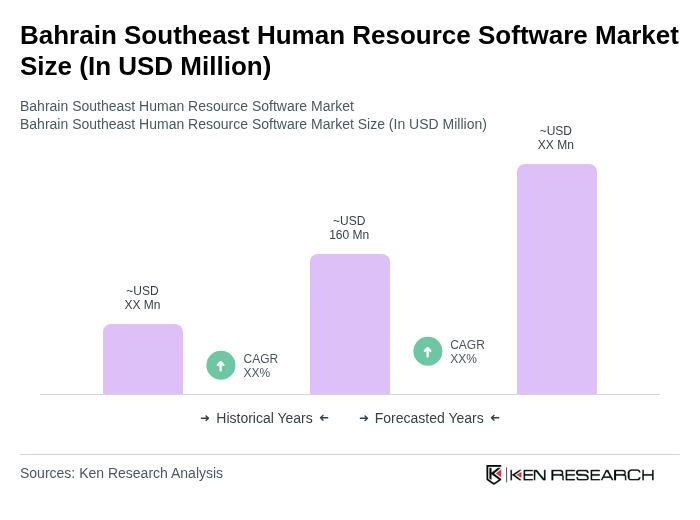
Bahrain Southeast Human Resource Software Market, valued at USD 160 million, grows with automation, data analytics, and remote work trends, featuring key players like SAP and Oracle.

Region:Middle East

Author(s):Dev

Product Code:KRAB1831

Pages:87

Published On:January 2026
About the Report

Base Year 2024

Bahrain Southeast Human Resource Software Market Overview

  • The Bahrain Southeast Human Resource Software Market is valued at USD 160 million, based on a five-year historical analysis. This growth is primarily driven by the increasing adoption of digital transformation initiatives across sectors such as financial services, oil and gas, manufacturing, healthcare, education, retail, and public administration, along with the rising demand for efficient workforce management solutions and cloud-based HR platforms. Organizations are increasingly investing in HR software to streamline operations, support hybrid and remote work models, enhance employee engagement through self-service and mobile HR tools, and improve overall productivity using analytics-driven decision-making.
  • Key players in this market include Manama, Riffa, and Muharraq, which dominate due to their strategic economic activities and concentration of businesses. Manama, as the capital and main financial and commercial hub, hosts a large share of Bahrain’s banks, professional services firms, and government institutions, all of which have complex HR requirements and higher adoption of enterprise-grade HR suites. Riffa and Muharraq also play important roles in Bahrain's economic landscape, with a growing base of SMEs, educational institutions, logistics, aviation, and services companies that increasingly deploy modular, cloud-based HR and payroll solutions to manage their workforce effectively, thus driving the demand for HR software.
  • In 2023, Bahrain's government advanced labor and employment protections through the Labour Law for the Private Sector, Law No. 36 of 2012, as amended, issued by the Kingdom of Bahrain, which sets comprehensive rules on employment contracts, working hours, leave, wages, and termination, and is enforced by the Ministry of Labour and the Labour Market Regulatory Authority. This regulatory framework requires employers to maintain accurate employee records, contracts, working time, and wage information and to comply with inspection and reporting obligations, which is increasingly supported through digital HR and payroll systems that help automate record-keeping, reporting, and policy enforcement. In parallel, Bahrain’s Personal Data Protection Law, Law No. 30 of 2018, issued by the Ministry of Justice, Islamic Affairs and Endowments, establishes requirements for lawful processing and safeguarding of employee data, encouraging organizations to adopt HR software with robust access controls, audit trails, and data protection features to ensure compliance.
Bahrain Southeast Human Resource Software Market Size

Bahrain Southeast Human Resource Software Market Segmentation

By Software Type:The software type segmentation includes various categories that cater to different HR functions, closely aligned with the way the Bahrain Human Resource Software Market is structured. The dominant sub-segment is Core HR & Employee Administration, which is essential for managing employee records, organization structures, and compliance workflows. Recruitment & Applicant Tracking Systems (ATS) also see significant usage as organizations focus on optimizing hiring with automated sourcing, screening, and onboarding. Payroll & Compensation Management Software is crucial for ensuring accurate and timely salary processing, benefits administration, and statutory deductions in line with Bahraini labor requirements. Performance & Talent Management Software is increasingly adopted to support continuous feedback, goal setting, and succession planning, enhancing employee productivity and development. Learning & Development systems are gaining traction as companies invest in structured training, e-learning, and certification tracking to upskill their workforce. Time, Attendance & Workforce Scheduling Solutions are vital for managing shifts, overtime, and leave, especially in sectors such as retail, hospitality, manufacturing, and public services. HR Analytics & Reporting Platforms are becoming essential for data-driven decision-making, workforce planning, and tracking HR KPIs. Employee Self-Service & Engagement Portals are also popular as they empower employees to manage their own data, leave requests, and payroll information via web and mobile interfaces, improving engagement. The "Others" category includes niche tools such as benefits administration, succession planning, and industry-specific HR modules that address specialized needs.
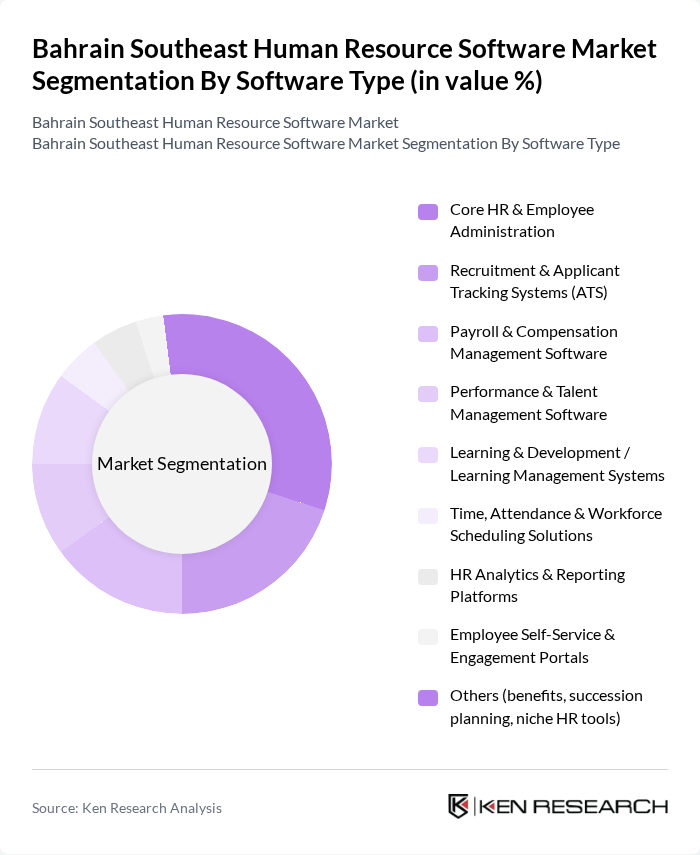
Bahrain Southeast Human Resource Software Market segmentation by Software Type.

By Organization Size:The organization size segmentation reflects the varying needs of businesses based on their scale and mirrors adoption patterns seen in Bahrain’s HR software landscape. Small Enterprises (1–49 employees) are increasingly adopting lightweight, cloud-based HR software and payroll tools to streamline operations and manage employee data efficiently at lower upfront cost. Medium Enterprises (50–249 employees) are significant users, often seeking integrated platforms that can combine core HR, payroll, time and attendance, and performance management while remaining scalable. Large Enterprises (250+ employees) dominate in terms of overall spend due to their complex HR needs, multi-site operations, and preference for comprehensive HR suites with advanced analytics, integrations, and strong governance. Government & Public Sector Entities require specialized solutions for civil service rules, grade structures, and public-sector reporting, and many initiatives in Bahrain focus on digitizing HR for ministries and public agencies. Non-Profit & Semi-Government Organizations often seek cost-effective, configurable solutions that can handle grant-funded projects, mixed workforce arrangements, and volunteer management alongside standard HR processes. The "Others" category includes various organizations such as joint ventures and regional offices that do not fit neatly into these classifications but still invest in HR tools to align with corporate policies and local compliance.
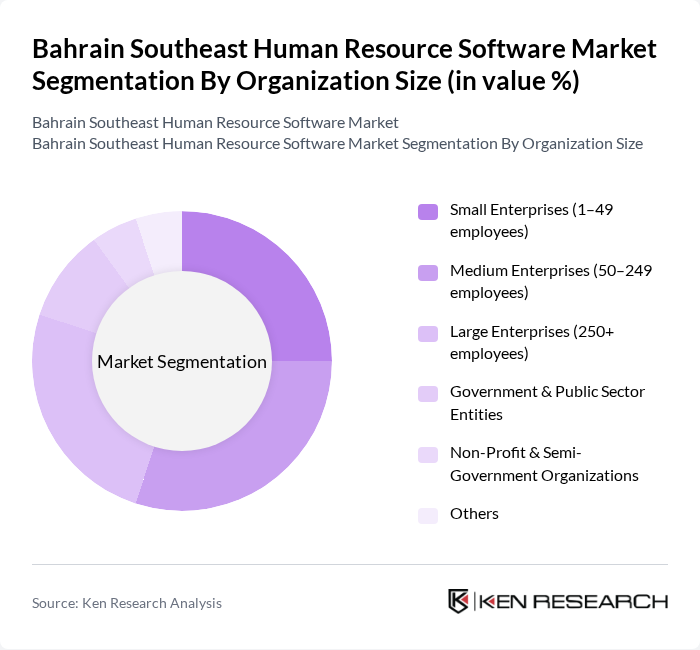
Bahrain Southeast Human Resource Software Market segmentation by Organization Size.

Bahrain Southeast Human Resource Software Market Competitive Landscape

The Bahrain Southeast Human Resource Software Market is characterized by a dynamic mix of regional and international players. Leading participants such as SAP SuccessFactors, Oracle Fusion Cloud HCM, Workday HCM, Microsoft Dynamics 365 Human Resources, BambooHR, ADP Workforce Now, Paychex Flex, Zoho People & Zoho Payroll, peopleHum, InfoRise HRMS (Bahrain), GulfHR, Bayzat, Darwinbox, Cezanne HR / Sage People, and other emerging regional players contribute to innovation, cloud adoption, localization for GCC labor and payroll rules, and broader service delivery in this space. Many of these vendors focus on cloud-based deployment, mobile-first interfaces, Arabic language support, and integrations with regional payroll, social insurance, and attendance systems, which are key differentiators in the Bahrain market.

SAP SuccessFactors

2001

Walldorf, Germany

Oracle Fusion Cloud HCM

2011

Redwood City, California, USA

Workday HCM

2005

Pleasanton, California, USA

BambooHR

2008

Lindon, Utah, USA

ADP Workforce Now

1949

Roseland, New Jersey, USA

Company

Establishment Year

Headquarters

Group Size (Large, Medium, or Small as per industry convention)

Annual Recurring Revenue (ARR)

Revenue Growth Rate (YoY)

Customer Acquisition Cost (CAC)

Customer Lifetime Value (CLV)

Net Revenue Retention / Churn Rate

Bahrain Southeast Human Resource Software Market Industry Analysis

Growth Drivers

  • Increasing Demand for Automation in HR Processes:The Bahrain Southeast region is witnessing a significant shift towards automation in HR processes, driven by a 17% increase in operational efficiency reported by companies adopting HR software. The World Bank indicates that Bahrain's GDP growth is projected at 3.8% in future, encouraging businesses to invest in technology. This trend is further supported by a 22% rise in the adoption of automated payroll systems, reflecting a broader move towards streamlined HR operations.
  • Rising Need for Data-Driven Decision Making:Organizations in Bahrain are increasingly prioritizing data-driven decision-making, with a reported 32% increase in the use of analytics tools for HR functions. The International Monetary Fund (IMF) highlights that businesses leveraging data analytics can improve employee performance by up to 27%. This growing emphasis on data utilization is prompting HR software providers to enhance their offerings, aligning with the region's economic growth and competitive landscape.
  • Growth in Remote Work and Digital Workforce Management:The shift towards remote work has accelerated in Bahrain, with a 45% increase in remote job postings since 2020. According to the Bahrain Economic Development Board, this trend is expected to continue, leading to a demand for digital workforce management solutions. Companies are investing in HR software that facilitates remote collaboration, reflecting a broader global trend towards flexible work arrangements and the need for effective management tools.

Market Challenges

  • High Initial Investment Costs:One of the primary challenges facing the Bahrain Southeast HR software market is the high initial investment required for implementation. Companies report an average expenditure of approximately $55,000 for comprehensive HR software solutions. This financial barrier can deter small and medium-sized enterprises (SMEs) from adopting necessary technologies, limiting overall market growth and innovation in the region.
  • Resistance to Change from Traditional HR Practices:Many organizations in Bahrain still rely on traditional HR practices, with 62% of HR departments reporting reluctance to transition to digital solutions. This resistance is often rooted in a lack of understanding of the benefits of modern HR software. Consequently, this challenge hampers the adoption of innovative technologies, slowing down the overall growth of the HR software market in the region.

Bahrain Southeast Human Resource Software Market Future Outlook

The future of the Bahrain Southeast HR software market appears promising, driven by technological advancements and changing workforce dynamics. As organizations increasingly recognize the importance of employee engagement and data analytics, the demand for innovative HR solutions is expected to rise in future. Furthermore, the integration of AI and machine learning into HR processes will likely enhance operational efficiency, enabling companies to make informed decisions and improve talent management strategies, thereby fostering a more agile workforce.

Market Opportunities

  • Expansion of Cloud-Based HR Solutions:The growing trend towards cloud-based HR solutions presents a significant opportunity for market players. With a projected 28% increase in cloud adoption among businesses in Bahrain, companies can benefit from reduced IT costs and enhanced scalability, making HR processes more efficient and accessible.
  • Integration of AI and Machine Learning in HR Software:The integration of AI and machine learning technologies into HR software is set to revolutionize talent management. With an estimated 35% of HR software providers planning to incorporate these technologies in future, organizations can expect improved recruitment processes and enhanced employee experience, driving overall market growth.

Scope of the Report

SegmentSub-Segments
By Software Type

Core HR & Employee Administration

Recruitment & Applicant Tracking Systems (ATS)

Payroll & Compensation Management Software

Performance & Talent Management Software

Learning & Development / Learning Management Systems

Time, Attendance & Workforce Scheduling Solutions

HR Analytics & Reporting Platforms

Employee Self-Service & Engagement Portals

Others (benefits, succession planning, niche HR tools)

By Organization Size

Small Enterprises (1–49 employees)

Medium Enterprises (50–249 employees)

Large Enterprises (250+ employees)

Government & Public Sector Entities

Non-Profit & Semi-Government Organizations

Others

By Industry Vertical

Financial Services & Banking

Oil, Gas & Industrial Manufacturing

Healthcare & Life Sciences

Education & Training Institutions

Retail, Hospitality & Restaurants

IT, Telecom & Professional Services

Government & Public Administration

Others

By Deployment Model

On-Premises Solutions

Cloud-Based (SaaS) Solutions

Hybrid Solutions

Others

By Key HR Functionality

Recruitment & Talent Acquisition

Core HR & Employee Records Management

Time, Attendance & Leave Management

Payroll, Benefits & Compensation

Performance, Succession & Career Development

Compliance & HR Governance Management

Employee Engagement, Feedback & Collaboration

Others

By User Type

HR Professionals

Line Managers & Business Leaders

Employees

IT & Admin Teams

Others

By Geographic Presence / Installation Location

Capital & Major Urban Centers

Industrial & Economic Zones

Other Regions

Key Target Audience

Investors and Venture Capitalist Firms

Government and Regulatory Bodies (e.g., Ministry of Labour and Social Development, Economic Development Board)

Human Resource Departments of Corporations

Small and Medium Enterprises (SMEs)

Technology Providers and Software Developers

Business Process Outsourcing (BPO) Companies

Industry Associations and Professional Bodies

Financial Institutions and Banks

Players Mentioned in the Report:

SAP SuccessFactors

Oracle Fusion Cloud HCM

Workday HCM

Microsoft Dynamics 365 Human Resources

BambooHR

ADP Workforce Now

Paychex Flex

Zoho People & Zoho Payroll

peopleHum

InfoRise HRMS (Bahrain)

GulfHR

Bayzat

Darwinbox

Cezanne HR / Sage People

Other Emerging Regional Players

Table of Contents

Market Assessment Phase

1. Executive Summary and Approach


2. Bahrain Southeast Human Resource Software Market Overview

2.1 Key Insights and Strategic Recommendations

2.2 Bahrain Southeast Human Resource Software Market Overview

2.3 Definition and Scope

2.4 Evolution of Market Ecosystem

2.5 Timeline of Key Regulatory Milestones

2.6 Value Chain & Stakeholder Mapping

2.7 Business Cycle Analysis

2.8 Policy & Incentive Landscape


3. Bahrain Southeast Human Resource Software Market Analysis

3.1 Growth Drivers

3.1.1 Increasing demand for automation in HR processes
3.1.2 Rising need for data-driven decision making
3.1.3 Growth in remote work and digital workforce management
3.1.4 Enhanced focus on employee engagement and retention

3.2 Market Challenges

3.2.1 High initial investment costs
3.2.2 Resistance to change from traditional HR practices
3.2.3 Data privacy and security concerns
3.2.4 Limited awareness of software capabilities

3.3 Market Opportunities

3.3.1 Expansion of cloud-based HR solutions
3.3.2 Integration of AI and machine learning in HR software
3.3.3 Growing demand for mobile HR applications
3.3.4 Potential for partnerships with local businesses

3.4 Market Trends

3.4.1 Shift towards employee self-service platforms
3.4.2 Increasing use of analytics for talent management
3.4.3 Focus on diversity and inclusion in hiring processes
3.4.4 Adoption of gamification in HR software

3.5 Government Regulation

3.5.1 Labor law compliance requirements
3.5.2 Data protection regulations
3.5.3 Employment equity legislation
3.5.4 Incentives for digital transformation in HR

4. SWOT Analysis


5. Stakeholder Analysis


6. Porter's Five Forces Analysis


7. Bahrain Southeast Human Resource Software Market Market Size, 2019-2024

7.1 By Value

7.2 By Volume

7.3 By Average Selling Price


8. Bahrain Southeast Human Resource Software Market Segmentation

8.1 By Software Type

8.1.1 Core HR & Employee Administration
8.1.2 Recruitment & Applicant Tracking Systems (ATS)
8.1.3 Payroll & Compensation Management Software
8.1.4 Performance & Talent Management Software
8.1.5 Learning & Development / Learning Management Systems
8.1.6 Time, Attendance & Workforce Scheduling Solutions
8.1.7 HR Analytics & Reporting Platforms
8.1.8 Employee Self-Service & Engagement Portals
8.1.9 Others (benefits, succession planning, niche HR tools)

8.2 By Organization Size

8.2.1 Small Enterprises (1–49 employees)
8.2.2 Medium Enterprises (50–249 employees)
8.2.3 Large Enterprises (250+ employees)
8.2.4 Government & Public Sector Entities
8.2.5 Non-Profit & Semi-Government Organizations
8.2.6 Others

8.3 By Industry Vertical

8.3.1 Financial Services & Banking
8.3.2 Oil, Gas & Industrial Manufacturing
8.3.3 Healthcare & Life Sciences
8.3.4 Education & Training Institutions
8.3.5 Retail, Hospitality & Restaurants
8.3.6 IT, Telecom & Professional Services
8.3.7 Government & Public Administration
8.3.8 Others

8.4 By Deployment Model

8.4.1 On-Premises Solutions
8.4.2 Cloud-Based (SaaS) Solutions
8.4.3 Hybrid Solutions
8.4.4 Others

8.5 By Key HR Functionality

8.5.1 Recruitment & Talent Acquisition
8.5.2 Core HR & Employee Records Management
8.5.3 Time, Attendance & Leave Management
8.5.4 Payroll, Benefits & Compensation
8.5.5 Performance, Succession & Career Development
8.5.6 Compliance & HR Governance Management
8.5.7 Employee Engagement, Feedback & Collaboration
8.5.8 Others

8.6 By User Type

8.6.1 HR Professionals
8.6.2 Line Managers & Business Leaders
8.6.3 Employees
8.6.4 IT & Admin Teams
8.6.5 Others

8.7 By Geographic Presence / Installation Location

8.7.1 Capital & Major Urban Centers
8.7.2 Industrial & Economic Zones
8.7.3 Other Regions

9. Bahrain Southeast Human Resource Software Market Competitive Analysis

9.1 Market Share of Key Players

9.2 Cross Comparison of Key Players

9.2.1 Company Name
9.2.2 Group Size (Large, Medium, or Small as per industry convention)
9.2.3 Annual Recurring Revenue (ARR)
9.2.4 Revenue Growth Rate (YoY)
9.2.5 Customer Acquisition Cost (CAC)
9.2.6 Customer Lifetime Value (CLV)
9.2.7 Net Revenue Retention / Churn Rate
9.2.8 Average Contract Value (ACV) / Deal Size
9.2.9 Number of Active Customers in Bahrain & Southeast Asia
9.2.10 Market Penetration & Share in Target Segments
9.2.11 Gross Margin and EBITDA Margin (where available)
9.2.12 Pricing Positioning (premium, mid-market, value)

9.3 SWOT Analysis of Top Players

9.4 Pricing Analysis

9.5 Detailed Profile of Major Companies

9.5.1 SAP SuccessFactors
9.5.2 Oracle Fusion Cloud HCM
9.5.3 Workday HCM
9.5.4 Microsoft Dynamics 365 Human Resources
9.5.5 BambooHR
9.5.6 ADP Workforce Now
9.5.7 Paychex Flex
9.5.8 Zoho People & Zoho Payroll
9.5.9 peopleHum
9.5.10 InfoRise HRMS (Bahrain)
9.5.11 GulfHR
9.5.12 Bayzat
9.5.13 Darwinbox
9.5.14 Cezanne HR / Sage People
9.5.15 Other Emerging Regional Players

10. Bahrain Southeast Human Resource Software Market End-User Analysis

10.1 Procurement Behavior of Key Ministries

10.1.1 Budget Allocation Trends
10.1.2 Decision-Making Processes
10.1.3 Preferred Vendor Criteria
10.1.4 Contract Duration Preferences

10.2 Corporate Spend on Infrastructure & Energy

10.2.1 Investment Priorities
10.2.2 Spending Trends in HR Technology
10.2.3 Budgeting for Software Upgrades
10.2.4 Cost-Benefit Analysis Practices

10.3 Pain Point Analysis by End-User Category

10.3.1 Common HR Challenges
10.3.2 Software Usability Issues
10.3.3 Integration Difficulties
10.3.4 Support and Maintenance Concerns

10.4 User Readiness for Adoption

10.4.1 Training Needs Assessment
10.4.2 Change Management Strategies
10.4.3 Technology Acceptance Levels
10.4.4 Feedback Mechanisms

10.5 Post-Deployment ROI and Use Case Expansion

10.5.1 Measurement of Success Metrics
10.5.2 User Satisfaction Surveys
10.5.3 Future Expansion Plans
10.5.4 Case Studies of Successful Implementations

11. Bahrain Southeast Human Resource Software Market Future Size, 2025-2030

11.1 By Value

11.2 By Volume

11.3 By Average Selling Price


Go-To-Market Strategy Phase

1. Whitespace Analysis + Business Model Canvas

1.1 Market Gaps Identification

1.2 Value Proposition Development

1.3 Revenue Streams Analysis

1.4 Key Resources and Activities

1.5 Customer Segments and Relationships

1.6 Channels for Delivery

1.7 Cost Structure Overview


2. Marketing and Positioning Recommendations

2.1 Branding Strategies

2.2 Product USPs


3. Distribution Plan

3.1 Urban Retail vs Rural NGO Tie-Ups


4. Channel & Pricing Gaps

4.1 Underserved Routes

4.2 Pricing Bands


5. Unmet Demand & Latent Needs

5.1 Category Gaps

5.2 Consumer Segments


6. Customer Relationship

6.1 Loyalty Programs

6.2 After-Sales Service


7. Value Proposition

7.1 Sustainability

7.2 Integrated Supply Chains


8. Key Activities

8.1 Regulatory Compliance

8.2 Branding

8.3 Distribution Setup


9. Entry Strategy Evaluation

9.1 Domestic Market Entry Strategy

9.1.1 Product Mix
9.1.2 Pricing Band
9.1.3 Packaging

9.2 Export Entry Strategy

9.2.1 Target Countries
9.2.2 Compliance Roadmap

10. Entry Mode Assessment

10.1 JV

10.2 Greenfield

10.3 M&A

10.4 Distributor Model


11. Capital and Timeline Estimation

11.1 Capital Requirements

11.2 Timelines


12. Control vs Risk Trade-Off

12.1 Ownership vs Partnerships


13. Profitability Outlook

13.1 Breakeven Analysis

13.2 Long-Term Sustainability


14. Potential Partner List

14.1 Distributors

14.2 JVs

14.3 Acquisition Targets


15. Execution Roadmap

15.1 Phased Plan for Market Entry

15.1.1 Market Setup
15.1.2 Market Entry
15.1.3 Growth Acceleration
15.1.4 Scale & Stabilize

15.2 Key Activities and Milestones

15.2.1 Milestone Planning
15.2.2 Activity Tracking

Research Methodology

ApproachModellingSample

Phase 1: Approach1

Desk Research

  • Analysis of industry reports from Bahrain's Ministry of Labor and Social Development
  • Review of academic journals focusing on human resource management trends in the Middle East
  • Examination of market studies published by local consulting firms on HR software adoption

Primary Research

  • Interviews with HR managers from various sectors including finance, healthcare, and education
  • Telephonic surveys with software vendors and service providers in the HR tech space
  • Field interviews with IT directors responsible for HR software implementation

Validation & Triangulation

  • Cross-validation of findings through multiple data sources including government statistics and industry reports
  • Triangulation of qualitative insights from interviews with quantitative data from surveys
  • Sanity checks conducted through expert panel reviews comprising HR consultants and software developers

Phase 2: Market Size Estimation1

Top-down Assessment

  • Estimation of total HR software market size based on Bahrain's GDP and IT spending trends
  • Segmentation of the market by software type, including payroll, recruitment, and performance management
  • Incorporation of government initiatives promoting digital transformation in HR practices

Bottom-up Modeling

  • Collection of data on the number of businesses in Bahrain and their HR software usage rates
  • Operational cost analysis based on pricing models of leading HR software solutions
  • Volume x cost calculations for different HR software categories and their adoption rates

Forecasting & Scenario Analysis

  • Multi-factor regression analysis incorporating economic growth, workforce trends, and technology adoption rates
  • Scenario modeling based on potential regulatory changes and shifts in workforce demographics
  • Development of baseline, optimistic, and pessimistic forecasts through 2030

Phase 3: CATI Sample Composition1

Scope Item/SegmentSample SizeTarget Respondent Profiles
Corporate HR Software Adoption120HR Managers, Chief HR Officers
SME HR Solutions90Business Owners, HR Consultants
Payroll Management Systems80Finance Managers, Payroll Administrators
Performance Management Tools70Talent Development Managers, HR Analysts
Recruitment Software Usage100Recruitment Officers, Talent Acquisition Specialists

Frequently Asked Questions

What is the current value of the Bahrain Southeast Human Resource Software Market?

The Bahrain Southeast Human Resource Software Market is valued at approximately USD 160 million, reflecting a five-year historical analysis. This growth is driven by the increasing adoption of digital transformation initiatives across various sectors.

What are the key drivers of growth in the Bahrain HR software market?

Which sectors are primarily adopting HR software in Bahrain?

What are the main types of HR software available in Bahrain?

Other Regional/Country Reports

Bahrain Southeast Human Resource Software Market Report Size, Share, Growth Drivers, Trends, Opportunities & Forecast 2025–2030

Indonesia Human Resource Software Market

Malaysia Human Resource Software Market

KSA Human Resource Software Market

APAC Human Resource Software Market

SEA Human Resource Software Market

Why Buy From Us?

Refine Robust Result (RRR) Framework

What makes us stand out is that our consultants follow Robust, Refine and Result (RRR) methodology. Robust for clear definitions, approaches and sanity checking, Refine for differentiating respondents' facts and opinions, and Result for presenting data with story.

Our Reach Is Unmatched

We have set a benchmark in the industry by offering our clients with syndicated and customized market research reports featuring coverage of entire market as well as meticulous research and analyst insights.

Shifting the Research Paradigm

While we don't replace traditional research, we flip the method upside down. Our dual approach of Top Bottom & Bottom Top ensures quality deliverable by not just verifying company fundamentals but also looking at the sector and macroeconomic factors.

More Insights-Better Decisions

With one step in the future, our research team constantly tries to show you the bigger picture. We help with some of the tough questions you may encounter along the way: How is the industry positioned? Best marketing channel? KPI's of competitors? By aligning every element, we help maximize success.

Transparency and Trust

Our report gives you instant access to the answers and sources that other companies might choose to hide. We elaborate each steps of research methodology we have used and showcase you the sample size to earn your trust.

Round the Clock Support

If you need any support, we are here! We pride ourselves on universe strength, data quality, and quick, friendly, and professional service.

Why Clients Choose Us?

400000+
Reports in repository
150+
Consulting projects a year
100+
Analysts
8000+
Client Queries in 2022








