About the Report
Base Year 2024Listen to the audio summary
Bangladesh Seed Market Overview
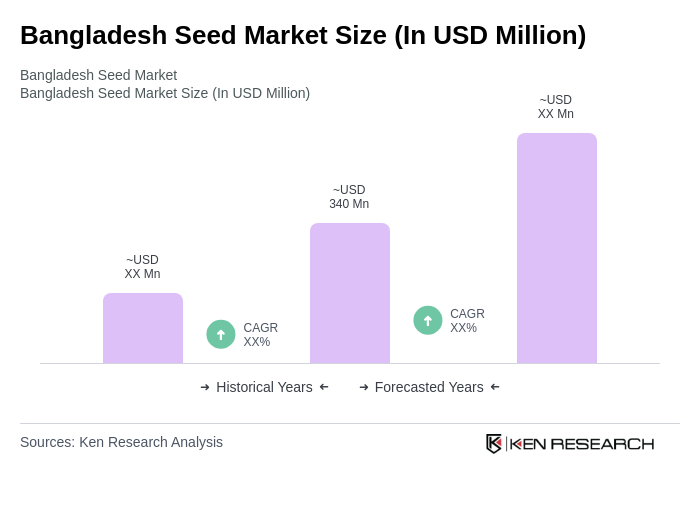
- The Bangladesh Seed Market is valued at USD 340 million, based on a five-year historical analysis. This growth is primarily driven by increasing adoption of high-yielding and disease-resistant varieties, rising private-sector participation, and government focus on agricultural modernization and food security. The market has seen increased investment in varietal development (including hybrids), quality assurance, and distribution, with emphasis on climate-resilient and improved vegetable and rice seeds.
- Key hubs for seed industry activity include Dhaka and Chattogram due to their roles in corporate headquarters, trade, and logistics; these centers anchor import channels, private seed company operations, and distribution networks. Agricultural production and input distribution are nationwide, with intensive vegetable seed use in peri-urban belts and rice/maize seed demand concentrated in major producing regions; city names themselves are not “players,” but serve as strategic nodes for market access and logistics.
- In 2023, the government issued the Seed Policy 2023 to improve seed quality, availability, and governance. Policy measures include mandatory registration and release procedures for varieties, promotion of certified seed use, and support for public–private collaboration to strengthen seed production, quality control, and distribution.
Bangladesh Seed Market Segmentation
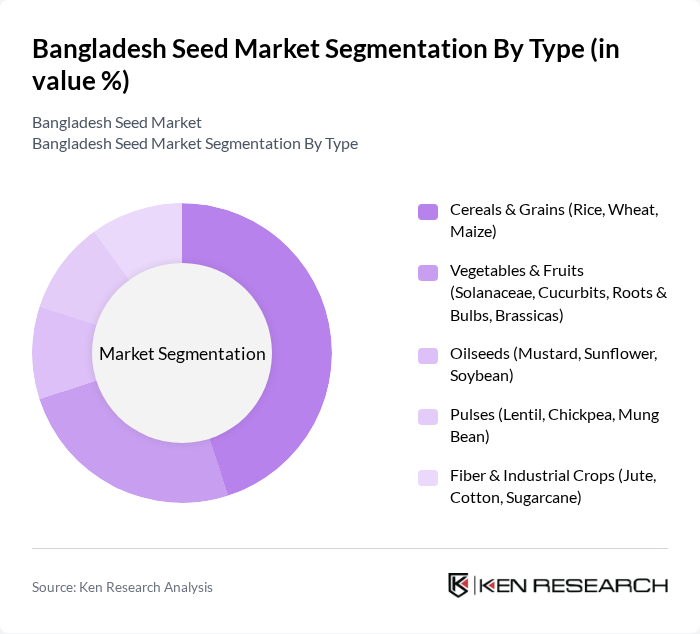
By Type:The seed market can be segmented into various types, including cereals & grains, vegetables & fruits, oilseeds, pulses, and fiber & industrial crops. Among these, cereals & grains—particularly rice—dominate due to rice’s staple status and continual replacement demand for improved and hybrid varieties; vegetables are a fast-growing segment driven by higher margins, intensive cultivation, and year-round peri-urban demand. The increasing population and urbanization have supported demand for rice, maize, and diversified vegetables, encouraging investment in breeding and quality seed systems.
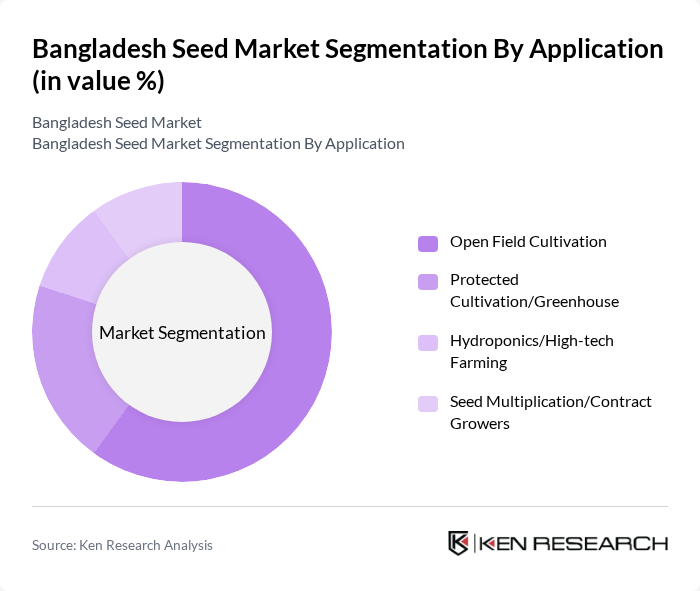
By Application:The seed market is also segmented by application, which includes open field cultivation, protected cultivation/greenhouse, hydroponics/high-tech farming, and seed multiplication/contract growers. Open field cultivation is the most prevalent method, as it aligns with traditional farming practices and is suitable for a wide range of crops, particularly in rural areas where most farming occurs.
Bangladesh Seed Market Competitive Landscape
The Bangladesh Seed Market is characterized by a dynamic mix of regional and international players. Leading participants such as BRAC Seed & Agro (BRAC), ACI Seed (ACI Agribusiness), Lal Teer Seed Limited (Multimode Group), Bayer Crop Science (Bangladesh), Syngenta Bangladesh Limited, East-West Seed (Bangladesh), Advanta Seeds (UPL Group) – Bangladesh, Supreme Seed Company Limited, Getco Agro Vision Ltd., Ispahani Agro Limited, Metal Agro Limited (Kazi Farms Group – Contract/Distribution for seeds), Haji Seeds (Haji Seed Company), Krishibid Seed Limited (KSL), Benipro Agro (Benimashito/Benipro Seeds Bangladesh), Bangladesh Agricultural Development Corporation (BADC) – Seed Wing contribute to innovation, geographic expansion, and service delivery in this space.
Bangladesh Seed Market Industry Analysis
Growth Drivers
- Increasing Agricultural Demand:The agricultural sector in Bangladesh contributes approximatelyabout 12%to the national GDP, with a workforce of aroundabout 37%engaged in farming. The demand for food is projected to rise by25%, driven by a growing population of over170 million. This surge in agricultural demand necessitates the use of high-quality seeds to enhance productivity, thereby propelling the seed market's growth significantly in the coming years.
- Government Support and Subsidies:The Bangladeshi government allocated approximatelyBDT 1,500 crore (around USD 180 million)for agricultural subsidies, including seed production. This financial support aims to improve seed quality and accessibility for farmers. Additionally, initiatives like the National Seed Policy promote the development of high-yield varieties, further stimulating market growth and ensuring food security in the region.
- Technological Advancements in Seed Production:The adoption of modern agricultural technologies has led to significant improvements in seed production processes. In future, investments in biotechnology and genetic research reachedBDT 800 crore (approximately USD 96 million), facilitating the development of disease-resistant and high-yield seed varieties. These advancements are crucial for enhancing agricultural productivity and meeting the increasing food demand in Bangladesh.
Market Challenges
- Climate Change Impact:Bangladesh is highly vulnerable to climate change, with an estimated20%of its agricultural land affected by flooding and salinity. The World Bank reported that climate-related disasters could reduce agricultural output byup to 10%. This unpredictability poses a significant challenge for seed production, as farmers struggle to adapt to changing weather patterns and crop failures, impacting the overall seed market.
- Regulatory Hurdles:The seed industry in Bangladesh faces stringent regulatory requirements, which can hinder market growth. The process for obtaining seed variety approvals can takeup to three years, delaying the introduction of innovative products. Additionally, compliance with international standards for seed quality and safety can be costly, limiting the ability of local producers to compete effectively in both domestic and export markets.
Bangladesh Seed Market Future Outlook
The Bangladesh seed market is poised for significant transformation, driven by increasing agricultural demands and technological innovations. As farmers increasingly adopt sustainable practices, the focus on climate-resilient seed varieties will intensify. Furthermore, the integration of e-commerce platforms for seed distribution is expected to enhance accessibility for farmers, particularly in rural areas. These trends indicate a dynamic market landscape, with opportunities for growth and development in the coming years, fostering a more resilient agricultural sector.
Market Opportunities
- Development of Organic Seed Varieties:With the global organic food market projected to reachUSD 200 billion, there is a growing opportunity for Bangladesh to develop organic seed varieties. This shift can cater to both domestic and international markets, enhancing the country's agricultural exports and promoting sustainable farming practices among local farmers.
- Collaboration with NGOs for Distribution:Collaborating with NGOs can significantly improve seed distribution networks in rural areas. By leveraging existing infrastructure and outreach programs, NGOs can facilitate access to quality seeds for smallholder farmers, thereby enhancing agricultural productivity and ensuring food security in underserved communities across Bangladesh.
Scope of the Report
| Segment | Sub-Segments |
|---|---|
| By Type | Cereals & Grains (Rice, Wheat, Maize) Vegetables & Fruits (Solanaceae, Cucurbits, Roots & Bulbs, Brassicas) Oilseeds (Mustard, Sunflower, Soybean) Pulses (Lentil, Chickpea, Mung Bean) Fiber & Industrial Crops (Jute, Cotton, Sugarcane) |
| By Application | Open Field Cultivation Protected Cultivation/Greenhouse Hydroponics/High-tech Farming Seed Multiplication/Contract Growers |
| By End-User | Smallholder Farmers Commercial Farms & Agribusinesses Government & Public Agencies (BADC, DAE, Research Institutes) NGOs & Development Programs/Projects |
| By Distribution Channel | Company Direct & Field Sales Force Agri-Dealers & Retail Outlets E-commerce/Online Platforms Government Schemes & Subsidy Channels |
| By Region | Dhaka Chattogram (Chittagong) Khulna Rajshahi & Rangpur Sylhet, Barishal & Mymensingh |
| By Price Range | Value/Low Price Mid Price Premium/High Price |
| By Certification Type | Certified Seeds Truthfully Labeled (TFL) / Quality Declared Seed (QDS) Uncertified/Informal Sector |
| By Product Technology | Open-Pollinated Varieties (OPVs) Non-transgenic Hybrids Transgenic/GM Traits (imported vegetable traits; field crops largely non-GM) |
Key Target Audience
Investors and Venture Capitalist Firms
Government and Regulatory Bodies (e.g., Department of Agricultural Extension, Bangladesh Agricultural Research Council)
Seed Manufacturers and Producers
Distributors and Retailers
Agrochemical Companies
Non-Governmental Organizations (NGOs) focused on agriculture
Farmers' Cooperatives and Associations
Financial Institutions providing agricultural loans
Players Mentioned in the Report:
BRAC Seed & Agro (BRAC)
ACI Seed (ACI Agribusiness)
Lal Teer Seed Limited (Multimode Group)
Bayer Crop Science (Bangladesh)
Syngenta Bangladesh Limited
East-West Seed (Bangladesh)
Advanta Seeds (UPL Group) Bangladesh
Supreme Seed Company Limited
Getco Agro Vision Ltd.
Ispahani Agro Limited
Metal Agro Limited (Kazi Farms Group Contract/Distribution for seeds)
Haji Seeds (Haji Seed Company)
Krishibid Seed Limited (KSL)
Benipro Agro (Benimashito/Benipro Seeds Bangladesh)
Bangladesh Agricultural Development Corporation (BADC) Seed Wing
Table of Contents
Market Assessment Phase
1. Executive Summary and Approach
2. Bangladesh Seed Market Overview
2.1 Key Insights and Strategic Recommendations
2.2 Bangladesh Seed Market Overview
2.3 Definition and Scope
2.4 Evolution of Market Ecosystem
2.5 Timeline of Key Regulatory Milestones
2.6 Value Chain & Stakeholder Mapping
2.7 Business Cycle Analysis
2.8 Policy & Incentive Landscape
3. Bangladesh Seed Market Analysis
3.1 Growth Drivers
3.1.1 Increasing Agricultural Demand
3.1.2 Government Support and Subsidies
3.1.3 Technological Advancements in Seed Production
3.1.4 Rising Awareness of Hybrid Seeds
3.2 Market Challenges
3.2.1 Climate Change Impact
3.2.2 Regulatory Hurdles
3.2.3 Limited Access to Quality Seeds
3.2.4 Price Volatility
3.3 Market Opportunities
3.3.1 Expansion of Export Markets
3.3.2 Development of Organic Seed Varieties
3.3.3 Investment in Research and Development
3.3.4 Collaboration with NGOs for Distribution
3.4 Market Trends
3.4.1 Shift Towards Sustainable Agriculture
3.4.2 Increasing Use of Biotechnology
3.4.3 Growth of E-commerce in Seed Distribution
3.4.4 Focus on Climate-Resilient Varieties
3.5 Government Regulation
3.5.1 Seed Quality Control Regulations
3.5.2 Intellectual Property Rights for Seed Varieties
3.5.3 Import and Export Regulations
3.5.4 Subsidy Programs for Farmers
4. SWOT Analysis
5. Stakeholder Analysis
6. Porter's Five Forces Analysis
7. Bangladesh Seed Market Market Size, 2019-2024
7.1 By Value
7.2 By Volume
7.3 By Average Selling Price
8. Bangladesh Seed Market Segmentation
8.1 By Type
8.1.1 Cereals & Grains (Rice, Wheat, Maize)
8.1.2 Vegetables & Fruits (Solanaceae, Cucurbits, Roots & Bulbs, Brassicas)
8.1.3 Oilseeds (Mustard, Sunflower, Soybean)
8.1.4 Pulses (Lentil, Chickpea, Mung Bean)
8.1.5 Fiber & Industrial Crops (Jute, Cotton, Sugarcane)
8.2 By Application
8.2.1 Open Field Cultivation
8.2.2 Protected Cultivation/Greenhouse
8.2.3 Hydroponics/High-tech Farming
8.2.4 Seed Multiplication/Contract Growers
8.3 By End-User
8.3.1 Smallholder Farmers
8.3.2 Commercial Farms & Agribusinesses
8.3.3 Government & Public Agencies (BADC, DAE, Research Institutes)
8.3.4 NGOs & Development Programs/Projects
8.4 By Distribution Channel
8.4.1 Company Direct & Field Sales Force
8.4.2 Agri-Dealers & Retail Outlets
8.4.3 E-commerce/Online Platforms
8.4.4 Government Schemes & Subsidy Channels
8.5 By Region
8.5.1 Dhaka
8.5.2 Chattogram (Chittagong)
8.5.3 Khulna
8.5.4 Rajshahi & Rangpur
8.5.5 Sylhet, Barishal & Mymensingh
8.6 By Price Range
8.6.1 Value/Low Price
8.6.2 Mid Price
8.6.3 Premium/High Price
8.7 By Certification Type
8.7.1 Certified Seeds
8.7.2 Truthfully Labeled (TFL) / Quality Declared Seed (QDS)
8.7.3 Uncertified/Informal Sector
8.8 By Product Technology
8.8.1 Open-Pollinated Varieties (OPVs)
8.8.2 Non-transgenic Hybrids
8.8.3 Transgenic/GM Traits (imported vegetable traits; field crops largely non-GM)
9. Bangladesh Seed Market Competitive Analysis
9.1 Market Share of Key Players
9.2 Cross Comparison of Key Players
9.2.1 Company Name
9.2.2 Scale Tier (Bangladesh: Large ? BDT 2,000m seed revenue; Mid BDT 500–1,999m; Small & Emerging)
9.2.3 Bangladesh Seed Revenue (latest fiscal, BDT/USD)
9.2.4 3-year CAGR in Bangladesh Seed Revenue
9.2.5 Portfolio Breadth (Cereals, Vegetables, Oilseeds, Pulses, Fiber)
9.2.6 Hybrid Penetration (% of sales from hybrids)
9.2.7 Distribution Coverage (districts/dealers/outlets)
9.2.8 R&D Intensity (% of revenue; local breeding stations, trials)
9.2.9 Registration Pipeline (no. of varieties pending/approved)
9.2.10 Quality & Compliance (certified share, germination rates, recalls)
9.2.11 Farmer Reach & Extension (demos/trainings per year)
9.2.12 Pricing Positioning (value, mid, premium)
9.2.13 Supply Reliability (in-season fill rate, lead times)
9.2.14 Brand Equity (farmer awareness/NPS/proxy survey rank)
9.3 SWOT Analysis of Top Players
9.4 Pricing Analysis
9.5 Detailed Profile of Major Companies
9.5.1 BRAC Seed & Agro (BRAC)
9.5.2 ACI Seed (ACI Agribusiness)
9.5.3 Lal Teer Seed Limited (Multimode Group)
9.5.4 Bayer Crop Science (Bangladesh)
9.5.5 Syngenta Bangladesh Limited
9.5.6 East-West Seed (Bangladesh)
9.5.7 Advanta Seeds (UPL Group) – Bangladesh
9.5.8 Supreme Seed Company Limited
9.5.9 Getco Agro Vision Ltd.
9.5.10 Ispahani Agro Limited
9.5.11 Metal Agro Limited (Kazi Farms Group – Contract/Distribution for seeds)
9.5.12 Haji Seeds (Haji Seed Company)
9.5.13 Krishibid Seed Limited (KSL)
9.5.14 Benipro Agro (Benimashito/Benipro Seeds Bangladesh)
9.5.15 Bangladesh Agricultural Development Corporation (BADC) – Seed Wing
10. Bangladesh Seed Market End-User Analysis
10.1 Procurement Behavior of Key Ministries
10.1.1 Ministry of Agriculture
10.1.2 Ministry of Fisheries and Livestock
10.1.3 Ministry of Environment
10.2 Corporate Spend on Infrastructure & Energy
10.2.1 Investment in Seed Production Facilities
10.2.2 Funding for Research and Development
10.3 Pain Point Analysis by End-User Category
10.3.1 Access to Quality Seeds
10.3.2 Price Sensitivity
10.3.3 Information Gaps
10.4 User Readiness for Adoption
10.4.1 Awareness of New Seed Varieties
10.4.2 Training and Support Needs
10.5 Post-Deployment ROI and Use Case Expansion
10.5.1 Yield Improvement
10.5.2 Cost Savings
10.5.3 Market Expansion Opportunities
11. Bangladesh Seed Market Future Size, 2025-2030
11.1 By Value
11.2 By Volume
11.3 By Average Selling Price
Go-To-Market Strategy Phase
1. Whitespace Analysis + Business Model Canvas
1.1 Market Gaps Identification
1.2 Value Proposition Development
1.3 Revenue Streams
1.4 Key Partnerships
1.5 Cost Structure
1.6 Customer Segments
1.7 Channels
2. Marketing and Positioning Recommendations
2.1 Branding Strategies
2.2 Product USPs
3. Distribution Plan
3.1 Urban Retail vs Rural NGO Tie-ups
4. Channel & Pricing Gaps
4.1 Underserved Routes
4.2 Pricing Bands
5. Unmet Demand & Latent Needs
5.1 Category Gaps
5.2 Consumer Segments
6. Customer Relationship
6.1 Loyalty Programs
6.2 After-sales Service
7. Value Proposition
7.1 Sustainability
7.2 Integrated Supply Chains
8. Key Activities
8.1 Regulatory Compliance
8.2 Branding
8.3 Distribution Setup
9. Entry Strategy Evaluation
9.1 Domestic Market Entry Strategy
9.1.1 Product Mix
9.1.2 Pricing Band
9.1.3 Packaging
9.2 Export Entry Strategy
9.2.1 Target Countries
9.2.2 Compliance Roadmap
10. Entry Mode Assessment
10.1 JV
10.2 Greenfield
10.3 M&A
10.4 Distributor Model
11. Capital and Timeline Estimation
11.1 Capital Requirements
11.2 Timelines
12. Control vs Risk Trade-Off
12.1 Ownership vs Partnerships
13. Profitability Outlook
13.1 Breakeven Analysis
13.2 Long-term Sustainability
14. Potential Partner List
14.1 Distributors
14.2 JVs
14.3 Acquisition Targets
15. Execution Roadmap
15.1 Phased Plan for Market Entry
15.1.1 Market Setup
15.1.2 Market Entry
15.1.3 Growth Acceleration
15.1.4 Scale & Stabilize
15.2 Key Activities and Milestones
15.2.1 Activity Planning
15.2.2 Milestone Tracking
Research Methodology
Phase 1: Approach1
Desk Research
- Analysis of agricultural production statistics from the Bangladesh Bureau of Statistics
- Review of market reports from the Bangladesh Agricultural Research Institute (BARI)
- Examination of government policies and regulations affecting the seed market from the Ministry of Agriculture
Primary Research
- Interviews with seed distributors and retailers across various regions of Bangladesh
- Surveys with farmers to understand seed preferences and purchasing behavior
- Focus group discussions with agricultural experts and agronomists
Validation & Triangulation
- Cross-validation of findings with data from agricultural cooperatives and NGOs
- Triangulation of market insights from interviews, surveys, and secondary data sources
- Sanity checks through expert reviews and feedback sessions with industry stakeholders
Phase 2: Market Size Estimation1
Top-down Assessment
- Estimation of total seed market size based on national agricultural output and crop area
- Segmentation of the market by crop type (e.g., rice, vegetables, pulses)
- Incorporation of growth trends in hybrid seed segments
Bottom-up Modeling
- Collection of sales data from major seed companies operating in Bangladesh
- Estimation of average seed prices across different crop categories
- Volume estimates based on farmer adoption rates and planting area
Forecasting & Scenario Analysis
- Multi-factor regression analysis incorporating factors such as climate change and policy shifts
- Scenario modeling based on potential changes in agricultural practices and technology adoption
- Development of baseline, optimistic, and pessimistic forecasts through 2030
Phase 3: CATI Sample Composition1
| Scope Item/Segment | Sample Size | Target Respondent Profiles |
|---|---|---|
| Seed Retailers | 100 | Store Owners, Sales Representatives |
| Farmers (Rice Cultivation) | 140 | Smallholder Farmers, Large-scale Farmers |
| Seed Distributors | 80 | Distribution Managers, Logistics Coordinators |
| Agricultural Experts | 60 | Agronomists, Extension Workers |
| Government Officials | 50 | Policy Makers, Regulatory Authorities |
Frequently Asked Questions
What is the current value of the Bangladesh Seed Market?
The Bangladesh Seed Market is valued at approximately USD 340 million, driven by the adoption of high-yielding and disease-resistant seed varieties, increased private-sector participation, and government initiatives focused on agricultural modernization and food security.
What are the main types of seeds available in Bangladesh?
How does the government support the seed industry in Bangladesh?
What are the key challenges facing the Bangladesh Seed Market?
Why Buy From Us?

What makes us stand out is that our consultants follow Robust, Refine and Result (RRR) methodology. Robust for clear definitions, approaches and sanity checking, Refine for differentiating respondents' facts and opinions, and Result for presenting data with story.

We have set a benchmark in the industry by offering our clients with syndicated and customized market research reports featuring coverage of entire market as well as meticulous research and analyst insights.

While we don't replace traditional research, we flip the method upside down. Our dual approach of Top Bottom & Bottom Top ensures quality deliverable by not just verifying company fundamentals but also looking at the sector and macroeconomic factors.

With one step in the future, our research team constantly tries to show you the bigger picture. We help with some of the tough questions you may encounter along the way: How is the industry positioned? Best marketing channel? KPI's of competitors? By aligning every element, we help maximize success.

Our report gives you instant access to the answers and sources that other companies might choose to hide. We elaborate each steps of research methodology we have used and showcase you the sample size to earn your trust.

If you need any support, we are here! We pride ourselves on universe strength, data quality, and quick, friendly, and professional service.