About the Report
Base Year 2024Brazil Car Rental & Mobility Services Market Overview
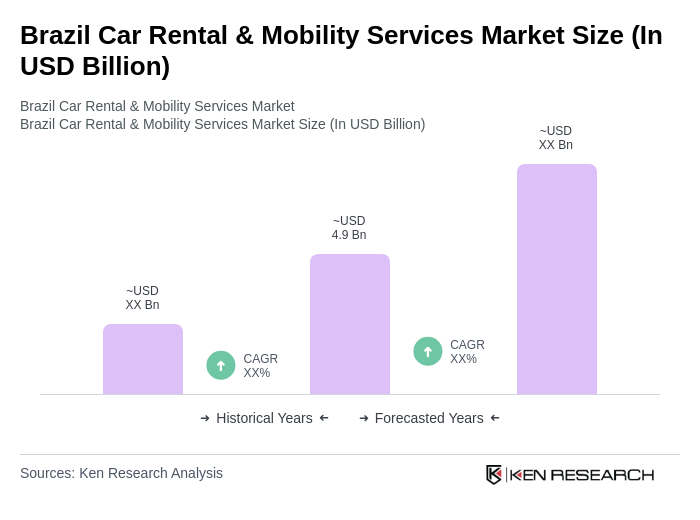
- The Brazil Car Rental & Mobility Services Market is valued at USD 4.9 billion, based on a five-year historical analysis. This growth is primarily driven by the increasing demand for flexible transportation solutions, rapid urbanization, the expansion of digital booking platforms, and a notable rise in domestic and international tourism. The market has experienced a significant uptick in both leisure and corporate rentals, reflecting evolving consumer preferences toward on-demand mobility and subscription-based services.
- Key cities such as São Paulo, Rio de Janeiro, and Brasília continue to dominate the market due to their high population density, robust tourism infrastructure, and concentration of economic activities. These urban centers serve as major hubs for both business and leisure travel, leading to a higher demand for car rental and mobility services, which are essential for navigating these metropolitan areas.
- In 2023, the Brazilian government enacted Resolution No. 999/2023 issued by the National Traffic Department (DENATRAN), which mandates annual emissions testing for all rental vehicles and incentivizes the adoption of electric vehicles within rental fleets. This regulation is part of a broader national strategy to reduce greenhouse gas emissions, improve air quality, and promote sustainable mobility solutions. Rental companies are required to comply with these standards to maintain operational licenses, and incentives are provided for fleets that transition a portion of their vehicles to electric or hybrid models.
Brazil Car Rental & Mobility Services Market Segmentation
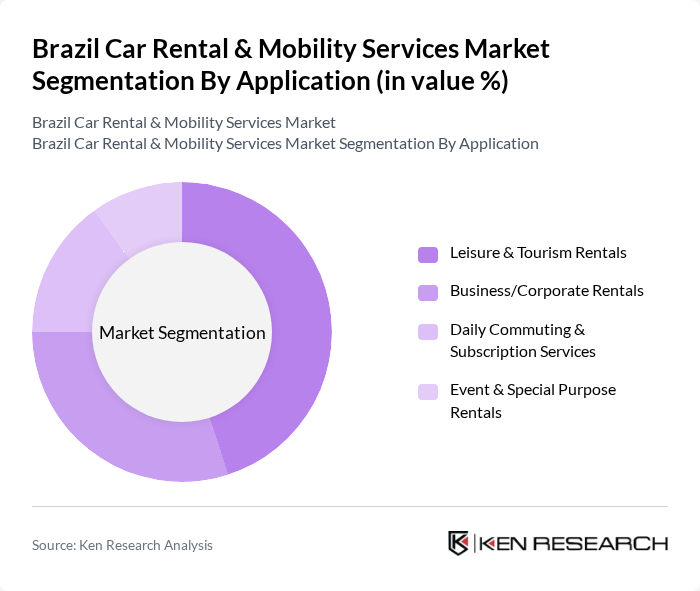
By Application:The application segment includes various sub-segments such as Leisure & Tourism Rentals, Business/Corporate Rentals, Daily Commuting & Subscription Services, and Event & Special Purpose Rentals. Among these, Leisure & Tourism Rentals dominate the market, supported by Brazil's vibrant tourism sector, which attracts millions of visitors annually. The demand for rental cars for sightseeing, travel convenience, and access to remote destinations significantly contributes to this segment's growth.
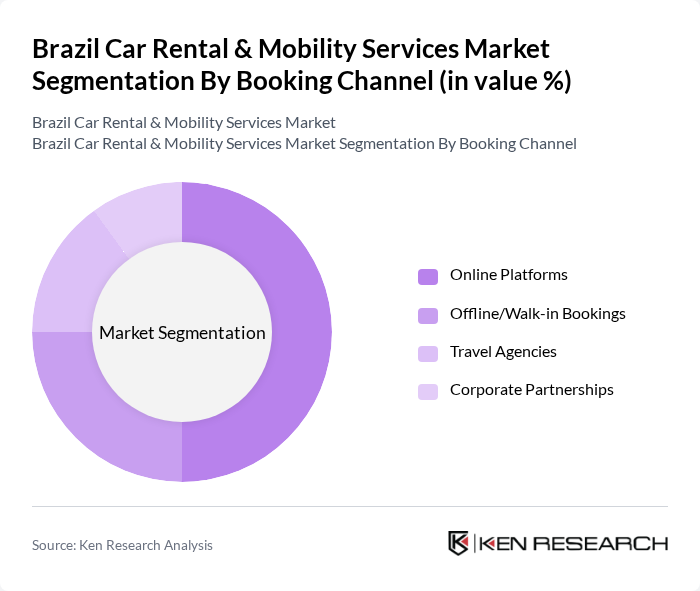
By Booking Channel:The booking channel segment encompasses Online Platforms, Offline/Walk-in Bookings, Travel Agencies, and Corporate Partnerships. Online Platforms are leading this segment, driven by the increasing penetration of smartphones, widespread internet access, and the adoption of digital payment solutions. Consumers increasingly prefer booking rentals through mobile apps and websites, reflecting a broader shift towards digitalization in the travel and mobility sectors.
Brazil Car Rental & Mobility Services Market Competitive Landscape
The Brazil Car Rental & Mobility Services Market is characterized by a dynamic mix of regional and international players. Leading participants such as Localiza Rent a Car S.A., Movida Participações S.A., Unidas (now part of Localiza&Co), Hertz Brasil (Hertz Global Holdings, Inc.), Avis Budget Group, Inc., Sixt SE, Europcar Mobility Group, Rentcars.com, 99 (formerly 99 Táxi, now part of Didi Chuxing), Cabify Brasil, BlaBlaCar Brasil, Zipcar (Avis Budget Group), Tembici (Bike and Micro-mobility), Kovi, and Turbi contribute to innovation, geographic expansion, and service delivery in this space.
Brazil Car Rental & Mobility Services Market Industry Analysis
Growth Drivers
- Increasing Urbanization:Brazil's urban population is projected to reach 87% by future, up from 85% in 2020, according to the World Bank. This rapid urbanization drives demand for car rental services as residents seek flexible transportation options. The urban centers, particularly São Paulo and Rio de Janeiro, are experiencing significant congestion, prompting individuals to opt for rentals over personal vehicles. The growing urban population translates to an increased need for mobility solutions, enhancing the car rental market's growth prospects.
- Rise in Tourism:Brazil welcomed approximately 6.2 million international tourists in future, a significant rebound from the pandemic's impact. The tourism sector is expected to contribute around $6.9 billion to the economy in future, according to the Brazilian Ministry of Tourism. This influx of tourists creates a robust demand for car rentals, as visitors prefer the convenience of personal transportation to explore diverse attractions. The anticipated growth in tourism will further bolster the car rental market in Brazil.
- Technological Advancements in Mobility Solutions:The Brazilian car rental market is increasingly adopting technology, with over 60% of rental companies implementing mobile apps for bookings and customer service in future. This shift enhances customer experience and operational efficiency. Additionally, the integration of AI and data analytics allows companies to optimize fleet management and pricing strategies. As technology continues to evolve, it will play a crucial role in driving the growth of the car rental and mobility services market in Brazil.
Market Challenges
- Regulatory Compliance Issues:The Brazilian car rental industry faces stringent regulatory requirements, including licensing and safety standards. In future, compliance costs are expected to rise by 15% due to new regulations aimed at improving safety and environmental standards. These increased costs can strain smaller operators, limiting their competitiveness. Additionally, navigating the complex regulatory landscape can hinder market entry for new players, posing a significant challenge to industry growth.
- Economic Instability:Brazil's economy is projected to grow at a modest rate of around 2% in future, according to the IMF. This slow growth, coupled with inflation rates averaging approximately 4%, can negatively impact consumer spending on discretionary services like car rentals. Economic uncertainty may lead to reduced travel and tourism, further challenging the car rental market. Operators must adapt to these economic conditions to maintain profitability and market share.
Brazil Car Rental & Mobility Services Market Future Outlook
The future of Brazil's car rental and mobility services market appears promising, driven by urbanization and technological advancements. As cities expand, the demand for flexible transportation options will likely increase. Additionally, the integration of electric vehicles into rental fleets is expected to gain traction, aligning with global sustainability trends. Companies that leverage technology to enhance customer experience and operational efficiency will be well-positioned to capitalize on emerging opportunities in this evolving landscape.
Market Opportunities
- Growth of Electric Vehicle Rentals:With Brazil's commitment to reducing carbon emissions, the electric vehicle (EV) rental segment is poised for growth. The government aims for 10% of all vehicles to be electric by future, creating a favorable environment for EV rentals. This shift not only meets consumer demand for sustainable options but also aligns with regulatory incentives, making it a lucrative opportunity for rental companies.
- Development of Mobility-as-a-Service (MaaS):The MaaS model is gaining traction in Brazil, with an expected market value of $1.2 billion by future. This model integrates various transportation services into a single accessible platform, enhancing user convenience. As urban mobility needs evolve, companies that invest in MaaS solutions can tap into a growing customer base seeking seamless transportation options, presenting a significant opportunity for market expansion.
Scope of the Report
| Segment | Sub-Segments |
|---|---|
| By Application | Leisure & Tourism Rentals Business/Corporate Rentals Daily Commuting & Subscription Services Event & Special Purpose Rentals |
| By Booking Channel | Online Platforms Offline/Walk-in Bookings Travel Agencies Corporate Partnerships |
| By Vehicle Type | Economy Cars Executive Cars SUVs Vans & MUVs Luxury Cars Electric Vehicles |
| By Rental Duration | Short-term Rentals (Daily/Weekly) Long-term Rentals (Monthly/Annual) Subscription-based Rentals |
| By End-User | Individual Consumers Corporate Clients Government Agencies Tour Operators Event Organizers |
| By Region | Southeast Brazil South Brazil Northeast Brazil Central-West Brazil North Brazil |
Key Target Audience
Investors and Venture Capitalist Firms
Government and Regulatory Bodies (e.g., Agência Nacional de Transportes Terrestres, Ministério da Infraestrutura)
Car Rental Companies
Mobility Service Providers
Automobile Manufacturers
Insurance Companies
Fleet Management Companies
Technology Solution Providers
Players Mentioned in the Report:
Localiza Rent a Car S.A.
Movida Participacoes S.A.
Unidas (now part of Localiza&Co)
Hertz Brasil (Hertz Global Holdings, Inc.)
Avis Budget Group, Inc.
Sixt SE
Europcar Mobility Group
Rentcars.com
99 (formerly 99 Taxi, now part of Didi Chuxing)
Cabify Brasil
BlaBlaCar Brasil
Zipcar (Avis Budget Group)
Tembici (Bike and Micro-mobility)
Kovi
Turbi
Table of Contents
Market Assessment Phase
1. Executive Summary and Approach
2. Brazil Car Rental & Mobility Services Market Overview
2.1 Key Insights and Strategic Recommendations
2.2 Brazil Car Rental & Mobility Services Market Overview
2.3 Definition and Scope
2.4 Evolution of Market Ecosystem
2.5 Timeline of Key Regulatory Milestones
2.6 Value Chain & Stakeholder Mapping
2.7 Business Cycle Analysis
2.8 Policy & Incentive Landscape
3. Brazil Car Rental & Mobility Services Market Analysis
3.1 Growth Drivers
3.1.1 Increasing Urbanization
3.1.2 Rise in Tourism
3.1.3 Expansion of E-commerce
3.1.4 Technological Advancements in Mobility Solutions
3.2 Market Challenges
3.2.1 Regulatory Compliance Issues
3.2.2 High Competition
3.2.3 Economic Instability
3.2.4 Infrastructure Limitations
3.3 Market Opportunities
3.3.1 Growth of Electric Vehicle Rentals
3.3.2 Development of Mobility-as-a-Service (MaaS)
3.3.3 Partnerships with Technology Providers
3.3.4 Expansion into Underserved Regions
3.4 Market Trends
3.4.1 Shift Towards Sustainable Mobility
3.4.2 Integration of AI and Big Data
3.4.3 Increasing Demand for Flexible Rental Options
3.4.4 Growth of Subscription-Based Services
3.5 Government Regulation
3.5.1 Emission Standards for Rental Fleets
3.5.2 Licensing Requirements for Operators
3.5.3 Tax Incentives for Electric Vehicles
3.5.4 Safety Regulations for Mobility Services
4. SWOT Analysis
5. Stakeholder Analysis
6. Porter's Five Forces Analysis
7. Brazil Car Rental & Mobility Services Market Market Size, 2019-2024
7.1 By Value
7.2 By Volume
7.3 By Average Selling Price
8. Brazil Car Rental & Mobility Services Market Segmentation
8.1 By Application
8.1.1 Leisure & Tourism Rentals
8.1.2 Business/Corporate Rentals
8.1.3 Daily Commuting & Subscription Services
8.1.4 Event & Special Purpose Rentals
8.2 By Booking Channel
8.2.1 Online Platforms
8.2.2 Offline/Walk-in Bookings
8.2.3 Travel Agencies
8.2.4 Corporate Partnerships
8.3 By Vehicle Type
8.3.1 Economy Cars
8.3.2 Executive Cars
8.3.3 SUVs
8.3.4 Vans & MUVs
8.3.5 Luxury Cars
8.3.6 Electric Vehicles
8.4 By Rental Duration
8.4.1 Short-term Rentals (Daily/Weekly)
8.4.2 Long-term Rentals (Monthly/Annual)
8.4.3 Subscription-based Rentals
8.5 By End-User
8.5.1 Individual Consumers
8.5.2 Corporate Clients
8.5.3 Government Agencies
8.5.4 Tour Operators
8.5.5 Event Organizers
8.6 By Region
8.6.1 Southeast Brazil
8.6.2 South Brazil
8.6.3 Northeast Brazil
8.6.4 Central-West Brazil
8.6.5 North Brazil
9. Brazil Car Rental & Mobility Services Market Competitive Analysis
9.1 Market Share of Key Players
9.2 KPIs for Cross Comparison of Key Players
9.2.1 Company Name
9.2.2 Fleet Size
9.2.3 Revenue (USD Million)
9.2.4 Revenue Growth Rate (%)
9.2.5 Market Share (%)
9.2.6 Fleet Utilization Rate (%)
9.2.7 Average Daily Rate (ADR, BRL)
9.2.8 Customer Retention Rate (%)
9.2.9 Digital Booking Share (%)
9.2.10 Customer Satisfaction Score (NPS)
9.2.11 Geographic Coverage (Cities/States)
9.2.12 Operational Efficiency Ratio
9.3 SWOT Analysis of Top Players
9.4 Pricing Analysis
9.5 List of Major Companies
9.5.1 Localiza Rent a Car S.A.
9.5.2 Movida Participações S.A.
9.5.3 Unidas (now part of Localiza&Co)
9.5.4 Hertz Brasil (Hertz Global Holdings, Inc.)
9.5.5 Avis Budget Group, Inc.
9.5.6 Sixt SE
9.5.7 Europcar Mobility Group
9.5.8 Rentcars.com
9.5.9 99 (formerly 99 Táxi, now part of Didi Chuxing)
9.5.10 Cabify Brasil
9.5.11 BlaBlaCar Brasil
9.5.12 Zipcar (Avis Budget Group)
9.5.13 Tembici (Bike and Micro-mobility)
9.5.14 Kovi
9.5.15 Turbi
10. Brazil Car Rental & Mobility Services Market End-User Analysis
10.1 Procurement Behavior of Key Ministries
10.1.1 Government Fleet Management
10.1.2 Budget Allocation for Mobility Services
10.1.3 Preference for Local Providers
10.1.4 Compliance with Sustainability Goals
10.2 Corporate Spend on Infrastructure & Energy
10.2.1 Investment in Fleet Expansion
10.2.2 Budget for Technology Integration
10.2.3 Expenditure on Maintenance and Upgrades
10.3 Pain Point Analysis by End-User Category
10.3.1 High Rental Costs
10.3.2 Limited Availability in Remote Areas
10.3.3 Inconsistent Service Quality
10.4 User Readiness for Adoption
10.4.1 Awareness of Mobility Solutions
10.4.2 Acceptance of New Technologies
10.4.3 Demand for Flexible Options
10.5 Post-Deployment ROI and Use Case Expansion
10.5.1 Evaluation of Cost Savings
10.5.2 User Feedback for Service Improvement
10.5.3 Opportunities for Service Diversification
11. Brazil Car Rental & Mobility Services Market Future Size, 2025-2030
11.1 By Value
11.2 By Volume
11.3 By Average Selling Price
Go-To-Market Strategy Phase
1. Whitespace Analysis + Business Model Canvas
1.1 Market Gaps Identification
1.2 Value Proposition Development
1.3 Revenue Streams Analysis
1.4 Cost Structure Evaluation
1.5 Key Partnerships Exploration
1.6 Customer Segmentation
1.7 Channels of Distribution
2. Marketing and Positioning Recommendations
2.1 Branding Strategies
2.2 Product USPs
2.3 Target Audience Identification
2.4 Communication Strategy
2.5 Digital Marketing Tactics
3. Distribution Plan
3.1 Urban Retail Strategies
3.2 Rural NGO Tie-ups
3.3 Online vs Offline Distribution
3.4 Partnerships with Local Businesses
4. Channel & Pricing Gaps
4.1 Underserved Routes
4.2 Pricing Bands Analysis
4.3 Competitor Pricing Comparison
5. Unmet Demand & Latent Needs
5.1 Category Gaps Identification
5.2 Consumer Segments Analysis
5.3 Emerging Trends Exploration
6. Customer Relationship
6.1 Loyalty Programs Development
6.2 After-sales Service Improvement
6.3 Customer Feedback Mechanisms
7. Value Proposition
7.1 Sustainability Initiatives
7.2 Integrated Supply Chains
7.3 Customer-Centric Services
8. Key Activities
8.1 Regulatory Compliance
8.2 Branding Efforts
8.3 Distribution Setup
9. Entry Strategy Evaluation
9.1 Domestic Market Entry Strategy
9.1.1 Product Mix Considerations
9.1.2 Pricing Band Strategy
9.1.3 Packaging Options
9.2 Export Entry Strategy
9.2.1 Target Countries Analysis
9.2.2 Compliance Roadmap Development
10. Entry Mode Assessment
10.1 Joint Ventures
10.2 Greenfield Investments
10.3 Mergers & Acquisitions
10.4 Distributor Model Evaluation
11. Capital and Timeline Estimation
11.1 Capital Requirements Analysis
11.2 Timelines for Implementation
12. Control vs Risk Trade-Off
12.1 Ownership vs Partnerships
13. Profitability Outlook
13.1 Breakeven Analysis
13.2 Long-term Sustainability Strategies
14. Potential Partner List
14.1 Distributors Identification
14.2 Joint Ventures Opportunities
14.3 Acquisition Targets
15. Execution Roadmap
15.1 Phased Plan for Market Entry
15.1.1 Market Setup
15.1.2 Market Entry
15.1.3 Growth Acceleration
15.1.4 Scale & Stabilize
15.2 Key Activities and Milestones
15.2.1 Milestone Planning
15.2.2 Activity Tracking
Research Methodology
Phase 1: Approach1
Desk Research
- Analysis of industry reports from Brazilian transportation and mobility associations
- Review of government publications on transportation regulations and mobility initiatives
- Examination of market trends through academic journals and white papers on car rental services
Primary Research
- Interviews with executives from leading car rental companies operating in Brazil
- Surveys targeting fleet managers and mobility service providers
- Focus groups with consumers to understand preferences and usage patterns
Validation & Triangulation
- Cross-validation of findings with data from industry stakeholders and government sources
- Triangulation of insights from primary interviews and secondary data sources
- Sanity checks through expert reviews from transportation economists and market analysts
Phase 2: Market Size Estimation1
Top-down Assessment
- Estimation of total addressable market based on national transportation expenditure
- Segmentation of market size by car rental categories (e.g., leisure, corporate, and long-term rentals)
- Incorporation of macroeconomic indicators such as GDP growth and tourism statistics
Bottom-up Modeling
- Collection of operational data from major car rental firms regarding fleet size and utilization rates
- Cost analysis based on average rental prices and service fees across different regions
- Volume estimates derived from historical rental patterns and consumer demand forecasts
Forecasting & Scenario Analysis
- Development of predictive models using historical growth rates and emerging trends in mobility
- Scenario planning based on potential regulatory changes and shifts in consumer behavior
- Creation of multiple forecasts (baseline, optimistic, and pessimistic) through 2030
Phase 3: CATI Sample Composition1
| Scope Item/Segment | Sample Size | Target Respondent Profiles |
|---|---|---|
| Leisure Car Rentals | 100 | Travel Agency Managers, Vacation Rental Coordinators |
| Corporate Car Rental Services | 80 | Corporate Travel Managers, HR Executives |
| Long-term Rental Solutions | 60 | Fleet Managers, Business Development Executives |
| Mobility-as-a-Service (MaaS) Providers | 40 | Product Managers, Technology Officers |
| Consumer Preferences in Car Rentals | 90 | Frequent Travelers, Urban Commuters |
Frequently Asked Questions
What is the current value of the Brazil Car Rental & Mobility Services Market?
The Brazil Car Rental & Mobility Services Market is valued at approximately USD 4.9 billion, reflecting a significant growth trend driven by urbanization, tourism, and the rise of digital booking platforms.
What factors are driving the growth of the car rental market in Brazil?
Which cities are the primary hubs for car rental services in Brazil?
What recent regulations have impacted the car rental industry in Brazil?
Other Regional/Country Reports
Indonesia Car Rental & Mobility Services Market
Malaysia Car Rental & Mobility Services Market
KSA Car Rental & Mobility Services Market
APAC Car Rental & Mobility Services Market
Other Adjacent Reports
KSA Ride-Sharing Market
Kuwait Vehicle Leasing Market Outlook to 2026FPhilippines Electric Vehicle Rental Market
Kuwait Tourism Transportation Market
KSA Fleet Management Software MarketUAE Automotive Insurance Market
Belgium Bike Sharing Market
UAE Logistics Delivery Market
Qatar Autonomous Vehicle Technology Market
Qatar Public Transportation Integration Market
Why Buy From Us?

What makes us stand out is that our consultants follow Robust, Refine and Result (RRR) methodology. Robust for clear definitions, approaches and sanity checking, Refine for differentiating respondents' facts and opinions, and Result for presenting data with story.

We have set a benchmark in the industry by offering our clients with syndicated and customized market research reports featuring coverage of entire market as well as meticulous research and analyst insights.

While we don't replace traditional research, we flip the method upside down. Our dual approach of Top Bottom & Bottom Top ensures quality deliverable by not just verifying company fundamentals but also looking at the sector and macroeconomic factors.

With one step in the future, our research team constantly tries to show you the bigger picture. We help with some of the tough questions you may encounter along the way: How is the industry positioned? Best marketing channel? KPI's of competitors? By aligning every element, we help maximize success.

Our report gives you instant access to the answers and sources that other companies might choose to hide. We elaborate each steps of research methodology we have used and showcase you the sample size to earn your trust.

If you need any support, we are here! We pride ourselves on universe strength, data quality, and quick, friendly, and professional service.