About the Report
Base Year 2024Brazil Online Auto Aftermarket Overview
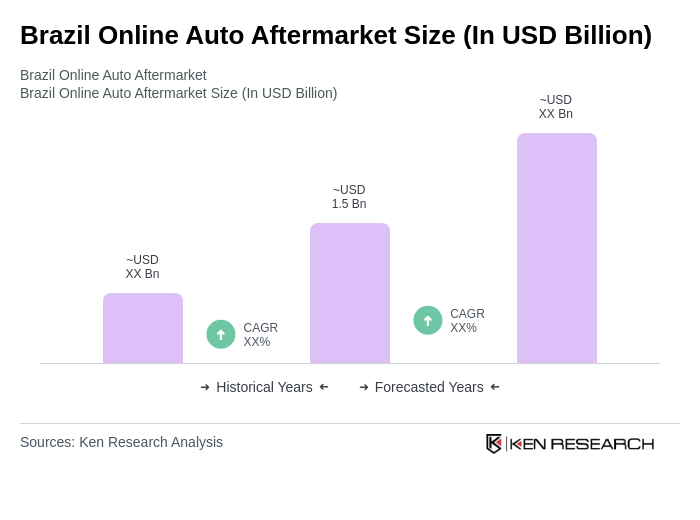
- The Brazil Online Auto Aftermarket market is valued at USD 1.5 billion, based on a five-year historical analysis. This growth is primarily driven by the increasing penetration of e-commerce, rising vehicle ownership, and a growing trend towards online shopping for auto parts and services. The convenience of online platforms, digital payment adoption, and the availability of a wide range of products have significantly contributed to the market's expansion. Additionally, the aging vehicle fleet and demand for cost-effective maintenance solutions are accelerating online aftermarket sales.
- Key cities such as São Paulo, Rio de Janeiro, and Belo Horizonte dominate the market due to their large populations, high vehicle ownership rates, and robust infrastructure. These urban centers serve as major hubs for logistics and distribution, facilitating efficient delivery and access to a variety of auto aftermarket products and services. São Paulo, in particular, leads in digital commerce volume and automotive product demand.
- In 2023, the Brazilian government implemented regulations aimed at enhancing consumer protection in the online auto aftermarket. The “Consumer Protection Code (Código de Defesa do Consumidor), Law No. 8.078/1990” is enforced by the National Consumer Secretariat (SENACON), requiring mandatory transparency in pricing and product information for all e-commerce transactions, including auto aftermarket platforms. These regulations ensure consumers are well-informed before making purchases, foster trust in online transactions, and promote fair competition among service providers.
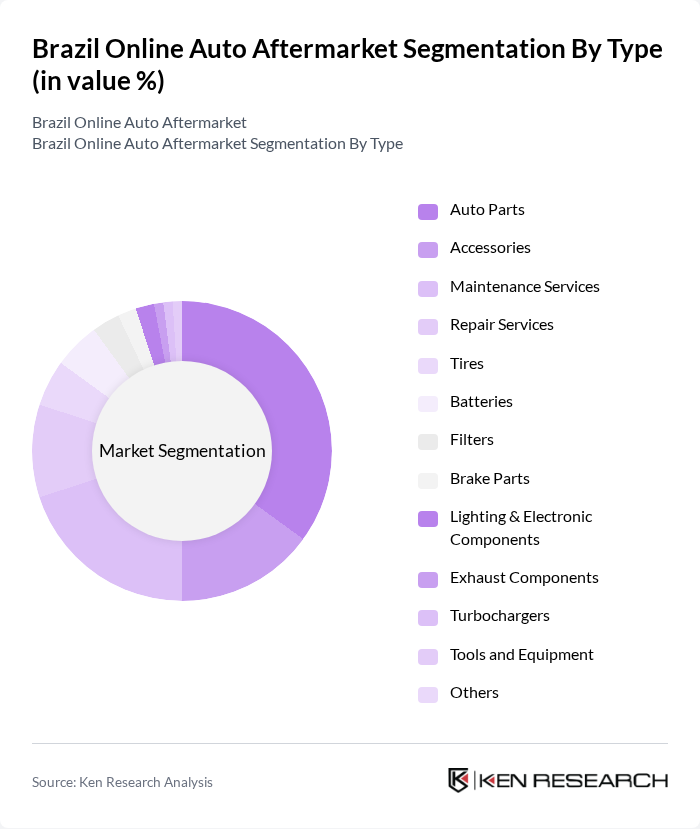
Brazil Online Auto Aftermarket Segmentation
By Type:The online auto aftermarket in Brazil is segmented into various types, including Auto Parts, Accessories, Maintenance Services, Repair Services, Tires, Batteries, Filters, Brake Parts, Lighting & Electronic Components, Exhaust Components, Turbochargers, Tools and Equipment, and Others. Among these, Auto Parts and Maintenance Services are particularly significant due to the increasing demand for vehicle upkeep and repair, with transmission, steering, and lighting components showing notable growth.
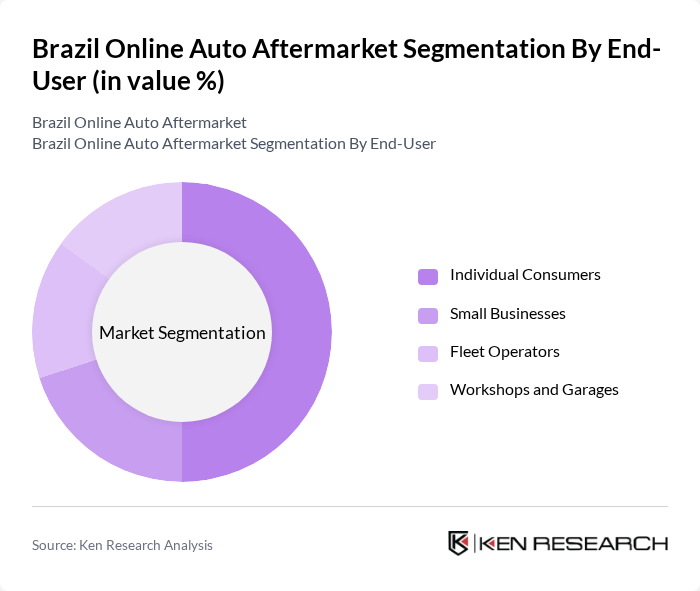
By End-User:The end-user segmentation of the online auto aftermarket includes Individual Consumers, Small Businesses, Fleet Operators, and Workshops and Garages. Individual Consumers represent the largest segment, driven by the increasing trend of DIY vehicle maintenance and repair, as well as the convenience of online shopping. Fleet operators and workshops are also increasing their online procurement for efficiency and cost savings.
Brazil Online Auto Aftermarket Competitive Landscape
The Brazil Online Auto Aftermarket market is characterized by a dynamic mix of regional and international players. Leading participants such as Mercado Livre, OLX Brasil, AutoZone Brasil, Webmotors, iCarros, Amazon Brasil, Peça Rara, Connect Parts, AutoPecasOnline, AutoFácil, Trocafiltros, Mão na Roda, Carro na Rede, Peças e Acessórios, Rede PitStop contribute to innovation, geographic expansion, and service delivery in this space.
Brazil Online Auto Aftermarket Industry Analysis
Growth Drivers
- Increasing Internet Penetration:Brazil's internet penetration rate is approximately84%with over181 millionusers accessing online services. This growth facilitates the online auto aftermarket, allowing consumers to research and purchase auto parts conveniently. The Brazilian government continues to promote digital inclusion, with penetration rates steadily rising. Enhanced connectivity supports e-commerce platforms, enabling consumers to access a wider range of products and services, thus driving market growth in the online auto aftermarket.
- Rise in E-commerce Adoption:E-commerce sales in Brazil reached approximatelyUSD 41 billion, reflecting robust growth in online retail. This trend is driven by changing consumer behaviors, with about64%of Brazilians making online purchases. The online auto aftermarket benefits from this shift, as consumers increasingly seek to purchase auto parts and accessories online. The Brazilian e-commerce market is expected to continue expanding, further bolstering the online auto aftermarket's growth potential.
- Growing Vehicle Ownership:Brazil's vehicle fleet comprises over60 millionregistered vehicles, reflecting steady growth in ownership. This increase is attributed to rising disposable incomes and urbanization, leading to higher demand for auto parts and services. As vehicle ownership continues to rise, the need for maintenance and aftermarket products will also increase, providing a substantial opportunity for online platforms to cater to this expanding consumer base in the auto aftermarket sector.
Market Challenges
- Intense Competition:The Brazilian online auto aftermarket is characterized by fierce competition, withover 200active e-commerce platforms vying for market share. Major players like Mercado Livre and OLX dominate the landscape, making it challenging for new entrants to establish a foothold. This competitive environment pressures pricing strategies and customer acquisition efforts, necessitating innovative marketing and differentiation strategies to attract and retain consumers in a crowded marketplace.
- Regulatory Compliance Issues:The Brazilian auto aftermarket faces complex regulatory frameworks, including consumer protection laws and e-commerce regulations. Compliance with these regulations can be burdensome for online platforms, particularly smaller businesses lacking resources. Approximately30%of e-commerce companies report challenges in navigating regulatory requirements, which can hinder operational efficiency and increase costs. Ensuring compliance is crucial for maintaining consumer trust and avoiding legal repercussions in this dynamic market.
Brazil Online Auto Aftermarket Future Outlook
The future of Brazil's online auto aftermarket appears promising, driven by technological advancements and evolving consumer preferences. As mobile platforms gain traction, businesses are likely to invest in user-friendly applications to enhance customer experiences. Additionally, the integration of AI and machine learning will enable personalized marketing strategies, improving customer engagement. Sustainability will also play a crucial role, with increasing demand for eco-friendly products shaping the market landscape. These trends indicate a dynamic and responsive industry poised for growth.
Market Opportunities
- Expansion of Product Offerings:Online platforms can capitalize on the growing demand for diverse auto parts by expanding their product ranges. In future, the average consumer purchased3.5auto parts online, indicating a significant opportunity for platforms to introduce new categories and brands, enhancing customer satisfaction and loyalty.
- Partnerships with Local Workshops:Collaborating with local auto repair workshops can create synergies that benefit both parties. Partnerships could facilitate service bundles, combining parts sales with installation services, thereby increasing consumer convenience and driving sales for online platforms while supporting local businesses.
Scope of the Report
| Segment | Sub-Segments |
|---|---|
| By Type | Auto Parts Accessories Maintenance Services Repair Services Tires Batteries Filters Brake Parts Lighting & Electronic Components Exhaust Components Turbochargers Tools and Equipment Others |
| By End-User | Individual Consumers Small Businesses Fleet Operators Workshops and Garages |
| By Sales Channel | Online Marketplaces Direct-to-Consumer (D2C) Platforms Third-Party E-commerce Platforms Retail Chains with Online Presence Distributors |
| By Product Category | OEM Parts Aftermarket Parts Performance Parts Remanufactured Parts |
| By Pricing Strategy | Premium Mid-range Budget |
| By Geographic Distribution | Urban Areas Suburban Areas Rural Areas |
| By Customer Demographics | Age Group Income Level Vehicle Type |
Key Target Audience
Investors and Venture Capitalist Firms
Government and Regulatory Bodies (e.g., Agência Nacional de Transportes Terrestres, Departamento Nacional de Trânsito)
Automotive Parts Manufacturers
Online Retail Platforms
Logistics and Supply Chain Companies
Automotive Service Providers
Insurance Companies
Automotive Industry Associations
Players Mentioned in the Report:
Mercado Livre
OLX Brasil
AutoZone Brasil
Webmotors
iCarros
Amazon Brasil
Peca Rara
Connect Parts
AutoPecasOnline
AutoFacil
Trocafiltros
Mao na Roda
Carro na Rede
Pecas e Acessorios
Rede PitStop
Table of Contents
Market Assessment Phase
1. Executive Summary and Approach
2. Brazil Online Auto Aftermarket Overview
2.1 Key Insights and Strategic Recommendations
2.2 Brazil Online Auto Aftermarket Overview
2.3 Definition and Scope
2.4 Evolution of Market Ecosystem
2.5 Timeline of Key Regulatory Milestones
2.6 Value Chain & Stakeholder Mapping
2.7 Business Cycle Analysis
2.8 Policy & Incentive Landscape
3. Brazil Online Auto Aftermarket Analysis
3.1 Growth Drivers
3.1.1 Increasing Internet Penetration
3.1.2 Rise in E-commerce Adoption
3.1.3 Growing Vehicle Ownership
3.1.4 Demand for Convenience and Accessibility
3.2 Market Challenges
3.2.1 Intense Competition
3.2.2 Regulatory Compliance Issues
3.2.3 Supply Chain Disruptions
3.2.4 Consumer Trust and Security Concerns
3.3 Market Opportunities
3.3.1 Expansion of Product Offerings
3.3.2 Partnerships with Local Workshops
3.3.3 Technological Innovations
3.3.4 Growing Demand for Eco-friendly Products
3.4 Market Trends
3.4.1 Shift Towards Mobile Platforms
3.4.2 Personalization of Customer Experience
3.4.3 Integration of AI and Machine Learning
3.4.4 Increasing Focus on Sustainability
3.5 Government Regulation
3.5.1 Emission Standards Compliance
3.5.2 Consumer Protection Laws
3.5.3 E-commerce Regulations
3.5.4 Tax Incentives for Green Products
4. SWOT Analysis
5. Stakeholder Analysis
6. Porter's Five Forces Analysis
7. Brazil Online Auto Aftermarket Market Size, 2019-2024
7.1 By Value
7.2 By Volume
7.3 By Average Selling Price
8. Brazil Online Auto Aftermarket Segmentation
8.1 By Type
8.1.1 Auto Parts
8.1.2 Accessories
8.1.3 Maintenance Services
8.1.4 Repair Services
8.1.5 Tires
8.1.6 Batteries
8.1.7 Filters
8.1.8 Brake Parts
8.1.9 Lighting & Electronic Components
8.1.10 Exhaust Components
8.1.11 Turbochargers
8.1.12 Tools and Equipment
8.1.13 Others
8.2 By End-User
8.2.1 Individual Consumers
8.2.2 Small Businesses
8.2.3 Fleet Operators
8.2.4 Workshops and Garages
8.3 By Sales Channel
8.3.1 Online Marketplaces
8.3.2 Direct-to-Consumer (D2C) Platforms
8.3.3 Third-Party E-commerce Platforms
8.3.4 Retail Chains with Online Presence
8.3.5 Distributors
8.4 By Product Category
8.4.1 OEM Parts
8.4.2 Aftermarket Parts
8.4.3 Performance Parts
8.4.4 Remanufactured Parts
8.5 By Pricing Strategy
8.5.1 Premium
8.5.2 Mid-range
8.5.3 Budget
8.6 By Geographic Distribution
8.6.1 Urban Areas
8.6.2 Suburban Areas
8.6.3 Rural Areas
8.7 By Customer Demographics
8.7.1 Age Group
8.7.2 Income Level
8.7.3 Vehicle Type
9. Brazil Online Auto Aftermarket Competitive Analysis
9.1 Market Share of Key Players
9.2 Cross Comparison of Key Players
9.2.1 Company Name
9.2.2 Group Size (Large, Medium, or Small as per industry convention)
9.2.3 Annual Revenue (BRL/USD)
9.2.4 Revenue Growth Rate (%)
9.2.5 Number of Monthly Active Users
9.2.6 Customer Acquisition Cost (CAC)
9.2.7 Customer Retention Rate (%)
9.2.8 Average Order Value (AOV)
9.2.9 Market Penetration Rate (%)
9.2.10 Product Return Rate (%)
9.2.11 Customer Satisfaction Score (NPS/CSAT)
9.2.12 Website/App Traffic
9.2.13 SKU Count (Product Assortment)
9.2.14 Delivery Lead Time
9.2.15 Share of Sales by Product Category
9.3 SWOT Analysis of Top Players
9.4 Pricing Analysis
9.5 Detailed Profile of Major Companies
9.5.1 Mercado Livre
9.5.2 OLX Brasil
9.5.3 AutoZone Brasil
9.5.4 Webmotors
9.5.5 iCarros
9.5.6 Amazon Brasil
9.5.7 Peça Rara
9.5.8 Connect Parts
9.5.9 AutoPecasOnline
9.5.10 AutoFácil
9.5.11 Trocafiltros
9.5.12 Mão na Roda
9.5.13 Carro na Rede
9.5.14 Peças e Acessórios
9.5.15 Rede PitStop
10. Brazil Online Auto Aftermarket End-User Analysis
10.1 Procurement Behavior of Key Ministries
10.1.1 Government Fleet Management
10.1.2 Maintenance Contracts
10.1.3 Procurement Policies
10.2 Corporate Spend on Infrastructure & Energy
10.2.1 Investment in Vehicle Maintenance
10.2.2 Budget Allocation for Fleet Upgrades
10.2.3 Spending on Eco-friendly Solutions
10.3 Pain Point Analysis by End-User Category
10.3.1 Cost of Parts
10.3.2 Availability of Services
10.3.3 Quality of Products
10.4 User Readiness for Adoption
10.4.1 Digital Literacy
10.4.2 Trust in Online Transactions
10.4.3 Awareness of Online Options
10.5 Post-Deployment ROI and Use Case Expansion
10.5.1 Cost Savings Analysis
10.5.2 Performance Metrics
10.5.3 Customer Feedback Integration
11. Brazil Online Auto Aftermarket Future Size, 2025-2030
11.1 By Value
11.2 By Volume
11.3 By Average Selling Price
Go-To-Market Strategy Phase
1. Whitespace Analysis + Business Model Canvas
1.1 Market Gaps Identification
1.2 Value Proposition Development
1.3 Revenue Streams Analysis
1.4 Key Partnerships Exploration
1.5 Customer Segmentation
1.6 Cost Structure Assessment
1.7 Competitive Advantage Analysis
2. Marketing and Positioning Recommendations
2.1 Branding Strategies
2.2 Product USPs
2.3 Target Audience Identification
2.4 Communication Channels
2.5 Promotional Tactics
2.6 Market Positioning
3. Distribution Plan
3.1 Urban Retail Strategies
3.2 Rural NGO Tie-ups
3.3 Online Distribution Channels
3.4 Logistics and Supply Chain Management
3.5 Inventory Management
4. Channel & Pricing Gaps
4.1 Underserved Routes
4.2 Pricing Bands Analysis
4.3 Competitor Pricing Strategies
4.4 Customer Price Sensitivity
5. Unmet Demand & Latent Needs
5.1 Category Gaps Identification
5.2 Consumer Segments Analysis
5.3 Emerging Trends Exploration
5.4 Product Development Opportunities
6. Customer Relationship
6.1 Loyalty Programs
6.2 After-sales Service Strategies
6.3 Customer Engagement Tactics
6.4 Feedback Mechanisms
7. Value Proposition
7.1 Sustainability Initiatives
7.2 Integrated Supply Chains
7.3 Customer-Centric Approaches
7.4 Competitive Differentiation
8. Key Activities
8.1 Regulatory Compliance
8.2 Branding Initiatives
8.3 Distribution Setup
8.4 Marketing Campaigns
9. Entry Strategy Evaluation
9.1 Domestic Market Entry Strategy
9.1.1 Product Mix
9.1.2 Pricing Band
9.1.3 Packaging
9.2 Export Entry Strategy
9.2.1 Target Countries
9.2.2 Compliance Roadmap
10. Entry Mode Assessment
10.1 Joint Ventures
10.2 Greenfield Investments
10.3 Mergers & Acquisitions
10.4 Distributor Model
11. Capital and Timeline Estimation
11.1 Capital Requirements
11.2 Timelines
12. Control vs Risk Trade-Off
12.1 Ownership vs Partnerships
13. Profitability Outlook
13.1 Breakeven Analysis
13.2 Long-term Sustainability
14. Potential Partner List
14.1 Distributors
14.2 Joint Ventures
14.3 Acquisition Targets
15. Execution Roadmap
15.1 Phased Plan for Market Entry
15.1.1 Market Setup
15.1.2 Market Entry
15.1.3 Growth Acceleration
15.1.4 Scale & Stabilize
15.2 Key Activities and Milestones
15.2.1 Activity Planning
15.2.2 Milestone Tracking
Research Methodology
Phase 1: Approach1
Desk Research
- Analysis of industry reports from Brazilian automotive associations and market research firms
- Review of government publications on automotive regulations and aftermarket policies
- Examination of online platforms and e-commerce data specific to the Brazilian auto parts market
Primary Research
- Interviews with key stakeholders in the Brazilian auto aftermarket, including suppliers and distributors
- Surveys targeting automotive repair shops and service centers to understand demand trends
- Focus groups with consumers to gauge preferences and purchasing behavior in the online auto parts sector
Validation & Triangulation
- Cross-validation of findings through multiple data sources, including sales data and consumer feedback
- Triangulation of insights from industry experts and market analysts to ensure accuracy
- Sanity checks through comparative analysis with similar markets in Latin America
Phase 2: Market Size Estimation1
Top-down Assessment
- Estimation of total market size based on national automotive sales and aftermarket growth rates
- Segmentation of the market by product categories, including parts, accessories, and services
- Incorporation of macroeconomic factors influencing consumer spending in the automotive sector
Bottom-up Modeling
- Collection of sales data from leading online auto parts retailers in Brazil
- Estimation of average transaction values and frequency of purchases in the aftermarket
- Analysis of consumer demographics to refine market segmentation and targeting strategies
Forecasting & Scenario Analysis
- Development of growth projections based on historical trends and emerging market dynamics
- Scenario modeling considering factors such as economic fluctuations and regulatory changes
- Creation of best-case, worst-case, and most-likely scenarios for market growth through 2030
Phase 3: CATI Sample Composition1
| Scope Item/Segment | Sample Size | Target Respondent Profiles |
|---|---|---|
| Online Auto Parts Retailers | 100 | eCommerce Managers, Marketing Directors |
| Automotive Repair Shops | 80 | Shop Owners, Service Managers |
| Consumer Preferences in Auto Parts | 120 | Car Owners, Automotive Enthusiasts |
| Distribution Channels Analysis | 60 | Logistics Coordinators, Supply Chain Analysts |
| Market Trends and Innovations | 50 | Industry Experts, Product Development Managers |
Frequently Asked Questions
What is the current value of the Brazil Online Auto Aftermarket?
The Brazil Online Auto Aftermarket is valued at approximately USD 1.5 billion, driven by increased e-commerce penetration, rising vehicle ownership, and a growing trend towards online shopping for auto parts and services.
Which cities are the main hubs for the Brazil Online Auto Aftermarket?
What are the main types of products in the Brazil Online Auto Aftermarket?
Who are the primary end-users in the Brazil Online Auto Aftermarket?
Other Regional/Country Reports
Indonesia Online Auto Aftermarket Platforms Market
Malaysia Online Auto Aftermarket Platforms Market
KSA Online Auto Aftermarket Platforms Market
APAC Online Auto Aftermarket Platforms Market
SEA Online Auto Aftermarket Platforms Market
Vietnam Online Auto Aftermarket Platforms Market
Other Adjacent Reports
Thailand Automotive E-commerce Market
Belgium Auto Parts Retail Market
UAE Vehicle Maintenance Services Market
Indonesia Tire Manufacturing Market
UAE Battery Supply Market
KSA Automotive Accessories Market
Bahrain Logistics and Distribution Market
Bahrain digital payment solutions market size, share, growth drivers, trends, opportunities & forecast 2025–2030Egypt Vehicle Insurance Market
UAE Used Car Sales Market
Why Buy From Us?

What makes us stand out is that our consultants follow Robust, Refine and Result (RRR) methodology. Robust for clear definitions, approaches and sanity checking, Refine for differentiating respondents' facts and opinions, and Result for presenting data with story.

We have set a benchmark in the industry by offering our clients with syndicated and customized market research reports featuring coverage of entire market as well as meticulous research and analyst insights.

While we don't replace traditional research, we flip the method upside down. Our dual approach of Top Bottom & Bottom Top ensures quality deliverable by not just verifying company fundamentals but also looking at the sector and macroeconomic factors.

With one step in the future, our research team constantly tries to show you the bigger picture. We help with some of the tough questions you may encounter along the way: How is the industry positioned? Best marketing channel? KPI's of competitors? By aligning every element, we help maximize success.

Our report gives you instant access to the answers and sources that other companies might choose to hide. We elaborate each steps of research methodology we have used and showcase you the sample size to earn your trust.

If you need any support, we are here! We pride ourselves on universe strength, data quality, and quick, friendly, and professional service.