About the Report
Base Year 2024Canada Luxury Real Estate Market Overview
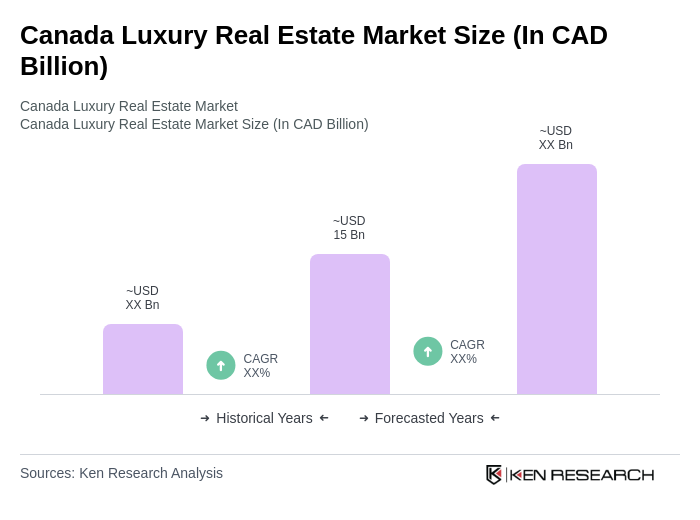
- The Canada Luxury Real Estate Market is valued at CAD 15 billion, based on a five-year historical analysis. This growth is primarily driven by increasing demand from affluent buyers, foreign investments, and a robust economy that supports high-value transactions. The luxury segment has seen a surge in interest, particularly in urban areas, as buyers seek exclusive properties that offer both comfort and status.
- Key cities dominating the luxury real estate market include Toronto, Vancouver, and Montreal. Toronto stands out due to its diverse economy and cultural attractions, while Vancouver is favored for its stunning natural landscapes and lifestyle. Montreal, with its rich history and vibrant arts scene, also attracts high-net-worth individuals, making these cities prime locations for luxury property investments.
- In 2023, the Canadian government implemented a foreign buyer ban aimed at cooling the housing market and making homes more accessible to local buyers. This regulation restricts non-residents from purchasing residential properties, which is expected to impact the luxury segment by limiting foreign investments and encouraging domestic ownership.
Canada Luxury Real Estate Market Segmentation
By Type:The luxury real estate market in Canada can be segmented into various types, including Single-Family Homes, Condominiums, Townhouses, Luxury Estates, Waterfront Properties, Ski Resort Properties, and Others. Each of these subsegments caters to different consumer preferences and investment strategies, with unique features and amenities that appeal to affluent buyers.
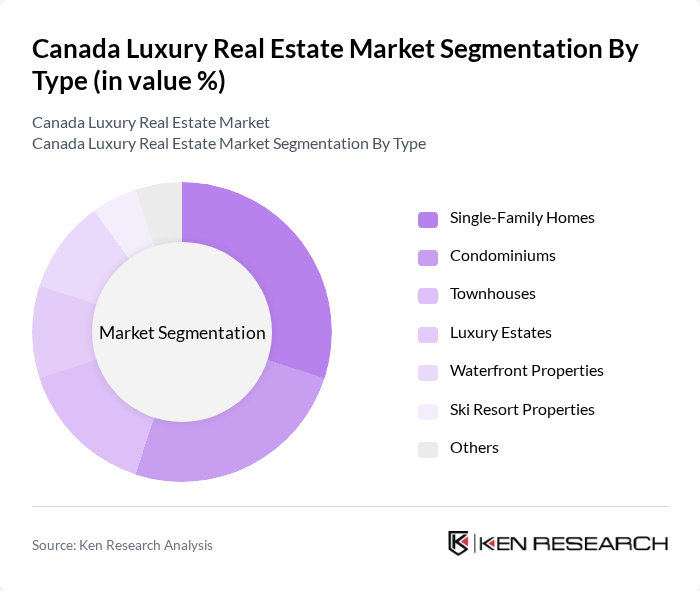
The Single-Family Homes subsegment dominates the luxury real estate market in Canada, driven by consumer preferences for privacy, space, and customization. These properties often feature expansive lots, high-end finishes, and desirable locations, making them highly sought after by affluent buyers. The trend towards remote work has also increased demand for larger homes that can accommodate home offices and leisure spaces, further solidifying the position of single-family homes as the leading choice in the luxury market.
By End-User:The luxury real estate market can also be segmented by end-user categories, including Primary Residences, Vacation Homes, Investment Properties, and Corporate Housing. Each category reflects different buyer motivations, from personal use to investment strategies, influencing the types of properties that are in demand.
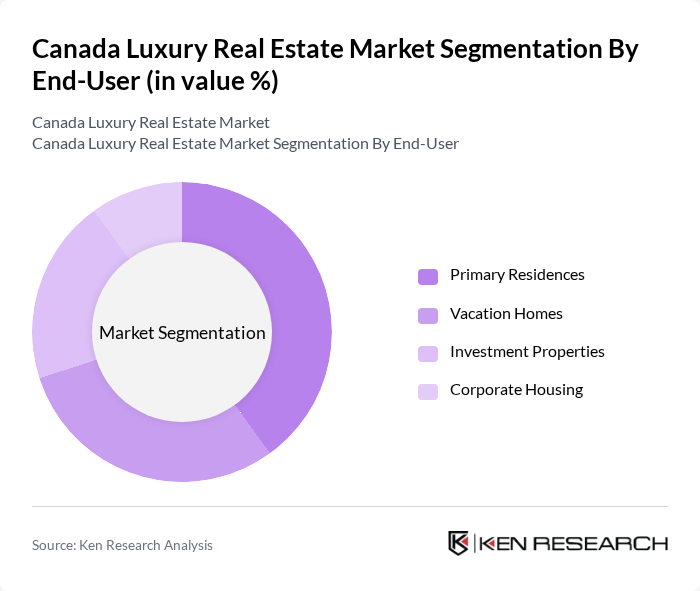
Primary Residences represent the largest segment in the luxury real estate market, as affluent buyers prioritize purchasing homes that serve as their main living spaces. This trend is fueled by a desire for stability and investment in quality living environments. Additionally, the rise in remote work has led many high-net-worth individuals to seek larger homes that accommodate both personal and professional needs, further driving demand in this category.
Canada Luxury Real Estate Market Competitive Landscape
The Canada Luxury Real Estate Market is characterized by a dynamic mix of regional and international players. Leading participants such as Sotheby's International Realty Canada, Engel & Völkers, Royal LePage, RE/MAX, Coldwell Banker, The Agency, Bosley Real Estate Ltd., Oakwyn Realty Ltd., Century 21, Harvey Kalles Real Estate, Johnston & Daniel, Chestnut Park Real Estate Limited, Remax Hallmark Realty Ltd., Right at Home Realty Inc., Forest Hill Real Estate Inc. contribute to innovation, geographic expansion, and service delivery in this space.
Canada Luxury Real Estate Market Industry Analysis
Growth Drivers
- High Net-Worth Individual Growth:The number of high net-worth individuals (HNWIs) in Canada has surged, with over 1.5 million individuals possessing assets exceeding CAD 1 million in the future. This growth is projected to continue, driven by a robust economy and favorable investment conditions. The wealth accumulation among HNWIs is expected to fuel demand for luxury properties, particularly in urban centers like Toronto and Vancouver, where the average luxury home price reached CAD 2.5 million in the future, reflecting a 10% increase from the previous year.
- Urbanization Trends:Canada’s urban population is projected to reach 38 million in the future, with cities like Toronto and Vancouver experiencing significant growth. This urbanization trend is accompanied by a demand for luxury real estate, as individuals seek upscale living environments. The urban housing market has seen a 15% increase in luxury property transactions in the future, driven by the influx of professionals and families seeking proximity to amenities and employment opportunities, further enhancing the appeal of luxury real estate.
- Foreign Investment Influx:Foreign investments in Canadian real estate reached CAD 13 billion in the future, with a significant portion directed towards luxury properties. This influx is primarily driven by investors from Asia and Europe, attracted by Canada’s stable economy and favorable immigration policies. The demand from foreign buyers has led to a 20% increase in luxury property sales in key markets, contributing to the overall growth of the luxury real estate sector and enhancing market dynamics in urban areas.
Market Challenges
- Economic Uncertainty:The Canadian economy faces challenges, including inflation rates projected at 3.5% in the future, which may impact consumer confidence and spending. Economic uncertainty can lead to hesitancy among potential luxury homebuyers, affecting sales volumes. Additionally, fluctuations in interest rates, which are expected to rise to 5% in the future, could further deter investment in high-value properties, creating a challenging environment for luxury real estate transactions.
- Regulatory Hurdles:The luxury real estate market in Canada is increasingly affected by regulatory challenges, including foreign buyer taxes that have been implemented in several provinces. For instance, British Columbia's foreign buyer tax stands at 20%, significantly impacting foreign investment. Additionally, zoning laws and property transfer taxes can complicate transactions, leading to delays and increased costs for buyers and developers, ultimately hindering market growth and investment potential.
Canada Luxury Real Estate Market Future Outlook
The future of the Canada luxury real estate market appears promising, driven by ongoing urbanization and a growing affluent population. As cities expand, the demand for luxury properties is expected to rise, particularly in emerging markets outside major urban centers. Additionally, technological advancements in real estate transactions and a shift towards sustainable living will likely shape the market landscape, creating new opportunities for developers and investors. The integration of smart home technologies will further enhance property appeal, attracting discerning buyers.
Market Opportunities
- Emerging Markets in Secondary Cities:Secondary cities like Calgary and Ottawa are witnessing a surge in luxury real estate demand, with property values increasing by 12% in the future. These markets offer opportunities for developers to create upscale living spaces, catering to affluent buyers seeking more affordable options outside major urban centers, thus diversifying investment portfolios and reducing market saturation risks.
- Eco-Friendly Luxury Developments:The demand for eco-friendly luxury properties is on the rise, with 30% of buyers prioritizing sustainability in their purchasing decisions. Developers can capitalize on this trend by incorporating green technologies and sustainable materials into new projects, appealing to environmentally conscious consumers and potentially commanding higher prices, thereby enhancing profitability and market competitiveness.
Scope of the Report
| Segment | Sub-Segments |
|---|---|
| By Type | Single-Family Homes Condominiums Townhouses Luxury Estates Waterfront Properties Ski Resort Properties Others |
| By End-User | Primary Residences Vacation Homes Investment Properties Corporate Housing |
| By Price Range | Below CAD 1 Million CAD 1 Million - CAD 3 Million CAD 3 Million - CAD 5 Million Above CAD 5 Million |
| By Location | Urban Centers Suburban Areas Rural Locations |
| By Property Features | Smart Home Features Eco-Friendly Designs Luxury Amenities |
| By Investment Type | Direct Ownership Real Estate Investment Trusts (REITs) Fractional Ownership |
| By Sales Channel | Real Estate Agents Online Platforms Auctions Direct Sales |
Key Target Audience
Investors and Venture Capitalist Firms
Government and Regulatory Bodies (e.g., Canada Mortgage and Housing Corporation, Financial Transactions and Reports Analysis Centre of Canada)
High-Net-Worth Individuals (HNWIs)
Luxury Real Estate Developers
Real Estate Investment Trusts (REITs)
Wealth Management Firms
Luxury Property Management Companies
International Buyers and Foreign Investors
Players Mentioned in the Report:
Sotheby's International Realty Canada
Engel & Volkers
Royal LePage
RE/MAX
Coldwell Banker
The Agency
Bosley Real Estate Ltd.
Oakwyn Realty Ltd.
Century 21
Harvey Kalles Real Estate
Johnston & Daniel
Chestnut Park Real Estate Limited
Remax Hallmark Realty Ltd.
Right at Home Realty Inc.
Forest Hill Real Estate Inc.
Table of Contents
Market Assessment Phase
1. Executive Summary and Approach
2. Canada Luxury Real Estate Market Overview
2.1 Key Insights and Strategic Recommendations
2.2 Canada Luxury Real Estate Market Overview
2.3 Definition and Scope
2.4 Evolution of Market Ecosystem
2.5 Timeline of Key Regulatory Milestones
2.6 Value Chain & Stakeholder Mapping
2.7 Business Cycle Analysis
2.8 Policy & Incentive Landscape
3. Canada Luxury Real Estate Market Analysis
3.1 Growth Drivers
3.1.1 High Net-Worth Individual Growth
3.1.2 Urbanization Trends
3.1.3 Foreign Investment Influx
3.1.4 Luxury Lifestyle Demand
3.2 Market Challenges
3.2.1 Economic Uncertainty
3.2.2 Regulatory Hurdles
3.2.3 Market Saturation in Key Areas
3.2.4 High Maintenance Costs
3.3 Market Opportunities
3.3.1 Emerging Markets in Secondary Cities
3.3.2 Eco-Friendly Luxury Developments
3.3.3 Technological Integration in Real Estate
3.3.4 Customization and Personalization Trends
3.4 Market Trends
3.4.1 Increased Demand for Smart Homes
3.4.2 Rise of Co-Living Spaces
3.4.3 Shift Towards Sustainable Properties
3.4.4 Growth of Virtual Real Estate Tours
3.5 Government Regulation
3.5.1 Foreign Buyer Tax Regulations
3.5.2 Zoning Laws and Restrictions
3.5.3 Property Transfer Tax Changes
3.5.4 Environmental Compliance Standards
4. SWOT Analysis
5. Stakeholder Analysis
6. Porter's Five Forces Analysis
7. Canada Luxury Real Estate Market Market Size, 2019-2024
7.1 By Value
7.2 By Volume
7.3 By Average Selling Price
8. Canada Luxury Real Estate Market Segmentation
8.1 By Type
8.1.1 Single-Family Homes
8.1.2 Condominiums
8.1.3 Townhouses
8.1.4 Luxury Estates
8.1.5 Waterfront Properties
8.1.6 Ski Resort Properties
8.1.7 Others
8.2 By End-User
8.2.1 Primary Residences
8.2.2 Vacation Homes
8.2.3 Investment Properties
8.2.4 Corporate Housing
8.3 By Price Range
8.3.1 Below CAD 1 Million
8.3.2 CAD 1 Million - CAD 3 Million
8.3.3 CAD 3 Million - CAD 5 Million
8.3.4 Above CAD 5 Million
8.4 By Location
8.4.1 Urban Centers
8.4.2 Suburban Areas
8.4.3 Rural Locations
8.5 By Property Features
8.5.1 Smart Home Features
8.5.2 Eco-Friendly Designs
8.5.3 Luxury Amenities
8.6 By Investment Type
8.6.1 Direct Ownership
8.6.2 Real Estate Investment Trusts (REITs)
8.6.3 Fractional Ownership
8.7 By Sales Channel
8.7.1 Real Estate Agents
8.7.2 Online Platforms
8.7.3 Auctions
8.7.4 Direct Sales
9. Canada Luxury Real Estate Market Competitive Analysis
9.1 Market Share of Key Players
9.2 Cross Comparison of Key Players
9.2.1 Company Name
9.2.2 Group Size (Large, Medium, or Small as per industry convention)
9.2.3 Revenue Growth Rate
9.2.4 Market Penetration Rate
9.2.5 Customer Satisfaction Index
9.2.6 Pricing Strategy
9.2.7 Average Days on Market
9.2.8 Lead Conversion Rate
9.2.9 Return on Investment (ROI)
9.2.10 Brand Recognition Score
9.3 SWOT Analysis of Top Players
9.4 Pricing Analysis
9.5 Detailed Profile of Major Companies
9.5.1 Sotheby's International Realty Canada
9.5.2 Engel & Völkers
9.5.3 Royal LePage
9.5.4 RE/MAX
9.5.5 Coldwell Banker
9.5.6 The Agency
9.5.7 Bosley Real Estate Ltd.
9.5.8 Oakwyn Realty Ltd.
9.5.9 Century 21
9.5.10 Harvey Kalles Real Estate
9.5.11 Johnston & Daniel
9.5.12 Chestnut Park Real Estate Limited
9.5.13 Remax Hallmark Realty Ltd.
9.5.14 Right at Home Realty Inc.
9.5.15 Forest Hill Real Estate Inc.
10. Canada Luxury Real Estate Market End-User Analysis
10.1 Procurement Behavior of Key Ministries
10.1.1 Government Housing Initiatives
10.1.2 Budget Allocations for Luxury Developments
10.1.3 Collaboration with Private Sector
10.2 Corporate Spend on Infrastructure & Energy
10.2.1 Investment in Sustainable Developments
10.2.2 Corporate Real Estate Portfolios
10.2.3 Partnerships with Luxury Developers
10.3 Pain Point Analysis by End-User Category
10.3.1 Affordability Concerns
10.3.2 Availability of Desired Locations
10.3.3 Quality of Construction
10.4 User Readiness for Adoption
10.4.1 Awareness of Luxury Market Trends
10.4.2 Financial Preparedness
10.4.3 Interest in Smart Home Technologies
10.5 Post-Deployment ROI and Use Case Expansion
10.5.1 Long-Term Value Appreciation
10.5.2 Rental Income Potential
10.5.3 Market Resale Opportunities
11. Canada Luxury Real Estate Market Future Size, 2025-2030
11.1 By Value
11.2 By Volume
11.3 By Average Selling Price
Go-To-Market Strategy Phase
1. Whitespace Analysis + Business Model Canvas
1.1 Market Gaps Identification
1.2 Value Proposition Development
1.3 Revenue Streams Analysis
1.4 Customer Segmentation
1.5 Key Partnerships
1.6 Cost Structure
1.7 Channels of Distribution
2. Marketing and Positioning Recommendations
2.1 Branding Strategies
2.2 Product USPs
2.3 Target Audience Identification
2.4 Marketing Channels
2.5 Promotional Strategies
3. Distribution Plan
3.1 Urban Retail vs Rural NGO Tie-ups
3.2 Online vs Offline Sales Strategies
3.3 Partnerships with Real Estate Platforms
3.4 Logistics and Supply Chain Management
4. Channel & Pricing Gaps
4.1 Underserved Routes
4.2 Pricing Bands
4.3 Competitive Pricing Analysis
4.4 Customer Feedback on Pricing
5. Unmet Demand & Latent Needs
5.1 Category Gaps
5.2 Consumer Segments
5.3 Emerging Trends
5.4 Future Demand Projections
6. Customer Relationship
6.1 Loyalty Programs
6.2 After-sales Service
6.3 Customer Engagement Strategies
6.4 Feedback Mechanisms
7. Value Proposition
7.1 Sustainability
7.2 Integrated Supply Chains
7.3 Unique Selling Points
7.4 Customer-Centric Approaches
8. Key Activities
8.1 Regulatory Compliance
8.2 Branding
8.3 Distribution Setup
8.4 Market Research
9. Entry Strategy Evaluation
9.1 Domestic Market Entry Strategy
9.1.1 Product Mix
9.1.2 Pricing Band
9.1.3 Packaging
9.2 Export Entry Strategy
9.2.1 Target Countries
9.2.2 Compliance Roadmap
10. Entry Mode Assessment
10.1 Joint Ventures
10.2 Greenfield Investments
10.3 Mergers & Acquisitions
10.4 Distributor Model
11. Capital and Timeline Estimation
11.1 Capital Requirements
11.2 Timelines
12. Control vs Risk Trade-Off
12.1 Ownership vs Partnerships
13. Profitability Outlook
13.1 Breakeven Analysis
13.2 Long-term Sustainability
14. Potential Partner List
14.1 Distributors
14.2 Joint Ventures
14.3 Acquisition Targets
15. Execution Roadmap
15.1 Phased Plan for Market Entry
15.1.1 Market Setup
15.1.2 Market Entry
15.1.3 Growth Acceleration
15.1.4 Scale & Stabilize
15.2 Key Activities and Milestones
15.2.1 Activity Planning
15.2.2 Milestone Tracking
Research Methodology
Phase 1: Approach1
Desk Research
- Analysis of real estate market reports from Canadian Real Estate Association (CREA)
- Review of luxury property listings and sales data from MLS and other real estate platforms
- Examination of economic indicators and demographic trends affecting luxury real estate demand
Primary Research
- Interviews with luxury real estate agents and brokers specializing in high-end properties
- Surveys with affluent homebuyers to understand preferences and purchasing behavior
- Focus groups with real estate developers to gather insights on market trends and challenges
Validation & Triangulation
- Cross-validation of findings with multiple data sources, including government statistics and industry reports
- Triangulation of qualitative insights from interviews with quantitative data from market analysis
- Sanity checks through expert panel reviews consisting of real estate economists and market analysts
Phase 2: Market Size Estimation1
Top-down Assessment
- Estimation of total luxury real estate market size based on national housing market data
- Segmentation of market by province and major urban centers with high luxury property sales
- Incorporation of macroeconomic factors such as GDP growth and foreign investment trends
Bottom-up Modeling
- Analysis of sales data from top luxury real estate firms to establish average transaction values
- Estimation of the number of luxury properties sold annually based on historical trends
- Calculation of market size using volume of sales multiplied by average price per property
Forecasting & Scenario Analysis
- Multi-factor regression analysis incorporating interest rates, consumer confidence, and foreign buyer activity
- Scenario modeling based on potential changes in government policy affecting foreign ownership
- Development of baseline, optimistic, and pessimistic market forecasts through 2030
Phase 3: CATI Sample Composition1
| Scope Item/Segment | Sample Size | Target Respondent Profiles |
|---|---|---|
| Luxury Home Buyers | 150 | Affluent Individuals, Real Estate Investors |
| Real Estate Agents | 100 | Luxury Property Specialists, Brokers |
| Developers of Luxury Properties | 80 | Real Estate Developers, Project Managers |
| Financial Advisors | 70 | Wealth Managers, Investment Consultants |
| Luxury Property Management Firms | 60 | Property Managers, Operations Directors |
Frequently Asked Questions
What is the current value of the Canada luxury real estate market?
The Canada luxury real estate market is valued at approximately CAD 15 billion, driven by increasing demand from affluent buyers, foreign investments, and a strong economy that supports high-value transactions, particularly in urban areas.
Which cities are the main hubs for luxury real estate in Canada?
How has the foreign buyer ban affected the luxury real estate market in Canada?
What types of properties are included in the luxury real estate market in Canada?
Other Regional/Country Reports
Indonesia Luxury Real Estate Market
Malaysia Luxury Real Estate Market
KSA Luxury Real Estate Market
APAC Luxury Real Estate Market
SEA Luxury Real Estate Market
Other Adjacent Reports
Singapore Luxury Property Management Market
Mexico High-End Interior Design Market
Oman Real Estate Investment Trust Market
Singapore Luxury Home Construction Market
Mexico Vacation Home Rental Market
Saudi Arabia Commercial Real Estate MarketJapan Real Estate Technology Market
Germany Sustainable Luxury Development Market
South Africa Property Insurance Market
Germany Home Automation Systems Market
Why Buy From Us?

What makes us stand out is that our consultants follow Robust, Refine and Result (RRR) methodology. Robust for clear definitions, approaches and sanity checking, Refine for differentiating respondents' facts and opinions, and Result for presenting data with story.

We have set a benchmark in the industry by offering our clients with syndicated and customized market research reports featuring coverage of entire market as well as meticulous research and analyst insights.

While we don't replace traditional research, we flip the method upside down. Our dual approach of Top Bottom & Bottom Top ensures quality deliverable by not just verifying company fundamentals but also looking at the sector and macroeconomic factors.

With one step in the future, our research team constantly tries to show you the bigger picture. We help with some of the tough questions you may encounter along the way: How is the industry positioned? Best marketing channel? KPI's of competitors? By aligning every element, we help maximize success.

Our report gives you instant access to the answers and sources that other companies might choose to hide. We elaborate each steps of research methodology we have used and showcase you the sample size to earn your trust.

If you need any support, we are here! We pride ourselves on universe strength, data quality, and quick, friendly, and professional service.