About the Report
Base Year 2024China Mortgage Loan Brokers Market Overview
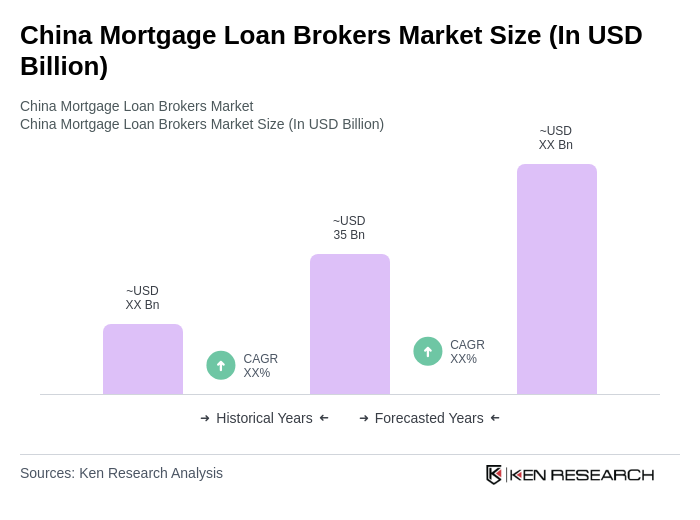
- The China Mortgage/Loan Brokers Market is valued at approximately USD 35 billion, based on a five?year historical analysis. This market is supported by housing demand from urbanization and a large middle class, along with ongoing policy support to stabilize housing and improve mortgage access, including measures to reduce down?payments and mortgage rates for first homes.
- Key cities such as Beijing, Shanghai, and Shenzhen drive activity due to their economic weight, population density, and deep real?estate markets where major lenders and broker platforms concentrate, reinforcing higher mortgage origination volumes and service availability in these hubs.
- In 2023, authorities advanced streamlining measures in the mortgage process as part of broader real?estate stabilization—local implementations included cuts to minimum down?payments, relaxation of “first?home” definitions, and lower mortgage rates for first?time buyers, aimed at improving approval efficiency and supporting end?user demand.
China Mortgage Loan Brokers Market Segmentation
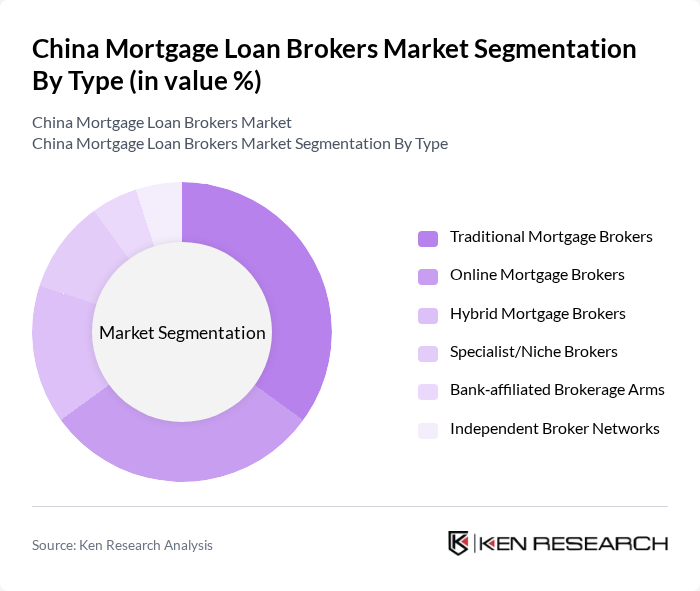
By Type:The market is segmented into various types of mortgage brokers, including traditional, online, hybrid, specialist/niche brokers, bank-affiliated brokerage arms, and independent broker networks. Traditional mortgage brokers remain important where in?person advisory and lender relationships are critical, while online channels are expanding quickly as fintech platforms digitize pre?qualification, document collection, and lender matching. Hybrid brokers combining offline advisory with online workflow are gaining adoption as consumers seek convenience with human guidance.
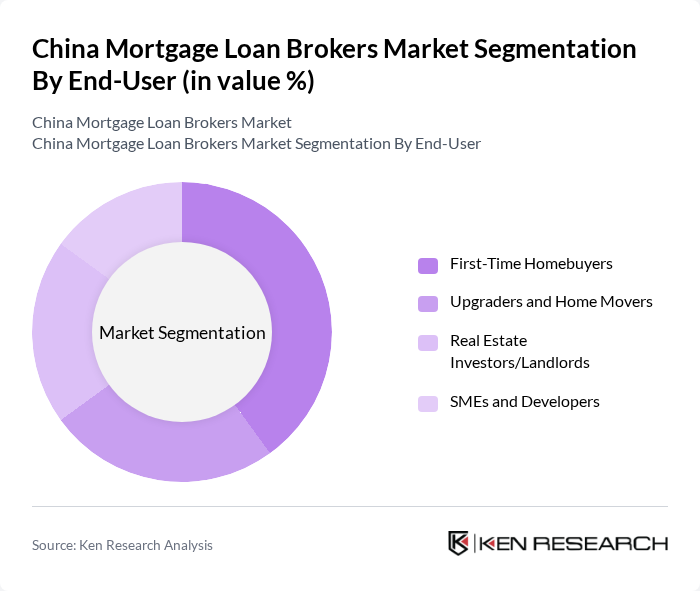
By End-User:The end?user segmentation includes first-time homebuyers, upgraders and home movers, real estate investors/landlords, and SMEs and developers. First?time homebuyers constitute the largest demand driver due to policy incentives and relaxed first?home criteria; upgraders/home movers contribute as households seek better locations and amenities; investors use brokers to compare loan terms amid tighter developer conditions; SMEs and developers access broker channels for collateralized and project?linked financing.
China Mortgage Loan Brokers Market Competitive Landscape
The China Mortgage Loan Brokers Market is characterized by a dynamic mix of regional and international players. Leading participants such as Lianjia (Beijing) Technology Co., Ltd. (????/??), E-House (China) Enterprise Holdings Limited (??????), Ke Holdings Inc. (Beike Zhaofang, ????), 58.com Inc. (58??, Anjuke ???), Ping An Bank Co., Ltd. – Mortgage Brokerage/Partnership Channels, China Merchants Bank Co., Ltd. – Retail Mortgage Partnership Channels, Industrial and Commercial Bank of China – Third-party Broker Partnerships, China Construction Bank – Broker and Agency Collaboration Programs, Bank of China – Retail Mortgage Collaboration Networks, China CITIC Bank – Consumer Mortgage Channels, China Minsheng Bank – Retail Mortgage Partnerships, Shanghai Pudong Development Bank – Mortgage Channel Partnerships, ZhongAn Online P&C Insurance Co., Ltd. – Digital Credit Facilitation, Lufax Holding Ltd. (???) – Online Lending & Mortgage Facilitation, Yixin Group Limited (????) – Auto/Collateral Finance Platform with Brokerage Tie?ins contribute to innovation, geographic expansion, and service delivery in this space.
China Mortgage Loan Brokers Market Industry Analysis
Growth Drivers
- Increasing Urbanization:Urbanization in China is accelerating, with the urban population projected to reach 65% in future, up from 61% in 2020. This shift is driving demand for housing, leading to an increase in mortgage applications. The National Bureau of Statistics reported that urban housing sales reached 1.5 trillion yuan in future, indicating a robust market for mortgage loan brokers. As more individuals seek homeownership, brokers play a crucial role in facilitating these transactions.
- Rising Middle-Class Income:The middle-class population in China is expected to exceed 550 million in future, with average disposable income projected to rise to 42,000 yuan annually. This increase in income enhances purchasing power, enabling more families to consider homeownership. According to the China Household Finance Survey, 70% of middle-class families are looking to buy homes, creating a significant opportunity for mortgage loan brokers to cater to this expanding demographic.
- Government Housing Initiatives:The Chinese government has implemented various housing initiatives, including the "Housing for All" policy, which aims to provide affordable housing options. In future, the government allocated 1 trillion yuan for housing development projects. These initiatives are expected to stimulate the mortgage market, as more citizens will require financing options. Consequently, mortgage loan brokers are positioned to benefit from increased demand for loans associated with these government-backed housing projects.
Market Challenges
- Regulatory Compliance Issues:The mortgage loan brokerage sector in China faces stringent regulatory compliance requirements. In future, the China Banking and Insurance Regulatory Commission issued new guidelines that increased the compliance burden on brokers, requiring them to adhere to 15 new regulations. This complexity can hinder operational efficiency and increase costs, making it challenging for brokers to maintain profitability while ensuring compliance with evolving regulations.
- High Competition Among Brokers:The mortgage brokerage market in China is highly competitive, with over 10,000 registered brokers in future. This saturation leads to price wars and reduced profit margins. According to industry reports, the average commission for brokers has decreased by 20% over the past three years. As competition intensifies, brokers must differentiate their services to attract clients, which can strain resources and impact overall market stability.
China Mortgage Loan Brokers Market Future Outlook
The future of the China mortgage loan brokers market appears promising, driven by ongoing urbanization and rising incomes. As digital platforms continue to expand, brokers will increasingly leverage technology to streamline processes and enhance customer experiences. Additionally, the integration of artificial intelligence in loan processing is expected to improve efficiency and reduce turnaround times. These trends indicate a shift towards more innovative and customer-centric services, positioning brokers to capitalize on emerging opportunities in the evolving housing market.
Market Opportunities
- Expansion of Digital Platforms:The rise of digital platforms presents a significant opportunity for mortgage loan brokers. With over 1 billion internet users in China, brokers can utilize online channels to reach potential clients more effectively. By offering digital mortgage applications and consultations, brokers can streamline the process, attract tech-savvy customers, and enhance overall service delivery.
- Collaboration with Financial Institutions:Collaborating with banks and financial institutions can create synergies for mortgage loan brokers. By forming partnerships, brokers can access exclusive loan products and competitive rates, enhancing their service offerings. In future, partnerships between brokers and banks increased by 30%, indicating a growing trend that can lead to improved customer satisfaction and increased market share for brokers.
Scope of the Report
| Segment | Sub-Segments |
|---|---|
| By Type | Traditional Mortgage Brokers Online Mortgage Brokers Hybrid Mortgage Brokers Specialist/Niche Brokers (e.g., self-employed, foreign buyers) Bank?affiliated Brokerage Arms Independent Broker Networks |
| By End-User | First-Time Homebuyers Upgraders and Home Movers Real Estate Investors/Landlords SMEs and Developers (Commercial/Mixed?use) |
| By Loan Type | Residential Mortgages (Purchase) Commercial Mortgages Refinancing/Rate?Switch Mortgages Home Equity/Second?lien Loans |
| By Service Model | Full?Service Advisory (end?to?end) Execution?Only/Comparison?Led Online?Only/Digital Brokerage |
| By Distribution Channel | Direct?to?Consumer (D2C) Partnerships with Real Estate Agencies/Developers Online Marketplaces & Aggregators |
| By Customer Demographics | Millennials/Gen Y Gen X Affluent/HNW Individuals |
| By Policy Support | First?home Buyer Support Policies LPR?linked Rate Adjustments/Refinancing Windows Government?Backed Loan Programs (e.g., provident fund) |
Key Target Audience
Investors and Venture Capitalist Firms
Government and Regulatory Bodies (e.g., People's Bank of China, China Banking and Insurance Regulatory Commission)
Real Estate Developers
Mortgage Insurance Providers
Financial Institutions (e.g., Commercial Banks, Credit Unions)
Property Management Companies
Real Estate Investment Trusts (REITs)
Technology Providers for Financial Services
Players Mentioned in the Report:
Lianjia (Beijing) Technology Co., Ltd. (/)
E-House (China) Enterprise Holdings Limited ()
Ke Holdings Inc. (Beike Zhaofang, )
58.com Inc. (58, Anjuke )
Ping An Bank Co., Ltd. Mortgage Brokerage/Partnership Channels
China Merchants Bank Co., Ltd. Retail Mortgage Partnership Channels
Industrial and Commercial Bank of China Thirdparty Broker Partnerships
China Construction Bank Broker and Agency Collaboration Programs
Bank of China Retail Mortgage Collaboration Networks
China CITIC Bank Consumer Mortgage Channels
China Minsheng Bank Retail Mortgage Partnerships
Shanghai Pudong Development Bank Mortgage Channel Partnerships
ZhongAn Online P&C Insurance Co., Ltd. Digital Credit Facilitation
Lufax Holding Ltd. () Online Lending & Mortgage Facilitation
Yixin Group Limited () Auto/Collateral Finance Platform with Brokerage Tieins
Table of Contents
Market Assessment Phase
1. Executive Summary and Approach
2. China Mortgage Loan Brokers Market Overview
2.1 Key Insights and Strategic Recommendations
2.2 China Mortgage Loan Brokers Market Overview
2.3 Definition and Scope
2.4 Evolution of Market Ecosystem
2.5 Timeline of Key Regulatory Milestones
2.6 Value Chain & Stakeholder Mapping
2.7 Business Cycle Analysis
2.8 Policy & Incentive Landscape
3. China Mortgage Loan Brokers Market Analysis
3.1 Growth Drivers
3.1.1 Increasing Urbanization
3.1.2 Rising Middle-Class Income
3.1.3 Government Housing Initiatives
3.1.4 Technological Advancements in Financial Services
3.2 Market Challenges
3.2.1 Regulatory Compliance Issues
3.2.2 High Competition Among Brokers
3.2.3 Economic Fluctuations
3.2.4 Consumer Trust and Awareness
3.3 Market Opportunities
3.3.1 Expansion of Digital Platforms
3.3.2 Collaboration with Financial Institutions
3.3.3 Niche Market Segmentation
3.3.4 Increased Demand for Sustainable Housing
3.4 Market Trends
3.4.1 Growth of Online Mortgage Services
3.4.2 Integration of AI in Loan Processing
3.4.3 Shift Towards Eco-Friendly Financing
3.4.4 Rise of Peer-to-Peer Lending Models
3.5 Government Regulation
3.5.1 Mortgage Rate Caps
3.5.2 Consumer Protection Laws
3.5.3 Licensing Requirements for Brokers
3.5.4 Data Privacy Regulations
4. SWOT Analysis
5. Stakeholder Analysis
6. Porter's Five Forces Analysis
7. China Mortgage Loan Brokers Market Market Size, 2019-2024
7.1 By Value
7.2 By Volume
7.3 By Average Selling Price
8. China Mortgage Loan Brokers Market Segmentation
8.1 By Type
8.1.1 Traditional Mortgage Brokers
8.1.2 Online Mortgage Brokers
8.1.3 Hybrid Mortgage Brokers
8.1.4 Specialist/Niche Brokers (e.g., self-employed, foreign buyers)
8.1.5 Bank?affiliated Brokerage Arms
8.1.6 Independent Broker Networks
8.2 By End-User
8.2.1 First-Time Homebuyers
8.2.2 Upgraders and Home Movers
8.2.3 Real Estate Investors/Landlords
8.2.4 SMEs and Developers (Commercial/Mixed?use)
8.3 By Loan Type
8.3.1 Residential Mortgages (Purchase)
8.3.2 Commercial Mortgages
8.3.3 Refinancing/Rate?Switch Mortgages
8.3.4 Home Equity/Second?lien Loans
8.4 By Service Model
8.4.1 Full?Service Advisory (end?to?end)
8.4.2 Execution?Only/Comparison?Led
8.4.3 Online?Only/Digital Brokerage
8.5 By Distribution Channel
8.5.1 Direct?to?Consumer (D2C)
8.5.2 Partnerships with Real Estate Agencies/Developers
8.5.3 Online Marketplaces & Aggregators
8.6 By Customer Demographics
8.6.1 Millennials/Gen Y
8.6.2 Gen X
8.6.3 Affluent/HNW Individuals
8.7 By Policy Support
8.7.1 First?home Buyer Support Policies
8.7.2 LPR?linked Rate Adjustments/Refinancing Windows
8.7.3 Government?Backed Loan Programs (e.g., provident fund)
9. China Mortgage Loan Brokers Market Competitive Analysis
9.1 Market Share of Key Players
9.2 KPIs for Cross Comparison of Key Players
9.2.1 Company Name
9.2.2 Group Size (Large/Medium/Small as per China market)
9.2.3 Brokered Loan Volume (annual, RMB)
9.2.4 Number of Active Lender Partnerships
9.2.5 Lead?to?Application Conversion Rate
9.2.6 Application?to?Approval Rate
9.2.7 Average Loan Processing Time (application to disbursement, days)
9.2.8 Customer Acquisition Cost (CAC, RMB per funded loan)
9.2.9 Net Take Rate/Commission per Loan (%)
9.2.10 Customer Retention/Repeat Business Rate
9.2.11 Digital Share of Originations (%)
9.2.12 NPL/Early?Delinquency Incidence on Brokered Loans (proxy risk metric)
9.3 SWOT Analysis of Top Players
9.4 Pricing Analysis
9.5 Detailed Profile of Major Companies
9.5.1 Lianjia (Beijing) Technology Co., Ltd. (????/??)
9.5.2 E-House (China) Enterprise Holdings Limited (??????)
9.5.3 Ke Holdings Inc. (Beike Zhaofang, ????)
9.5.4 58.com Inc. (58??, Anjuke ???)
9.5.5 Ping An Bank Co., Ltd. – Mortgage Brokerage/Partnership Channels
9.5.6 China Merchants Bank Co., Ltd. – Retail Mortgage Partnership Channels
9.5.7 Industrial and Commercial Bank of China – Third?party Broker Partnerships
9.5.8 China Construction Bank – Broker and Agency Collaboration Programs
9.5.9 Bank of China – Retail Mortgage Collaboration Networks
9.5.10 China CITIC Bank – Consumer Mortgage Channels
9.5.11 China Minsheng Bank – Retail Mortgage Partnerships
9.5.12 Shanghai Pudong Development Bank – Mortgage Channel Partnerships
9.5.13 ZhongAn Online P&C Insurance Co., Ltd. – Digital Credit Facilitation
9.5.14 Lufax Holding Ltd. (???) – Online Lending & Mortgage Facilitation
9.5.15 Yixin Group Limited (????) – Auto/Collateral Finance Platform with Brokerage Tie?ins
10. China Mortgage Loan Brokers Market End-User Analysis
10.1 Procurement Behavior of Key Ministries
10.1.1 Budget Allocation for Housing
10.1.2 Decision-Making Processes
10.1.3 Preferred Loan Types
10.2 Corporate Spend on Infrastructure & Energy
10.2.1 Investment Trends in Real Estate
10.2.2 Financing Preferences
10.2.3 Impact of Economic Policies
10.3 Pain Point Analysis by End-User Category
10.3.1 Access to Affordable Loans
10.3.2 Complexity of Loan Processes
10.3.3 Lack of Transparency
10.4 User Readiness for Adoption
10.4.1 Awareness of Mortgage Options
10.4.2 Digital Literacy Levels
10.4.3 Trust in Online Platforms
10.5 Post-Deployment ROI and Use Case Expansion
10.5.1 Evaluation of Loan Performance
10.5.2 Customer Feedback Mechanisms
10.5.3 Opportunities for Upselling
11. China Mortgage Loan Brokers Market Future Size, 2025-2030
11.1 By Value
11.2 By Volume
11.3 By Average Selling Price
Go-To-Market Strategy Phase
1. Whitespace Analysis + Business Model Canvas
1.1 Market Gaps Identification
1.2 Value Proposition Development
1.3 Revenue Streams Analysis
1.4 Key Partnerships Exploration
1.5 Customer Segmentation
1.6 Cost Structure Assessment
1.7 Competitive Advantage Analysis
2. Marketing and Positioning Recommendations
2.1 Branding Strategies
2.2 Product USPs
2.3 Target Audience Engagement
2.4 Digital Marketing Tactics
2.5 Offline Marketing Strategies
3. Distribution Plan
3.1 Urban Retail Strategies
3.2 Rural NGO Tie-Ups
3.3 Online Distribution Channels
3.4 Partnerships with Real Estate Firms
4. Channel & Pricing Gaps
4.1 Underserved Routes
4.2 Pricing Bands Analysis
4.3 Competitor Pricing Strategies
5. Unmet Demand & Latent Needs
5.1 Category Gaps Identification
5.2 Consumer Segments Analysis
5.3 Emerging Trends Exploration
6. Customer Relationship
6.1 Loyalty Programs Development
6.2 After-Sales Service Strategies
6.3 Customer Feedback Mechanisms
7. Value Proposition
7.1 Sustainability Initiatives
7.2 Integrated Supply Chains
7.3 Unique Selling Points
8. Key Activities
8.1 Regulatory Compliance
8.2 Branding Initiatives
8.3 Distribution Setup
9. Entry Strategy Evaluation
9.1 Domestic Market Entry Strategy
9.1.1 Product Mix Considerations
9.1.2 Pricing Band Strategy
9.1.3 Packaging Options
9.2 Export Entry Strategy
9.2.1 Target Countries Identification
9.2.2 Compliance Roadmap Development
10. Entry Mode Assessment
10.1 Joint Ventures
10.2 Greenfield Investments
10.3 Mergers & Acquisitions
10.4 Distributor Model Evaluation
11. Capital and Timeline Estimation
11.1 Capital Requirements Analysis
11.2 Timelines for Market Entry
12. Control vs Risk Trade-Off
12.1 Ownership vs Partnerships
13. Profitability Outlook
13.1 Breakeven Analysis
13.2 Long-Term Sustainability Strategies
14. Potential Partner List
14.1 Distributors Identification
14.2 Joint Ventures Opportunities
14.3 Acquisition Targets
15. Execution Roadmap
15.1 Phased Plan for Market Entry
15.1.1 Market Setup
15.1.2 Market Entry
15.1.3 Growth Acceleration
15.1.4 Scale & Stabilize
15.2 Key Activities and Milestones
15.2.1 Activity Planning
15.2.2 Milestone Tracking
Research Methodology
Phase 1: Approach1
Desk Research
- Analysis of government publications and reports on mortgage lending regulations in China
- Review of industry reports from financial institutions and real estate associations
- Examination of market trends and statistics from national housing and urban-rural development departments
Primary Research
- Interviews with mortgage loan brokers to gather insights on market dynamics and challenges
- Surveys targeting consumers who have recently obtained mortgage loans to understand their experiences
- Focus group discussions with real estate agents to explore the interplay between property sales and mortgage lending
Validation & Triangulation
- Cross-validation of findings through comparison with historical mortgage lending data
- Triangulation of insights from brokers, consumers, and real estate professionals
- Sanity checks conducted through expert panel reviews comprising industry veterans
Phase 2: Market Size Estimation1
Top-down Assessment
- Estimation of total mortgage loan volume based on national housing market size
- Segmentation of mortgage loans by type (e.g., residential, commercial) and region
- Incorporation of macroeconomic indicators such as GDP growth and urbanization rates
Bottom-up Modeling
- Collection of data on average loan sizes and interest rates from leading mortgage lenders
- Estimation of the number of loans issued based on historical growth rates and current market conditions
- Analysis of consumer demographics to refine loan demand projections
Forecasting & Scenario Analysis
- Multi-factor regression analysis incorporating interest rate trends and housing price fluctuations
- Scenario modeling based on potential regulatory changes and economic shifts
- Development of baseline, optimistic, and pessimistic forecasts through 2030
Phase 3: CATI Sample Composition1
| Scope Item/Segment | Sample Size | Target Respondent Profiles |
|---|---|---|
| Residential Mortgage Brokers | 120 | Mortgage Brokers, Loan Officers |
| Commercial Mortgage Brokers | 90 | Commercial Loan Specialists, Financial Advisors |
| First-time Homebuyers | 110 | Recent Homebuyers, Financial Planners |
| Real Estate Agents | 80 | Real Estate Brokers, Property Managers |
| Financial Institutions | 80 | Bank Managers, Risk Assessment Officers |
Frequently Asked Questions
What is the current value of the China Mortgage Loan Brokers Market?
The China Mortgage Loan Brokers Market is valued at approximately USD 35 billion, driven by urban housing demand, a growing middle class, and supportive government policies aimed at stabilizing housing and improving mortgage access.
What factors are driving growth in the China Mortgage Loan Brokers Market?
Which cities are the main hubs for mortgage loan brokerage in China?
What types of mortgage brokers are present in the China market?
Other Regional/Country Reports
Indonesia Mortgage Loan Brokers Market
Malaysia Mortgage Loan Brokers Market
KSA Mortgage Loan Brokers Market
APAC Mortgage Loan Brokers Market
SEA Mortgage Loan Brokers Market
Why Buy From Us?

What makes us stand out is that our consultants follow Robust, Refine and Result (RRR) methodology. Robust for clear definitions, approaches and sanity checking, Refine for differentiating respondents' facts and opinions, and Result for presenting data with story.

We have set a benchmark in the industry by offering our clients with syndicated and customized market research reports featuring coverage of entire market as well as meticulous research and analyst insights.

While we don't replace traditional research, we flip the method upside down. Our dual approach of Top Bottom & Bottom Top ensures quality deliverable by not just verifying company fundamentals but also looking at the sector and macroeconomic factors.

With one step in the future, our research team constantly tries to show you the bigger picture. We help with some of the tough questions you may encounter along the way: How is the industry positioned? Best marketing channel? KPI's of competitors? By aligning every element, we help maximize success.

Our report gives you instant access to the answers and sources that other companies might choose to hide. We elaborate each steps of research methodology we have used and showcase you the sample size to earn your trust.

If you need any support, we are here! We pride ourselves on universe strength, data quality, and quick, friendly, and professional service.