About the Report
Base Year 2024China Thermal Power Plant Market Overview
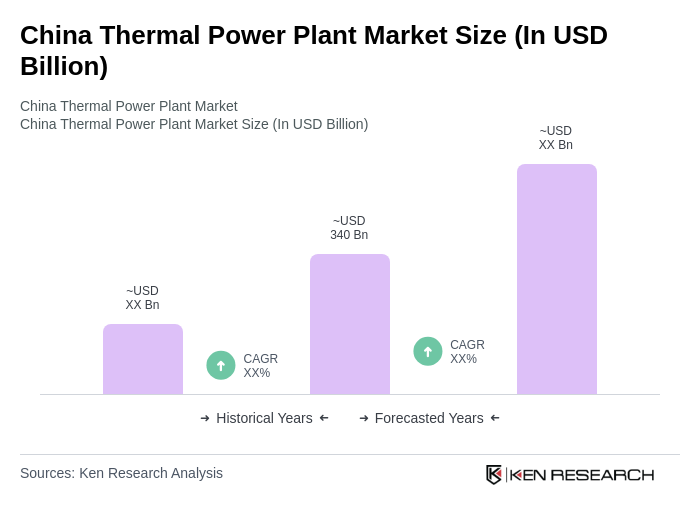
- The China Thermal Power Plant Market is valued at approximately USD 340 billion, based on a five-year analysis. This market is underpinned by continued growth in electricity demand from urbanization, industrial production, and data center expansion, with thermal generation remaining essential for baseload and peak-shaving needs.
- Key regions dominating the market include North China (Beijing–Tianjin–Hebei) and East China (Shanghai–Jiangsu–Zhejiang), which are among China’s largest power-consuming clusters due to dense populations, heavy industry, and services, and host significant coal and gas-fired capacity alongside major grid hubs and transmission corridors.
- The “14th Five?Year Plan for Energy Development” emphasizes maintaining a supportive role for thermal power as a flexible and reliable capacity source while tightening ultra?low emissions standards, advancing high?efficiency, ultra?supercritical retrofits, and promoting flexible upgrades for coal units to support renewable integration.
China Thermal Power Plant Market Segmentation
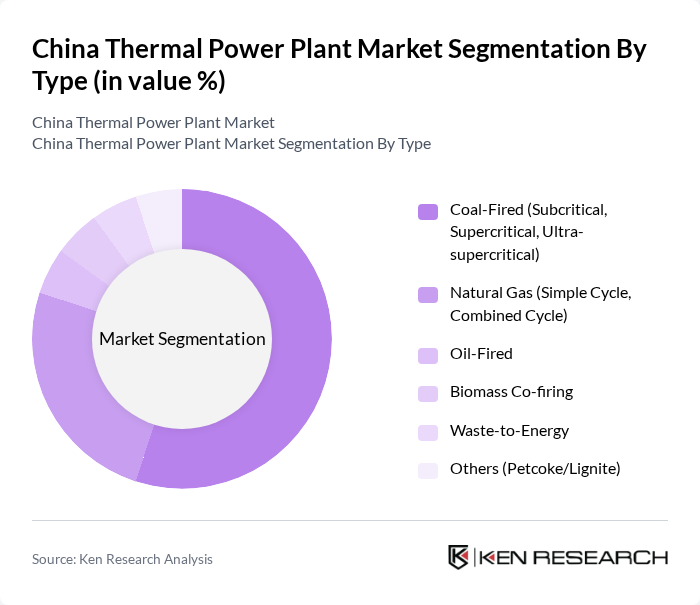
By Type:The thermal power plant market includes coal?fired, natural gas, oil?fired, biomass co?firing, waste?to?energy, and others. Coal?fired plants—particularly supercritical and ultra?supercritical—continue to dominate due to mature supply chains and cost competitiveness, while gas?fired capacity is expanding for lower emissions, faster ramping, and grid balancing alongside renewables.
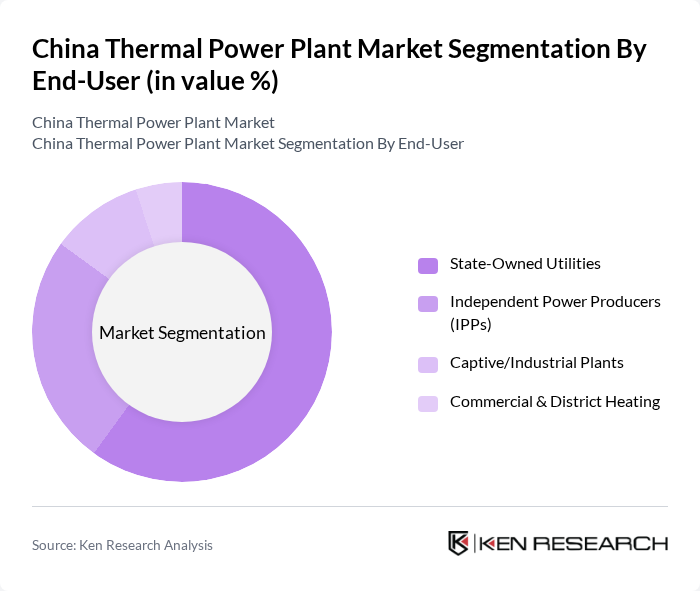
By End-User:The end?user segmentation includes state?owned utilities, independent power producers (IPPs), captive/industrial plants, and commercial & district heating. State?owned utilities dominate due to control of most installed capacity and grid access, while IPPs contribute through incremental capacity additions and efficiency?focused projects.
China Thermal Power Plant Market Competitive Landscape
The China Thermal Power Plant Market is characterized by a dynamic mix of regional and international players. Leading participants such as China Huaneng Group Co., Ltd., China Datang Corporation Ltd., China Guodian Corporation (now part of China Energy Investment Corporation), State Power Investment Corporation Limited (SPIC), China Resources Power Holdings Company Limited, Shanghai Electric Group Co., Ltd., Harbin Electric International Company Limited, Dongfang Electric Corporation Limited, China National Petroleum Corporation (CNPC), China National Offshore Oil Corporation (CNOOC), China Shenhua Energy Company Limited (part of China Energy Investment Corporation), China Energy Engineering Corporation Limited (CEEC), China Huadian Corporation Ltd., China Energy Investment Corporation (CHN Energy), China Power International Development Limited contribute to innovation, geographic expansion, and service delivery in this space.
China Thermal Power Plant Market Industry Analysis
Growth Drivers
- Increasing Energy Demand:China's energy consumption reached approximately 9,000 terawatt-hours (TWh), driven by rapid industrialization and urbanization. The World Bank projects that energy demand will continue to rise, with an expected increase of 3% annually in future. This growing demand necessitates the expansion of thermal power generation capacity, as it currently accounts for about 60% of China's total electricity production, highlighting the critical role of thermal power plants in meeting energy needs.
- Government Investment in Infrastructure:The Chinese government allocated over $100 billion for energy infrastructure development, including thermal power plants. This investment is part of the broader 14th Five-Year Plan, which emphasizes energy security and infrastructure modernization. By 2024, the government aims to enhance thermal power capacity by 50 gigawatts (GW), ensuring reliable energy supply and supporting economic growth, particularly in less developed regions.
- Technological Advancements in Power Generation:The thermal power sector is witnessing significant technological innovations, with investments in high-efficiency, low-emission (HELE) technologies. In future, China installed over 20 GW of HELE capacity, which is projected to increase by 15% in future. These advancements not only improve energy efficiency but also reduce operational costs, making thermal power generation more competitive and environmentally sustainable in the long term.
Market Challenges
- High Initial Capital Investment:The construction of thermal power plants requires substantial upfront capital, often exceeding $1 billion for large facilities. In future, the average cost of building a new thermal power plant in China was approximately $1,200 per kilowatt (kW). This high initial investment poses a significant barrier for new entrants and existing operators looking to expand, particularly in a market increasingly focused on renewable energy alternatives.
- Regulatory Compliance Complexity:The regulatory landscape for thermal power plants in China is becoming increasingly complex, with stringent emission standards and compliance requirements. In future, the Ministry of Ecology and Environment issued new regulations that require a 30% reduction in sulfur dioxide emissions in future. Navigating these regulations can be challenging for operators, leading to increased operational costs and potential penalties for non-compliance, which can hinder market growth.
China Thermal Power Plant Market Future Outlook
The future of the thermal power sector in China is poised for transformation, driven by a shift towards cleaner energy sources and increased automation. In future, the integration of artificial intelligence (AI) and Internet of Things (IoT) technologies is expected to enhance operational efficiency and reduce emissions. Additionally, the government’s commitment to achieving renewable energy targets will likely spur investments in hybrid systems that combine thermal and renewable sources, ensuring a balanced energy mix and sustainable growth in the sector.
Market Opportunities
- Expansion into Emerging Regions:There is a significant opportunity for thermal power plants to expand into China's western and northern regions, where energy demand is rapidly increasing. The government’s focus on regional development is expected to drive investments in new thermal facilities, potentially adding over 20 GW of capacity in future, thus enhancing energy access and supporting local economies.
- Adoption of Smart Grid Technologies:The integration of smart grid technologies presents a lucrative opportunity for thermal power operators. In future, investments in smart grid infrastructure are projected to exceed $30 billion, facilitating better energy management and efficiency. This technology will enable thermal plants to optimize operations, reduce waste, and improve grid reliability, aligning with national energy goals.
Scope of the Report
| Segment | Sub-Segments |
|---|---|
| By Type | Coal-Fired (Subcritical, Supercritical, Ultra-supercritical) Natural Gas (Simple Cycle, Combined Cycle) Oil-Fired Biomass Co-firing Waste-to-Energy Others (Petcoke/Lignite) |
| By End-User | State-Owned Utilities Independent Power Producers (IPPs) Captive/Industrial Plants Commercial & District Heating |
| By Region | North China (Beijing, Tianjin, Hebei, Shanxi, Inner Mongolia) East China (Shanghai, Jiangsu, Zhejiang, Anhui, Fujian, Jiangxi, Shandong) South Central China (Henan, Hubei, Hunan, Guangdong, Guangxi, Hainan) Northeast China (Liaoning, Jilin, Heilongjiang) Southwest China (Chongqing, Sichuan, Guizhou, Yunnan, Tibet) |
| By Technology | Conventional Steam (Subcritical) Supercritical & Ultra-supercritical Combined Cycle Gas Turbine (CCGT) Cogeneration/CHP Emissions Control Retrofits (FGD/DeNOx/CCS-ready) |
| By Application | Base Load Generation Mid-Merit/Load Following Peak Load Generation Backup & Reserve |
| By Investment Source | Central SOE Investment Provincial/Municipal Investment Foreign Direct Investment (FDI)/Joint Ventures Public-Private Partnerships (PPP) |
| By Policy Support | Capacity Payment/Ancillary Services Revenues Ultra-low Emission Retrofit Subsidies Tax Incentives & Green Credit Grid Dispatch & Flexibility Compensation |
Key Target Audience
Investors and Venture Capitalist Firms
Government and Regulatory Bodies (e.g., National Energy Administration, Ministry of Ecology and Environment)
Power Generation Companies
Energy Equipment Manufacturers
Utility Companies
Environmental NGOs
Energy Policy Makers
Financial Institutions
Players Mentioned in the Report:
China Huaneng Group Co., Ltd.
China Datang Corporation Ltd.
China Guodian Corporation (now part of China Energy Investment Corporation)
State Power Investment Corporation Limited (SPIC)
China Resources Power Holdings Company Limited
Shanghai Electric Group Co., Ltd.
Harbin Electric International Company Limited
Dongfang Electric Corporation Limited
China National Petroleum Corporation (CNPC)
China National Offshore Oil Corporation (CNOOC)
China Shenhua Energy Company Limited (part of China Energy Investment Corporation)
China Energy Engineering Corporation Limited (CEEC)
China Huadian Corporation Ltd.
China Energy Investment Corporation (CHN Energy)
China Power International Development Limited
Table of Contents
Market Assessment Phase
1. Executive Summary and Approach
2. China Thermal Power Plant Market Overview
2.1 Key Insights and Strategic Recommendations
2.2 China Thermal Power Plant Market Overview
2.3 Definition and Scope
2.4 Evolution of Market Ecosystem
2.5 Timeline of Key Regulatory Milestones
2.6 Value Chain & Stakeholder Mapping
2.7 Business Cycle Analysis
2.8 Policy & Incentive Landscape
3. China Thermal Power Plant Market Analysis
3.1 Growth Drivers
3.1.1 Increasing Energy Demand
3.1.2 Government Investment in Infrastructure
3.1.3 Technological Advancements in Power Generation
3.1.4 Environmental Regulations Driving Cleaner Technologies
3.2 Market Challenges
3.2.1 High Initial Capital Investment
3.2.2 Regulatory Compliance Complexity
3.2.3 Competition from Renewable Energy Sources
3.2.4 Aging Infrastructure and Maintenance Costs
3.3 Market Opportunities
3.3.1 Expansion into Emerging Regions
3.3.2 Adoption of Smart Grid Technologies
3.3.3 Partnerships with Renewable Energy Firms
3.3.4 Government Incentives for Clean Energy Projects
3.4 Market Trends
3.4.1 Shift Towards Cleaner Energy Sources
3.4.2 Increased Automation in Power Plants
3.4.3 Focus on Energy Efficiency Improvements
3.4.4 Integration of AI and IoT in Operations
3.5 Government Regulation
3.5.1 Emission Standards and Compliance Requirements
3.5.2 Renewable Energy Targets
3.5.3 Subsidies for Clean Technology Adoption
3.5.4 Grid Access Regulations
4. SWOT Analysis
5. Stakeholder Analysis
6. Porter's Five Forces Analysis
7. China Thermal Power Plant Market Market Size, 2019-2024
7.1 By Value
7.2 By Volume
7.3 By Average Selling Price
8. China Thermal Power Plant Market Segmentation
8.1 By Type
8.1.1 Coal-Fired (Subcritical, Supercritical, Ultra-supercritical)
8.1.2 Natural Gas (Simple Cycle, Combined Cycle)
8.1.3 Oil-Fired
8.1.4 Biomass Co-firing
8.1.5 Waste-to-Energy
8.1.6 Others (Petcoke/Lignite)
8.2 By End-User
8.2.1 State-Owned Utilities
8.2.2 Independent Power Producers (IPPs)
8.2.3 Captive/Industrial Plants
8.2.4 Commercial & District Heating
8.3 By Region
8.3.1 North China (Beijing, Tianjin, Hebei, Shanxi, Inner Mongolia)
8.3.2 East China (Shanghai, Jiangsu, Zhejiang, Anhui, Fujian, Jiangxi, Shandong)
8.3.3 South Central China (Henan, Hubei, Hunan, Guangdong, Guangxi, Hainan)
8.3.4 Northeast China (Liaoning, Jilin, Heilongjiang)
8.3.5 Southwest China (Chongqing, Sichuan, Guizhou, Yunnan, Tibet)
8.4 By Technology
8.4.1 Conventional Steam (Subcritical)
8.4.2 Supercritical & Ultra-supercritical
8.4.3 Combined Cycle Gas Turbine (CCGT)
8.4.4 Cogeneration/CHP
8.4.5 Emissions Control Retrofits (FGD/DeNOx/CCS-ready)
8.5 By Application
8.5.1 Base Load Generation
8.5.2 Mid-Merit/Load Following
8.5.3 Peak Load Generation
8.5.4 Backup & Reserve
8.6 By Investment Source
8.6.1 Central SOE Investment
8.6.2 Provincial/Municipal Investment
8.6.3 Foreign Direct Investment (FDI)/Joint Ventures
8.6.4 Public-Private Partnerships (PPP)
8.7 By Policy Support
8.7.1 Capacity Payment/Ancillary Services Revenues
8.7.2 Ultra-low Emission Retrofit Subsidies
8.7.3 Tax Incentives & Green Credit
8.7.4 Grid Dispatch & Flexibility Compensation
9. China Thermal Power Plant Market Competitive Analysis
9.1 Market Share of Key Players
9.2 Cross Comparison of Key Players
9.2.1 Company Name
9.2.2 Installed Capacity in China (GW)
9.2.3 Annual Generation from Thermal Assets (TWh)
9.2.4 Revenue from Power Generation (USD/CNY, latest fiscal year)
9.2.5 Thermal Fleet Mix (% coal, % gas, % oil/others)
9.2.6 Average Heat Rate of Coal Fleet (kJ/kWh)
9.2.7 Average Plant Load Factor/Utilization (%)
9.2.8 Emissions Intensity (gCO?/kWh)
9.2.9 Ultra-low Emission Units Share (% of coal capacity meeting ULE)
9.2.10 Capex per kW for New Builds/Retrofits (CNY/kW)
9.2.11 O&M Cost per MWh (CNY/MWh)
9.2.12 Average Tariff/Realized On-grid Price (CNY/kWh)
9.2.13 EBITDA Margin from Thermal Segment (%)
9.2.14 Debt-to-Equity Ratio
9.2.15 Average Project Cycle Time (Financial Close to COD, months)
9.2.16 HSE Recordable Incident Rate (per million hours)
9.3 SWOT Analysis of Top Players
9.4 Pricing Analysis
9.5 Detailed Profile of Major Companies
9.5.1 China Huaneng Group Co., Ltd.
9.5.2 China Datang Corporation Ltd.
9.5.3 China Guodian Corporation (now part of China Energy Investment Corporation)
9.5.4 State Power Investment Corporation Limited (SPIC)
9.5.5 China Resources Power Holdings Company Limited
9.5.6 Shanghai Electric Group Co., Ltd.
9.5.7 Harbin Electric International Company Limited
9.5.8 Dongfang Electric Corporation Limited
9.5.9 China National Petroleum Corporation (CNPC)
9.5.10 China National Offshore Oil Corporation (CNOOC)
9.5.11 China Shenhua Energy Company Limited (part of China Energy Investment Corporation)
9.5.12 China Energy Engineering Corporation Limited (CEEC)
9.5.13 China Huadian Corporation Ltd.
9.5.14 China Energy Investment Corporation (CHN Energy)
9.5.15 China Power International Development Limited
10. China Thermal Power Plant Market End-User Analysis
10.1 Procurement Behavior of Key Ministries
10.1.1 Ministry of Energy
10.1.2 Ministry of Environmental Protection
10.1.3 Ministry of Finance
10.1.4 Others
10.2 Corporate Spend on Infrastructure & Energy
10.2.1 Energy Sector Investments
10.2.2 Infrastructure Development Budgets
10.2.3 Public Utility Expenditures
10.3 Pain Point Analysis by End-User Category
10.3.1 High Energy Costs
10.3.2 Reliability of Supply
10.3.3 Regulatory Compliance Issues
10.4 User Readiness for Adoption
10.4.1 Awareness of New Technologies
10.4.2 Financial Readiness
10.4.3 Training and Skill Development Needs
10.5 Post-Deployment ROI and Use Case Expansion
10.5.1 Performance Metrics Tracking
10.5.2 Scalability of Solutions
10.5.3 Long-term Cost Savings
11. China Thermal Power Plant Market Future Size, 2025-2030
11.1 By Value
11.2 By Volume
11.3 By Average Selling Price
Go-To-Market Strategy Phase
1. Whitespace Analysis + Business Model Canvas
1.1 Market Gaps Identification
1.2 Value Proposition Development
1.3 Revenue Streams Analysis
1.4 Key Partnerships Exploration
1.5 Cost Structure Assessment
1.6 Customer Segmentation
1.7 Channels of Distribution
2. Marketing and Positioning Recommendations
2.1 Branding Strategies
2.2 Product USPs
2.3 Target Market Positioning
2.4 Communication Strategies
2.5 Digital Marketing Approaches
3. Distribution Plan
3.1 Urban Retail Strategies
3.2 Rural NGO Tie-ups
3.3 Logistics and Supply Chain Management
3.4 Distribution Channel Optimization
4. Channel & Pricing Gaps
4.1 Underserved Routes
4.2 Pricing Bands Analysis
4.3 Competitor Pricing Strategies
4.4 Customer Willingness to Pay
5. Unmet Demand & Latent Needs
5.1 Category Gaps Identification
5.2 Consumer Segments Analysis
5.3 Emerging Trends and Needs
6. Customer Relationship
6.1 Loyalty Programs
6.2 After-sales Service
6.3 Customer Feedback Mechanisms
7. Value Proposition
7.1 Sustainability Initiatives
7.2 Integrated Supply Chains
7.3 Competitive Advantages
8. Key Activities
8.1 Regulatory Compliance
8.2 Branding Initiatives
8.3 Distribution Setup
9. Entry Strategy Evaluation
9.1 Domestic Market Entry Strategy
9.1.1 Product Mix Considerations
9.1.2 Pricing Band Strategy
9.1.3 Packaging Innovations
9.2 Export Entry Strategy
9.2.1 Target Countries Identification
9.2.2 Compliance Roadmap Development
10. Entry Mode Assessment
10.1 Joint Ventures
10.2 Greenfield Investments
10.3 Mergers & Acquisitions
10.4 Distributor Model Evaluation
11. Capital and Timeline Estimation
11.1 Capital Requirements Analysis
11.2 Timelines for Implementation
12. Control vs Risk Trade-Off
12.1 Ownership vs Partnerships
13. Profitability Outlook
13.1 Breakeven Analysis
13.2 Long-term Sustainability Strategies
14. Potential Partner List
14.1 Distributors
14.2 Joint Ventures
14.3 Acquisition Targets
15. Execution Roadmap
15.1 Phased Plan for Market Entry
15.1.1 Market Setup
15.1.2 Market Entry
15.1.3 Growth Acceleration
15.1.4 Scale & Stabilize
15.2 Key Activities and Milestones
15.2.1 Milestone Planning
15.2.2 Activity Tracking
Research Methodology
Phase 1: Approach1
Desk Research
- Analysis of government reports and energy policies from the National Energy Administration of China
- Review of industry publications and market reports from energy research organizations
- Examination of thermal power plant operational data and capacity statistics from the China Electricity Council
Primary Research
- Interviews with senior executives at major thermal power generation companies
- Surveys with energy analysts and consultants specializing in the Chinese power sector
- Field visits to operational thermal power plants for firsthand insights on technology and efficiency
Validation & Triangulation
- Cross-validation of findings through multiple data sources including government, industry, and academic publications
- Triangulation of market trends using historical data and expert opinions
- Sanity checks through feedback from a panel of industry experts and stakeholders
Phase 2: Market Size Estimation1
Top-down Assessment
- Estimation of total electricity generation capacity in China and the share attributed to thermal power
- Analysis of national energy consumption patterns and projected growth rates for thermal energy
- Incorporation of government targets for renewable energy and its impact on thermal power demand
Bottom-up Modeling
- Collection of operational data from leading thermal power plants to establish performance benchmarks
- Cost analysis based on fuel prices, maintenance, and operational expenditures of thermal plants
- Volume and revenue projections based on plant output and market pricing trends
Forecasting & Scenario Analysis
- Multi-variable regression analysis incorporating economic growth, energy policy changes, and technological advancements
- Scenario modeling based on potential shifts in energy regulations and market dynamics
- Development of baseline, optimistic, and pessimistic forecasts for thermal power generation through 2030
Phase 3: CATI Sample Composition1
| Scope Item/Segment | Sample Size | Target Respondent Profiles |
|---|---|---|
| Thermal Power Plant Operations | 120 | Plant Managers, Operations Directors |
| Energy Policy and Regulation | 80 | Government Officials, Regulatory Analysts |
| Fuel Supply Chain Management | 70 | Procurement Managers, Supply Chain Coordinators |
| Environmental Compliance and Sustainability | 60 | Environmental Managers, Compliance Officers |
| Investment and Financing in Thermal Power | 90 | Financial Analysts, Investment Managers |
Frequently Asked Questions
What is the current value of the China Thermal Power Plant Market?
The China Thermal Power Plant Market is valued at approximately USD 340 billion, driven by increasing electricity demand from urbanization, industrial production, and data center expansion, with thermal generation remaining crucial for baseload and peak-shaving needs.
Which regions in China dominate the thermal power plant market?
What role does the Chinese government play in the thermal power sector?
What types of thermal power plants are prevalent in China?
Other Regional/Country Reports
Indonesia Thermal Power Plant Market
Malaysia Thermal Power Plant Market
KSA Thermal Power Plant Market
APAC Thermal Power Plant Market
SEA Thermal Power Plant Market
Why Buy From Us?

What makes us stand out is that our consultants follow Robust, Refine and Result (RRR) methodology. Robust for clear definitions, approaches and sanity checking, Refine for differentiating respondents' facts and opinions, and Result for presenting data with story.

We have set a benchmark in the industry by offering our clients with syndicated and customized market research reports featuring coverage of entire market as well as meticulous research and analyst insights.

While we don't replace traditional research, we flip the method upside down. Our dual approach of Top Bottom & Bottom Top ensures quality deliverable by not just verifying company fundamentals but also looking at the sector and macroeconomic factors.

With one step in the future, our research team constantly tries to show you the bigger picture. We help with some of the tough questions you may encounter along the way: How is the industry positioned? Best marketing channel? KPI's of competitors? By aligning every element, we help maximize success.

Our report gives you instant access to the answers and sources that other companies might choose to hide. We elaborate each steps of research methodology we have used and showcase you the sample size to earn your trust.

If you need any support, we are here! We pride ourselves on universe strength, data quality, and quick, friendly, and professional service.