France Logistics and Cold Chain Pharma Transport Market

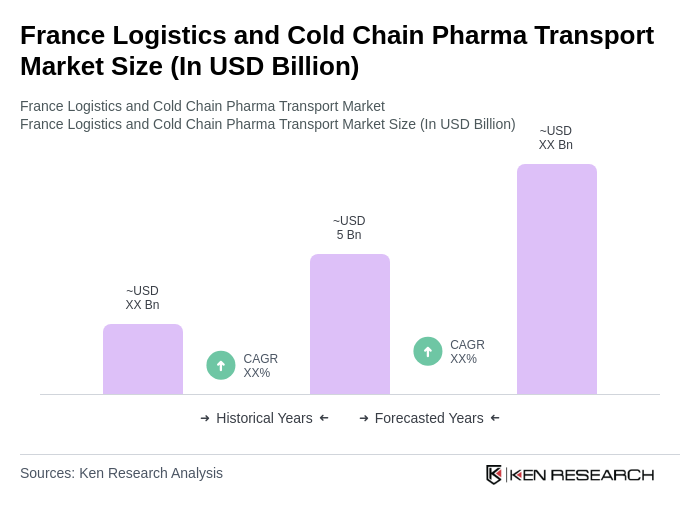
France Logistics and Cold Chain Pharma Transport Market, valued at USD 5 Bn, grows due to biopharmaceutical expansion, stringent GDP regulations, and IoT innovations for efficient supply chains.

Region:Europe

Author(s):Dev

Product Code:KRAB6511

Pages:89

Published On:October 2025
About the Report

Base Year 2024

France Logistics and Cold Chain Pharma Transport Market Overview

  • The France Logistics and Cold Chain Pharma Transport Market is valued at USD 5 billion, based on a five-year historical analysis. This growth is primarily driven by the increasing demand for temperature-sensitive pharmaceuticals, the expansion of the biopharmaceutical sector, and the rising need for efficient supply chain solutions to ensure product integrity during transportation.
  • Key cities such as Paris, Lyon, and Marseille dominate the market due to their strategic locations, advanced infrastructure, and proximity to major healthcare facilities and pharmaceutical manufacturers. These cities serve as critical hubs for logistics operations, facilitating efficient distribution networks across France and beyond.
  • In 2023, the French government implemented stringent regulations under the EU Good Distribution Practice (GDP) guidelines, mandating that all pharmaceutical products transported within the country must adhere to specific temperature control standards. This regulation aims to enhance the safety and efficacy of pharmaceutical products, ensuring that they are stored and transported under optimal conditions.
France Logistics and Cold Chain Pharma Transport Market Size

France Logistics and Cold Chain Pharma Transport Market Segmentation

By Type:The market is segmented into various types, including Refrigerated Transport, Temperature-Controlled Warehousing, Packaging Solutions, Monitoring Systems, Logistics Management Software, and Others. Among these, Refrigerated Transport is the leading segment due to the critical need for maintaining specific temperature ranges during the transportation of pharmaceuticals. The increasing focus on supply chain efficiency and product safety drives the demand for advanced refrigerated transport solutions.
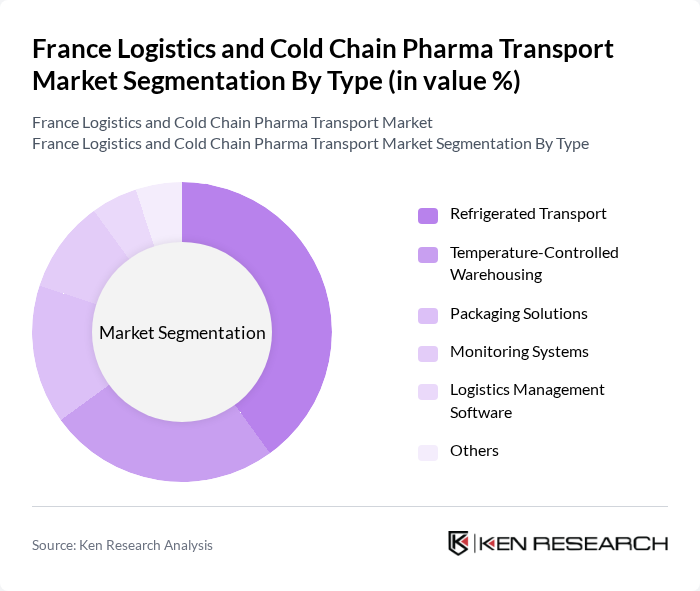
France Logistics and Cold Chain Pharma Transport Market segmentation by Type.

By End-User:The end-user segmentation includes Pharmaceutical Manufacturers, Biotechnology Companies, Hospitals and Clinics, Research Institutions, and Others. Pharmaceutical Manufacturers dominate this segment, driven by the need for reliable logistics solutions to transport sensitive products. The increasing production of biologics and specialty pharmaceuticals further fuels the demand for cold chain logistics tailored to the pharmaceutical industry.
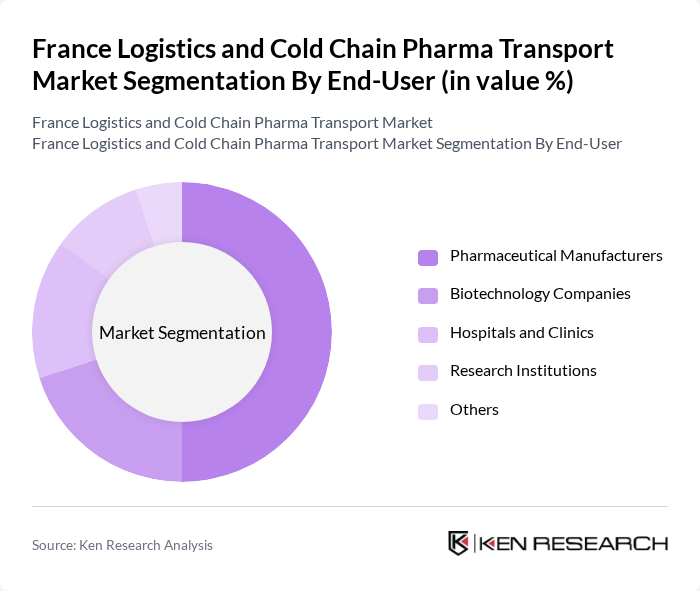
France Logistics and Cold Chain Pharma Transport Market segmentation by End-User.

France Logistics and Cold Chain Pharma Transport Market Competitive Landscape

The France Logistics and Cold Chain Pharma Transport Market is characterized by a dynamic mix of regional and international players. Leading participants such as DHL Supply Chain, Kuehne + Nagel, DB Schenker, UPS Healthcare, FedEx, Geodis, XPO Logistics, Cardinal Health, Thermo Fisher Scientific, Agility Logistics, World Courier, CEVA Logistics, Panalpina, Maersk, DSV Panalpina contribute to innovation, geographic expansion, and service delivery in this space.

DHL Supply Chain

1969

Germany

Kuehne + Nagel

1890

Switzerland

DB Schenker

2002

Germany

UPS Healthcare

1907

USA

FedEx

1971

USA

Company

Establishment Year

Headquarters

Group Size (Large, Medium, or Small as per industry convention)

Revenue Growth Rate

Market Penetration Rate

Customer Retention Rate

Operational Efficiency Ratio

Delivery Timeliness

France Logistics and Cold Chain Pharma Transport Market Industry Analysis

Growth Drivers

  • Increasing Demand for Biopharmaceuticals:The biopharmaceutical sector in France is projected to reach €40 billion in future, driven by advancements in drug development and an aging population. This surge necessitates efficient logistics and cold chain solutions to maintain product integrity. The rise in chronic diseases, with over 22 million patients requiring biopharmaceuticals, further amplifies the demand for specialized transport services, ensuring timely delivery and compliance with stringent temperature controls.
  • Stringent Regulatory Requirements:France's pharmaceutical logistics are governed by strict regulations, including the EU Good Distribution Practice (GDP). Compliance with these regulations is crucial, as non-compliance can lead to significant penalties. In future, the French government is expected to increase inspections by 15%, emphasizing the need for robust cold chain management systems. This regulatory landscape drives investment in advanced logistics solutions to ensure adherence and maintain product quality throughout the supply chain.
  • Technological Advancements in Cold Chain Solutions:The integration of IoT and AI technologies in cold chain logistics is transforming the industry. In future, the market for smart cold chain solutions in France is anticipated to grow to €1.5 billion, driven by the need for real-time monitoring and data analytics. These technologies enhance operational efficiency, reduce waste, and ensure compliance with temperature requirements, ultimately supporting the growing demand for temperature-sensitive pharmaceuticals.

Market Challenges

  • High Operational Costs:The logistics and cold chain sector in France faces significant operational costs, with average expenses reaching €1.2 billion annually. Factors contributing to these costs include energy prices, labor expenses, and the need for specialized equipment. In future, energy costs are projected to rise by 10%, further straining profit margins for logistics providers. This financial pressure can hinder investment in necessary infrastructure and technology upgrades.
  • Limited Infrastructure in Remote Areas:Approximately 30% of rural areas in France lack adequate cold chain infrastructure, posing challenges for pharmaceutical distribution. In future, the French government plans to allocate €200 million to improve logistics in underserved regions. However, the existing gaps in infrastructure can lead to delays and increased costs, impacting the timely delivery of critical medications and biopharmaceuticals to patients in these areas.

France Logistics and Cold Chain Pharma Transport Market Future Outlook

The future of the logistics and cold chain pharma transport market in France appears promising, driven by technological innovations and regulatory compliance. As the demand for biopharmaceuticals continues to rise, logistics providers are expected to invest in advanced cold chain solutions, enhancing efficiency and reliability. Additionally, the focus on sustainability will likely lead to the adoption of eco-friendly practices, ensuring that the industry meets both regulatory standards and consumer expectations for environmentally responsible operations.

Market Opportunities

  • Growth in Personalized Medicine:The personalized medicine market in France is projected to reach €10 billion in future, creating opportunities for specialized logistics services. This growth necessitates tailored cold chain solutions to ensure the safe transport of individualized therapies, presenting a lucrative avenue for logistics providers to expand their service offerings and enhance operational capabilities.
  • Adoption of IoT in Cold Chain Monitoring:The implementation of IoT technologies in cold chain monitoring is expected to increase by 25% in future. This trend offers logistics companies the chance to enhance tracking and traceability, reducing the risk of temperature deviations. By investing in IoT solutions, companies can improve operational efficiency and ensure compliance with stringent regulatory requirements, ultimately boosting customer satisfaction.

Scope of the Report

SegmentSub-Segments
By Type

Refrigerated Transport

Temperature-Controlled Warehousing

Packaging Solutions

Monitoring Systems

Logistics Management Software

Others

By End-User

Pharmaceutical Manufacturers

Biotechnology Companies

Hospitals and Clinics

Research Institutions

Others

By Distribution Mode

Road Transport

Air Transport

Rail Transport

Sea Transport

Others

By Packaging Type

Insulated Containers

Refrigerated Pallets

Active Temperature-Controlled Packaging

Passive Temperature-Controlled Packaging

Others

By Service Type

Transportation Services

Warehousing Services

Value-Added Services

Consulting Services

Others

By Temperature Range

Controlled Room Temperature (CRT)

Refrigerated (2-8°C)

Frozen (-20°C and below)

Others

By Compliance Standards

EU GDP Compliance

ISO Standards

WHO Guidelines

Others

Key Target Audience

Investors and Venture Capitalist Firms

Government and Regulatory Bodies (e.g., French Ministry of Health, ANSM)

Pharmaceutical Manufacturers

Cold Chain Logistics Providers

Healthcare Institutions and Hospitals

Biotechnology Companies

Pharmaceutical Wholesalers

Insurance Companies

Players Mentioned in the Report:

DHL Supply Chain

Kuehne + Nagel

DB Schenker

UPS Healthcare

FedEx

Geodis

XPO Logistics

Cardinal Health

Thermo Fisher Scientific

Agility Logistics

World Courier

CEVA Logistics

Panalpina

Maersk

DSV Panalpina

Table of Contents

Market Assessment Phase

1. Executive Summary and Approach


2. France Logistics and Cold Chain Pharma Transport Market Overview

2.1 Key Insights and Strategic Recommendations

2.2 France Logistics and Cold Chain Pharma Transport Market Overview

2.3 Definition and Scope

2.4 Evolution of Market Ecosystem

2.5 Timeline of Key Regulatory Milestones

2.6 Value Chain & Stakeholder Mapping

2.7 Business Cycle Analysis

2.8 Policy & Incentive Landscape


3. France Logistics and Cold Chain Pharma Transport Market Analysis

3.1 Growth Drivers

3.1.1 Increasing Demand for Biopharmaceuticals
3.1.2 Stringent Regulatory Requirements
3.1.3 Expansion of E-commerce in Pharmaceuticals
3.1.4 Technological Advancements in Cold Chain Solutions

3.2 Market Challenges

3.2.1 High Operational Costs
3.2.2 Limited Infrastructure in Remote Areas
3.2.3 Compliance with Regulatory Standards
3.2.4 Risk of Temperature Deviations

3.3 Market Opportunities

3.3.1 Growth in Personalized Medicine
3.3.2 Adoption of IoT in Cold Chain Monitoring
3.3.3 Expansion of Global Supply Chains
3.3.4 Investment in Sustainable Logistics Solutions

3.4 Market Trends

3.4.1 Increasing Use of Automation in Warehousing
3.4.2 Shift Towards Eco-Friendly Packaging
3.4.3 Rise of Third-Party Logistics Providers
3.4.4 Enhanced Focus on Supply Chain Resilience

3.5 Government Regulation

3.5.1 EU Good Distribution Practice (GDP) Compliance
3.5.2 National Cold Chain Regulations
3.5.3 Environmental Regulations on Packaging
3.5.4 Data Protection Regulations in Pharma Transport

4. SWOT Analysis


5. Stakeholder Analysis


6. Porter's Five Forces Analysis


7. France Logistics and Cold Chain Pharma Transport Market Market Size, 2019-2024

7.1 By Value

7.2 By Volume

7.3 By Average Selling Price


8. France Logistics and Cold Chain Pharma Transport Market Segmentation

8.1 By Type

8.1.1 Refrigerated Transport
8.1.2 Temperature-Controlled Warehousing
8.1.3 Packaging Solutions
8.1.4 Monitoring Systems
8.1.5 Logistics Management Software
8.1.6 Others

8.2 By End-User

8.2.1 Pharmaceutical Manufacturers
8.2.2 Biotechnology Companies
8.2.3 Hospitals and Clinics
8.2.4 Research Institutions
8.2.5 Others

8.3 By Distribution Mode

8.3.1 Road Transport
8.3.2 Air Transport
8.3.3 Rail Transport
8.3.4 Sea Transport
8.3.5 Others

8.4 By Packaging Type

8.4.1 Insulated Containers
8.4.2 Refrigerated Pallets
8.4.3 Active Temperature-Controlled Packaging
8.4.4 Passive Temperature-Controlled Packaging
8.4.5 Others

8.5 By Service Type

8.5.1 Transportation Services
8.5.2 Warehousing Services
8.5.3 Value-Added Services
8.5.4 Consulting Services
8.5.5 Others

8.6 By Temperature Range

8.6.1 Controlled Room Temperature (CRT)
8.6.2 Refrigerated (2-8°C)
8.6.3 Frozen (-20°C and below)
8.6.4 Others

8.7 By Compliance Standards

8.7.1 EU GDP Compliance
8.7.2 ISO Standards
8.7.3 WHO Guidelines
8.7.4 Others

9. France Logistics and Cold Chain Pharma Transport Market Competitive Analysis

9.1 Market Share of Key Players(Micro, Small, Medium, Large Enterprises)

9.2 Cross Comparison of Key Players

9.2.1 Company Name
9.2.2 Group Size (Large, Medium, or Small as per industry convention)
9.2.3 Revenue Growth Rate
9.2.4 Market Penetration Rate
9.2.5 Customer Retention Rate
9.2.6 Operational Efficiency Ratio
9.2.7 Delivery Timeliness
9.2.8 Pricing Strategy
9.2.9 Service Quality Index
9.2.10 Innovation Index

9.3 SWOT Analysis of Top Players

9.4 Pricing Analysis(By Class and Payload)

9.5 Detailed Profile of Major Companies

9.5.1 DHL Supply Chain
9.5.2 Kuehne + Nagel
9.5.3 DB Schenker
9.5.4 UPS Healthcare
9.5.5 FedEx
9.5.6 Geodis
9.5.7 XPO Logistics
9.5.8 Cardinal Health
9.5.9 Thermo Fisher Scientific
9.5.10 Agility Logistics
9.5.11 World Courier
9.5.12 CEVA Logistics
9.5.13 Panalpina
9.5.14 Maersk
9.5.15 DSV Panalpina

10. France Logistics and Cold Chain Pharma Transport Market End-User Analysis

10.1 Procurement Behavior of Key Ministries

10.1.1 Ministry of Health
10.1.2 Ministry of Economy and Finance
10.1.3 Ministry of Research and Innovation

10.2 Corporate Spend on Infrastructure & Energy

10.2.1 Investment in Cold Chain Facilities
10.2.2 Budget Allocation for Technology Upgrades
10.2.3 Expenditure on Compliance and Training

10.3 Pain Point Analysis by End-User Category

10.3.1 Pharmaceutical Manufacturers
10.3.2 Hospitals and Clinics
10.3.3 Research Institutions

10.4 User Readiness for Adoption

10.4.1 Awareness of Cold Chain Solutions
10.4.2 Training and Skill Development
10.4.3 Infrastructure Readiness

10.5 Post-Deployment ROI and Use Case Expansion

10.5.1 Measurement of Cost Savings
10.5.2 Expansion of Service Offerings
10.5.3 Customer Satisfaction Metrics

11. France Logistics and Cold Chain Pharma Transport Market Future Size, 2025-2030

11.1 By Value

11.2 By Volume

11.3 By Average Selling Price


Go-To-Market Strategy Phase

1. Whitespace Analysis + Business Model Canvas

1.1 Market Gaps Identification

1.2 Value Proposition Development

1.3 Revenue Streams Analysis

1.4 Cost Structure Evaluation

1.5 Key Partnerships Exploration

1.6 Customer Segmentation

1.7 Channels of Distribution


2. Marketing and Positioning Recommendations

2.1 Branding Strategies

2.2 Product USPs

2.3 Target Market Identification

2.4 Communication Strategy

2.5 Digital Marketing Approaches


3. Distribution Plan

3.1 Urban Retail Strategies

3.2 Rural NGO Tie-Ups

3.3 Logistics Partnerships

3.4 Distribution Channel Optimization


4. Channel & Pricing Gaps

4.1 Underserved Routes

4.2 Pricing Bands Analysis

4.3 Competitive Pricing Strategies


5. Unmet Demand & Latent Needs

5.1 Category Gaps Identification

5.2 Consumer Segments Analysis

5.3 Emerging Trends Exploration


6. Customer Relationship

6.1 Loyalty Programs

6.2 After-Sales Service Enhancements

6.3 Customer Feedback Mechanisms


7. Value Proposition

7.1 Sustainability Initiatives

7.2 Integrated Supply Chains

7.3 Customer-Centric Solutions


8. Key Activities

8.1 Regulatory Compliance

8.2 Branding Initiatives

8.3 Distribution Setup


9. Entry Strategy Evaluation

9.1 Domestic Market Entry Strategy

9.1.1 Product Mix Considerations
9.1.2 Pricing Band Strategy
9.1.3 Packaging Solutions

9.2 Export Entry Strategy

9.2.1 Target Countries Identification
9.2.2 Compliance Roadmap Development

10. Entry Mode Assessment

10.1 Joint Ventures

10.2 Greenfield Investments

10.3 Mergers & Acquisitions

10.4 Distributor Model Evaluation


11. Capital and Timeline Estimation

11.1 Capital Requirements Analysis

11.2 Timelines for Implementation


12. Control vs Risk Trade-Off

12.1 Ownership Considerations

12.2 Partnerships Evaluation


13. Profitability Outlook

13.1 Breakeven Analysis

13.2 Long-Term Sustainability Strategies


14. Potential Partner List

14.1 Distributors Identification

14.2 Joint Ventures Opportunities

14.3 Acquisition Targets


15. Execution Roadmap

15.1 Phased Plan for Market Entry

15.1.1 Market Setup
15.1.2 Market Entry
15.1.3 Growth Acceleration
15.1.4 Scale & Stabilize

15.2 Key Activities and Milestones

15.2.1 Milestone Planning
15.2.2 Activity Tracking

Research Methodology

ApproachModellingSample

Phase 1: Approach1

Desk Research

  • Analysis of industry reports from pharmaceutical logistics associations in France
  • Review of government publications on cold chain regulations and compliance standards
  • Examination of market trends through academic journals and white papers on pharmaceutical transport

Primary Research

  • Interviews with logistics managers at major pharmaceutical companies operating in France
  • Surveys with cold chain service providers to gather insights on operational challenges
  • Field interviews with regulatory experts to understand compliance requirements in cold chain logistics

Validation & Triangulation

  • Cross-validation of data through multiple sources including trade publications and expert opinions
  • Triangulation of findings from primary interviews and secondary data to ensure accuracy
  • Sanity checks conducted through expert panel reviews to validate assumptions and projections

Phase 2: Market Size Estimation1

Top-down Assessment

  • Estimation of the total logistics market size in France, focusing on the pharmaceutical sector
  • Segmentation of the market by temperature-controlled transport and storage solutions
  • Incorporation of growth rates from related sectors such as biotechnology and healthcare

Bottom-up Modeling

  • Collection of data on shipment volumes from leading cold chain logistics providers
  • Operational cost analysis based on service pricing models for temperature-sensitive products
  • Volume and cost calculations to derive revenue estimates for cold chain services

Forecasting & Scenario Analysis

  • Multi-factor regression analysis incorporating factors such as healthcare spending and population demographics
  • Scenario modeling based on potential regulatory changes and technological advancements in logistics
  • Development of baseline, optimistic, and pessimistic forecasts through 2030

Phase 3: CATI Sample Composition1

Scope Item/SegmentSample SizeTarget Respondent Profiles
Pharmaceutical Cold Chain Providers100Logistics Managers, Operations Directors
Healthcare Institutions80Pharmacy Directors, Supply Chain Coordinators
Regulatory Compliance Experts50Quality Assurance Managers, Regulatory Affairs Specialists
Temperature-Controlled Storage Facilities70Facility Managers, Operations Supervisors
Pharmaceutical Manufacturers90Procurement Officers, Logistics Coordinators

Frequently Asked Questions

What is the current value of the France Logistics and Cold Chain Pharma Transport Market?

The France Logistics and Cold Chain Pharma Transport Market is valued at approximately USD 5 billion, driven by the increasing demand for temperature-sensitive pharmaceuticals and the expansion of the biopharmaceutical sector.

Which cities are key hubs for the cold chain pharma transport market in France?

What regulations govern the cold chain transport of pharmaceuticals in France?

What are the main types of services offered in the cold chain pharma transport market?

Other Regional/Country Reports

UK Logistics and Cold Chain Pharma Transport Market

Indonesia Logistics and Cold Chain Pharma Transport Market

Malaysia Logistics and Cold Chain Pharma Transport Market

KSA Logistics and Cold Chain Pharma Transport Market

APAC Logistics and Cold Chain Pharma Transport Market

SEA Logistics and Cold Chain Pharma Transport Market

Other Adjacent Reports

Saudi Arabia Pharmaceutical Manufacturing Market Size, Share, Growth Drivers, Trends, Opportunities & Forecast 2025–2030

Brazil Biopharmaceutical Sector Market

Brazil Temperature-Controlled Warehousing Market

Saudi Arabia refrigerated transport market report Size, Share, Growth Drivers, Trends, Opportunities & Forecast 2025–2030

Germany Logistics Management Software Market

Oman Cold Chain Packaging Solutions Market

Mexico Monitoring Systems Market

Oman Healthcare Supply Chain Market

Brazil Biotechnology Companies Market

Qatar Regulatory Compliance Services Market

Why Buy From Us?

Refine Robust Result (RRR) Framework

What makes us stand out is that our consultants follow Robust, Refine and Result (RRR) methodology. Robust for clear definitions, approaches and sanity checking, Refine for differentiating respondents' facts and opinions, and Result for presenting data with story.

Our Reach Is Unmatched

We have set a benchmark in the industry by offering our clients with syndicated and customized market research reports featuring coverage of entire market as well as meticulous research and analyst insights.

Shifting the Research Paradigm

While we don't replace traditional research, we flip the method upside down. Our dual approach of Top Bottom & Bottom Top ensures quality deliverable by not just verifying company fundamentals but also looking at the sector and macroeconomic factors.

More Insights-Better Decisions

With one step in the future, our research team constantly tries to show you the bigger picture. We help with some of the tough questions you may encounter along the way: How is the industry positioned? Best marketing channel? KPI's of competitors? By aligning every element, we help maximize success.

Transparency and Trust

Our report gives you instant access to the answers and sources that other companies might choose to hide. We elaborate each steps of research methodology we have used and showcase you the sample size to earn your trust.

Round the Clock Support

If you need any support, we are here! We pride ourselves on universe strength, data quality, and quick, friendly, and professional service.

Why Clients Choose Us?

400000+
Reports in repository
150+
Consulting projects a year
100+
Analysts
8000+
Client Queries in 2022








