About the Report
Base Year 2024GCC Almond Powder Market Overview
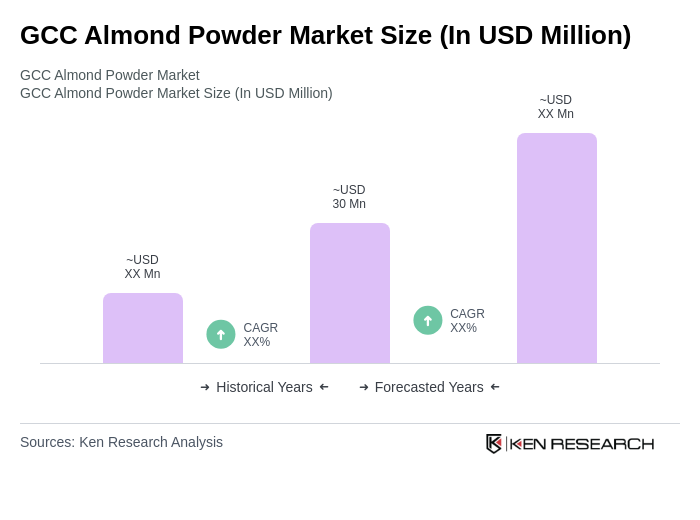
- The GCC Almond Powder Market is valued at USD 30 million, based on a five-year historical analysis. This growth is primarily driven by the increasing demand for healthy and nutritious food products, as well as the rising popularity of plant-based diets among consumers. The market is also supported by the growing awareness of the health benefits associated with almond consumption, including its high protein and fiber content. The adoption of almond powder is further accelerated by its gluten-free and allergen-friendly profile, which appeals to a broad spectrum of health-conscious consumers .
- Key players in this market include Saudi Arabia and the United Arab Emirates, which dominate due to their robust food and beverage industries and increasing consumer preferences for healthy ingredients. The UAE, in particular, has become a hub for food innovation and product development, attracting investments and fostering a competitive environment for almond powder producers. The region’s food sector is witnessing a surge in demand for plant-based and functional ingredients, with almond powder being incorporated into bakery, confectionery, and beverage products .
- In 2023, the Gulf Cooperation Council Food Safety Technical Regulation (GSO 2500/2023), issued by the Gulf Standardization Organization, established binding requirements for the use of natural and organic ingredients in food products across GCC member states. This regulation mandates clear labeling, ingredient traceability, and compliance with maximum residue limits for food additives, encouraging manufacturers to adopt almond powder as a healthier alternative in bakery and confectionery applications.
GCC Almond Powder Market Segmentation
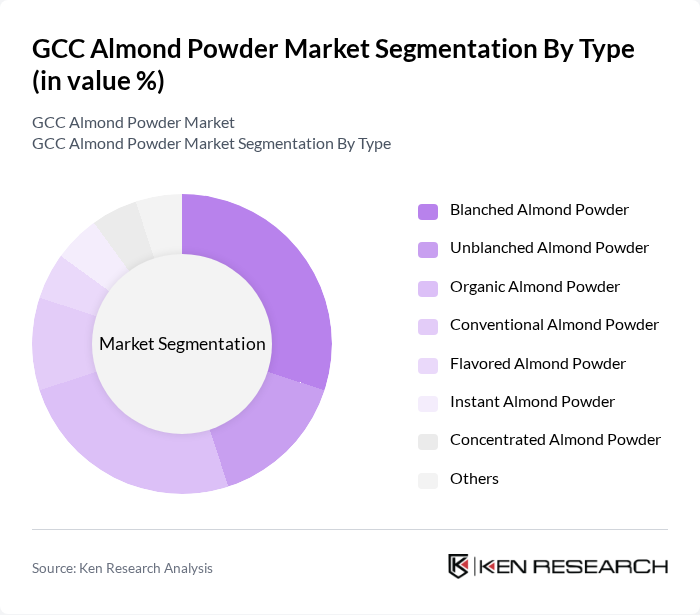
By Type:The almond powder market can be segmented into various types, including Blanched Almond Powder, Unblanched Almond Powder, Organic Almond Powder, Conventional Almond Powder, Flavored Almond Powder, Instant Almond Powder, Concentrated Almond Powder, and Others. Among these, Organic Almond Powder is gaining significant traction due to the increasing consumer preference for organic products, driven by health consciousness and environmental concerns. The demand for Blanched Almond Powder is also notable, particularly in the bakery sector, where it is favored for its fine texture and versatility. Concentrated Almond Powder is also widely used in food manufacturing for its strong flavor and nutrient density, reflecting a broader industry trend toward functional and clean-label ingredients .
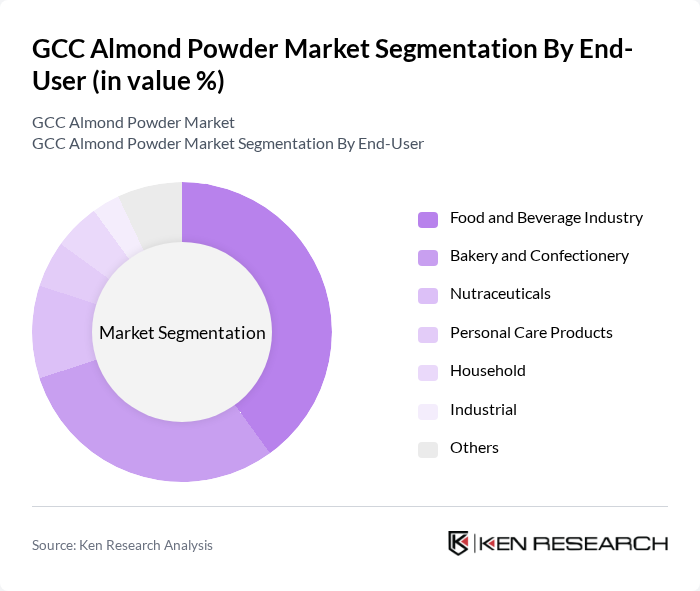
By End-User:The almond powder market is segmented by end-user into the Food and Beverage Industry, Bakery and Confectionery, Nutraceuticals, Personal Care Products, Household, Industrial, and Others. The Food and Beverage Industry is the leading segment, driven by the increasing incorporation of almond powder in health foods, snacks, and beverages. The Bakery and Confectionery segment is also significant, as almond powder is widely used in various baked goods and desserts, appealing to health-conscious consumers. Nutraceuticals and personal care products are emerging segments, leveraging almond powder’s nutritional and functional benefits .
GCC Almond Powder Market Competitive Landscape
The GCC Almond Powder Market is characterized by a dynamic mix of regional and international players. Leading participants such as Blue Diamond Growers, Olam International, Harris Woolf Almonds, Borges Agricultural & Industrial Nuts, Savola Group, Al Foah, Al Dahra Agriculture, Select Harvests, Mariani Nut Company, Suncoast Gold Macadamias, NutraBlend Foods, H.B. Specialty Foods, The Almond Company, Wonderful Pistachios & Almonds, California Almonds contribute to innovation, geographic expansion, and service delivery in this space.
GCC Almond Powder Market Industry Analysis
Growth Drivers
- Increasing Health Consciousness:The GCC region has seen a significant rise in health awareness, with 60% of consumers actively seeking healthier food options. This trend is supported by the World Health Organization's report indicating that 30% of the population is now prioritizing nutrition. Almond powder, rich in protein and healthy fats, aligns perfectly with this shift, driving demand as consumers opt for nutrient-dense alternatives in their diets.
- Rising Demand for Gluten-Free Products:The gluten-free market in the GCC is projected to reach USD 1.5 billion in future, reflecting a growing consumer base avoiding gluten for health reasons. Almond powder serves as a versatile gluten-free substitute in various recipes, appealing to this demographic. The increasing prevalence of celiac disease and gluten sensitivity among the population further fuels this demand, positioning almond powder as a key ingredient in gluten-free formulations.
- Expansion of the Food and Beverage Industry:The GCC food and beverage sector is expected to grow to USD 196 billion in future, driven by a burgeoning population and changing consumer preferences. This expansion creates a favorable environment for almond powder, which is increasingly incorporated into snacks, baked goods, and health foods. The rise in food innovation and product diversification in the region enhances the market potential for almond powder as a functional ingredient.
Market Challenges
- Price Volatility of Raw Almonds:The price of raw almonds has fluctuated significantly, with a reported increase of 15% in future due to supply chain disruptions and climatic factors. This volatility poses a challenge for almond powder manufacturers, as it affects production costs and profit margins. Companies must navigate these fluctuations to maintain competitive pricing while ensuring product quality, which can strain financial resources.
- Limited Awareness Among Consumers:Despite the health benefits of almond powder, consumer awareness remains low, with only 25% of the population familiar with its uses and advantages. This lack of knowledge hinders market growth, as potential customers may opt for more familiar alternatives. Educational initiatives and marketing strategies are essential to increase awareness and drive adoption, but they require investment and strategic planning from manufacturers.
GCC Almond Powder Market Future Outlook
The GCC almond powder market is poised for growth, driven by increasing health consciousness and the demand for gluten-free products. As consumers continue to prioritize nutrition, the market will likely see innovations in product offerings, including organic and fortified almond powders. Additionally, the rise of e-commerce platforms will facilitate broader access to almond powder, enabling manufacturers to reach a wider audience. Strategic partnerships with health-focused brands will further enhance market penetration and consumer trust in almond powder products.
Market Opportunities
- Expansion into Emerging Markets:The GCC region's growing middle class presents a significant opportunity for almond powder manufacturers. With disposable incomes rising, there is an increasing willingness to spend on premium health products. Targeting emerging markets within the GCC can lead to substantial growth, as consumers seek nutritious alternatives to traditional ingredients.
- Development of Innovative Products:There is a notable opportunity for creating innovative almond powder products tailored to specific dietary needs, such as protein-enriched or flavored variants. By leveraging consumer trends towards customization and health, manufacturers can differentiate their offerings and capture niche markets, enhancing overall market share and profitability.
Scope of the Report
| Segment | Sub-Segments |
|---|---|
| By Type | Blanched Almond Powder Unblanched Almond Powder Organic Almond Powder Conventional Almond Powder Flavored Almond Powder Instant Almond Powder Concentrated Almond Powder Others |
| By End-User | Food and Beverage Industry Bakery and Confectionery Nutraceuticals Personal Care Products Household Industrial Others |
| By Distribution Channel | Online Retail Supermarkets/Hypermarkets Specialty Stores Direct Sales Convenience Stores Departmental Stores Others |
| By Packaging Type | Bulk Packaging Retail Packaging Eco-Friendly Packaging Single-Use Packaging Others |
| By Price Range | Economy Mid-Range Premium Others |
| By Form | Powder Granules Coarse Meal Fine Ground Others |
| By Region | Saudi Arabia United Arab Emirates Qatar Kuwait Oman Bahrain Others |
Key Target Audience
Investors and Venture Capitalist Firms
Government and Regulatory Bodies (e.g., Gulf Cooperation Council, Ministry of Climate Change and Environment)
Manufacturers and Producers
Distributors and Retailers
Food and Beverage Companies
Health and Wellness Brands
Importers and Exporters
Food Safety and Quality Assurance Organizations
Players Mentioned in the Report:
Blue Diamond Growers
Olam International
Harris Woolf Almonds
Borges Agricultural & Industrial Nuts
Savola Group
Al Foah
Al Dahra Agriculture
Select Harvests
Mariani Nut Company
Suncoast Gold Macadamias
NutraBlend Foods
H.B. Specialty Foods
The Almond Company
Wonderful Pistachios & Almonds
California Almonds
Table of Contents
Market Assessment Phase
1. Executive Summary and Approach
2. GCC Almond Powder Market Overview
2.1 Key Insights and Strategic Recommendations
2.2 GCC Almond Powder Market Overview
2.3 Definition and Scope
2.4 Evolution of Market Ecosystem
2.5 Timeline of Key Regulatory Milestones
2.6 Value Chain & Stakeholder Mapping
2.7 Business Cycle Analysis
2.8 Policy & Incentive Landscape
3. GCC Almond Powder Market Analysis
3.1 Growth Drivers
3.1.1 Increasing Health Consciousness
3.1.2 Rising Demand for Gluten-Free Products
3.1.3 Expansion of the Food and Beverage Industry
3.1.4 Growth in Vegan and Plant-Based Diets
3.2 Market Challenges
3.2.1 Price Volatility of Raw Almonds
3.2.2 Competition from Other Nut Powders
3.2.3 Regulatory Compliance Issues
3.2.4 Limited Awareness Among Consumers
3.3 Market Opportunities
3.3.1 Expansion into Emerging Markets
3.3.2 Development of Innovative Products
3.3.3 Strategic Partnerships with Health Brands
3.3.4 Increasing Online Sales Channels
3.4 Market Trends
3.4.1 Growing Popularity of Organic Almond Powder
3.4.2 Rise in E-commerce for Food Products
3.4.3 Focus on Sustainable Sourcing
3.4.4 Customization of Almond Powder Products
3.5 Government Regulation
3.5.1 Food Safety Standards Compliance
3.5.2 Labeling Regulations for Health Claims
3.5.3 Import Tariffs on Almond Products
3.5.4 Environmental Regulations on Packaging
4. SWOT Analysis
5. Stakeholder Analysis
6. Porter's Five Forces Analysis
7. GCC Almond Powder Market Market Size, 2019-2024
7.1 By Value
7.2 By Volume
7.3 By Average Selling Price
8. GCC Almond Powder Market Segmentation
8.1 By Type
8.1.1 Blanched Almond Powder
8.1.2 Unblanched Almond Powder
8.1.3 Organic Almond Powder
8.1.4 Conventional Almond Powder
8.1.5 Flavored Almond Powder
8.1.6 Instant Almond Powder
8.1.7 Concentrated Almond Powder
8.1.8 Others
8.2 By End-User
8.2.1 Food and Beverage Industry
8.2.2 Bakery and Confectionery
8.2.3 Nutraceuticals
8.2.4 Personal Care Products
8.2.5 Household
8.2.6 Industrial
8.2.7 Others
8.3 By Distribution Channel
8.3.1 Online Retail
8.3.2 Supermarkets/Hypermarkets
8.3.3 Specialty Stores
8.3.4 Direct Sales
8.3.5 Convenience Stores
8.3.6 Departmental Stores
8.3.7 Others
8.4 By Packaging Type
8.4.1 Bulk Packaging
8.4.2 Retail Packaging
8.4.3 Eco-Friendly Packaging
8.4.4 Single-Use Packaging
8.4.5 Others
8.5 By Price Range
8.5.1 Economy
8.5.2 Mid-Range
8.5.3 Premium
8.5.4 Others
8.6 By Form
8.6.1 Powder
8.6.2 Granules
8.6.3 Coarse Meal
8.6.4 Fine Ground
8.6.5 Others
8.7 By Region
8.7.1 Saudi Arabia
8.7.2 United Arab Emirates
8.7.3 Qatar
8.7.4 Kuwait
8.7.5 Oman
8.7.6 Bahrain
8.7.7 Others
9. GCC Almond Powder Market Competitive Analysis
9.1 Market Share of Key Players
9.2 KPIs for Cross Comparison of Key Players
9.2.1 Company Name
9.2.2 Group Size (Large, Medium, or Small as per industry convention)
9.2.3 Revenue Growth Rate (YoY %)
9.2.4 Market Share in GCC Almond Powder Segment (%)
9.2.5 Distribution Network Coverage (number of GCC countries served)
9.2.6 Product Portfolio Breadth (number of almond powder SKUs)
9.2.7 Supply Chain Efficiency (average lead time in days)
9.2.8 Brand Recognition Score (regional consumer survey index)
9.2.9 Pricing Strategy (premium, mid-range, economy)
9.2.10 Customer Retention Rate (%)
9.2.11 Regulatory Compliance Record (number of compliance breaches in last 3 years)
9.2.12 Innovation Index (number of new product launches in last 2 years)
9.3 SWOT Analysis of Top Players
9.4 Pricing Analysis
9.5 List of Major Companies
9.5.1 Blue Diamond Growers
9.5.2 Olam International
9.5.3 Harris Woolf Almonds
9.5.4 Borges Agricultural & Industrial Nuts
9.5.5 Savola Group
9.5.6 Al Foah
9.5.7 Al Dahra Agriculture
9.5.8 Select Harvests
9.5.9 Mariani Nut Company
9.5.10 Suncoast Gold Macadamias
9.5.11 NutraBlend Foods
9.5.12 H.B. Specialty Foods
9.5.13 The Almond Company
9.5.14 Wonderful Pistachios & Almonds
9.5.15 California Almonds
10. GCC Almond Powder Market End-User Analysis
10.1 Procurement Behavior of Key Ministries
10.1.1 Government Procurement Policies
10.1.2 Budget Allocations for Food Products
10.1.3 Supplier Selection Criteria
10.2 Corporate Spend on Infrastructure & Energy
10.2.1 Investment in Food Processing Facilities
10.2.2 Expenditure on Sustainable Practices
10.3 Pain Point Analysis by End-User Category
10.3.1 Quality Assurance Issues
10.3.2 Supply Chain Disruptions
10.3.3 Cost Management Challenges
10.4 User Readiness for Adoption
10.4.1 Awareness of Health Benefits
10.4.2 Availability of Products
10.5 Post-Deployment ROI and Use Case Expansion
10.5.1 Measurement of ROI in Food Applications
10.5.2 Expansion into New Product Lines
11. GCC Almond Powder Market Future Size, 2025-2030
11.1 By Value
11.2 By Volume
11.3 By Average Selling Price
Go-To-Market Strategy Phase
1. Whitespace Analysis + Business Model Canvas
1.1 Market Gaps Identification
1.2 Business Model Framework
2. Marketing and Positioning Recommendations
2.1 Branding Strategies
2.2 Product USPs
3. Distribution Plan
3.1 Urban Retail Strategies
3.2 Rural NGO Tie-Ups
4. Channel & Pricing Gaps
4.1 Underserved Routes
4.2 Pricing Bands Analysis
5. Unmet Demand & Latent Needs
5.1 Category Gaps
5.2 Consumer Segments
6. Customer Relationship
6.1 Loyalty Programs
6.2 After-Sales Service
7. Value Proposition
7.1 Sustainability Initiatives
7.2 Integrated Supply Chains
8. Key Activities
8.1 Regulatory Compliance
8.2 Branding Efforts
8.3 Distribution Setup
9. Entry Strategy Evaluation
9.1 Domestic Market Entry Strategy
9.1.1 Product Mix Considerations
9.1.2 Pricing Band Strategy
9.1.3 Packaging Solutions
9.2 Export Entry Strategy
9.2.1 Target Countries Identification
9.2.2 Compliance Roadmap Development
10. Entry Mode Assessment
10.1 Joint Ventures
10.2 Greenfield Investments
10.3 Mergers & Acquisitions
10.4 Distributor Model
11. Capital and Timeline Estimation
11.1 Capital Requirements
11.2 Timelines for Market Entry
12. Control vs Risk Trade-Off
12.1 Ownership vs Partnerships
13. Profitability Outlook
13.1 Breakeven Analysis
13.2 Long-Term Sustainability
14. Potential Partner List
14.1 Distributors
14.2 Joint Ventures
14.3 Acquisition Targets
15. Execution Roadmap
15.1 Phased Plan for Market Entry
15.1.1 Market Setup
15.1.2 Market Entry
15.1.3 Growth Acceleration
15.1.4 Scale & Stabilize
15.2 Key Activities and Milestones
15.2.1 Milestone Planning
15.2.2 Activity Tracking
Research Methodology
Phase 1: Approach1
Desk Research
- Market reports from industry associations such as the GCC Food and Agriculture Organization
- Trade statistics and import/export data from GCC customs authorities
- Published articles and white papers on almond powder applications and trends in food processing
Primary Research
- Interviews with key stakeholders in the almond supply chain, including farmers and processors
- Surveys targeting food manufacturers and product developers using almond powder
- Focus group discussions with nutritionists and health food retailers
Validation & Triangulation
- Cross-validation of findings through multiple data sources, including trade publications and market surveys
- Triangulation of qualitative insights from interviews with quantitative data from market reports
- Sanity checks through expert reviews from industry veterans and market analysts
Phase 2: Market Size Estimation1
Top-down Assessment
- Analysis of the overall GCC food market size and almond consumption trends
- Segmentation of almond powder demand by end-use applications such as bakery, snacks, and health foods
- Incorporation of regional dietary trends and health awareness impacting almond powder consumption
Bottom-up Modeling
- Volume estimates based on production capacities of almond processing facilities in the GCC
- Cost analysis derived from pricing data of almond powder across various distribution channels
- Estimation of market share based on sales data from leading almond powder suppliers
Forecasting & Scenario Analysis
- Multi-variable forecasting using growth rates in health food trends and almond production
- Scenario analysis based on potential regulatory changes affecting food safety and labeling
- Development of baseline, optimistic, and pessimistic market projections through 2030
Phase 3: CATI Sample Composition1
| Scope Item/Segment | Sample Size | Target Respondent Profiles |
|---|---|---|
| Food Manufacturers Using Almond Powder | 120 | Product Development Managers, Quality Assurance Officers |
| Health Food Retailers | 90 | Store Managers, Category Buyers |
| Almond Powder Processors | 60 | Operations Managers, Supply Chain Coordinators |
| Nutritionists and Dieticians | 50 | Health Consultants, Wellness Coaches |
| Importers and Distributors of Almond Products | 50 | Sales Managers, Logistics Coordinators |
Frequently Asked Questions
What is the current value of the GCC Almond Powder Market?
The GCC Almond Powder Market is valued at approximately USD 30 million, reflecting a growing demand for healthy and nutritious food products, particularly among consumers adopting plant-based diets and seeking gluten-free alternatives.
What factors are driving the growth of the GCC Almond Powder Market?
Which countries are the leading players in the GCC Almond Powder Market?
What types of almond powder are available in the GCC market?
Other Regional/Country Reports
Indonesia Almond Powder Market
Malaysia Almond Powder Market
KSA Almond Powder Market
APAC Almond Powder Market
SEA Almond Powder Market
Vietnam Almond Powder Market
Other Adjacent Reports
Oman Nut Flour Market
Global Plant-Based Protein Market Size, Share & Forecast, By Protein Source, Product Form, Application & Distribution Channel, 2026-2031Philippines Gluten-Free Ingredients Market
UAE Bakery Ingredients Market
Brazil Confectionery Ingredients Market
Japan Nutraceutical Ingredients Market
Oman Organic Food Ingredients Market
Global Functional Food Market Size, Share & Forecast, By Product Type, Ingredient, Health Benefit & Distribution Channel, 2026-2031Philippines Personal Care Ingredients Market
Qatar Beverage Ingredients Market
Why Buy From Us?

What makes us stand out is that our consultants follow Robust, Refine and Result (RRR) methodology. Robust for clear definitions, approaches and sanity checking, Refine for differentiating respondents' facts and opinions, and Result for presenting data with story.

We have set a benchmark in the industry by offering our clients with syndicated and customized market research reports featuring coverage of entire market as well as meticulous research and analyst insights.

While we don't replace traditional research, we flip the method upside down. Our dual approach of Top Bottom & Bottom Top ensures quality deliverable by not just verifying company fundamentals but also looking at the sector and macroeconomic factors.

With one step in the future, our research team constantly tries to show you the bigger picture. We help with some of the tough questions you may encounter along the way: How is the industry positioned? Best marketing channel? KPI's of competitors? By aligning every element, we help maximize success.

Our report gives you instant access to the answers and sources that other companies might choose to hide. We elaborate each steps of research methodology we have used and showcase you the sample size to earn your trust.

If you need any support, we are here! We pride ourselves on universe strength, data quality, and quick, friendly, and professional service.