GCC bb cream market Size, Share, Growth Drivers, Trends, Opportunities & Forecast 2025–2030

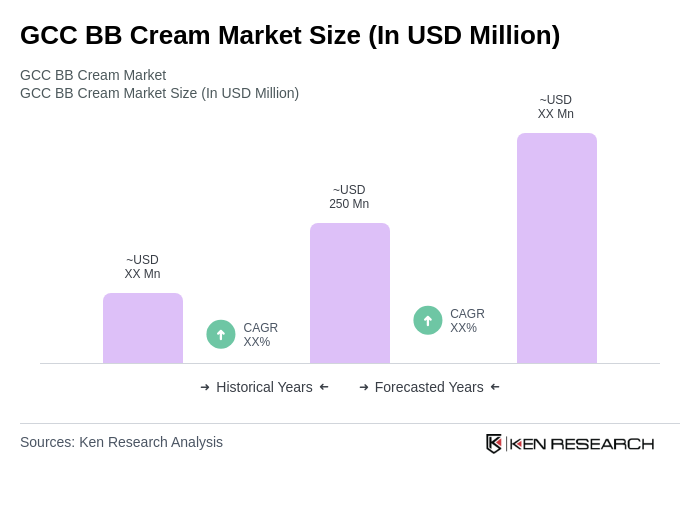
GCC BB Cream Market, valued at USD 250 million, grows due to skincare awareness, K-beauty trends, and e-commerce, with hydrating types leading segments.

Region:Middle East

Author(s):Rebecca

Product Code:KRAC4656

Pages:84

Published On:October 2025
About the Report

Base Year 2024

GCC BB Cream Market Overview

  • The GCC BB Cream Market is valued at USD 250 million, based on a five-year historical analysis. This growth is primarily driven by the increasing demand for multifunctional beauty products that offer skincare benefits alongside cosmetic coverage. The rising awareness of skincare among consumers, coupled with the growing trend of minimalistic beauty routines and the influence of K-beauty and J-beauty trends, has significantly contributed to the market's expansion. The preference for lightweight, skincare-infused cosmetics and the popularity of products with added benefits such as hydration, SPF, and anti-aging properties are key growth drivers in the region .
  • The United Arab Emirates and Saudi Arabia dominate the GCC BB Cream Market due to their high disposable incomes and a strong inclination towards beauty and personal care products. These countries have a well-established retail infrastructure and a growing population of beauty-conscious consumers, which further fuels the demand for BB creams. The expansion of e-commerce and the presence of international beauty brands have also accelerated market growth in these countries .
  • In 2023, the Gulf Cooperation Council Standardization Organization (GSO) issued the “GSO 1943:2021 Cosmetics – General Requirements” regulation, requiring all cosmetic products, including BB creams, to undergo safety assessments and comply with labeling standards. This regulation, enforced by national authorities across GCC member states, mandates ingredient disclosure, product registration, and adherence to safety and efficacy criteria, thereby enhancing consumer safety and fostering trust in the beauty industry .
GCC BB Cream Market Size

GCC BB Cream Market Segmentation

By Type:The market is segmented into various types of BB creams, including Hydrating BB Cream, Mattifying BB Cream, Tinted BB Cream, Anti-Aging BB Cream, BB Cream with SPF (Below 15, 15-30, Above 30), BB Cream for Sensitive Skin, BB Cream for Combination Skin, and Others. Among these, Hydrating BB Cream is currently the most popular choice among consumers due to its moisturizing properties, which cater to the needs of individuals with dry skin. The demand for BB creams that offer additional skincare benefits, such as hydration and sun protection, is driving the growth of this segment. The growing preference for lightweight, breathable, and skin-nourishing formulas is also influencing product innovation and consumer choice .
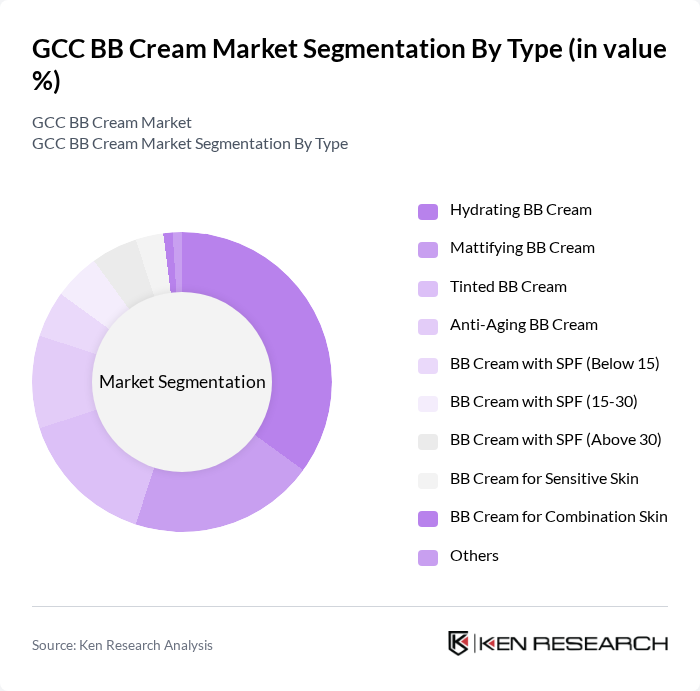
GCC BB Cream Market segmentation by Type.

By End-User:The end-user segmentation includes Women, Men, Teens, and Unisex. The Women segment holds the largest share of the market, driven by the increasing focus on beauty and skincare among female consumers. Women are more likely to invest in products that offer both cosmetic and skincare benefits, making BB creams a popular choice. The growing trend of gender-neutral beauty products is also contributing to the rise of the Unisex segment. The influence of social media, changing beauty standards, and increased product accessibility are further shaping end-user preferences in the region .
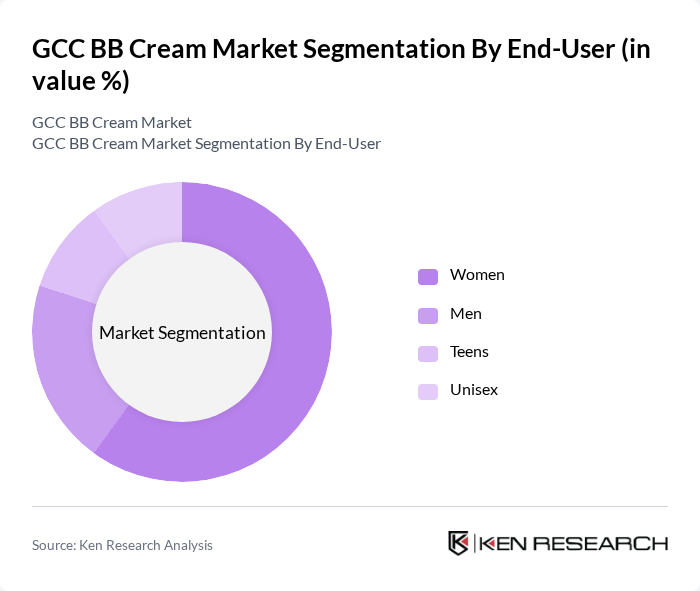
GCC BB Cream Market segmentation by End-User.

GCC BB Cream Market Competitive Landscape

The GCC BB Cream Market is characterized by a dynamic mix of regional and international players. Leading participants such as L'Oréal Middle East, Estée Lauder Companies Inc., Procter & Gamble Co., Unilever PLC, Shiseido Company, Limited, Coty Inc., Revlon, Inc., Avon Products, Inc., Mary Kay Inc., Oriflame Cosmetics S.A., Amway Corporation, Beiersdorf AG (NIVEA), Johnson & Johnson (Neutrogena), Clarins Group, Kiehl's Since 1851, The Face Shop (LG Household & Health Care), Missha (Able C&C Co., Ltd.), Etude House (Amorepacific Corporation), Maybelline New York (L'Oréal), Bourjois (Coty Inc.) contribute to innovation, geographic expansion, and service delivery in this space.

L'Oréal Middle East

1909

Dubai, UAE

Estée Lauder Companies Inc.

1946

New York, USA

Procter & Gamble Co.

1837

Cincinnati, USA

Unilever PLC

1929

London, UK

Shiseido Company, Limited

1872

Tokyo, Japan

Company

Establishment Year

Headquarters

Group Size (Large, Medium, or Small as per industry convention)

Revenue Growth Rate (GCC BB Cream segment)

Market Penetration Rate (GCC region)

Customer Retention Rate

Product Diversification Index (BB Cream portfolio breadth)

Pricing Strategy (Premium, Mass, Budget)

GCC BB Cream Market Industry Analysis

Growth Drivers

  • Increasing Demand for Multi-Functional Products:The GCC region has seen a significant rise in the demand for multi-functional beauty products, with the market for BB creams growing by approximately 15 million units in future. This trend is driven by consumers seeking products that offer skincare benefits alongside cosmetic coverage. The increasing disposable income, projected to reach $1.2 trillion in future, further supports this demand as consumers are willing to invest in quality beauty products that simplify their routines.
  • Rising Awareness of Skin Care Benefits:Awareness regarding the importance of skincare has surged, with 75% of consumers in the GCC now prioritizing products that provide sun protection and hydration. This shift is reflected in the sales of BB creams, which have increased by 22% year-on-year. The growing influence of social media and beauty influencers has played a crucial role in educating consumers about the benefits of BB creams, leading to a more informed purchasing decision.
  • Growth of E-commerce Platforms:E-commerce in the GCC is projected to reach $30 billion in future, significantly impacting the beauty sector. The convenience of online shopping has led to a 35% increase in BB cream sales through digital channels. Brands are leveraging this trend by enhancing their online presence and offering exclusive online promotions, making it easier for consumers to access a wider range of products, thus driving market growth.

Market Challenges

  • Intense Competition Among Brands:The GCC BB cream market is characterized by fierce competition, with over 55 brands vying for market share. This saturation has led to aggressive pricing strategies, impacting profit margins. In future, the average price of BB creams dropped by 12%, forcing brands to innovate continuously to differentiate their products. This competitive landscape poses a challenge for new entrants and established brands alike.
  • Regulatory Compliance Issues:Navigating the regulatory landscape in the GCC can be complex, with stringent requirements for cosmetic products. In future, the region is expected to implement stricter labeling and safety regulations, which could increase compliance costs for manufacturers. Companies may face delays in product launches and potential fines for non-compliance, creating barriers to market entry and expansion for many brands.

GCC BB Cream Market Future Outlook

The GCC BB cream market is poised for continued growth, driven by evolving consumer preferences and technological advancements in product formulation. As consumers increasingly seek personalized beauty solutions, brands are likely to invest in research and development to create innovative products that cater to diverse skin types. Additionally, the rise of digital marketing strategies will enhance brand visibility, further driving sales and market penetration in the coming years.

Market Opportunities

  • Introduction of Organic and Natural BB Creams:The demand for organic and natural beauty products is on the rise, with a 30% increase in consumer interest reported in future. Brands that introduce BB creams formulated with natural ingredients can tap into this growing segment, appealing to health-conscious consumers and potentially increasing market share significantly.
  • Targeting Male Grooming Segment:The male grooming market in the GCC is expected to reach $6 billion in future, presenting a lucrative opportunity for BB cream brands. By developing products specifically designed for men, companies can cater to this emerging demographic, capitalizing on the increasing acceptance of skincare among male consumers and expanding their customer base.

Scope of the Report

SegmentSub-Segments
By Type

Hydrating BB Cream

Mattifying BB Cream

Tinted BB Cream

Anti-Aging BB Cream

BB Cream with SPF (Below 15, 15-30, Above 30)

BB Cream for Sensitive Skin

BB Cream for Combination Skin

Others

By End-User

Women

Men

Teens

Unisex

By Distribution Channel

Online Retail (E-Retailers)

Supermarkets/Hypermarkets

Specialty Outlets/Beauty Stores

Pharmacies

Convenience Stores

Direct Sales

Others

By Price Range

Premium

Mid-Range

Budget

By Brand Positioning

Luxury Brands

Mass Market Brands

Niche Brands

By Packaging Type

Tube

Jar

Pump

By Ingredient Type

Natural Ingredients

Synthetic Ingredients

Organic Ingredients

Key Target Audience

Investors and Venture Capitalist Firms

Government and Regulatory Bodies (e.g., Ministry of Health, Gulf Cooperation Council)

Manufacturers and Producers

Distributors and Retailers

Beauty and Personal Care Brands

Market Analysts and Industry Experts

Trade Associations and Organizations

Financial Institutions

Players Mentioned in the Report:

L'Oreal Middle East

Estee Lauder Companies Inc.

Procter & Gamble Co.

Unilever PLC

Shiseido Company, Limited

Coty Inc.

Revlon, Inc.

Avon Products, Inc.

Mary Kay Inc.

Oriflame Cosmetics S.A.

Amway Corporation

Beiersdorf AG (NIVEA)

Johnson & Johnson (Neutrogena)

Clarins Group

Kiehl's Since 1851

The Face Shop (LG Household & Health Care)

Missha (Able C&C Co., Ltd.)

Etude House (Amorepacific Corporation)

Maybelline New York (L'Oreal)

Bourjois (Coty Inc.)

Table of Contents

Market Assessment Phase

1. Executive Summary and Approach


2. GCC BB Cream Market Overview

2.1 Key Insights and Strategic Recommendations

2.2 GCC BB Cream Market Overview

2.3 Definition and Scope

2.4 Evolution of Market Ecosystem

2.5 Timeline of Key Regulatory Milestones

2.6 Value Chain & Stakeholder Mapping

2.7 Business Cycle Analysis

2.8 Policy & Incentive Landscape


3. GCC BB Cream Market Analysis

3.1 Growth Drivers

3.1.1 Increasing Demand for Multi-Functional Products
3.1.2 Rising Awareness of Skin Care Benefits
3.1.3 Growth of E-commerce Platforms
3.1.4 Expansion of Beauty and Personal Care Industry

3.2 Market Challenges

3.2.1 Intense Competition Among Brands
3.2.2 Regulatory Compliance Issues
3.2.3 Price Sensitivity Among Consumers
3.2.4 Limited Awareness in Certain Demographics

3.3 Market Opportunities

3.3.1 Introduction of Organic and Natural BB Creams
3.3.2 Targeting Male Grooming Segment
3.3.3 Collaborations with Influencers and Beauty Experts
3.3.4 Expansion into Emerging Markets within GCC

3.4 Market Trends

3.4.1 Increasing Popularity of Customizable Products
3.4.2 Growth of Sustainable and Eco-Friendly Packaging
3.4.3 Rise of Social Media Marketing Strategies
3.4.4 Shift Towards Online Shopping Experiences

3.5 Government Regulation

3.5.1 Stricter Labeling Requirements
3.5.2 Import Tariffs on Cosmetic Products
3.5.3 Safety and Efficacy Testing Regulations
3.5.4 Guidelines for Advertising and Marketing Claims

4. SWOT Analysis


5. Stakeholder Analysis


6. Porter's Five Forces Analysis


7. GCC BB Cream Market Market Size, 2019-2024

7.1 By Value

7.2 By Volume

7.3 By Average Selling Price


8. GCC BB Cream Market Segmentation

8.1 By Type

8.1.1 Hydrating BB Cream
8.1.2 Mattifying BB Cream
8.1.3 Tinted BB Cream
8.1.4 Anti-Aging BB Cream
8.1.5 BB Cream with SPF (Below 15, 15-30, Above 30)
8.1.6 BB Cream for Sensitive Skin
8.1.7 BB Cream for Combination Skin
8.1.8 Others

8.2 By End-User

8.2.1 Women
8.2.2 Men
8.2.3 Teens
8.2.4 Unisex

8.3 By Distribution Channel

8.3.1 Online Retail (E-Retailers)
8.3.2 Supermarkets/Hypermarkets
8.3.3 Specialty Outlets/Beauty Stores
8.3.4 Pharmacies
8.3.5 Convenience Stores
8.3.6 Direct Sales
8.3.7 Others

8.4 By Price Range

8.4.1 Premium
8.4.2 Mid-Range
8.4.3 Budget

8.5 By Brand Positioning

8.5.1 Luxury Brands
8.5.2 Mass Market Brands
8.5.3 Niche Brands

8.6 By Packaging Type

8.6.1 Tube
8.6.2 Jar
8.6.3 Pump

8.7 By Ingredient Type

8.7.1 Natural Ingredients
8.7.2 Synthetic Ingredients
8.7.3 Organic Ingredients

9. GCC BB Cream Market Competitive Analysis

9.1 Market Share of Key Players

9.2 Cross Comparison of Key Players

9.2.1 Company Name
9.2.2 Group Size (Large, Medium, or Small as per industry convention)
9.2.3 Revenue Growth Rate (GCC BB Cream segment)
9.2.4 Market Penetration Rate (GCC region)
9.2.5 Customer Retention Rate
9.2.6 Product Diversification Index (BB Cream portfolio breadth)
9.2.7 Pricing Strategy (Premium, Mass, Budget)
9.2.8 Brand Equity Score (Regional consumer perception)
9.2.9 Distribution Network Efficiency (GCC coverage)
9.2.10 Customer Satisfaction Index (GCC BB Cream consumers)

9.3 SWOT Analysis of Top Players

9.4 Pricing Analysis

9.5 Detailed Profile of Major Companies

9.5.1 L'Oréal Middle East
9.5.2 Estée Lauder Companies Inc.
9.5.3 Procter & Gamble Co.
9.5.4 Unilever PLC
9.5.5 Shiseido Company, Limited
9.5.6 Coty Inc.
9.5.7 Revlon, Inc.
9.5.8 Avon Products, Inc.
9.5.9 Mary Kay Inc.
9.5.10 Oriflame Cosmetics S.A.
9.5.11 Amway Corporation
9.5.12 Beiersdorf AG (NIVEA)
9.5.13 Johnson & Johnson (Neutrogena)
9.5.14 Clarins Group
9.5.15 Kiehl's Since 1851
9.5.16 The Face Shop (LG Household & Health Care)
9.5.17 Missha (Able C&C Co., Ltd.)
9.5.18 Etude House (Amorepacific Corporation)
9.5.19 Maybelline New York (L'Oréal)
9.5.20 Bourjois (Coty Inc.)

10. GCC BB Cream Market End-User Analysis

10.1 Procurement Behavior of Key Ministries

10.1.1 Government Procurement Policies
10.1.2 Budget Allocations for Beauty Products
10.1.3 Supplier Selection Criteria

10.2 Corporate Spend on Infrastructure & Energy

10.2.1 Investment in Beauty and Personal Care
10.2.2 Trends in Corporate Gifting

10.3 Pain Point Analysis by End-User Category

10.3.1 Product Efficacy Concerns
10.3.2 Availability of Desired Shades
10.3.3 Price Sensitivity

10.4 User Readiness for Adoption

10.4.1 Awareness of BB Cream Benefits
10.4.2 Willingness to Experiment with New Products

10.5 Post-Deployment ROI and Use Case Expansion

10.5.1 Customer Feedback Mechanisms
10.5.2 Repeat Purchase Rates
10.5.3 Brand Loyalty Indicators

11. GCC BB Cream Market Future Size, 2025-2030

11.1 By Value

11.2 By Volume

11.3 By Average Selling Price


Go-To-Market Strategy Phase

1. Whitespace Analysis + Business Model Canvas

1.1 Market Gaps Identification

1.2 Value Proposition Development

1.3 Revenue Streams Analysis

1.4 Customer Segmentation

1.5 Key Partnerships

1.6 Cost Structure

1.7 Channels of Distribution


2. Marketing and Positioning Recommendations

2.1 Branding Strategies

2.2 Product USPs

2.3 Target Audience Identification

2.4 Marketing Channels

2.5 Promotional Strategies


3. Distribution Plan

3.1 Urban Retail Strategies

3.2 Rural NGO Tie-Ups

3.3 E-commerce Strategies

3.4 Partnerships with Retail Chains


4. Channel & Pricing Gaps

4.1 Underserved Routes

4.2 Pricing Bands Analysis

4.3 Competitor Pricing Strategies


5. Unmet Demand & Latent Needs

5.1 Category Gaps

5.2 Consumer Segments Analysis

5.3 Emerging Trends


6. Customer Relationship

6.1 Loyalty Programs

6.2 After-sales Service

6.3 Customer Engagement Strategies


7. Value Proposition

7.1 Sustainability Initiatives

7.2 Integrated Supply Chains

7.3 Unique Selling Points


8. Key Activities

8.1 Regulatory Compliance

8.2 Branding Initiatives

8.3 Distribution Setup


9. Entry Strategy Evaluation

9.1 Domestic Market Entry Strategy

9.1.1 Product Mix
9.1.2 Pricing Band
9.1.3 Packaging Considerations

9.2 Export Entry Strategy

9.2.1 Target Countries
9.2.2 Compliance Roadmap

10. Entry Mode Assessment

10.1 Joint Ventures

10.2 Greenfield Investments

10.3 Mergers & Acquisitions

10.4 Distributor Model


11. Capital and Timeline Estimation

11.1 Capital Requirements

11.2 Timelines for Market Entry


12. Control vs Risk Trade-Off

12.1 Ownership vs Partnerships


13. Profitability Outlook

13.1 Breakeven Analysis

13.2 Long-term Sustainability


14. Potential Partner List

14.1 Distributors

14.2 Joint Ventures

14.3 Acquisition Targets


15. Execution Roadmap

15.1 Phased Plan for Market Entry

15.1.1 Market Setup
15.1.2 Market Entry
15.1.3 Growth Acceleration
15.1.4 Scale & Stabilize

15.2 Key Activities and Milestones

15.2.1 Milestone Planning
15.2.2 Activity Tracking

Research Methodology

ApproachModellingSample

Phase 1: Approach1

Desk Research

  • Market reports from industry associations and trade publications specific to the GCC beauty and cosmetics sector
  • Analysis of consumer behavior studies and demographic data from government statistical agencies
  • Review of online retail platforms and e-commerce trends related to BB cream sales in the GCC region

Primary Research

  • Interviews with brand managers and product developers from leading cosmetic companies operating in the GCC
  • Surveys conducted with beauty consultants and dermatologists to understand consumer preferences and skin care trends
  • Focus group discussions with end-users to gather qualitative insights on product usage and brand perception

Validation & Triangulation

  • Cross-validation of findings through comparison with historical sales data and market growth rates
  • Triangulation of insights from primary interviews with secondary data sources to ensure consistency
  • Sanity checks through expert panel reviews involving industry veterans and market analysts

Phase 2: Market Size Estimation1

Top-down Assessment

  • Estimation of the overall GCC cosmetics market size and segmentation specific to BB creams
  • Analysis of import/export data to gauge market penetration and growth potential
  • Incorporation of regional beauty trends and consumer spending patterns on skincare products

Bottom-up Modeling

  • Collection of sales data from key retailers and e-commerce platforms to establish baseline figures
  • Estimation of average selling prices and volume sold across different distribution channels
  • Analysis of consumer purchasing frequency and brand loyalty metrics to refine volume estimates

Forecasting & Scenario Analysis

  • Multi-factor regression analysis incorporating economic indicators, demographic shifts, and beauty trends
  • Scenario modeling based on potential regulatory changes and shifts in consumer preferences towards natural ingredients
  • Development of baseline, optimistic, and pessimistic forecasts for BB cream market growth through 2030

Phase 3: CATI Sample Composition1

Scope Item/SegmentSample SizeTarget Respondent Profiles
Retail Sales of BB Creams50Store Managers, Beauty Advisors
Consumer Preferences in Skincare80Female Consumers aged 18-45
Online Purchase Behavior60eCommerce Shoppers, Digital Marketing Specialists
Product Development Insights40Product Managers, R&D Specialists
Market Trends and Innovations50Industry Analysts, Trend Forecasters

Frequently Asked Questions

What is the current value of the GCC BB Cream Market?

The GCC BB Cream Market is valued at approximately USD 250 million, reflecting a growing demand for multifunctional beauty products that combine skincare benefits with cosmetic coverage, driven by consumer preferences for lightweight and effective formulations.

Which countries dominate the GCC BB Cream Market?

What are the key growth drivers for the GCC BB Cream Market?

What types of BB creams are available in the GCC market?

Other Regional/Country Reports

Indonesia bb cream market

Malaysia bb cream market

KSA bb cream market

APAC bb cream market

SEA bb cream market

Vietnam bb cream market

Other Adjacent Reports

UAE Skincare Products Market

Kuwait Foundation Cosmetics Market

Bahrain Sunscreen Products Market

Belgium Anti-Aging Cream Market

Mexico Tinted Moisturizer Market

Japan CC Cream Market

South Africa Organic Beauty Products Market

India Male Grooming Products Market Outlook to 2030

South Africa E-Commerce Beauty Market

Japan K-Beauty Products Market

Why Buy From Us?

Refine Robust Result (RRR) Framework

What makes us stand out is that our consultants follow Robust, Refine and Result (RRR) methodology. Robust for clear definitions, approaches and sanity checking, Refine for differentiating respondents' facts and opinions, and Result for presenting data with story.

Our Reach Is Unmatched

We have set a benchmark in the industry by offering our clients with syndicated and customized market research reports featuring coverage of entire market as well as meticulous research and analyst insights.

Shifting the Research Paradigm

While we don't replace traditional research, we flip the method upside down. Our dual approach of Top Bottom & Bottom Top ensures quality deliverable by not just verifying company fundamentals but also looking at the sector and macroeconomic factors.

More Insights-Better Decisions

With one step in the future, our research team constantly tries to show you the bigger picture. We help with some of the tough questions you may encounter along the way: How is the industry positioned? Best marketing channel? KPI's of competitors? By aligning every element, we help maximize success.

Transparency and Trust

Our report gives you instant access to the answers and sources that other companies might choose to hide. We elaborate each steps of research methodology we have used and showcase you the sample size to earn your trust.

Round the Clock Support

If you need any support, we are here! We pride ourselves on universe strength, data quality, and quick, friendly, and professional service.

Why Clients Choose Us?

400000+
Reports in repository
150+
Consulting projects a year
100+
Analysts
8000+
Client Queries in 2022








