About the Report
Base Year 2024GCC Decorated Apparel Market Overview
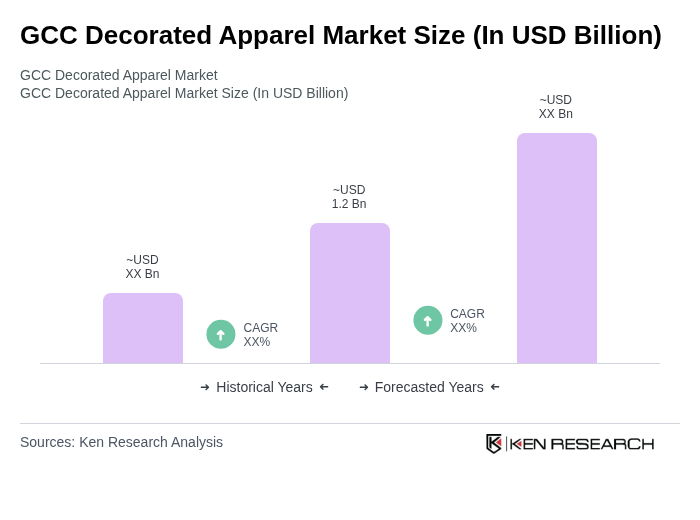
- The GCC Decorated Apparel Market is valued at USD 1.2 billion, based on a five-year historical analysis, considering the share of decorated apparel within the wider GCC apparel market and global decorated apparel benchmarks. This growth is primarily driven by the increasing demand for customized apparel in various sectors, including retail, corporate, and sports, in line with global trends where personalization and branding are key purchase drivers. The rise in e-commerce and social media marketing has further fueled consumer interest in personalized clothing, with online custom-order platforms and print?on?demand services expanding decorated apparel production and sales across the GCC.
- The UAE and Saudi Arabia dominate the GCC Decorated Apparel Market due to their robust retail infrastructure, higher disposable incomes, and a growing youth and expatriate population that favors trendy and personalized clothing. Additionally, major events such as sports tournaments, entertainment events, and cultural festivals in these countries, including international football, motorsport, and large-scale cultural seasons, create significant demand for decorated teamwear, fanwear, and event merchandise, further solidifying their market leadership.
- In 2023, GCC countries strengthened sustainability-related requirements affecting the apparel industry through national policies and standards on textiles, chemicals, and waste, which apply to many manufacturers and importers of decorated apparel. For example, in the United Arab Emirates, the Cabinet Resolution No. 10 of 2017 on the UAE RoHS Regulation, issued by the UAE Cabinet, restricts hazardous substances in electrical and electronic equipment used in decoration processes and printing machinery, requiring manufacturers and importers to comply with limits on substances such as lead, mercury, and cadmium. In Saudi Arabia, the Technical Regulation for Textile Products issued by the Saudi Standards, Metrology and Quality Organization (SASO) in 2022 sets detailed rules on labelling, fiber content, and chemical restrictions (including azo dyes and formaldehyde) for textile products placed on the market, encouraging the adoption of more eco?friendly materials and processes in apparel and decorated garments.
GCC Decorated Apparel Market Segmentation
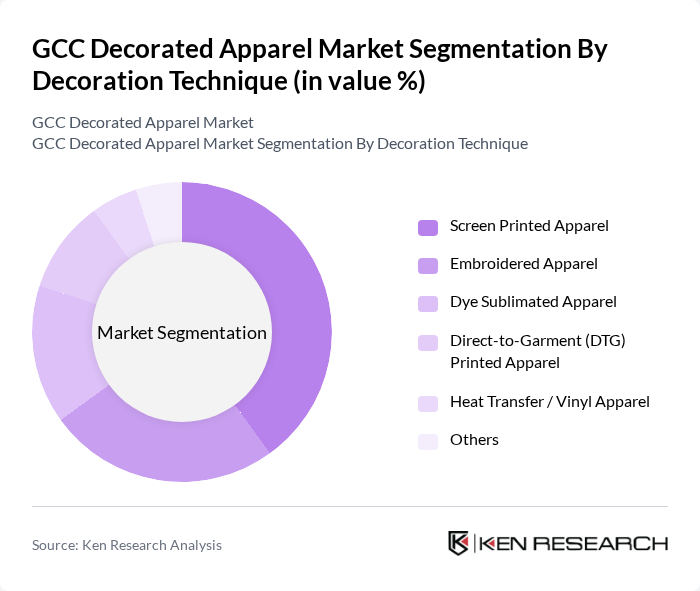
By Decoration Technique:The decorated apparel market is segmented based on various decoration techniques, including screen printing, embroidery, dye sublimation, direct-to-garment printing, heat transfer, and others, which is consistent with the main global embellishment methods used for customized garments. Screen printed apparel is currently one of the leading sub-segments due to its cost-effectiveness, ability to handle large volumes, and versatility across cotton and blended fabrics, making it a preferred choice for bulk orders in retail, promotional events, and sportswear. Embroidered apparel remains highly relevant and is widely favored for its durability, colorfastness, and premium appearance, particularly in corporate uniforms, hospitality workwear, and teamwear where long-lasting logos and branding are critical. At the same time, techniques such as direct?to?garment and dye sublimation are growing in use for short runs and high-resolution, full?color designs, especially through e?commerce and print?on?demand channels.
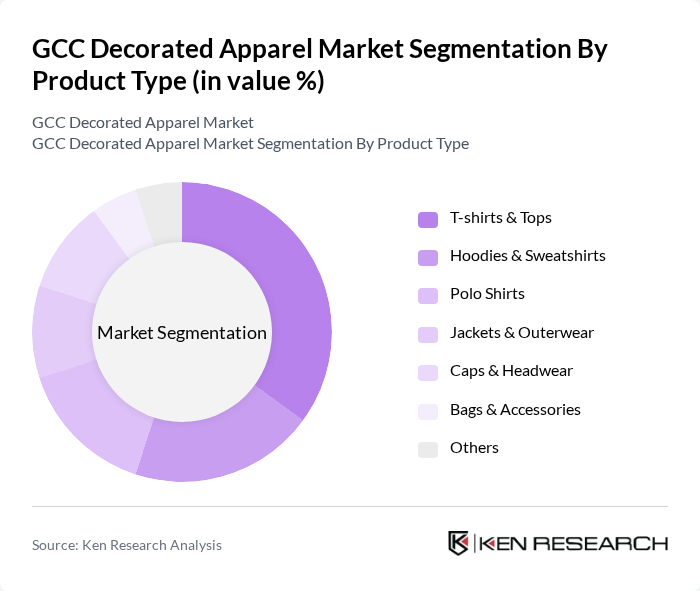
By Product Type:The market is also segmented by product type, which includes T-shirts & tops, hoodies & sweatshirts, polo shirts, jackets & outerwear, caps & headwear, bags & accessories, and others, reflecting the main decorated categories used for casualwear, corporate branding, and fanwear globally. T-shirts & tops dominate the market due to their widespread appeal, relatively low unit cost, and versatility across age groups, genders, and applications ranging from promotional giveaways to fashion streetwear. Hoodies & sweatshirts are gaining traction, especially among younger consumers, driven by the athleisure trend, increasing popularity of casual and oversized silhouettes, and strong demand for branded and logo?centric styles linked to sports, music, and gaming communities.
GCC Decorated Apparel Market Competitive Landscape
The GCC Decorated Apparel Market is characterized by a dynamic mix of regional and international players. Leading participants such as Nike, Inc., Adidas AG, Puma SE, Under Armour, Inc., Gildan Activewear Inc., Hanesbrands Inc., Custom Ink, LLC, Spreadshirt GmbH, Vistaprint (Cimpress plc), Zazzle Inc., Kitbag Ltd. / Fanatics, Local GCC Corporate Workwear Specialists, Regional Sports & Teamwear Suppliers, Online Custom Apparel Platforms (GCC-focused), Private Label Brands of Major GCC Retailers contribute to innovation, geographic expansion, and service delivery in this space.
GCC Decorated Apparel Market Industry Analysis
Growth Drivers
- Increasing Demand for Customized Apparel:The GCC region has witnessed a significant rise in demand for customized apparel, driven by a growing consumer preference for unique fashion statements. In future, the market for personalized clothing is projected to reach approximately 1.3 billion USD, reflecting a 8% increase from current levels. This trend is fueled by the rise of e-commerce platforms that offer customization options, catering to the desires of millennials and Gen Z consumers who prioritize individuality in their fashion choices.
- Rising Disposable Incomes:The GCC countries are experiencing a steady increase in disposable incomes, with an average growth rate of 5.2% annually. In future, the average disposable income per capita is expected to reach around 32,000 USD, enabling consumers to spend more on premium and decorated apparel. This increase in purchasing power is particularly evident in urban areas, where consumers are more inclined to invest in high-quality, fashionable clothing that reflects their lifestyle and status.
- Influence of Social Media on Fashion Trends:Social media platforms have become pivotal in shaping fashion trends within the GCC region. In future, it is estimated that over 85% of the population actively engages with social media, with platforms like Instagram and TikTok driving fashion inspiration. This engagement has led to a surge in demand for trendy, decorated apparel, as consumers seek to emulate influencers and celebrities. Brands that leverage social media marketing effectively can tap into this growing consumer base, enhancing their market presence.
Market Challenges
- Intense Competition Among Local and International Brands:The GCC decorated apparel market is characterized by fierce competition, with numerous local and international brands vying for market share. In future, the number of active apparel brands in the region is projected to exceed 1,700, intensifying the struggle for consumer attention. This saturation makes it challenging for new entrants to establish themselves, as established brands leverage brand loyalty and marketing budgets to maintain their market positions.
- Fluctuating Raw Material Prices:The apparel industry in the GCC faces challenges due to fluctuating raw material prices, particularly cotton and synthetic fibers. In future, cotton prices are expected to average around 1.25 USD per pound, influenced by global supply chain disruptions and climatic factors. These price fluctuations can significantly impact production costs, forcing brands to either absorb costs or pass them onto consumers, potentially affecting sales and profitability.
GCC Decorated Apparel Market Future Outlook
The future of the GCC decorated apparel market appears promising, driven by evolving consumer preferences and technological advancements. As sustainability becomes a priority, brands are increasingly adopting eco-friendly practices, which are expected to resonate with environmentally conscious consumers. Additionally, the integration of advanced printing technologies will enhance customization capabilities, allowing brands to offer unique products that cater to individual tastes. This dynamic environment presents opportunities for growth and innovation in the coming years.
Market Opportunities
- Expansion into Untapped Markets:There is significant potential for brands to expand into untapped markets within the GCC, particularly in rural areas where demand for decorated apparel is rising. By establishing local distribution channels, brands can cater to these emerging consumer bases, potentially increasing their market share and revenue streams.
- Collaborations with Local Designers:Collaborating with local designers presents a unique opportunity for brands to create culturally relevant apparel that resonates with consumers. Such partnerships can enhance brand visibility and authenticity, tapping into the growing trend of supporting local talent while offering exclusive collections that appeal to the GCC market.
Scope of the Report
| Segment | Sub-Segments |
|---|---|
| By Decoration Technique | Screen Printed Apparel Embroidered Apparel Dye Sublimated Apparel Direct-to-Garment (DTG) Printed Apparel Heat Transfer / Vinyl Apparel Others |
| By Product Type | T-shirts & Tops Hoodies & Sweatshirts Polo Shirts Jackets & Outerwear Caps & Headwear Bags & Accessories Others |
| By End-User Segment | Men Women Children |
| By Application | Retail / Fashion Corporate & Workwear Sports Teams & Clubs Schools & Universities Events & Promotions Hospitality & Tourism Others |
| By Distribution Channel | Online (Marketplaces & Brand e-commerce) Offline Retail (Multi-brand & Monobrand Stores) Corporate / Institutional Direct Sales Distributors & Wholesalers Others |
| By Material | Cotton Polyester Blended Fabrics Performance / Technical Fabrics Others |
| By GCC Country | UAE Saudi Arabia Qatar Kuwait Oman Bahrain |
Key Target Audience
Investors and Venture Capitalist Firms
Government and Regulatory Bodies (e.g., Ministry of Economy, Ministry of Commerce and Industry)
Manufacturers and Producers
Distributors and Retailers
Textile and Apparel Trade Associations
Brand Owners and Designers
Logistics and Supply Chain Companies
Financial Institutions
Players Mentioned in the Report:
Nike, Inc.
Adidas AG
Puma SE
Under Armour, Inc.
Gildan Activewear Inc.
Hanesbrands Inc.
Custom Ink, LLC
Spreadshirt GmbH
Vistaprint (Cimpress plc)
Zazzle Inc.
Kitbag Ltd. / Fanatics
Local GCC Corporate Workwear Specialists
Regional Sports & Teamwear Suppliers
Online Custom Apparel Platforms (GCC-focused)
Private Label Brands of Major GCC Retailers
Table of Contents
Market Assessment Phase
1. Executive Summary and Approach
2. GCC Decorated Apparel Market Overview
2.1 Key Insights and Strategic Recommendations
2.2 GCC Decorated Apparel Market Overview
2.3 Definition and Scope
2.4 Evolution of Market Ecosystem
2.5 Timeline of Key Regulatory Milestones
2.6 Value Chain & Stakeholder Mapping
2.7 Business Cycle Analysis
2.8 Policy & Incentive Landscape
3. GCC Decorated Apparel Market Analysis
3.1 Growth Drivers
3.1.1 Increasing demand for customized apparel
3.1.3 Rising disposable incomes
3.1.4 Influence of social media on fashion trends
3.2 Market Challenges
3.2.1 Intense competition among local and international brands
3.2.2 Fluctuating raw material prices
3.2.3 Regulatory compliance issues
3.2.4 Supply chain disruptions
3.3 Market Opportunities
3.3.1 Expansion into untapped markets
3.3.2 Collaborations with local designers
3.3.3 Adoption of sustainable practices
3.3.4 Technological advancements in printing techniques
3.4 Market Trends
3.4.1 Shift towards eco-friendly materials
3.4.2 Personalization and customization of apparel
3.4.3 Growth of athleisure wear
3.4.4 Increasing popularity of online shopping
3.5 Government Regulation
3.5.1 Compliance with labor laws
3.5.2 Environmental regulations on textile production
3.5.3 Import/export tariffs on apparel
3.5.4 Standards for product safety and quality
4. SWOT Analysis
5. Stakeholder Analysis
6. Porter's Five Forces Analysis
7. GCC Decorated Apparel Market Market Size, 2019-2024
7.1 By Value
7.2 By Volume
7.3 By Average Selling Price
8. GCC Decorated Apparel Market Segmentation
8.1 By Decoration Technique
8.1.1 Screen Printed Apparel
8.1.2 Embroidered Apparel
8.1.3 Dye Sublimated Apparel
8.1.4 Direct-to-Garment (DTG) Printed Apparel
8.1.5 Heat Transfer / Vinyl Apparel
8.1.6 Others
8.2 By Product Type
8.2.1 T-shirts & Tops
8.2.2 Hoodies & Sweatshirts
8.2.3 Polo Shirts
8.2.4 Jackets & Outerwear
8.2.5 Caps & Headwear
8.2.6 Bags & Accessories
8.2.7 Others
8.3 By End-User Segment
8.3.1 Men
8.3.2 Women
8.3.3 Children
8.4 By Application
8.4.1 Retail / Fashion
8.4.2 Corporate & Workwear
8.4.3 Sports Teams & Clubs
8.4.4 Schools & Universities
8.4.5 Events & Promotions
8.4.6 Hospitality & Tourism
8.4.7 Others
8.5 By Distribution Channel
8.5.1 Online (Marketplaces & Brand e-commerce)
8.5.2 Offline Retail (Multi-brand & Monobrand Stores)
8.5.3 Corporate / Institutional Direct Sales
8.5.4 Distributors & Wholesalers
8.5.5 Others
8.6 By Material
8.6.1 Cotton
8.6.2 Polyester
8.6.3 Blended Fabrics
8.6.4 Performance / Technical Fabrics
8.6.5 Others
8.7 By GCC Country
8.7.1 UAE
8.7.2 Saudi Arabia
8.7.3 Qatar
8.7.4 Kuwait
8.7.5 Oman
8.7.6 Bahrain
9. GCC Decorated Apparel Market Competitive Analysis
9.1 Market Share of Key Players
9.2 Cross Comparison of Key Players
9.2.1 Company Name
9.2.2 Company Size (Revenue Bracket)
9.2.3 GCC Decorated Apparel Revenue (USD Mn)
9.2.4 3-Year Revenue CAGR (%)
9.2.5 EBITDA Margin (%)
9.2.6 Market Share in GCC Decorated Apparel (%)
9.2.7 Average Order Value (AOV)
9.2.8 Online vs Offline Revenue Mix (%)
9.2.9 Capacity Utilization Rate (%)
9.2.10 On-time Delivery Rate (%)
9.2.11 Customer Acquisition Cost (CAC)
9.2.12 Customer Lifetime Value (CLV)
9.2.13 Repeat Purchase Rate (%)
9.2.14 SKU Count / Product Breadth
9.2.15 Sustainability / ESG Certifications Count
9.3 SWOT Analysis of Top Players
9.4 Pricing Analysis
9.5 Detailed Profile of Major Companies
9.5.1 Nike, Inc.
9.5.2 Adidas AG
9.5.3 Puma SE
9.5.4 Under Armour, Inc.
9.5.5 Gildan Activewear Inc.
9.5.6 Hanesbrands Inc.
9.5.7 Custom Ink, LLC
9.5.8 Spreadshirt GmbH
9.5.9 Vistaprint (Cimpress plc)
9.5.10 Zazzle Inc.
9.5.11 Kitbag Ltd. / Fanatics
9.5.12 Local GCC Corporate Workwear Specialists
9.5.13 Regional Sports & Teamwear Suppliers
9.5.14 Online Custom Apparel Platforms (GCC-focused)
9.5.15 Private Label Brands of Major GCC Retailers
10. GCC Decorated Apparel Market End-User Analysis
10.1 Procurement Behavior of Key Ministries
10.1.1 Key Procurement Trends
10.1.2 Budget Allocation Insights
10.1.3 Supplier Selection Criteria
10.1.4 Contract Management Practices
10.2 Corporate Spend on Infrastructure & Energy
10.2.1 Investment Trends in Apparel
10.2.2 Budgeting for Decorated Apparel
10.2.3 Cost Management Strategies
10.2.4 Procurement Cycles
10.3 Pain Point Analysis by End-User Category
10.3.1 Common Challenges Faced
10.3.2 Quality Concerns
10.3.3 Delivery Timeliness Issues
10.3.4 Customization Limitations
10.4 User Readiness for Adoption
10.4.1 Awareness Levels
10.4.2 Training Needs
10.4.3 Technology Adoption Rates
10.4.4 Feedback Mechanisms
10.5 Post-Deployment ROI and Use Case Expansion
10.5.1 Measurement of Success
10.5.2 Case Studies of Successful Implementations
10.5.3 Future Use Cases
10.5.4 Expansion Opportunities
11. GCC Decorated Apparel Market Future Size, 2025-2030
11.1 By Value
11.2 By Volume
11.3 By Average Selling Price
Go-To-Market Strategy Phase
1. Whitespace Analysis + Business Model Canvas
1.1 Market Gaps Identification
1.2 Business Model Framework
2. Marketing and Positioning Recommendations
2.1 Branding Strategies
2.2 Product USPs
3. Distribution Plan
3.1 Urban Retail vs Rural NGO Tie-ups
4. Channel & Pricing Gaps
4.1 Underserved Routes
4.2 Pricing Bands
5. Unmet Demand & Latent Needs
5.1 Category Gaps
5.2 Consumer Segments
6. Customer Relationship
6.1 Loyalty Programs
6.2 After-sales Service
7. Value Proposition
7.1 Sustainability
7.2 Integrated Supply Chains
8. Key Activities
8.1 Regulatory Compliance
8.2 Branding
8.3 Distribution Setup
9. Entry Strategy Evaluation
9.1 Domestic Market Entry Strategy
9.1.1 Product Mix
9.1.2 Pricing Band
9.1.3 Packaging
9.2 Export Entry Strategy
9.2.1 Target Countries
9.2.2 Compliance Roadmap
10. Entry Mode Assessment
10.1 JV
10.2 Greenfield
10.3 M&A
10.4 Distributor Model
11. Capital and Timeline Estimation
11.1 Capital Requirements
11.2 Timelines
12. Control vs Risk Trade-Off
12.1 Ownership vs Partnerships
13. Profitability Outlook
13.1 Breakeven Analysis
13.2 Long-term Sustainability
14. Potential Partner List
14.1 Distributors
14.2 JVs
14.3 Acquisition Targets
15. Execution Roadmap
15.1 Phased Plan for Market Entry
15.1.1 Market Setup
15.1.2 Market Entry
15.1.3 Growth Acceleration
15.1.4 Scale & Stabilize
15.2 Key Activities and Milestones
15.2.1 Milestone Planning
15.2.2 Activity Tracking
Research Methodology
Phase 1: Approach1
Desk Research
- Analysis of market reports from industry associations in the GCC region
- Review of trade publications and journals focusing on decorated apparel trends
- Examination of demographic and economic data from government statistical agencies
Primary Research
- Interviews with key stakeholders in the decorated apparel supply chain, including manufacturers and retailers
- Surveys targeting consumers to understand preferences and purchasing behavior
- Focus groups with fashion designers and brand managers to gather insights on market trends
Validation & Triangulation
- Cross-validation of findings through multiple data sources, including sales data and consumer feedback
- Triangulation of insights from primary interviews with secondary research findings
- Sanity checks conducted through expert panel reviews and industry roundtables
Phase 2: Market Size Estimation1
Top-down Assessment
- Estimation of total market size based on regional apparel market data and growth rates
- Segmentation of the market by product type, including screen printing, embroidery, and digital printing
- Incorporation of macroeconomic factors such as GDP growth and consumer spending trends
Bottom-up Modeling
- Collection of sales data from leading decorated apparel manufacturers in the GCC
- Estimation of average selling prices and production volumes across different product categories
- Analysis of distribution channels and their impact on market penetration and growth
Forecasting & Scenario Analysis
- Development of forecasting models based on historical sales data and market trends
- Scenario analysis considering factors such as economic fluctuations and changing consumer preferences
- Projections for market growth through 2030, including best-case and worst-case scenarios
Phase 3: CATI Sample Composition1
| Scope Item/Segment | Sample Size | Target Respondent Profiles |
|---|---|---|
| Retail Apparel Outlets | 120 | Store Managers, Merchandising Directors |
| Online Decorated Apparel Brands | 90 | E-commerce Managers, Digital Marketing Specialists |
| Custom Apparel Manufacturers | 75 | Production Managers, Quality Control Supervisors |
| Fashion Design Firms | 60 | Creative Directors, Product Development Managers |
| Consumer Insights on Decorated Apparel | 130 | Fashion Enthusiasts, Regular Apparel Buyers |
Frequently Asked Questions
What is the current value of the GCC Decorated Apparel Market?
The GCC Decorated Apparel Market is valued at approximately USD 1.2 billion, reflecting a significant share within the broader GCC apparel market. This valuation is based on a five-year historical analysis and global benchmarks for decorated apparel.
What factors are driving the growth of the GCC Decorated Apparel Market?
Which countries dominate the GCC Decorated Apparel Market?
What decoration techniques are commonly used in the GCC Decorated Apparel Market?
Other Regional/Country Reports
Indonesia Decorated Apparel Market
Malaysia Decorated Apparel Market
KSA Decorated Apparel Market
Other Adjacent Reports
Singapore Promotional Products Market
Singapore Corporate Uniform Market
Thailand E-commerce Fashion Market
Oman Sustainable Apparel Market
KSA athleisure market Size, Share, Growth Drivers, Trends, Opportunities & Forecast 2025–2030Kuwait fashion accessories market report size, share, growth drivers, trends, opportunities & forecast 2025–2030Why Buy From Us?

What makes us stand out is that our consultants follow Robust, Refine and Result (RRR) methodology. Robust for clear definitions, approaches and sanity checking, Refine for differentiating respondents' facts and opinions, and Result for presenting data with story.

We have set a benchmark in the industry by offering our clients with syndicated and customized market research reports featuring coverage of entire market as well as meticulous research and analyst insights.

While we don't replace traditional research, we flip the method upside down. Our dual approach of Top Bottom & Bottom Top ensures quality deliverable by not just verifying company fundamentals but also looking at the sector and macroeconomic factors.

With one step in the future, our research team constantly tries to show you the bigger picture. We help with some of the tough questions you may encounter along the way: How is the industry positioned? Best marketing channel? KPI's of competitors? By aligning every element, we help maximize success.

Our report gives you instant access to the answers and sources that other companies might choose to hide. We elaborate each steps of research methodology we have used and showcase you the sample size to earn your trust.

If you need any support, we are here! We pride ourselves on universe strength, data quality, and quick, friendly, and professional service.