About the Report
Base Year 2024GCC Filtration Drying Equipment Market Overview
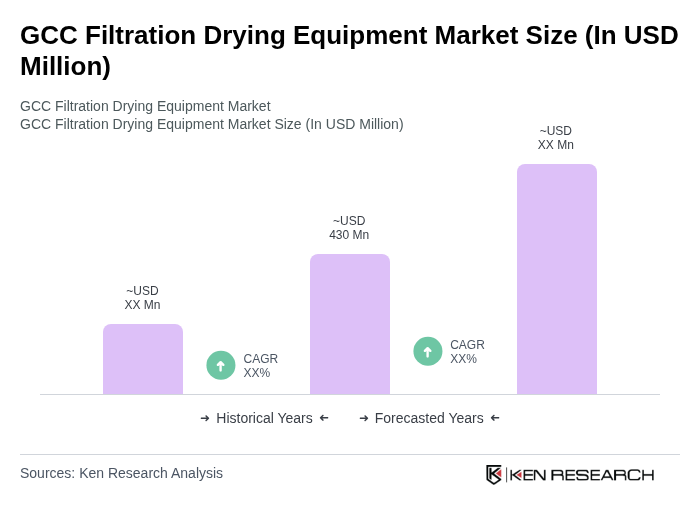
- The GCC Filtration Drying Equipment Market is valued at USD 430 million, based on recent analysis. Growth is primarily driven by expanding industrial activity in sectors such as petrochemicals, pharmaceuticals, and water treatment, where efficient separation and moisture control are critical. Demand is further buoyed by increasing environmental awareness, the adoption of energy-efficient technologies to reduce operational costs and meet stricter air and water quality standards, and rising investments in sustainable wastewater management.
- Key countries dominating the market include Saudi Arabia and the UAE, where large-scale infrastructure and industrial diversification efforts stimulate demand for advanced filtration drying solutions. In Saudi Arabia, agitated nutsche filter-dyers represent a leading technology segment supported by robust domestic waste and water treatment initiatives. The UAE's focus on sustainable practices and innovation in industrial processes also contributes significantly to market growth.
- The Standards for Drinking Water Quality, 2022 issued by the Saudi Food and Drug Authority (SFDA) establish binding requirements for water purification systems in industrial applications. These standards mandate compliance through filtration and drying processes achieving specific contaminant removal thresholds of at least 99% for particulates and microbes, with licensing required for equipment exceeding 10 cubic meters per hour capacity, thereby supporting industrial water treatment capabilities under Vision 2030.
GCC Filtration Drying Equipment Market Segmentation
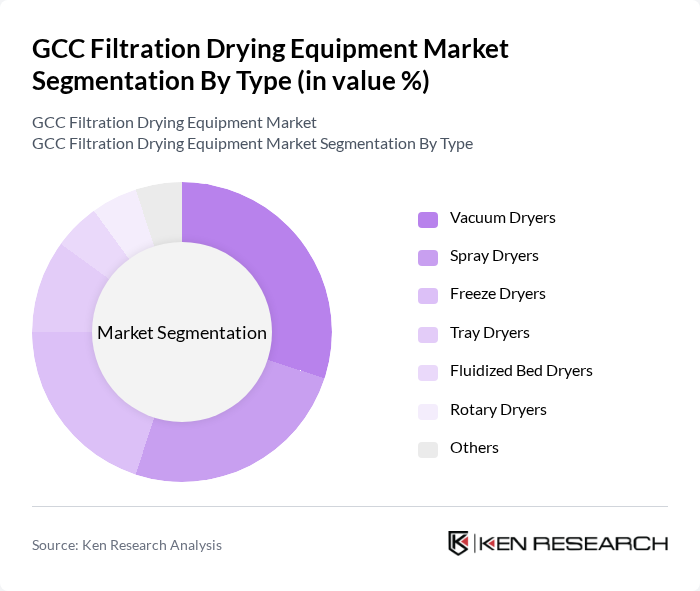
By Type:The filtration drying equipment market is segmented into various types, including vacuum dryers, spray dryers, freeze dryers, tray dryers, fluidized bed dryers, rotary dryers, and others. Among these, vacuum dryers are gaining traction due to their efficiency in moisture removal and energy savings. Spray dryers are also popular, especially in the food and pharmaceutical industries, where rapid drying is essential. The demand for freeze dryers is increasing in the pharmaceutical sector, driven by the need for preserving sensitive compounds.
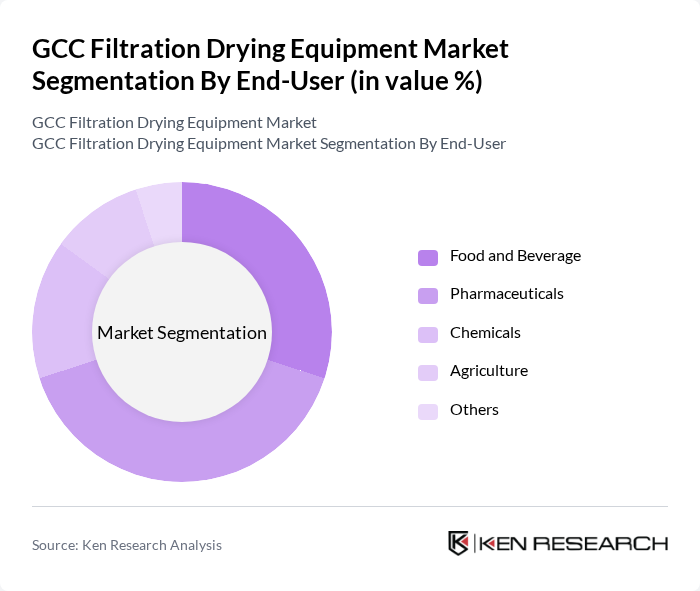
By End-User:The end-user segmentation includes food and beverage, pharmaceuticals, chemicals, agriculture, and others. The pharmaceutical sector is the largest end-user, driven by the need for high-quality drying processes to maintain product integrity. The food and beverage industry follows closely, where efficient drying methods are essential for preserving flavor and nutritional value. The chemicals sector also contributes significantly, as drying processes are critical for various chemical formulations.
GCC Filtration Drying Equipment Market Competitive Landscape
The GCC Filtration Drying Equipment Market is characterized by a dynamic mix of regional and international players. Leading participants such as Alfa Laval, GEA Group, Andritz AG, Schenck Process, SPX Flow, Bucher Unipektin AG, FLSmidth, Kason Corporation, Hosokawa Micron Group, Thermo Fisher Scientific, Simatek, ACG Worldwide, Huber Technology, Pavan Group, and Coperion contribute to innovation, geographic expansion, and service delivery in this space.
GCC Filtration Drying Equipment Market Industry Analysis
Growth Drivers
- Economic Growth Across GCC:The GCC region is experiencing robust economic growth, with the UAE projected to achieve a real GDP growth of 4.2% in future, while Saudi Arabia is expected to grow by 3.5%. This economic expansion is driving capital investments in industrial sectors, including filtration and drying equipment, as businesses seek to enhance operational efficiency. The overall industrial output is anticipated to rise, further stimulating demand for advanced drying technologies.
- Industrialization and Regulatory Push for Air Filtration:The GCC industrial air filtration market was valued at USD 450 million in future and is projected to reach USD 800 million by future. This growth is fueled by rapid industrialization and increasing regulations aimed at improving indoor air quality. Government incentives are also promoting the adoption of advanced filtration systems, which are integral to modern drying processes, thereby enhancing market demand for filtration drying equipment.
- Rising Import Value of Gas Filtration Machinery:In future, the import value of machinery for filtering or purifying gases in the GCC reached USD 500 million. This increase indicates a shift towards higher-end filtration technologies, which often incorporate drying functionalities. The growing investment in sophisticated equipment reflects a broader trend of modernization within the industrial sector, driving demand for integrated filtration and drying solutions.
Market Challenges
- Decline in Local Production:The production of machinery for filtering or purifying gases in the GCC has sharply declined to 140,000 units in future, with a corresponding production value of only USD 18 million. This decline highlights an over-reliance on imports and a diminishing domestic manufacturing capacity, which may hinder the resilience of the regional supply chain for filtration and drying equipment.
- Import Volume Drop:The import volume for gas filtration machinery fell by 22.5% to 2.5 million units in future. This significant contraction suggests potential supply chain disruptions or shifts in demand that could adversely affect the filtration and drying equipment market. Such challenges may lead to increased costs and delays in equipment availability for end-users.
GCC Filtration Drying Equipment Market Future Outlook
The future of the GCC filtration drying equipment market appears promising, driven by technological advancements and a strong regulatory framework. The industrial air filtration market is expected to grow significantly, indicating a shift towards more efficient and eco-friendly solutions. Additionally, the integration of IoT and AI technologies into filtration systems is likely to enhance operational efficiency and monitoring capabilities, aligning with broader digital transformation trends across the region.
Market Opportunities
- High-Value Import Market:The USD 500 million import value in future reflects a strong willingness to invest in advanced filtration and drying equipment. This presents an opportunity for manufacturers to introduce high-end products that offer enhanced features and justify premium pricing, catering to the evolving needs of industrial clients.
- Government Incentives for Cleaner Technologies:The expansion of the GCC industrial air filtration market is supported by regulatory mandates and government incentives for cleaner technologies. This favorable environment encourages the adoption of innovative filtration and drying solutions, providing a significant opportunity for companies to capitalize on emerging market trends.
Scope of the Report
| Segment | Sub-Segments |
|---|---|
| By Type | Vacuum Dryers Spray Dryers Freeze Dryers Tray Dryers Fluidized Bed Dryers Rotary Dryers Others |
| By End-User | Food and Beverage Pharmaceuticals Chemicals Agriculture Others |
| By Application | Industrial Processing Laboratory Use Waste Treatment Others |
| By Material Type | Granular Materials Powdered Materials Liquid Materials Others |
| By Technology | Conventional Drying Technologies Advanced Drying Technologies Hybrid Drying Technologies Others |
| By Region | Saudi Arabia UAE Qatar Kuwait Oman Bahrain |
| By Policy Support | Government Subsidies Tax Incentives Research Grants Others |
Key Target Audience
Investors and Venture Capitalist Firms
Government and Regulatory Bodies (e.g., Ministry of Industry and Advanced Technology, Saudi Standards, Metrology and Quality Organization)
Manufacturers and Producers
Distributors and Retailers
Equipment Suppliers and Service Providers
Industry Associations
Financial Institutions
Environmental Agencies (e.g., Gulf Cooperation Council Environment and Wildlife Authority)
Players Mentioned in the Report:
Alfa Laval
GEA Group
Andritz AG
Schenck Process
SPX Flow
Bucher Unipektin AG
FLSmidth
Kason Corporation
Hosokawa Micron Group
Thermo Fisher Scientific
Simatek
ACG Worldwide
Huber Technology
Pavan Group
Coperion
Table of Contents
Market Assessment Phase
1. Executive Summary and Approach
2. GCC Filtration Drying Equipment Market Overview
2.1 Key Insights and Strategic Recommendations
2.2 GCC Filtration Drying Equipment Market Overview
2.3 Definition and Scope
2.4 Evolution of Market Ecosystem
2.5 Timeline of Key Regulatory Milestones
2.6 Value Chain & Stakeholder Mapping
2.7 Business Cycle Analysis
2.8 Policy & Incentive Landscape
3. GCC Filtration Drying Equipment Market Analysis
3.1 Growth Drivers
3.1.1 Increasing demand for efficient drying processes
3.1.2 Technological advancements in filtration systems
3.1.3 Rising environmental regulations promoting sustainable practices
3.1.4 Growth in the pharmaceutical and food processing industries
3.2 Market Challenges
3.2.1 High initial investment costs
3.2.2 Limited awareness of advanced filtration technologies
3.2.3 Stringent regulatory compliance requirements
3.2.4 Competition from alternative drying methods
3.3 Market Opportunities
3.3.1 Expansion in emerging markets within the GCC
3.3.2 Development of energy-efficient drying solutions
3.3.3 Increasing investments in R&D for innovative filtration technologies
3.3.4 Collaborations with key industry players for market penetration
3.4 Market Trends
3.4.1 Shift towards automation in drying processes
3.4.2 Growing preference for eco-friendly filtration solutions
3.4.3 Integration of IoT in filtration and drying equipment
3.4.4 Customization of equipment to meet specific industry needs
3.5 Government Regulation
3.5.1 Implementation of environmental protection laws
3.5.2 Standards for energy efficiency in industrial equipment
3.5.3 Regulations on waste management and disposal
3.5.4 Compliance requirements for safety and health standards
4. SWOT Analysis
5. Stakeholder Analysis
6. Porter's Five Forces Analysis
7. GCC Filtration Drying Equipment Market Size, 2019-2024
7.1 By Value
7.2 By Volume
7.3 By Average Selling Price
8. GCC Filtration Drying Equipment Market Segmentation
8.1 By Type
8.1.1 Vacuum Dryers
8.1.2 Spray Dryers
8.1.3 Freeze Dryers
8.1.4 Tray Dryers
8.1.5 Fluidized Bed Dryers
8.1.6 Rotary Dryers
8.1.7 Others
8.2 By End-User
8.2.1 Food and Beverage
8.2.2 Pharmaceuticals
8.2.3 Chemicals
8.2.4 Agriculture
8.2.5 Others
8.3 By Application
8.3.1 Industrial Processing
8.3.2 Laboratory Use
8.3.3 Waste Treatment
8.3.4 Others
8.4 By Material Type
8.4.1 Granular Materials
8.4.2 Powdered Materials
8.4.3 Liquid Materials
8.4.4 Others
8.5 By Technology
8.5.1 Conventional Drying Technologies
8.5.2 Advanced Drying Technologies
8.5.3 Hybrid Drying Technologies
8.5.4 Others
8.6 By Region
8.6.1 Saudi Arabia
8.6.2 UAE
8.6.3 Qatar
8.6.4 Kuwait
8.6.5 Oman
8.6.6 Bahrain
8.7 By Policy Support
8.7.1 Government Subsidies
8.7.2 Tax Incentives
8.7.3 Research Grants
8.7.4 Others
9. GCC Filtration Drying Equipment Market Competitive Analysis
9.1 Market Share of Key Players
9.2 Cross Comparison of Key Players
9.2.1 Company Name
9.2.2 Group Size (Large, Medium, or Small as per industry convention)
9.2.3 Revenue Growth Rate
9.2.4 Market Penetration Rate
9.2.5 Customer Retention Rate
9.2.6 Pricing Strategy
9.2.7 Product Innovation Rate
9.2.8 Operational Efficiency
9.2.9 Supply Chain Reliability
9.2.10 Customer Satisfaction Index
9.3 SWOT Analysis of Top Players
9.4 Pricing Analysis
9.5 Detailed Profile of Major Companies
9.5.1 Alfa Laval
9.5.2 GEA Group
9.5.3 Andritz AG
9.5.4 Schenck Process
9.5.5 SPX Flow
9.5.6 Bucher Unipektin AG
9.5.7 FLSmidth
9.5.8 Kason Corporation
9.5.9 Hosokawa Micron Group
9.5.10 Thermo Fisher Scientific
9.5.11 Simatek
9.5.12 ACG Worldwide
9.5.13 Huber Technology
9.5.14 Pavan Group
9.5.15 Coperion
10. GCC Filtration Drying Equipment Market End-User Analysis
10.1 Procurement Behavior of Key Ministries
10.1.1 Budget Allocation Trends
10.1.2 Procurement Processes
10.1.3 Supplier Selection Criteria
10.1.4 Contract Management Practices
10.2 Corporate Spend on Infrastructure & Energy
10.2.1 Investment Trends in Filtration and Drying Equipment
10.2.2 Budgeting for Maintenance and Upgrades
10.2.3 Impact of Economic Conditions on Spending
10.2.4 Strategic Partnerships for Cost Efficiency
10.3 Pain Point Analysis by End-User Category
10.3.1 Equipment Reliability Issues
10.3.2 Maintenance Challenges
10.3.3 Compliance with Regulatory Standards
10.3.4 Cost Management Concerns
10.4 User Readiness for Adoption
10.4.1 Awareness of New Technologies
10.4.2 Training and Skill Development Needs
10.4.3 Financial Readiness for Investment
10.4.4 Infrastructure Support for Implementation
10.5 Post-Deployment ROI and Use Case Expansion
10.5.1 Measurement of ROI Metrics
10.5.2 Case Studies of Successful Implementations
10.5.3 Opportunities for Scaling Solutions
10.5.4 Feedback Mechanisms for Continuous Improvement
11. GCC Filtration Drying Equipment Market Future Size, 2025-2030
11.1 By Value
11.2 By Volume
11.3 By Average Selling Price
Go-To-Market Strategy Phase
1. Whitespace Analysis + Business Model Canvas
1.1 Market Gaps Identification
1.2 Value Proposition Development
1.3 Revenue Streams Analysis
1.4 Cost Structure Evaluation
1.5 Key Partnerships Exploration
1.6 Customer Segmentation
1.7 Channels of Distribution
2. Marketing and Positioning Recommendations
2.1 Branding Strategies
2.2 Product USPs
2.3 Target Market Identification
2.4 Communication Strategies
2.5 Digital Marketing Approaches
2.6 Trade Show Participation
2.7 Customer Engagement Tactics
3. Distribution Plan
3.1 Urban Retail Strategies
3.2 Rural NGO Tie-ups
3.3 E-commerce Integration
3.4 Logistics and Supply Chain Management
3.5 Distribution Partnerships
3.6 Inventory Management Practices
3.7 Customer Service Framework
4. Channel & Pricing Gaps
4.1 Underserved Routes Analysis
4.2 Pricing Bands Evaluation
4.3 Competitor Pricing Strategies
4.4 Customer Willingness to Pay
4.5 Discounting Strategies
4.6 Bundling Opportunities
4.7 Price Sensitivity Analysis
5. Unmet Demand & Latent Needs
5.1 Category Gaps Identification
5.2 Consumer Segments Analysis
5.3 Emerging Trends Exploration
5.4 Feedback from Current Users
5.5 Future Needs Assessment
5.6 Innovation Opportunities
5.7 Market Entry Barriers
6. Customer Relationship
6.1 Loyalty Programs Development
6.2 After-sales Service Strategies
6.3 Customer Feedback Mechanisms
6.4 Relationship Management Tools
6.5 Community Engagement Initiatives
6.6 Customer Education Programs
6.7 Retention Strategies
7. Value Proposition
7.1 Sustainability Initiatives
7.2 Integrated Supply Chains
7.3 Cost-Effectiveness Analysis
7.4 Quality Assurance Measures
7.5 Customer-Centric Innovations
7.6 Competitive Differentiation
7.7 Long-term Value Creation
8. Key Activities
8.1 Regulatory Compliance
8.2 Branding Initiatives
8.3 Distribution Setup
8.4 Training and Development Programs
8.5 Market Research Activities
8.6 Stakeholder Engagement
8.7 Performance Monitoring
9. Entry Strategy Evaluation
9.1 Domestic Market Entry Strategy
9.1.1 Product Mix Considerations
9.1.2 Pricing Band Analysis
9.1.3 Packaging Strategies
9.2 Export Entry Strategy
9.2.1 Target Countries Identification
9.2.2 Compliance Roadmap Development
10. Entry Mode Assessment
10.1 Joint Ventures
10.2 Greenfield Investments
10.3 Mergers & Acquisitions
10.4 Distributor Model Evaluation
11. Capital and Timeline Estimation
11.1 Capital Requirements Analysis
11.2 Timelines for Implementation
12. Control vs Risk Trade-Off
12.1 Ownership vs Partnerships
13. Profitability Outlook
13.1 Breakeven Analysis
13.2 Long-term Sustainability Assessment
14. Potential Partner List
14.1 Distributors Identification
14.2 Joint Ventures Opportunities
14.3 Acquisition Targets
15. Execution Roadmap
15.1 Phased Plan for Market Entry
15.1.1 Market Setup
15.1.2 Market Entry
15.1.3 Growth Acceleration
15.1.4 Scale & Stabilize
15.2 Key Activities and Milestones
15.2.1 Milestone Planning
15.2.2 Activity Tracking
Research Methodology
Phase 1: Approach1
Desk Research
- Industry reports from GCC trade associations and market research firms
- Government publications on manufacturing and export statistics related to filtration and drying equipment
- Technical papers and white papers from leading engineering and technology institutions
Primary Research
- Interviews with key decision-makers in manufacturing firms utilizing filtration drying equipment
- Surveys targeting equipment suppliers and distributors in the GCC region
- Field visits to production facilities to gather firsthand insights on equipment usage and preferences
Validation & Triangulation
- Cross-validation of data from multiple sources including industry reports and expert interviews
- Triangulation of market trends with historical data and future projections
- Sanity checks through feedback from industry experts and stakeholders
Phase 2: Market Size Estimation1
Top-down Assessment
- Analysis of the overall GCC manufacturing sector growth and its impact on filtration drying equipment demand
- Segmentation of the market by end-user industries such as pharmaceuticals, food processing, and chemicals
- Incorporation of regional economic indicators and government initiatives promoting industrial growth
Bottom-up Modeling
- Estimation of equipment sales based on production capacity and operational needs of key industries
- Cost analysis of filtration drying equipment including installation and maintenance expenses
- Volume estimates derived from historical sales data and projected growth rates in specific sectors
Forecasting & Scenario Analysis
- Multi-variable forecasting models incorporating economic growth, technological advancements, and regulatory changes
- Scenario analysis based on varying levels of market penetration and adoption rates of new technologies
- Development of baseline, optimistic, and pessimistic forecasts through 2030
Phase 3: CATI Sample Composition1
| Scope Item/Segment | Sample Size | Target Respondent Profiles |
|---|---|---|
| Pharmaceutical Manufacturing | 120 | Production Managers, Quality Assurance Heads |
| Food Processing Industry | 100 | Operations Directors, Equipment Procurement Officers |
| Chemical Processing Plants | 110 | Plant Managers, R&D Directors |
| Environmental Services | 90 | Sustainability Managers, Compliance Officers |
| Textile Manufacturing | 80 | Production Supervisors, Supply Chain Managers |
Frequently Asked Questions
What is the current value of the GCC Filtration Drying Equipment Market?
The GCC Filtration Drying Equipment Market is valued at approximately USD 430 million, driven by industrial growth in sectors like petrochemicals, pharmaceuticals, and water treatment, alongside increasing environmental awareness and investments in sustainable technologies.
Which countries are leading in the GCC Filtration Drying Equipment Market?
What are the key technologies in the GCC Filtration Drying Equipment Market?
What are the main end-user segments for filtration drying equipment in the GCC?
Other Regional/Country Reports
Indonesia Filtration Drying Equipment Market
Malaysia Filtration Drying Equipment Market
APAC Filtration Drying Equipment Market
SEA Filtration Drying Equipment Market
Other Adjacent Reports
Thailand Water Treatment Equipment Market
UAE Petrochemical Processing Market
UAE Pharmaceutical Equipment MarketUAE food processing equipment market size, share, growth drivers, trends, opportunities & forecast 2025–2030UAE Chemical Processing Equipment Market
Malaysia Air Filtration Systems Market
Vietnam Wastewater Management Market
Oman Vacuum Drying Equipment Market
Oman Spray Drying Equipment Market
Why Buy From Us?

What makes us stand out is that our consultants follow Robust, Refine and Result (RRR) methodology. Robust for clear definitions, approaches and sanity checking, Refine for differentiating respondents' facts and opinions, and Result for presenting data with story.

We have set a benchmark in the industry by offering our clients with syndicated and customized market research reports featuring coverage of entire market as well as meticulous research and analyst insights.

While we don't replace traditional research, we flip the method upside down. Our dual approach of Top Bottom & Bottom Top ensures quality deliverable by not just verifying company fundamentals but also looking at the sector and macroeconomic factors.

With one step in the future, our research team constantly tries to show you the bigger picture. We help with some of the tough questions you may encounter along the way: How is the industry positioned? Best marketing channel? KPI's of competitors? By aligning every element, we help maximize success.

Our report gives you instant access to the answers and sources that other companies might choose to hide. We elaborate each steps of research methodology we have used and showcase you the sample size to earn your trust.

If you need any support, we are here! We pride ourselves on universe strength, data quality, and quick, friendly, and professional service.