About the Report
Base Year 2024GCC Green Sukuk Market Overview
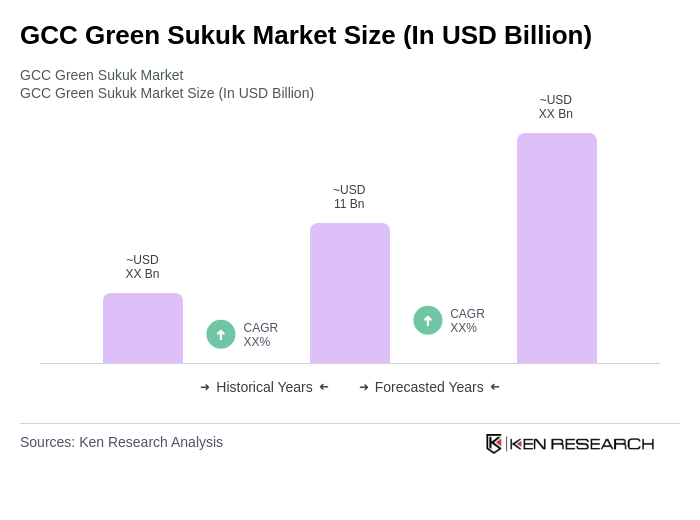
- The GCC Green Sukuk Market is valued at approximately USD 11 billion, based on a five-year historical analysis. This growth is primarily driven by increasing investments in sustainable infrastructure, government-led green finance initiatives, and heightened investor awareness of environmental, social, and governance (ESG) criteria. The market has experienced a notable rise in issuances as GCC countries pursue economic diversification and align with international climate and sustainability commitments .
- Key players in this market include the United Arab Emirates, Saudi Arabia, and Qatar. These countries lead the market due to robust financial sectors, proactive government support for green initiatives, and increasing demand for sustainable investment products. Their strategic economic diversification agendas and strong regulatory frameworks further reinforce their leadership in the green sukuk segment .
- In 2023, the Saudi Arabian government introduced the “Green Financing Framework” issued by the Ministry of Finance. This binding instrument sets out eligibility criteria for green projects, mandates external reviews, and requires detailed reporting on the use of proceeds for green sukuk issuances. The framework enhances transparency, standardizes project assessment, and aims to build investor trust while supporting the Kingdom’s Vision 2030 sustainability goals .
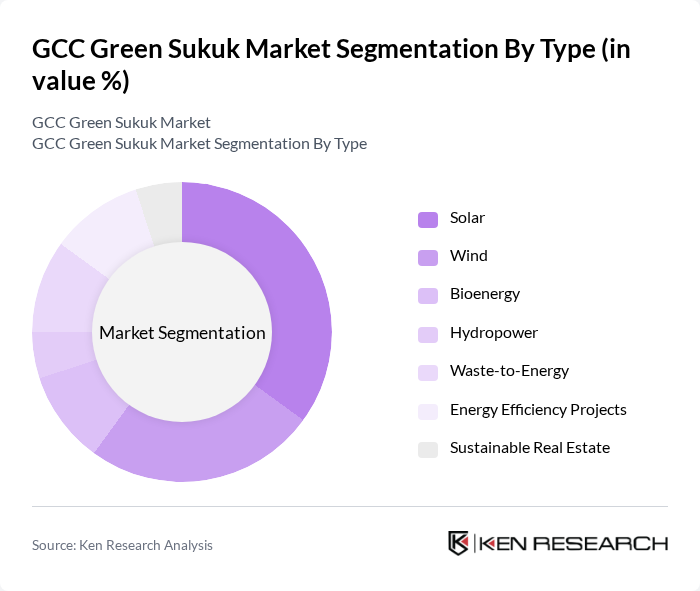
GCC Green Sukuk Market Segmentation
By Type:The market is segmented into Solar, Wind, Bioenergy, Hydropower, Waste-to-Energy, Energy Efficiency Projects, and Sustainable Real Estate. Solar and Wind projects are particularly prominent, reflecting the region’s abundant solar irradiance and favorable wind corridors. The GCC’s focus on renewable energy diversification—exemplified by large-scale solar parks and wind farms—has driven significant investment into these segments, positioning them as leading contributors to the green sukuk market .
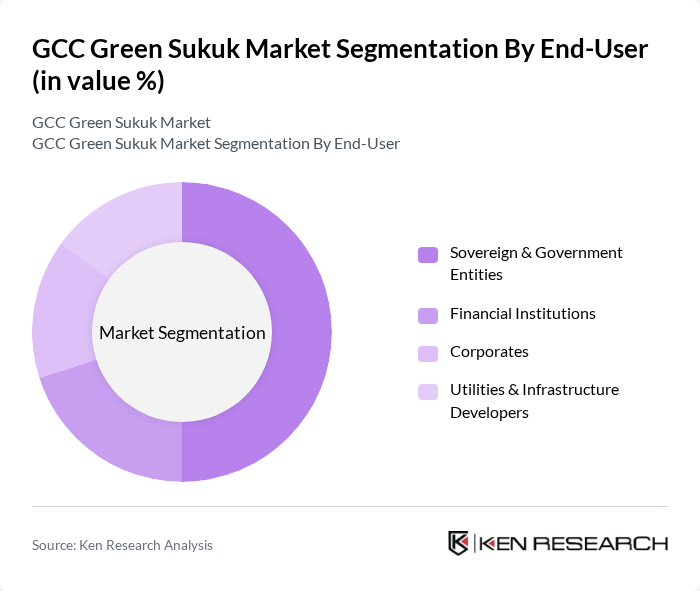
By End-User:The end-user segmentation includes Sovereign & Government Entities, Financial Institutions, Corporates, and Utilities & Infrastructure Developers. Sovereign and government entities are the dominant end-users, frequently acting as primary issuers of green sukuk to finance national sustainability and infrastructure projects. Their leadership is critical for establishing regulatory frameworks and catalyzing private sector participation in green finance .
GCC Green Sukuk Market Competitive Landscape
The GCC Green Sukuk Market is characterized by a dynamic mix of regional and international players. Leading participants such as Abu Dhabi Islamic Bank, Dubai Islamic Bank, Qatar Islamic Bank, Al Baraka Banking Group, Bank Aljazira, Emirates NBD, Kuwait Finance House, Saudi National Bank, Al Rajhi Bank, Abu Dhabi Investment Authority, Qatar Investment Authority, Bahrain Mumtalakat Holding Company, Oman Investment Authority, Islamic Development Bank, and Majid Al Futtaim contribute to innovation, geographic expansion, and service delivery in this space.
GCC Green Sukuk Market Industry Analysis
Growth Drivers
- Increasing Demand for Sustainable Financing:The GCC region has witnessed a surge in sustainable financing, with green bond issuances reaching approximately $5.5 billion in future. This demand is driven by a growing recognition of environmental, social, and governance (ESG) factors among investors. The World Bank projects that sustainable investments could reach $35 trillion globally in future, indicating a robust market potential for green sukuk in the GCC, particularly as institutional investors seek to align portfolios with sustainability goals.
- Government Initiatives and Support:Governments in the GCC are increasingly prioritizing green financing, with initiatives such as Saudi Arabia's Vision 2030 and the UAE's Green Agenda 2030. In future, the UAE allocated $2 billion for renewable energy projects, showcasing commitment to sustainable development. These initiatives not only enhance the regulatory framework but also provide financial incentives, fostering a conducive environment for green sukuk issuance and attracting both local and international investors.
- Rising Awareness of Climate Change:The urgency of addressing climate change has led to heightened awareness among businesses and consumers in the GCC. Reports indicate that 75% of GCC residents are concerned about climate change impacts, prompting companies to adopt sustainable practices. This shift is reflected in the increasing number of green projects, with investments in renewable energy expected to exceed $25 billion in future, further driving the demand for green sukuk as a financing mechanism.
Market Challenges
- Limited Awareness Among Investors:Despite the growth potential, there remains a significant knowledge gap regarding green sukuk among investors in the GCC. A survey conducted in future revealed that only 40% of institutional investors were familiar with green sukuk, limiting their participation in this market. This lack of awareness hinders the mobilization of capital towards sustainable projects, posing a challenge for market expansion and the overall effectiveness of green financing initiatives.
- Regulatory Uncertainties:The regulatory landscape for green sukuk in the GCC is still evolving, leading to uncertainties that can deter investment. In future, only 50% of GCC countries had established clear guidelines for green financing, creating inconsistencies in project eligibility and reporting standards. This lack of uniformity can lead to investor hesitance, as potential backers seek clarity and assurance regarding the legitimacy and impact of their investments in green sukuk.
GCC Green Sukuk Market Future Outlook
The future of the GCC green sukuk market appears promising, driven by increasing governmental support and a growing emphasis on sustainable development. As countries in the region align their economic strategies with global sustainability goals, the issuance of green sukuk is expected to rise significantly. Furthermore, the integration of technology in financing processes will enhance transparency and efficiency, attracting more investors. The collaboration between local entities and international green funds will also play a crucial role in expanding the market and fostering innovative financial solutions.
Market Opportunities
- Expansion of Green Projects in GCC:The GCC is set to expand its green project portfolio, with an estimated $60 billion earmarked for renewable energy initiatives in future. This expansion presents a significant opportunity for green sukuk to finance these projects, enabling investors to support sustainable development while achieving competitive returns.
- Collaboration with International Green Funds:Collaborating with international green funds can enhance the credibility and reach of GCC green sukuk. In future, partnerships with global funds resulted in $3 billion in investments for local green projects, showcasing the potential for increased capital inflow and knowledge transfer, which can further stimulate market growth.
Scope of the Report
| Segment | Sub-Segments |
|---|---|
| By Type | Solar Wind Bioenergy Hydropower Waste-to-Energy Energy Efficiency Projects Sustainable Real Estate |
| By End-User | Sovereign & Government Entities Financial Institutions Corporates Utilities & Infrastructure Developers |
| By Investment Source | Domestic Institutional Investors Foreign Institutional Investors Multilateral Development Banks Public-Private Partnerships (PPP) |
| By Application | Renewable Energy Infrastructure Green Building Projects Sustainable Transportation Water and Waste Management |
| By Policy Support | Green Finance Guidelines Tax Incentives Subsidies & Grants |
| By Market Maturity | Emerging Markets Established Markets Developing Markets |
| By Risk Profile | Low Risk Medium Risk High Risk |
Key Target Audience
Investors and Venture Capitalist Firms
Government and Regulatory Bodies (e.g., Central Bank of the UAE, Saudi Arabian Monetary Authority)
Green Project Developers
Environmental NGOs and Advocacy Groups
Financial Institutions (e.g., Islamic Banks)
Asset Management Firms
Public Sector Entities (e.g., Municipalities)
International Development Organizations (e.g., Islamic Development Bank)
Players Mentioned in the Report:
Abu Dhabi Islamic Bank
Dubai Islamic Bank
Qatar Islamic Bank
Al Baraka Banking Group
Bank Aljazira
Emirates NBD
Kuwait Finance House
Saudi National Bank
Al Rajhi Bank
Abu Dhabi Investment Authority
Qatar Investment Authority
Bahrain Mumtalakat Holding Company
Oman Investment Authority
Islamic Development Bank
Majid Al Futtaim
Table of Contents
Market Assessment Phase
1. Executive Summary and Approach
2. GCC Green Sukuk Market Overview
2.1 Key Insights and Strategic Recommendations
2.2 GCC Green Sukuk Market Overview
2.3 Definition and Scope
2.4 Evolution of Market Ecosystem
2.5 Timeline of Key Regulatory Milestones
2.6 Value Chain & Stakeholder Mapping
2.7 Business Cycle Analysis
2.8 Policy & Incentive Landscape
3. GCC Green Sukuk Market Analysis
3.1 Growth Drivers
3.1.1 Increasing Demand for Sustainable Financing
3.1.2 Government Initiatives and Support
3.1.3 Rising Awareness of Climate Change
3.1.4 Development of Green Projects
3.2 Market Challenges
3.2.1 Limited Awareness Among Investors
3.2.2 Regulatory Uncertainties
3.2.3 Competition from Conventional Sukuk
3.2.4 Lack of Standardization in Green Definitions
3.3 Market Opportunities
3.3.1 Expansion of Green Projects in GCC
3.3.2 Collaboration with International Green Funds
3.3.3 Development of Innovative Financial Products
3.3.4 Increased Institutional Investment
3.4 Market Trends
3.4.1 Growth of ESG Investment Strategies
3.4.2 Integration of Technology in Green Financing
3.4.3 Emergence of Green Bonds as a Financing Tool
3.4.4 Focus on Sustainable Development Goals (SDGs)
3.5 Government Regulation
3.5.1 Introduction of Green Tax Incentives
3.5.2 Establishment of Regulatory Frameworks
3.5.3 Implementation of Reporting Standards
3.5.4 Support for Green Infrastructure Projects
4. SWOT Analysis
5. Stakeholder Analysis
6. Porter's Five Forces Analysis
7. GCC Green Sukuk Market Market Size, 2019-2024
7.1 By Value
7.2 By Volume
7.3 By Average Selling Price
8. GCC Green Sukuk Market Segmentation
8.1 By Type
8.1.1 Solar
8.1.2 Wind
8.1.3 Bioenergy
8.1.4 Hydropower
8.1.5 Waste-to-Energy
8.1.6 Energy Efficiency Projects
8.1.7 Sustainable Real Estate
8.2 By End-User
8.2.1 Sovereign & Government Entities
8.2.2 Financial Institutions
8.2.3 Corporates
8.2.4 Utilities & Infrastructure Developers
8.3 By Investment Source
8.3.1 Domestic Institutional Investors
8.3.2 Foreign Institutional Investors
8.3.3 Multilateral Development Banks
8.3.4 Public-Private Partnerships (PPP)
8.4 By Application
8.4.1 Renewable Energy Infrastructure
8.4.2 Green Building Projects
8.4.3 Sustainable Transportation
8.4.4 Water and Waste Management
8.5 By Policy Support
8.5.1 Green Finance Guidelines
8.5.2 Tax Incentives
8.5.3 Subsidies & Grants
8.6 By Market Maturity
8.6.1 Emerging Markets
8.6.2 Established Markets
8.6.3 Developing Markets
8.7 By Risk Profile
8.7.1 Low Risk
8.7.2 Medium Risk
8.7.3 High Risk
9. GCC Green Sukuk Market Competitive Analysis
9.1 Market Share of Key Players
9.2 Cross Comparison of Key Players
9.2.1 Company Name
9.2.2 Sukuk Issuance Volume
9.2.3 Green Sukuk Outstanding (USD)
9.2.4 Market Share in GCC Green Sukuk
9.2.5 ESG Rating/Certification
9.2.6 Use of Proceeds Transparency
9.2.7 Project Impact Metrics (e.g., CO? avoided, MW installed)
9.2.8 Investor Base Diversification
9.2.9 Return on Green Sukuk Portfolio
9.2.10 Shariah Compliance Oversight
9.3 SWOT Analysis of Top Players
9.4 Pricing Analysis
9.5 Detailed Profile of Major Companies
9.5.1 Abu Dhabi Islamic Bank
9.5.2 Dubai Islamic Bank
9.5.3 Qatar Islamic Bank
9.5.4 Al Baraka Banking Group
9.5.5 Bank Aljazira
9.5.6 Emirates NBD
9.5.7 Kuwait Finance House
9.5.8 Saudi National Bank
9.5.9 Al Rajhi Bank
9.5.10 Abu Dhabi Investment Authority
9.5.11 Qatar Investment Authority
9.5.12 Bahrain Mumtalakat Holding Company
9.5.13 Oman Investment Authority
9.5.14 Islamic Development Bank
9.5.15 Majid Al Futtaim
10. GCC Green Sukuk Market End-User Analysis
10.1 Procurement Behavior of Key Ministries
10.1.1 Ministry of Energy
10.1.2 Ministry of Environment
10.1.3 Ministry of Finance
10.2 Corporate Spend on Infrastructure & Energy
10.2.1 Investment Trends
10.2.2 Budget Allocations
10.2.3 Project Financing
10.3 Pain Point Analysis by End-User Category
10.3.1 Funding Limitations
10.3.2 Regulatory Hurdles
10.3.3 Project Delays
10.4 User Readiness for Adoption
10.4.1 Awareness Levels
10.4.2 Training Needs
10.4.3 Technology Adoption
10.5 Post-Deployment ROI and Use Case Expansion
10.5.1 Performance Metrics
10.5.2 Scalability Potential
10.5.3 Long-term Benefits
11. GCC Green Sukuk Market Future Size, 2025-2030
11.1 By Value
11.2 By Volume
11.3 By Average Selling Price
Go-To-Market Strategy Phase
1. Whitespace Analysis + Business Model Canvas
1.1 Market Gaps Identification
1.2 Value Proposition Development
1.3 Revenue Streams Analysis
1.4 Cost Structure Evaluation
1.5 Key Partnerships Exploration
1.6 Customer Segmentation
1.7 Channels of Distribution
2. Marketing and Positioning Recommendations
2.1 Branding Strategies
2.2 Product USPs
2.3 Target Audience Identification
2.4 Communication Strategies
2.5 Digital Marketing Approaches
2.6 Event Marketing Opportunities
3. Distribution Plan
3.1 Urban Retail Strategies
3.2 Rural NGO Tie-ups
3.3 Online Distribution Channels
3.4 Partnerships with Financial Institutions
3.5 Logistics and Supply Chain Management
4. Channel & Pricing Gaps
4.1 Underserved Routes
4.2 Pricing Bands Analysis
4.3 Competitor Pricing Strategies
4.4 Customer Willingness to Pay
4.5 Price Sensitivity Assessment
5. Unmet Demand & Latent Needs
5.1 Category Gaps
5.2 Consumer Segments
5.3 Emerging Trends
5.4 Feedback Mechanisms
5.5 Future Demand Projections
6. Customer Relationship
6.1 Loyalty Programs
6.2 After-sales Service
6.3 Customer Feedback Loops
6.4 Community Engagement Initiatives
6.5 Customer Education Programs
7. Value Proposition
7.1 Sustainability Initiatives
7.2 Integrated Supply Chains
7.3 Cost Savings for Customers
7.4 Enhanced Brand Reputation
7.5 Long-term Partnerships
8. Key Activities
8.1 Regulatory Compliance
8.2 Branding Efforts
8.3 Distribution Setup
8.4 Training and Development
8.5 Market Research Activities
9. Entry Strategy Evaluation
9.1 Domestic Market Entry Strategy
9.1.1 Product Mix
9.1.2 Pricing Band
9.1.3 Packaging
9.2 Export Entry Strategy
9.2.1 Target Countries
9.2.2 Compliance Roadmap
10. Entry Mode Assessment
10.1 Joint Ventures
10.2 Greenfield Investments
10.3 Mergers & Acquisitions
10.4 Distributor Model
11. Capital and Timeline Estimation
11.1 Capital Requirements
11.2 Timelines
12. Control vs Risk Trade-Off
12.1 Ownership vs Partnerships
13. Profitability Outlook
13.1 Breakeven Analysis
13.2 Long-term Sustainability
14. Potential Partner List
14.1 Distributors
14.2 Joint Ventures
14.3 Acquisition Targets
15. Execution Roadmap
15.1 Phased Plan for Market Entry
15.1.1 Market Setup
15.1.2 Market Entry
15.1.3 Growth Acceleration
15.1.4 Scale & Stabilize
15.2 Key Activities and Milestones
15.2.1 Milestone Planning
15.2.2 Activity Tracking
Research Methodology
Phase 1: Approach1
Desk Research
- Analysis of existing literature on Green Sukuk frameworks and regulations in the GCC region
- Review of market reports and white papers from financial institutions and environmental organizations
- Examination of government publications and policy documents related to sustainable finance initiatives
Primary Research
- Interviews with financial analysts specializing in Islamic finance and green investments
- Surveys targeting issuers of Green Sukuk and institutional investors in the GCC
- Focus group discussions with stakeholders from environmental NGOs and regulatory bodies
Validation & Triangulation
- Cross-validation of findings through multiple data sources, including market trends and regulatory changes
- Triangulation of qualitative insights from interviews with quantitative data from market reports
- Sanity checks conducted through expert panel reviews to ensure data reliability
Phase 2: Market Size Estimation1
Top-down Assessment
- Estimation of the total value of Green Sukuk issued in the GCC over the past five years
- Analysis of macroeconomic indicators influencing green finance, such as GDP growth and investment trends
- Incorporation of government targets for renewable energy and sustainable development into market projections
Bottom-up Modeling
- Collection of data on individual Green Sukuk issuances, including amounts and project types
- Estimation of potential future issuances based on project pipelines and investor interest
- Volume x average issuance size to derive market size estimates for the next five years
Forecasting & Scenario Analysis
- Multi-factor regression analysis incorporating variables such as climate policy changes and investor sentiment
- Scenario modeling based on varying levels of regulatory support and market adoption rates
- Development of baseline, optimistic, and pessimistic forecasts for Green Sukuk growth through 2030
Phase 3: CATI Sample Composition1
| Scope Item/Segment | Sample Size | Target Respondent Profiles |
|---|---|---|
| Green Sukuk Issuers | 60 | Corporate Finance Managers, Sustainability Officers |
| Institutional Investors | 50 | Portfolio Managers, Investment Analysts |
| Regulatory Bodies | 40 | Policy Makers, Financial Regulators |
| Environmental NGOs | 40 | Program Directors, Research Analysts |
| Financial Analysts | 40 | Equity Analysts, Credit Analysts |
Frequently Asked Questions
What is the current value of the GCC Green Sukuk Market?
The GCC Green Sukuk Market is valued at approximately USD 11 billion, driven by investments in sustainable infrastructure and government-led green finance initiatives. This growth reflects the region's commitment to economic diversification and international climate commitments.
Which countries are the key players in the GCC Green Sukuk Market?
What are the main types of projects financed by green sukuk?
Who are the primary end-users of green sukuk?
Other Regional/Country Reports
Indonesia Green Sukuk Market
Malaysia Green Sukuk Market
KSA Green Sukuk Market
APAC Green Sukuk Market
SEA Green Sukuk Market
Other Adjacent Reports
Bahrain Sustainable Investment Market
Japan Renewable Energy Financing Market
Japan ESG Investment Market
Vietnam Climate Finance Market
Malaysia Sharia-Compliant Bonds Market
Brazil Infrastructure Finance Market
Kuwait Carbon Credit Market Size, Share & Forecast, By Project Type, End User, Credit Standard & Trading Mechanism, 2026–2031UAE Impact Investing MarketWhy Buy From Us?

What makes us stand out is that our consultants follow Robust, Refine and Result (RRR) methodology. Robust for clear definitions, approaches and sanity checking, Refine for differentiating respondents' facts and opinions, and Result for presenting data with story.

We have set a benchmark in the industry by offering our clients with syndicated and customized market research reports featuring coverage of entire market as well as meticulous research and analyst insights.

While we don't replace traditional research, we flip the method upside down. Our dual approach of Top Bottom & Bottom Top ensures quality deliverable by not just verifying company fundamentals but also looking at the sector and macroeconomic factors.

With one step in the future, our research team constantly tries to show you the bigger picture. We help with some of the tough questions you may encounter along the way: How is the industry positioned? Best marketing channel? KPI's of competitors? By aligning every element, we help maximize success.

Our report gives you instant access to the answers and sources that other companies might choose to hide. We elaborate each steps of research methodology we have used and showcase you the sample size to earn your trust.

If you need any support, we are here! We pride ourselves on universe strength, data quality, and quick, friendly, and professional service.