Gcc Heat Not Burn Market Size, Share, Growth Drivers, Trends, Opportunities & Forecast 2025–2030

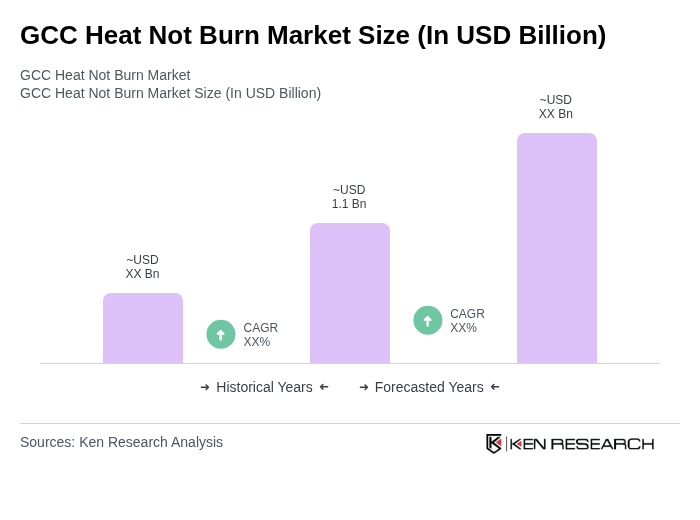
GCC Heat Not Burn Market, valued at USD 1.1 Bn, grows due to health trends, tech advancements, and demand for reduced-harm products in UAE and Saudi Arabia.

Region:Middle East

Author(s):Dev

Product Code:KRAD3266

Pages:90

Published On:November 2025
About the Report

Base Year 2024

GCC Heat Not Burn Market Overview

  • The GCC Heat Not Burn Market is valued at USD 1.1 billion, based on a five-year historical analysis. This growth is primarily driven by increasing health awareness among consumers, a shift towards less harmful alternatives to traditional smoking, and the rising popularity of innovative tobacco products. The market has seen a significant uptick in demand as consumers seek products that offer a smoking experience without combustion. Recent trends highlight the influence of digital marketing, the introduction of advanced device technologies, and the expansion of retail distribution networks as additional growth drivers.
  • The United Arab Emirates and Saudi Arabia dominate the GCC Heat Not Burn Market due to their large populations of adult smokers and a growing trend towards smoking alternatives. These countries have also seen substantial investments in marketing and distribution channels, making them key players in the adoption of heat-not-burn technologies. The urban centers in these nations are particularly influential in shaping consumer preferences, with premium product launches and targeted campaigns accelerating market penetration.
  • The UAE Cabinet Resolution No. 24 of 2019, issued by the United Arab Emirates Cabinet, established the regulatory framework for the marketing, sale, and import of electronic smoking devices, including heat-not-burn products. The regulation mandates product registration, compliance with technical standards, and health warnings on packaging, supporting the government's public health strategy to reduce traditional smoking rates and promote less harmful alternatives.
GCC Heat Not Burn Market Size

GCC Heat Not Burn Market Segmentation

By Type:The market is segmented into various types, including Tobacco Heating Devices (Direct/Indirect, Hybrid/Infused), Tobacco Sticks, Tobacco Capsules & Cartridges, Herbal and Non-Tobacco Products, and Flavored Heat Not Burn Products. Among these, Tobacco Heating Devices are leading the market due to their innovative technology and consumer preference for devices that offer a more authentic smoking experience without combustion. The demand for flavored products is also rising, particularly among younger consumers seeking diverse options.
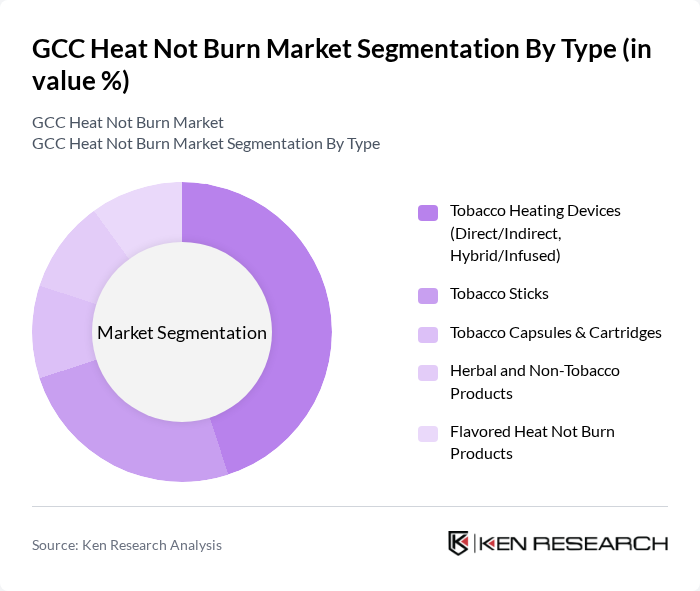
GCC Heat Not Burn Market segmentation by Type.

By End-User:The end-user segmentation includes Adult Smokers, E-cigarette Users, Health-Conscious Consumers, and Retailers. Adult Smokers represent the largest segment, as they are the primary consumers of heat-not-burn products, seeking alternatives to traditional cigarettes. E-cigarette users are also a significant demographic, often transitioning to heat-not-burn products for a more satisfying experience. Health-conscious consumers are increasingly drawn to these products due to their perceived reduced harm.
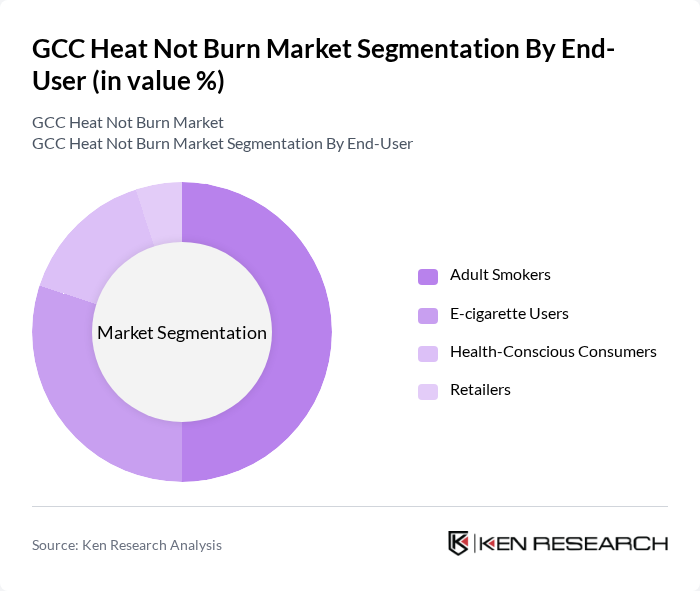
GCC Heat Not Burn Market segmentation by End-User.

GCC Heat Not Burn Market Competitive Landscape

The GCC Heat Not Burn Market is characterized by a dynamic mix of regional and international players. Leading participants such as Philip Morris International (IQOS), British American Tobacco (glo, Vype, Vuse), Japan Tobacco International (Ploom), Altria Group, Imperial Brands (Pulze), KT&G Corporation (lil), China National Tobacco Corporation, Swedish Match, RELX Technology, Njoy LLC, Myeongin Industry Co., Ltd., Emirates Tobacco Factory (UAE), Al Fakher (UAE), Mazaya (Jordan, GCC presence), Shisha Kartel (GCC distributor) contribute to innovation, geographic expansion, and service delivery in this space.

Philip Morris International

1847

New York, USA

British American Tobacco

1902

London, UK

Japan Tobacco International

1985

Geneva, Switzerland

Altria Group

1985

Richmond, USA

Imperial Brands

1901

Bristol, UK

Company

Establishment Year

Headquarters

Group Size (Large, Medium, or Small as per industry convention)

Revenue Growth Rate (GCC Heat Not Burn Segment)

Market Penetration Rate (GCC Markets)

Customer Retention Rate

Average Selling Price (ASP)

Product Portfolio Breadth (Device & Consumable SKUs)

GCC Heat Not Burn Market Industry Analysis

Growth Drivers

  • Increasing Health Awareness:The GCC region has seen a significant rise in health consciousness, with 61% of adults actively seeking alternatives to traditional smoking. This shift is driven by a growing body of research indicating that heat-not-burn products can reduce exposure to harmful chemicals. The World Health Organization reported that smoking-related diseases cost the GCC economies approximately $22 billion annually, prompting consumers to seek less harmful options, thereby boosting the heat-not-burn market.
  • Technological Advancements in Heating Devices:The introduction of advanced heating technologies has enhanced the appeal of heat-not-burn products. In future, the GCC market is expected to witness a 32% increase in the adoption of devices featuring smart technology, such as temperature control and user-friendly interfaces. This innovation not only improves user experience but also aligns with the region's push towards modernization and technological integration in consumer products, further driving market growth.
  • Rising Demand for Reduced Harmful Emissions:With air quality concerns escalating, particularly in urban areas, there is a growing demand for products that emit fewer harmful substances. The GCC's air pollution levels are among the highest globally, with particulate matter (PM2.5) levels exceeding 72 µg/m³ in some cities. Heat-not-burn products, which produce significantly lower emissions compared to traditional cigarettes, are increasingly favored by consumers, contributing to market expansion and environmental sustainability efforts.

Market Challenges

  • Regulatory Hurdles:The heat-not-burn market in the GCC faces stringent regulatory challenges, with various countries implementing complex laws governing tobacco products. For instance, Saudi Arabia's Tobacco Control Law imposes heavy restrictions on advertising and sales, which can hinder market penetration. Compliance with these regulations requires significant investment, and failure to navigate this landscape can result in substantial financial penalties, limiting growth opportunities for companies in the sector.
  • Competition from Traditional Tobacco Products:Despite the growth of heat-not-burn products, traditional tobacco remains a formidable competitor. In future, traditional cigarette sales in the GCC were valued at approximately $9 billion, overshadowing the heat-not-burn segment. The entrenched habits of smokers and the strong brand loyalty towards established tobacco products pose significant challenges for new entrants, making it difficult for heat-not-burn products to gain market share effectively.

GCC Heat Not Burn Market Future Outlook

The future of the heat-not-burn market in the GCC appears promising, driven by increasing health awareness and technological advancements. As consumers continue to prioritize health and sustainability, the demand for innovative heating devices is expected to rise. Additionally, the expansion of e-commerce platforms will facilitate greater accessibility to these products. Companies that adapt to regulatory changes and focus on consumer education will likely thrive, positioning themselves favorably in this evolving market landscape.

Market Opportunities

  • Growth in E-commerce Platforms:The GCC's e-commerce sector is projected to reach $30 billion in future, providing a significant opportunity for heat-not-burn products. Online sales channels enable companies to reach a broader audience, particularly younger consumers who prefer shopping online. This shift can enhance brand visibility and drive sales, making e-commerce a vital component of market strategy.
  • Partnerships with Health Organizations:Collaborating with health organizations can enhance credibility and consumer trust in heat-not-burn products. By aligning with public health initiatives, companies can leverage the growing emphasis on smoking cessation programs. Such partnerships can facilitate educational campaigns, increasing awareness of the benefits of heat-not-burn products and potentially expanding the customer base significantly.

Scope of the Report

SegmentSub-Segments
By Type

Tobacco Heating Devices (Direct/Indirect, Hybrid/Infused)

Tobacco Sticks

Tobacco Capsules & Cartridges

Herbal and Non-Tobacco Products

Flavored Heat Not Burn Products

By End-User

Adult Smokers

E-cigarette Users

Health-Conscious Consumers

Retailers

By Distribution Channel

Supermarkets/Hypermarkets

Specialty Tobacco Stores

Convenience Stores

Online Retail (Company & E-commerce Websites)

By Region

United Arab Emirates

Saudi Arabia

Qatar

Kuwait

Oman

Bahrain

By Product Form

Stick Form

Pod Form

Cartridge Form

Others

By Consumer Demographics

Age Group

Gender

Income Level

Others

By Brand Loyalty

Brand-Conscious Consumers

Price-Sensitive Consumers

Quality-Driven Consumers

Others

Key Target Audience

Investors and Venture Capitalist Firms

Government and Regulatory Bodies (e.g., Ministry of Health, Ministry of Economy)

Manufacturers and Producers

Distributors and Retailers

Health Organizations (e.g., World Health Organization, Gulf Cooperation Council Health Ministers)

Industry Associations (e.g., Tobacco Manufacturers Association)

Financial Institutions

Market Analysts and Industry Experts

Players Mentioned in the Report:

Philip Morris International (IQOS)

British American Tobacco (glo, Vype, Vuse)

Japan Tobacco International (Ploom)

Altria Group

Imperial Brands (Pulze)

KT&G Corporation (lil)

China National Tobacco Corporation

Swedish Match

RELX Technology

Njoy LLC

Myeongin Industry Co., Ltd.

Emirates Tobacco Factory (UAE)

Al Fakher (UAE)

Mazaya (Jordan, GCC presence)

Shisha Kartel (GCC distributor)

Table of Contents

Market Assessment Phase

1. Executive Summary and Approach


2. GCC Heat Not Burn Market Overview

2.1 Key Insights and Strategic Recommendations

2.2 GCC Heat Not Burn Market Overview

2.3 Definition and Scope

2.4 Evolution of Market Ecosystem

2.5 Timeline of Key Regulatory Milestones

2.6 Value Chain & Stakeholder Mapping

2.7 Business Cycle Analysis

2.8 Policy & Incentive Landscape


3. GCC Heat Not Burn Market Analysis

3.1 Growth Drivers

3.1.1 Increasing Health Awareness
3.1.2 Technological Advancements in Heating Devices
3.1.3 Rising Demand for Reduced Harmful Emissions
3.1.4 Expansion of Distribution Channels

3.2 Market Challenges

3.2.1 Regulatory Hurdles
3.2.2 Competition from Traditional Tobacco Products
3.2.3 Consumer Perception and Acceptance
3.2.4 Limited Awareness of Product Benefits

3.3 Market Opportunities

3.3.1 Growth in E-commerce Platforms
3.3.2 Partnerships with Health Organizations
3.3.3 Development of Innovative Product Variants
3.3.4 Expansion into Untapped Markets

3.4 Market Trends

3.4.1 Shift Towards Sustainable Products
3.4.2 Increasing Popularity of Online Sales Channels
3.4.3 Rise of Customizable Heating Devices
3.4.4 Focus on User Experience and Design

3.5 Government Regulation

3.5.1 Age Restrictions on Sales
3.5.2 Advertising Limitations
3.5.3 Health Warnings on Packaging
3.5.4 Taxation Policies on Heat Not Burn Products

4. SWOT Analysis


5. Stakeholder Analysis


6. Porter's Five Forces Analysis


7. GCC Heat Not Burn Market Market Size, 2019-2024

7.1 By Value

7.2 By Volume

7.3 By Average Selling Price


8. GCC Heat Not Burn Market Segmentation

8.1 By Type

8.1.1 Tobacco Heating Devices (Direct/Indirect, Hybrid/Infused)
8.1.2 Tobacco Sticks
8.1.3 Tobacco Capsules & Cartridges
8.1.4 Herbal and Non-Tobacco Products
8.1.5 Flavored Heat Not Burn Products

8.2 By End-User

8.2.1 Adult Smokers
8.2.2 E-cigarette Users
8.2.3 Health-Conscious Consumers
8.2.4 Retailers

8.3 By Distribution Channel

8.3.1 Supermarkets/Hypermarkets
8.3.2 Specialty Tobacco Stores
8.3.3 Convenience Stores
8.3.4 Online Retail (Company & E-commerce Websites)

8.4 By Region

8.4.1 United Arab Emirates
8.4.2 Saudi Arabia
8.4.3 Qatar
8.4.4 Kuwait
8.4.5 Oman
8.4.6 Bahrain

8.5 By Product Form

8.5.1 Stick Form
8.5.2 Pod Form
8.5.3 Cartridge Form
8.5.4 Others

8.6 By Consumer Demographics

8.6.1 Age Group
8.6.2 Gender
8.6.3 Income Level
8.6.4 Others

8.7 By Brand Loyalty

8.7.1 Brand-Conscious Consumers
8.7.2 Price-Sensitive Consumers
8.7.3 Quality-Driven Consumers
8.7.4 Others

9. GCC Heat Not Burn Market Competitive Analysis

9.1 Market Share of Key Players

9.2 Cross Comparison of Key Players

9.2.1 Company Name
9.2.2 Group Size (Large, Medium, or Small as per industry convention)
9.2.3 Revenue Growth Rate (GCC Heat Not Burn Segment)
9.2.4 Market Penetration Rate (GCC Markets)
9.2.5 Customer Retention Rate
9.2.6 Average Selling Price (ASP)
9.2.7 Product Portfolio Breadth (Device & Consumable SKUs)
9.2.8 Brand Recognition Score (GCC)
9.2.9 Distribution Network Strength (Retail & Online)
9.2.10 Innovation Index (Patents, New Launches)

9.3 SWOT Analysis of Top Players

9.4 Pricing Analysis

9.5 Detailed Profile of Major Companies

9.5.1 Philip Morris International (IQOS)
9.5.2 British American Tobacco (glo, Vype, Vuse)
9.5.3 Japan Tobacco International (Ploom)
9.5.4 Altria Group
9.5.5 Imperial Brands (Pulze)
9.5.6 KT&G Corporation (lil)
9.5.7 China National Tobacco Corporation
9.5.8 Swedish Match
9.5.9 RELX Technology
9.5.10 Njoy LLC
9.5.11 Myeongin Industry Co., Ltd.
9.5.12 Emirates Tobacco Factory (UAE)
9.5.13 Al Fakher (UAE)
9.5.14 Mazaya (Jordan, GCC presence)
9.5.15 Shisha Kartel (GCC distributor)

10. GCC Heat Not Burn Market End-User Analysis

10.1 Procurement Behavior of Key Ministries

10.1.1 Budget Allocation Trends
10.1.2 Decision-Making Processes
10.1.3 Supplier Selection Criteria
10.1.4 Others

10.2 Corporate Spend on Infrastructure & Energy

10.2.1 Investment Trends
10.2.2 Budgeting Practices
10.2.3 Long-term Contracts
10.2.4 Others

10.3 Pain Point Analysis by End-User Category

10.3.1 Product Availability
10.3.2 Quality Concerns
10.3.3 Pricing Issues
10.3.4 Others

10.4 User Readiness for Adoption

10.4.1 Awareness Levels
10.4.2 Trial and Adoption Rates
10.4.3 Feedback Mechanisms
10.4.4 Others

10.5 Post-Deployment ROI and Use Case Expansion

10.5.1 Performance Metrics
10.5.2 User Satisfaction Levels
10.5.3 Expansion Opportunities
10.5.4 Others

11. GCC Heat Not Burn Market Future Size, 2025-2030

11.1 By Value

11.2 By Volume

11.3 By Average Selling Price


Go-To-Market Strategy Phase

1. Whitespace Analysis + Business Model Canvas

1.1 Market Gaps Identification

1.2 Value Proposition Development

1.3 Revenue Streams Analysis

1.4 Cost Structure Evaluation

1.5 Key Partnerships Exploration

1.6 Customer Segments Definition

1.7 Channels Strategy


2. Marketing and Positioning Recommendations

2.1 Branding Strategies

2.2 Product USPs

2.3 Target Audience Identification

2.4 Communication Strategy

2.5 Digital Marketing Approaches

2.6 Offline Marketing Strategies

2.7 Performance Metrics


3. Distribution Plan

3.1 Urban Retail Strategies

3.2 Rural NGO Tie-ups

3.3 E-commerce Integration

3.4 Logistics and Supply Chain Management

3.5 Distribution Partnerships

3.6 Inventory Management

3.7 Performance Tracking


4. Channel & Pricing Gaps

4.1 Underserved Routes

4.2 Pricing Bands Analysis

4.3 Competitor Pricing Strategies

4.4 Consumer Price Sensitivity

4.5 Value-Based Pricing Models

4.6 Discount Strategies

4.7 Pricing Optimization Techniques


5. Unmet Demand & Latent Needs

5.1 Category Gaps Identification

5.2 Consumer Segments Analysis

5.3 Product Development Opportunities

5.4 Market Entry Strategies

5.5 Feedback Collection Mechanisms

5.6 Trend Analysis

5.7 Future Demand Projections


6. Customer Relationship

6.1 Loyalty Programs

6.2 After-sales Service

6.3 Customer Feedback Systems

6.4 Engagement Strategies

6.5 Retention Strategies

6.6 Customer Education Initiatives

6.7 Performance Metrics


7. Value Proposition

7.1 Sustainability Initiatives

7.2 Integrated Supply Chains

7.3 Customer-Centric Approaches

7.4 Competitive Advantages

7.5 Brand Positioning

7.6 Value Communication

7.7 Performance Metrics


8. Key Activities

8.1 Regulatory Compliance

8.2 Branding Initiatives

8.3 Distribution Setup

8.4 Marketing Campaigns

8.5 Training and Development

8.6 Performance Monitoring

8.7 Continuous Improvement Processes


9. Entry Strategy Evaluation

9.1 Domestic Market Entry Strategy

9.1.1 Product Mix
9.1.2 Pricing Band
9.1.3 Packaging Strategies

9.2 Export Entry Strategy

9.2.1 Target Countries
9.2.2 Compliance Roadmap

10. Entry Mode Assessment

10.1 Joint Ventures

10.2 Greenfield Investments

10.3 Mergers & Acquisitions

10.4 Distributor Model

10.5 Risk Assessment

10.6 Strategic Fit Evaluation

10.7 Performance Metrics


11. Capital and Timeline Estimation

11.1 Capital Requirements

11.2 Timelines

11.3 Funding Sources

11.4 Financial Projections

11.5 Risk Management Strategies

11.6 Performance Metrics


12. Control vs Risk Trade-Off

12.1 Ownership vs Partnerships

12.2 Risk Mitigation Strategies

12.3 Control Mechanisms

12.4 Performance Metrics


13. Profitability Outlook

13.1 Breakeven Analysis

13.2 Long-term Sustainability

13.3 Financial Health Indicators

13.4 Performance Metrics


14. Potential Partner List

14.1 Distributors

14.2 Joint Ventures

14.3 Acquisition Targets

14.4 Strategic Alliances

14.5 Performance Metrics


15. Execution Roadmap

15.1 Phased Plan for Market Entry

15.1.1 Market Setup
15.1.2 Market Entry
15.1.3 Growth Acceleration
15.1.4 Scale & Stabilize

15.2 Key Activities and Milestones

15.2.1 Activity Planning
15.2.2 Milestone Tracking
15.2.3 Performance Metrics

Research Methodology

ApproachModellingSample

Phase 1: Approach1

Desk Research

  • Analysis of market reports from regional health organizations and tobacco regulatory bodies
  • Review of academic journals and publications on heat-not-burn technology and consumer behavior
  • Examination of industry white papers and market analysis from trade associations in the GCC region

Primary Research

  • Interviews with product development managers at leading heat-not-burn device manufacturers
  • Surveys with retailers and distributors specializing in tobacco alternatives
  • Focus groups with consumers to understand preferences and usage patterns of heat-not-burn products

Validation & Triangulation

  • Cross-validation of findings through multiple data sources including sales data and consumer surveys
  • Triangulation of insights from industry experts and market analysts
  • Sanity checks through expert panel discussions to ensure data reliability

Phase 2: Market Size Estimation1

Top-down Assessment

  • Estimation of market size based on overall tobacco consumption trends in the GCC
  • Analysis of regulatory impacts on heat-not-burn product adoption rates
  • Segmentation of market by country within the GCC to identify regional variations

Bottom-up Modeling

  • Collection of sales data from key retailers and distributors of heat-not-burn products
  • Estimation of average selling prices and volume sold across different product categories
  • Calculation of market potential based on consumer demographics and purchasing behavior

Forecasting & Scenario Analysis

  • Development of predictive models using historical sales data and market trends
  • Scenario analysis based on potential regulatory changes and shifts in consumer preferences
  • Creation of multiple forecasts (baseline, optimistic, and pessimistic) through 2030

Phase 3: CATI Sample Composition1

Scope Item/SegmentSample SizeTarget Respondent Profiles
Retail Market for Heat-Not-Burn Products100Store Managers, Category Buyers
Consumer Preferences in Tobacco Alternatives120Adult Smokers, Vapers, Health-Conscious Consumers
Distribution Channels for Heat-Not-Burn Devices80Distributors, Wholesalers, Supply Chain Managers
Regulatory Impact Assessment60Policy Makers, Regulatory Affairs Specialists
Market Trends and Innovations50Industry Analysts, Product Development Experts

Frequently Asked Questions

What is the current value of the GCC Heat Not Burn Market?

The GCC Heat Not Burn Market is valued at approximately USD 1.1 billion, reflecting a significant growth trend driven by increasing health awareness and a shift towards less harmful smoking alternatives.

Which countries dominate the GCC Heat Not Burn Market?

What regulatory framework governs heat-not-burn products in the UAE?

What are the main types of heat-not-burn products available in the GCC market?

Other Regional/Country Reports

Indonesia Heat Not Burn Market Size, Share, Growth Drivers, Trends, Opportunities & Forecast 2025–2030

Malaysia Heat Not Burn Market Size, Share, Growth Drivers, Trends, Opportunities & Forecast 2025–2030

KSA Heat Not Burn Market Size, Share, Growth Drivers, Trends, Opportunities & Forecast 2025–2030

APAC Heat Not Burn Market Size, Share, Growth Drivers, Trends, Opportunities & Forecast 2025–2030

SEA Heat Not Burn Market Size, Share, Growth Drivers, Trends, Opportunities & Forecast 2025–2030

Vietnam Heat Not Burn Market Size, Share, Growth Drivers, Trends, Opportunities & Forecast 2025–2030

Other Adjacent Reports

Germany E-Cigarette Market

Mexico Vaping Devices Market

Belgium Tobacco Products Market

Qatar Smoking Cessation Aids Market

UAE Nicotine Replacement Therapy Market Report Size Share Growth Drivers Trends Opportunities & Forecast 2025–2030

Philippines Herbal Tobacco Alternatives Market

Oman Flavored Tobacco Market

Singapore Electronic Nicotine Delivery Systems Market

Brazil Reduced-Risk Tobacco Products Market

Qatar Tobacco Heating Devices Market

Why Buy From Us?

Refine Robust Result (RRR) Framework

What makes us stand out is that our consultants follow Robust, Refine and Result (RRR) methodology. Robust for clear definitions, approaches and sanity checking, Refine for differentiating respondents' facts and opinions, and Result for presenting data with story.

Our Reach Is Unmatched

We have set a benchmark in the industry by offering our clients with syndicated and customized market research reports featuring coverage of entire market as well as meticulous research and analyst insights.

Shifting the Research Paradigm

While we don't replace traditional research, we flip the method upside down. Our dual approach of Top Bottom & Bottom Top ensures quality deliverable by not just verifying company fundamentals but also looking at the sector and macroeconomic factors.

More Insights-Better Decisions

With one step in the future, our research team constantly tries to show you the bigger picture. We help with some of the tough questions you may encounter along the way: How is the industry positioned? Best marketing channel? KPI's of competitors? By aligning every element, we help maximize success.

Transparency and Trust

Our report gives you instant access to the answers and sources that other companies might choose to hide. We elaborate each steps of research methodology we have used and showcase you the sample size to earn your trust.

Round the Clock Support

If you need any support, we are here! We pride ourselves on universe strength, data quality, and quick, friendly, and professional service.

Why Clients Choose Us?

400000+
Reports in repository
150+
Consulting projects a year
100+
Analysts
8000+
Client Queries in 2022








