About the Report
Base Year 2024GCC Luxury Apparel Retail Market Overview
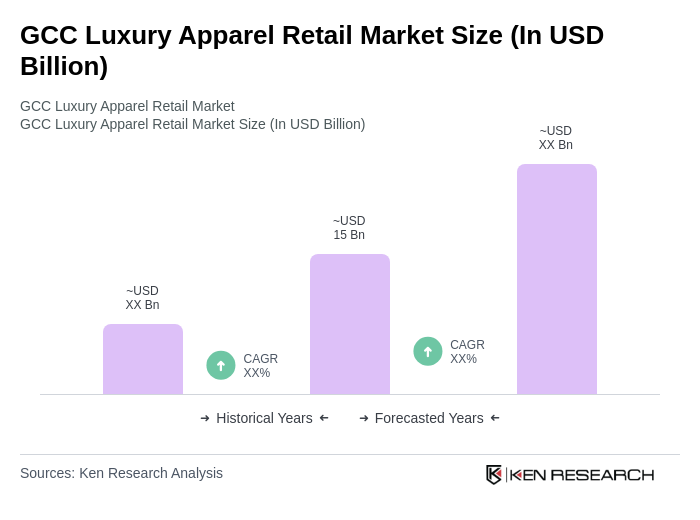
- The GCC Luxury Apparel Retail Market is valued at USD 15 billion, based on a five-year historical analysis. This growth is primarily driven by increasing disposable incomes, a burgeoning middle class, and a strong inclination towards luxury brands among consumers in the region. The market has seen a significant rise in demand for high-end fashion, influenced by global fashion trends and the increasing presence of luxury brands in the GCC region.
- Key players in this market include the United Arab Emirates and Saudi Arabia, which dominate due to their affluent populations and a strong retail infrastructure. The UAE, particularly Dubai, is a global shopping hub, attracting tourists and residents alike, while Saudi Arabia's Vision 2030 initiative aims to diversify the economy, further boosting luxury retail growth.
- In 2023, the Saudi Arabian government implemented a new regulation aimed at enhancing the luxury retail sector by reducing import tariffs on luxury goods. This initiative is designed to encourage foreign brands to enter the market, thereby increasing competition and providing consumers with a wider range of luxury apparel options.
GCC Luxury Apparel Retail Market Segmentation
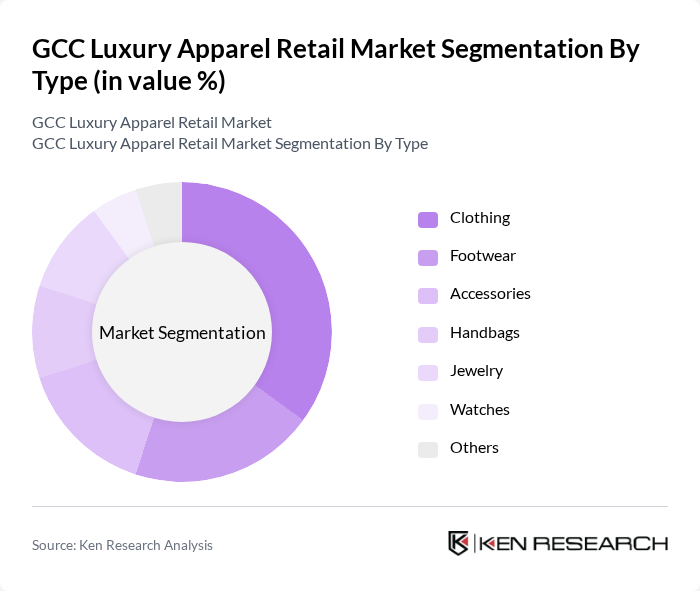
By Type:The luxury apparel market can be segmented into various types, including clothing, footwear, accessories, handbags, jewelry, watches, and others. Among these, clothing and accessories are the most dominant segments, driven by changing fashion trends and consumer preferences for high-quality materials and unique designs. The demand for luxury clothing is particularly strong, as consumers seek to express their individuality and status through their fashion choices.
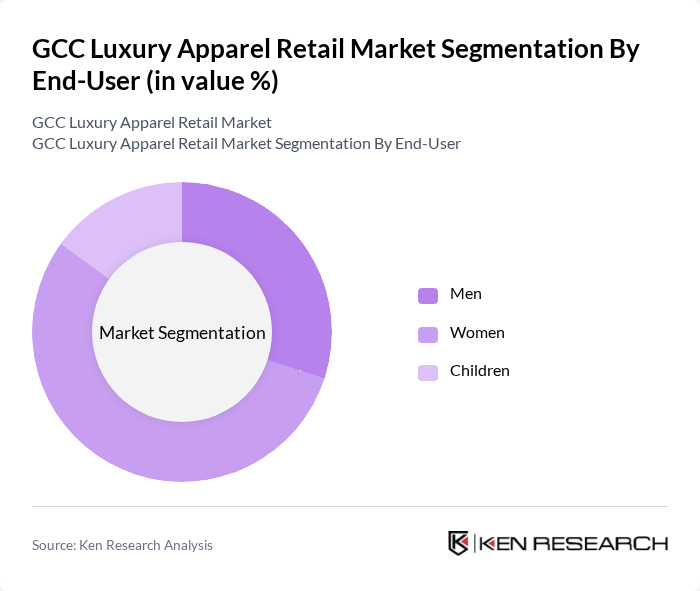
By End-User:The luxury apparel market is segmented by end-user demographics, including men, women, and children. Women represent the largest segment, driven by a growing interest in fashion and luxury brands. The increasing participation of women in the workforce and their rising disposable incomes have led to a surge in demand for luxury apparel tailored specifically for them. Men's luxury apparel is also gaining traction, reflecting changing societal norms and the growing acceptance of luxury fashion among male consumers.
GCC Luxury Apparel Retail Market Competitive Landscape
The GCC Luxury Apparel Retail Market is characterized by a dynamic mix of regional and international players. Leading participants such as Louis Vuitton, Gucci, Chanel, Prada, Burberry, Hermès, Dior, Versace, Fendi, Valentino, Bottega Veneta, Salvatore Ferragamo, Balenciaga, Givenchy, Dolce & Gabbana contribute to innovation, geographic expansion, and service delivery in this space.
GCC Luxury Apparel Retail Market Industry Analysis
Growth Drivers
- Increasing Disposable Income:The GCC region has witnessed a significant rise in disposable income, with average per capita income reaching approximately $34,000 in future. This increase is driven by economic diversification and growth in sectors such as tourism and finance. As consumers have more disposable income, they are more inclined to spend on luxury apparel, leading to a surge in demand for high-end fashion brands and products, thereby boosting the luxury apparel retail market.
- Rising Demand for High-Quality Products:The GCC luxury apparel market is experiencing a shift towards high-quality products, with consumers increasingly prioritizing craftsmanship and brand reputation. In future, the luxury goods market in the region is projected to exceed $12 billion, reflecting a growing preference for premium materials and exclusive designs. This trend is fueled by affluent consumers seeking unique and durable fashion items, which enhances the overall market for luxury apparel.
- Expansion of E-commerce Platforms:E-commerce in the GCC is rapidly expanding, with online retail sales expected to reach $30 billion in future. This growth is driven by increased internet penetration and mobile device usage, making luxury apparel more accessible to consumers. Major luxury brands are investing in online platforms, enhancing customer experience through personalized services and exclusive online collections, which significantly contributes to the growth of the luxury apparel retail market.
Market Challenges
- Economic Fluctuations:The GCC luxury apparel market faces challenges from economic fluctuations, particularly due to reliance on oil revenues. In future, oil prices are projected to remain volatile, impacting consumer spending power. Economic uncertainty can lead to reduced discretionary spending on luxury goods, posing a significant challenge for retailers in maintaining sales and profitability in the luxury apparel sector.
- Intense Competition:The luxury apparel market in the GCC is characterized by intense competition among established global brands and emerging local designers. With over 250 luxury brands operating in the region, competition for market share is fierce. This saturation can lead to price wars and reduced profit margins, making it challenging for retailers to differentiate themselves and maintain a loyal customer base in a crowded marketplace.
GCC Luxury Apparel Retail Market Future Outlook
The future of the GCC luxury apparel market appears promising, driven by evolving consumer preferences and technological advancements. As sustainability becomes a priority, brands that adopt eco-friendly practices are likely to gain a competitive edge. Additionally, the integration of augmented reality and virtual fitting rooms is expected to enhance the online shopping experience, attracting tech-savvy consumers. These trends indicate a dynamic market landscape that will continue to evolve in response to consumer demands and technological innovations.
Market Opportunities
- Growth of Sustainable Fashion:The increasing consumer awareness regarding environmental issues presents a significant opportunity for luxury brands to invest in sustainable fashion. In future, the sustainable fashion market in the GCC is projected to grow by 18%, as consumers seek eco-friendly products. Brands that prioritize sustainability can attract a new segment of environmentally conscious consumers, enhancing their market presence.
- Collaborations with Local Designers:Collaborating with local designers offers luxury brands a unique opportunity to tap into regional aesthetics and cultural heritage. In future, partnerships with local talent can enhance brand authenticity and appeal, potentially increasing sales by 25%. This strategy not only supports local economies but also resonates with consumers seeking unique, culturally relevant luxury apparel, thereby expanding market reach.
Scope of the Report
| Segment | Sub-Segments |
|---|---|
| By Type | Clothing Footwear Accessories Handbags Jewelry Watches Others |
| By End-User | Men Women Children |
| By Sales Channel | Online Retail Brick-and-Mortar Stores Department Stores Luxury Boutiques |
| By Price Range | Premium Super Premium Ultra Luxury |
| By Brand Positioning | Established Brands Emerging Brands Niche Brands |
| By Distribution Mode | Direct Sales Indirect Sales |
| By Consumer Demographics | Age Group Income Level Lifestyle Preferences |
Key Target Audience
Investors and Venture Capitalist Firms
Government and Regulatory Bodies (e.g., Ministry of Economy, Ministry of Commerce and Industry)
Luxury Apparel Manufacturers and Producers
Distributors and Retailers in Luxury Goods
Luxury Brand Owners and Designers
Trade Associations for Fashion and Apparel
Financial Institutions and Investment Banks
Logistics and Supply Chain Companies
Players Mentioned in the Report:
Louis Vuitton
Gucci
Chanel
Prada
Burberry
Hermes
Dior
Versace
Fendi
Valentino
Bottega Veneta
Salvatore Ferragamo
Balenciaga
Givenchy
Dolce & Gabbana
Table of Contents
Market Assessment Phase
1. Executive Summary and Approach
2. GCC Luxury Apparel Retail Market Overview
2.1 Key Insights and Strategic Recommendations
2.2 GCC Luxury Apparel Retail Market Overview
2.3 Definition and Scope
2.4 Evolution of Market Ecosystem
2.5 Timeline of Key Regulatory Milestones
2.6 Value Chain & Stakeholder Mapping
2.7 Business Cycle Analysis
2.8 Policy & Incentive Landscape
3. GCC Luxury Apparel Retail Market Analysis
3.1 Growth Drivers
3.1.1 Increasing Disposable Income
3.1.2 Rising Demand for High-Quality Products
3.1.3 Expansion of E-commerce Platforms
3.1.4 Influence of Social Media and Celebrity Endorsements
3.2 Market Challenges
3.2.1 Economic Fluctuations
3.2.2 Intense Competition
3.2.3 Counterfeit Products
3.2.4 Changing Consumer Preferences
3.3 Market Opportunities
3.3.1 Growth of Sustainable Fashion
3.3.2 Expansion into Emerging Markets
3.3.3 Collaborations with Local Designers
3.3.4 Increasing Online Shopping Trends
3.4 Market Trends
3.4.1 Personalization and Customization
3.4.2 Rise of Rental and Resale Markets
3.4.3 Focus on Ethical Sourcing
3.4.4 Integration of Technology in Retail
3.5 Government Regulation
3.5.1 Import Tariffs on Luxury Goods
3.5.2 Regulations on Counterfeit Products
3.5.3 Consumer Protection Laws
3.5.4 Sustainability Regulations
4. SWOT Analysis
5. Stakeholder Analysis
6. Porter's Five Forces Analysis
7. GCC Luxury Apparel Retail Market Market Size, 2019-2024
7.1 By Value
7.2 By Volume
7.3 By Average Selling Price
8. GCC Luxury Apparel Retail Market Segmentation
8.1 By Type
8.1.1 Clothing
8.1.2 Footwear
8.1.3 Accessories
8.1.4 Handbags
8.1.5 Jewelry
8.1.6 Watches
8.1.7 Others
8.2 By End-User
8.2.1 Men
8.2.2 Women
8.2.3 Children
8.3 By Sales Channel
8.3.1 Online Retail
8.3.2 Brick-and-Mortar Stores
8.3.3 Department Stores
8.3.4 Luxury Boutiques
8.4 By Price Range
8.4.1 Premium
8.4.2 Super Premium
8.4.3 Ultra Luxury
8.5 By Brand Positioning
8.5.1 Established Brands
8.5.2 Emerging Brands
8.5.3 Niche Brands
8.6 By Distribution Mode
8.6.1 Direct Sales
8.6.2 Indirect Sales
8.7 By Consumer Demographics
8.7.1 Age Group
8.7.2 Income Level
8.7.3 Lifestyle Preferences
9. GCC Luxury Apparel Retail Market Competitive Analysis
9.1 Market Share of Key Players
9.2 Cross Comparison of Key Players
9.2.1 Company Name
9.2.2 Group Size (Large, Medium, or Small as per industry convention)
9.2.3 Revenue Growth Rate
9.2.4 Customer Acquisition Cost
9.2.5 Average Order Value
9.2.6 Customer Retention Rate
9.2.7 Pricing Strategy
9.2.8 Market Penetration Rate
9.2.9 Brand Loyalty Index
9.2.10 Return on Marketing Investment (ROMI)
9.3 SWOT Analysis of Top Players
9.4 Pricing Analysis
9.5 Detailed Profile of Major Companies
9.5.1 Louis Vuitton
9.5.2 Gucci
9.5.3 Chanel
9.5.4 Prada
9.5.5 Burberry
9.5.6 Hermès
9.5.7 Dior
9.5.8 Versace
9.5.9 Fendi
9.5.10 Valentino
9.5.11 Bottega Veneta
9.5.12 Salvatore Ferragamo
9.5.13 Balenciaga
9.5.14 Givenchy
9.5.15 Dolce & Gabbana
10. GCC Luxury Apparel Retail Market End-User Analysis
10.1 Procurement Behavior of Key Ministries
10.1.1 Government Procurement Policies
10.1.2 Budget Allocations for Luxury Goods
10.1.3 Supplier Selection Criteria
10.2 Corporate Spend on Infrastructure & Energy
10.2.1 Investment in Luxury Retail Spaces
10.2.2 Corporate Gifting Trends
10.2.3 Sponsorship of Fashion Events
10.3 Pain Point Analysis by End-User Category
10.3.1 Quality Concerns
10.3.2 Availability of Sizes
10.3.3 Customer Service Issues
10.4 User Readiness for Adoption
10.4.1 Awareness of Luxury Brands
10.4.2 Willingness to Pay Premium Prices
10.4.3 Online Shopping Comfort Level
10.5 Post-Deployment ROI and Use Case Expansion
10.5.1 Customer Feedback Mechanisms
10.5.2 Repeat Purchase Rates
10.5.3 Brand Advocacy Metrics
11. GCC Luxury Apparel Retail Market Future Size, 2025-2030
11.1 By Value
11.2 By Volume
11.3 By Average Selling Price
Go-To-Market Strategy Phase
1. Whitespace Analysis + Business Model Canvas
1.1 Market Gaps Identification
1.2 Value Proposition Development
1.3 Revenue Streams Analysis
1.4 Cost Structure Evaluation
1.5 Key Partnerships Exploration
1.6 Customer Segmentation Insights
1.7 Channels of Distribution
2. Marketing and Positioning Recommendations
2.1 Branding Strategies
2.2 Product USPs
2.3 Target Audience Engagement
2.4 Digital Marketing Tactics
2.5 Influencer Collaborations
3. Distribution Plan
3.1 Urban Retail Strategies
3.2 Rural NGO Tie-ups
3.3 E-commerce Integration
3.4 Logistics and Supply Chain Management
4. Channel & Pricing Gaps
4.1 Underserved Routes
4.2 Pricing Bands Analysis
4.3 Competitor Pricing Strategies
5. Unmet Demand & Latent Needs
5.1 Category Gaps Identification
5.2 Consumer Segments Analysis
5.3 Emerging Trends Exploration
6. Customer Relationship
6.1 Loyalty Programs
6.2 After-sales Service Enhancements
6.3 Customer Feedback Integration
7. Value Proposition
7.1 Sustainability Initiatives
7.2 Integrated Supply Chains
7.3 Unique Selling Points
8. Key Activities
8.1 Regulatory Compliance
8.2 Branding Efforts
8.3 Distribution Setup
9. Entry Strategy Evaluation
9.1 Domestic Market Entry Strategy
9.1.1 Product Mix Considerations
9.1.2 Pricing Band Strategy
9.1.3 Packaging Innovations
9.2 Export Entry Strategy
9.2.1 Target Countries Identification
9.2.2 Compliance Roadmap Development
10. Entry Mode Assessment
10.1 Joint Ventures
10.2 Greenfield Investments
10.3 Mergers & Acquisitions
10.4 Distributor Model Evaluation
11. Capital and Timeline Estimation
11.1 Capital Requirements Analysis
11.2 Timelines for Market Entry
12. Control vs Risk Trade-Off
12.1 Ownership vs Partnerships
13. Profitability Outlook
13.1 Breakeven Analysis
13.2 Long-term Sustainability Strategies
14. Potential Partner List
14.1 Distributors
14.2 Joint Ventures
14.3 Acquisition Targets
15. Execution Roadmap
15.1 Phased Plan for Market Entry
15.1.1 Market Setup
15.1.2 Market Entry
15.1.3 Growth Acceleration
15.1.4 Scale & Stabilize
15.2 Key Activities and Milestones
15.2.1 Milestone Planning
15.2.2 Activity Tracking
Research Methodology
Phase 1: Approach1
Desk Research
- Analysis of market reports from industry associations and luxury apparel trade publications
- Review of government publications and economic reports related to consumer spending in the GCC region
- Examination of online retail platforms and e-commerce trends specific to luxury apparel
Primary Research
- Interviews with brand managers and marketing executives from leading luxury apparel brands
- Surveys targeting high-income consumers to understand purchasing behavior and preferences
- Focus groups with fashion influencers and stylists to gauge market trends and consumer sentiment
Validation & Triangulation
- Cross-validation of findings through multiple data sources, including sales data and consumer surveys
- Triangulation of insights from primary interviews with secondary data trends
- Sanity checks conducted through expert panel reviews comprising industry veterans and market analysts
Phase 2: Market Size Estimation1
Top-down Assessment
- Estimation of total luxury apparel market size based on GDP growth and luxury spending trends in the GCC
- Segmentation of the market by product categories such as clothing, accessories, and footwear
- Incorporation of demographic data to assess potential market growth among affluent consumers
Bottom-up Modeling
- Collection of sales data from key luxury retailers and boutiques across the GCC
- Estimation of average transaction values and purchase frequencies among target consumer segments
- Analysis of distribution channels, including online and offline sales, to refine market size estimates
Forecasting & Scenario Analysis
- Development of forecasting models based on historical sales data and economic indicators
- Scenario analysis considering factors such as economic fluctuations, consumer trends, and geopolitical events
- Projections for market growth through 2030, including best-case, worst-case, and most likely scenarios
Phase 3: CATI Sample Composition1
| Scope Item/Segment | Sample Size | Target Respondent Profiles |
|---|---|---|
| Luxury Apparel Retailers | 150 | Store Managers, Brand Representatives |
| High-Income Consumers | 200 | Affluent Shoppers, Fashion Enthusiasts |
| Fashion Influencers | 50 | Social Media Influencers, Fashion Bloggers |
| Market Analysts | 30 | Industry Analysts, Economic Researchers |
| Luxury Brand Executives | 40 | Marketing Directors, Product Managers |
Frequently Asked Questions
What is the current value of the GCC Luxury Apparel Retail Market?
The GCC Luxury Apparel Retail Market is valued at approximately USD 15 billion, driven by increasing disposable incomes and a growing middle class that favors luxury brands. This market has experienced significant growth due to global fashion trends and the presence of luxury brands in the region.
Which countries dominate the GCC Luxury Apparel Retail Market?
What are the main segments of the GCC Luxury Apparel Retail Market?
How has e-commerce impacted the GCC Luxury Apparel Retail Market?
Other Regional/Country Reports
Indonesia Luxury Apparel Retail Market
Malaysia Luxury Apparel Retail Market
KSA Luxury Apparel Retail Market
APAC Luxury Apparel Retail Market
SEA Luxury Apparel Retail Market
Vietnam Luxury Apparel Retail Market
Other Adjacent Reports
UAE Luxury Accessories Market
Bahrain Luxury Jewelry Market Report Size, Share, Growth Drivers, Trends, Opportunities & Forecast 2025–2030UAE Luxury Watches Market Size, Share, Growth Drivers, Trends, Opportunities & Forecast 2025–2030UAE Luxury Handbags Market Size, Share, Growth Drivers, Trends, Opportunities & Forecast 2025–2030Philippines Fashion E-Commerce Market
Malaysia Sustainable Fashion Market
Mexico Beauty Products Market
Global Personal Care Market Outlook to 2030Egypt High-End Cosmetics Market
Why Buy From Us?

What makes us stand out is that our consultants follow Robust, Refine and Result (RRR) methodology. Robust for clear definitions, approaches and sanity checking, Refine for differentiating respondents' facts and opinions, and Result for presenting data with story.

We have set a benchmark in the industry by offering our clients with syndicated and customized market research reports featuring coverage of entire market as well as meticulous research and analyst insights.

While we don't replace traditional research, we flip the method upside down. Our dual approach of Top Bottom & Bottom Top ensures quality deliverable by not just verifying company fundamentals but also looking at the sector and macroeconomic factors.

With one step in the future, our research team constantly tries to show you the bigger picture. We help with some of the tough questions you may encounter along the way: How is the industry positioned? Best marketing channel? KPI's of competitors? By aligning every element, we help maximize success.

Our report gives you instant access to the answers and sources that other companies might choose to hide. We elaborate each steps of research methodology we have used and showcase you the sample size to earn your trust.

If you need any support, we are here! We pride ourselves on universe strength, data quality, and quick, friendly, and professional service.