About the Report
Base Year 2024GCC Sodium Hyaluronate Based Products Market Overview
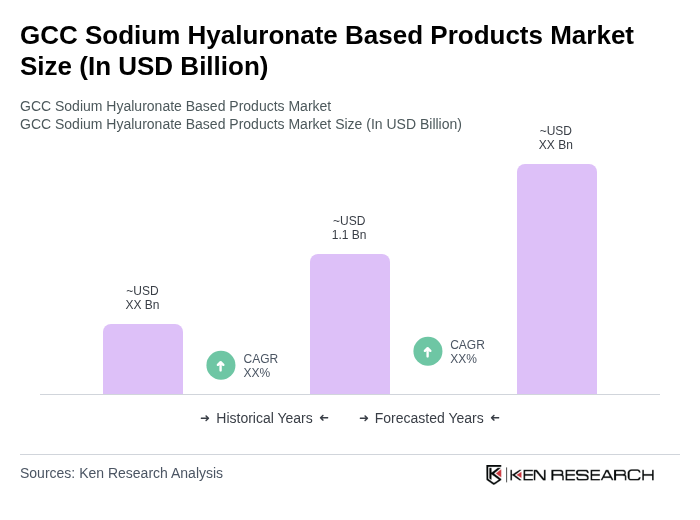
- The GCC Sodium Hyaluronate Based Products Market is valued at USD 1.1 billion, based on a five-year historical analysis and by proportionally aligning GCC demand with the global sodium hyaluronate-based products market, which generated revenues of around USD 10.5–11.3 billion globally in recent assessments. This growth is primarily driven by the increasing demand for aesthetic procedures, rapid expansion of minimally invasive treatments, advancements in medical technology, and growing awareness of the benefits of sodium hyaluronate across dermatology, orthopedics, and ophthalmology.
- Key players in this market include the United Arab Emirates and Saudi Arabia, which dominate due to their advanced healthcare infrastructure, high disposable incomes, medical tourism focus, and strong emphasis on cosmetic and aesthetic treatments. The presence of numerous dermatology and aesthetic clinics, specialty hospitals, and dedicated ophthalmology and orthopedic centers offering sodium hyaluronate-based injectables, topical products, and ophthalmic solutions further enhances their market position.
- In the GCC, sodium hyaluronate-based fillers, ophthalmic solutions, and related products are regulated within broader medicinal product, medical device, and cosmetic frameworks; for example, in Saudi Arabia, the Medical Devices Interim Regulation and associated implementing rules issued by the Saudi Food and Drug Authority (SFDA) in 2008 and subsequent updates require that sodium hyaluronate-based medical devices and injectable fillers obtain SFDA marketing authorization, comply with quality and safety standards, and, where applicable, submit clinical data, performance evaluation, and post?market surveillance documentation before and after being placed on the market. Similar registration, safety, and quality requirements are applied by other GCC health authorities (such as the UAE Ministry of Health and Prevention) to ensure that sodium hyaluronate products meet established standards for efficacy, traceability, and risk management across therapeutic and aesthetic uses.
GCC Sodium Hyaluronate Based Products Market Segmentation
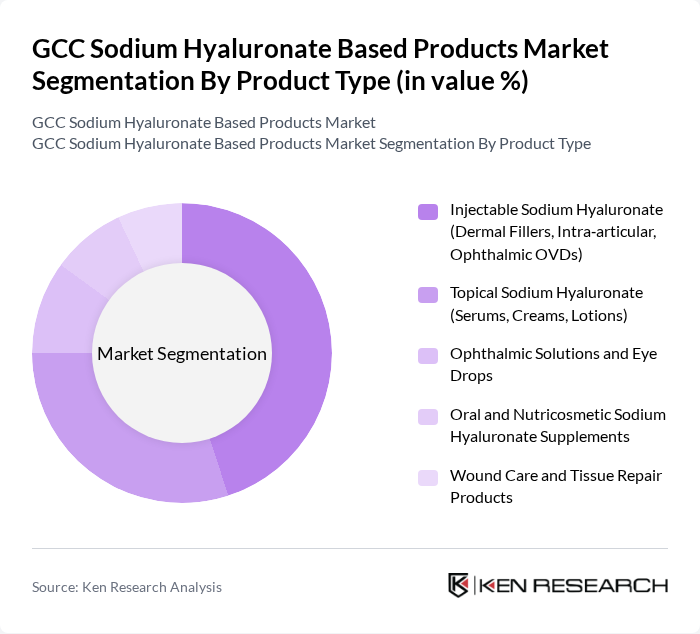
By Product Type:The product type segmentation includes various forms of sodium hyaluronate products, each catering to specific consumer needs and preferences. Injectable sodium hyaluronate, particularly in the form of dermal fillers and intra?articular injections, has gained significant traction due to its effectiveness in aesthetic facial rejuvenation and joint pain management. Topical products, such as serums and creams, are also popular for their hydration, barrier-support, and anti?aging benefits, and represent the largest global segment by revenue. The market is witnessing a growing trend towards oral nutricosmetic supplements and advanced wound care or tissue repair products incorporating sodium hyaluronate, driven by rising consumer interest in holistic beauty?from?within, healthy aging, and chronic wound management.
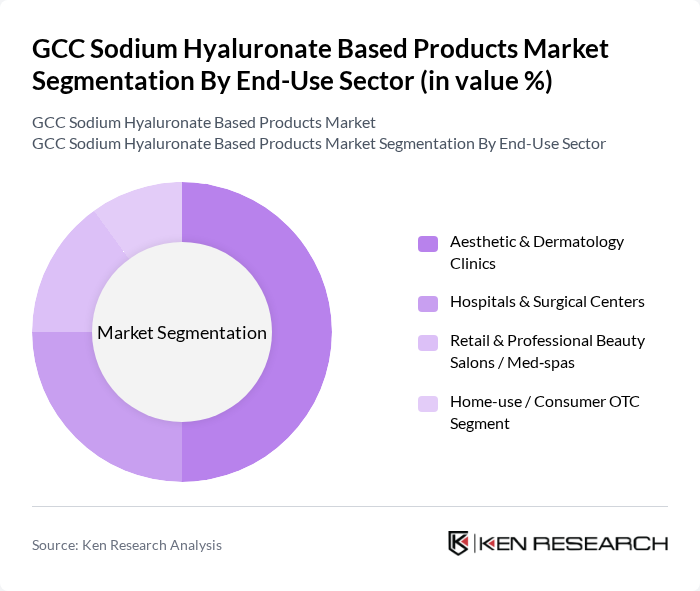
By End-Use Sector:The end-use sector segmentation highlights the various applications of sodium hyaluronate products across different industries. Aesthetic and dermatology clinics are the leading consumers of injectable products, supported by the rising popularity of non-surgical cosmetic procedures such as dermal fillers and skin boosters. Hospitals and surgical centers utilize sodium hyaluronate for therapeutic applications, particularly viscosupplementation in orthopedics and as ophthalmic viscoelastic devices in cataract and refractive surgeries. Retail and professional beauty salons or med?spas are increasingly adopting topical formulations and professional-use products featuring sodium hyaluronate for intensive hydration and anti?aging treatments, while the home?use segment is expanding with over?the?counter serums, eye drops, and oral supplements aligned with the broader self?care and wellness trend.
GCC Sodium Hyaluronate Based Products Market Competitive Landscape
The GCC Sodium Hyaluronate Based Products Market is characterized by a dynamic mix of regional and international players. Leading participants such as Allergan Aesthetics, an AbbVie Company, Galderma S.A., Merz Aesthetics GmbH, TEOXANE Laboratories, LG Chem Ltd. (YVOIRE), Bloomage Biotechnology Corporation Limited, Fidia Farmaceutici S.p.A., Croma-Pharma GmbH, Prollenium Medical Technologies Inc., Laboratoires Vivacy SAS, Medytox Inc., Revitacare SAS, Sinclair Pharma Ltd., Hyaltech Ltd., AMI Healthcare / Regional Distributors of Sodium Hyaluronate Products in GCC contribute to innovation, geographic expansion, differentiated product portfolios (injectables, topicals, ophthalmic solutions), and service delivery in this space.
GCC Sodium Hyaluronate Based Products Market Industry Analysis
Growth Drivers
- Increasing Demand for Anti-Aging Products:The GCC region has witnessed a significant rise in the demand for anti-aging products, with the market valued at approximately $1.5 billion. This growth is driven by a demographic shift, as over 30% of the population is aged 40 and above, leading to increased spending on skincare. The anti-aging segment is projected to grow by 8% annually, reflecting a strong consumer preference for sodium hyaluronate-based formulations that offer hydration and skin elasticity.
- Rising Awareness of Skin Health:Awareness regarding skin health has surged in the GCC, with 65% of consumers actively seeking products that promote skin wellness. This trend is supported by a growing number of dermatology clinics and skincare workshops, which have increased consumer education. The market for skin health products is expected to reach $2 billion in future, driven by the popularity of sodium hyaluronate, known for its moisturizing properties and ability to improve skin texture.
- Growth in Aesthetic Procedures:The GCC has seen a 15% increase in aesthetic procedures, with over 1.2 million procedures performed. This growth is attributed to the rising acceptance of cosmetic treatments, particularly among younger demographics. Sodium hyaluronate is a key ingredient in dermal fillers, which accounted for approximately $500 million in revenue. The increasing number of aesthetic clinics is expected to further boost the demand for these products in the coming years.
Market Challenges
- High Cost of Raw Materials:The production of sodium hyaluronate is significantly impacted by the high cost of raw materials, which can exceed $300 per kilogram. This cost pressure affects profit margins for manufacturers, particularly small and medium enterprises. As the demand for high-quality products increases, companies are compelled to invest in sourcing premium raw materials, which can limit their competitive pricing strategies in the GCC market.
- Regulatory Compliance Issues:Navigating the regulatory landscape in the GCC can be challenging, with stringent compliance requirements for cosmetic products. Companies must adhere to local regulations, which can vary significantly across member states. The cost of compliance can reach up to $100,000 for product registration and testing, posing a barrier for new entrants. This complexity can hinder market growth and innovation in sodium hyaluronate-based products.
GCC Sodium Hyaluronate Based Products Market Future Outlook
The future of the GCC sodium hyaluronate-based products market appears promising, driven by increasing consumer demand for innovative skincare solutions. As the market evolves, companies are likely to focus on developing advanced formulations that cater to specific skin concerns. Additionally, the rise of e-commerce platforms is expected to enhance product accessibility, allowing brands to reach a broader audience. This shift towards digital sales channels will likely reshape the competitive landscape, fostering growth and innovation in the sector.
Market Opportunities
- Development of Innovative Formulations:There is a significant opportunity for companies to create innovative sodium hyaluronate formulations that address specific skin issues, such as acne or hyperpigmentation. With the market for specialized skincare projected to grow by 10% annually, brands that invest in research and development can capture a larger share of this lucrative segment.
- Expansion into Untapped Markets:Emerging markets within the GCC, such as Oman and Bahrain, present untapped opportunities for sodium hyaluronate-based products. With a growing middle class and increasing disposable income, these regions are expected to see a rise in demand for premium skincare products, providing a fertile ground for market expansion and brand establishment.
Scope of the Report
| Segment | Sub-Segments |
|---|---|
| By Product Type | Injectable Sodium Hyaluronate (Dermal Fillers, Intra?articular, Ophthalmic OVDs) Topical Sodium Hyaluronate (Serums, Creams, Lotions) Ophthalmic Solutions and Eye Drops Oral and Nutricosmetic Sodium Hyaluronate Supplements Wound Care and Tissue Repair Products |
| By End-Use Sector | Aesthetic & Dermatology Clinics Hospitals & Surgical Centers Retail & Professional Beauty Salons / Med?spas Home-use / Consumer OTC Segment |
| By Distribution Channel | Hospital & Clinic Pharmacies Retail Pharmacies & Drug Stores Online Pharmacies & E?commerce Platforms Direct-to-Consumer (D2C) / Professional Distributors |
| By Application | Aesthetic & Cosmetic Dermatology (Fillers, Skin Rejuvenation) Orthopedics & Rheumatology (Viscosupplementation) Ophthalmology (Dry Eye, OVDs) Wound Care, Tissue Engineering & Drug Delivery Personal Care & Cosmetics (Hydration, Anti?aging) |
| By Country | United Arab Emirates (UAE) Kingdom of Saudi Arabia Qatar Kuwait Oman Bahrain |
| By Formulation | Single-crosslinked Gel Formulations Biphasic and Monophasic Dermal Filler Gels Multi?molecular Weight Liquid Solutions Sustained-release and Combination Formulations |
| By Packaging Type | Pre?filled Syringes & Injection Kits Vials, Ampoules & Bottles Tubes, Airless Pumps & Sachets Single?dose Units & Others |
Key Target Audience
Investors and Venture Capitalist Firms
Government and Regulatory Bodies (e.g., Gulf Cooperation Council, Saudi Food and Drug Authority, UAE Ministry of Health and Prevention)
Manufacturers and Producers
Distributors and Retailers
Pharmaceutical Companies
Cosmetic and Personal Care Brands
Healthcare Providers and Clinics
Industry Associations and Trade Organizations
Players Mentioned in the Report:
Allergan Aesthetics, an AbbVie Company
Galderma S.A.
Merz Aesthetics GmbH
TEOXANE Laboratories
LG Chem Ltd. (YVOIRE)
Bloomage Biotechnology Corporation Limited
Fidia Farmaceutici S.p.A.
Croma-Pharma GmbH
Prollenium Medical Technologies Inc.
Laboratoires Vivacy SAS
Medytox Inc.
Revitacare SAS
Sinclair Pharma Ltd.
Hyaltech Ltd.
AMI Healthcare / Regional Distributors of Sodium Hyaluronate Products in GCC
Table of Contents
Market Assessment Phase
1. Executive Summary and Approach
2. GCC Sodium Hyaluronate Based Products Market Overview
2.1 Key Insights and Strategic Recommendations
2.2 GCC Sodium Hyaluronate Based Products Market Overview
2.3 Definition and Scope
2.4 Evolution of Market Ecosystem
2.5 Timeline of Key Regulatory Milestones
2.6 Value Chain & Stakeholder Mapping
2.7 Business Cycle Analysis
2.8 Policy & Incentive Landscape
3. GCC Sodium Hyaluronate Based Products Market Analysis
3.1 Growth Drivers
3.1.1 Increasing Demand for Anti-Aging Products
3.1.2 Rising Awareness of Skin Health
3.1.3 Growth in Aesthetic Procedures
3.1.4 Expansion of Distribution Channels
3.2 Market Challenges
3.2.1 High Cost of Raw Materials
3.2.2 Regulatory Compliance Issues
3.2.3 Competition from Alternative Products
3.2.4 Limited Consumer Awareness in Emerging Markets
3.3 Market Opportunities
3.3.1 Development of Innovative Formulations
3.3.2 Expansion into Untapped Markets
3.3.3 Collaborations with Dermatology Clinics
3.3.4 Increasing Online Sales Channels
3.4 Market Trends
3.4.1 Growing Popularity of Natural Ingredients
3.4.2 Rise in Personalized Skincare Products
3.4.3 Increasing Use of Hyaluronic Acid in Medical Applications
3.4.4 Shift Towards Sustainable Packaging Solutions
3.5 Government Regulation
3.5.1 Stricter Quality Control Standards
3.5.2 Labeling and Marketing Regulations
3.5.3 Import Tariffs on Raw Materials
3.5.4 Compliance with International Standards
4. SWOT Analysis
5. Stakeholder Analysis
6. Porter's Five Forces Analysis
7. GCC Sodium Hyaluronate Based Products Market Market Size, 2019-2024
7.1 By Value
7.2 By Volume
7.3 By Average Selling Price
8. GCC Sodium Hyaluronate Based Products Market Segmentation
8.1 By Product Type
8.1.1 Injectable Sodium Hyaluronate (Dermal Fillers, Intra?articular, Ophthalmic OVDs)
8.1.2 Topical Sodium Hyaluronate (Serums, Creams, Lotions)
8.1.3 Ophthalmic Solutions and Eye Drops
8.1.4 Oral and Nutricosmetic Sodium Hyaluronate Supplements
8.1.5 Wound Care and Tissue Repair Products
8.2 By End-Use Sector
8.2.1 Aesthetic & Dermatology Clinics
8.2.2 Hospitals & Surgical Centers
8.2.3 Retail & Professional Beauty Salons / Med?spas
8.2.4 Home-use / Consumer OTC Segment
8.3 By Distribution Channel
8.3.1 Hospital & Clinic Pharmacies
8.3.2 Retail Pharmacies & Drug Stores
8.3.3 Online Pharmacies & E?commerce Platforms
8.3.4 Direct-to-Consumer (D2C) / Professional Distributors
8.4 By Application
8.4.1 Aesthetic & Cosmetic Dermatology (Fillers, Skin Rejuvenation)
8.4.2 Orthopedics & Rheumatology (Viscosupplementation)
8.4.3 Ophthalmology (Dry Eye, OVDs)
8.4.4 Wound Care, Tissue Engineering & Drug Delivery
8.4.5 Personal Care & Cosmetics (Hydration, Anti?aging)
8.5 By Country
8.5.1 United Arab Emirates (UAE)
8.5.2 Kingdom of Saudi Arabia
8.5.3 Qatar
8.5.4 Kuwait
8.5.5 Oman
8.5.6 Bahrain
8.6 By Formulation
8.6.1 Single-crosslinked Gel Formulations
8.6.2 Biphasic and Monophasic Dermal Filler Gels
8.6.3 Multi?molecular Weight Liquid Solutions
8.6.4 Sustained-release and Combination Formulations
8.7 By Packaging Type
8.7.1 Pre?filled Syringes & Injection Kits
8.7.2 Vials, Ampoules & Bottles
8.7.3 Tubes, Airless Pumps & Sachets
8.7.4 Single?dose Units & Others
9. GCC Sodium Hyaluronate Based Products Market Competitive Analysis
9.1 Market Share of Key Players
9.2 Cross Comparison of Key Players
9.2.1 Company Name
9.2.2 Group Size (Global, Regional, or Local Player)
9.2.3 GCC Revenue and Revenue Growth Rate from Sodium Hyaluronate Products
9.2.4 Number of Sodium Hyaluronate SKUs / Indications Covered
9.2.5 GCC Market Share in Injectables vs. Topicals
9.2.6 Average Selling Price Positioning (Premium / Mid / Value)
9.2.7 Geographic Footprint within GCC (Number of Countries / Clinics Served)
9.2.8 Distribution Network Strength (Distributors, Pharmacies, E?commerce Partnerships)
9.2.9 R&D and Regulatory Strength (Approvals, Clinical Studies, Patents)
9.2.10 Brand Equity & KOL Adoption (Brand Awareness, Key Opinion Leader Usage)
9.2.11 Product Safety & Pharmacovigilance Track Record
9.3 SWOT Analysis of Top Players
9.4 Pricing Analysis
9.5 Detailed Profile of Major Companies
9.5.1 Allergan Aesthetics, an AbbVie Company
9.5.2 Galderma S.A.
9.5.3 Merz Aesthetics GmbH
9.5.4 TEOXANE Laboratories
9.5.5 LG Chem Ltd. (YVOIRE)
9.5.6 Bloomage Biotechnology Corporation Limited
9.5.7 Fidia Farmaceutici S.p.A.
9.5.8 Croma-Pharma GmbH
9.5.9 Prollenium Medical Technologies Inc.
9.5.10 Laboratoires Vivacy SAS
9.5.11 Medytox Inc.
9.5.12 Revitacare SAS
9.5.13 Sinclair Pharma Ltd.
9.5.14 Hyaltech Ltd.
9.5.15 AMI Healthcare / Regional Distributors of Sodium Hyaluronate Products in GCC
10. GCC Sodium Hyaluronate Based Products Market End-User Analysis
10.1 Procurement Behavior of Key Ministries
10.1.1 Budget Allocation Trends
10.1.2 Decision-Making Processes
10.1.3 Preferred Suppliers
10.1.4 Compliance Requirements
10.2 Corporate Spend on Infrastructure & Energy
10.2.1 Investment Trends
10.2.2 Key Projects
10.2.3 Funding Sources
10.2.4 Strategic Partnerships
10.3 Pain Point Analysis by End-User Category
10.3.1 Common Challenges Faced
10.3.2 Service Gaps
10.3.3 Product Performance Issues
10.3.4 Support and Maintenance Needs
10.4 User Readiness for Adoption
10.4.1 Awareness Levels
10.4.2 Training Requirements
10.4.3 Technology Acceptance
10.4.4 Feedback Mechanisms
10.5 Post-Deployment ROI and Use Case Expansion
10.5.1 Measurement of Success
10.5.2 Case Studies
10.5.3 Future Investment Plans
10.5.4 Expansion Opportunities
11. GCC Sodium Hyaluronate Based Products Market Future Size, 2025-2030
11.1 By Value
11.2 By Volume
11.3 By Average Selling Price
Go-To-Market Strategy Phase
1. Whitespace Analysis + Business Model Canvas
1.1 Market Gaps Identification
1.2 Value Proposition Development
1.3 Revenue Streams
1.4 Cost Structure Analysis
1.5 Key Partnerships
1.6 Customer Segments
1.7 Channels
2. Marketing and Positioning Recommendations
2.1 Branding Strategies
2.2 Product USPs
2.3 Target Audience Identification
2.4 Communication Strategies
2.5 Digital Marketing Approaches
2.6 Offline Marketing Strategies
2.7 Performance Metrics
3. Distribution Plan
3.1 Urban Retail Strategies
3.2 Rural NGO Tie-ups
3.3 E-commerce Strategies
3.4 Direct Sales Approaches
3.5 Distribution Partnerships
3.6 Logistics and Supply Chain Management
3.7 Performance Evaluation
4. Channel & Pricing Gaps
4.1 Underserved Routes
4.2 Pricing Bands
4.3 Competitor Pricing Analysis
4.4 Customer Willingness to Pay
4.5 Price Sensitivity Analysis
4.6 Discount Strategies
4.7 Pricing Optimization Techniques
5. Unmet Demand & Latent Needs
5.1 Category Gaps
5.2 Consumer Segments
5.3 Emerging Trends
5.4 Product Development Opportunities
5.5 Market Entry Strategies
5.6 Customer Feedback Mechanisms
5.7 Future Demand Projections
6. Customer Relationship
6.1 Loyalty Programs
6.2 After-sales Service
6.3 Customer Engagement Strategies
6.4 Feedback Collection Methods
6.5 Relationship Management Tools
6.6 Performance Metrics
6.7 Customer Retention Strategies
7. Value Proposition
7.1 Sustainability Initiatives
7.2 Integrated Supply Chains
7.3 Unique Selling Points
7.4 Customer-Centric Approaches
7.5 Competitive Advantages
7.6 Value Delivery Mechanisms
7.7 Performance Metrics
8. Key Activities
8.1 Regulatory Compliance
8.2 Branding
8.3 Distribution Setup
8.4 Marketing Campaigns
8.5 Training and Development
8.6 Performance Monitoring
8.7 Continuous Improvement Strategies
9. Entry Strategy Evaluation
9.1 Domestic Market Entry Strategy
9.1.1 Product Mix
9.1.2 Pricing Band
9.1.3 Packaging
9.2 Export Entry Strategy
9.2.1 Target Countries
9.2.2 Compliance Roadmap
10. Entry Mode Assessment
10.1 Joint Ventures
10.2 Greenfield Investments
10.3 Mergers & Acquisitions
10.4 Distributor Model
10.5 Risk Assessment
10.6 Strategic Fit Analysis
10.7 Performance Metrics
11. Capital and Timeline Estimation
11.1 Capital Requirements
11.2 Timelines
11.3 Funding Sources
11.4 Financial Projections
11.5 Risk Management Strategies
11.6 Performance Metrics
12. Control vs Risk Trade-Off
12.1 Ownership vs Partnerships
12.2 Risk Mitigation Strategies
12.3 Performance Metrics
13. Profitability Outlook
13.1 Breakeven Analysis
13.2 Long-term Sustainability
13.3 Financial Health Indicators
13.4 Performance Metrics
14. Potential Partner List
14.1 Distributors
14.2 Joint Ventures
14.3 Acquisition Targets
14.4 Strategic Alliances
14.5 Performance Metrics
15. Execution Roadmap
15.1 Phased Plan for Market Entry
15.1.1 Market Setup
15.1.2 Market Entry
15.1.3 Growth Acceleration
15.1.4 Scale & Stabilize
15.2 Key Activities and Milestone
Research Methodology
Phase 1: Approach1
Desk Research
- Analysis of market reports from industry associations and trade publications specific to sodium hyaluronate products
- Review of scientific literature and clinical studies related to the efficacy and applications of sodium hyaluronate
- Examination of regulatory frameworks and guidelines from health authorities in the GCC region
Primary Research
- Interviews with product managers and R&D heads at leading manufacturers of sodium hyaluronate-based products
- Surveys targeting dermatologists and cosmetic surgeons to understand product usage and market trends
- Focus group discussions with end-users to gather insights on consumer preferences and purchasing behavior
Validation & Triangulation
- Cross-validation of findings through multiple data sources, including sales data and market trends
- Triangulation of insights from primary interviews with secondary data to ensure consistency
- Sanity checks conducted through expert panels comprising industry veterans and market analysts
Phase 2: Market Size Estimation1
Top-down Assessment
- Estimation of the overall market size based on historical sales data and growth rates in the GCC region
- Segmentation of the market by application areas such as cosmetics, pharmaceuticals, and medical devices
- Incorporation of macroeconomic factors and demographic trends influencing market demand
Bottom-up Modeling
- Collection of sales volume data from key players in the sodium hyaluronate market
- Estimation of average selling prices across different product categories and applications
- Calculation of market size based on product volume and pricing strategies of manufacturers
Forecasting & Scenario Analysis
- Development of forecasting models using historical data and projected growth rates for the next five years
- Scenario analysis based on potential regulatory changes and shifts in consumer preferences
- Creation of best-case, worst-case, and most-likely scenarios to assess market dynamics
Phase 3: CATI Sample Composition1
| Scope Item/Segment | Sample Size | Target Respondent Profiles |
|---|---|---|
| Cosmetic Product Manufacturers | 95 | Product Development Managers, Marketing Directors |
| Pharmaceutical Companies | 75 | Regulatory Affairs Specialists, R&D Managers |
| Healthcare Professionals | 110 | Dermatologists, Plastic Surgeons |
| Retailers of Beauty Products | 85 | Store Managers, Category Buyers |
| End-Consumers of Sodium Hyaluronate Products | 140 | Beauty Enthusiasts, Regular Users of Skincare Products |
Frequently Asked Questions
What is the current value of the GCC Sodium Hyaluronate Based Products Market?
The GCC Sodium Hyaluronate Based Products Market is valued at approximately USD 1.1 billion, reflecting a significant growth trajectory influenced by rising demand for aesthetic procedures and advancements in medical technology.
What factors are driving the growth of the GCC Sodium Hyaluronate market?
Which countries are leading in the GCC Sodium Hyaluronate market?
What types of products are included in the GCC Sodium Hyaluronate market?
Other Regional/Country Reports
Indonesia Sodium Hyaluronate Based Products Market
Malaysia Sodium Hyaluronate Based Products Market
KSA Sodium Hyaluronate Based Products Market
APAC Sodium Hyaluronate Based Products Market
SEA Sodium Hyaluronate Based Products Market
Vietnam Sodium Hyaluronate Based Products Market
Other Adjacent Reports
South Korea Anti-Aging Skincare Market
Egypt Orthopedic Viscosupplements Market
Germany Ophthalmic Solutions Market
KSA Cosmetic Injectables Market
Singapore Wound Care Products Market
Egypt Nutricosmetics Market
Middle East aesthetic devices market report size, share, growth drivers, trends, opportunities & forecast 2025–2030Global Medical Tourism Market Size, Share & Forecast, By Treatment Type, Care Setting & Patient Origin, 2026-2031UAE Pharmaceutical Excipients MarketWhy Buy From Us?

What makes us stand out is that our consultants follow Robust, Refine and Result (RRR) methodology. Robust for clear definitions, approaches and sanity checking, Refine for differentiating respondents' facts and opinions, and Result for presenting data with story.

We have set a benchmark in the industry by offering our clients with syndicated and customized market research reports featuring coverage of entire market as well as meticulous research and analyst insights.

While we don't replace traditional research, we flip the method upside down. Our dual approach of Top Bottom & Bottom Top ensures quality deliverable by not just verifying company fundamentals but also looking at the sector and macroeconomic factors.

With one step in the future, our research team constantly tries to show you the bigger picture. We help with some of the tough questions you may encounter along the way: How is the industry positioned? Best marketing channel? KPI's of competitors? By aligning every element, we help maximize success.

Our report gives you instant access to the answers and sources that other companies might choose to hide. We elaborate each steps of research methodology we have used and showcase you the sample size to earn your trust.

If you need any support, we are here! We pride ourselves on universe strength, data quality, and quick, friendly, and professional service.