








Ken Research Logo

Gcc Steel Long Products Market Size, Share, Growth Drivers, Trends, Opportunities & Forecast 2025–2030

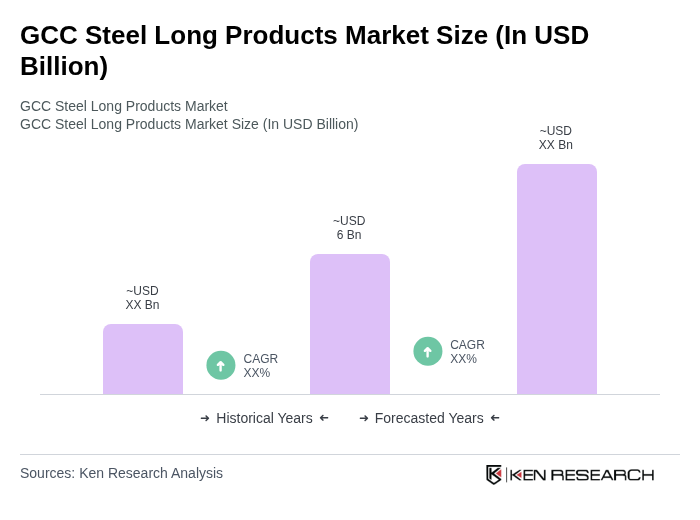
The GCC Steel Long Products Market, valued at USD 6 billion, is driven by rising demand in construction and infrastructure, led by rebar and building sectors across key GCC countries.

Region:Middle East

Author(s):Shubham

Product Code:KRAD5480

Pages:87

Published On:December 2025
About the Report

Base Year 2024

GCC Steel Long Products Market Overview

  • The GCC Steel Long Products Market is valued at USD 6 billion, based on a five-year historical analysis of regional steel demand and production within the broader GCC steel market. This growth is primarily driven by the increasing demand for construction and infrastructure development across the region, supported by large public spending programs such as Saudi Arabia’s Vision 2030, the UAE’s federal and emirate-level housing and transport programs, and Qatar’s post–World Cup infrastructure and real estate pipeline. The market has seen a significant rise in consumption due to urbanization, industrialization, and population growth, which have led to a surge in the need for steel long products used in reinforced concrete, structural framing, and infrastructure networks.
  • Key players in this market include Saudi Arabia, the United Arab Emirates, and Qatar, which together account for the majority of steel consumption and production capacity in the GCC. Saudi Arabia dominates the market due to its large-scale construction and infrastructure projects in housing, rail, metro, industrial zones, and giga-projects such as NEOM and Red Sea developments. The UAE benefits from its strategic location, re-export role, and robust construction sector in Dubai and Abu Dhabi, including high-rise buildings, ports, free zones, and industrial areas. Qatar’s rapid urban development, expansion of transport and logistics infrastructure, and legacy projects around major international events have also contributed to its significant market presence in long products, especially rebar and wire rod.
  • In 2023, GCC countries advanced sustainability requirements on steel production and use through national industrial and environmental frameworks, including instruments such as Saudi Arabia’s Law of the Environment issued by Royal Decree No. M/165 of 2021 and its implementing regulations, which set limits on industrial emissions and require environmental permits and monitoring for steel plants. Similar measures are embedded in the UAE’s Federal Law No. 24 of 1999 for the Protection and Development of the Environment and subsequent implementing regulations, under which steel producers must comply with emission standards, waste management rules, and environmental impact assessment requirements. Across the GCC, these frameworks encourage energy-efficient furnaces, increased scrap-based production via electric arc furnaces, and recycling initiatives, supporting regional decarbonization goals and driving investment in cleaner steelmaking technologies.
GCC Steel Long Products Market Size

GCC Steel Long Products Market Segmentation

By Product Type:The product type segmentation includes various categories such as Rebar, Wire Rod, Merchant Bars (Angles, Channels, Flats), Structural Sections (I-beams, H-beams, Universal Beams), Rails and Railway Sections, Steel Piles, and Others (Special Sections, Bright Bars, etc.). This structure is consistent with the way long steel products are categorized globally. Among these, Rebar is the leading subsegment due to its extensive use in residential, commercial, and infrastructure construction, particularly for reinforced concrete structures across GCC building and civil works. The Wire Rod segment also shows significant growth, primarily used in manufacturing of mesh, fasteners, welding electrodes, and in construction applications such as reinforcing wire and prestressed concrete strands.
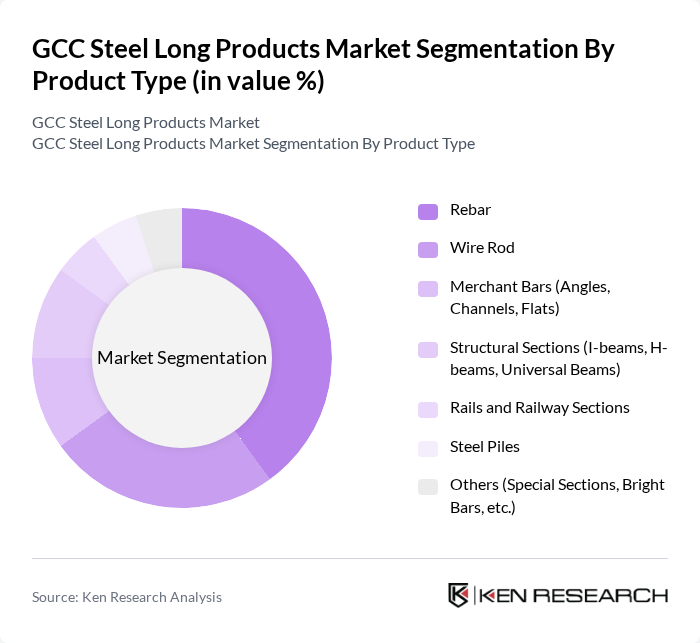
GCC Steel Long Products Market segmentation by Product Type.

By End-Use Sector:The end-use sector segmentation includes Building & Construction, Infrastructure (Roads, Bridges, Rail, Ports, Airports), Oil & Gas and Petrochemicals, Industrial & Manufacturing Facilities, Power & Utilities, and Others (Marine, Agriculture, etc.). This segmentation aligns with the primary demand centers for long steel products globally and in the Middle East. The Building & Construction sector is the dominant segment, driven by ongoing urbanization, housing programs, commercial real estate, and mixed-use developments across GCC cities. The Infrastructure sector also plays a crucial role, with significant investments in highways, bridges, metros, rail, ports, airports, and utility corridors enhancing the demand for rebar, structural sections, and piles in long products.
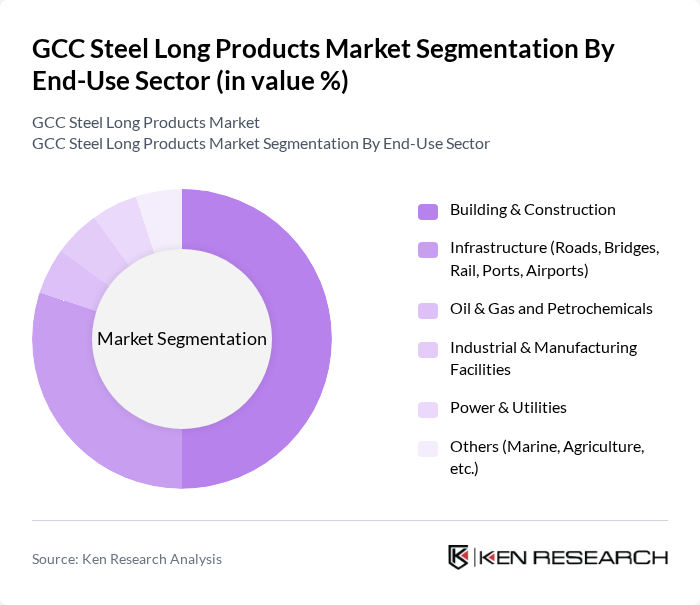
GCC Steel Long Products Market segmentation by End-Use Sector.

GCC Steel Long Products Market Competitive Landscape

The GCC Steel Long Products Market is characterized by a dynamic mix of regional and international players. Leading participants such as Emirates Steel Arkan (UAE), Qatar Steel Company (Qatar), Saudi Iron and Steel Company (Hadeed) – SABIC (Saudi Arabia), Al Ittefaq Steel Products Co. (ISPC) (Saudi Arabia), Jindal Shadeed Iron & Steel LLC (Oman), SULB Company B.S.C. (Bahrain), Al Rajhi Steel Industries Co. (Saudi Arabia), United Steel Company (Foulath Holding) (Bahrain), Oman United Steel Industries LLC (Oman), Gulf Steel Industries Co. LLC (UAE), Al Jazeera Steel Products Co. SAOG (Oman), Union Iron & Steel Company LLC (UAE), Al Yamamah Steel Industries Co. (Saudi Arabia), Al Ghurair Iron & Steel LLC (UAE), Qatar National Aluminum & Steel Factory (Qatar) contribute to innovation, geographic expansion, and service delivery in this space.

Emirates Steel Arkan

1998

Abu Dhabi, UAE

Qatar Steel Company

1974

Doha, Qatar

Saudi Iron and Steel Company (Hadeed) – SABIC

1979

Jubail, Saudi Arabia

Al Ittefaq Steel Products Co. (ISPC)

1989

Dammam, Saudi Arabia

Jindal Shadeed Iron & Steel LLC

2010

Sohar, Oman

Company

Establishment Year

Headquarters

Group Size (Large, Medium, or Small as per industry convention)

Installed Crude Steel Capacity (MTPA)

Long Products Rolling Capacity (MTPA)

Capacity Utilization Rate (%)

Share of Long Products in Total Revenue (%)

GCC Market Share in Long Products (%)

GCC Steel Long Products Market Industry Analysis

Growth Drivers

  • Increasing Infrastructure Development:The GCC region is witnessing a surge in infrastructure projects, with investments projected to reach $1.2 trillion in the future. Major initiatives include the Saudi Vision 2030 and Qatar's National Vision 2030, which emphasize extensive infrastructure upgrades. This growth is expected to drive the demand for steel long products, as they are essential for constructing roads, bridges, and public facilities, thereby significantly boosting the market.
  • Rising Demand from Construction Sector:The construction sector in the GCC is anticipated to grow by 7% annually, fueled by urbanization and population growth. In the future, the sector's value is expected to exceed $220 billion, creating a robust demand for steel long products. This demand is driven by residential, commercial, and industrial projects, which require substantial quantities of steel for structural integrity and durability, further propelling market growth.
  • Government Investments in Mega Projects:Governments in the GCC are investing heavily in mega projects, with over $350 billion allocated for various initiatives in the future. Projects like NEOM in Saudi Arabia and the Qatar World Cup infrastructure are significant contributors. These investments not only enhance regional infrastructure but also create a sustained demand for steel long products, as they are integral to the construction of large-scale developments and facilities.

Market Challenges

  • Fluctuating Raw Material Prices:The steel industry faces challenges due to volatile raw material prices, particularly iron ore and scrap steel. In the future, iron ore prices are projected to fluctuate between $95 and $125 per ton, impacting production costs. This volatility can lead to reduced profit margins for manufacturers, making it difficult to maintain competitive pricing in the GCC steel long products market.
  • Environmental Regulations and Compliance:Stricter environmental regulations are being implemented across the GCC, with compliance costs expected to rise by 20% in the future. These regulations aim to reduce emissions and promote sustainable practices in steel production. Companies may face significant investments in technology and processes to meet these standards, which can strain financial resources and impact overall market competitiveness.

GCC Steel Long Products Market Future Outlook

The GCC steel long products market is poised for significant transformation, driven by a focus on sustainability and technological advancements. As governments push for greener manufacturing practices, the adoption of eco-friendly steel production methods is expected to rise. Additionally, the integration of automation and AI in production processes will enhance efficiency and reduce costs. These trends will likely shape the market landscape, fostering innovation and attracting investments in the coming years.

Market Opportunities

  • Expansion into Emerging Markets:Companies in the GCC steel long products market have the opportunity to expand into emerging markets in Africa and Asia, where infrastructure development is accelerating. With a projected growth rate of 8% in these regions, GCC manufacturers can leverage their expertise and quality products to capture new market share and drive revenue growth.
  • Development of Eco-Friendly Steel Products:The increasing demand for sustainable construction materials presents a significant opportunity for the GCC steel industry. By developing eco-friendly steel products, manufacturers can cater to environmentally conscious consumers and comply with stringent regulations. This shift not only enhances brand reputation but also opens new revenue streams in a growing market segment focused on sustainability.

Scope of the Report

SegmentSub-Segments
By Product Type

Rebar

Wire Rod

Merchant Bars (Angles, Channels, Flats)

Structural Sections (I-beams, H-beams, Universal Beams)

Rails and Railway Sections

Steel Piles

Others (Special Sections, Bright Bars, etc.)

By End-Use Sector

Building & Construction

Infrastructure (Roads, Bridges, Rail, Ports, Airports)

Oil & Gas and Petrochemicals

Industrial & Manufacturing Facilities

Power & Utilities

Others (Marine, Agriculture, etc.)

By Application

Reinforced Concrete (Foundations, Slabs, Columns)

Structural Steel Frames

Precast & Prefabricated Elements

Steel for Infrastructure Projects (Bridges, Rail, Ports)

Fabricated Steel Components & Engineering Uses

Others

By Sales Channel

Direct Sales to EPC Contractors & End-Users

Sales via Steel Service Centers & Stockists

Sales via Distributors & Traders

Export Sales within GCC and to Neighboring Regions

Others

By Country

Saudi Arabia

United Arab Emirates

Qatar

Kuwait

Oman

Bahrain

By Production Route

Electric Arc Furnace (EAF)

Basic Oxygen Furnace (BOF)

Induction Furnace

Others (Hybrid/Integrated Routes)

By Raw Material Source

Scrap-Based Steel

DRI/HBI-Based Steel

Mixed/Other Sources

Key Target Audience

Investors and Venture Capitalist Firms

Government and Regulatory Bodies (e.g., Ministry of Industry and Advanced Technology, Saudi Standards, Metrology and Quality Organization)

Manufacturers and Producers

Distributors and Retailers

Construction and Infrastructure Companies

Steel Industry Associations

Financial Institutions

Raw Material Suppliers

Players Mentioned in the Report:

Emirates Steel Arkan (UAE)

Qatar Steel Company (Qatar)

Saudi Iron and Steel Company (Hadeed) SABIC (Saudi Arabia)

Al Ittefaq Steel Products Co. (ISPC) (Saudi Arabia)

Jindal Shadeed Iron & Steel LLC (Oman)

SULB Company B.S.C. (Bahrain)

Al Rajhi Steel Industries Co. (Saudi Arabia)

United Steel Company (Foulath Holding) (Bahrain)

Oman United Steel Industries LLC (Oman)

Gulf Steel Industries Co. LLC (UAE)

Al Jazeera Steel Products Co. SAOG (Oman)

Union Iron & Steel Company LLC (UAE)

Al Yamamah Steel Industries Co. (Saudi Arabia)

Al Ghurair Iron & Steel LLC (UAE)

Qatar National Aluminum & Steel Factory (Qatar)

Table of Contents

Market Assessment Phase

1. Executive Summary and Approach


2. GCC Steel Long Products Market Overview

2.1 Key Insights and Strategic Recommendations

2.2 GCC Steel Long Products Market Overview

2.3 Definition and Scope

2.4 Evolution of Market Ecosystem

2.5 Timeline of Key Regulatory Milestones

2.6 Value Chain & Stakeholder Mapping

2.7 Business Cycle Analysis

2.8 Policy & Incentive Landscape


3. GCC Steel Long Products Market Analysis

3.1 Growth Drivers

3.1.1 Increasing Infrastructure Development
3.1.2 Rising Demand from Construction Sector
3.1.3 Government Investments in Mega Projects
3.1.4 Technological Advancements in Steel Production

3.2 Market Challenges

3.2.1 Fluctuating Raw Material Prices
3.2.2 Environmental Regulations and Compliance
3.2.3 Competition from Alternative Materials
3.2.4 Supply Chain Disruptions

3.3 Market Opportunities

3.3.1 Expansion into Emerging Markets
3.3.2 Development of Eco-Friendly Steel Products
3.3.3 Strategic Partnerships and Collaborations
3.3.4 Adoption of Automation and AI in Production

3.4 Market Trends

3.4.1 Shift Towards Sustainable Manufacturing
3.4.2 Increasing Use of Recycled Steel
3.4.3 Digital Transformation in Supply Chain Management
3.4.4 Growth of Prefabricated Construction Solutions

3.5 Government Regulation

3.5.1 Emission Standards for Steel Production
3.5.2 Import Tariffs on Steel Products
3.5.3 Safety Regulations in Construction
3.5.4 Incentives for Green Manufacturing Practices

4. SWOT Analysis


5. Stakeholder Analysis


6. Porter's Five Forces Analysis


7. GCC Steel Long Products Market Market Size, 2019-2024

7.1 By Value

7.2 By Volume

7.3 By Average Selling Price


8. GCC Steel Long Products Market Segmentation

8.1 By Product Type

8.1.1 Rebar
8.1.2 Wire Rod
8.1.3 Merchant Bars (Angles, Channels, Flats)
8.1.4 Structural Sections (I-beams, H-beams, Universal Beams)
8.1.5 Rails and Railway Sections
8.1.6 Steel Piles
8.1.7 Others (Special Sections, Bright Bars, etc.)

8.2 By End-Use Sector

8.2.1 Building & Construction
8.2.2 Infrastructure (Roads, Bridges, Rail, Ports, Airports)
8.2.3 Oil & Gas and Petrochemicals
8.2.4 Industrial & Manufacturing Facilities
8.2.5 Power & Utilities
8.2.6 Others (Marine, Agriculture, etc.)

8.3 By Application

8.3.1 Reinforced Concrete (Foundations, Slabs, Columns)
8.3.2 Structural Steel Frames
8.3.3 Precast & Prefabricated Elements
8.3.4 Steel for Infrastructure Projects (Bridges, Rail, Ports)
8.3.5 Fabricated Steel Components & Engineering Uses
8.3.6 Others

8.4 By Sales Channel

8.4.1 Direct Sales to EPC Contractors & End-Users
8.4.2 Sales via Steel Service Centers & Stockists
8.4.3 Sales via Distributors & Traders
8.4.4 Export Sales within GCC and to Neighboring Regions
8.4.5 Others

8.5 By Country

8.5.1 Saudi Arabia
8.5.2 United Arab Emirates
8.5.3 Qatar
8.5.4 Kuwait
8.5.5 Oman
8.5.6 Bahrain

8.6 By Production Route

8.6.1 Electric Arc Furnace (EAF)
8.6.2 Basic Oxygen Furnace (BOF)
8.6.3 Induction Furnace
8.6.4 Others (Hybrid/Integrated Routes)

8.7 By Raw Material Source

8.7.1 Scrap-Based Steel
8.7.2 DRI/HBI-Based Steel
8.7.3 Mixed/Other Sources

9. GCC Steel Long Products Market Competitive Analysis

9.1 Market Share of Key Players

9.2 Cross Comparison of Key Players

9.2.1 Company Name
9.2.2 Group Size (Large, Medium, or Small as per industry convention)
9.2.3 Installed Crude Steel Capacity (MTPA)
9.2.4 Long Products Rolling Capacity (MTPA)
9.2.5 Capacity Utilization Rate (%)
9.2.6 Share of Long Products in Total Revenue (%)
9.2.7 GCC Market Share in Long Products (%)
9.2.8 Export Share of Long Products (% of Sales)
9.2.9 Average Realization / ASP for Key Long Products (USD/ton)
9.2.10 EBITDA Margin (%)
9.2.11 Net Debt to EBITDA (x)
9.2.12 3-Year Revenue CAGR in Long Products (%)
9.2.13 Product Mix Breadth (Rebar, Wire Rod, Sections, Merchant Bars, Rails, etc.)
9.2.14 Share of EAF / DRI-Based Production (%)
9.2.15 Energy Intensity (kWh/ton of Crude Steel or Rolled Product)
9.2.16 CO? Emissions Intensity (tCO?/ton of Crude Steel)
9.2.17 Share of Scrap in Charge Mix (%)
9.2.18 On-time Delivery Performance (%)
9.2.19 Order Book Visibility (Months of Production Covered)
9.2.20 Capex Intensity (Capex as % of Sales)

9.3 SWOT Analysis of Top Players

9.4 Pricing Analysis

9.5 Detailed Profile of Major Companies

9.5.1 Emirates Steel Arkan (UAE)
9.5.2 Qatar Steel Company (Qatar)
9.5.3 Saudi Iron and Steel Company (Hadeed) – SABIC (Saudi Arabia)
9.5.4 Al Ittefaq Steel Products Co. (ISPC) (Saudi Arabia)
9.5.5 Jindal Shadeed Iron & Steel LLC (Oman)
9.5.6 SULB Company B.S.C. (Bahrain)
9.5.7 Al Rajhi Steel Industries Co. (Saudi Arabia)
9.5.8 United Steel Company (Foulath Holding) (Bahrain)
9.5.9 Oman United Steel Industries LLC (Oman)
9.5.10 Gulf Steel Industries Co. LLC (UAE)
9.5.11 Al Jazeera Steel Products Co. SAOG (Oman)
9.5.12 Union Iron & Steel Company LLC (UAE)
9.5.13 Al Yamamah Steel Industries Co. (Saudi Arabia)
9.5.14 Al Ghurair Iron & Steel LLC (UAE)
9.5.15 Qatar National Aluminum & Steel Factory (Qatar)

10. GCC Steel Long Products Market End-User Analysis

10.1 Procurement Behavior of Key Ministries

10.1.1 Government Procurement Policies
10.1.2 Budget Allocations for Infrastructure
10.1.3 Supplier Selection Criteria
10.1.4 Contracting Processes

10.2 Corporate Spend on Infrastructure & Energy

10.2.1 Investment Trends in Construction
10.2.2 Corporate Budgets for Steel Products
10.2.3 Major Infrastructure Projects
10.2.4 Energy Sector Investments

10.3 Pain Point Analysis by End-User Category

10.3.1 Construction Sector Challenges
10.3.2 Manufacturing Sector Needs
10.3.3 Energy Sector Requirements
10.3.4 Transportation Sector Issues

10.4 User Readiness for Adoption

10.4.1 Awareness of Steel Products
10.4.2 Training and Skill Development
10.4.3 Adoption Barriers
10.4.4 Feedback Mechanisms

10.5 Post-Deployment ROI and Use Case Expansion

10.5.1 Measurement of ROI
10.5.2 Case Studies of Successful Deployments
10.5.3 Expansion Opportunities
10.5.4 Long-term Benefits Analysis

11. GCC Steel Long Products Market Future Size, 2025-2030

11.1 By Value

11.2 By Volume

11.3 By Average Selling Price


Go-To-Market Strategy Phase

1. Whitespace Analysis + Business Model Canvas

1.1 Market Gaps Identification

1.2 Business Model Development


2. Marketing and Positioning Recommendations

2.1 Branding Strategies

2.2 Product USPs


3. Distribution Plan

3.1 Urban Retail vs Rural NGO Tie-ups


4. Channel & Pricing Gaps

4.1 Underserved Routes

4.2 Pricing Bands


5. Unmet Demand & Latent Needs

5.1 Category Gaps

5.2 Consumer Segments


6. Customer Relationship

6.1 Loyalty Programs

6.2 After-sales Service


7. Value Proposition

7.1 Sustainability

7.2 Integrated Supply Chains


8. Key Activities

8.1 Regulatory Compliance

8.2 Branding

8.3 Distribution Setup


9. Entry Strategy Evaluation

9.1 Domestic Market Entry Strategy

9.1.1 Product Mix
9.1.2 Pricing Band
9.1.3 Packaging

9.2 Export Entry Strategy

9.2.1 Target Countries
9.2.2 Compliance Roadmap

10. Entry Mode Assessment

10.1 JV

10.2 Greenfield

10.3 M&A

10.4 Distributor Model


11. Capital and Timeline Estimation

11.1 Capital Requirements

11.2 Timelines


12. Control vs Risk Trade-Off

12.1 Ownership vs Partnerships


13. Profitability Outlook

13.1 Breakeven Analysis

13.2 Long-term Sustainability


14. Potential Partner List

14.1 Distributors

14.2 JVs

14.3 Acquisition Targets


15. Execution Roadmap

15.1 Phased Plan for Market Entry

15.1.1 Market Setup
15.1.2 Market Entry
15.1.3 Growth Acceleration
15.1.4 Scale & Stabilize

15.2 Key Activities and Milestones

15.2.1 Milestone Planning
15.2.2 Activity Tracking

Research Methodology

ApproachModellingSample

Phase 1: Approach1

Desk Research

  • Industry reports from GCC steel associations and trade bodies
  • Market analysis from government publications and economic surveys
  • Academic journals and white papers on steel production and consumption trends

Primary Research

  • Interviews with executives from leading steel manufacturers in the GCC
  • Surveys targeting construction firms and infrastructure developers
  • Field interviews with distributors and retailers of long steel products

Validation & Triangulation

  • Cross-validation of data through multiple industry sources and reports
  • Triangulation of findings from primary interviews and secondary data
  • Sanity checks conducted with industry experts and market analysts

Phase 2: Market Size Estimation1

Top-down Assessment

  • Analysis of national steel consumption statistics and production capacities
  • Segmentation of market size by end-user industries such as construction and manufacturing
  • Incorporation of government infrastructure spending forecasts and initiatives

Bottom-up Modeling

  • Volume estimates based on production data from major steel plants in the region
  • Cost analysis derived from pricing models of long steel products
  • Estimation of market share based on sales data from key distributors

Forecasting & Scenario Analysis

  • Multi-variable forecasting using economic indicators and construction activity levels
  • Scenario planning based on potential regulatory changes and trade policies
  • Development of baseline, optimistic, and pessimistic market growth projections through 2030

Phase 3: CATI Sample Composition1

Scope Item/SegmentSample SizeTarget Respondent Profiles
Construction Sector Steel Usage120Project Managers, Procurement Officers
Manufacturing Industry Steel Demand100Operations Managers, Supply Chain Directors
Retail Distribution of Long Steel Products80Sales Managers, Retail Buyers
Infrastructure Development Projects70Government Officials, Urban Planners
Steel Recycling and Sustainability Initiatives60Sustainability Managers, Environmental Consultants

Frequently Asked Questions

What is the current value of the GCC Steel Long Products Market?

The GCC Steel Long Products Market is valued at approximately USD 6 billion, driven by increasing demand for construction and infrastructure development across the region, particularly due to initiatives like Saudi Arabias Vision 2030 and Qatars post-World Cup projects.

What factors are driving growth in the GCC Steel Long Products Market?

Which countries are the major players in the GCC Steel Long Products Market?

What are the main product types in the GCC Steel Long Products Market?

Other Regional/Country Reports

Indonesia Steel Long Products Market

Malaysia Steel Long Products Market

KSA Steel Long Products Market

APAC Steel Long Products Market

SEA Steel Long Products Market

Vietnam Steel Long Products Market

Other Adjacent Reports

KSA Steel Flat Products Market

India Construction Materials Market Outlook to 2030

Bahrain Infrastructure Development Market

Mexico Oil and Gas Infrastructure MARKET

India Metal Fabrication MarketGlobal Scrap Metal Recycling Market Outlook to 2030

Germany Iron Ore Supply Market

Singapore Automotive Steel Components Market

Belgium Railway Infrastructure Market

Oman Shipbuilding Materials Market

Why Buy From Us?

Refine Robust Result (RRR) Framework

What makes us stand out is that our consultants follow Robust, Refine and Result (RRR) methodology. Robust for clear definitions, approaches and sanity checking, Refine for differentiating respondents' facts and opinions, and Result for presenting data with story.

Our Reach Is Unmatched

We have set a benchmark in the industry by offering our clients with syndicated and customized market research reports featuring coverage of entire market as well as meticulous research and analyst insights.

Shifting the Research Paradigm

While we don't replace traditional research, we flip the method upside down. Our dual approach of Top Bottom & Bottom Top ensures quality deliverable by not just verifying company fundamentals but also looking at the sector and macroeconomic factors.

More Insights-Better Decisions

With one step in the future, our research team constantly tries to show you the bigger picture. We help with some of the tough questions you may encounter along the way: How is the industry positioned? Best marketing channel? KPI's of competitors? By aligning every element, we help maximize success.

Transparency and Trust

Our report gives you instant access to the answers and sources that other companies might choose to hide. We elaborate each steps of research methodology we have used and showcase you the sample size to earn your trust.

Round the Clock Support

If you need any support, we are here! We pride ourselves on universe strength, data quality, and quick, friendly, and professional service.

Why Clients Choose Us?

400000+
Reports in repository
150+
Consulting projects a year
100+
Analysts
8000+
Client Queries in 2022