








Ken Research Logo

Gcc Sterile Tubing Welders Market Size, Share, Growth Drivers, Trends, Opportunities & Forecast 2025–2030

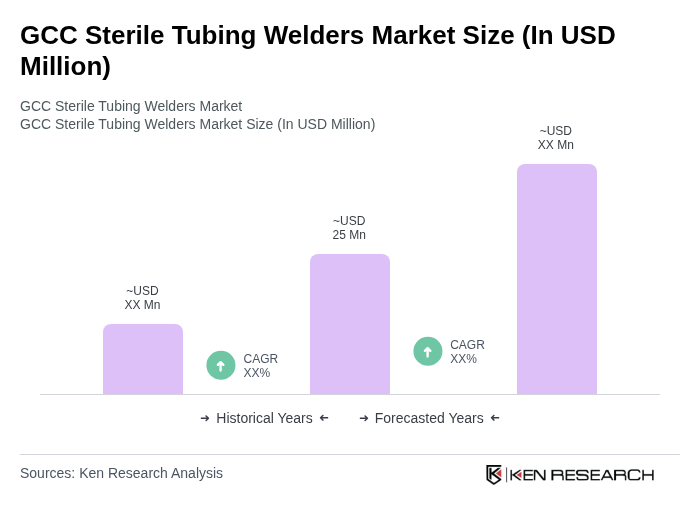
GCC Sterile Tubing Welders Market is valued at USD 25 million, fueled by healthcare advancements, chronic diseases, and biopharmaceutical needs in the GCC region.

Region:Middle East

Author(s):Geetanshi

Product Code:KRAD5959

Pages:82

Published On:December 2025
About the Report

Base Year 2024

GCC Sterile Tubing Welders Market Overview

  • The GCC Sterile Tubing Welders Market is valued at USD 25 million, based on a five-year historical analysis. This growth is primarily driven by the increasing demand for sterile medical devices, advancements in healthcare infrastructure, the rising prevalence of chronic diseases that require blood and plasma management, and the growing demand for single-use technologies in bioprocessing and cell and gene therapy production. The market is also supported by the growing biopharmaceutical sector, which necessitates high-quality sterile tubing solutions.
  • Key players in this market include Saudi Arabia and the UAE, which dominate due to their advanced healthcare systems, significant investments in medical technology, and a high number of healthcare facilities. The UAE's strategic location as a medical hub in the region further enhances its market position, while Saudi Arabia's Vision 2030 initiative aims to improve healthcare services, driving demand for sterile tubing welders.
  • The GCC Medical Devices Registration Regulation, 2022 issued by the GCC Standardization Organization (GSO), governs the manufacturing and use of medical devices, including sterile tubing welders. These regulations mandate compliance with international quality standards such as ISO 13485, require manufacturers to obtain GSO certification for devices intended for sterile processing, and set thresholds for biocompatibility testing and cleanroom validation to ensure safety and efficacy, thereby enhancing the overall quality of healthcare products in the region.
GCC Sterile Tubing Welders Market Size

GCC Sterile Tubing Welders Market Segmentation

By Type:The market is segmented into four types of sterile tubing welders: Automatic Sterile Tubing Welders, Manual Sterile Tubing Welders, Battery-Operated / Portable Sterile Tubing Welders, and Benchtop Sterile Tubing Welders. Among these, Automatic Sterile Tubing Welders are leading the market due to their efficiency, precision, ability to handle high volumes of production, consistent weld quality, reduced manual intervention, and minimized operator error in cleanroom manufacturing settings. The increasing demand for automation in healthcare processes is driving the adoption of these systems, as they reduce human error and enhance productivity.

GCC Sterile Tubing Welders Market segmentation by Type.

By End-User:The end-user segmentation includes Blood Banks and Transfusion Centers, Hospitals and Clinical Laboratories, Biopharmaceutical and Vaccine Manufacturers, Contract Manufacturing Organizations (CMOs/CDMOs), and Research and Academic Institutes. The Biopharmaceutical and Vaccine Manufacturers segment is currently dominating the market due to the increasing focus on vaccine production, biologics, cell-based therapies, and the need for sterile processing in biopharmaceutical manufacturing. This trend is further fueled by the global health crisis, which has heightened the demand for efficient and reliable sterile tubing solutions.
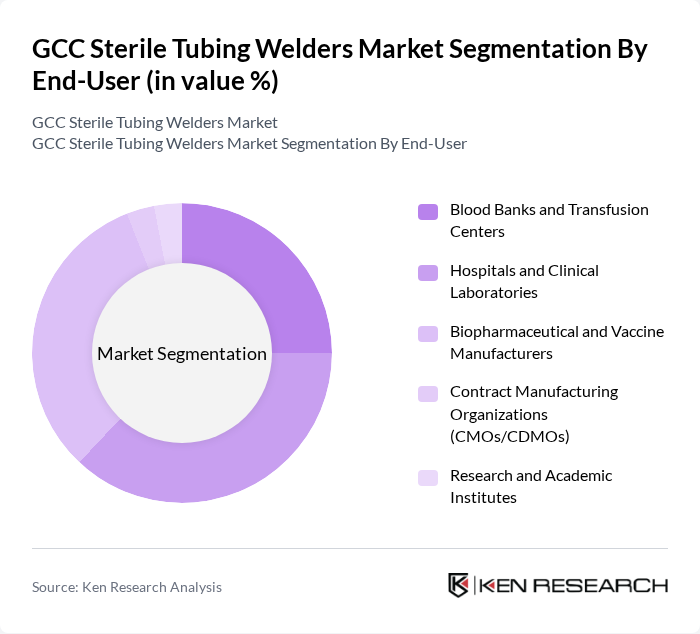
GCC Sterile Tubing Welders Market segmentation by End-User.

GCC Sterile Tubing Welders Market Competitive Landscape

The GCC Sterile Tubing Welders Market is characterized by a dynamic mix of regional and international players. Leading participants such as Terumo Blood and Cell Technologies, Sartorius Stedim Biotech S.A., Cytiva (Danaher Corporation), Entegris, Inc. (Including Formerly Nordson Medical / Value Plastics Assets Where Applicable), Pall Corporation (A Danaher Company), GE Healthcare Technologies Inc., Eppendorf SE, Parker Hannifin Corporation, Saint?Gobain Life Sciences, Merck KGaA (MilliporeSigma Life Science), Thermo Fisher Scientific Inc., OriGen Biomedical, Inc., Vante Biopharm / SEBRA (Part of Nordson Corporation), MGA Technologies, Flexonics / Other Regional OEM and System Integrators Active in GCC contribute to innovation, geographic expansion, and service delivery in this space.

Terumo Blood and Cell Technologies

1978

Lakewood, Colorado, USA

Sartorius Stedim Biotech S.A.

1870

Göttingen, Germany

Cytiva (Danaher Corporation)

1960

Marlborough, Massachusetts, USA

Pall Corporation (A Danaher Company)

1946

Port Washington, New York, USA

GE Healthcare Technologies Inc.

1892

Chicago, Illinois, USA

Company

Establishment Year

Headquarters

Group Size (Global, Regional, or Local Player)

GCC Sterile Tubing Welder Revenue (US$ Million)

GCC Sterile Tubing Welder Revenue CAGR (Historical & Forecast)

Installed Base in GCC (Number of Units)

Share of Automatic Systems in GCC Portfolio (%)

Average Selling Price Range in GCC (US$ per Unit)

GCC Sterile Tubing Welders Market Industry Analysis

Growth Drivers

  • Increasing Demand for Sterile Medical Devices:The GCC region has witnessed a surge in demand for sterile medical devices, driven by a growing population and rising health awareness. In future, the healthcare market in the GCC is projected to reach approximately $104 billion, reflecting a compound annual growth rate (CAGR) of 7.5%. This increase is primarily attributed to the expansion of healthcare facilities and the rising prevalence of chronic diseases, necessitating advanced sterile solutions like tubing welders.
  • Technological Advancements in Welding Processes:Innovations in welding technology are enhancing the efficiency and precision of sterile tubing welders. For instance, the introduction of laser welding technology has improved the quality of welds, reducing contamination risks. In future, the global market for advanced welding technologies is expected to exceed $25 billion, with a significant portion attributed to the medical device sector, indicating a robust growth trajectory for GCC sterile tubing welders.
  • Rising Healthcare Expenditure in GCC Countries:Healthcare expenditure in the GCC is on the rise, with countries like Saudi Arabia and the UAE increasing their budgets significantly. In future, Saudi Arabia's healthcare spending is projected to reach approximately $66 billion, driven by Vision 2030 initiatives aimed at enhancing healthcare infrastructure. This increased investment is expected to boost the demand for sterile tubing welders, as healthcare facilities seek to improve their operational capabilities and patient safety.

Market Challenges

  • High Initial Investment Costs:The initial investment required for sterile tubing welders can be substantial, often reaching around $20,000 to $80,000 for advanced models, depending on configuration and automation level. This financial barrier can deter smaller medical device manufacturers from adopting these technologies. As a result, many companies may opt for less expensive alternatives, limiting the market's growth potential. The high costs associated with maintenance and training further exacerbate this challenge, impacting overall profitability.
  • Stringent Regulatory Requirements:The sterile tubing welding industry faces rigorous regulatory scrutiny, particularly concerning compliance with ISO standards and local health authority approvals. In future, the cost of compliance for medical device manufacturers in the GCC is estimated to be around $10 million annually. These stringent regulations can delay product launches and increase operational costs, posing significant challenges for companies looking to enter or expand in the market.

GCC Sterile Tubing Welders Market Future Outlook

The future of the GCC sterile tubing welders market appears promising, driven by technological advancements and increasing healthcare investments. As the region continues to prioritize healthcare infrastructure, the demand for efficient and reliable sterile solutions is expected to rise. Additionally, the integration of automation and IoT technologies in production processes will enhance operational efficiency, further propelling market growth. Companies that adapt to these trends will likely gain a competitive edge in this evolving landscape.

Market Opportunities

  • Growth in the Medical Device Manufacturing Sector:The medical device manufacturing sector in the GCC is projected to grow significantly, with an estimated value of $20 billion in future. This growth presents a substantial opportunity for sterile tubing welders, as manufacturers seek to enhance production capabilities and meet increasing demand for high-quality medical devices.
  • Development of Eco-Friendly Welding Technologies:There is a growing emphasis on sustainability within the medical device industry, with eco-friendly welding technologies gaining traction. In future, the market for sustainable manufacturing practices is expected to reach approximately $15 billion globally. Companies that invest in developing eco-friendly welding solutions can capitalize on this trend, appealing to environmentally conscious consumers and regulatory bodies.

Scope of the Report

SegmentSub-Segments
By Type

Automatic Sterile Tubing Welders

Manual Sterile Tubing Welders

Battery-Operated / Portable Sterile Tubing Welders

Benchtop Sterile Tubing Welders

By End-User

Blood Banks and Transfusion Centers

Hospitals and Clinical Laboratories

Biopharmaceutical and Vaccine Manufacturers

Contract Manufacturing Organizations (CMOs/CDMOs)

Research and Academic Institutes

By Application

Blood and Blood Component Processing

Biopharmaceutical and Cell Therapy Manufacturing

Vaccine and Plasma Fractionation

Single?Use System Assembly and Changeover

By Material Type

PVC and EVA Tubing

Polyolefin and TPE Tubing

Silicone and Thermoplastic Elastomer Tubing

Others

By Region

Saudi Arabia

UAE

Qatar

Kuwait

Oman

Bahrain

By Distribution Channel

Direct Sales by OEMs

Regional Distributors and System Integrators

Online / E?Procurement Platforms

Group Purchasing Organizations (GPOs) and Tender-Based Sales

By Technology

Heat Sealing / Thermal Welding

Automatic Rotary Welding

Infrared / Laser-Based Sterile Welding

Others

Key Target Audience

Investors and Venture Capitalist Firms

Government and Regulatory Bodies (e.g., Gulf Cooperation Council, Ministry of Health and Prevention)

Manufacturers and Producers of Sterile Tubing Welders

Distributors and Retailers of Medical Equipment

Healthcare Providers and Hospitals

Technology Providers for Medical Devices

Industry Associations (e.g., Gulf Medical Devices Association)

Financial Institutions and Investment Banks

Players Mentioned in the Report:

Terumo Blood and Cell Technologies

Sartorius Stedim Biotech S.A.

Cytiva (Danaher Corporation)

Entegris, Inc. (Including Formerly Nordson Medical / Value Plastics Assets Where Applicable)

Pall Corporation (A Danaher Company)

GE Healthcare Technologies Inc.

Eppendorf SE

Parker Hannifin Corporation

SaintGobain Life Sciences

Merck KGaA (MilliporeSigma Life Science)

Thermo Fisher Scientific Inc.

OriGen Biomedical, Inc.

Vante Biopharm / SEBRA (Part of Nordson Corporation)

MGA Technologies

Flexonics / Other Regional OEM and System Integrators Active in GCC

Table of Contents

Market Assessment Phase

1. Executive Summary and Approach


2. GCC Sterile Tubing Welders Market Overview

2.1 Key Insights and Strategic Recommendations

2.2 GCC Sterile Tubing Welders Market Overview

2.3 Definition and Scope

2.4 Evolution of Market Ecosystem

2.5 Timeline of Key Regulatory Milestones

2.6 Value Chain & Stakeholder Mapping

2.7 Business Cycle Analysis

2.8 Policy & Incentive Landscape


3. GCC Sterile Tubing Welders Market Analysis

3.1 Growth Drivers

3.1.1 Increasing demand for sterile medical devices
3.1.2 Technological advancements in welding processes
3.1.3 Rising healthcare expenditure in GCC countries
3.1.4 Expansion of the pharmaceutical and biotechnology sectors

3.2 Market Challenges

3.2.1 High initial investment costs
3.2.2 Stringent regulatory requirements
3.2.3 Limited availability of skilled workforce
3.2.4 Competition from alternative joining technologies

3.3 Market Opportunities

3.3.1 Growth in the medical device manufacturing sector
3.3.2 Increasing focus on automation in production processes
3.3.3 Expansion into emerging markets within the GCC
3.3.4 Development of eco-friendly welding technologies

3.4 Market Trends

3.4.1 Shift towards single-use sterile tubing systems
3.4.2 Integration of IoT in welding equipment
3.4.3 Customization of welding solutions for specific applications
3.4.4 Growing emphasis on sustainability and waste reduction

3.5 Government Regulation

3.5.1 Compliance with ISO standards for medical devices
3.5.2 Regulatory approvals from local health authorities
3.5.3 Implementation of safety and quality control measures
3.5.4 Incentives for local manufacturing of medical devices

4. SWOT Analysis


5. Stakeholder Analysis


6. Porter's Five Forces Analysis


7. GCC Sterile Tubing Welders Market Market Size, 2019-2024

7.1 By Value

7.2 By Volume

7.3 By Average Selling Price


8. GCC Sterile Tubing Welders Market Segmentation

8.1 By Type

8.1.1 Automatic Sterile Tubing Welders
8.1.2 Manual Sterile Tubing Welders
8.1.3 Battery-Operated / Portable Sterile Tubing Welders
8.1.4 Benchtop Sterile Tubing Welders

8.2 By End-User

8.2.1 Blood Banks and Transfusion Centers
8.2.2 Hospitals and Clinical Laboratories
8.2.3 Biopharmaceutical and Vaccine Manufacturers
8.2.4 Contract Manufacturing Organizations (CMOs/CDMOs)
8.2.5 Research and Academic Institutes

8.3 By Application

8.3.1 Blood and Blood Component Processing
8.3.2 Biopharmaceutical and Cell Therapy Manufacturing
8.3.3 Vaccine and Plasma Fractionation
8.3.4 Single?Use System Assembly and Changeover

8.4 By Material Type

8.4.1 PVC and EVA Tubing
8.4.2 Polyolefin and TPE Tubing
8.4.3 Silicone and Thermoplastic Elastomer Tubing
8.4.4 Others

8.5 By Region

8.5.1 Saudi Arabia
8.5.2 UAE
8.5.3 Qatar
8.5.4 Kuwait
8.5.5 Oman
8.5.6 Bahrain

8.6 By Distribution Channel

8.6.1 Direct Sales by OEMs
8.6.2 Regional Distributors and System Integrators
8.6.3 Online / E?Procurement Platforms
8.6.4 Group Purchasing Organizations (GPOs) and Tender-Based Sales

8.7 By Technology

8.7.1 Heat Sealing / Thermal Welding
8.7.2 Automatic Rotary Welding
8.7.3 Infrared / Laser-Based Sterile Welding
8.7.4 Others

9. GCC Sterile Tubing Welders Market Competitive Analysis

9.1 Market Share of Key Players

9.2 Cross Comparison of Key Players

9.2.1 Company Name
9.2.2 Group Size (Global, Regional, or Local Player)
9.2.3 GCC Sterile Tubing Welder Revenue (US$ Million)
9.2.4 GCC Sterile Tubing Welder Revenue CAGR (Historical & Forecast)
9.2.5 Installed Base in GCC (Number of Units)
9.2.6 Share of Automatic Systems in GCC Portfolio (%)
9.2.7 Average Selling Price Range in GCC (US$ per Unit)
9.2.8 Key GCC End?User Coverage (Number of Blood Banks / Biopharma Sites)
9.2.9 Service & Maintenance Footprint in GCC (Service Hubs / Partners)
9.2.10 New Product Launches / Upgrades in Last 5 Years (Number)
9.2.11 Local Partnership / Distribution Strength (Qualitative Score)

9.3 SWOT Analysis of Top Players

9.4 Pricing Analysis

9.5 Detailed Profile of Major Companies

9.5.1 Terumo Blood and Cell Technologies
9.5.2 Sartorius Stedim Biotech S.A.
9.5.3 Cytiva (Danaher Corporation)
9.5.4 Entegris, Inc. (Including Formerly Nordson Medical / Value Plastics Assets Where Applicable)
9.5.5 Pall Corporation (A Danaher Company)
9.5.6 GE Healthcare Technologies Inc.
9.5.7 Eppendorf SE
9.5.8 Parker Hannifin Corporation
9.5.9 Saint?Gobain Life Sciences
9.5.10 Merck KGaA (MilliporeSigma Life Science)
9.5.11 Thermo Fisher Scientific Inc.
9.5.12 OriGen Biomedical, Inc.
9.5.13 Vante Biopharm / SEBRA (Part of Nordson Corporation)
9.5.14 MGA Technologies
9.5.15 Flexonics / Other Regional OEM and System Integrators Active in GCC

10. GCC Sterile Tubing Welders Market End-User Analysis

10.1 Procurement Behavior of Key Ministries

10.1.1 Budget Allocation Trends
10.1.2 Procurement Processes
10.1.3 Supplier Selection Criteria
10.1.4 Contract Management Practices

10.2 Corporate Spend on Infrastructure & Energy

10.2.1 Investment Trends in Medical Infrastructure
10.2.2 Spending on Technological Upgrades
10.2.3 Budgeting for Compliance and Safety
10.2.4 Others

10.3 Pain Point Analysis by End-User Category

10.3.1 Challenges in Supply Chain Management
10.3.2 Quality Assurance Issues
10.3.3 Cost Management Concerns
10.3.4 Others

10.4 User Readiness for Adoption

10.4.1 Training and Support Needs
10.4.2 Technology Acceptance Levels
10.4.3 Infrastructure Readiness
10.4.4 Others

10.5 Post-Deployment ROI and Use Case Expansion

10.5.1 Measurement of ROI
10.5.2 Expansion into New Applications
10.5.3 User Feedback and Iteration
10.5.4 Others

11. GCC Sterile Tubing Welders Market Future Size, 2025-2030

11.1 By Value

11.2 By Volume

11.3 By Average Selling Price


Go-To-Market Strategy Phase

1. Whitespace Analysis + Business Model Canvas

1.1 Market Gaps Identification

1.2 Value Proposition Development

1.3 Revenue Model Structuring

1.4 Key Partnerships Identification

1.5 Customer Segmentation Analysis

1.6 Competitive Landscape Overview

1.7 Risk Assessment


2. Marketing and Positioning Recommendations

2.1 Branding Strategies

2.2 Product USPs

2.3 Target Market Identification

2.4 Communication Strategy

2.5 Digital Marketing Approach

2.6 Customer Engagement Tactics

2.7 Performance Metrics


3. Distribution Plan

3.1 Urban Retail Strategies

3.2 Rural NGO Tie-ups

3.3 E-commerce Integration

3.4 Logistics and Supply Chain Management

3.5 Distribution Partnerships

3.6 Inventory Management

3.7 Performance Tracking


4. Channel & Pricing Gaps

4.1 Underserved Routes

4.2 Pricing Bands Analysis

4.3 Competitor Pricing Strategies

4.4 Customer Willingness to Pay

4.5 Price Sensitivity Analysis

4.6 Discounting Strategies

4.7 Pricing Model Recommendations


5. Unmet Demand & Latent Needs

5.1 Category Gaps Identification

5.2 Consumer Segments Analysis

5.3 Product Development Opportunities

5.4 Market Entry Strategies

5.5 Customer Feedback Mechanisms

5.6 Innovation Opportunities

5.7 Future Trends Analysis


6. Customer Relationship

6.1 Loyalty Programs

6.2 After-sales Service

6.3 Customer Support Strategies

6.4 Feedback and Improvement Processes

6.5 Community Engagement

6.6 Relationship Management Tools

6.7 Performance Metrics


7. Value Proposition

7.1 Sustainability Initiatives

7.2 Integrated Supply Chains

7.3 Customer-Centric Innovations

7.4 Competitive Differentiation

7.5 Value-Added Services

7.6 Market Positioning

7.7 Performance Metrics


8. Key Activities

8.1 Regulatory Compliance

8.2 Branding Initiatives

8.3 Distribution Setup

8.4 Training and Development

8.5 Performance Monitoring

8.6 Stakeholder Engagement

8.7 Risk Management


9. Entry Strategy Evaluation

9.1 Domestic Market Entry Strategy

9.1.1 Product Mix
9.1.2 Pricing Band
9.1.3 Packaging Considerations

9.2 Export Entry Strategy

9.2.1 Target Countries
9.2.2 Compliance Roadmap

10. Entry Mode Assessment

10.1 Joint Ventures

10.2 Greenfield Investments

10.3 Mergers & Acquisitions

10.4 Distributor Model

10.5 Risk Assessment

10.6 Performance Metrics

10.7 Strategic Partnerships


11. Capital and Timeline Estimation

11.1 Capital Requirements

11.2 Timelines for Implementation

11.3 Financial Projections

11.4 Funding Sources

11.5 Risk Assessment

11.6 Performance Metrics


12. Control vs Risk Trade-Off

12.1 Ownership vs Partnerships

12.2 Risk Management Strategies

12.3 Performance Metrics

12.4 Strategic Decision-Making

12.5 Long-term Sustainability


13. Profitability Outlook

13.1 Breakeven Analysis

13.2 Long-term Sustainability

13.3 Financial Health Indicators

13.4 Market Positioning

13.5 Performance Metrics


14. Potential Partner List

14.1 Distributors

14.2 Joint Ventures

14.3 Acquisition Targets

14.4 Strategic Alliances

14.5 Performance Metrics


15. Execution Roadmap

15.1 Phased Plan for Market Entry

15.1.1 Market Setup
15.1.2 Market Entry
15.1.3 Growth Acceleration
15.1.4 Scale & Stabilize

15.2 Key Activities and Milestones

15.2.1 Activity Planning</h

Research Methodology

ApproachModellingSample

Phase 1: Approach1

Desk Research

  • Industry reports from GCC health and safety regulatory bodies
  • Market analysis from trade associations focused on medical devices
  • Published articles and white papers on sterile tubing welding technologies

Primary Research

  • Interviews with engineers and technical leads in medical device manufacturing
  • Surveys with procurement managers in hospitals and healthcare facilities
  • Field interviews with quality assurance professionals in sterile processing departments

Validation & Triangulation

  • Cross-validation of data from multiple industry sources and expert opinions
  • Triangulation of market size estimates from sales data and production statistics
  • Sanity checks through feedback from industry panels and focus groups

Phase 2: Market Size Estimation1

Top-down Assessment

  • Analysis of healthcare expenditure trends across GCC countries
  • Segmentation of the market by end-user applications and product types
  • Incorporation of growth rates from related medical device sectors

Bottom-up Modeling

  • Volume estimates based on production capacities of leading manufacturers
  • Cost analysis derived from pricing strategies of sterile tubing welders
  • Estimation of market share based on sales data from key players

Forecasting & Scenario Analysis

  • Multi-variable regression analysis considering healthcare trends and technological advancements
  • Scenario modeling based on potential regulatory changes and market disruptions
  • Baseline, optimistic, and pessimistic forecasts through 2030

Phase 3: CATI Sample Composition1

Scope Item/SegmentSample SizeTarget Respondent Profiles
Medical Device Manufacturers100Production Managers, R&D Directors
Healthcare Facilities80Procurement Officers, Facility Managers
Regulatory Bodies40Compliance Officers, Policy Makers
Research Institutions60Research Scientists, Lab Managers
Industry Experts and Consultants40Market Analysts, Technical Consultants

Frequently Asked Questions

What is the current value of the GCC Sterile Tubing Welders Market?

The GCC Sterile Tubing Welders Market is valued at approximately USD 25 million, driven by the increasing demand for sterile medical devices and advancements in healthcare infrastructure across the region.

What factors are driving the growth of the GCC Sterile Tubing Welders Market?

Which countries dominate the GCC Sterile Tubing Welders Market?

What are the main types of sterile tubing welders available in the market?

Other Regional/Country Reports

Indonesia Sterile Tubing Welders Market

Malaysia Sterile Tubing Welders Market

KSA Sterile Tubing Welders Market

APAC Sterile Tubing Welders Market

SEA Sterile Tubing Welders Market

Vietnam Sterile Tubing Welders Market

Other Adjacent Reports

Philippines Sterile Medical Devices Market

Oman Bioprocessing Equipment Market

Egypt Blood Processing Systems Market

Mexico Single-Use Bioprocessing Market

Bahrain Cell and Gene Therapy Market

Kuwait Vaccine Manufacturing Market

Saudi Arabia Pharmaceutical Manufacturing Market Size, Share, Growth Drivers, Trends, Opportunities & Forecast 2025–2030

Mexico Hospital Sterilization Equipment Market

United States Contract Manufacturing Services Market

KSA Biomedical Research Equipment Market

Why Buy From Us?

Refine Robust Result (RRR) Framework

What makes us stand out is that our consultants follow Robust, Refine and Result (RRR) methodology. Robust for clear definitions, approaches and sanity checking, Refine for differentiating respondents' facts and opinions, and Result for presenting data with story.

Our Reach Is Unmatched

We have set a benchmark in the industry by offering our clients with syndicated and customized market research reports featuring coverage of entire market as well as meticulous research and analyst insights.

Shifting the Research Paradigm

While we don't replace traditional research, we flip the method upside down. Our dual approach of Top Bottom & Bottom Top ensures quality deliverable by not just verifying company fundamentals but also looking at the sector and macroeconomic factors.

More Insights-Better Decisions

With one step in the future, our research team constantly tries to show you the bigger picture. We help with some of the tough questions you may encounter along the way: How is the industry positioned? Best marketing channel? KPI's of competitors? By aligning every element, we help maximize success.

Transparency and Trust

Our report gives you instant access to the answers and sources that other companies might choose to hide. We elaborate each steps of research methodology we have used and showcase you the sample size to earn your trust.

Round the Clock Support

If you need any support, we are here! We pride ourselves on universe strength, data quality, and quick, friendly, and professional service.

Why Clients Choose Us?

400000+
Reports in repository
150+
Consulting projects a year
100+
Analysts
8000+
Client Queries in 2022