About the Report
Base Year 2024GCC Underground Gas Storage Market Overview
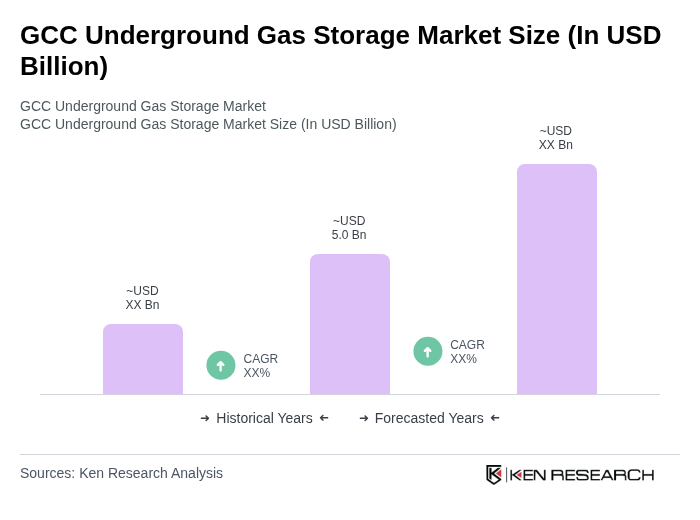
- The GCC Underground Gas Storage Market is valued at USD 5.0 billion, based on a five-year historical analysis. This value is consistent with the GCC’s share of global underground gas storage capacity, where the Middle East (including GCC countries) accounts for around 9 billion cubic meters of working gas out of 424 billion cubic meters globally, and GCC states such as Saudi Arabia, Qatar, Kuwait, and the United Arab Emirates are highlighted as key markets within the Middle East & Africa underground gas storage landscape. This growth is primarily driven by the increasing demand for natural gas as a cleaner energy source, coupled with the need for energy security and flexibility in gas supply management. The market is also supported by investments in infrastructure and technology to enhance storage capabilities and efficiency, including advances in drilling, seismic imaging, and reservoir management to optimize depleted reservoirs and salt caverns for storage.
- Key players in this market include Saudi Arabia, the United Arab Emirates, and Qatar. These countries dominate the market due to their substantial natural gas reserves, advanced technological capabilities, and strategic investments in underground storage facilities and related midstream infrastructure. Their geographical advantages and government support further enhance their position in the GCC Underground Gas Storage Market, as they leverage proximity to major LNG export hubs, industrial clusters, and power generation centers to improve system balancing and supply security.
- In 2023, the GCC governments implemented regulations to promote the development of underground gas storage facilities. These regulations include incentives for private investments and mandates for national oil companies to enhance their storage capacities, ensuring a stable supply of natural gas and supporting the region's energy transition goals. For example, in Saudi Arabia, underground storage developments are aligned with the Gas Market Regulations issued by the Electricity and Cogeneration Regulatory Authority and the Ministry of Energy, which set out licensing, third?party access, and operational requirements for gas infrastructure, including storage, as part of broader gas market liberalization and energy security objectives.
GCC Underground Gas Storage Market Segmentation
By Storage Type:The market is segmented into various storage types, including Depleted Gas Reservoirs, Salt Caverns, Aquifers, and Other Geological Formations. Each of these storage types has unique characteristics and applications, catering to different market needs.
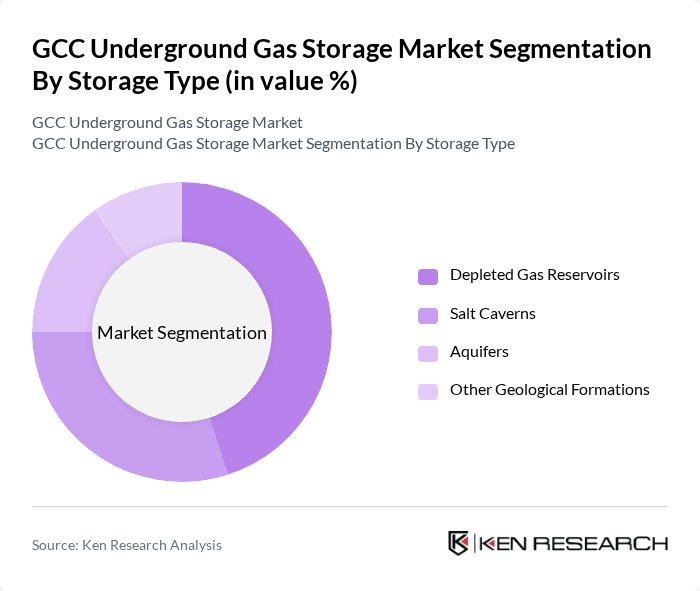
The Depleted Gas Reservoirs segment is currently dominating the market due to their established infrastructure and cost-effectiveness. These reservoirs are often repurposed from previous production activities, making them a viable option for gas storage. The ability to utilize existing facilities reduces capital expenditure and accelerates the time to market, appealing to operators looking for efficient storage solutions. Additionally, the high capacity and reliability of depleted reservoirs make them a preferred choice for seasonal and strategic gas storage needs, particularly in regions like the Middle East where former producing gas fields offer favorable geological characteristics for large-scale storage.
By Product Stored:The market is segmented based on the type of products stored, including Natural Gas, Hydrogen, Blended Gas (Hydrogen-Natural Gas), and Others. Each product type serves different applications and market demands.
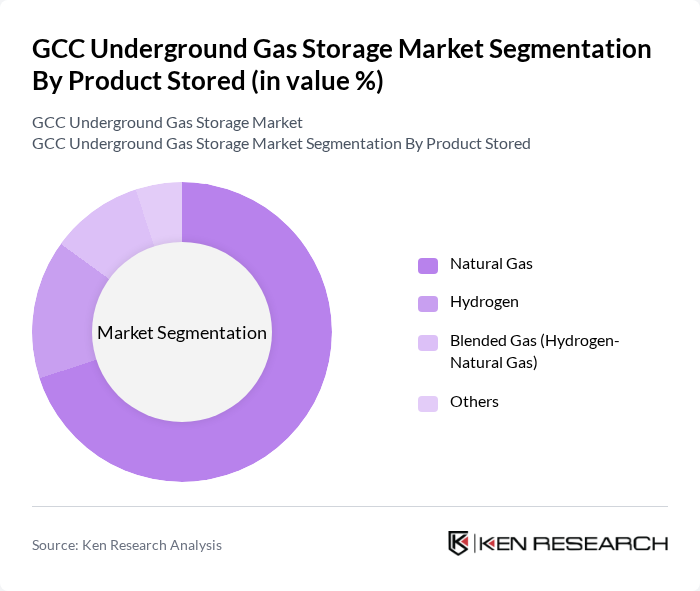
The Natural Gas segment is the largest in the market, accounting for a significant share due to its widespread use in power generation, industrial applications, and residential uses, consistent with global underground gas storage where natural gas fields represent the dominant product stored. The increasing shift towards cleaner energy sources has also led to a growing interest in hydrogen storage, although it currently represents a smaller portion of the market and is often in pilot or demonstration phases for salt caverns and depleted fields. The versatility of natural gas as a fuel and its established infrastructure contribute to its dominance in the underground gas storage sector, providing system flexibility, seasonal balancing, and back-up for intermittent renewable generation in the GCC.
GCC Underground Gas Storage Market Competitive Landscape
The GCC Underground Gas Storage Market is characterized by a dynamic mix of regional and international players. Leading participants such as Saudi Aramco, Abu Dhabi National Oil Company (ADNOC), QatarEnergy, Kuwait Oil Company (KOC), OQ (Oman), Dubai Supply Authority (DUSUP), Sharjah National Oil Corporation (SNOC), Bahrain Petroleum Company (BAPCO), Emirates National Oil Company (ENOC), Qatar Gas Transport Company (Nakilat), Al Hosn Gas, National Gas & Industrialization Company (GASCO), Saudi Arabia, Petrofac, Gulf Cooperation Council Interconnection Authority (GCCIA), Selected International EPC / Storage Technology Providers Active in GCC contribute to innovation, geographic expansion, and service delivery in this space.
GCC Underground Gas Storage Market Industry Analysis
Growth Drivers
- Increasing Energy Demand:The GCC region's energy demand is projected to reach 1,100 terawatt-hours (TWh) in future, driven by population growth and industrial expansion. The International Energy Agency (IEA) indicates that natural gas consumption will rise by 3% annually, necessitating robust underground gas storage solutions to ensure supply stability. This demand surge is further supported by the region's economic diversification efforts, which aim to reduce reliance on oil and enhance energy security.
- Strategic Geographical Location:The GCC's strategic location, bridging Europe, Asia, and Africa, positions it as a critical energy hub. The region's proximity to major markets allows for efficient gas transportation, with pipeline capacities exceeding 800 million cubic meters per day. This geographical advantage facilitates the development of underground gas storage facilities, enabling the GCC to respond swiftly to regional energy demands and fluctuations in global gas prices, enhancing its competitive edge.
- Government Initiatives for Energy Security:GCC governments are investing heavily in energy security, with over $40 billion allocated for infrastructure development in future. Initiatives include the establishment of strategic gas reserves and regulatory frameworks to promote underground storage projects. The UAE's Energy Strategy aims to increase the share of gas in the energy mix to 45%, highlighting the commitment to enhancing energy resilience and ensuring a stable supply for future generations.
Market Challenges
- High Initial Investment Costs:The establishment of underground gas storage facilities requires significant capital investment, often exceeding $900 million per project. This high upfront cost poses a barrier to entry for many companies, particularly smaller players. Additionally, the long payback periods associated with these investments can deter potential investors, especially in a market characterized by fluctuating gas prices and uncertain demand forecasts.
- Regulatory Compliance Issues:Navigating the complex regulatory landscape in the GCC can be challenging for underground gas storage projects. Compliance with local and international regulations often requires extensive documentation and can lead to delays in project approvals. For instance, the need to adhere to environmental protection standards can add layers of complexity, with potential fines for non-compliance reaching up to $8 million, further complicating project feasibility.
GCC Underground Gas Storage Market Future Outlook
The future of the GCC underground gas storage market appears promising, driven by increasing energy demands and a shift towards sustainable energy solutions. As governments prioritize energy security and invest in infrastructure, the market is expected to witness significant advancements in storage technologies. Furthermore, the integration of digitalization in energy management will enhance operational efficiency, allowing for better forecasting and management of gas supplies, ultimately supporting the region's energy transition goals.
Market Opportunities
- Expansion of Renewable Energy Integration:The GCC's commitment to integrating renewable energy sources presents a significant opportunity for underground gas storage. With renewable energy capacity expected to exceed 25 gigawatts in future, gas storage can provide essential backup during low production periods, ensuring grid stability and reliability, thus enhancing the overall energy mix.
- Development of New Storage Technologies:Innovations in storage technologies, such as advanced compressed air energy storage, are emerging as viable solutions for the GCC. These technologies can enhance storage capacity and efficiency, with potential reductions in operational costs by up to 15%. Investing in these advancements can position the region as a leader in energy storage solutions, attracting further investments and partnerships.
Scope of the Report
| Segment | Sub-Segments |
|---|---|
| By Storage Type | Depleted Gas Reservoirs Salt Caverns Aquifers Other Geological Formations |
| By Product Stored | Natural Gas Hydrogen Blended Gas (Hydrogen-Natural Gas) Others |
| By Application | Seasonal Storage Base Load Storage Peak Load / Peak Shaving Strategic Reserves |
| By End-User | National Oil & Gas Companies International Oil Companies Gas & Power Utilities Industrial & Large Commercial Users |
| By Ownership / Investment Model | State-Owned Projects Private Investments Public-Private Partnerships (PPP) Sovereign Wealth Fund–Backed Projects |
| By Technology & Engineering Complexity | Conventional Underground Storage Advanced Monitoring & Digitalized Storage Hydrogen-Ready / Repurposed Facilities Integrated Storage & Transmission Hubs |
| By Country | Saudi Arabia United Arab Emirates Qatar Kuwait Oman Bahrain |
Key Target Audience
Investors and Venture Capitalist Firms
Government and Regulatory Bodies (e.g., Ministry of Energy, National Oil Companies)
Gas Storage Facility Operators
Energy Trading Companies
Pipeline and Infrastructure Developers
Environmental Agencies (e.g., Environmental Protection Authority)
Utility Companies
Energy Policy Makers
Players Mentioned in the Report:
Saudi Aramco
Abu Dhabi National Oil Company (ADNOC)
QatarEnergy
Kuwait Oil Company (KOC)
OQ (Oman)
Dubai Supply Authority (DUSUP)
Sharjah National Oil Corporation (SNOC)
Bahrain Petroleum Company (BAPCO)
Emirates National Oil Company (ENOC)
Qatar Gas Transport Company (Nakilat)
Al Hosn Gas
National Gas & Industrialization Company (GASCO), Saudi Arabia
Petrofac
Gulf Cooperation Council Interconnection Authority (GCCIA)
Selected International EPC / Storage Technology Providers Active in GCC
Table of Contents
Market Assessment Phase
1. Executive Summary and Approach
2. GCC Underground Gas Storage Market Overview
2.1 Key Insights and Strategic Recommendations
2.2 GCC Underground Gas Storage Market Overview
2.3 Definition and Scope
2.4 Evolution of Market Ecosystem
2.5 Timeline of Key Regulatory Milestones
2.6 Value Chain & Stakeholder Mapping
2.7 Business Cycle Analysis
2.8 Policy & Incentive Landscape
3. GCC Underground Gas Storage Market Analysis
3.1 Growth Drivers
3.1.1 Increasing Energy Demand
3.1.2 Strategic Geographical Location
3.1.3 Government Initiatives for Energy Security
3.1.4 Technological Advancements in Storage Solutions
3.2 Market Challenges
3.2.1 High Initial Investment Costs
3.2.2 Regulatory Compliance Issues
3.2.3 Environmental Concerns
3.2.4 Market Volatility
3.3 Market Opportunities
3.3.1 Expansion of Renewable Energy Integration
3.3.2 Development of New Storage Technologies
3.3.3 Increasing Investments in Infrastructure
3.3.4 Strategic Partnerships and Collaborations
3.4 Market Trends
3.4.1 Shift Towards Sustainable Energy Solutions
3.4.2 Digitalization in Energy Management
3.4.3 Enhanced Focus on Energy Efficiency
3.4.4 Growing Importance of Energy Storage Systems
3.5 Government Regulation
3.5.1 Energy Storage Regulations
3.5.2 Environmental Protection Standards
3.5.3 Safety and Operational Guidelines
3.5.4 Incentives for Renewable Energy Projects
4. SWOT Analysis
5. Stakeholder Analysis
6. Porter's Five Forces Analysis
7. GCC Underground Gas Storage Market Size, 2019-2024
7.1 By Value
7.2 By Volume
7.3 By Average Selling Price
8. GCC Underground Gas Storage Market Segmentation
8.1 By Storage Type
8.1.1 Depleted Gas Reservoirs
8.1.2 Salt Caverns
8.1.3 Aquifers
8.1.4 Other Geological Formations
8.2 By Product Stored
8.2.1 Natural Gas
8.2.2 Hydrogen
8.2.3 Blended Gas (Hydrogen-Natural Gas)
8.2.4 Others
8.3 By Application
8.3.1 Seasonal Storage
8.3.2 Base Load Storage
8.3.3 Peak Load / Peak Shaving
8.3.4 Strategic Reserves
8.4 By End-User
8.4.1 National Oil & Gas Companies
8.4.2 International Oil Companies
8.4.3 Gas & Power Utilities
8.4.4 Industrial & Large Commercial Users
8.5 By Ownership / Investment Model
8.5.1 State-Owned Projects
8.5.2 Private Investments
8.5.3 Public-Private Partnerships (PPP)
8.5.4 Sovereign Wealth Fund–Backed Projects
8.6 By Technology & Engineering Complexity
8.6.1 Conventional Underground Storage
8.6.2 Advanced Monitoring & Digitalized Storage
8.6.3 Hydrogen-Ready / Repurposed Facilities
8.6.4 Integrated Storage & Transmission Hubs
8.7 By Country
8.7.1 Saudi Arabia
8.7.2 United Arab Emirates
8.7.3 Qatar
8.7.4 Kuwait
8.7.5 Oman
8.7.6 Bahrain
9. GCC Underground Gas Storage Market Competitive Analysis
9.1 Market Share of Key Players
9.2 Cross Comparison of Key Players
9.2.1 Company Name
9.2.2 Installed Working Gas Capacity (BCM)
9.2.3 Capacity Under Development / Planned (BCM)
9.2.4 5-Year Revenue CAGR from Gas Storage–Related Activities
9.2.5 EBITDA Margin from Midstream & Storage Operations
9.2.6 Return on Invested Capital (ROIC) – Storage Assets
9.2.7 Average Utilization Rate of Storage Facilities
9.2.8 Contract Mix (Share of Long-Term vs Spot / Short-Term Contracts)
9.2.9 Share of Regulated vs Merchant / Market-Based Revenues
9.2.10 Capital Intensity (Capex per BCM of Working Gas)
9.2.11 Market Share Percentage (GCC Underground Storage Capacity)
9.2.12 Project Execution Record (On-Time / On-Budget Delivery)
9.2.13 HSE Performance (Reportable Incident Rate)
9.3 SWOT Analysis of Top Players
9.4 Pricing Analysis
9.5 Detailed Profile of Major Companies
9.5.1 Saudi Aramco
9.5.2 Abu Dhabi National Oil Company (ADNOC)
9.5.3 QatarEnergy
9.5.4 Kuwait Oil Company (KOC)
9.5.5 OQ (Oman)
9.5.6 Dubai Supply Authority (DUSUP)
9.5.7 Sharjah National Oil Corporation (SNOC)
9.5.8 Bahrain Petroleum Company (BAPCO)
9.5.9 Emirates National Oil Company (ENOC)
9.5.10 Qatar Gas Transport Company (Nakilat)
9.5.11 Al Hosn Gas
9.5.12 National Gas & Industrialization Company (GASCO), Saudi Arabia
9.5.13 Petrofac
9.5.14 Gulf Cooperation Council Interconnection Authority (GCCIA)
9.5.15 Selected International EPC / Storage Technology Providers Active in GCC
10. GCC Underground Gas Storage Market End-User Analysis
10.1 Procurement Behavior of Key Ministries
10.1.1 Government Procurement Policies
10.1.2 Budget Allocation Trends
10.1.3 Decision-Making Processes
10.1.4 Supplier Selection Criteria
10.2 Corporate Spend on Infrastructure & Energy
10.2.1 Investment Trends in Energy Sector
10.2.2 Infrastructure Development Budgets
10.2.3 Energy Efficiency Initiatives
10.2.4 Corporate Sustainability Goals
10.3 Pain Point Analysis by End-User Category
10.3.1 Cost Management Challenges
10.3.2 Reliability of Supply Issues
10.3.3 Regulatory Compliance Difficulties
10.3.4 Technological Adaptation Barriers
10.4 User Readiness for Adoption
10.4.1 Awareness of Storage Solutions
10.4.2 Training and Skill Development Needs
10.4.3 Financial Readiness
10.4.4 Infrastructure Readiness
10.5 Post-Deployment ROI and Use Case Expansion
10.5.1 Performance Metrics Evaluation
10.5.2 Long-term Cost Savings
10.5.3 Scalability of Solutions
10.5.4 User Feedback and Improvement
11. GCC Underground Gas Storage Market Future Size, 2025-2030
11.1 By Value
11.2 By Volume
11.3 By Average Selling Price
Go-To-Market Strategy Phase
1. Whitespace Analysis + Business Model Canvas
1.1 Market Gaps Identification
1.2 Value Proposition Development
1.3 Revenue Streams Analysis
1.4 Cost Structure Evaluation
1.5 Key Partnerships Exploration
1.6 Customer Segmentation
1.7 Channels of Distribution
2. Marketing and Positioning Recommendations
2.1 Branding Strategies
2.2 Product USPs
3. Distribution Plan
3.1 Urban Retail vs Rural NGO Tie-ups
4. Channel & Pricing Gaps
4.1 Underserved Routes
4.2 Pricing Bands
5. Unmet Demand & Latent Needs
5.1 Category Gaps
5.2 Consumer Segments
6. Customer Relationship
6.1 Loyalty Programs
6.2 After-sales Service
7. Value Proposition
7.1 Sustainability
7.2 Integrated Supply Chains
8. Key Activities
8.1 Regulatory Compliance
8.2 Branding
8.3 Distribution Setup
9. Entry Strategy Evaluation
9.1 Domestic Market Entry Strategy
9.1.1 Product Mix
9.1.2 Pricing Band
9.1.3 Packaging
9.2 Export Entry Strategy
9.2.1 Target Countries
9.2.2 Compliance Roadmap
10. Entry Mode Assessment
10.1 JV
10.2 Greenfield
10.3 M&A
10.4 Distributor Model
11. Capital and Timeline Estimation
11.1 Capital Requirements
11.2 Timelines
12. Control vs Risk Trade-Off
12.1 Ownership vs Partnerships
13. Profitability Outlook
13.1 Breakeven Analysis
13.2 Long-term Sustainability
14. Potential Partner List
14.1 Distributors
14.2 JVs
14.3 Acquisition Targets
15. Execution Roadmap
15.1 Phased Plan for Market Entry
15.1.1 Market Setup
15.1.2 Market Entry
15.1.3 Growth Acceleration
15.1.4 Scale & Stabilize
15.2 Key Activities and Milestones
15.2.1 Milestone Planning
15.2.2 Activity Tracking
Research Methodology
Phase 1: Approach1
Desk Research
- Analysis of industry reports from regional energy authorities and organizations
- Review of academic publications and white papers on underground gas storage technologies
- Examination of market trends and forecasts from energy market analysts
Primary Research
- Interviews with executives from gas storage facility operators in the GCC region
- Surveys targeting energy policy makers and regulatory bodies
- Field interviews with engineers and technical experts involved in gas storage projects
Validation & Triangulation
- Cross-validation of findings through multiple data sources including government publications
- Triangulation of market insights from industry experts and academic researchers
- Sanity checks through feedback from a panel of energy sector specialists
Phase 2: Market Size Estimation1
Top-down Assessment
- Estimation of total gas consumption in the GCC and its implications for storage needs
- Analysis of regional energy policies and their impact on gas storage infrastructure
- Identification of key drivers influencing the demand for underground gas storage
Bottom-up Modeling
- Collection of operational data from existing underground gas storage facilities
- Cost analysis based on construction, maintenance, and operational expenditures
- Volume capacity assessments based on geological surveys and site evaluations
Forecasting & Scenario Analysis
- Development of predictive models based on historical gas demand and supply trends
- Scenario planning considering geopolitical factors and energy transition policies
- Creation of baseline, optimistic, and pessimistic forecasts through 2035
Phase 3: CATI Sample Composition1
| Scope Item/Segment | Sample Size | Target Respondent Profiles |
|---|---|---|
| Gas Storage Facility Operators | 80 | Facility Managers, Operations Directors |
| Energy Policy Makers | 60 | Government Officials, Regulatory Analysts |
| Technical Experts in Gas Storage | 50 | Engineers, Project Managers |
| Energy Market Analysts | 45 | Market Researchers, Economic Analysts |
| Environmental Consultants | 40 | Sustainability Officers, Environmental Engineers |
Frequently Asked Questions
What is the current value of the GCC Underground Gas Storage Market?
The GCC Underground Gas Storage Market is valued at approximately USD 5.0 billion, reflecting the region's significant share of global underground gas storage capacity, which is around 9 billion cubic meters out of a total of 424 billion cubic meters worldwide.
Which countries are key players in the GCC Underground Gas Storage Market?
What are the main drivers of growth in the GCC Underground Gas Storage Market?
What types of storage are available in the GCC Underground Gas Storage Market?
Other Regional/Country Reports
Indonesia Underground Gas Storage Market
Malaysia Underground Gas Storage Market
KSA Underground Gas Storage Market
APAC Underground Gas Storage Market
SEA Underground Gas Storage Market
Vietnam Underground Gas Storage Market
Other Adjacent Reports
Qatar Oil and Gas Midstream Market
Egypt Gas Pipeline Market
Mexico Energy Infrastructure Market
Singapore Carbon Capture and Storage Market
Philippines Renewable Energy Integration Market
Singapore Seismic Imaging Market
Germany Reservoir Management Market
Why Buy From Us?

What makes us stand out is that our consultants follow Robust, Refine and Result (RRR) methodology. Robust for clear definitions, approaches and sanity checking, Refine for differentiating respondents' facts and opinions, and Result for presenting data with story.

We have set a benchmark in the industry by offering our clients with syndicated and customized market research reports featuring coverage of entire market as well as meticulous research and analyst insights.

While we don't replace traditional research, we flip the method upside down. Our dual approach of Top Bottom & Bottom Top ensures quality deliverable by not just verifying company fundamentals but also looking at the sector and macroeconomic factors.

With one step in the future, our research team constantly tries to show you the bigger picture. We help with some of the tough questions you may encounter along the way: How is the industry positioned? Best marketing channel? KPI's of competitors? By aligning every element, we help maximize success.

Our report gives you instant access to the answers and sources that other companies might choose to hide. We elaborate each steps of research methodology we have used and showcase you the sample size to earn your trust.

If you need any support, we are here! We pride ourselves on universe strength, data quality, and quick, friendly, and professional service.